NOTES
Reading edition
Note 1 (page 5)
When the vast territory then known as Louisiana was purchased from the French Nation for fifteen million dollars, in the nineteenth century, no one knew what its extent was. It took in the country west of the Mississippi, from the Gulf below New Orleans; but what really lay to the far northwest was merely a conjecture.
President Jefferson was determined to know just what was included in this Louisiana Purchase, and it was mainly through his individual efforts that an expedition was organized with the purpose of exploring the country as far as the Pacific; for, of course, it was understood that the ocean bounded the land on the west.
His private secretary, Meriwether Lewis, was put in command of the party, with a military second, Captain Clark. What wonderful things they accomplished history has recorded. It was in the spring of 1804 that the expedition left St. Louis, and two years and a half expired before they returned to that border post, having successfully carried out their undertaking.
Note 2 (page 22)
In those early pioneer days flint and steel were commonly brought into service when a fire was needed. So expert did the settlers and borderers become in the use of these that they thought little more of accomplishing the end they had in view than a Boy Scout of to-day does with the match. All they asked was a handful of dry tinder, and the ready spark quickly had a blaze going.
It was not so easy when the question of firing their guns was concerned. The flint was fastened to the heavy hammer, and, in falling, was supposed to strike the steel plate provided for this purpose, when a spark might be looked for. This, falling into the powder placed in the little cavity known as the “pan,” brought about the explosion. But, frequently, this small amount of powder would be jostled from its receptacle, and this would cause a failure at perhaps a most critical time. Many a settler in those days lost his life by just this accident; and frequent disappointments during a hunt for game could be traced to the same cause.
Note 3 (page 44)
Contact with the natives made the early settlers quite proficient in deciphering Indian picture writing, so they were able to read fairly well many communications passing between parties of those who possibly might be reckoned their deadly enemies. This method of using crude designs to convey the sense of a communication, or even the history of a tribe or family, was often carried out by fanciful pictures decorating the skin of which the teepee was made. In such fashion many of the gallant deeds of the chief or warrior to whom the wigwam belonged were perpetuated.
Really, little common sense alone is needed to decipher most of these picture writings. Once the key had been found, they become as plain as print. Smoke stands for fires; the sun is easily seen on the horizon, or high above it, though toward the west, it may be; horses; deer with antlers; men walking, running, or crawling; and similar designs become plainly decipherable; and in this manner the story that is intended to be conveyed can be traced out.
It is an interesting study, and many who belong to Boy Scout troops have found considerable entertainment in pursuing the fascinating work.
Note 4 (page 50)
Among all the Indian tribes found upon the North American Continent when the pioneers surged toward the setting sun, none has interested the historian so much as the Mandans, sometimes called the “White Indians,” because their skins differed so much from that of other tribes. All sorts of wild theories have been offered as an explanation of the wide difference existing between this tribe and others. It is true that they buried their dead as did the rest of the tribes west of the Mississippi, using scaffolds that the wolves might not get to the bodies; and there were many other habits that stamped them true Indians. At the same time historians, who had lived among them, find a similarity in many of their words and customs to the Welsh people; and it has always been believed by many that, long ago, a boat containing Welsh sailors was wrecked in the Gulf of Mexico after a tropical hurricane, and that, ascending the mighty river, the whites married into some Indian tribe, so that eventually the Mandans came into existence.
There have been other speculations, and it is very interesting to read about these various theories, and try to guess which one of them can be the true explanation; for that there must have been something remarkable about the origin of this tribe no one can deny. They were not as warlike as some of the tribes with whom they came in contact, such as the fierce Sioux; but at the same time it appears that they held their own in the numerous wars which followed an invasion by one tribe upon the hunting grounds of another.
Unfortunately the Mandans were utterly wiped out in later years by the great scourge of smallpox, which possibly may have been one of the unwelcome gifts brought to them by the palefaces.
Note 5 (page 64)
In crossing the great plains that lie between the valley of the Mississippi and the foothills of the Rocky Mountains, it is in these days difficult to realize the tremendous changes that have taken place there during the last fifty or sixty years. Especially is this true with regard to animal life. Where to-day herds of long-horned cattle graze, or vast fields of nodding grain tell of the prosperous farmer, in those times uncounted numbers of great shaggy bison roamed.
According to many of the accounts that have come down to us from authentic sources, the sight of such a herd rolling past, as far as the eye could see, and for hour after hour, must have been a most impressive spectacle.
Where have they all gone? Up to then the needs of the Indians and the depredations of wild animals had made no impression on the incredible number of the herds; although the red men often drove hundreds of the big animals over some precipice, and took nothing but the tongues, to be dried as a delicacy.
The first serious inroad among the buffaloes occurred when the railroad was being pushed across the plains, and men like Cody, afterwards known as Buffalo Bill, were employed to slaughter the beasts in order to provide sufficient food for the thousands of workers. Then it began to be the thing for parties to set out and kill for the sake of the slaughter. The robes were also brought into use for sleighing and other purposes. But the advent of the repeating rifle signed the real death warrant for the bison of the plains. Then they rapidly dwindled to almost nothing. In place of the millions that once galloped north and south in the seasons there are to-day but one or two small herds, in the National Yellowstone Park or in private preserves. Like the once numerous wild pigeons called the passenger pigeons which existed in untold numbers, the buffaloes have had their day.
Note 6 (page 194)
In the cabin of every pioneer family could always be seen rows of dried herbs fastened to the rafters. These as a rule were intended for medicinal purposes, most of them being brewed into tea, when sickness invaded the household, which was not often, since the active outdoor life, and the primitive food of the early settlers, made them an exceedingly hardy race.
Most housewives knew how to make ointments for sprains and healing by a clever admixture of these strong decoctions with bear’s fat, or, if they chanced to have it, pork lard, though in most cases pigs were unknown to frontier life, while a bear was always a possibility.
Many of those old remedies were fully as satisfactory as those of the modern druggist. They were pure, to begin with, and calculated not to serve as “cure-alls,” but each intended for a specific purpose. Indeed, it would seem as if in those days they counted on Nature’s taking hold and lending a helping hand. A simple remedy to break a fever was resorted to, and then careful nursing, as well as a good constitution, did the rest.
Before the Armstrong boys set out upon their trip it was only natural for their mothers to see that in their ditty bags they carried a supply of several of these standard remedies.
Note 7 (page 233)
From the accounts that have been handed down to us, written by Captain Lewis himself, it appears that the explorers were awed and inspired by the wonderful scenery that lay before them on their way to the Great Divide. Rugged mountains were there, brown, steep, hemlock-clad. Deep game trails led through the tangled meshes of the forest, and in the sparkling rivulets the trout jumped at the floating gnats and other insects. Gorges and canyons had to be passed, where the howling waters raced in an apparent agony, and flute-like came the sound of the snow-cold water against the pebbly bottoms.
At night the scream of the mountain lion echoed across the silent valleys, while the bleat of the antelope could be heard upon the vast plains near the river-bed. Eagles soared above, peering disdainfully at the black specks of men beneath; and sage hens craned their necks at them, when they tramped from the river in search of game. Over all was the clear, pure air of that vast mountain plateau, which invigorates, stimulates, and makes one feel as if he had the strength of ten. Inspired and stimulated by the thought that they were making history, it is no wonder those men pressed steadily on, determined to view the gray waters of the fog-sheeted Pacific in the end.
Note 8 (page 268)
One of the first things noticed by the members of the expedition, when they began to encounter the tribes living near the Rockies, was the fact that every warrior or chief who was looked up to as a brave man wore a necklace of terrible bears’ claws. This proved that the possessor had by his own individual prowess, and usually in an encounter at close quarters, succeeded in slaying one of those monster denizens of the wilds, afterwards known as grizzly bears.
There can be no doubt that this beast is by all odds the most savage and dreaded wild animal of the Western World. Indeed, there are those who say they would much rather meet a lion or a tiger in its native country than the grizzly bear. When an Indian, with his primitive weapons, and at the risk of his life, was able to take those claws, and string them about his neck, none could dispute his right to the title of a valiant man.
Those who have hunted big game under every sun are frank enough to say that if a grizzly bear could climb a tree like a panther, and get over ground as fast as a lion, he would stand without a peer as the most feared game to be found. In these modern days of the repeating rifle of large bore, and the exploding bullet, it is not very difficult to kill the monster; but every one who has seen a grizzly bear in his native haunts is willing to hold in honor those red hunters of the early times, who, armed only with hatchet and knife, deliberately sought an encounter, bent on proving their right to the name of warrior.
Note 9 (page 300)
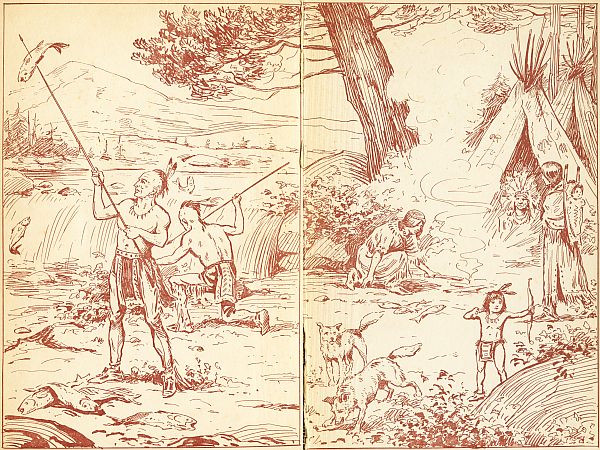
The Indians took toll of the big silver-sided salmon as they made their way up the Columbia to spawn. They used as a rule a primitive fish spear with which they were very expert.
There were always salmon to be found at the foot of the fall, or in shallow creeks that emptied into the big river, but, when the spring finally came, the fish would pass in from the sea in multitudes beyond reckoning, all eager to get up to the shallow waters where they could spawn.
Eye witnesses of undoubted veracity have described the scene where, in places, the multitude of these big fish was so great that they filled the stream with a solid mass.
Of course those days are past. In these times, when numerous canneries are operating along the river, and millions of tins of fish are put up every season, it could hardly be expected that the supply would continue in unlimited quantities. Though as yet there has been no serious inroad made, thanks to the action of the Federal Government, and the work of the active Fish Commissioners, who see to it that the fish wheels, by means of which catches are made, are regulated according to law. Still the sight of the untold numbers that greeted the eyes of the explorers on that early spring of 1806 has passed forever.
Note 10 (page 305)
The fear sometimes felt by the explorers that the Indians were using poisoned arrows was not unfounded, since it was well known that some of the tribes resorted to this fiendish practice, with the flint-tipped weapons intended for war purposes.
Their usual way of making the arrows deadly was to find a healthy looking rattlesnake, and provoke him by thrusts from a long stick. When the reptile had become sufficiently furious, and was lunging madly, a piece of raw meat would be fastened to the end of the pole, and this he was coaxed to strike again and again, until it was well saturated with the green virus from his fangs.
When this infected meat had become a mass of poison, arrows were dipped in it, and allowed to dry. Once these entered the flesh of an enemy, as a rule his death was certain. Of course an entirely different lot of arrows would be used for hunting purposes, the deadly sort being kept only for war.
History however does not record many deaths from this source, so it must be taken for granted that, as a rule, the Indians disliked resorting to such a severe measure of defense. Possibly it did not appeal to them as exactly fair, and they were more than ready to measure their tomahawks and knives and spears, as well as their ordinary arrows, against the guns owned by the white men. Certainly no one of the Lewis and Clark party suffered from poisoned arrows during the long journey across the western country.
FOOTNOTES:
Selections from The Page Company’s Books for Young People
THE BLUE BONNET SERIES
Each large 12mo, cloth decorative, illustrated, per volume $1.50
A TEXAS BLUE BONNET
By Caroline E. Jacobs.
“The book’s heroine, Blue Bonnet, has the very finest kind of wholesome, honest, lively girlishness and cannot but make friends with every one who meets her through the book as medium.”—Chicago Inter-Ocean.
BLUE BONNET’S RANCH PARTY
By Caroline E. Jacobs and Edyth Ellerbeck Read.
“A healthy, natural atmosphere breathes from every chapter.”—Boston Transcript.
BLUE BONNET IN BOSTON; Or, Boarding-School Days at Miss North’s.
By Caroline E. Jacobs and Lela Horn Richards.
“It is a fine story for girls, and is bound to become popular because of its wholesomeness and its many human touches.”—Boston Globe.
BLUE BONNET KEEPS HOUSE; Or, The New Home in the East.
By Caroline E. Jacobs and Lela Horn Richards.
“It cannot fail to prove fascinating to girls in their teens, not to mention those of older growth, who still hold dear the memory of their youth.”—New York Sun.
THE YOUNG PIONEER SERIES
By Harrison Adams Each 12mo, cloth decorative, illustrated, per volume $1.25
THE PIONEER BOYS OF THE OHIO; Or, Clearing the Wilderness.
“Such books as this are an admirable means of stimulating among the young Americans of to-day interest in the story of their pioneer ancestors and the early days of the Republic.”—Boston Globe.
THE PIONEER BOYS ON THE GREAT LAKES; Or, On the Trail of the Iroquois.
“The recital of the daring deeds of the frontier is not only interesting but instructive as well and shows the sterling type of character which these days of self-reliance and trial produced.”—American Tourist, Chicago.
THE PIONEER BOYS OF THE MISSISSIPPI; Or, The Homestead in the Wilderness.
“The story is told with spirit, and is full of adventure.”—New York Sun.
THE PIONEER BOYS OF THE MISSOURI; Or, In the Country of the Sioux.
“Vivid in style, vigorous in movement, full of dramatic situations, true to historic perspective, this story is a capital one for boys.”—Watchman Examiner, New York City.
THE PIONEER BOYS OF THE YELLOWSTONE; Or, Lost in the Land of Wonders.
“There is plenty of lively adventure and action and the story is well told.”—Duluth Herald, Duluth, Minn.
THE PIONEER BOYS OF THE COLUMBIA; Or, In the Wilderness of the Great Northwest.
“The story is full of spirited action and contains much valuable historical information.”—Boston Herald.
THE HADLEY HALL SERIES
By Louise M. Breitenbach Each large 12mo, cloth decorative, illustrated, per volume $1.50
ALMA AT HADLEY HALL
“The author is to be congratulated on having written such an appealing book for girls.”—Detroit Free Press.
ALMA’S SOPHOMORE YEAR
“It cannot fail to appeal to the lovers of good things in girls’ books.”—Boston Herald.
ALMA’S JUNIOR YEAR
“The diverse characters in the boarding-school are strongly drawn, the incidents are well developed and the action is never dull.”—The Boston Herald.
ALMA’S SENIOR YEAR
“Incident abounds in all of Miss Breitenbach’s stories and a healthy, natural atmosphere breathes from every chapter.”—Boston Transcript.
THE GIRLS OF FRIENDLY TERRACE SERIES
By Harriet Lummis Smith Each large 12mo, cloth decorative, illustrated, per volume $1.50
THE GIRLS OF FRIENDLY TERRACE
“A book sure to please girl readers, for the author seems to understand perfectly the girl character.”—Boston Globe.
PEGGY RAYMOND’S VACATION
“It is a wholesome, hearty story.”—Utica Observer.
SCHOOL DAYS ON FRIENDLY TERRACE
The book is delightfully written, and contains lots of exciting incidents.
FAMOUS LEADERS SERIES
By Charles H. L. Johnston Each large 12mo, cloth decorative, illustrated, per volume $1.50
FAMOUS CAVALRY LEADERS
“More of such books should be written, books that acquaint young readers with historical personages in a pleasant, informal way.”—New York Sun.
“It is a book that will stir the heart of every boy and will prove interesting as well to the adults.”—Lawrence Daily World.
FAMOUS INDIAN CHIEFS
“Mr. Johnston has done faithful work in this volume, and his relation of battles, sieges and struggles of these famous Indians with the whites for the possession of America is a worthy addition to United States History.”—New York Marine Journal.
FAMOUS SCOUTS
“It is the kind of a book that will have a great fascination for boys and young men, and while it entertains them it will also present valuable information in regard to those who have left their impress upon the history of the country.”—The New London Day.
FAMOUS PRIVATEERSMEN AND ADVENTURERS OF THE SEA
“The tales are more than merely interesting; they are entrancing, stirring the blood with thrilling force and bringing new zest to the never-ending interest in the dramas of the sea.”—The Pittsburgh Post.
FAMOUS FRONTIERSMEN AND HEROES OF THE BORDER
This book is devoted to a description of the adventurous lives and stirring experiences of many pioneer heroes who were prominently identified with the opening of the Great West.
“The accounts are not only authentic, but distinctly readable, making a book of wide appeal to all who love the history of actual adventure.”—Cleveland Leader.
HILDEGARDE-MARGARET SERIES
By Laura E. Richards Eleven Volumes
The Hildegarde-Margaret Series, beginning with “Queen Hildegarde” and ending with “The Merryweathers,” make one of the best and most popular series of books for girls ever written.
Each large 12mo, cloth decorative, illustrated, per volume $1.25
The eleven volumes boxed as a set $13.75
LIST OF TITLES
QUEEN HILDEGARDE
HILDEGARDE’S HOLIDAY
HILDEGARDE’S HOME
HILDEGARDE’S NEIGHBORS
HILDEGARDE’S HARVEST
THREE MARGARETS
MARGARET MONTFORT
PEGGY
RITA
FERNLEY HOUSE
THE MERRYWEATHERS
THE CAPTAIN JANUARY SERIES
By Laura E. Richards Each 12mo, cloth decorative, illustrated, per volume 50 cents
CAPTAIN JANUARY
A charming idyl of New England coast life, whose success has been very remarkable.
SAME. Illustrated Holiday Edition $1.25
SAME, French Text. Illustrated Holiday Edition $1.25
MELODY: The Story of a Child.
SAME. Illustrated Holiday Edition $1.25
MARIE
A companion to “Melody” and “Captain January.”
ROSIN THE BEAU
A sequel to “Melody” and “Marie.”
SNOW-WHITE; Or, The House in the Wood.
JIM OF HELLAS; Or, In Durance Vile, and a companion story, Bethesda Pool.
NARCISSA
And a companion story, In Verona, being two delightful short stories of New England life.
“SOME SAY”
And a companion story, Neighbors in Cyrus.
NAUTILUS
“‘Nautilus’ is by far the best product of the author’s powers, and is certain to achieve the wide success it so richly merits.”
ISLA HERON
This interesting story is written in the author’s usual charming manner.
THE LITTLE MASTER
“A well told, interesting tale of a high character.”—California Gateway Gazette.
DELIGHTFUL BOOKS FOR LITTLE FOLKS
By Laura E. Richards
THREE MINUTE STORIES
Cloth decorative, 12mo, with eight plates in full color and many text illustrations by Josephine Bruce.
Net $1.25; carriage paid $1.40
“Little ones will understand and delight in the stories and poems.”—Indianapolis News.
FIVE MINUTE STORIES
Cloth decorative, square 12mo, illustrated $1.25
A charming collection of short stories and clever poems for children.
MORE FIVE MINUTE STORIES
Cloth decorative, square 12mo, illustrated $1.25
A noteworthy collection of short stories and poems for children, which will prove as popular with mothers as with boys and girls.
FIVE MICE IN A MOUSE TRAP
Cloth decorative, square 12mo, illustrated $1.25
The story of their lives and other wonderful things related by the Man in the Moon, done in the vernacular from the lunacular form by Laura E. Richards.
WHEN I WAS YOUR AGE
Cloth, 8vo, illustrated $1.25
The title most happily introduces the reader to the charming home life of Doctor Howe and Mrs. Julia Ward Howe, during the childhood of the author.
A HAPPY LITTLE TIME
Cloth, 8vo, illustrated $1.25
Little Betty and the happy time she had will appeal strongly to mothers as well as to the little ones who will have this story read to them, and appeal all the more on account of its being such a “real” story.
THE BOYS’ STORY OF THE RAILROAD SERIES
By Burton E. Stevenson Each large 12mo, cloth decorative, illustrated, per volume $1.50
THE YOUNG SECTION-HAND; Or, The Adventures of Allan West.
“A thrilling story, well told, clean and bright. The whole range of section railroading is covered in the story, and it contains information as well as interest.”—Chicago Post.
THE YOUNG TRAIN DISPATCHER
“A vivacious account of the varied and often hazardous nature of railroad life, full of incident and adventure, in which the author has woven admirable advice about honesty, manliness, self-culture, good reading, and the secrets of success.”—Congregationalist.
THE YOUNG TRAIN MASTER
“It is a book that can be unreservedly commended to anyone who loves a good, wholesome, thrilling, informing yarn.”—Passaic News.
THE YOUNG APPRENTICE; Or, Allan West’s Chum.
“The story is intensely interesting, and one gains an intimate knowledge of the methods and works in the great car shops not easily gained elsewhere.”—Baltimore Sun.
“It appeals to every boy of enterprising spirit, and at the same time teaches him some valuable lessons in honor, pluck, and perseverance.”—Cleveland Plain Dealer.
“The lessons that the books teach in development of uprightness, honesty and true manly character are sure to appeal to the reader.”—The American Boy.
THE LITTLE COLONEL BOOKS
(Trade Mark) By Annie Fellows Johnston Each large 12mo, cloth, illustrated, per volume $1.50
THE LITTLE COLONEL STORIES
(Trade Mark)
Being three “Little Colonel” stories in the Cosy Comer Series, “The Little Colonel,” “Two Little Knights of Kentucky,” and “The Giant Scissors,” in a single volume.
THE LITTLE COLONEL’S HOUSE PARTY
(Trade Mark)
THE LITTLE COLONEL’S HOLIDAYS
(Trade Mark)
THE LITTLE COLONEL’S HERO
(Trade Mark)
THE LITTLE COLONEL AT BOARDING-SCHOOL
(Trade Mark)
THE LITTLE COLONEL IN ARIZONA
(Trade Mark)
THE LITTLE COLONEL’S CHRISTMAS VACATION
(Trade Mark)
THE LITTLE COLONEL, MAID OF HONOR
(Trade Mark)
THE LITTLE COLONEL’S KNIGHT COMES RIDING
(Trade Mark)
MARY WARE: THE LITTLE COLONEL’S CHUM
(Trade Mark)
MARY WARE IN TEXAS
MARY WARE’S PROMISED LAND
These twelve volumes, boxed as a set, $18.00.
SPECIAL HOLIDAY EDITIONS
Each small quarto, cloth decorative, per volume $1.25
New plates, handsomely illustrated with eight full-page drawings in color, and many marginal sketches.
THE LITTLE COLONEL
(Trade Mark)
TWO LITTLE KNIGHTS OF KENTUCKY
THE GIANT SCISSORS
BIG BROTHER
THE JOHNSTON JEWEL SERIES
Each small 16mo, cloth decorative, with frontispiece and decorative text borders, per volume Net $0.50
IN THE DESERT OF WAITING: The Legend of Camelback Mountain.
THE THREE WEAVERS: A Fairy Tale for Fathers and Mothers as Well as for Their Daughters.
KEEPING TRYST: A Tale of King Arthur’s Time.
THE LEGEND OF THE BLEEDING HEART
THE RESCUE OF PRINCESS WINSOME: A Fairy Play for Old and Young.
THE JESTER’S SWORD
THE LITTLE COLONEL’S GOOD TIMES BOOK
Uniform in size with the Little Colonel Series $1.50
Bound in white kid (morocco) and goldNet 3.00
Cover design and decorations by Peter Verberg.
“A mighty attractive volume in which the owner may record the good times she has on decorated pages, and under the directions as it were of Annie Fellows Johnston.”—Buffalo Express.
THE LITTLE COLONEL DOLL BOOK—First Series
Quarto, boards, printed in colors $1.50
A series of “Little Colonel” dolls. Each has several changes of costume, so they can be appropriately clad for the rehearsal of any scene or incident in the series.
THE LITTLE COLONEL DOLL BOOK—Second Series
Quarto, boards, printed in colors $1.50
An artistic series of paper dolls, including not only lovable Mary Ware, the Little Colonel’s chum, but many another of the much loved characters which appear in the last three volumes of the famous “Little Colonel Series.”
ASA HOLMES
By Annie Fellows Johnston.
With a frontispiece by Ernest Fosbery.
16mo, cloth decorative, gilt top $1.00
“‘Asa Holmes’ is the most delightful, most sympathetic and wholesome book that has been published in a long while.”—Boston Times.
TRAVELERS FIVE: ALONG LIFE’S HIGHWAY
By Annie Fellows Johnston.
With an introduction by Bliss Carman, and a frontispiece by E. H. Garrett.
12mo, cloth decorative $1.25
“Mrs. Johnston broadens her reputation with this book so rich in the significance of common things.”—Boston Advertiser.
JOEL: A BOY OF GALILEE
By Annie Fellows Johnston.
12mo, cloth decorative, illustrated $1.50
“The book is a very clever handling of the greatest event in the history of the world.”—Rochester, N. Y., Herald.
THE BOYS’ STORY OF THE ARMY SERIES
By Florence Kimball Russel
BORN TO THE BLUE
12mo, cloth decorative, illustrated $1.25
“The story deserves warm commendation and genuine popularity.”—Army and Navy Register.
IN WEST POINT GRAY
12mo, cloth decorative, illustrated $1.50
“One of the best books that deals with West Point.”—New York Sun.
FROM CHEVRONS TO SHOULDER-STRAPS
12mo, cloth decorative, illustrated $1.50
“The life of a cadet at West Point is portrayed very realistically.”—The Hartford Post, Hartford, Conn.
DOCTOR’S LITTLE GIRL SERIES
By Marion Ames Taggart Each large 12mo, cloth, illustrated, per volume, $1.50
THE DOCTOR’S LITTLE GIRL
“A charming story of the ups and downs of the life of a dear little maid.”—The Churchman.
SWEET NANCY: The Further Adventures of the Doctor’s Little Girl.
“Just the sort of book to amuse, while its influence cannot but be elevating.”—New York Sun.
NANCY, THE DOCTOR’S LITTLE PARTNER
“The story is sweet and fascinating, such as many girls of wholesome tastes will enjoy.”—Springfield Union.
NANCY PORTER’S OPPORTUNITY
“Nancy shows throughout that she is a splendid young woman, with plenty of pluck.”—Boston Globe.
NANCY AND THE COGGS TWINS
“The story is refreshing.”—New York Sun.