JAPAN IN THE TENTH CENTURY
Arthur Waley translation
When the first volume of The Tale of Genji appeared in English, the prevailing comment of critics was that the book revealed a subtle and highly developed civilization, the very existence of which had hitherto remained unsuspected. It was guessed that so curious a state of society, with its rampant æstheticism and sophisticated unmorality, its dread of the explicit, the emphatic, must have behind it a protracted history of undisturbed development, or (as others put it) must be the climax of an age-long decadence.
And it is indeed true that the unique civilization portrayed in the Tale of Genji and The Pillow-Book of Sei Shōnagon corresponds to a unique record of isolation and tranquillity. The position of Japan, lying on the edge of the Oriental world, has been compared to that of England always in full communion with Europe, yet exempt from the worst perils of contiguity—in fact, ideally ‘semi-detached.’
But the comparison has little force. Japan is eight times farther from the mainland than we from France. One cannot swim across the Straits of Tsushima. Yet phase after phase of civilization—agriculture, tools, domestic animals at an age long before history, then later, the Chinese ideograms, Indian religion, Persian textiles—managed to filter across the Straits; while invasion, save for an occasional raid of pirates from China, not merely during those early years, but until the abortive Mongol descent in the thirteenth century, was almost unknown. In Europe and on the continent of Asia no single strip of land has ever enjoyed a like immunity. Across France, Hungary, Poland, Turkestan, how many armies marched during the long centuries of Japan’s absolute security! Thus arose a culture that, among other peculiarities, had that of not being cosmopolitan. Rome, Byzantium, Ctesiphon, even Ch’ang-an were international cities. In the streets of Kyōto a stray Korean or Chinaman were, as specimens of the exotic, the best that could be hoped for. The world, to a Japanese of the tenth century, meant Japan and China. India was semi-mythical, and Persia uncertainly poised somewhere between China and Japan.
Thus, since the establishment of the capital at Heian[3] in 794, had grown up a highly specialized, intense and uniform civilization, dominated by one family, the Fujiwara; a state of society in which the stock of knowledge, the experience, the prejudices of all individuals were so similar that the grosser forms of communication seemed no longer necessary. A phrase, a clouded hint, an allusion half-expressed, a gesture imperceptible to common eyes, moved this courtly herd with a facility as magic as those silent messages that in the prairie ripple from beast to beast.
It was a purely æsthetic and, above all, a literary civilization. Never, among people of exquisite cultivation and lively intelligence, have purely intellectual pursuits played so small a part. What strikes us most is that the past was almost a blank; not least so the history of Japan, extending even in mythological theory only to the seventh century b.c. and remaining fabulous for fifteen hundred years.
It is indeed our intense curiosity about the past that most sharply distinguishes us from the ancient Japanese. Here every educated person is interested in some form or another of history. The busiest merchant is an authority upon snuff-boxes, Tudor London, or Chinese jade. The remotest country clergyman reads papers on eoliths; his daughters revive forgotten folk-dances. But to the Japanese of the tenth century, ‘old’ meant fusty, uncouth, disagreeable. To be ‘worth looking at’ a thing must be imamekashi, ‘now-ish,’ up-to-date. By Shōnagon and Murasaki the great collection of early poetry (the Manyōshū), on the rare occasions when they quote it, is always referred to in an apologetic way, as something which despite its solid merits will necessarily offend the modern eye. Nor did they feel that the future—with us an increasing preoccupation—in any way concerned them.
Their absorption in the present, the fact that with them ‘modern’ was invariably a term of praise, differentiates them from us in a way that is immediately obvious. The other aspects of their intellectual passivity—the absence of mathematics, science, philosophy (even such amateur speculation as amused the Romans was entirely unknown)—may not seem at first sight to constitute an important difference. Scientists and philosophers, it is true, exist in modern Europe. But to most of us their pronouncements are as unintelligible as the incantations of a Lama; we are mere drones, slumbering amid the clatter of thoughts and contrivances that we do not understand and could still less ever have created. If the existence of contemporary research had no influence except upon those capable of understanding it, we should indeed be in much the same position as the people of Heian. But, strangely enough, something straggles through; ideas which we do not completely understand modify our perceptions and hence refashion our thoughts to such an extent that the society lady who said ‘Einstein means so much to me’ was expressing a profound truth.
It is, then, not only their complete absorption in the passing moment, but more generally the entire absence of intellectual background that makes the ancient Japanese so different from us, and gives even to the purely æsthetic sides of their culture a curious quality of patchiness. At any moment these men and women, to all appearances so infinitely urbane and sophisticated, may surprise us, even where matters of taste rather than intellect are concerned, by lapsing into a niaiserie far surpassing the silliness of our own Middle Ages. It is this insecurity which gives to the Heian period that oddly evasive and, as it were, two-dimensional quality, its figures and appurtenances seeming to us sometimes all to be cut out of thin, transparent paper.
Religious ceremonies were much in vogue, but were viewed chiefly from an æsthetic standpoint. The recitation of sacred texts was an art practised by the laity as well as the clergy. An exacting standard of connoisseurship prevailed, and if Buddhist services were packed to overflowing, it was upon appraising the merits of the performers rather than upon his own spiritual improvement that a Heian worshipper was bent.
Mimes, pageants, processions filled the Court calendar. Those organized by the Church had a certain tinge of exotic solemnity; for till the tenth century Indian Buddhism continued to send out fresh waves of influence, which now reached China (and hence Japan) less circuitously than in former days.
But it would scarcely be an exaggeration to say that the real religion of Heian was the cult of calligraphy. Certainly writing was the form of conduct that was scrutinized most severely. We find beauty of penmanship not merely counting for almost as much as beauty of person, but spoken of rather as a virtue than as a talent, and the epithet ‘good,’ when applied to an individual, frequently refers not to conduct but to handwriting. Often in Japanese romances it is with some chance view of the heroine’s writing that a love-affair begins; and if the hero happens to fall in love with a lady before he has seen her script, he awaits the first ‘traces of her hand’ with the same anxiety as that which afflicted a Victorian gentleman before he had ascertained his fiancée’s religious views. It was as indispensable that a Japanese mistress should write beautifully as that Mrs. Gladstone should be sound about the episcopal succession.
Again, a considerable place in the lives of the ancient Japanese was given to arts the very existence of which the West has barely recognized. For example, the art of blending perfumes, regarded by us as a mere trade, ranked in ancient Japan as the equal of music and poetry.
These things, however, are only differences of emphasis. Calligraphy has perhaps nowhere else so nearly achieved the status of a religion; but it has been practised as an art throughout the East, and was esteemed at certain moments even in Europe. So recently as the beginning of the present century a small school, led by Dr. Bridges, gave it a considerable prominence in one part of England. And even the burning of perfumes, though on the whole neglected in this country, has always been practised here and there, experimentally, in corners that some chance has screened from the censure of Nordic virility.
Again, the purely æsthetic approach to religion, which was the rule in Heian, has often been fostered in Europe by cliques of exceptional people. At first sight, indeed, Buddhism (with its rosaries, baptism, tonsured monks, and nuns; its Heaven, Purgatory, and Hell) appears to have many points of resemblance to Catholic Christianity. But I fancy, all the same, that the most fundamental difference between the Japanese (or, for that matter, any Far Eastern nation) and us is the fact, obvious indeed yet constantly overlooked, that they were not Christians.
The Buddhist is taught that the world of appearances, with all its imperfection, is coeval with Buddha (using the name in its metaphysical not its historical sense). He is, in fact, this world, and does not exist outside it. Impossible, then, to reproach him with its sorrow or iniquity. The Christian (or strictly, the adherent of any Semitic religion; for it holds good of the Moslem and Jew) alone has compassed the magnificent conception of a Being all-wise, all-powerful, the incarnation of Good. But the world (His creation) is patently evil. Is there then some mistake? Is this adored Being in reality powerless against evil, or ignorant, or cruel? These are the questions that in all ages have racked the Christian’s soul. Official solutions (which it was heresy to reject) failed to satisfy him; the conflict became an agony that has continually goaded Western man into what to the East have seemed gratuitous turmoils and achievements, making his thoughts a hard bed to lie on, waking him (as uneasy quarters drive a traveller on to the road at dawn) not only to fresh adventures but to the discovery of beauties that, wrapped in morning dreams, the East has ignored.
It has been suggested, as a dominating characteristic of the ancient Japanese, that they were without a sense of sin. It would, I maintain, be truer to say that they were not troubled by the Problem of Evil. But a sense of sin they certainly did not lack. Hell gaped at them perpetually; no delicately Japanicized variety, but a true Dantesque inferno, brutally depicted not only on monastery walls, but even amid the gay elegancies of the Palace. The period at which Shōnagon wrote her book corresponded with a time of general panic concerning the Life to Come. In 985 appeared Eshin Sōzu’s Ōjō Yōshū or ‘Essentials of Salvation,’ with its ghoulish evangelism that culminated in the great democratic ‘revivals’ of Hōnen Shōnin in the twelfth and Shinran in the thirteenth century.
And if Eshin’s mission marked the beginning of a new phase in Japanese religion, it was at the same time associated with the political counter-currents that ultimately destroyed the civilization of Heian.
Among Eshin’s aristocratic adherents the most important were drawn not from the dominant Fujiwara family but its rivals, the Taira and Minamoto.[4] One of his most influential followers was Taira no Koremochi, a lawless character, possibly the model for Murasaki’s Tayū (the braggadocio suitor of Tamakatsura) in the third volume of Genji. Koremochi had a dispute with one of the Fujiwaras about a piece of land, and failing to win his case, waylaid and slaughtered his rival. The consequences of this murder, committed with complete impunity, were far-reaching. For centuries the Fujiwaras had been hedged round by a mysterious prestige. Fiefs, titles, offices of state—all seemed to belong to them by some inviolable decree, and each fresh claim met only with a superstitious acquiescence. But now it had been discovered, to everyone’s astonishment, that even a Fujiwara could crumple at the touch of steel, ‘roll over like an ox and vanish unavenged.’ These events took place in the extreme north of the main Island. Here, and in all the border provinces the hold of the Fujiwaras was beginning to weaken. The great struggle began early in the twelfth century; but when it came it was a contest not between civilization and barbarism—for the effeminate and decadent society of Heian disappeared at the first breath of conflict—but between a long series of rival swashbucklers and dictators. And with the advent of a robust militarism the old attitude towards religion, half childish, half cynical, gave way on the one hand to the intense, peasant faith of Hōnen, and on the other to the passionate mysticism of the Nō plays.
The life of the Heian Court in the tenth century is known to us chiefly through two documents, The Tale of Genji, a novel by Murasaki Shikibu, and The Pillow-Book by Sei Shōnagon. The first has, as a document, the disadvantage of being fiction. Murasaki shows us the world, particularly the male part of it, rather as she would like it to have been than as she actually found it. She dreamed of lovers who, though in every sense men, should yet retain the gentleness and grace of her girl friend Saishō.[5] How different was the world she actually lived in we can see in her Diary, which fortunately is also preserved.
The Pillow-Book, on the other hand, is a plain record of fact, and being at least ten times as long as Murasaki’s Diary, and far more varied in contents, it is the most important document of the period that we possess.[6]
Sei Shōnagon, the authoress of the Pillow-Book, was born in 966 or 967, the daughter of Kiyohara no Motosuke. The Kiyohara clan was descended from Temmu, the fortieth Emperor of Japan. For many generations, Motosuke’s ancestors had held office as provincial governors, a respectable but undistinguished form of employment. Chiefly, however, they are known for their devotion to learning and literature. Prince Toneri, the founder of the family, was one of the compilers of the Nihongi, or ‘Chronicles of Japan’;[7] another ancestor, Natsuno,[8] who died in 837, was the author of an important work, the Ryō no gige or ‘Commentary on the Penal Code,’ while Shōnagon’s great-grandfather, Fukayabu, became the typical Court-poet of the early tenth century, and his thin elegant verse still figures in every anthology.
Motosuke held a series of governorships; but he, too, is best known as a poet and student of poetry. He lectured upon the text of the Manyōshū, a collection of ancient poems that were already becoming difficult to understand, and was one of the compilers of the Gosenshū, the second official anthology. He was appointed to his last governorship, that of Bingo, in 986 and died in 990.
A year later Shōnagon, now aged about twenty-four, entered the service of the little Empress Sadako, who had arrived at Court the year before. The Empress, a daughter of the Prime Minister, Fujiwara no Michitaka, was now fifteen: she died in childbirth ten years later, and it is with these years, from 991 to 1000, that the Pillow-Book deals.
It consists partly of reminiscences, partly of entries in diary-form. The book is arranged not chronologically, but under a series of headings, such as ‘Disagreeable Things,’ ‘Amusing Things,’ ‘Disappointing Things,’ and the like; but often this scheme breaks down and the sequence becomes entirely arbitrary.
To keep some kind of journal was a common practice of the day. No other miscellany like the Pillow-Book exists; but there may well have been others, for Heian literature has not survived in its entirety. Thus, Shōnagon gives us a list of her favourite novels. Out of eleven, only one (The Hollow Tree) survives; and from other sources we know the names of over twenty novels belonging to this period, all of which are lost. The question whether the particular form in which she cast her book, that of grouping the entries under headings such as ‘disagreeable things,’ ‘amusing things,’ etc., was suggested to her by some previous work is difficult to decide. There exists a book[9] by the Chinese poet Li Shang-yin (813–58) called Tsa Tsuan, or ‘Miscellaneous Notes,’ which is arranged on this principle, though its matter is very different, the author remaining content with mere enumerations, for example:
Things that certainly won’t come.
A dog, if called to by a man with a stick in his hand.
A singing-girl, if summoned by a penniless student.
Inappropriate Things.
For a Persian to be poor. For a doctor to fall ill. For a schoolmaster not to recognize an ideogram. For a butcher to recite the Scriptures.[10]
Things that make a Bad Impression.
To fall off one’s horse at polo. To choke when eating with one’s superiors. To return to worldly life after having been in a monastery or convent. To lie on someone else’s bed with one’s boots on. To sing love-songs in the presence of one’s parents.
Whereas Shōnagon almost always illustrates her categories by long anecdotes and reminiscences, the Chinese writer, as we have seen, confines himself to bald lists. Shōnagon is concerned with her own likes and irritabilities; Li Shang-yin merely expresses a sort of generalized proverbial wisdom. Her experience is drawn exclusively from the Court; his illustrations are drawn from market-place and farm.
Despite these differences, the particular form in which the Pillow-Book is cast might quite conceivably be due to the Tsa Tsuan. The difficulty is that Li Shang-yin’s book does not seem to have reached Japan till many centuries later. That no single copy of the Tsa Tsuan existed in Japan at a particular date is a thing that obviously cannot be proved. The question is not in itself of much importance, but it is worth mentioning in order to call attention to the Chinese book, which is a singularly interesting document of social history.
Shōnagon protests, as do most diarists and makers of journals, that the Pillow-Book was intended for herself alone. But it quickly fell into other hands. In 1002 she writes:
When the present Captain of the Bodyguard of the Left (Minamoto no Tsunefusa) was governor of Ise (i.e. in 995 or 996) he one day called on me at my home. By accident a mattress that was pushed out into the front room for him to sit on had my book lying on it. The moment I realized this I snatched at the book and made frantic efforts to recover it. But Tsunefusa carried it off with him and did not return it till a long time afterwards.
So far as I remember, this was the beginning of my book being handed about at Court.
What Tsunefusa saw and handed round in 995–6 was, of course, only part of the work, most of it having been written later than this.
Printing did not become general in Japan till the seventeenth century. The editio princeps of the Pillow-Book is in movable type and is said to date from the Keichō Period, 1596–1614. Many mediæval manuscript-copies exist; but their relative age and trustworthiness have not been fully investigated.
Concerning her arrival at Court, Shōnagon writes as follows:
When I first entered her Majesty’s service I felt indescribably shy, and was indeed constantly on the verge of tears. When I came on duty the first evening, the Empress was sitting with only a three-foot screen in front of her, and so nervous was I that when she passed me some picture or book to look at, I was hardly capable of putting out my hand to take it. While she was talking about what she wanted me to see—telling me what it was or who had made it—I was all the time wondering whether my hair was in order. For the lamp was not in the middle of the room, but on a stand immediately beside where we sat, and we were more exposed than we should have been even by daylight. It was all I could do to fix my attention on what I was looking at. Only part of her Majesty’s hand showed, for the weather was very cold and she had muffled herself in her sleeves; but I could see that it was pink and very lovely. I gazed and gazed. To an inexperienced home-bred girl like me it was a wonderful surprise to discover that such people as this existed on earth at all. At dawn I hurried away, but the Empress called after me, saying I seemed to be as frightened of the daylight as the ugly old God of Katsuragi.[11] I lay down again, purposely choosing an attitude in which she could not get a full view of me. The shutters had not yet been opened. But soon one of the ladies came along and the Empress called out to her, ‘Please open those things!’ She was beginning to do so, when the Empress suddenly said, ‘Not now!’ and, laughing, the lackey withdrew. Her Majesty then engaged me in conversation for some time, and said at last: ‘Well, I expect you are wanting to be off. Go as soon as you like.’ ‘And come back in good time to-night,’ she added. It was so late when I got back to my room that I found it all tidied and opened up for the day. The snow outside was lovely. Presently there came a message from the Empress saying it was a good opportunity for me to wait upon her in the morning. ‘The snow-clouds make it so dark,’ she said, ‘that you will be almost invisible.’ I could not bring myself to go, and the message was repeated several times. At last the head-girl of our room said: ‘You mustn’t shut yourself up here all the time. You ought to be thankful to get a chance like this. Her Majesty would not ask for you unless she really wanted you, and she will think it very bad manners if you do not go.’ So I was hustled off, and arrived once more in the Imperial Presence, in a state of miserable embarrassment and confusion.
Shōnagon goes on to describe the ease and nonchalance with which those in attendance upon the Empress went about their duties or lay ‘with their Chinese cloaks trailing across the floor.’ ‘How I envied the composure with which they took and handed on the Empress’s notes and letters, standing up and sitting down, talking and laughing without the slightest trace of embarrassment! Would a time ever come when I should feel equally at home in such surroundings? The mere thought made me tremble.... Presently there were loud cries of “Make way!” Someone said it was the Prime Minister, and a great scuffling began, everyone clutching at whatever possessions they had left lying about and making hastily for the alcove.’
Shōnagon goes on to tell us that the visitor turns out to be not Michitaka, the Prime Minister, but his son, Korechika, the Empress’s favourite brother, then a lad of eighteen.
Korechika. These last two days I have been supposed to be in retreat.[12] But I wanted to see how you were getting on in this tremendous snow-storm.
Empress. I did not expect you. I thought ‘no roads were left....’[13]
Korechika. Did you think that would stop me? I made sure ‘your heart was filled with pity....’
What, I thought, could have been more elegant than such a conversation as this? It was up to the most high-flown passages in any of the novels I had read.... After a while my Lord Korechika asked who was behind the curtains-of-state, and someone having told him it was I, he rose to his feet, intending, as I first thought, to go away. But instead, he came close up to the curtains and spoke about something that he heard had happened to me before I came to Court. I had already been feeling utterly awe-struck as I gazed at him through the curtains; and now when he actually came up and began to address me, I almost fainted.
Sometimes at festivals and processions he had seemed to be looking in the direction of our carriage; whereupon we had immediately made fast the blinds and even hidden our faces with our fans, lest he should get a momentary view of our profiles. And now, sitting terror-stricken before him, I wondered how it was that I had ever consented to embark upon a career for which I was so hopelessly ill-qualified. Even the fan with which I was attempting to hide my embarrassment he now took from me. I felt certain at once that my hair was straggling down in the wildest disorder, and whether it really was or no, probably I looked quite as distraught as I was feeling. Twisting my fan in his fingers, he began asking who painted it, and other questions—I all the while hoping only that he would soon go away. But it was clear he had no intention of doing so, for he was now reclining on his back close to the curtains. I think her Majesty felt at last that his long stay was disconcerting me, for she called to him: ‘Come over here! I want you to tell me whose writing this is.’ How thankful I felt! But Lord Korechika replied: ‘Send it along and I will look at it!’ and when she still insisted that he should come to her, he said: ‘I would come; but Shōnagon here has hold of me and will not let go.’ This, of course, was whimsical enough, but rather embarrassing for me, considering the immense difference in our ages and positions.
Her Majesty was now looking at some piece or other of writing in cursive syllabary. ‘If you want to know who wrote it, show it to this lady. I’ll be bound there’s not a hand in the world that she would not recognize.’ So he went on, always trying to say something that would get an answer out of me.
‘Shōnagon, do you like me?’ the Empress asked presently. ‘Why, Madam, what else do you suppose?’ I was beginning to reply, when someone in the breakfast-room sneezed violently. ‘There!’ cried her Majesty. ‘That shows you are not telling the truth. Of course, it would be nice if you liked me, but it can’t be helped.’
Next morning, when Shōnagon is in her room, someone brings her a note written on light green paper, and very prettily got up. In it is the poem: ‘Never had I known, never had known that false was false; save for the God of Truth whose voice resounded in the empty air.’ ‘It had been dictated,’ Shōnagon continues, ‘to one of her ladies. I felt terribly mortified and confused. How I should have liked to get hold of the person who produced that unlucky sneeze!’
Shōnagon’s reply—‘Thankless my lot who, for the trespass of another’s nose, am thought of shallow heart’—contains puns and ingenuities which it would be tedious to explain.
Thus began Shōnagon’s career at Court. There are, however, in the Pillow-Book two passages which refer to an earlier period in her life. In 986, when she was about twenty, she attended a Buddhist Ceremony at the palace of Fujiwara no Naritoki, Colonel of the Bodyguard and Assistant Councillor of State. ‘The heat,’ she says, ‘was desolating, and we had things to attend to that could not be left over till next day; so we meant only to hear a little of the service and then go home. But such surging oceans of carriages had pressed in behind us, that it was impossible to escape. When the morning part of the ceremony was over we sent word to the carriages at the back of us that we were going away, and being glad enough to get a little closer, they at once let us through, and themselves moved up into line. We had to put up with a good deal of chaffing as we retired.... His lordship Yoshichika[14] called to me as we passed: “You do well to retire.” At the moment I was suffering so much from the heat that I did not see the point: but afterwards I sent a man to him with the message: “Among five thousand arrogants, you too will surely find a place.”’
The allusion (and nothing would so have covered Shōnagon with shame as that it should be thought she had not recognized it) is to a passage in the Lotus Sūtra where five thousand of Buddha’s hearers walk out during one of his sermons. Buddha makes no attempt to stop them, saying only: ‘Arrogant creatures, they do well to retire.’ It is precisely this part of the Lotus Sūtra that is read at the end of the morning service on the first day of the ceremony in question, so that Shōnagon, who became the great pastmaster in the art of capping quotations, begins her career with a very light ordeal.
The following passage also seems to belong to about the year 986:
On that day too (the seventh of the first month) I loved being taken to see the White Horses.[15] We girls living at home used to drive off to the Palace in a coach marvellously furbished. When we came to the ground-bar of the Middle Gate, there was always a terrible bump. Heads knocked together, combs fell out, and, if one did not instantly rescue them, got trampled upon and smashed to pieces. Near the guard-room were a lot of officers, who used to take bows from soldiers in the procession and twang them, to make the White Horses prance. This we found very entertaining. In the distance, through one of the gates of the Inner Palace, we could see shutters, behind which figures were moving to and fro, ladies perhaps of the Lamp or Wardrobe. How marvellous they seemed to us—these people who walked about the Palace as though it belonged to them!
So close did the procession pass that one could study the very texture of the soldiers’ faces. I remember one who had put on his powder unevenly, so that here and there his dark skin showed through, looking like those black patches in the garden, when the snow has begun to melt. An absurd sight. But when the horses reared and plunged wildly about I was frightened, and shrinking back into our coach saw nothing more of the show.
Here is an after-breakfast scene in the Palace, dating from the spring of 994:
Presently we heard those who had been handing the Imperial Dishes tell the serving-men they might clear, and a moment later His Majesty reappeared. He asked me to mix some ink ... and presently folded a white poem-slip, saying to us gentlewomen: ‘Write me a few scraps of old poetry—anything that comes into your head.’ I asked my lord Korechika what he advised me to choose. ‘Don’t ask me,’ he said. ‘Write something quickly and hand it in. This is entirely your affair. We men are not intended to help you.’ And he put the inkstand by me, adding: ‘Don’t stop to think! The Naniwazu[16] or anything else you happen to know....’ Really there was nothing to be afraid of; but for some reason I felt terribly confused, and the blood rushed to my face. Two or three of the upper ladies tried their hands, one with a spring song, another with a poem on this or that flower. Then it came to me, and I wrote out the poem: “The years go by; age and its evils crowd upon me, but be this as it may, while flowers are here to see, I cannot grieve.’ But instead of ‘flowers’ I wrote ‘my Lord.’ ‘I did this out of curiosity,’ said the Emperor, while he was looking at what I had written. ‘It is so interesting to see what is going on in people’s heads.’ A conversation followed, in the course of which he said: ‘I remember my father, the late Emperor Enyū, once[17] saying to his gentlemen-in-attendance: “Here is a book. Each of you shall write a poem in it.” Several of them found great difficulty in getting started. “Don’t bother about your handwriting,” my father said, “nor, for that matter, whether your poems are suitable to the season. It’s all one to me.” Thus encouraged (but still making rather a burden of it) they set to work. One of them was the present Prime Minister! He was only a captain of the Third Rank then. When it came to his turn he wrote the old poem: “Like the tide that rises on the shore of Izumo, deeper and deeper grows my love for you; yes, mine.” But he altered “love for you” to “devotion to my Sovereign,” which pleased my father very much.’
Shōnagon then tells us of the Emperor’s astonishment that people should be able to read such vast quantities of poetry. Twenty chapters (the length of the Kokinshū, the first official anthology) was far too much. ‘I am sure for my part,’ said the Emperor, ‘I shall never succeed in getting beyond Chapter 2.’
Another extract:
From the beginning of the fifth month,[18] it had been dark, rainy weather all the time. I became so bored that at last I suggested we had better go out and see if we couldn’t somewhere hear the cuckoo singing. This idea was very well received, and one of the girls suggested we should try that bridge behind the Kamo Shrine (it isn’t called Magpie Bridge, but something rather like it). She said that there was a cuckoo there every day. Someone else said it was not a cuckoo at all, but a cricket. However, on the morning of the fifth day, off we went. When we ordered the carriage, the men said they didn’t suppose that in such weather as this anyone would mind if we were picked up outside our own quarters and taken out by the Northern Gate.[19] There was only room for four. Some of the other ladies asked whether we should mind their getting another carriage and coming too. But the Empress said ‘No,’ and though they were very much disappointed we drove off rather hard-heartedly without attempting to console them or indeed worrying about them at all. Something seemed to be happening at the riding-ground, where there was a great press of people. When we asked what was going on, we were told that the competitions were being held, and that the archers were just going to shoot on horseback. It was said, too, that the Officers of the Bodyguard of the Left were there; but all we could see, when we had pulled up, was a few gentlemen of the Sixth Rank wandering vaguely about. ‘Oh, do let us get on,’ someone said; ‘there’s no one of any interest here.’ So we drove on towards Kamo, the familiar road making us feel quite as though we were on our way to the Festival.[20] Presently we came to my lord Akinobu’s[21] house, and someone suggested we should get out and have a look at it. Everything was very simple and countrified—pictures of horses on the panels, screens of wattled bamboo, curtains of plaited grass—all in a style that seemed to be intentionally behind the times. The house itself was a poor affair and very cramped, but quite pretty in its way. As for cuckoos, we were nearly deafened! It is really a great pity her Majesty never hears them. And when we thought of the ladies who had wanted so badly to come with us, we felt quite guilty. ‘It’s always interesting to see things done on the spot,’ said Akinobu, and sending for some stuff which I suppose was husked rice, he made some girls—very clean and respectable—along with others who seemed to come from neighbouring farms, show us how the rice was thrashed. Five or six of them did this, and then the grain was put into a sort of machine that went round, two girls turning it and at the same time singing so strange a song that we could not help laughing, and had soon forgotten all about the cuckoos. Then refreshments were brought on a queer old tray-stand such as one sees in Chinese pictures. As no one seemed much interested in its contents, our host said: ‘This is rough, country fare. If you don’t like it, the only thing to do in a place like this is to go on bothering your host or his servants till you get something you can eat. We don’t expect you people from the Capital to be shy. These fern-shoots, now. I gathered them with my own hand.’ ‘You don’t want us to arrange ourselves round the tray-stand like a lot of maid-servants sitting down to their supper?’ I protested.
‘Hand the things round,’ he said ... and while this was going on, in the midst of the clatter, one of the men came in and said that it was going to rain, and we hurried back to our carriage. I wanted to make my cuckoo-poem before we started; but the others said I could do it in the carriage. Before going we picked a huge branch of white-flower and decorated our carriage with it, great trails of blossom hanging over the windows and sides, till one would have thought a huge canopy of white brocade had been flung across the roof of the coach. Our grooms, throwing themselves into the thing, began with shouts of laughter squeezing fresh boughs of blossom into every cranny that would hold them. We longed to be seen by someone on our way back, but not a soul did we meet, save one or two wretched priests or other such uninteresting people. When we were nearly home we made up our minds it would be too dull to finish the day without anyone having seen us in our splendour, so we stopped at the palace in the First Ward and asked for the Captain,[22] saying we were just back from hearing the cuckoo. We were told he had been off-duty for some time and had got into easy clothes; but was now being helped into his Court trousers. Wouldn’t we wait? We said we couldn’t do that, and were driving on to the Eastern Gate, when he suddenly appeared running after us down the road. He had certainly changed in a marvellously short space of time, but was still buckling his belt as he ran. Behind him, barefooted in their haste, panted several dressers and grooms. We called to the coachman to drive on and had already reached the gate when, hopelessly out of breath, he staggered up to us. It was only then that he saw how we were decorated. ‘This is a fairy chariot,’ he laughed. ‘I do not believe there are real people in it. If there are, let them get down and show themselves.’
‘But, Shōnagon, what poems did you make to-day? That’s what I should like to hear.’ ‘We’re keeping them for her Majesty,’ I replied. Just then it once more began to rain in earnest. ‘I have always wondered,’ he said, ‘why when all the other gates have arches, this Eastern gate should have none. To-day, for example, one badly needs it.’ ‘What am I to do now?’ he asked presently. ‘I was so determined to catch you up that I rushed out without thinking what was to become of me afterwards.’ ‘Don’t be so ridiculous,’ I said. ‘You can come with us to the Palace.’ ‘In an eboshi?’[23] he asked. ‘What can you be thinking of?’ ‘Send someone to fetch your hat,’ I suggested. But it was now raining badly and our men, who had no raincoats with them, were pulling in the carriage as quickly as they could.[24] One of his men presently arrived from his palace with an umbrella, and under its shelter he now, with a slow reluctance that contrasted oddly with his previous haste, made his way home, continually stopping to look back at us over his shoulder. With his umbrella in one hand and a bunch of white-flower in the other, he was an amusing sight.
When we were back in the Palace, her Majesty asked for an account of our adventures. The girls who had been left behind were at first inclined to be rather sulky; but when we described how the Captain had run after us down the Great Highway of the First Ward, they could not help laughing. Presently the Empress asked about our poems, and we were obliged to explain that we had not made any. ‘That is very unfortunate,’ she said. ‘Some of the gentlemen at Court are bound to hear of your excursion, and they will certainly expect something to have come of it. I can quite understand that on the spot it was not very easy to write anything. When people make too solemn an affair of such things, one is apt suddenly to feel completely uninterested. But it is not too late. Write something now. You’re good for that much, surely.’ This was all true enough; but it turned out to be a painful business. We were still trying to produce something when a messenger arrived, with a note from the Captain. It was written on thin paper stamped with the white-flower pattern, and was attached to the spray that he had taken from our carriage. His poem said: ‘Would that of this journey I had heard. So had my heart been with you when you sought the cuckoo’s song.’ Fearing that we were keeping the messenger waiting, her Majesty sent round her own writing-case to our room, with paper slipped into the lid. ‘You write something, Saishō,’ I said. But Saishō was determined that I should write, and while we argued about it the sky suddenly grew dark, rain began to pour, and there were such deafening peals of thunder, that we forgot all about our poem, and frightened out of our wits ran wildly from place to place, closing shutters and doors. The storm lasted a long time, and when at last the thunder became less frequent, it was already dark. We were just saying we really must get on with our answer, when crowds of visitors began to arrive, all anxious to talk about the storm, and we were obliged to go out and look after them. One of the courtiers said that a poem only needs an answer when it is addressed to someone in particular, and we decided to do no more about it. I said to the Empress that poetry seemed to have a bad karma to-day, and added that the best thing we could do was to keep as quiet as possible about our excursion. ‘I still don’t see why some of you who went should not be able to produce a few poems,’ she replied, pretending to be cross. ‘It isn’t that you can’t; of that I am sure. You have made up your minds not to.’ ‘The time has passed,’ I said. ‘One must do those things when one is in the right mood.’ ‘Right mood? What nonsense!’ she exclaimed indignantly. But all the same, she did not worry me any more about it.
Two days afterwards Saishō was talking about our excursion, and mentioned the fern-shoots that Akinobu had ‘plucked with his own hand.’ The Empress was amused that Saishō seemed to have retained a much clearer memory of the refreshments than of anything else that happened during the expedition, and picking up a stray piece of paper she wrote: ‘The memory of a salad lingers in her head,’ and bade me make a beginning for the poem. I wrote: ‘More than the cuckoo’s song that she went out to hear.’ ‘Well, Shōnagon,’ she said, laughing, ‘how you of all people can have the face to mention cuckoos, I cannot imagine.’ I felt very crestfallen, but answered boldly: ‘I don’t see anything to be ashamed of. I have made up my mind only to make poems when I feel inclined to. If, whenever there is a question of poetry, you turn upon me and ask me to compose, I shall stay in your service no longer. When I am called upon like that, I can’t even count the syllables, still less think whether I am writing a winter song in spring, or a spring song in autumn.... I know there have been a lot of poets in my family; and it would certainly be very nice if, after one of these occasions, people said: “Of course, hers was much the best; but that is not surprising, considering what her father was.” As it is, not having the slightest degree of special talent in that direction, I object strongly to being perpetually thrust forward and made to behave as though I thought myself a genius. I feel I am disgracing my father’s memory!’ I said this quite seriously; but the Empress laughed. However, she said I might do as I pleased, and promised that for her part she would never call upon me again. I felt immensely relieved.
... Late one night when Korechika came in and began giving out themes upon which the ladies were to write poems, everyone else was delighted and poems were turned out in bundles. I meanwhile went on talking to the Empress about other matters. Presently Korechika caught sight of me and asked why I did not join the others and make some poems. ‘Come and take your theme,’ he said. I told him that I had, for good reasons of my own, given up writing poetry. This he was very loath to believe. ‘I am sure,’ he said, ‘my sister would not allow you to do so. It is the most absurd thing I ever heard of. Well! you may do as you like on other occasions; but I am not going to let you off to-night.’ However, I took no notice. While the poems of the other ladies were being judged, a minute slip of paper was handed to me by the Empress. On it was the poem: ‘Shall she, who of the famed Motosuke an offspring is deemed, alone be missing from to-night’s great tournament of song?’... To this I replied: ‘Were I another’s child, who sooner had enrolled in this night’s tournament of song?’ And I told the Empress, that if I were anyone else, I should be only too pleased to present her with thousands of poems.
A few weeks before the cuckoo-expedition, the Empress’s father, the Prime Minister Michitaka had died at the early age of forty-eight. In the normal course of affairs he would have been succeeded by his eldest son, Korechika; for already the Fujiwaras had established a kind of kingship in Japan, at the expense of the Mikado, who, though he had to be handled according to certain fixed rules, was a mere pawn in their game. But Michitaka’s brother, Michinaga, still a young man and with far more gift for politics than his nephew Korechika, was determined to shift the succession to his own branch of the family. For this purpose it was necessary to get up some kind of popular agitation against Korechika, and if possible to discredit his sister, the Empress Sadako, and replace her by a child of Michinaga’s own. Just as Genji,[25] in a rather similar situation, gave a handle to his enemies by his impudent escapade with Oborozuki, so the Empress’s brother Korechika lost no time in providing the opposing faction with a magnificent lever for his overthrow.
We are now in the fourth month of 995. To understand how Korechika gave the desired opportunity to his enemies it is necessary to go back some years. In 984 the Emperor Kwazan had ascended the Throne at the age of sixteen. Almost immediately Kane-iye, the then Prime Minister, decided that the new Emperor was inconveniently old. He wanted to make an Empress of his grand-daughter, Sadako, a child of about ten. She could enter the Palace in a couple of years, but it would be a long time before she could be formally established as Empress. Meanwhile the Emperor would have grown to years of unmanageable discretion. A plot was hatched to replace Kwazan by his younger cousin, the subsequent Emperor Ichijō.[26] The problem was how to induce Kwazan to retire. The opportunity came when in 986 one of the Emperor’s Court ladies, a certain Fujiwara no Tsuneko,[27] died suddenly. Kwazan was much affected, and obviously in a state of mind upon which it would be easy to work. Kane-iye’s son Michikane went to the Palace and after a great harangue on the transience of all human things, announced that he was about to enter the priesthood, and called upon Kwazan to resign the vanities of kingship and follow him to the cloister. Kwazan agreed, but saw no necessity for the moment to make any formal gesture of abdication. Fearing that he would change his mind, Michikane packed up the regalia and with his own hand deposited them in the Heir Apparent’s quarters.
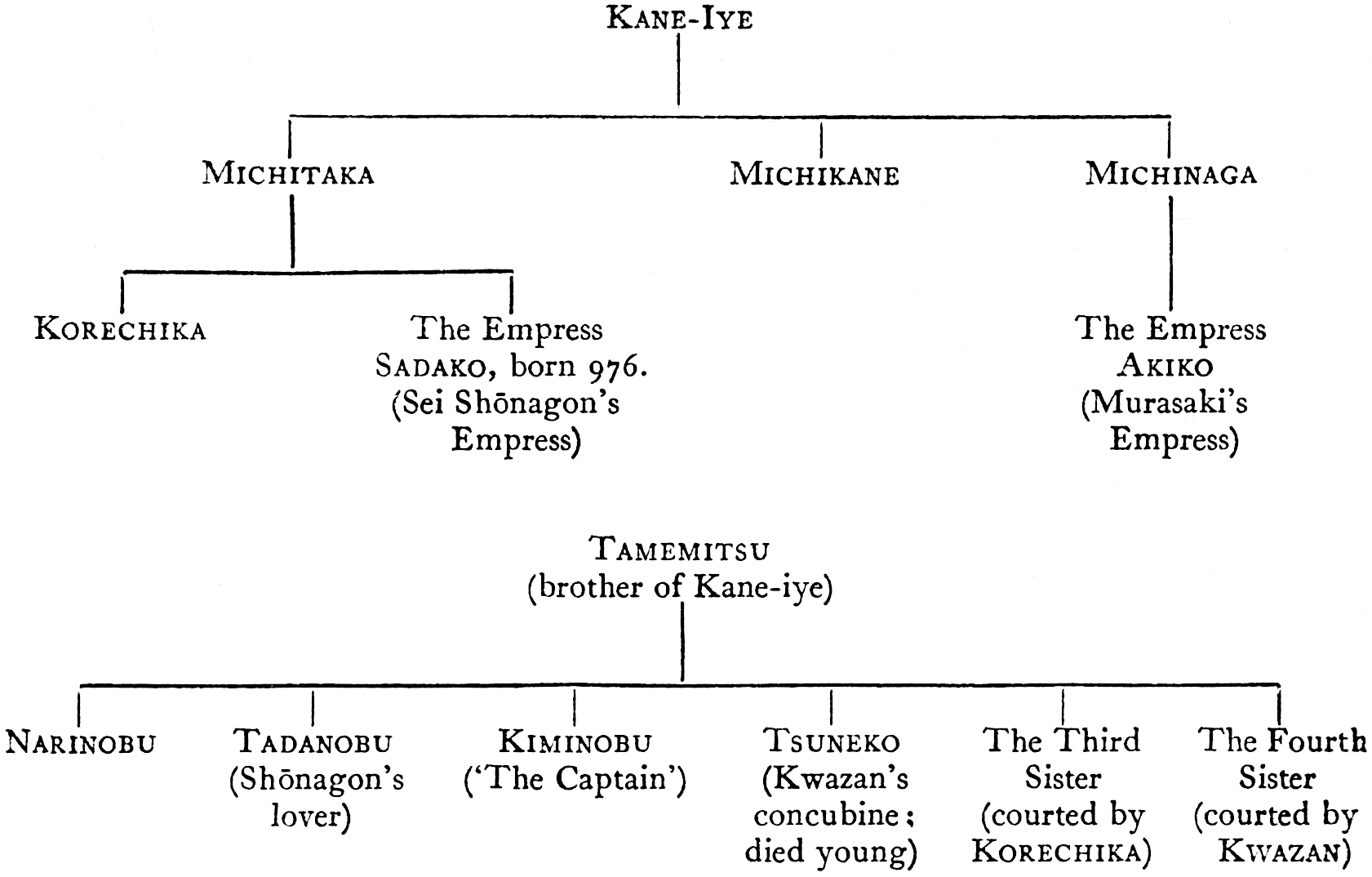
There was an elder sister (name unknown) who does not come into the story.
Michikane then led the Emperor to a monastery on the outskirts of the Capital, and stood by while he received the tonsure. When it came to his own turn he said he must first go back to the City and obtain his father’s consent.
Kwazan saw that he had been the victim of a plot and burst into tears. The step which he had taken was irrevocable; it only remained to make the best of it. Officially he was a monk in the Flower Mountain Temple; but it began to be rumoured that under another guise he was to be seen nightly in Kyōto. Kwazan abdicated in 986. In 995[28] it was said that he was secretly frequenting the palace of the late High Falconer Tamemitsu—the very house from which ‘the Captain’ (Fujiwara no Kiminobu) had come running down the highway in pursuit of Shōnagon’s carriage.
In the first month of 996, less than a year after his father’s death, Korechika gave his enemies the opportunity for which they had been waiting.[29] He had for some while been in love with one of Kiminobu’s sisters. He got it into his head that the ex-Emperor Kwazan was cutting him out. He stationed himself, along with his brother Taka-iye, outside Kiminobu’s palace, and when a muffled figure crept out in the darkness, shot at it with his bow. Kwazan was wounded in the leg, but managed to crawl back to his monastery. The story leaked out, and both brothers were accused of sacrilege against the Church and the Imperial Family. It was no very reputable specimen either of royalty or priesthood who had been thus assaulted; but popular feeling, as regards the sanctity both of the Throne and the Church, was at that time passionate, and amid universal reprobation Korechika was banished to Kyūshū, his brother to Izumo. The Empress Sadako seems to have shared to some extent in her brothers’ disgrace. In the third month of 996 she left the Court and moved into her own house, the ‘Small Palace in the Second Ward.’ There was, however, an adequate reason for this removal. She was going to have a baby, and pregnant women were not allowed to remain in the Palace.
Only when all these commotions were over did Korechika discover that Kwazan’s visits to the First Ward had been paid not, as rumour (which commonly makes light of such details) had informed him, to the Third Sister but to the Fourth, a lady in whom Korechika took no interest whatever.
The banishment of the young lords and the retirement from the Palace of the Empress Sadako were events which would in any case have moved Sei Shōnagon very deeply. It so happened, however, that she herself became unexpectedly involved. She had for years past carried on a desultory love-affair with Kiminobu’s brother, Tadanobu. He was naturally furious at the scandal of his sister’s connexion with the ex-Emperor becoming known, and openly sided with Korechika’s prosecutors. It is likely enough that on some occasion, at a time when everyone’s nerves were on edge, Shōnagon flared up on behalf of her lover.
In any case, she was regarded as being ‘on the other side,’ and after the Empress’s move to the Second Ward, was allowed to remain in miserable suspense at her brother’s house.
This went on for about four months. But in the autumn of 996 a certain captain of the Bodyguard of the Left told Shōnagon that he had been talking with some of the Empress’s women, and had gathered from their conversation that her Majesty would welcome Shōnagon’s return. ‘At any rate go and have a look,’ said the captain. ‘The peonies in front of the terrace give the place an amusingly Chinese air. I am sure you would be delighted by it.’ ‘No,’ she said, ‘I don’t like people thinking such things of me as they have thought.’
Shōnagon, however, relented, and soon afterwards we find her in the Small Palace. As I came from my room, she writes, I passed a group of ladies who were whispering together. I caught something about ‘being in with Michinaga’s party’; but when they saw me coming, they stopped talking, and edged away from me in so hostile a manner that I made up my mind I would not enter the Presence. This went on for several weeks, and though I was constantly asked to return, I would not do so; for I was sure that those about the Empress were all the while telling her I was on the other side, and every sort of other lie. For a long while her Majesty seemed completely to have forgotten me.
At last, Shōnagon tells us, a messenger arrived with a letter from the Small Palace. On opening it she found a single petal of the mountain-azalea, wrapped up in a sheet of paper. On the paper nothing was written, but on the petal were the words: ‘My love, long silent....’[30]
Then to Shōnagon in her excitement the strangest thing happened. When she sat down to write her reply she could not remember the first words of the poem to which she knew the Empress was alluding. Not to make some reference to these words would place her under a suspicion hardly less grave than that from which she seemed just to be emerging. To side with Michinaga was indiscreet; but to misunderstand a literary allusion was disgraceful. Fortunately a small boy who happened to be in the room heard Shōnagon fumbling for the elusive words and piped out: ‘Like a river that has dived....’
When I arrived, continues Shōnagon, describing her meeting with the Empress, I felt very nervous.... Her Majesty pretended not to know me and asked whether I was a new lady-in-waiting. Then turning to me she said: ‘It was a bad poem that I made use of. But for a long time I had been feeling that something of the kind must be said. I am wretched all the time, when you are not here.’ I could see at once that everything was right again. Presently I confessed that I had been in difficulties about the beginning of the poem, till a little boy told me how it went. She was very much amused. ‘That is just what happens,’ she said. ‘It is always those old tags that slip one’s memory. One grows careless about them....’
The banishment of the Empress’s brothers was not a very serious affair. Korechika paid a secret visit to the Capital in the late autumn of 996, and in the spring of 997 both brothers were officially recalled, in consequence of the general amnesty which celebrated the birth of the Empress Sadako’s child.
In the summer of that year Sadako and her ladies returned to the Emperor’s Palace, bringing with them the little princess Osako.
The following extract dates from 998:
While the western side-room was being got ready for the Continual Service, there were, of course, a lot of priests about, hanging up Buddhas and so on. Two days after this we heard a strange voice out on the veranda saying: ‘There’ll be some scraps left from the offerings, I suppose,’ and one of the priests replied that it was too early yet to say. We wondered who it could be, and looking out saw an old nun, wearing an extraordinarily grimy pair of hunting-trousers, very narrow and short, and something in the nature of a cloak, that hardly came more than five inches below her belt and was as dirty as the trousers—the sort of garment, indeed, that is put on to a performing monkey. ‘What is she saying?’ I asked, and the old woman herself in a strange, affected voice croaked that she was a disciple of Buddha. ‘I am only asking for the Lord Buddha’s leavings,’ she said. ‘But these monks are stingy and won’t give me any.’ Her voice was refined and her speech that of someone who had moved in good society. I could not help feeling very sorry that a gentlewoman should have sunk to so miserable a plight. I said I supposed she never ate anything but Buddha’s holy leavings, and said it was an edifying diet. She saw that I was laughing at her and cried out at once: ‘Not eat anything else! I don’t eat scraps from the altar, I can tell you, when I can get anything better!’ We then put some fruit and some broad-cakes into a basket and sent them out to her. When she was feeling thoroughly comforted inside, she became very talkative. The young girls teased her with questions, asking whether she had a lover, and where her house was. Her replies were very lively, not to say scurrilous. Someone asked her whether she could sing and dance, which set her off on a long ballad about ‘With whom shall I sleep to-night? With the sheriff of Hitachi will I sleep; for his skin is the best to touch.’ There was a great deal more of it. This was followed by ‘Many as the red leaves on the peak of Mount Otoko are the tongues that whisper my shame.’ While she was singing, she rolled her head from side to side in the most extraordinary manner. We were now all getting rather tired of her.... Some said we ought to give her a present before we drove her away. The Empress heard this. ‘I can’t think what possessed you to let her make such a painful exhibition of herself,’ her Majesty exclaimed. ‘Her singing was really more than I could endure. I was obliged to stop up my ears. Here, take this cloak and send her off with it as quickly as you can.’
‘Her Majesty sends you this cloak,’ we told her. ‘Your own is rather soiled; it would be nice if you were to put on something fresh.’ We tossed it to her, and she received it with a profound bow; then threw it across her shoulders and executed a sort of dance. But we could not stand her a moment longer, and went indoors.
After this she got into the habit of coming, and was always trying in one way or another to call attention to herself. We used to call her ‘the sheriff of Hitachi.’ She still wore the same filthy cloak, and we wondered how she had disposed of the one we gave her. She had, indeed, long ceased to amuse us when one day Ukon, the Emperor’s waiting-woman, came over to her Majesty’s apartments and the Empress began telling her that we had taken up with this extraordinary old creature, who was always coming to the Palace. Then she made Kohyōye do her imitation of ‘the sheriff of Hitachi.’ ‘Do show her to me one day,’ cried Ukon; ‘I long to see her. Don’t think I shall run off with her. I quite realize that she is your perquisite.’
However, soon after this another nun, crippled but very well-behaved and respectable, called us out on to the veranda and begged for assistance. She seemed so ashamed of having to beg, that we were sorry for her. When we gave her some clothes, she did indeed prostrate herself profoundly, but in how different a manner from the other! Just as she was going off, with tears of gratitude in her eyes, ‘Hitachi’ turned up. She saw her, and was so jealous that she did not come near us again for ever so long afterwards.
A great friend of Sei Shōnagon’s was Fujiwara no Yukinari, a first cousin of her chief lover, Tadanobu.
One day[31] when my lord Yukinari came to see us, he stayed for an immense while talking to someone outside. ‘Who was it?’ I asked, when he at last appeared. ‘Ben no Naishi’ (one of the Empress’s gentlewomen), he replied. ‘What can you have found to talk about with her, that took so long?’ I asked, very much surprised. ‘If the Clerk of the Grand Secretariat[32] had come along, you would soon have found yourself left in the lurch.’ ‘Now who, I should like to know, has told you about that business,’ he said, laughing. ‘As a matter of fact, that was what she was talking to me of just now. She was trying to persuade me not to tell anyone about it.’
Yukinari has no particular talents,[33] or indeed any characteristic likely to recommend him on a superficial acquaintance, and everyone else is content to take him as he seems. But I have had opportunities of seeing the deeper parts of his nature, and I know that he is far from being so ordinary as he appears. I have often said so to the Empress; and as a matter of fact, she knows it quite well herself.... But the young girls are always abusing him and openly repeating the most disagreeable stories about him. ‘What a wretched sight he is!’ they say. ‘And why can’t he recite the Scriptures and make poems like other people? He is really very tiresome.’
The truth is, these ladies do not interest him and he never addresses a word to them. He always says: ‘I wouldn’t mind if a woman’s eyes stood upright in her head, nor if her eyebrows spread all over her forehead and her nose were crooked, provided she had a good mouth and a fine chin and neck. A bad voice I couldn’t, of course, stand.’ ‘But come to think of it,’ he would add, ‘faces are rather important. It is unpleasant when people are ugly.’ This has added to the number of his enemies all ladies who believe themselves to have narrow chins or mouths that are lacking in charm, and it is they who have tried to prejudice her Majesty against him.
As it was I whom he first employed to carry messages to the Empress, he seems unable to communicate with her in any other way. If I am in my room he sends for me to the front of the house, or else comes right into our quarters. When I am not at the Palace but in my home, he follows me there and even if he has written a note[34] he brings it in himself, saying that if anything prevents my going back to Court immediately, he will be obliged if I will send a messenger to her Majesty ‘with instructions to report what he is now about to tell me,’ and so forth. It is useless for me to point out that there are plenty of people in the Palace who would gladly give a message. He rejects one after another. Once, with the best intentions, I suggested that it is often a good thing to act according to circumstances, instead of making for oneself these hard-and-fast rules. But he said it came natural to him to live according to rule, and ‘one can’t change one’s nature.’ ‘Don’t stand on ceremony,’ I answered. He did not see the allusion,[35] and laughing in a puzzled way, he said, ‘I am afraid there has been a good deal of talk lately about our being so friendly. Well, suppose we are! I don’t see anything to be ashamed of. I think, by this time, you might uncover your face, and so on.’ ‘I daren’t,’ I answered. ‘I have heard how particular you are about the shape of people’s chins, and mine is very ugly.’ ‘Is it really?’ he asked seriously; ‘I had no idea of that. Perhaps after all you had better not let me see you.’ After this I always covered my face on any occasion when he could possibly have seen me; but I noticed that he never looked my way, and it seemed clear that he had taken what I said about my own ugliness quite seriously.
One morning Shikibu no Omoto [one of the Empress’s ladies] and I lay in the side-room (where we had slept that night) till the sun was well up. Suddenly we heard someone sliding back the door that leads into the main building, and there before us stood the Emperor and Empress! We were so much surprised that we simply lay helpless, while their Majesties stood by, laughing immoderately at our confusion. Presently they came across and stood half hidden behind the pile of rugs and cloaks (for we had buried ourselves head and all under our bedding), to watch the people going to and fro between the Palace and the guard-room. Several courtiers (not, of course, having the least idea who was inside the room) came to the window and saluted us. The Emperor was much amused and begged me not to give him away.
When their Majesties went back to the main building, the Empress said, ‘Come along, both of you,’ intending us to go on duty that minute. ‘Do at least give us time to make up our faces!’ I answered, and we stayed where we were. Later on, when Shikibu and I were still talking about their Majesties’ visit, we became conscious of something swarthy which had suddenly loomed up close to the front door of our room, and was visible through a chink in our curtains, where one flap had got caught up upon the framework. We thought it was only Noritaka,[36] but on looking more closely we saw that the face was not the least like his.
With a good deal of laughing and scuffling, we began pulling the curtain back into its place; but before we had finished doing so, we realized that it was Yukinari who had been looking at us. This was very annoying, for I had made a point of his never seeing me. Shikibu was sitting with her back to him, so she came out of it all right. Stepping forward, he now said: ‘This time I have really managed to see you completely.’ ‘We thought it was only Noritaka,’[37] I explained, ‘and were careless. I must say that, for a person who is supposed to take no interest in women, you stared pretty hard.’ ‘Someone,’ he answered, ‘told me recently that there is a particular charm in women’s faces just at the moment they wake from sleep; so I came along here this morning hoping to get a chance of peeping into one of the bedrooms. I was already watching you when their Majesties were here, but you did not notice me.’ Presently he raised the curtains[38] and made as though to join us.
[The section which follows dates from 999, second month.]
When I was away from the Palace on holidays there were several Court gentlemen who used to come and visit us. This seemed to agitate the people of the house. I was, however, not at all sorry to see it put a stop to, for I had no very strong feeling about any of these visitors. But it was difficult without rudeness to be invariably ‘not at home’ to people who were calling repeatedly at all hours of the night and day; all the more so because, precisely with those whose visits were causing most scandal, my acquaintance was in reality very slight.
So this time I made up my mind not to let my whereabouts be generally known, but only to tell Tsunefusa,[39] Narimasa[40] and a few others.
To-day Norimitsu came, and told me in the course of conversation that yesterday my lord Tadanobu had tried to find out from him where I was, saying that as I was Norimitsu’s ‘sister’[41] he must surely know my address. ‘He was very insistent,’ Norimitsu said to me, ‘but I was determined not to give you away. He refused to believe that I didn’t know, and went on pressing me in a way that really made me feel very uncomfortable. Moreover, Tsunefusa was sitting near by, looking perfectly innocent and unconcerned, and I was certain that if I caught his eye I should inevitably burst out laughing. In the end I was obliged to choke my laughter by seizing upon an odd sort of cloth that was lying on the table and stuffing it into my mouth. Everyone must have thought me very greedy, and wondered what new delicacy I had found to devour between meals. But I managed all the same to avoid telling him anything. If I had laughed, it would of course have been fatal. In the end, he really thought I did not know. It was splendid...!’ I begged him to go on as he had begun, and for days afterwards heard no more about it.
But very late one night there was a tremendous banging on the front gate, enough to have woken a houseful of people at twice the distance. I sent someone to see what was the matter, and was told it was an Imperial Guardsman ‘with a letter from the Major of the Bodyguard of the Left,’ that is to say, from Norimitsu. Everyone in the house was in bed, so I took the letter close to the hall-lamp, and read: ‘To-morrow is the last day of the Spring Reading in the Palace. If Tadanobu is there keeping the penance-day with their Majesties, he may easily ask me where you are, and if (in front of everyone) he insists upon my telling him, I certainly shall not be able to keep up the pretense that I do not know. May I tell him you are here? I certainly won’t unless I have your permission to do so.’
I wrote no answer, but sent him a minute piece of cloth,[42] wrapped up in paper.
Next time he called, Norimitsu said: ‘He got me into a corner and went on at me about it all night. It is really very disagreeable to be pestered like that, and as you did not answer the letter in which I asked for your instructions.... But, by the way, I did receive a wrapper containing a piece of rag. No doubt in a moment of absent-mindedness....’
As if one could conceivably do such a thing by accident! He still could not in the least understand what I had meant, and evidently thought I had merely sent him a very mean and useless present. Irritated by his stupidity, I made no reply, but seizing the inkstand wrote on a scrap of paper the poem: ‘If from the fishing-girl who dives beneath the waves the present of a rag you have received, surely she hints that to the world you should not tell in what sea-bed she hides.’[43]
‘So Madam has started writing poems, has she?’ he exclaimed. ‘I, for one, shall not read them,’ and scrunching up the piece of paper, he marched off.
So it came about that Norimitsu and I, who had always been such good friends and allies, were for a while rather cool towards each other. Soon, however, he wrote to me saying: ‘I may have been to blame; but even if you don’t wish to see me, I hope you do not regard our old alliance as altogether a thing of the past. That, after all, would mean the breaking of a good many promises....’
It was a favourite saying of his that people never sent him poems so long as they liked him. ‘It’s a sure sign that they have turned against one,’ he used to say. ‘When you have made up your mind that you can bear me no longer, just send me one of those, and I shall know what to make of it.’
Despite this warning, Shōnagon sent him another acrostic poem. ‘I don’t suppose he ever read it,’ she continues, ‘and in any case he never answered. Soon afterwards he was promoted to the Fifth Rank and became Lieutenant-Governor of Tōtōmi; since when our friendship has come completely to an end....’
The following dates from about the same time:
A Court lady, when she is on holiday, needs to have both her parents alive.[44] She will get on best in a house where people are always going in and out, where there is a great deal of conversation always going on in the back rooms, and where at the gate there is a continual clatter of horsemen. Indeed, she would far rather have too much noise than too little.
It is very annoying if one is living in someone else’s house and a friend comes from Court, either openly or in secret, just to ask how long one will be away or to apologize for not having written (‘I did not even know you were on holiday ...’)—it is, as I say, extremely annoying, particularly if he is a lover, to have the owner of the house coming and making a scene (‘very dangerous ... at this time of night too,’ and more in the same style) merely because one has opened the front door for a moment, to let the visitor in. Then later on: ‘Is the big gate locked?’ To which the porter grunts in an injured tone: ‘There’s someone here still. Am I to lock him in?’ ‘Well, lock up directly he goes,’ says the landlord. ‘There have been a lot of burglaries round here lately.’ All of which is not very pleasant to overhear.
After this the master of the house is continually poking out his head to see whether the visitor is still there, to the great amusement of the footmen whom the guest has brought with him. Most alarming of all is to hear these footmen doing an imitation of the landlord’s voice. What a row there will be if he hears them!
It may happen that someone, who neither appears to be nor indeed is in any way a lover, finds it more convenient to come at night. In that case he will not feel inclined to put up with the churlishness of the family, and saying: ‘Well, it is rather late; and as it seems to be such a business for you to open the gate ...’ he will take his departure.
But if it is someone of whom the lady is really fond, and after she has told him again and again that she dare not receive him, he nevertheless goes on waiting outside her room till dawn; at which point the porter, who has during his nightly rounds continually lingered regretfully by the gate, exclaims in a tone intended to be heard: ‘The morning’s come’ (as though such a thing had never happened before!) ‘and that front gate has been ——[45] open all night,’ whereupon in broad daylight, when there is no longer any point in doing so, he locks the gate—all that sort of thing is very trying.
As I have said, with real parents of one’s own, it would be all right. But step-parents can be a nuisance. One is always wondering how they will take things; and even a brother’s house can be very tiresome in this way.
Of course, what I really like is a house where there is no fuss about the front gate, and no one particularly minds whether it is midnight or morning. Then one can go out[46] and talk to whoever it may be—perhaps one of the princes, or of the lords attached to his Majesty’s service—sit all through a winter’s night with the shutters open, and after the guest has gone, watch him make his way into the distance. If he leaves just at daybreak, this is very agreeable, particularly if he plays upon his flute as he goes. Then, when he is out of sight, one does not hurry to go to bed, but discusses the visitor with someone, reviews the poems he made, and so gradually falls to sleep.
‘I saw someone, who had no business here, in the corridor early this morning. There was a servant holding an umbrella over him. He was just going away....’ So I heard one of the girls say, and suddenly realized that it was to a visitor of mine that she was referring!
However, I really didn’t know why she should describe him as ‘having no business here.’ As a matter of fact, he is only a chige,[47] a person of quite comfortable eminence, whom I have every right to know, if I choose.
Presently a letter came from the Empress, with a message that I was to reply instantly. Opening it in great agitation, I saw a drawing of a huge umbrella; the person holding it was entirely hidden, save for the fingers of one hand. Underneath was written the quotation: ‘Since the morning when dawn broke behind the fringe of the Mikasa[48] Hills....’
The whole affair was a trivial one, but her Majesty might easily have been cross about it, and when the letter came I was actually hoping that no one would mention the matter to her. And now, instead of a scolding, came only this joke, which, though it humiliated me, was really very amusing. I took another piece of paper and drawing upon it the picture of a heavy rainstorm, I wrote underneath: ‘It is a case of much cry and no rain.’
Masahiro
Everyone laughs at Masahiro.[49] It must really be very painful for his parents and friends. If he is seen anywhere with at all a decent-looking servant in attendance upon him, someone is sure to send for the fellow and ask him whether he can be in his senses, to wait upon such a master. Everything at his house is extremely well done and he chooses his clothes with unusually good taste; but the only result is to make people say: ‘How nice those things would look on anyone else!’
It is true that he does sometimes talk in the most peculiar way. For example, he was sending home some things he had been using when on duty at the Palace and he called for two messengers. One came, saying that there was not more there than one man could easily carry. ‘You idiot,’ said Masahiro, ‘I asked for two messengers because there is someone else’s things here as well as my own. You can’t ask one man to carry two men’s stuff, any more than you can put two pints into a one-pint pot.’ What he meant no one knew; but there was loud laughter.
Once someone brought him a letter, asking for an immediate reply. ‘What a moment to choose!’ Masahiro cried. ‘I can hear beans crackling on the stove. And why is there never either ink or brushes in this house? Someone must steal them. If it were something to eat or drink that got stolen, I could understand....’
When the Emperor’s mother, Princess Senshi, was ill, Masahiro was sent from the Palace to inquire after her. When he came back, we asked him what gentleman had been in waiting upon the Princess. ‘So-and-so and so-and-so,’ he said, mentioning four or five names. ‘No one else?’ we said. ‘Oh yes,’ answered Masahiro, ‘there were others there, only they had gone away.’
Once when I happened to be alone he came up to me and said: ‘My dear lady, I have something I must tell you about at once.’ ‘Well, what is it?’ I asked. ‘Something,’ he said, ‘that I have just heard one of the gentlemen say.’ And coming quite close to my curtain: ‘I overheard someone who instead of saying “Bring your body up closer to mine,” said “Bring your five limbs[50] ...” and he went off into fits of laughter.
Once on the second of the three Appointment nights[51] it fell to Masahiro to go round oiling the lamps. He rested his foot on the pedestal of a lamp-stand, and as it happened to have been recently covered with yutan[52] and was not yet dry, it stuck to him, and as soon as he started to move away the lamp-stand toppled over. So fast was the framework stuck to his stockinged foot, that the lamp banged along after him as he walked, causing a regular earthquake at each step.
The Palace roll-call[53] has a special charm. Those who are actually waiting upon his Majesty do not have to attend it, but are checked off on the spot by officers who come from seat to seat. But the rest all come clattering out into the courtyard, pell-mell. In our quarters,[54] if one goes to that side and listens hard, one can actually hear the names, which must have caused a flutter in many a susceptible breast.... Some by their manner of answering win great approval, while on others very severe judgments are passed. When it is all over, the watchmen twang their bows, and there is another great clatter of shoes, among which is discernible the even heavier tread of the Chamberlain who is advancing to take up his position at the north-east corner of the balcony, where he kneels in the attitude called the High Obeisance, facing the Emperor’s seat, while with his back to the watchmen he asks them who was there.... Sometimes, if for one reason or another a good many courtiers are absent, no roll-call is held, and when the head-watchman reports this, the Chamberlain generally asks him to explain the reason why there was no roll-call, and then retires. But when Masahiro is on duty he does not listen to what he is told, and if the young lords try to teach him his duties, flies into a temper, lectures them on the impropriety of omitting a roll-call, and is laughed at for his pains not only by these lords, but by the very watchmen whom he is rebuking.
On one occasion Masahiro left his shoes on the sideboard in the Royal pantry. Everyone who passed broke into exclamations of disgust and called upon the owner of the filthy things to take them away at once. It was very awkward, for though no one dared mention Masahiro’s name, everyone knew they were his. ‘Who do these things belong to? I haven’t the least idea,’ said the Chief Steward or someone of that kind. Suddenly Masahiro appeared, saying: ‘Those dirty things are mine!’ The fact that he had the face to come for them in person caused a fresh sensation.
Once when neither of the chamberlains was on duty and there was no one near the High Table, Masahiro took a dish of beans that was lying there and hiding behind the small partition,[55] began stealthily devouring them. Presently some courtiers came along and pulled away the partition....
I have a great objection to gentlemen coming to the rooms of us ladies-in-waiting and eating there. Some gentlewomen have a tiresome habit of giving them food. Of course, if he is teased long enough and told that nothing can happen till he has eaten, a man will in the end give way. He cannot very well express disgust at what he is offered, cover up his mouth, or turn his head the other way. But for my part, even if they come very late and very drunk, I absolutely refuse to give them even so much as a bowl of rice. If they think this is mean, and don’t come again—well then, let them not come!
Of course, if one is at home and food is sent from the back room, one cannot interfere. But it is just as unpleasant.
Elsewhere Shōnagon says:
The things that workmen eat are most extraordinary. When the roof of the eastern wing was being mended, there were a whole lot of workmen sitting in a row and having dinner. I went across to that side of the house and watched. The moment the things were handed to them, they gulped down the gravy, and then, putting their bowls aside, ate up all the vegetables. I began to think that they were going to leave their rice, when suddenly they fell upon it and in a twinkling it had all disappeared. There were several of them sitting there together and they all ate in the same way; so I suppose it is a habit of builders. I can’t say I think that it is a very attractive one.
Another of Shōnagon’s butts was Fujiwara no Nobutsune, Assistant in the Board of Rites.
‘I am very ready at making Chinese poems or Japanese,’ he said to her one day,[56] ‘you need only give me a subject....’ ‘That is easily done,’ I said. ‘It shall be a Japanese poem.’ ‘Good,’ he cried. ‘But you had better give me a whole lot, while you are about it. One would hardly be worth while.’ But when I gave him the subject, he suddenly lost his nerve and said he must be going. Someone told us it was his handwriting that he was uneasy about. ‘He writes an atrocious hand in Chinese and Japanese,’ this lady said, ‘and he has been laughed at about it so much that he is apt to take fright.’
In the days[57] when he had an appointment in the Board of Household Works, he sent a plan to some craftsman or other with ‘This is the way I want it done’ written underneath in Chinese characters of a sort one would never have supposed anyone in the world could perpetrate. The document was such a monstrosity that I seized it and wrote in the margin ‘I should not do it quite in this way, or you will indeed produce a queer object.’ The document then went to the Imperial apartments, where it was passed from hand to hand, causing a good deal of amusement.
Nobutsune was very angry about this.
Annoying Things
When one sends a poem or a kayeshi (‘return-poem’) to someone and, after it has gone, thinks of some small alteration—perhaps only a couple of letters—that would have improved it.
When one is doing a piece of needlework in a hurry, and thinking it is finished unthreads the needle, only to discover that the knot at the beginning has slipped and the whole thing come undone. It is also very annoying to find that one has sewn back to front.
Once when her Majesty was staying at my Lord the Prime Minister’s house,[58] and she was with him in the western wing, to which he had retired in order to make room for her, we gentlewomen found ourselves herded together in the central building with very little to occupy us. We were romping and idling in the corridors, when someone came from the Empress, saying: ‘This dress is wanted in a hurry. Please get together and do it immediately. Her Majesty wants it back within the hour.’[59] What we were to make up was a piece of plain, undamasked silk.[60] We all collected along the front of the main hall, the work was given out piecemeal, and there was a wild race to see who could get her bit finished first. It was a maddening business, for one was not near enough to some of the others to see what they were doing.
Nurse Myōbu got hers done in no time, and laid it down in front of her. She had been told to sew the shoulders of the bodice, but had carelessly put the stuff inside out and without finishing off the work in any way had just slammed it down and gone off to amuse herself. When we came to put the dress together, the back seams did not fit properly, and it was clear there had been some mistake. There was a great deal of laughing and scolding. It was clearly Myōbu’s fault and everyone said she must do her seam over again.
‘I should first like to know who has sewn anything wrong,’ she burst out. ‘If anyone had sewn a piece of damask inside out, so that the pattern was wrong, of course she would have to do it again. But with plain silk, what difference can it make? If anyone has got to do it all over again, I should think it had better be one of the girls who did not do her share the first time.’ ‘How can anyone have the face to suggest such a thing?’ the others cried. But Myōbu could not be prevailed upon, and in the end Gen Shōnagon and some others were obliged to unpick the stitches and put the thing right. It was amusing to watch the expression on their faces while they did so.
This all happened because her Majesty was to wait upon the Emperor at dusk and wanted the dress to be ready in time. ‘I shall know that the one who gets her work done quickest really loves me,’ she had said.
It is particularly annoying if a letter goes astray and gets delivered to someone to whom one would never have dreamt of showing it. If the messenger would simply say straight out that he has made a mistake, one could put up with it. But he always begins arguing and trying to prove that he only did as he was told. It is this that is so trying, and if there was not always someone looking on, I am sure I should rush at him and strike him.
To plant a nice hagi[61] or susuki[62] and then find someone with a long-box and gardening tools who has dug them up and is carrying them away—is a painful and annoying experience. The provoking part of it is that if a male even of the humblest description were on the spot, the wretch would never dare to do so. When one stops him and expostulates, he pretends he has only thinned them out a bit, and hurries off. I really cannot tell you how annoying it is.
One is staying with a provincial Governor or some small official of that kind, and a servant comes from some grand house. He speaks and behaves with the utmost rudeness and an air as much as to say ‘I know I am being rude; but people like you can’t punish me for it, so what do I care?’ I find that very annoying.
A man picks up a letter that one does not want him to see and takes it with him into the courtyard, where he stands reading it. At the first moment one rushes after him in rage and desperation; but at the curtains one is obliged to stop, and while one watches him reading one can hardly prevent oneself from swooping down upon him and snatching it away.
A lady is out of humour about some trifle, and leaving her lover’s side goes and establishes herself on another couch. He creeps over to her and tries to bring her back, but she is still cross, and he, feeling that this time she has really gone too far, says: ‘As you please,’ and returns to the big bed, where he ensconces himself comfortably and goes to sleep. It is a very cold night and the lady, having only an unlined wrap to cover herself with, soon begins to suffer. She thinks of getting up; but everyone else in the house is asleep and she does not know what to do or where to go. If she must needs have this quarrel, it would have been better, she thinks, to start it a little earlier in the evening. Then she begins to hear strange noises both in the women’s quarters and outside. She becomes frightened and softly creeps towards her lover, plucks at the bedclothes, and raises them. But he vexingly pretends to be fast asleep; or merely says: ‘I advise you to go on sulking a little longer.’
Small children and babies ought to be fat. So ought provincial governors, or one suspects them of being bad-tempered. As regards appearance, it is most essential of all that the boys who feed the carriage-oxen should be presentable. If one’s other servants are not fit to be seen, they can be stowed away behind the carriage. But outriders or the like, who are bound to catch the eye, make a painful impression if they are not perfectly trim. However, if it is too obvious that one’s menservants have been lumped together behind the carriage in order to escape notice, this in itself looks very bad.
It is a mistake to choose slim, elegant youths on purpose that they may look well as footmen, and then let them wear trousers that are grimy at the ends and hunting-cloaks or the like that have seen too much wear. The best that can be hoped is that people will think they are walking beside your carriage by chance and have nothing to do with you.
But it is a great convenience that all one’s servants should be handsome. Then if they should happen to tear their clothes or make themselves in any way shabby or untidy, it is more likely to be overlooked.
Officers of State, who have official attendants allotted to them, sometimes spoil the effect by allowing their page-boys to go about dirty and ill-kempt.
Whether a gentleman is at home or on an official mission or staying with friends he ought always to have round him quantities of handsome page-boys.
For secret meetings summer is best. It is true that the nights are terribly short and it begins to grow light before one has had a wink of sleep. But it is delightful to have all the shutters open, so that the cool air comes in and one can see into the garden. At last comes the time of parting, and just as the lovers are trying to finish off all the small things that remain to be said, they are suddenly startled by a loud noise just outside the window. For a moment they make certain they are betrayed; but it turns out only to be a crow that cried as it flew past.
But it is pleasant, too, on very cold nights to lie with one’s lover, buried under a great pile of bed-clothes. Noises such as the tolling of a bell sound so strange. It seems as though they came up from the bottom of a deep pit. Strange, too, is the first cry of the birds, sounding so muffled and distant that one feels sure their beaks are still tucked under their wings. Then each fresh note gets shriller and nearer.
Very Tiresome Things
When a poem of one’s own, that one has allowed someone else to use as his, is singled out for praise.
Someone who is going a long journey wants introductions to people in the various places through which he will pass, and asks you for a letter. You write a really nice letter of recommendation for him to present to one of your friends who lives at some place through which he will pass. But your friend is cross at being bothered and ignores the letter. To be thus shown up as having no influence is very humiliating.