Chapter VI
Reading edition
Coming back now, to a consideration of the course and functions of the counter-trade after it leaves the northern limit of the surface-trades, we find it curves to the eastward and gradually assumes about an E. N. E. course, and becomes a W. S. W. current where it crosses the line of no variation, and continues on until it passes off over the Atlantic; and this course and curve is analogous to what may be found true of the counter-trades every where. It is best illustrated by the course of all the storms (in the American sense of the word, as distinguished from thunder showers and other brief rains), which have been traced north or south of the limits of the trades. It was found by Mr. Redfield in most of the storms investigated by him, which originated within, or north of the tropics.
Doubtless it was the actual course of the others, and that the investigation was imperfect. All the great autumnal, winter, or spring storms which have traversed the whole or any considerable portion of the territory of the United States, east of New Mexico, which have been investigated by Professors Espy, Loomis, Redfield, or others, have been found to follow this course. A storm which passed over Madeira, appears from the investigations of Colonel Reid to have followed the same law of curvature.
And so, doubtless, did another which he has described as passing over the Levant. The storms which supply the winter rains of California and Utah, reach them by this law of curvature and progress, after the northern limits of the trades have descended to the south with the sun, so that the counter-trades of the Pacific may descend to the surface and curve in upon them. But the absence of a concentration of the counter-trade, and its deficient action because of its passage over mountain ranges, and their location so near the northern limit of the trades that their storms can not expand and become extensive, as well as their weaker magnetic intensity, prevent their storms from becoming violent, and their supply of rain is not large and much of it falls in showers. The same is true of the Barbary States, of Syria, and Persia, and of Southern Europe; and indeed of all the countries of the globe which lie between the winter and summer extreme limits of the surface-trades, and without the limits of the two concentrated counter-trades. Enough appears in the writings of the meteorologists of Europe to show, that their long continued rains, which are analogous to our storms and are preceded by the formation of the true cirrus of the counter-trade, follow the same great law of curvature and progress; although the presence of the Gulf Stream with its mass of south polar waters on the western side of the British Islands, Denmark, and Norway supplies them with showers, and fogs, and cumuli from the west and north-west, and makes the mean of the surface winds of their storms somewhat variant from ours. A like law reversed prevails in the southern hemisphere. The storms of New Holland and the Indian Ocean, south of the limits of the trade, curve to the eastward and travel about south-east, their south-west being a clearing off wind as our north-west is, and precisely similar in all its other characteristics, where the relation of magnetic intensity is the same.
The storms of the Pacific on the S. W. coast of South America, in like manner travel to the S. E., flooding the western slopes of the mountain ranges with rain, and aggravated by the intensity of the magnetic currents at the extremity of the continent in a high latitude, meet the mariner in the face as he emerges from under the lee of the land and attempts to pass the Horn. It will ultimately be shown that the precipitation which takes place, as the storms and counter-trades pass north and east in the northern hemisphere and south and east in the southern hemisphere, is owing less to cold than increased magnetic intensity. And all this is the result of one great uniform law, existing every where, varying in its phenomena only in consequence of the difference in volume, and magneto-electric intensity of the portions of the counter-trade, as of the surface-trade at different places, and the different magnetic intensity of the local perpendicular and circular currents of the earth over which they pass, at different periods and at different points.
Mr. Redfield and Lieutenant Maury have assumed that our S. W. current comes from the Pacific Ocean. Aside from the adverse evidence which the investigations of the former in relation to the course of the West Indian storms, and their curving over the continent, furnish to the contrary, and that which has herein before been stated in relation to the law of curvature, it is obvious they are mistaken, for another and conclusive reason.
In order to reach us from the Pacific in a direction from S. W. to N. E., it must pass the table lands and mountain ranges of Mexico and New Mexico, and it would supply them bountifully, even if it did not thereby leave us comparatively rainless and sterile. Every where currents passing from the ocean over mountain ranges part with a large share of their moisture. Thus the counter-trade which curves over the Andes and over Peru, is deprived of its moisture and leaves the western coast rainless. So in degree of the counter-trade which curves over the Himalaya and Kuenlon Mountains, and from there passes over the Desert of Cobi, to the north and east—it is deprived by those elevated ranges of its moisture. So the mountains on the south-western coast of South America are drenched with rain, while Patagonia, which lies on the east of them is comparatively dry. And so of every other country similarly situated.
Now the mountain ranges and table lands of Mexico are not thus supplied with moisture. For the space of four months in Southern and less in Northern Mexico, and in summer, and while the belt of the tropics is extended up over them, they have rain and in daily showers which travel up from the south, indicating the course of the counter-trade. (See Bartlett’s Personal Narrative, vol. ii. p. 286.) At other seasons, and while we are bountifully supplied, they are dry. In short, there are no two portions of the earth that differ more widely in regard to their supply of moisture, and all their climatic characteristics and relations. It is therefore, according to all analogy, impossible that our counter-trade should come from the South Pacific across the continent and below 35°, and in this also those gentlemen are mistaken.
Messrs. Espy and Redfield recognizing the existence of “a prevailing” S. W. current, but considering the surface-winds beneath it as the principal actors in producing the atmospherical conditions and changes, have attributed no office to that current, except that of giving direction and progression to our storms. This is their great mistake. It plays no such unimportant part in the philosophy of the weather, as we have already incidentally seen, and will proceed still further to consider.
All our storms originate in it. This we may know from analogy.
Where there is no counter-trade, outside of the equatorial belt of rains, and within influential distance of the earth, there are neither storms nor rain. So, when, as we have seen, the concentration of the volume of northern counter-trade in the West Indies, gathered by the hauling of the S. E. trades more from the east, as they approach the central belt, diminishing the volume of the counter-trade over the North Atlantic, the calms and drought of the horse-latitudes are found. And when the counter-trade is small in volume and weak in intensity, by reason of the fact that the surface-trades from the opposite hemisphere which constitute it, formed upon land where evaporation was small, as upon Southern Africa and New Holland, or formed where the magnetic intensity was weak, or passed over mountain ranges in their course, the annual supply of rain, the ranges of the barometer, and the alternations of atmospheres conditions are remarkably less.
We have already seen where the rainless portions of the earth are, and why they are so; because those lying north of the northern limit of the equatorial rainy belt were yet too far south to be covered by the line of extra-tropical rains; or in other words, too far south to be uncovered by the surface N. E. trades and the longitudinal magnetic currents, and to be covered by the counter-trades in contact, or nearly so with the earth, and influenced by the perpendicular north polar magnetic currents. Thus we have seen that the rains of Southern Mexico were summer rains, due to the northern extension of the equatorial rainy belt; those of California were winter rains, due to the southern extension of the extra-tropical rains following the N. E. surface trades. We have also briefly alluded to the fact that either side of the equatorial rainy belt, evaporation is going on for months under a vertical sun, without precipitation—unless it be from an occasional brief storm of great intensity which originates in that belt at the line of it, and passing on in the counter-trade, reverses, for the time being, by its concentrated and powerful action, like a magnetic body introduced into the field of another magnet, the surface-trades. Mere evaporation then, does not produce the storm, or shower, or rain, where most active in the dry torrid zone. It may be said that those dry portions are, for the time being (as the rainless portions of the earth are continually), within the operation of the surface-trades, and that therefore the evaporated moisture is carried away by them toward the equatorial rainy belt. Precisely so; but why carried away? Why should it not condense, occasionally, at least, and drop the rain as it passes along, if a great supply of moisture from excessive evaporation could furnish rain. Perhaps it may still be said it is going from a cold to a warm section. This is not true, as we have shown.
But, it may be said that the rainless regions at any rate receive no moisture, and therefore can not supply any by evaporation. This would not meet the case, as it would still be true that when the rainy belt has left a given spot, the dry weather sets in with excessive evaporation, and the north-east trades in summer, blowing from the countries lying north of the rainless regions, and which have been supplied during the interval by the extra-tropical rains, and are loaded with evaporation, are passing over the rainless regions on their way to enter the central belt. So blow the N. E. trades from the Mediterranean, and the Barbary States over the Desert of Sahara and into the rainy belt south of it; but drop no moisture on their way, because exposed to no magnetic currents of an opposite polarity.
But it is not true that all the rainless regions are without evaporation. Egypt is an exception. The annual freshets of the Nile saturate its central valley, and vast reservoirs of water are saved from it and let out over its surface, and it all evaporates, but produces no rain. And so are large quantities turned aside and scattered over the bottom lands of Northern Mexico, and other countries, during the dry season, and their evaporation furnishes no rain. Hygrometers and dew points are of no consequence there—nor are they of any, on either side of the rainy belt, where six perpendicular feet of moisture is evaporated in six months.
Again we have alluded to a strip of coast on the Pacific west of the mountain ranges of South America, lying partly in Peru, partly in Bolivia, and partly in Northern Chili, which, although long and narrow, washed by the broad Pacific Ocean, is without rain. South America has no other wholly rainless region, so far as is known. A part of this region would lie between the equatorial belt of rain, and the southern extra-tropical one, and never be covered by either; but the volume of N. E. trades from the Atlantic, although from the make of the land not concentrated to so great an extent as the volume of S. E. trade on the north, and therefore not so liable to hurricanes and other violent storms, is yet sufficiently so to carry the southern line of the equinoctial rainy belt down in winter to the summer line of extra-tropical rains, and give a supply of rain to all the continent—leaving no strictly rainless region south of the equatorial rainy belt and east of the Andes. Those mountains, however, present a barrier to its south-western progress which it doubtless passes to some extent, but deprived of its moisture, and unable to supply the rainless coast region of Peru, Bolivia, and Northern Chili. There is, therefore, a portion of this rainless line of coast which is within the region of extra-tropical rains, over which a portion of the N. E. trades of the Atlantic, as a counter-trade, should or do, curve, and where there should therefore be extra-tropical rains. It is washed by the Pacific, an evaporating surface, and westerly and south-west breezes are drawn in from that ocean over it. Why then is it rainless? The only reason which can be assigned why rain does not fall there is that the high mountain ranges of the Andes intercept and perhaps in part divert the counter-trade, and deprive that portion of it which passes them, of its moisture, by that reciprocal action of opposite polarities which takes place whenever and wherever the trade approaches so near the earth; and it curves over the narrow line of coast with the feeble condensation, and imperfect forms, and varied coloring which mark so peculiarly the rainless clouds of that region. (See Stewart’s Journal of a Voyage to the Sandwich Islands, page 72.)
Again, it is estimated, and on reliable data, that twelve perpendicular feet of water are annually evaporated from the surface of the Red Sea, between Nubia on one side, and Arabia on the other; yet they are both rainless countries, except so far as the inter-tropical belt of rains extends up on to a small portion of them. The moisture of evaporation, floated up from a surface covered by the surface-trade is invariably so combined as to remain uncondensed till it has passed south into the equatorial rainy belt, and over to the opposite hemisphere, and been exposed to the currents of an opposite magnetism.
Again, the N. E. trades extended up in summer over the Mediterranean Sea, an evaporating surface, blow over the Barbary States in June and July, but furnish no rain. And so of the S. E. or N. E. trades which blow over Brazil and other countries in the absence north or south of the tropical belt of rains.
It is obvious from these facts—and more like them might be cited—that mere evaporation, however copious or long continued, does not make the storm or shower in the locality where it takes place, and without the existence and influential agency of a counter-trade; and that reciprocal action, whatever it may be, that takes place between it and the earth.
Again, our own experience is conclusive of this. We have no surface-trade north of 30°, and yet a long drought and great evaporation may follow a wet spring. Belts of droughts and frequent rains occur every year in different portions of the country side by side, and the dividing line follows the course of the counter-trade, and is sometimes distinctly marked for weeks. When a change occurs in the counter-trade, whether from causes existing there or the influence of terrestrial magnetism (in relation to which we shall inquire hereafter), showers form or storms come on: until it does they will not. Efforts at condensation will occasionally appear, but they will be feeble and ineffectual, and occasion a repetition of the axiom that “all signs fail in a drought.” And we may know it from direct observation.
The first indications of a storm, and of most if not all showers, are observable in the counter-trade. These indications, so far as they are visible, are of course to be looked for in the west; although the direction and character of the surface-winds are often indicative of these changes when not visible at the west as we shall see.
The indications are those of condensation, and vary very much in different seasons of the year. It is not my purpose in this place to examine them particularly. They will be alluded to hereafter under the head of prognostics. Suffice it now to say, then, that whether it be the long threads or lines of cirrus which occur in the trade in the winter after a period of severe cold, following the interposition of a large volume of N. W. cold air and the elevation of the counter-trade; or the forms of cirrus which occur at other times and other seasons; or whether it be the ordinary bank at night-fall, or the evening condensation which makes the “circle” around the moon, or the morning cirro-stratus haze which gradually thickens, passes over and obscures the sun, all which may be followed by the easterly scud and winds: they are alike condensation in the trade, the advance or forming condensation of a storm or showers.
The state of the weather, whether hot or cold, is extensively affected by this trade current. As we have already suggested, the mere presence of the sun in its summer solstice, or its absence in winter, is not an adequate cause of all the sudden and various changes to which we are subject. The state of the counter-trade, which is always over, or within influential distance of us, and sometimes probably in contact with us—the nature of the surface-winds which it is at any given time creating and attracting around us, and the electric condition of the surface-atmosphere induced by it, or by the immediate action of the earth’s magnetism, produce those sudden changes which mark our climate. When no intervening surface-winds elevate it above us, and there is no storm or other condensation within influential distance, it induces the gentle balmy S. W. wind of spring—the cooling S. W. wind of summer—the peculiar Indian summer air of autumn, or the comparatively moderate, although cold, open weather of winter. If there be a partial tendency to condensation in it, the cumuli form under the magnetic influence excited by the sunbeams from ten to three o’clock in the day, and float gently away to the eastward, disappearing before night-fall. If the disposition to condensation is stronger, whether inherent or induced by an increased local activity of terrestrial magnetism, these cumuli will increase toward night-fall, or earlier, and terminate me showers; and if it is in a highly electrical state, the still oppressive sultriness which precedes the tornado, and that devastating scourge may appear. If this disposition to condensation becomes extensive, cirri form and run into cirro-stratus, or they extend, coalesce, and form stratus; the surface-wind will be attracted under them, the thermometer fall in summer or rise in winter, and a storm begin. Intense action and sudden cold may exist in and under this counter-trade over the southern portion of the country, while all is calm, warm, and balmy at the north. Heavy snow storms sometimes pass at the south when there are none at the north, and a corresponding state of the weather follows. If a large body of snow fall at the north, the winter is cold, regular, and “old fashioned;” if little snow falls at the north and more at the south, the winter at the north is open and broken. I have known the ice make several inches thick at Baltimore and Washington, when none could be obtained for the ice-houses on the Connecticut shore of Long Island Sound. In short, although heat and cold are mainly dependent upon the altitude of the sun, aided by the other arrangements we have alluded to, yet the counter-trade, and the reciprocal action which takes place between it and the earth, are most powerful agents, mitigating the rigors of winter, bringing about the changes from cold to warm weather which the sun is too far south to produce. And on the other hand, by this reciprocal action, producing the electrical phenomena, the gusts, the tornadoes, the hail storms, and the cool seasons of summer, and the period of intense cold in winter.
All our surface-winds, except the light, peculiar W. S. W. wind which is felt where the counter-trade is in contact with the earth, and which is a part of it, and perhaps the genuine N. W. wind which is very peculiar, are incidents of the trade, and are due to its conditions and attractions. We have already said this was true of the easterly wind and scud of a storm—it is alike true of all. The storm winds east of the Alleghanies are usually, though not always, from the eastward. They are sometimes from the southward, as they doubtless are still more frequently in the interior of the continent.
There is occasionally a southerly afternoon wind, followed by short rains in spring and fall, or a succession of showers in summer, which is rather a precedent wind than a storm wind; blowing toward and under an advance portion of the storm at the north, and hauling to the eastward when the rain sets in, or to the westward when the showers reach us.
When there are no storms, or showers, or inducing electric action in the counter-trade, within influential distance to disturb the surface atmosphere, it is calm. If a storm approaches, or forms within inducing distance, the surface atmosphere is affected and attracted toward the storm, from one or more points, and “blows,” as we say, toward and under it. It commences blowing first nearest the storm, and extends as the storm travels, or becomes more intense and extends its inducing influence. I have repeatedly noticed this in traveling on steamboats and railroads running toward or from, and in several instances through a storm, and telegraphic notices and other investigations prove it. The point from which the surface atmosphere is attracted and blows, depends very much upon the position of the storm in relation to bodies of water and the point of observation, and its shape; and the force with which it may blow will depend much upon its intensity.
Let us take an instance or two by way of illustration of all these points; and as I have given instances of summer in the introduction, we will take those of winter. It is January of an “old fashioned winter;” the snow is about three feet deep in Canada, about one foot in Southern New York, and a few inches in Philadelphia, and so extends west to the Alleghanies at least. For several days the sky has been clear, the thermometer rising in the day-time, in the vicinity of New York to about 25° Fahrenheit, falling at night to about 6°, with light airs from the N. W. during the middle and latter part of the day; the counter-trade and the barometer both running high; cold but pleasant, steady, winter weather. There is a warm south-east rain and thaw coming, as one or more such almost invariably occur in January. How coming? The sun is far south, and shines aslant, but through a pure and windless atmosphere; he has tried for several days to melt the snow from the roof; a few icicles are pendant from the eaves; but the body of the snow is still there. How can a thaw come? not from the sun, surely. No, indeed, not from the action of the sun directly, upon our country, nor from the Atlantic or the Gulf Stream which is off our coast. But a portion of the current of counter-trade is coming, heated by his rays and the warm water in the South Atlantic, in an intense magneto-electric state, capable of inducing an electro-thermal change in the surface atmosphere which it approaches, and of being reciprocally acted upon by the north polar terrestrial magnetism. It is now over Northern Texas and Western Louisiana, it will be here day after tomorrow. The day passes as the day previous had passed; the sleigh-bells jingle merrily in the evening; the moon shines clear all night; the storm is coming steadily on, but its influence has not reached us, and the morning and midday are like those which preceded it. As nightfall approaches, however, the thermometer does not fall as rapidly as on the day previous; the sun shines dimly and through lines of whitish cirrus cloud extending from the horizon at the west, appearing darker as the sun descends and shines more horizontally through them—perhaps mainly in the N. W.—and which extend up and over toward the E. N. E. The air next the earth begins to feel raw; it is changing, not from warm to cold, but electrically from positive to negative; and dampening, from a tendency to condensation by induction, as we shall see—the same condensation which in warm weather may be seen on flagging stones, and walls, and vessels containing cold water. The advance cirrus condensation of the storm is over us and affecting us; the earth too is affecting the adjacent atmosphere by action extended from beneath the storm. Still there is no wind, although sounds seem to be heard a little more distinctly from the east, and so ends the day. Evening comes, and the moon wades in a smooth bank of cirro-stratus haze, with a very large circle around her; the cirrus bands of haze have coalesced and formed a thin stratus. The storm is coming steadily on, its condensation is seen to be thicker as it approaches, it is now raining from one hundred to one hundred and fifty miles to the west, but we do not know it.
That it is about to storm all believe, for all are conscious of a change. The candle if extinguished will not relight as readily, if at all, on being blown; there is a crackling almost too faint for snow in the fire; the sun did not set clear; the old rheumatic joints complain, and the venerable corns ache.
Morning comes, and the storm is on. The wind is blowing from the S. E., the scud are running rapidly from the same quarter to the N. W., the thermometer continues rising, and it rains. The storm has reached us and the thaw has commenced. Gradually, as the densest portion of the storm cloud reaches us, it darkens; the scud are nearer the earth, and run with more rapidity; the rain falls more heavily and continuously, and by the middle of the day a thick fog has enveloped the earth; the wind is dying away, and the trade itself, with its southern tendency to fog, has settled near us; the barometer has fallen, the thermometer is up to fifty degrees, the water is running down the hills, the snow is saturated with water and is disappearing under the influence of the fog, the rain, and the warm air. Evening comes; the south-east wind and the rain have ceased; the rain clouds have passed off to the eastward; the fog has followed on and disappeared; there is a light trade air from the S. W.; the moon shines out, and a few patches of stratus, broken up into fragments and melting away, are following on in the trade: the storm is past.
Hark! to the tones of Boreas as he bursts forth from the N. W., and rushing, whistling, howling, dashes on between the trade and the earth, following the storm. Now the barometer rises rapidly, the thermometer falls, and in an incredibly short time all is congealed, and cold and wintery as before. The cold N. W. wind has again interposed between the trade and the earth; the trade is elevated a mile or more above it and is entirely free from its influence and from condensation; the deep blue of a sky “as pure as the spirit that made it” is over us, and steady winter reigns again.
It is obvious that there was nothing in the action of the sun upon our snow-clad country, to induce the thaw or the storm. It began, continued, approached, and passed off to the N. E. in the counter-trade. The S. E. wind which existed every where within its influence: in the interior States, Missouri, Illinois, Indiana, Ohio, Michigan, and in Canada, as well as upon the Atlantic coast, commencing in the former earlier than upon the last, was the result of its induction and attraction. Of the N. W. wind that followed we shall speak hereafter. If any one doubts whether this be a true sketch let him examine the investigation of a storm published by Professor Loomis, or observe for himself hereafter. If, however, the storm of Professor Loomis is referred to, it should be remembered that his notes show the occurrence of a slight distinct snow storm at the N. W. stations one day in advance of the principal storm. The latter appears first as rain at Fort Towson, on the nineteenth, moving north and curving to the east—its center passing near St. Louis, and south of Quebec, and the whole storm enlarging as it advanced.
Take another instance. Since the thaw it has not been quite as cold as before; but the rain-soaked snow is hard and solid, the ground, where the snow was blown or worn off, icy and slippery—the thermometer falls during the night to about 12°, and rises to about 30°; the sun makes no impression upon the snow; the firmament is of the deepest blue, the borealis at night vivid. “O, for a storm of some kind, to mitigate the still severe cold;” for the thaw has made us more sensitive, and storm winds do blow warm in their season. But patience, it will come. Another day, or two, perhaps, pass: the sun rises as usual, the thermometer has the same range still. “Long cold snap,” we exclaim; “how long will it last?”
A change is coming, but this time it will snow. About an hour or two after sunrise the cirrus threads are discoverable again in the west, but now they are most numerous in the S. W. As the day passes on they thicken and advance toward the E. N. E., the sun begins to be obscured, the thermometer rises, and it slowly “moderates.” There is a snow storm approaching from the S. W.
But the thermometer rises slowly; it must get up to 26° or 28° before it can snow much. I have known in one instance, at Norwalk, a considerable fall of snow, although much mingled with hail, when the thermometer stood at 13° above zero, and one, a moderate fall, some two inches, with it at 24°, but these were exceptions. The snow range of the thermometer on the parallel of 41° north latitude, and south of it, is from 26° to 30° above 0°; when colder or warmer it may snow to whiten the ground, or perhaps barely cover it, but usually rains or hails. We have seen that in the polar regions, according to Dr. Kane, it is about zero, but the rise of the thermometer there, previous to the snow, was about the same as here, i. e., from 15° to 25°. This fact is instructive. Since the foregoing was written, and on the 7th of February, 1855, a snow-storm of considerable length set in, with the thermometer at 5°, and continued more than twenty-four hours, the thermometer gradually rising. The snow was very fine, like that described by Arctic voyagers as falling in extreme cold weather.
As the dense and darker portions of the storm approach, and although the sun is obscured, and the ground frozen, it continues to moderate, and at evening, when the thermometer is up to 28°, and the dense portion of the storm has reached us, gently and in calmness the snow begins to fall. Perhaps a light air following the storm, or the presence of the trade near the earth, at first inclines the snow-flakes to the eastward. This is frequently so at the commencement of snow storms. Ere long, however, the wind rises from the N. E., and the snow is driven against the windows, rounded and hardened by the attrition of its flakes upon each other, in their descent through the eddying and opposite currents. The next day we rise to witness a heavy fall of snow, perhaps, and a continued driving N. E. storm, in full blast; the snow whirling and settling in drifts under the lee of every fence or building.
Can it be, you ask, that this driving wind is but an incident of the storm? the result of attraction, while the storm clouds are sailing quietly and undisturbed on in the counter-trade above, directly over the gale which is blowing below? It is even so. Nor has it “backed up,” as it is termed by those who have ascertained that it has commenced snowing first, and cleared off first, at a point west of them. You saw, or might have seen, the cirro-stratus cloud passing to the E. N. E. in the afternoon, and until the snow-flakes filled the air, and the clouds became invisible. You may still see that the wind will die away before the storm breaks, and “come out” gently from the S. W., unless it should back into the northward and westward, and in either event you may see the last of the storm clouds, as you did see, or might have seen the first of them, pass to the eastward. Toward night the wind dies away, and the storm passes off abruptly, or the sky becomes clear in the N. W. Now you may see the smooth stratus storm cloud, continuous, or breaking up into fragments and passing off to the east, even at the edge which borders the clear sky in the west or north-west, to be followed that evening or the next day, by the north-west wind and its peculiar fair-weather scud.
I have given these as instances illustrating the manner in which rain and snow storms originate the surface easterly winds in winter.
But it must not be supposed that they commence with precisely the same appearances in every case in winter; much less in summer. There is very great diversity in this respect, in different seasons, and in different storms during the same season. A great many different and accurate descriptions might be given, if time and space would permit, which all would recognize as truthful. Very frequently in summer, and sometimes in winter, the wind will set in from the eastward, and blow fresh toward a storm, before the condensation in the trade, which forms the eastern and approaching edge of the storm, has assumed the form of a distinct cloud. Not unfrequently, when it is calm next the surface, a narrow stratum of easterly wind, a half a mile or a mile above the earth, may be seen with a continuous fog, condensing, but not in considerable patches like the usual scud, running with great rapidity toward the storm. Such a stream of fog blew with great rapidity for thirty-six hours toward the storm which inundated Virginia and Pennsylvania, in 1852, and carried away the Potomac bridge at Washington. Such a stream of fog was visible the evening before the great flood of 1854, which inundated Connecticut, and curried away so many railroad and other bridges. I have also seen such a stream of fog running at about the same height, when it was calm at the surface, from the S. W. toward a violent storm which formed over central New England—and from the north toward a heavy storm passing south of us. Such strata form, as far as I have been able to discover, the middle current of storms which are accompanied with very heavy falls of rain. These double currents are much more common than is supposed. East of the Alleghanies, short and heavy rain storms, which commence north-east, hauling to the south and lighting up about mid-day after a very rainy forenoon, frequently have a S. E. or S. S. E. middle current of this character, which involves the whole surface atmosphere when the storm has nearly passed, and the N. E. wind dies away, and the wind seems to haul to the S. S. E. and S.; so that it is rather the prevalence of a different and coexisting current, than a hauling of the same wind, which marks the period of lighting up in the south.
Sometimes the easterly wind will set in and blow a day or two before the border of the storm reaches us. Sometimes the storm is passing, or will pass, in its lateral southern extension, south of us, and the condensation in the trade extends over us sufficiently dense to induce an easterly current beneath it, but not dense enough to drop rain, and then we have a dry north-easter. I can not, within the limits I have prescribed, allude to all the peculiarities attending the induction and attraction of an easterly wind, by the storm in the counter-trade. They are readily noticeable by the attentive and discriminating observer, and their existence and cause is all with which I have to do at present.
Winds from the north, or any point from N. N. E. to N. N. W., are comparatively infrequent in the United States, east of the Alleghanies—though it is otherwise in the vicinity of the great lakes.
Sometimes the wind “backs,” as sailors term it, during a N. E. storm, from the N. E. through the N. N. E., N., and N. N. W. to N. W. When this takes place, it is toward the close of the storm. Occasionally, though very rarely, it continues to storm after the wind has passed the point of N. N. E., and until it gets N. W. I have known a few instances in the course of thirty years, and but a few. They are exceptions—rare exceptions. When the wind thus backs from the N. E. to the N. W. through the N., you may be very certain that the body of the storm, or at least the point of greatest intensity and greatest attraction, is at the time passing to the southward of you. This is most commonly the course of the wind when the storm extends far south and lasts several days, and does not extend north far, or if so, with much intensity, beyond the point of observation. The change of the wind is explained by the situation of the focus of intensity and attraction, to the south of the observer, and its passage by on that side.
Probably in locations further north and (as I think I have observed) south of the lakes, it may be more frequent than upon the parallel of 44° east of the Alleghanies (which is as far north as I have observed), inasmuch as the further north the locality, the more likely storms and other disturbances in the counter-trade will be to pass to the southward of it.
Between the N. E. and S. E. the wind may blow from any point, before and during storms, and in a clear day in the morning, as a light variable breeze, or, after mid-day, toward approaching showers. I have known it blow all day during a storm from due east; to change back and forth between south-east and north-east, and to blow for hours from any intermediate point—as different portions of the storm were of different intensity, and exerted a more or less powerful inducing influence; and doubtless this often takes place at sea. It depends upon the situation of the focus of attraction of the storm, its shape relative to the particular locality, and with reference to the atmosphere east of it, and peculiar local magnetic action; or, as is sometimes the case in low latitudes, is owing to the fact that the storm is made up of many imperfectly connected showers, which have different force, and induce changeable and baffling winds.
The inducing and attracting influence of the approaching storm is exerted sooner, and with most force, upon the surface atmosphere, over bodies of water like the ocean and the lakes. Thus, the wind will set from the eastward toward an approaching storm out upon Long Island Sound, for hours before it is felt upon either shore; and when all is calm in the evening on land, and often before the moon forms a halo or circle in the milky condensation of the approaching storm, or any sign of condensation is visible, the breaking of the waves upon the shores may be heard. Doubtless this may be observed on the shores of the Atlantic at other points.
This power of attracting the surface atmosphere from bodies of water like the ocean and the great lakes, will account for two apparent anomalies, mentioned by Mr. Blodget in a valuable and instructive article read to the Scientific Convention, in 1853, regarding the annual fall of rain over the United States.
First—the influence of mountains in extracting the water from the atmospheric currents which pass over them, is well known and readily explainable. Mr. Blodget, however, found that the source of our rains, whatever it might be, when it reached the Alleghanies, was so far exhausted of its moisture that those mountains extracted less from it than fell to the westward, by some five to ten inches annually; and that the fall of rain upon them was less than upon the Atlantic slope eastward of them, to the ocean. This does not accord with observation elsewhere, but is easily explained. As the storm approaches the ocean, it attracts in under it the surface atmosphere of the ocean, loaded with vapor, condensing in the form of fog and scud, as it becomes subject to the increasing influence of the storm. Although the scud and fog would not of itself make rain, it aids materially in increasing the quantity of that which falls through it. The drops, by attraction and contact, enlarge themselves as they pass through, in the same manner as a drop of water will do in running down a pane of glass which is covered with moisture. The small drop which starts from the upper portion of a fifteen-inch pane, will sometimes more than double its size before it reaches the bottom. It is by this power of attracting the surface atmosphere, which contains the moisture of evaporation, under it, and inducing condensation in it, that the moisture of evaporation which rarely rises very far in the atmosphere is made to fall again during storms and showers. This attraction of a moist atmosphere from the ocean accounts for the excess of rain on the east of the Alleghanies, compared with its fall upon them. So the great valley of the Mississippi is comparatively level, and less of its water runs off than of that which falls upon the Alleghanies. There is, therefore, more moisture of evaporation in the atmosphere of the former to be thus precipitated and add to the annual supply of rain upon that valley, and it exceeds that which falls upon the Alleghanies. Those mountains, too, are elevated but about 1,500 feet above the table-lands at their base, and exert little influence on the counter-trade. If they, were 6,000 or 8,000 feet high, a different state of things would exist.
Second—Mr. Blodget found the quantity of rain which fell in Iowa, and to the south and west of the lake region, to be greater than fell over the lake region itself. This is doubtless in part owing to the same cause. The counter-trade, in a stormy state, attracts the surface atmosphere from the lake region, with its evaporated moisture, before it arrives over it, and therefore more rain falls S. W. of the lake region than upon it. This power of attracting the surface wind of the ocean in under it, produces the heavy gales which affect our coast, and which are rarely felt west of the Alleghanies to any considerable degree; and a storm coming from the W. S. W., extending a thousand miles or more from S. S. E. to N. N. W., may have the wind set in violently at S. E. on the southern coast first, and at later periods, successively, at points further north, and thus induce the belief that the storm traveled from south to north.
Mr. Redfield finding that some of the gales which he investigated, particularly that of September 3d, 1821, did not extend far inland, and commenced at later periods regularly, at more northern points, concluded that the gale traveled along the line of the coast to the northward. In this, and in relation to the storm of 1821 (and perhaps some others), he has been deceived. My recollections of that storm are accurate and distinct. But I shall recur to this again when I come to speak of his theory.
Toward storms, or belts of showers which would be storms if it were not summer and the tropical tendency to showers active in the trade, which pass mainly to the north of us, or commence north and pass over us, condensing south while progressing east, the wind may commence blowing before the body of the storm reaches us, from any point between south by west and south east, particularly in the summer season and in the afternoon. When the rain in a storm of this character sets in, in the night, it will sometimes haul into the S. E., if the focus of attraction be situated north of us, and so remain until just before the storm is to break.
There are, however, a class of southerly summer winds which deserve more particular notice. For two or three months in the year—say from the middle of June to the 20th of August—storms on the eastern part of the continent, except in wet seasons, are rare, and most of our rain is derived from showers. During these periods belts of drought are frequent, sometimes in one locality, and sometimes in another, extending with considerable regularity from W. S. W. to E. N. E. in the course of the counter-trade, while rain falls in frequent and almost daily showers to the northward or southward of them. If the daily rains are at the north, over the belt of drought, S. S. W. and S. W. by S. winds blow, sometimes with cumuli or scud, during the middle of the day and afternoon, to underlie the showery counter-trade on the north of the line of drought. Thus, sometimes nearly every day for several days, the evaporated moisture of the dry belt will be carried over to increase the store of those who have a sufficient supply without. During the latter part of the afternoon the clouds in the west may look very much like a gathering shower, but the attractions of the counter-trade fifty or one or two hundred miles to the north, will absorb them all, and at nightfall the wind will haul to the S. W. on a line with the counter-trade, and die away.
If there be a drought on any given line of latitude, and frequent showers or heavy rains at the south of it, although there may not be a like surface-wind, with cumuli and fog, blowing from the north toward it, yet a general, gentle set of the atmosphere, from the N. N. W., or N. W., or other northerly point, toward the belt of rains, some distance above the earth, will often be observable, with a barometer continually depressed, and perhaps a cool atmosphere.
During set fair weather, when the attracting belt of rains is far north, on the north shore of Long Island Sound, the wind, like a sea breeze, will set in gently from about S. S. E. or S. by E. in the forenoon, blowing a gentle breeze through the day, and hauling to W. S. W. on a line with the trade at nightfall, and dying away. During a drought I have known this to happen for seventeen successive days. It is obvious to an attentive observer that this is the result of the influence of the sun in exciting the magnetic influence of the earth, and producing a state of the trade not unlike that which induces the formation of cumuli, and which attracts the surface atmosphere from the Sound in over the land: for the tendency to cumulus condensation precedes the breeze, and the breeze is often wanting in the hottest days where no such tendency to the formation of cumuli exists. The same is true of sea breezes elsewhere. They do not blow in upon some of the hottest surfaces. Where they do exist, they do not always blow, but are wanting during the hottest days; and careful observers have identified their appearance with the formation of cumuli, or other condensation, upon the hills inland. They are not, therefore, the result of ascending currents of heated air.
The received theory regarding sea and land breezes is a mistaken one in another respect. There is no such thing as a land wind corresponding in force to, and the opposite of, the sea breeze—occasioned by the comparative warmth of the ocean. These breezes blow mainly within the trade-wind region. Of course they are either beneath the belt of rains or the adjoining trades. They are said to be, and doubtless are, most active and strongly marked on lines of coast, particularly the Malabar coast, and where the trade-winds are drawing usually from them. In the day-time, when the action of the sun increases the action of the magnetic currents upon the land, or there are elevations inland which approach the counter-trade, and especially if it is elevated near the coast, as the Malabar coast is by the Ghauts, the attraction of this atmosphere over it reverses the trade, or inclines it in upon the land, and it blows in obliquely or perpendicularly, according to the relative trending of the coast and the direction of the surface-trade. Thus, where islands are situated within the range of the trades, the latter will be reversed during the day on the leeward side, but continue to blow as land winds during the night. So they are sometimes deflected in upon the land on the sides, during the day, and in like manner return to their course in the night. So, too, the north-east trades of Northern Africa, are occasionally (though feebly where the coast is flat) deflected during the day-time, and blow in as N. W. winds. Upon the southern coast of Africa the S. E. trade is deflected, and blows in as a S. W. wind. Upon the south-western coast of North America, the N. E. trades are deflected in like manner, and so are the S. E. trades upon the western coast of South America. Where the coast mountain ranges are very elevated, as upon the western coast of the American continent, this attracting influence and consequent deflection extends to a considerable distance seaward, and hence the westerly winds of California, etc. It must be understood that we are now speaking of the winds which blow within the range and during the existence of the trade-winds or the presence of the dry belt—for the trades are not always perceptible on the land. Captain Fitzroy thus describes the sea breezes of the western coast of Peru, at 23° south latitude. “The tops of the hills on the coast of Peru are frequently covered with heavy clouds. The prevailing winds are from S. S. E. to S. W., seldom stronger than a fresh breeze, and often very slight. Sometimes during the summer, for three or four successive days, there is not a breath of wind, the sky is beautifully clear, with a nearly vertical sun. On the days that a sea breeze sets in, it generally commences about ten in the morning, then light and variable, but gradually increasing till one or two in the afternoon. From that time a steady breeze prevails till near sunset, when it begins to die away, and soon after the sun is down there is a calm. About eight or nine in the evening light winds come off the land, and continue till sun-rise, when it again becomes calm until the sea breeze sets in as before.”
To illustrate this further, I take the following letter from Professor Espy’s Philosophy of Storms:
Clinton Hotel, N. Y., Dec. 20, 1839.
To Professor Espy,
Dear Sir,—Understanding you are desirous of collecting curious meteorological facts, I take the liberty of communicating to you what I saw in the month of December, 1815, at the Island of Owhyhee. I lay at that island in the Cavrico Bay,[3] in which Captain Cook was killed, three weeks, and every day during that time, very soon after the sea breeze set in, say about nine o’clock, a cloud began to form round the lofty conical mountain in that island, in the form of a ring, as the wooden horizon surrounds the terrestrial artificial globe, and it soon began to rain in torrents, and continued through the day. In the evening the sea breeze died away and the rain ceased, and the cloud soon disappeared, and it remained entirely clear till after the sea breeze set in next morning. The land breeze prevailed during the night, and was so cool as to render fires pleasant to the natives, which I observed they constantly kindled in the evening. I was particularly struck with the phenomena of the cloud surrounding the mountain, when none was ever seen in any other part of the sky, and none then till after the sea breeze set in, in the morning, which it did with wonderful regularity. The mountain stood in bold relief, and its top could always be seen from where the ship lay, above the cloud, even when it was the densest and blackest, with the lightning flashing and the thunder rolling, as it did every day. I passed up through the cloud once, and I know, therefore, how violently it rains, especially at the lower side of the cloud. This rain never extends beyond the base of the mountain;[4] and all round the horizon there is eternally a cloudless sky. The dews, however, are very heavy, and there seems to be no suffering for want of rain. That this state of things continues all the year, I have no doubt, from what an American, by name Sears, who had spent four years there, told me; he had seen no change in regard to the rain.
Caleb Williams.
Providence, R. I.
Similar citations might be made to show that the sea breeze is induced by the same cause which forms the clouds over the land—that it is frequently wanting for three or four days under a vertical sun, and that the land breeze blows gently and not with corresponding force where there is no surface trade, or where it is deflected, not reversed.
A succession of showers passing across the country to the north, within one hundred to one hundred and fifty miles, almost always produces a southerly wind to the southward of them. There is more that is peculiar about these belts of showers. Although they consist of large highly-electrified cumuli, there is a strong tendency to cirro-stratus condensation in the lower part of the trade over them; and it is that condensation rather than the cumuli, which attracts the surface atmosphere from the south. They would be storms, if the atmosphere had not a summer-tropical tendency to showers. There is, too, a tendency in these belts to extend to the south, and it is generally, as far as I have observed, the extension southerly of those belts, by the formation of new showers which terminate the “hot spells” or “heated terms” of mid-summer. The very oppressive and fatal one of the summer of 1853, was, in character, a type of all—although exceeding them in severity. The first three or four days were calm, hot, and smoky—an appearance which attends all similar periods more or less, refracting the red ray of the light, and giving the sun a peculiar dry-weather, red appearance. (This smoky haze is usually atmospheric, and occasionally seen even in March, although not unfrequently fires in the woods fill the air with actual smoke, and very much increase it, and when this is so, the odor of the smoke is often perceptible.) Then we began to have a fresh south-west by south breeze in the day-time, hauling to the south-west, and dying away at nightfall. The next day, the tendency to condensation and consequent belt of showers having extended further south and approached nearer to us, the S. S. W. wind blew fresher toward it, and did not die away at nightfall. During the evening the reflection of the lightning playing upon the tops of the thunder clouds, just visible at the north (heat-lightning, it is termed, because supposed to be unaccompanied by thunder, but in reality lightning reflected from clouds at too great a distance for the thunder to be heard), and the continuance of the southerly wind after nightfall, gave sure evidence of the coming showers the next day, and an end of the excessive heat for that time. So ended both of those long-to-be-remembered “heated terms” of 1853.
The same is probably true of the interior of the country every where. Lieutenant Maury, in the course of his investigations, and in order to ascertain the direction of the winds in the Mississippi valley during rain, addressed a number of gentlemen, and received their replies, which are published with his wind and current charts. Several answered, among other things, that, “whenever the lightning appears to linger at the north at eventide, rain almost invariably follows speedily; not so in the south.” Thus it frequently is with us. If, during a hot, dry time, of a few days continuance, the lightning so lingers in the evening, and the wind continues to blow fresh from the southward after nightfall, showers will generally follow within forty-eight hours, most commonly the next day, and a cool N. N. W. or N. W. wind with a favorable change ensue. Such, at least, has been the result of my observation for many years.
Indeed this seems to be the general law in summer in the Mississippi valley, where the easterly winds are not so common as with us. To illustrate this further, I copy from a recent work by T. Bassnett, entitled the “Mechanical Theory of Storms,” two short extracts, showing the manner in which belts of showers extend southerly, while progressing north-eastwardly, at Ottawa. The first occurred in August, 1853; the last, December, 1852. The first was a belt of showers; the latter would have been in August, but the lateness of the season changed its character somewhat, though not entirely, to a more regular rain, especially toward the close.
“August 6th.—Very fine and clear all day: wind from S. W.; a light breeze; 8 P.M. frequent flashes of lightning in the northern sky; 10 P.M., a low bank of dense clouds in north, fringed with cirri, visible during the flash of the lightning; 12 P.M., same continues.
“7th.—very fine and clear morning; wind S. W. moderate; noon, clouds accumulating in the northern half of the sky; wind fresher, S. W.; 3 P.M., a clap of thunder over head, and black cumuli in west, north, and east; 4 P.M., much thunder and scattered showers; six miles west rained very heavily; 6 P.M., the heavy clouds passing over to the south; 10 P.M., clear again in north.
“8th.—Clear all day; wind the same (S. W.); a hazy bank visible all along on southern horizon.
“December 21st, 1852.—Wind N. E., fine weather.
“22d.—Thick, hazy morning, wind east, much lighter in S. E. than in N. W.; 8 A.M., a clear arch in S. E. getting more to south; noon, very black in W. N. W.; above, a broken layer of cirro-cumulus, the sun visible sometimes through the waves; wind around to S. E., and fresher; getting thicker all day; 10 P.M., wind south, strong; thunder, lightning, and heavy rain all night, with strong squalls from south.
“23d.—Wind S. W., moderate, drizzly day; 10 P.M., wind west, and getting clearer.”
It is obvious that the showers at the north passed east on the evening of the 6th of August; that new showers, taking the same course, originated in the north, but more southerly next day, with S. W. wind, and that they passed east, and others formed successively further south, which passed over the place of observation late in the afternoon, and that others formed south and passed east during the night and next day, visible in a bank on the southern horizon.
Later or earlier in the spring and autumn, these brisk afternoon southerly winds continuing after nightfall, indicate moderate rains from a rainy belt extending in a similar manner, without the cumuli and thunder which attend those of mid-summer. I shall recur to this class of showers and storms when we come to their classification.
Light surface winds from south-west to west are not often storm-winds, and are usually those which the trade near the earth draws after it. Sometimes the trade seems to draw the surface wind from the S. W. and W. S. W. with considerable rapidity, and some scud a little distance above the earth. When this is so, it will be found that a storm has passed to the north of us, or a belt of rains is passing north, which may or may not have sufficient southern extension to reach us. When there have been heavy storms at the south in the spring, especially if of snow, the S. W. wind which the trade draws after it, and which comes from the snowy or chilled surface, is exceedingly “raw”—that is, damp and chilly, although not thermometrically very cold. Probably every one has noticed these “raw” S. W. winds of spring.
Usually, when storms and showers, which have not a southern lateral extension, pass off, the trade is very near the earth, and a light S. W. wind or calm follows for a longer or shorter period. Not unfrequently, however, our N. E. storms terminate with a S. W. wind, shifting suddenly, perhaps, just at the close of the storm, during what is sometimes called a “clearing-off-shower,” or, more frequently, dying gradually away as a N. E. wind, and coming out gently from the S. W., following the retreating cloud of the storm. In such cases it is said to “clear off warm.”
With us the wind rarely blows from the west, except while slowly hauling from some southerly point to the N. W. It is probably otherwise east of the lakes and in some other localities to the north-west.
Occasionally, and most frequently in March, a W. to W. N. W. wind follows storms, and blows with considerable severity, with large irregular, squally masses of scud, and sometimes a gale. Such was the character of the dry gale which crossed the country, particularly Northern New York, in March, 1854, doing great damage. These westerly winds are always accompanied by a continued depression of the barometer, and peculiar, foggy, scuddy, condensation, and should be distinguished with care from the regular and peculiar N. W. wind, as they may be, by the continued depression of the barometer, and the character of the scud. They are doubtless magnetic storms.
The remaining surface wind, the N. W., the genuine Boreas of our climate, the invariable fair-weather wind, is one of great interest. It is unique and peculiar. It is not the left-hand wind of a rotary gale, and has no immediate connection with the storm. I have known it blow moderately, fifteen successive days in winter; rising about ten A.M., and dying away at nightfall. Occasionally, but very rarely indeed, a light wind exists from the N. W. during a storm, owing probably to a focus of intensity in relation to some surface the storm covers, like the focus which exhibits itself as a clearing-off shower near the close of a storm; but the real fair-weather Boreas is a different affair altogether. Let us observe with care its peculiarities; they are instructive.
1st. It rarely blows with any considerable force beneath the trade while there are storm clouds, or any considerable condensation in it. It does not interfere with that reciprocal action which takes place between the trade and the earth, during approaching or existing storms. I have frequently seen it with its peculiar scud clouds in the N. W., waiting for the storm condensation of the trade to pass by, that full of positive electricity it might commence its sports; rushing and eddying along the surface, licking up the warm, south polar, electric rain, which stood in pools upon the ground, or rose in steamy vapor from the surface, and with its cool breath dry up the muddy roads as no degree of heat can dry them.
The annexed figure (14) shows the appearance of the northern edge of a stratus storm cloud, passing off E. N. E. at the close of the storm, which was “clearing off from the north-west.” It is from a daguerreotype view, looking W. N. W., taken at eight o’clock in the morning, in the fall of the year. Near the horizon maybe seen the N. W. scud, forming in the N. W. wind, which is about to follow the retreating edge of the storm cloud.
Figure 15 is from a daguerreotype view, taken at eleven o’clock the same day, when the storm cloud had passed off and its edge remained visible only south of the zenith, and the north-east scud had risen up and covered the northern half of the sky, and the wind was blowing a gale from that quarter.
Fig. 14.
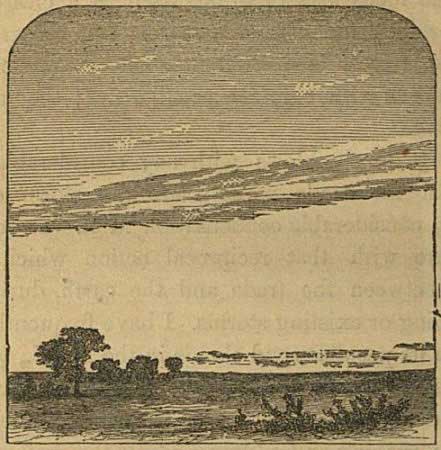
Another view was taken about two P.M. of the same day, when the scud had a very dark, gloomy appearance—as dark and gloomy as those of a Mexican norther—too dark to represent by a cut.
Not unfrequently in a moist summer season, after a day of showers or rain, which have had an extending formation or lateral extension from north to south, it will commence blowing in the morning, and encourage the hay-maker with the hope of fine weather. But often before noon, the milky stratus condensation above with cumuli below, will appear in the trade; the N. W. wind die away and variable airs from the east or south appear, to be followed toward night by an enlargement of the cumuli and showers. It rarely, if ever, blows fresh till the storm condensation of the trade has passed; or continues to blow after that condensation reappears. When it commences blowing after a storm, and the northern edge of the storm is not over us, we may frequently see the latter low down in the S. E. passing eastward.
Fig. 15.
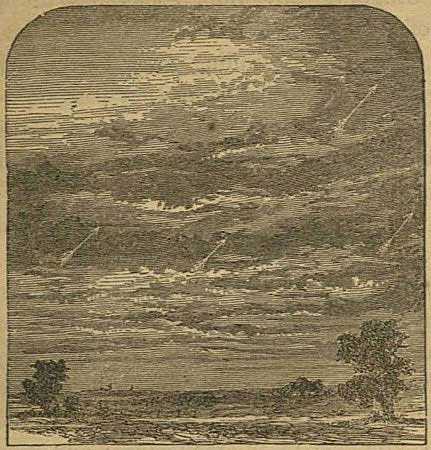
NORTH VIEW.
2d. Its scud are peculiar. Every one, probably, has noticed them. They are distinct, more or less disconnected, irregular, with every form between those of the easterly scud, cumulus, and stratus, according to the season. If large, with dark under surfaces; forming rapidly and as rapidly dissolving; rarely dropping any rain, sometimes dropping a flurry of snow, in November or March, oftener than at any other period; sailing away to the S. E., and casting a traveling shadow as they pass on over the surface of the earth. Their electricity, particularly when white, is probably always positive, as that of all whitish clouds is supposed to be.
3d. It is emphatically a surface wind. The incident storm winds, the N. E. and S. E., frequently commence blowing under the storm, toward its point of greatest intensity, up near the line of cirro-stratus condensation, evidenced by the running scud; or blow there with most rapidity, and so continue for hours before the whole surface atmosphere from thence to the earth becomes involved in the movement; and sometimes without being felt below at all. Not so with the N. W. wind; it begins at the surface and blows there with more rapidity than above; it seems to be attracted by the earth; it interposes between the earth and the trade, wedging the trade up and occupying its place. It blows under at all seasons of the year, but most readily and strongly from a surface of snow whose electricity is always positive. Hence it blows most strongly and continuously when snow has fallen at the north, and prevails during winter very much in proportion to the extent and continuance of the covering of snow which invests the earth in that direction. It follows after storms, and particularly warm rains, during the autumn, winter, and spring months, which have a lateral southern extension. Whether it is increased by the snow from the surface from which it blows, or is caused by the same magnetic action which causes the great fall of snow, is a question we shall consider hereafter.
4th. It does not connect or mingle with the trade current in any way, or change or divert the course of that current; but interposes between it and the earth, elevating the trade in proportion to its own volume, above the influences of the earth (when the trade becomes free from condensation, and singularly, clear); and raising proportionately the barometer. An experienced observer can frequently estimate, with considerable accuracy, the rise of the barometer, by measuring with his eye, (when the clouds will enable him to do so,) the depth of this interposed N. W. current. The barometer rarely rises after a storm, for twenty-four or forty-eight hours if the wind continues at any point from S. W. to W. N. W., but always rapidly as soon as the genuine N. W. current with any considerable depth interposes and elevates the trade.
It will be obvious to every one, I think, certainly, if they will hereafter study the subject and observe for themselves, that the N. W. wind does not blow away the storm; and that it follows after it, blowing over the surface which is uncovered by the storm; rarely, if ever, with any force when the body of the storm passed south of us; and that it is a purely surface wind, seemingly attracted by the peculiar magneto-electric state in which the surface of the earth is left, compared with a snow-clad surface to the north, by a recent storm, or that peculiar state of the trade which is left by the action of the storm. It seems to follow that magnetic wave which, passing from north to south, acts in its course upon the counter-trade, producing the storm, or belt of showers, and giving them their southern lateral extension, and will well repay future telegraphic investigation. Its electricity is intensely positive—that of the earth by the action of the storm as intensely negative.
5th. This N. W. wind occurs in all parts of the northern hemisphere, so far as we have data to determine, and its corresponding wind from the S. W. occurs in the southern hemisphere. It is identical with a class of the northers of the Gulf of Mexico, as a brief analysis of the character of the latter will show.
1st. The fall and winter norther is a dry wind without rain or falling weather—so is our N. W. wind.
2d. It is preceded by a falling barometer; S. E. scud and rain at the point where it blows, or to the eastward of it. So is ours when it blows a gale in the fall and spring months, which bear the nearest resemblance in climatic character to the periods when the northers blow. With this distinction, however, that our precedent rains either pass over us or to the southward, the direction of storms being E. N. E.; their precedent storms passing over or to the eastward of them as they move more to the northward.
3d. It is often preceded by a copious dew; so is ours—such dews often following light fall rains in our climate, and preceding N. W. wind.
4th. The most peculiar characteristic, however, is that the barometer rises rapidly and invariably while the norther prevails, and very much in proportion to its violence. The same is true of our genuine N. W. wind, and is not true of any other wind on this continent which I have observed or read of.
5th. While they are thus alike in these respects, they are unlike in no respect.
Mr. Redfield has traced them in supposed connection with storms which continue from that vicinity across the United States to the E. N. E., and endeavored to connect them with those storms, as the left-hand winds of a rotary gale. Obviously, I think, they are identical with our N. W. winds which also follow, indeed, but are distinct from the storms.
There are a class of northers in the Gulf of Mexico—the “Nortes del Muero Colorado”—sometimes occurring in the summer months, beginning at N. E., veering about and settling at N. N. W., and as they decline hauling round by the west to the southward. These winds correspond precisely with the hurricane winds of the West Indies, and are doubtless the incident winds of a storm traveling thence to the N. N. W. precisely as our N. E. or E. N. E gales are incident storm winds to the N. E. storms of our latitude.
In this connection we will look at the peculiarities of a West India hurricane.
“It is not a little remarkable,” says Mr. Espy, speaking of the storms and hurricanes of the West Indies, “that all these storms, and all others which have been traced to the West Indies, traveled N. W. almost at right angles to the direction of the trade-wind in those latitudes, but very nearly, if not exactly, in the direction of an upper current of the air known to exist there toward the N. W.” Substantially the same facts have been repeated by Mr. Redfield, and demonstrated by his able investigations, both there and in the Eastern Pacific, and are confirmed by the observations of Edwards, Lawson, and others, while residents there. It is a matter of surprise that gentlemen like Messrs. Redfield and Espy, who have certainly displayed great ability in the investigations of meteorological phenomena, should fail to recognize a more intimate relation between this upper current and the storms they were investigating, and to detect the general laws which govern both. The storms and hurricanes of the West Indies are comparatively of small diameter, and have little advance condensation. When they pass on to the south-western portion of North America and curve to the N. E., as they frequently do, they enlarge in front and at the sides, and their advance condensation, which is not dense enough to drop rain, extends in some cases from one to three hundred miles; and the storm itself, by the time it reaches the Alleghanies, may extend one thousand to fifteen hundred miles, and perhaps in certain magnetic states of the surface, and occasionally, may cover the entire portion of the continent, from north to south. Such, probably, was very nearly the extension of the storm investigated by Professor Loomis. In the West Indies, however, at the commencement, they vary from twenty to one hundred miles, or possibly more, in width.
First, they are preceded by a hot, sultry and oppressive atmosphere—as are electric storms every where—a peculiar electric state of the earth and adjacent air.
Second, the black clouds and lightning which indicate the approaching hurricane are seen to the S., S. E., and E. S. E., according to the season of the year, as we see them at the westward. During the rainy season, and when the storm, as is usual at that period, is small, and the S. E. trade blows more eastwardly, the wind at the Windward Islands, possibly, may set in at the north, and back round by the east as it progresses. So Colonel Reid thinks it sometimes does, at Barbadoes. But when the belt of rains is south, and the hurricane comes from the south-east, and is larger and more violent in its action, and the north-east winds prevail, the first effect is an increase of these trades. Soon, however, the wind hauls to the north and north-west, in opposition to its course, bearing the same relation to it that our east and north-east winds bear to storms in the United States; and the wind hauls around during the passage of the storm to the west, south-west, and south-east, and at the latter point it clears off. Mr. Edwards in his History of Jamaica says—and as a resident, his authority should be decisive as to this Island—“that all hurricanes begin from the north, veer back to the W. N. W., W., and S. S. W., and when they get around to the S. E. the foul weather breaks up.” Doubtless the same is true of the class of northers of which we are speaking on the Gulf of Mexico. But with this class the barometer does not rise during the gale, and in proportion to its length and violence. With the other class of N. W. winds—the northers of winter—it does.
The following description of two winter northers, copied from Colonel Reid’s valuable work, will illustrate what has been said. Precisely such changes from S. E. rains to N. W. winds, with blue sky and detached dark clouds—fair-weather N. W. scud—occur every autumn in October and November, and the falling of the thermometer and rising of the barometer, after rain, and a change of the wind, are perfectly characteristic.
1843. Wind. Force. Weather. Bar. Ther.
Jan. 30.
A.M. 4. S. S. W. 2 b. c. 29.90 77 Off Tampico.
Noon. South. 5 b. c. r. 29.86 76 Lat. 23° 41′ N., Long. 94° 50′ W.
P.M. 8. South. 6 b. c. r. 29.84 76
Jan. 31.
A.M. 4. S. Easterly. 3 b. c. 29.90 74 Between 6 and 10 A.M., wind was variable.
Noon. N. by W. 9 c. q. w. 29.96 76 Norther commenced at 10 A. M.
P.M. 8. N. N. W. 9 c. 30.09 73 Lat. 22° 36′ N., Long. 95° 48′ W.
Feb. 1.
A.M. 4. N. N. W. 7 c. g. 30.29 63 Lat. 22° 9′ N., Long. 94° 50′ W.
Noon. Westerly. 6 c. 30.03 67
P.M. 8. Calm. 0 c. 30.26 67
Feb. 14.
A.M. 4. S. E. 3 b. c. r. 29.66 73 At Sacraficios.
Noon. S. W. 4 b. c. 29.62 Norther comc’d at 5.30 P.M.
P.M. 8. N. W. by N. 10 c. q. u. 29.72 65
Feb. 15.
A.M. 4. N. W. by N. 10 c. q. u. 30.10 61 Gale moderated and again freshened about 8 A.M.
Noon. N. W. by N. 10 c. g. q. 30.19 61
P.M. 8. N. W. 4 c. g. 30.20 65
Feb. 16.
A.M. 4. N. W. 3 q. 30.18 62
P.M. 8. N. N. W. 2 c. g. 30.21 66
b. indicates blue sky—c. detached clouds—r. rain—v. visibility of objects—q. squalls—w. wet dew—u. ugly threatening appearance—g. gloomy weather.
The exact counterpart of the first norther may be observed with us every fall. On the 30th January, with a rising thermometer and falling barometer, there was rain at midday. The night following was moist—the next day, about ten A.M., the wind came out N. W., with squalls and gloomy weather, a falling thermometer, and rising barometer.
The norther of Feb. 14th differed from the other only in regard to the time of the day when it commenced; the order of events was the same. The rain fell in the night—it cleared off early in the day, and the norther followed in the afternoon. This also is frequently the case with us, as every one may observe.
This brief notice of the surface winds of our climate would be incomplete without a description of those of the thunder-gust and tornado.
The former is exceedingly simple. The showers, which are accompanied with much wind, form suddenly in hot weather, and have a considerable advance condensation (frequently with obvious lateral internal action), extending eastwardly from the line of smooth cloud from which the rain is falling, or rather where the falling rain obscures the inequalities of the cloud. The gust is never felt until the advancing condensation has passed over us, when it takes the place of the gentle easterly breeze which previously set toward the shower. The gust ceases as soon as the cloud has passed. It is obviously the result of the inducing and attracting influence of the cloud upon the atmosphere near the surface of the earth as it passes over it. Let the reader watch attentively this advance condensation, from its eastern edge to the line of smooth cloud and falling rain, and he will understand at a glance this internal action of gust-clouds. The whole phenomena are simple and intelligible. A cloud approaching from a westerly point, dark and irregular from its eastern edge to the line of falling rain, where it appears smooth and of a light color; wind from the east blowing gently toward it, till the condensation is over us; then the gust following the cloud; then the rain, and in a few minutes the cloud, and wind, and rain have passed on to the east, and “sunshine” returns.
The tornado, as it is termed when it occurs upon land, “spout,” if on the water, is sometimes of a different character, and as it undoubtedly had great influence in inducing the gyrating theory of Mr. Redfield, and the aspiratory theory of Mr. Espy, and has been cited by both in support of their respective theories, it deserves a more particular notice. There are several marked peculiarities attending it which determine its character.
1st. It occurs during a peculiarly sultry and electric state of the trade and surface atmosphere, and at a time when thunder showers are prevailing in and around the locality, and at every period of the year when such a state of the atmosphere exists. One recently occurred in Brandon, Ohio, in midwinter.
2d. There is always a cloud above, but very near the earth, between which and the earth the tornado forms and rages. It is usually described as a black cloud, ranging about 1000 feet or less above the earth, often with a whitish shaped cone projecting from it, and forming a connection with the earth; at intervals rising and breaking the connection, and again descending and renewing it with devastating energy. Its width at the surface varies from forty to one hundred and eighty rods—the most usual width being from sixty to ninety rods. Sometimes when still wider, they have more the character of thunder-gusts, and are brightly luminous.
3d. Two motions are usually visible, one ascending one near the earth and in the middle, and a gyratory one around the other. The latter is rarely felt, or its effects observed, near the earth. Occasionally, and at intervals, objects are thrown obliquely backward by it.
4th. It is composed, at the surface of the earth, of two lateral currents, a northerly and southerly one, varying in direction, but normally at right angles in most cases, although not always, with its course of progression, extending from the extreme limits of its track to the axis; which currents are most distinctly defined toward the center, and upward. These currents prostrate trees, or elevate and remove every thing in their way which is detached and movable. There does not seem to be any current in advance of these lateral ones tending toward the tornado, save in rare and excepted cases, and then owing to the make of the ground or the irregular action of the currents; nor any following, except that made by the curving of the lateral currents toward the center of the spout as it moves on, and perhaps a tendency of the air to follow and supply the place of that which has been carried upward and forward, like that of water following the stern of a vessel. The south current is always the strongest, and often a little in advance of the other, and covers the greatest area. The proportion of the two currents to each other is much the same that the S. E. trades bear to the N. E. This excess in volume and strength of the southerly current will explain the irregularities in most cases, and the fact that objects are so often taken up and carried from the south to the north side, and so rarely from the north and carried south of the axis. These irregularities are such as attend all violent forces, and something can be found which will favor almost any theory; but the two lateral currents appear always to be the principal actors, except, perhaps, when it widens out and assumes more the character of a straightforward gust. See a collection by Professor Loomis, American Journal of Science, vol. xliii. p. 278.
The following diagram is a section of the New Haven tornado, from Professor Olmstead’s map accompanying his article in the “American Journal of Science and Art,” vol. 37. p. 340.
The manner in which the main currents flow is shown by their early and unresisted effect in a cornfield, as represented by the dotted lines. The direction in which the fragments of buildings were carried by the greater power of the southerly currents is shown also. And so is this irregular action, where a part of the southerly current broke through the northerly one, and prostrated two or three trees backward on the north side of the axis.
Fig. 16.
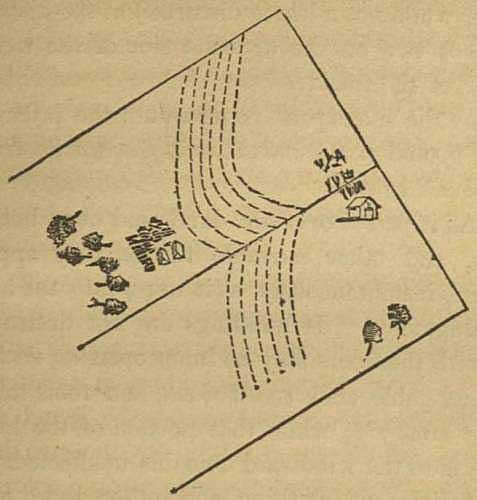
5th. This cloud, and its spout, move generally with the course of the counter-trade in the locality—i. e., from some point between S. W. and W., to the eastward, but occasionally a little south of east, deflected by the magnetic wave beneath the belt of showers.
6th. Several exceedingly instructive particulars have been observed and recorded.
a. No wind is felt outside of the track, as those assert who have stood very near it, and its effects show.
b. The track is often as distinctly marked, where it passed through a wood, as if the grubbers had been there with their axes to open a path for a rail-road. The branches of the trees, projecting within its limits, are found twisted and broken off, or stripped of their leaves, while not a leaf is disturbed at the distance of a foot or two on the opposite side of the tree, and outside of the track.
c. As the spout passes over water, the latter seems to boil up and rise to meet it, and flow up its trunk in a continued stream.
d. As it passes over the land, and over buildings, fences, and other movable things, they appear to shoot up, instantaneously, as it were, into the air, and into fragments. If buildings are not destroyed or removed, the doors may be burst open on the leeward side, and gable ends snatched out, and roofs taken off on the same side, while that portion of the building which is to the windward remains unaffected.
e. Articles of clothing, and other light articles, have been carried out of buildings through open doors, or chimneys, or holes made in the roofs, and to a great distance, without any opening being made for the air to blow in.
f. If there be a discharge of electricity up the spout from the earth, like that of lightning, the intense action ceases for a time or entirely.
g. Vegetation in the track is often scorched and killed, and so of the leaves on one side of a tree, which is within the track, while those on the other side, and without the track remain unaffected. (Espy’s Philosophy of Storms, 359, cited from Peltier.)
h. The active agent whatever it is, has been known to seize hold of a chain attached to a plow and draw the plow about, turning the stiff sod for a considerable distance. (See Loomis on the tornado at Stow, Ohio, American Journal of Science, vol. xxxiii. p. 368.)
i. In passing over ponds, the spout has taken up all the water and fish, and scattered them in every direction, and to a great distance.
j. The barometer falls very little during the passage of the spout. (See the Natchez hurricane of 1827, Espy page 337.) Not more than it frequently does during gentle showers.
k. Persons have been taken up, carried some distance, and if not projected against some object in the way, or some object against them, have usually been set down gently and uninjured.
l. Buildings which stood upon posts, with a free passage for the air under them, although in the path of the tornado, escaped undisturbed. (Olmstead’s account of the New Haven tornado, American Journal of Science, vol. xxxvii. p 340.)
m. A chisel taken from a chest of tools, and stuck fast in the wall of the house. (Ibid.)
n. Fowls have had all their feathers stripped from them in an instant and run about naked but uninjured.[5]
o. Articles of furniture, etc., have been found torn in pieces by antagonistic forces.
p. Frames taken from looking-glasses without breaking the glass. Nails drawn from the roofs of houses without disturbing the tiles.
q. Hinges taken from doors—mud taken from the bed of a stream (the water being first removed), and let down on a house covering it completely—a farmer taken up from his wagon and carried thirty rods, his horses carried an equal distance in another direction, the harness stripped from them, and the wagon carried off also, one wheel not found at all. (American Journal of Science, vol. xxxvii. p. 93.)
Pieces of timber, boards, and clapboard, driven into the side of a hill, as no force of powder could drive them, etc., etc.
Now to my mind, these circumstances indicate clearly, that it is not wind, i. e., mere currents of air, which produces the effect, but that a continuous current or stream of electricity from the earth to the cloud exists, and carries with it from near the earth, such articles as are movable: That this stream collects from the northerly and southerly side upon the magnetic meridian, in two currents with polarity, which meet in their passage up at the center; curving toward the center in the posterior part as the spout moves on, when acting in a normal manner, and making the “law of curvature” observed: That no conceivable movement of the air alone in such limited spaces could produce such effects; or if so, that no agent but electricity could so move the air: That the air in a building could not shoot the roof upward, and into fragments; much less could the air in a cellar by any conceivable force, be made to elevate or shoot up the entire house, and its inmates, and contents—effects so totally unlike what takes place in gales, hurricanes, and typhoons: That elastic free air never did nor could take hold of the plow chain, and plow up the ground; or scorch and kill the vegetation; or twist the limbs from one side of a tree, while the most delicate leaves on the other, and within two or three feet, remained unaffected and undisturbed; or pick the chickens: That even if the expansion of the air could produce these effects—if a sudden vacuum were produced—nothing but currents of electricity could produce the sudden vacuum, by removing the air above.
It is well settled that atmospheric electricity can and does flow in currents with light, by experiments in relation to the brush discharge, etc. That it may do so without light or disruptive discharge, and in a stream, or as it is termed, by convection, with the force and effect seen in the tornado, is perfectly consistent with what we know of it—and it is, I think clearly evinced that such is the character of the phenomena, by the fact that a sudden powerful disruptive discharge, with light, up the spout, produces an instantaneous partial or total suspension of its action; to be renewed as the cloud passes over another and more highly charged portion of the earth’s surface. Peltier gives instances where the spout has been entirely and instantaneously destroyed by such a sudden and powerful discharge of electricity; marking the spot where it was so destroyed by a large hole in the earth, from which the discharge issued. And in fact these tornados are often steadily luminous, and so much so, when they occur in the night, as to enable persons to read without difficulty.
The lateral inward and upward currents, are accompanied, after they meet and unite, or seem to unite, by gyratory or circular ones. How are they produced? This question can only be answered by analogy. No permanent impressions are left by the circular currents, except to a limited extent, and in occasional instances; and observation of them has been, and must necessarily be limited and uncertain. I have witnessed one or two on a moderate scale; but owing to the suddenness of their passage, and the confusion of the objects taken up, it was difficult to determine what the circular currents were. When the southerly current is much the strongest, it appears sometimes to cross the axis, and curve round the northerly one. Perhaps this may be all the curving that really takes place, except at the posterior part of the axis, for evidence of a curving on the south of the axis is rarely, if ever seen.
Assuming, however, that the main currents unite and form one from the earth to the cloud, induced circular currents would be in perfect keeping with the known laws of electricity. Such currents, and with magnetic properties, are always induced by powerful currents of voltaic electricity passing through wires. And doubtless in all cases powerful currents of electricity induce attendant circular currents. This may account for the external gyration of the spout.
Or it may be that the two lateral currents of air which attend the currents of electricity, do not unite; having opposite polarity, but pass by and around each other, in connection with the circular magnetic currents. Future observation and perhaps experimental research will determine this. But it may not be accomplished by the present generation; for the belief that tornados are mere whirlwinds, produced by the action of the sun in heating the land, is adhered to, notwithstanding they cross the intense magnetic area of Ohio in mid-winter, and seems to be ineradicable.
The proportions of different winds vary in different localities. For the benefit of those who are curious, I copy a table from an able compilation by Professor Coffin, published by the Smithsonian Institute, showing the proportion of the winds at New Haven (the station nearest to me). It will be noticed that during the year the N. W. winds blow the greatest number of days; the S. W. next; the N. E. and S. E. less than either, and about equal. It may be observed that the two latter bear about the same proportion to the whole, that our number of cloudy and stormy days, averaging about ninety, bear to the whole number of days in the year.