Note 139 — CHAP. IX.
Thomas Taylor translation
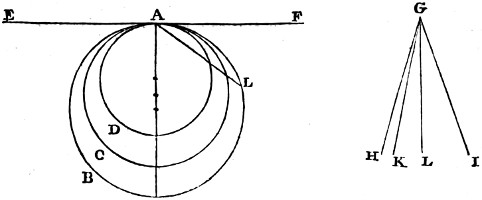
The cornicular angle is that which is made from the periphery of a circle and its tangent; that is, the angle comprehended by the arch L A, and the right line F A, which Euclid in (16. 3.) proves to be less than any right-lined angle. And from this admirable proposition it follows, by a legitimate consequence, that any quantity may be continually and infinitely increased, but another infinitely diminished; and yet the augment of the first, how great soever it may be, shall always be less than the decrement of the second: which Cardan demonstrates as follows. Let there be proposed an angle of contact B A E, and an acute angle H G I. Now if there be other lesser circles described A C, A D, the angle of contact will be evidently increased. And if between the right lines G H, G I, there fall other right lines G K, G L, the acute angle shall be continually diminished: yet the angle of contact, however increased, is always less than the acute angle, however diminished. Sir Isaac Newton likewise observes, in his Treatise on Fluxions, that there are angles of contact made by other curve lines, and their tangents infinitely less than those made by a circle and right line; all which is demonstrably certain: yet, such is the force of prejudice, that Mr. Simson is of opinion, with Vieta, that this part of the 16th proposition is adulterated; and that the space made by a circular line and its tangent, is no angle. At least his words, in the note upon this proposition, will bear such a construction. Peletarius was likewise of the same opinion; but is elaborately confuted by the excellent Clavius, as may be seen in his comment on this proposition. But all the difficulties and paradoxes in this affair, may be easily solved and admitted, if we consider, with our philosopher, that the essence of an angle does not subsist in ether quantity, quality, or inclination, taken singly, but in the aggregate of them all. For if we regard the inclination of a circular line to its tangent, we shall find it possess the property, by which Euclid defines an angle: if we respect its participation of quantity, we shall find it capable of being augmented and diminished; and if we regard it as possessing a peculiar quality, we shall account for its being incommensurable with every right-lined angle. See the Comment on the 8th Definition.