SIDE TALKS WITH THE PHILISTINES: BEING SUNDRY BITS OF WISDOM WHICH HAVE BEEN HERETOFORE SECRETED, AND ARE NOW SET FORTH IN PRINT.
Reading edition

To Robert Cameron Rogers: You are keeping the stage waiting.
My friend with the Sharp Scissors which edit the Table Talk column of the Buffalo Commercial had a few words to say the other evening regarding success. He alleged that Mr. Bok and Richard Harding Davis were successful men, and that it was the pleasure of unsuccessful people to jump on them mercilessly. I dislike to disagree with Mr. Quilp, but it seems to me that he belongs to that class of people who habitually miss the point of things.
The story in Gil Blas of the strolling player—true to what he deemed his art—working with commendable if misdirected energy, walking from town to town, and as he walked soaking his dry crusts in the water of wayside wells—this were a story of success. Success, it seems to me, lies not so much in having one’s name a commonplace among this great American public, which falls down to worship mediocrity if it is well advertised, as in doing one’s day’s work honestly and sincerely. To sing a song that finds its way into the hearts of men; to act a part that helps another toward his happiness, and do it all without blare of trumpets and jangle of hurdy-gurdy; and then walk on to the next town, stopping by the roadside wells to soak a dry crust in cool water, or, perhaps, a fresh cake in a mug of Bass as occasion served, and then, at the end, to lie down quietly, listening to the singing by the people of one’s own songs—though they know it not—presents a picture of a perfect harmony. This is the preachment of Stevenson and of men before him, and until a better one may be advanced this will serve. I would rather have written The Pavilion on the Links than Successward, or even Mr. Davis’s masterpiece, Van Bibber and the Swan Boats. Still, it is a matter of taste, and if one likes lactated food, roast mutton is bad for his stomach.
According to the prospectus Mr. Cudahy’s book fairly bristles with epigram: the bristles alone are said to be worth the money.
Probably Lawrence Hutton knows more about death masks than any living man. I cheerfully grant him this honor, but when he writes the advertising pages in Harper’s and springs them on an unsuspecting public as “Literary Notes,” I rebel. Rebellion is not, however, confined to mere objection to his sailing under false colors, but to such sentences as these from a recent number of Harper’s:
“Beyond the Dreams of Avarice is not as amusing as an entertaining story, but it is intensely interesting from beginning to end. No one who picks it up for an evening’s amusement will be likely to lay it down unfinished or to lay it aside for any other form of current entertainment.”
The italics are mine, and are put in simply to emphasize the occult meaning of Mr. Hutton, who belongs to the class which assumes to set the literary pace of the world. I doubt if Brander Matthews could do worse.
The portrait of Mr. Cudahy that is used as a frontispiece in his new book is a photograph from the original chromo, signed by the electrotyper.
It is reported to me that quite a large section of the Metropolitan colony sing their jubilate this way: “It is Howells that hath made us and not we ourselves—We are his people and the sheep of his pasture.”
“Papa,” said the smart boy at dinner, “does consomme mean consumed?”
“No, my son,” said the philologic pa, “consomme is from a Latin word, summum—all—and comes to us via the French. It means ‘all together’—the same as the Trilby pose.” And there was silence for the space of four seconds.
Somebody has sent me the prospectus of a magazine shortly to be published in Cincinnati. In spite of rumors to the contrary The Philistine will continue publication. Even The Century, although frightened, will let advertising contracts as heretofore. The Philistine, and supposedly other magazines, base their hopes of a longer existence not on their equal worth—for lo! it is but timorously we draw breath after reading this prospectus—but knowing that the new magazine will be keyed to so exquisite a pitch of literary supremacy that only a few from the world erudite may revel in such a rarified atmosphere. The birth of the periodical—from the prospectus—fittingly closes this momentous era. Evolution, hitherto satisfied with minute gradations, now forges ahead in a stupendous leap; we are diatoms, we scratch rudely on bones, and live in caves; we still bag the mastodon with embryonic pitfall, we shave with a shell and are only paleozoic microbes in a literary miocene age. We are mental fossils clogged in stratified oblivion—but we can’t help it, we are rudimentary and still possess some basal instincts such as love, religion, love of beauty and the like. But we never imagined how infinitesimal we were until the coming of that fatal prospectus. Now we realize that the groaning of the world, the extraordinary upheaval of the age, the quickening of the leaven, the quaking of the Zeit Gheist were but the premonitory travaillings of eternity before the awful nativity of this infant from Over-the-Rhine. The veil of our temple is rent and our suspenders are in hock. Mighty Spirit of the æons have mercy on us! we are worms! moribund, senile old things. Our ears are sessile, yet we hear the portents. In this hackneyed, conventional, sterile age somebody is going to be original! Prostrate we make obeisance. Spare us Original that is to be—spare us! But who t’ell started this Literary Fresh Air Fund, anyway?
“Three generations from the soil” may be a good rule of social eligibility after all. I know a family in one of our great lake cities which has ruled society therein for half a lifetime and it is only two removes from the mud. But savagery will crop out now and then, despite all the austerities of social custom and the perpetual effort to reach the calm of Nirvana and look as if life was a doosid bore. The delight of these, as of all savages, is to astonish the natives. When it can be done by driving a loping team of circus horses down the chief avenue of the city, that suffices. Another pet trick is to mass the family on the porch of the wooden-castled mansion on a Sunday morning and take their pictures in group, in full view of worshippers returning from church. The suggestion of a Ute reservation at such times is complete. When these fail to create a sensation, a yellow tally-ho driven madly through the narrowest streets of the Quartier Teuton, scattering dogs and babies, with whoops and horns and the mottled circus horses in the lead, does the business. It isn’t so long since the richest of our American nobility showed the craven blood of the materialistic sons of the bush, to whom brute life is everything. The American-English duel that failed is still an unpleasant memory. I mention these things only to illustrate the paradox of our days. We do labor hard to get rid of the joy of living and we call the new state culture and repose, when we get it. But the storage of force is a poor thing. It breaks out in abnormal ways and the acquisitive father is punished in his degenerate children to the third and fourth generation sometimes—and usually to the second.
I have received the second volume of Moods, which my Philadelphia correspondent calls Sulks. It is a retrograde from the first number in that in some places the printing is on both sides of the leaf. I had hope that Moods would continue its good work and in the second number leave both sides blank. As it is, however, I commend the first volume to that eminent figurer, Mr. Edward Atkinson of Boston, who may use the blank sides upon which to calculate what the other pages are good for. By the way, the announcement of the second volume contains a description of the type used, which is a reprint of the typefounder’s circular concerning the Jenson type. I would imagine that some of the geniuses of Moods could have at least written an original circular. The prospectus of the second volume contains a list of one hundred and seventeen stars—geniuses of the first magnitude—still as my friend of the Picayune says, “Though they twinkle, twinkle, twinkle, we wonder what they are.”
If McClure can give us more such exquisite stories as the Zenda tale in the August number, a good deal of reminiscent literature and living documents may be pardoned. Hope is better than memory, Mr. McClure.
Mr. Frank A. Munsey, who prints a picture book, of which eleven million copies are sold every four weeks, declares in a shrill, throaty falsetto that American literature at present is so and so; and that in the future he proposes to have it so. Mr. Oppenheimer of Rochester has not yet been heard from.
I hope no one suspects me of any disrespect toward Mr. Ham Garland of the Chicago Stock Yards, heretofore noticed in these columns. A correspondent reminds me that Mr. G. is favorably mentioned in the oldest records. The historian of the creation remarks “And Ham was the father of Canaan.”
Chicago’s Echo should be successful. It is taking from the foreign periodicals their very best of picturings and giving us a taste of the delightful fun of Fliegende Blætter, La Rire, and the rest—a fun which somehow we cannot produce in America, so Puck’s artists and those of Judge and a few others borrow the ideas and we pat ourselves on the back and say what a keen sense of humor we have. We are very funny—we Americans—funnier, by long odds, than we think. I notice, too, that The Echo knows another good thing when it sees it, so the editors have made the printers use my pet grape leaves for the beginnings of their paragraphs. For this compliment to my taste I thank The Echo.
What we are coming to in poetry is always a fascinating theme—like biking in the dark on a strange road. But what we are going away from is more satisfactory to contemplate. It is pleasant to think that Homer, the blind minstrel, and Omar, the tent maker, are fixed facts. They are the poles of verse—one standing for the heroic and romantic, self-unconscious and buoyant, the other for vampire introspection and fatalism which mistakes interior darkness for an eclipse of the universe. It is also consoling to know that such poetry as Francis Saltus Saltus’s “Dreams After Sunset” and Duncan Campbell Scott’s yawp in the August number has been written—for they won’t have to be written again.
Judge Grant, in commenting on the ways of the Summer Girl in the July Scribner’s, says that after her return to her own particular vine and fig-tree she has, among other perplexities, “a considerable uncertainty in her mind as to whom she is engaged to.” This is in form somewhat similar to the reporter who said the victim of the trolley accident was killed fatally dead.
According to Mr. F. Hopkinson Smith, who parts his name in the middle and therefore ought to know, “Abbey in his art really has done what Wagner has done in music, Tennyson and the poets in verse.” He says so in the current Scribner’s. Tennyson “and” the poets is so kind—with accent on the “so.” The author of “Locksley Hall” ought to come back to Lily Dale or somewhere and thank Mr. Hopsmith.
The style of whiskers formerly called “Dundreary,” is now known as “The Wind in the Clearing.”
I have received from the Department of Agriculture an envelope labelled “Official Business—Penalty for Private Use $300.” Stamped across the face in red ink is the autograph of Hon. D. N. Lockwood. Inside this envelope was one still smaller which bore this inscription:
U. S. Department of Agriculture.
FORGET-ME-NOT.
Blue.
A half-hardy perennial. It prefers a moist situation, is easily grown and blooms early.
If I remember correctly Mr. Lockwood Ran for something during last fall’s campaign. I wonder what he is going to Run for next that he wishes to be remembered.
New York rejoices in the possession of a magazine for rich people. It is called Form, and it tells all about the first families—Knickerbockers and others—and what they do to be decent. I understand it proposes to offer prizes after the manner of Judge Tourgee’s Basis for the cleverest paraphrase of the second verse in Genesis. The historian of creation declares that on the first day “the earth was without Form, and void.” It’s a great “ad.”
In Praising poetry of William Morris And Stephen Crane Were you poking fun? I hope ’twas so: For You must perceive That those slashed and mangled lines Do no more resemblance bear To true poetry Than hacked and shattered corpse On battle field Bears To a perfect man, Whose form divinely fair Fitly enfolds feelings consummate Against such lines— And in fact ’gainst all your verse, I do Protest. Nelson Ayres. New Orleans, Aug. 15, ’95.
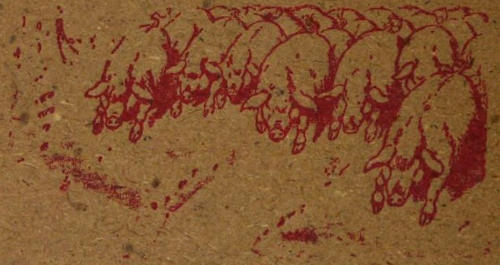
At the Publishers’ Convention recently held in San Francisco the delegates were treated to a steamboat ride down the bay where a picnic was held. Police were on hand to see that the delegates did not all rush down a steep place into the sea and perish in the waters.