Volume 46 — EVENTS IN FILIPINAS, 1721–1739
Reading edition
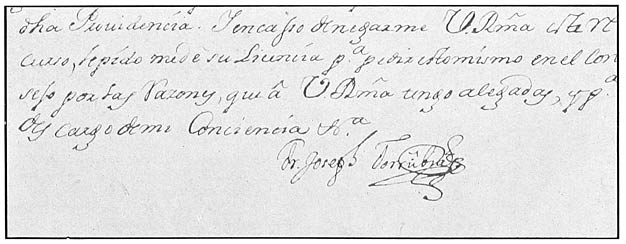
Signature of Joseph Torrubia, O.S.F.
[From original MS. in Archivo general de Indias, Sevilla]
[On July 23, 1726, the galleon “Santo Christo de Burgos” was driven by a storm on the rocks at Ticao, a long, narrow island adjoining San Bernardino Strait, and so badly wrecked that it could not be repaired. The auditor Julian de Velasco was on board the vessel, on his way to Mexico; as the official of highest rank on the ship, he held a conference with the officers, pilots, seamen, and other persons of experience, and it was decided (after several vain efforts had been made to save part of the cargo) to burn the ship and its contents, great part of which were ruined by the water. This was a great loss to the citizens of Manila, as all their investments for this year were thus destroyed. (Concepción, Hist. de Philipinas, x, pp. 157–167.)]
[Torrubia enumerates the armed naval expeditions sent against the Moro pirates during 1721–34, as follows: (1) An armada commanded by Antonio de Roxas sailed from Manila on July 10, 1721; it seems to have accomplished little, but cost the treasury much. (2) Another was commanded by Andrés Garcia; he fought with a Moro fleet—date not given, but probably in 1722—at Negros Island, and won a notable victory. (3) In 1723 a fleet set out under command of Juan de la Mesa y Aponte, warden of Fort Santiago at Manila; they went to Mindanao and captured from the Moros the fort at La Sabanilla, “slaying an immense number of that rabble, and among them several princes and datos.” (4) In February, 1731, four galleys were sent from Manila under command of Ignacio Irriberri; at Zamboanga they collected the vessels already there—two fragatas, four despatch-boats or champans, one taratana, one falua, eight caracoas of Bisayans and two others of Lutaos—and went to attack Joló, at which they found six forts defended by cannon. Here they had a fierce battle with the Moros, of whom many were slain, including two datos; then they ravaged the adjacent island of Talobo, destroying its salt-works (“which are the entire livelihood of that people”); and laid waste the district of the dato Salicaya, who, with many of his people, was slain. In the same year Captain Pedro Zacharias Villareal, with some vessels of the same fleet, attacked the island of Capual, near Joló, and burned three villages and many boats, and ravaged the fields, destroying their cattle and the salt-works there. (5) In November, 1731, Zacharias was sent by Valdés Tamon with a squadron from Manila to Zamboanga; at that very time, the sultan of Mindanao, Maulana Diafar Sadibsa, was asking aid from the Spaniards against his tributary Malinog, who had rebelled against him and had secured the support of more than thirty of the principal villages on the Rio Grande of Mindanao. This rebellion was caused by Malinog’s refusal to obey Maulana’s demand that he restore to the Spaniards the captives and spoil which Malinog, in conjunction with the Joloans, had carried away in 1722–23 from Negros and Panay. It was learned that Malinog was negotiating with the Dutch for succor, which they were inclined to grant him. At a council of war (in which the Jesuits were prominent) held in Zamboanga, it was decided to send Zacharias with a fleet to Tamontaca, to aid Maulana and punish Malinog. The latter’s fort—which, like that in Joló, was constructed by a Dutch engineer—at the entrance to his river, was captured by the united forces and large amounts of military supplies were destroyed. Two leguas further up the river, they attacked Malinog’s principal town, defended by six forts; many of the Moros (including their general, Tambul) were slain, three of their villages were burned, and their lands devastated. Returning to Zamboanga, the Spaniards harried the coasts of Joló and Basilan, so thoroughly that, later, “in order to terrify the Moros, it is only necessary to say, ‘Here comes Zacharias.’” (6) In January, 1733, a fleet under Juan Antonio Jove went to aid Maulana; but Malinog made a sudden attack on Tamontaca, which he destroyed with fire and sword, and slew Maulana, whereupon the Spaniards, disheartened, returned to Manila. (7) Maulana’s successor, Radiamura, asked aid from Manila, which was granted; the citizens subscribed more than nine thousand pesos in silver, and a fleet of forty-eight vessels was equipped. Under command of Francisco de Cardenas Pacheco and Captain (soon afterward made sargento-mayor) Zacharias, this fleet left Zamboanga on February 18, 1734, and went to Tamontaca. At Tuboc they attacked the sultan of Tawi-Tawi, but the Bisayan auxiliaries of the Spaniards fled, panic-stricken, and the Moro allies of the sultan swarmed in upon the Spaniards, compelling them to retreat. They then went against Malinog at Sulangan; at sight of the Spanish fleet, he set fire to his village and forts, and fled up the river to Libungang—a place which was strongly fortified by both nature and art. A fierce assault was made on this stronghold, but the Moros could not be dislodged; they killed many Spaniards with their unceasing discharge of balls and small weapons, and finally, by poisoning the water-supply, compelled the Spaniards to raise the siege. Then the latter went to Sulungan, and remained there until that place was well fortified, and the passage of the river securely closed to Malinog, who was thus shut in from his allies the Joloans and Camucones. On April 20, Radiamura was solemnly crowned as king by the Spaniards; and he agreed to allow the entrance of Christian missionaries, the building of churches, and the establishment of Spanish forts and garrisons, in his territories; also to acknowledge his vassalage to Spain by furnishing a quantity of wax, cacao, and other products of the country. Afterward, Zacharias made a raid on Basilan, devastated the lands, and seized much and rich booty; “so great was the spoil of the ‘enchanted island’ that, when the men had laden our armada and the captured vessels [which numbered over three hundred], they had to burn many articles because they could not carry them away.” (Torrubia, Dissertacion, pp. 68–90.) Cf. Concepción’s and Montero y Vidal’s accounts of these expeditions.]
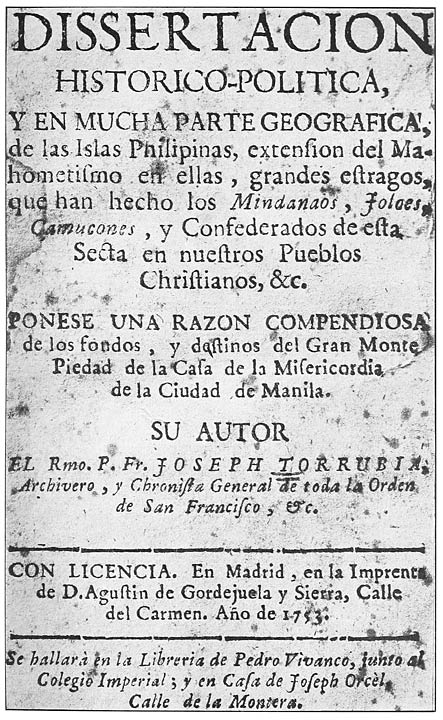
Title-page of Dissertacion historico-politita
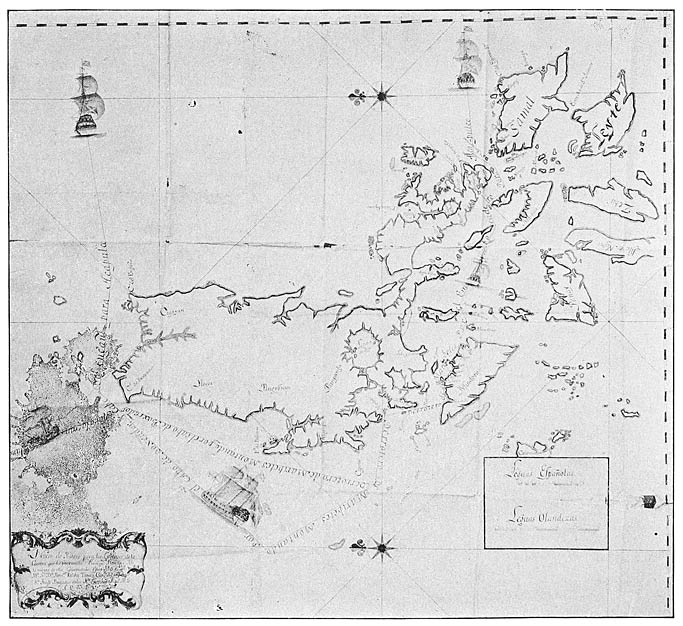
Map showing new route from Manila to Acapulco; presented to Governor Fernando Valdés Tamón by the pilot, Enrique Hermán, 1730
[Photographic facsimile from original MS. map in Archivo general de Indias, Sevilla]
[On June 18, 1733, the royal magazines at Manila were destroyed by fire, with all their contents, which included the supplies for the two vessels which were soon to go to Acapulco. The royal treasury had not the funds to make good this loss, and the galleons must sail at a certain time, in order to secure favorable winds; the governor therefore appealed to the citizens and merchants for help to meet the expenses of equipping the vessels. They responded with a donation of 30,000 pesos, which the governor duly reported to the king, asking that in view of the zeal and loyalty thus displayed by the citizens their interest might be cared for in the pending dispute regarding the Manila-Acapulco commerce. The losses sustained in the above fire were estimated by the royal officials at 66,807 pesos. (Concepción, Hist. de Philipinas, x, pp. 226–230.)]
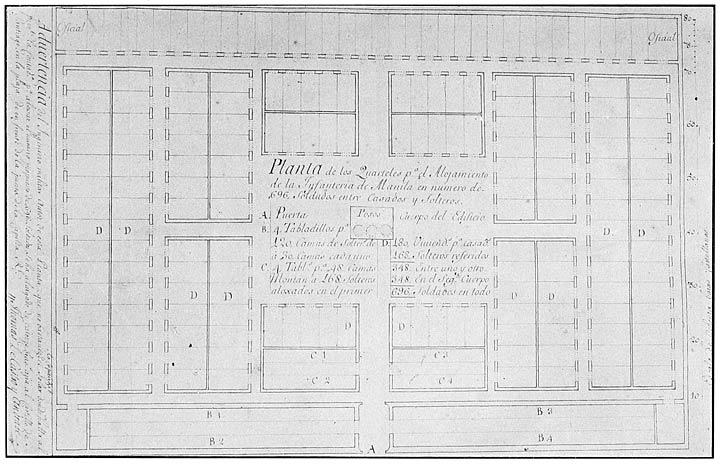
Plan of infantry barracks in Manila; drawn by the military engineer, Thomas de Castro y Andrade, 1733
[Photographic facsimile from original MS. in Archivo general de Indias, Sevilla]
[In October, 1733, a Spanish coastguard vessel captured a Dutch ship near the southern coast of Mindanao, and seized its despatches and instructions, “among these, the turban and crown which they were carrying as a present for Malinog.” When this event was learned at Batavia, great indignation was aroused among the Dutch, and they sent three warships, which anchored in Manila Bay (June, 1735) and demanded satisfaction; the Dutch would not allow any vessel to enter or leave the bay, and threatened to seize the patache “San Christoval,” which was expected to arrive from Acapulco. Warning was immediately sent to the commander of the latter, at the Embocadero; but the ship was already wrecked on the shoals of Calantás. The silver on board, 745,000 pesos belonging to the merchants and 773,025 to the royal situado, was transported by boat to Sorsogón, and the men removed the cargo to land and erected fortifications for its defense in case of necessity; the hull was then destroyed by fire, to prevent its being used by enemies. The Manila government, seeing that it had no funds for defense against the Dutch, and that the Acapulco galleon imprisoned in the bay might lose the favorable winds for its departure, finally came to a settlement with the Dutch, paying 6,500 pesos as satisfaction for the captured Dutch vessel and its contents; the Dutch ships thereupon retired. (Concepción, Hist. de Philipinas, x, pp. 375–410.)]
[In 1736, a controversy arose between the Recollects and Jesuits in northern Mindanao. The Indians of Cagayan, and the Recollect minister in charge there, Fray Hipolito de San Agustín, maintained a close and friendly communication with the native chiefs of Lake Lanao, who finally asked the Recollects (1736) to send missionaries to Larapan, a Malanao village, in order to instruct and baptize their people. The Jesuits were jealous of the Recollects, according to Concepción, and incited a heathen chief named Dalabahan in the mountains of the Cagayan district to attack the Malanaos, thinking that the latter would blame their Cagayan friends for the hostilities; but the latter were able to exonerate themselves from this suspicion, and remained on amicable terms with the Malanaos. The demand of these for Recollect missionaries had to go to Manila; the Jesuits, hearing of it, opposed the request, alleging that the Lanao territory belonged to them. The governor allowed the Jesuit claim, and the Malanaos appealed to the king himself; but “this remonstrance had no result, these unfortunate people being left in their barbarism—from which resulted to us most serious damages, as will be seen in due time.” (Concepción, Hist. de Philipinas, xi, pp. 54–66.)]
[In January, 1737, the new archbishop, Fray Juan Angel Rodriguez, took possession of his see; he belonged to the Order of Mercy, and was a native of Medina del Campo, Spain. “He began to govern like an angel” (Concepción; in allusion to his name). “He lessened the number of days for church processions, in order to give opportunity for the business of the courts, and for the necessary work of the people; he prohibited the processions at night, on account of the troubles which are wont to occur in them; he regularly attended the choir, and introduced the use of the Gregorian chant; he taught the sub-chanters plain-song, which they did not know,” etc. (Zúñiga, Hist. de Philipinas, pp. 535–536.)]
In the year thirty-seven, Governor Tamon issued a commission and powers to the licentiate Don Joseph Ignacio de Arzadun y Revolledo, in order that he might, in accordance with the royal laws, which decree that the provinces shall be visited every three years, fulfil that duty in those of Pampanga, Pangasinan, and Ylocos. There he was to inspect the fortresses, and the arms, ammunition, gunpowder, balls, and other military supplies, also their condition and circumstances; and to review the troops in the garrisons. He must investigate the mode and form in which the wages due them were paid, and the fictitious enrolments of men in the garrisons. He must also make lists of the warrants which the alcaldes-mayor might have issued; and if he found that these had not been confirmed by the general government, he must annul them. He must abrogate the enjoyment of exemptions, proceeding against those who should be guilty, in such manner as he should find most convenient; he might allow claims, and render definitive judgment in those of less value and amount than twenty pesos, placing the others in a condition to be judicially decided. He received full commission for the exercise and office of the said visitation, being appointed deputy (and a warrant for his title thereto being issued) in the offices of governor and captain-general in the provinces which were entrusted to him, for whatever emergencies might arise or which he might encounter, with superintendence over the other deputies who might be in those provinces. It is true, this is the royal provision; but it also is a fact that the governors profit by their opportunities, when any auditor resists their unjust maxims, and the dread of this often constrains the auditors to unbecoming acts of compliance; and they live as parasites, dependents on that quarter, in order to secure a shameful liberty and an inactive sloth.
Señor Arzadun set out on his commission, which he fulfilled with integrity; he was an unassuming and affable man. Without causing injuries to individuals, he reformed many abuses; and by mild measures he added two reals to each whole tribute. This peaceable result ruffled some persons, and led to various disputes with the ecclesiastical judge, provisor, and vicar-general, which ended in favor of the said auditor. Nor did he fail to have noisy controversies with some other persons; but all this ended as peacefully as possible.
Another controversy, no less disagreeable, occurred at that time between the fathers of the Society [of Jesus] and the mestizos of Santa Cruz. The latter complained, in a petition presented to the royal Audiencia, that with occasion of undertaking to build a bridge across a lagoon which extends from their village to that of Quiapo the fathers had compelled them to sign an obligation for two hundred and fifty pesos in favor of the superintendent of the work, for its cost and materials; and, for the payment of this, assessments had been levied in their village among the mestizos, and various persons had been arrested for not making their payments for this sum, part of which was not yet collected. On examination of this complaint, it was ordered that the auditor who was on duty for that week should proceed to the investigation of these statements; and the completion of such bridge was placed in his charge—for which he was to employ the means and measures that would be mildest, these being entrusted to his good judgment. In virtue of this order, the licentiate Don Pedro Calderon Henriquez, auditor of this royal Audiencia, made the investigation and examined the witnesses, which resulted in verifying the complaint made. It appeared from the judicial inquiry that the land of that village belonged to the Society; and the auditor drew up a formal statement, saying that the inhabitants of that village, who possessed no landed property, were paying ground rents that were exorbitant. He declared that the money for the cost of that bridge ought not to have been levied among the Sangleys and mestizos, even though they belonged to that village; and that consequently the owner of the land ought to pay it—citing laws i and v of título xvi, book iv of the Recopilación. [Here follows a relation of the various legal proceedings in this controversy; after hearing all the evidence in the case the decision of the court was against the Jesuits. It was shown that part of the land in question did not belong to them, and they were ordered not to disturb the tenants of it in their possession, and not to collect rents from them. They proved their title to other lands, but were warned that they must no longer exact, as they had been doing, three and one-half pesos as ground-rent for the sites occupied by the huts which the colonists erected within the grain-fields so that they might more conveniently cultivate the lands. “By this sentence the Jesuits lost some three thousand pesos a year for the [rents of the] ground-plots of the houses; each married man had paid them three pesos, and each unmarried man and widow a peso and a half—and this, besides, for houses and lands which belonged to those people.” The Jesuits pleaded ecclesiastical immunity, and claimed that they had a right to the rents in question. A long and clamorous dispute arose, in which manifestoes were issued on both sides; it appears to have lasted from March 28, 1738, to July 1, 1739. The Jesuits appealed to the king, but Auditor Calderon’s sentence was sustained. (Concepción, Hist. de Philipinas, xi, pp. 79–89.)]