Volume 37 — CHAPTER XI
Reading edition
The archbishop tries to visit the missions of the religious, but suspends that effort, and builds the cathedral of Manila.
In the beginning, the provinces of América were founded entirely in accordance with the regular institutes of communal houses and convents, with a great number of conventuals; they did not need to take these from the provinces of España, as they could choose plenty from the country. On the contrary in Filipinas we have no more than the convents of Manila, Cebú, and Guadalupe as communal convents—although only the convent of Manila preserves that character; while the others, more than seventy-four in number, are only missions where one single religious lives, and, in a very few, two ministers, according to the size of the village and the ability of the province. The latter is wont often to consist of as many priests as missions, until reënforcements of religious come from España; and if that reënforcement is very slow, then there are generally more missions than religious as priests. What I say here of our order is the same of all the others. It is not so in América, Perú, and Nueva España, where the convents are established totally independent of the missions. They have plenty of religious, and those who belong to the land itself, so that they do not have to send to España for them. Those convents have their incomes by which they are sustained, so that they do not need any of the fees of the missions; and consequently, the orders who wished to retain some missions subject to the ordinary could do so very easily, by assigning some religious to that mission who knew the language of those villages. Such religious are presented to the vice-patron, who presents them to the bishop. The latter examines them, and gives them the collation of the curacy in regular appointment. They administer that office in subjection to the priors of the convents, and to their visitation and correction in matters concerning the order; and in subjection to the bishops, who hold jurisdiction and visitation over them in regard to any transgressions in their office as curas. Those religious are maintained perpetually in their offices, and the chapters cannot change them to other convents; for they cannot leave their curacies without the intervention of the vice-patron and bishop, who are very loth to change them because of the investigations demanded by the presentation, examination, and collation. Those religious (who are very few) having been dedicated to that office of curas, the others, who consist of almost all the religious of the province who are exempt from that occupation, hold their chapters and change their priors according to the constitutions of the order.
It is not so in these Filipinas, where, as I have said, there are so few religious. Supposing that the plan of Don Juan de Palafox were to be inaugurated, and that all the religious submitted to receive the canonical collation of the curacies in proprietary appointment, the conservation and continued supply of religious would cease. The chapters would cease, for they could not remove the religious from the villages where they were acting as proprietary curas; and it would be necessary to keep them where they had their parishes. Very great difficulties would ensue from that. The province would cease to send procurators to España to bring back religious; and if the generous motive of coming as apostolic missionaries ceased, they would leave their provinces and fatherland—all the more because of being subject to the bishops, a burden so far from the exemption of the regulars that we watch so carefully. That subjection would have to be not only to the bishop but also to the ecclesiastical governors of a vacant see. There have been so many of the latter in these islands, that in Manila they had them for fourteen years; and in Cebú, Cagayán, and Camarines, for twenty years. The provincials would have nothing left but that name, and would not have entire control over their subordinates. The above and many other representations were made to Archbishop Don Millán de Poblete, and they availed so well with him that he suspended his resolve. The same things were represented to Don Diego Camacho, and these same reasons moved the gentlemen of the royal Council of the Indias to moderate that subjection—leaving it only in the visitation, with the limitations already mentioned, thus enjoining perpetual silence, in regard to erecting the missions into curacies, and to allowing the orders to abandon the ministries of those missions.
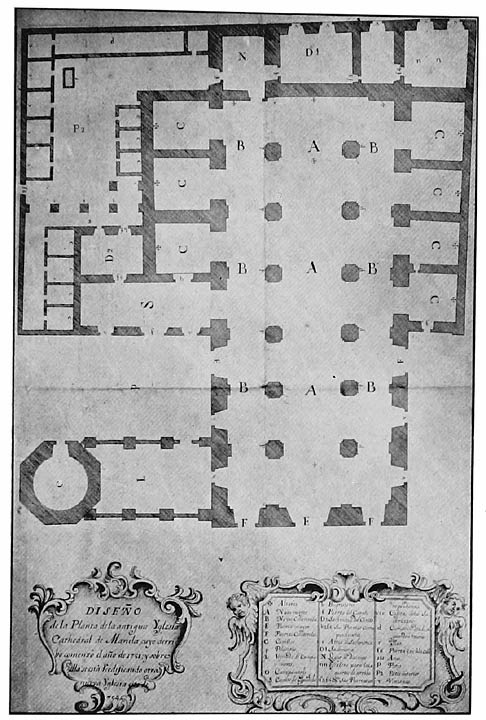
Plan of Manila Cathedral prior to 1750
[Photographic facsimile from original MS. in Archivo general de Indias, Sevilla]
The archbishop having put aside his doubt in regard to undertaking the visitation of the regulars, dedicated himself, as a true prelate, to his other obligations. The first one was the building of the cathedral, because of the ruin that occurred in it on the fatal night of St. Andrew in the year 1645; the church of the girls’ school of Santa Isabel was being used as a cathedral. He placed his shoulders very earnestly to that so chief obligation, although the poverty of the times made it difficult for him. He set about collecting materials, and the order of our father St. Augustine lent him the lime-kilns of Birabira, where the best and strongest lime of all the islands is made. The pious and Catholic governor, Don Sabiniano Manrique de Lara, was the one who conquered the greatest difficulties by collecting a generous alms from the citizens of Manila, and by giving his aid to the archbishop. The building was commenced, and, after the trenches for the foundations had been made, the archbishop clad himself in his pontifical garments and on the twentieth of April, 1654, blessed the first stone, which was carried by General Don Pedro de Mendiola. The master-of-camp, Don Pedro de Almonte, carried on a rich tray a bronze plate with the inscription of the erection of the church. Captain Don Nicolás Sarmiento carried on another tray five silver coins, and Captain Diego Castellanos a box of lead. All went in procession to the place where the stone was to be placed, and the governor and archbishop set it in position, while the litanies were being chanted. In a hollow already made in the stone were placed the plate and coins. The inscription on the plate is as follows:
“While Innocent X was governing the Church, King Felipe IV the Españas, and Don Sabiniano Manrique de Lara, knight of the Order of Calatrava, the Filipinas Islands, this stone for the building of this holy cathedral—its titular being the Conception, and its patron St. Andrew the apostle—was placed in position by Don Miguel de Poblete, metropolitan archbishop, April 20, 1654.”
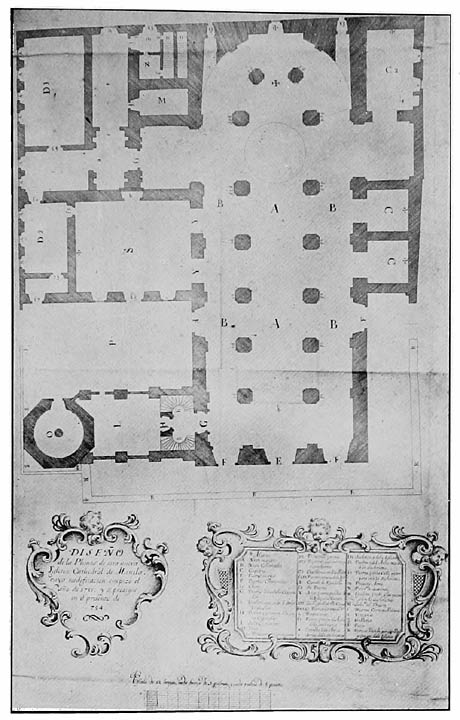
Plan of Manila Cathedral, showing the new structure building in 1754
[Photographic facsimile from original MS. in Archivo general de Indias, Sevilla]