Front matter
Reading edition
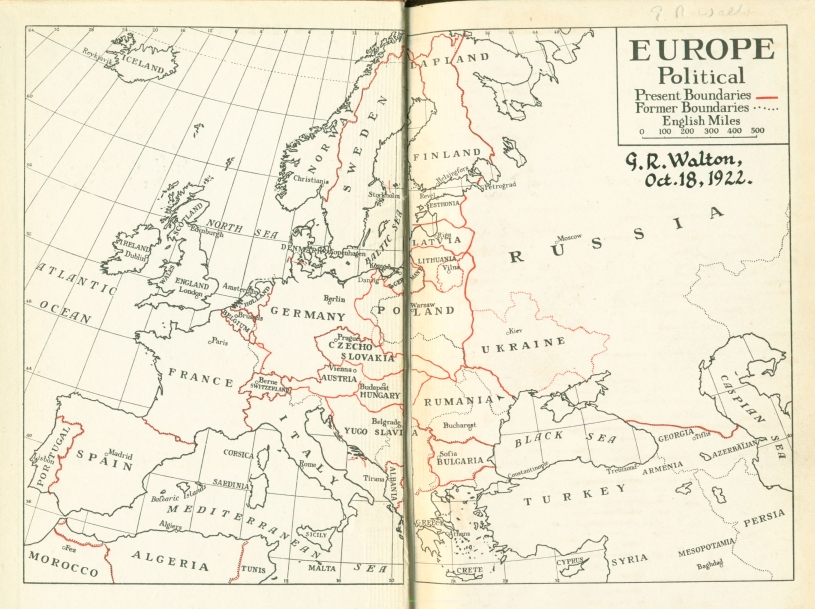
THE PEOPLES OF EUROPE
BY
HERBERT JOHN FLEURE, D.Sc.
PROFESSOR OF GEOGRAPHY AND ANTHROPOLOGY AT THE UNIVERSITY COLLEGE OF WALES HON. SECRETARY TO THE GEOGRAPHICAL ASSOCIATION
LONDON OXFORD UNIVERSITY PRESS HUMPHREY MILFORD 1922
Oxford University Press
London Edinburgh Glasgow Copenhagen New York Toronto Melbourne Cape Town Bombay Calcutta Madras Shanghai
Humphrey Milford Publisher to the UNIVERSITY
CONTENTS
Introduction
1. 'Races'
2. Language Families—Introductory
3. The Peoples of Romance Speech
4. The Peoples of German Speech
5. Some Peoples intermediate between Romance and Germanic in Speech
6. Peoples of Low German and Scandinavian Speech
7. The Peoples on the Eastern Border of Europe-of-the-Sea
8. The Slav-speaking Peoples and the Borders of the East
9. Some Phases of Evolution of European Life before the Industrial Revolution
10. Aspects of Modern Europe
Bibliographical Note
INTRODUCTION
If there be any truth in the view that our philosophical theories grow out of our circumstances, it cannot be doubted that the philosophy of change, sometimes optimistically called progress, is curiously appropriate to Europe. The intimate juxtaposition of small areas of mountain and plateau, of river and sea, of valley and plain has multiplied contacts between men of diverse activities, experience, and outlook, and has thus encouraged not only exchange of ideas but also fermentation of thought. Economically, also, the trend has always been towards mutual dependence, and the penetration of inland seas far into the Continent has further assisted intercourse from far-off times. A self-sufficing community left to itself will evolve a routine and may stagnate therein; external contacts are most important in that they may ward off this danger. On the other hand, it must be remembered that these contacts may prove disastrous by breaking threads of tradition developing towards a fuller realization of the good life. Thus social importations into many regions of the Mediterranean in the days of the growth of the Roman dominion were brought about through conquest followed by transportation of the enslaved foemen, with grievous results both to Rome and to the slaves. Or again, the rapid growth of British trade at the Industrial Revolution brought many new contacts that, as in the case of Rome long before, promoted exploitation on a large scale, and made the stories both of the factory-children of England and of the slaves of America stand dismally parallel with those of the slaves of ancient Rome. In both instances the loss of social and intellectual heritage involved in these ugly schemes is full of fateful consequences, which worked themselves out in the case of Rome and may be doing so in the case of Britain. Contact and association without alien dominations, whether personal or regional, at any rate are of the utmost value as refreshers, and Europe has had unequalled opportunities in this direction.
But Europe, as known in current geography, is not an effective human unit. In a certain broad sense it becomes one if we add to it a good deal of South-west Asia and North Africa, so that all the frame of the Mediterranean, Euxine, and Caspian is included. In a more real and detailed sense, however, we should be careful to distinguish that portion which is intimately affected by the sea from that part which is in the first place the threshold of the great interior.
Europe, west of the Pripet Marshes, rarely suffers from extreme heat, and its winter frosts are less severe and prolonged than those of Muscovy. The temperature north and west of the Alps varies just enough on either side of the optimum of 60°-64° F. to provide desirable physiological stimuli, with only short and irregular periods when conditions are really harmful. The Russian plain beyond the Pripet Marshes is, on the other hand, subject to painful extremes which seriously limit man's efficiency in both winter and summer, and leave him but short periods in spring and autumn for effective freshness and enterprise. In consequence of this, Western Europe, or we may call it Europe-of-the-Sea, shows continuity of activity through the changing seasons, a continuity of thought and criticism which has exercised a powerful influence on government and social order, while the sea, as above suggested, has promoted contacts and kept things moving. In Europe-of-the-Sea, at least where we do not get the ill effects of alien domination above mentioned, we thus find that, between the warrior leaders and the labourers, the traders and professional people or middle class have developed power and have acted as a cement for society on the one hand, and as organizers for its maintenance on the other. Spain (with its long struggle between Christianity and Islam), Ireland (under English domination), the Balkans (under one dominator after another and finally under the Turk), all show historic inhibitions which have delayed and hampered the healthy development of a society free to work for that fuller realization of the good life. Elsewhere it is noteworthy that there have been many attempts, some successful for a time and all valuable, to secure real participation by the people in their problems of social organization, real liberation from the inhibitions involved in government by a superposed class or group. In spite of the difficulties of the present generation, the tendency is for these attempts to gain in power and scope, and to overstep the artificial boundaries of nation and state which are becoming a bed of Procrustes for the peoples of Europe.
On the other hand, east of the Pripet Marshes the long periods of trying climate, coming regularly in winter and in summer, limit, for the folk who have to live unprotected lives, the possibilities of the effective vigilance and criticism whereby the western European organizations are kept going. There is actual pressing need of a routine of tradition on which to fall back in these times of stress. There is also the fear of the grassland tribes tending to keep the people organized on a traditional basis as war leaders and labourers, while the distance from the sea diminishes trade and the middle class, and helps to maintain localism, which in its turn strengthens routine. There we thus find typically a middle class largely immigrant and alien to the military and labouring classes, and this further complicates the problems of social development and organization.
Europe, east and west, thus shows striking contrasts which have fateful consequences; there are also contrasts of importance between north and south. The latitude of most of Europe is such that the sun's rays strike the soil too obliquely to act chemically upon it with sufficient rapidity to decompose fresh material for plant growth as fast as plants use it up. In the Mediterranean region this is hardly the case, but in several parts the soil possibilities are very indifferent, so that our contrast is more between Europe and the Tropics than between north and south in Europe, though it is a valuable clue to many of the differences between the German plain and the Paris basin. Broadly we may say that our latitude has made a really self-dependent agriculture almost an impossibility for Europe, and we note in illustration that Bohemia is suffering sadly because foreign fertilizers could not be imported in 1914-18. The problem of diminishing fertility has made itself insistent again and again in European life, and has proved a goad to drive men to agricultural experiment on the one hand and to trade as a supplementary source of wealth on the other. The contrast between Europe and many parts of China in this respect is a profitable study, if we do not exaggerate, as is so often done, the supposed stagnation of the Orient.
From trade the men of Europe have been lured on into large-scale industry with the application of coal, oil, water, and sundry other forms of power in immense amounts. The opportunities for domination and consequently exploitation which this has brought are working out fatefully for us all in many varieties of hurtful contacts, needing humanization most urgently if the situation is to be saved for our children.
The process of change, we realize, has progressed faster and farther in the west than in the east of Europe, which goes forward against the pressure of severe inhibitions that make its problems differ from our own. At times we are content to look down upon the wild ways of East and South-east Europe, forgetting that in many respects, such as the exposure of severed heads recently commented upon as happening in the Balkans, we were not long ago at least as wild as they seem to be now. But we must also guard against the thought that they are merely some steps behind us on the path we all are treading; that concept of human evolution as a procession along a path is a wrong and very misleading one. We must reach the broader view which thinks of East Europe not as undeveloped West, but as diverse.
In our changeful continent we may thus follow out one of the most varied and perilous of the stories of men, a story of hardly-won triumph over serious obstacles, triumph maintained for a while in the face of serious threats that never ceased. It is a story that leads us to the appreciation of Europe's precarious position of industrial and administrative leadership, with its implications of conflict and unsettlement that make our Chinese friends think of us as the White Peril.
We may study our physical racial origins and see how every modern European people has come to be composed of moderately diverse elements, probably attaining some of their present characteristics during the marked changes of climate and opportunity accompanying the retreat of the glaciers at the close of the great Ice Age of Europe, and developing them further with changes of location and opportunity in subsequent times. We may see, as it were afar off, facts that will be clearer to the scientific men of fifty years hence, facts of the Mendelian inheritance of physical characters, leading, on the one hand, to the maintenance of types very little changed even through thousands of years, and on the other to the combination of diverse heritages from many sources, making an individual in many cases a mosaic of characteristics from different ancestral types.
We may study the languages and religions of European peoples and see that in the days before writing and markets became features of local life, languages changed, albeit slowly, spreading in waves of civilization, with only a subordinate relation to the waves of racial type. And if languages spread in waves of civilization, this has been the case still more in matters of religion, though folk tradition has a remarkable power of resurgence that leads to the local adaptation of religious movements time after time.
We may finally study economic activities and follow their influence in waves, the power and direction of which are affected by racial facts because temperament is no doubt related to physical type, but are more governed by language distributions because difference of language makes such a bar to economic intercourse, at least in early stages. In later stages, with the utilization of coal and steam the international web is woven more closely and more subtly, and this has sadly aggravated the catastrophe due to its rupture by the clumsiness of politicians in the years leading on to 1914.
And all through the process of evolution of races, of language and religion and of industry, we may follow the social life of the European peoples and the development of its organization and its expression in response to those processes of evolution. We must see at the same time how it both affects and reflects alterations which are always occurring in the European environment through changes of climate, rising and sinking of the land, clearing of forests and draining of swamps by mankind, development of communications, and other results of the labour of man.
1 'Races'
Human diversities are deep enough to make the idea of 'European Man' a mere abstraction; we need to think rather of 'European Men' and to study with that broad fact always in mind, realizing that Russians and ourselves are not to be thought of as at different steps on the same ladder, and that the unity which has undoubtedly been trying to grow up in Europe must be a unity-in-diversity with an accompanying growth of education in toleration and breadth of appreciation.
As physical racial facts may be claimed to be to a large extent very old, it will be well to begin our survey with them, but for our present purposes it is permissible to neglect the scattered facts thus far ascertained about the European men of the days before the close of the last major phase (Würmian phase) of the Ice Age. From the period of climatic improvement (Aurignacian) next succeeding, we have several human skeletons that demonstrate the presence already at that early time of diverse physical types. One type, known from two skeletons at Grimaldi (lower Aurignacian), as well as from later remains, shows features in the mouth and nose as well as in the very long and high skull which relate it to types that have become specialized as Negroids of various kinds in Africa, but need not have had marked negroid characters in the first instance. Another type also possessed of a very long and high-ridged skull is known from several skeletons (Brunn, Brux, Combe Capelle, &c.), of which that from Brunn is the best known. There can be little doubt that this type with its strong brows, deep-set low eyes, cheek-bones projecting at the sides, broad nose, projecting upper jaw and dark colouring is an element in the modern population of remote spots in several parts of the maritime fringe of Europe to-day, and was an important element (whatever its colouring then) among the people of the 'Kurgan' burials so numerous along the borders of the South Russian steppe. Nor can we any longer doubt that this type, modified in the course of time, has been an important element in the evolution of modern European breeds. A third type remains mysterious; it is that represented by the skeleton of an old man at Cro-Magnon with tall stature and a fairly long head, which, however, was not very high or ridged. The nose was narrower, but the eyes were low and the jaws and cheek-bones very strong. The matter has been confused by the frequent application of the term 'Cro-Magnon Type' to all the above indiscriminately, mainly on the ground of long-headedness, and this makes it difficult at times to ascertain what writers really mean when they speak of survivals of the Cro-Magnon type in modern populations. There is, however, no doubt from Collignon's careful descriptions that both the Cro-Magnon and the Combe Capelle types survive in the Dordogne district of Central France, and it seems likely that the former as well as the latter also survives at least in the north of the Iberian peninsula.
However this may be, it seems clear that the peoples of Europe in the Aurignacian and the next following ages (Solutrean and Magdalenian) were long-headed, with varied accompanying characters which may still be seen nowadays. Those were ages of intermittent retreat of the Ice Sheets which had for ages previously made Europe so inhospitable to mankind, but at the end of the Magdalenian Age the snow line definitively crept up the mountain sides to something like its present level, and the mountain regions were made available for a beginning of human occupation. The coming of broad-headed men, probably from Asia Minor, then less divided from Europe, is characteristic of this period of change, and the mountain axis of Europe has ever since been a region of broad-headed men, separating provinces of long-headed men to the north around the Baltic and (for a time) in Russia, and to the south around the western Mediterranean, then becoming increasingly cut off from tropical Africa by the supervention of desert conditions, in place of grassland, in what we now call the Sahara.
The long-headed men around the Baltic and in early prehistoric Russia became, in course of time, what is called the Nordic race, and those around the western Mediterranean, with allied elements in the Aegean Isles, the Mediterranean race. In both cases they include survivors of the Combe Capelle type, and in the latter at least some of the Grimaldi type as well, and they are both still long-headed, though in both there has been a general, if slight, rounding of the head, so that it is less long and narrow than it was in early times. In the cool and cloudy north, with long continuance of the open-air life, sex maturity has come late, growth has been long continued, muscularity and the accompanying roughness of bone have been maintained and even developed, the nose has grown long and narrow, and with it the face has lengthened, the colouring has become fair. In the sunny south the settled life is of old standing, and sex maturity comes early. Growth is not so long continued, muscularity is less developed, and the tendency is towards smoothness of bone, the nose and face are moderate, the colouring is rather dark.
The provinces of Nordic and Mediterranean races are widely separated by the mountain zone in Central Europe, but in the west they grade into one another, and here the old long-headed type has become neither purely Nordic nor purely Mediterranean. Especially in Britain, of old a refuge of the past off the shores of Europe, Aurignacian types have persisted markedly, and this is still more noteworthy in Ireland. The mass of the population of our islands is long-headed and intermediate in character between the two differentiated races, tall, gaunt, and dark in parts of the Scottish Highlands and North Wales, short and almost Mediterranean in parts of South Wales and Ireland, and 'betwixt and between' almost everywhere. Probably almost every hundred, not to say every parish, of the British Isles has examples of these Intermediate Types, as well, of course, as of Nordics due to immigrations from Scandinavia and the Baltic.
The broad-heads of the mountain axis of Central Europe are technically called the Alpine race. They are distinguished by a thick-set appearance, rather straight brown or chestnut hair, grey to brown eyes, often a dry whitish skin, a short face, a moderate nose, sometimes pointing out rather markedly. In the Illyrian Alps and parts of the Carpathians, and stretching from the latter, on the south side of the Pripet Marshes away into Muscovy, this stock is often tall and dark. In the Swiss and French Alps it is rather short and stocky. In the Balkan Peninsula it is often characterized by a flattening of the back of the very high and short head; in the west the tendency is rather towards general rounding of the head.
It is interesting to notice from the above that the main facts of distribution of race type in Europe probably date from the beginning of the Neolithic Age, the period of ultimate recession of the great Ice Sheets. In the subsequent ages there has probably been modification of the race types to some extent, but the main facts of distribution of human stocks in Europe became settled in that early time.
Some of the modifications of this scheme must be noticed briefly.
The old long-headed stocks of the Steppe border in South Russia probably still form elements of the mixed Cossack populations, but the spreads of broad-heads both from the Carpathian forelands and from the Asiatic steppe have altered the average type a good deal. Asiatic broad-heads with the big cheek-bones and Tungus (often called Mongol) eyes have also long occupied the Arctic border of Russia, as Lapps, Samoyedes, &c., and, mixed with Nordics, they form the Finn populations. Their features have at times been said to be distinguishable right down the east side of the Baltic into East Prussia in individuals here and there; one certainly finds them now and again in Gothlanders and even in Swedes. The net result is that the long-headed type is not a dominant element in Russia, save perhaps in parts of the one time Baltic provinces, that is in the new Baltic States.
The line along which the hill masses of Central Europe grade down into the European plain that stretches from Ypres to the Urals is marked out in many ways in European life. Not far from it is the main line of European coalfields, a most momentous factor for modern times. It is a line of exchange towns of ancient renown. Near it is a belt of loess, that is of loose wind-blown material laid there in the interglacial phases of the Ice Age, so fine grained that it does not encourage and has never encouraged tree growth, though it is valuable for cultivation. The loess belt, because of its freedom from forest, was naturally of importance as a line of movement of early man as well as a line of early settlement, and it lay between the province of the long-heads (Nordics) and that of the broad-heads (Alpines). All along here are found and have long been found breeds originating from intimate inter-mixture of Nordic and Alpine stocks.
The general fact seems to be that the head form is derived from the Alpine, and so is broad, but the colouring is more usually inherited from the other side, and so is generally fair. There are many varieties with distinctive facial and other features, but the broad fact is that the southern zone of the European plain, where the two stocks have had much fractionated contact (contacts of small groups) in little clearings of the forests that grew in Neolithic times, is a region of Alpine-Nordic stocks which have spread to Britain and through the Danube gaps towards the Balkans as well as in many other directions.
The amount of intermixture and intermediacy on the south side of the mountain axis is less marked, for here there were not the same occasions for mingling of small groups. The broad-headed stocks have, however, spread downhill, and occupy a great deal of North Italy. They are of less consequence in the Iberian Peninsula; the Balkan Peninsula is and probably has been their home from early times. A broad-headed stock with markedly dark colouring and frequently massive build is found on coastal patches here and there along the Mediterranean shores and on the coasts of Western Europe. It occurs as an important percentage in many coastal communities, and is almost certainly composed of survivors of prospectors and traders of the dawn of the Bronze Age and some later periods.
These few references must suffice to illustrate the kind of modification which the early and fundamental racial distribution has undergone; it may be condensed into the statement that broad-headedness has on the whole spread downhill, and has increasingly limited long-headedness to the fringes of Europe. It has done this not so much by sheer replacement of population as through its biological advantage of dominance over long-headedness in many cases of mixture. There has, however, been a definite spread of people of broad-headed type into the Russian plain, as well as many movements of peoples, to some of which we get references in the early chapters of written history.
2 Language Families—Introductory
The languages of the European peoples are to a large extent grouped into Celtic, Romance, Teutonic, and Slavonic families, all of which have sufficiently similar features to be classed together with Sanskrit as Indo-European or, to use a much-disputed term, Aryan. Asiatic immigrants into Europe both in Arctic regions and on the steppes of South Russia have brought in Asiatic languages which have managed to persist as far west as Lapland, Finland, Esthonia, and Hungary, but they are not sufficient to affect the general statement.
The prior home of the Indo-European languages has been discussed almost ad nauseam, and it is still so unsettled a question as to make it unprofitable to discuss afresh whether that home was on the Asiatic steppe, in the mountain and plateau country from Asia Minor to the Hindu Kush, on the grassland borders of South Russia, or somewhere near the Baltic.
It would at any rate seem that these languages did not originate in the Mediterranean, and that the languages of that region in pre-classical times were of other affinities. Minoan, Etruscan, &c., are still undeciphered. If then the classical languages came into that region from outside, the probabilities are that they came in from the north, where are found related languages which have certainly not come from the Mediterranean.
The only language which is of older date in Western Europe than those of the Indo-European family is Basque, still spoken in and near the western Pyrenees. It is a mistake, however, to speak of a Basque race, for the physical types to north and south of the Pyrenees are predominantly broader and longer headed respectively. Educated people in Basque country speak either French or Spanish in addition to the mother tongue, and the Basque language has thus taken up many words from its neighbours; it has very little literature and has contributed extremely little, so far as is known, to French and Spanish. Its affinities are quite unknown, though a kinship with the Bronze Age languages of the Mediterranean is suspected, and suggestions of relations to languages of North Africa have been made.
Of the Indo-European languages it seems to be generally agreed that Lithuanian is the most primitive surviving in Europe, and may be the most primitive of all.
This might be held to imply that Lithuania is near the ancient home of these languages, but it is more probable that old forms survive here because it is a forest country shut off from the great highways of human movement by the immense Pripet swamps to the south of it. It is as likely a place for a 'refuge of the past' as any spot in Europe. Lettish is related to Lithuanian, but the Letts have long been active and commercial, and their language has shed archaisms and borrowed a good deal from Slavonic tongues. Prussian is now quite extinct. Meillet describes this little group as Baltic; and it is related to the Slavonic family. Other writers give the stricter name of Lettic. The Albanian dialects in the Illyrian Alps are another ancient survival with unknown but doubtless Indo-European affinities, and also a considerable Romance element.
Albanian and Letto-Lithuanian apart, the four great families of Indo-European language, Classical and Romance, Celtic, Teutonic, and Slavonic, must have become distinct before the days of the Roman Empire, and must already at that time have developed diverse forms in their various areas. The Classical languages seem to have reached Greece and Italy from the north; how and when we shall not attempt to speculate. The Celtic languages now spoken by the varied and mixed racial stocks on the westernmost fringe of France, Britain, and Ireland, include two groups, one of which, in its use of the q sound and in other features, is held to be fairly close to the root language of Latin, while the other often uses p instead of q.
The q-Celtic languages spoken in parts of Ireland, Isle of Man, and the Highlands of Scotland are usually supposed by archaeologists to have spread westward from Central Europe with the men of the leaf-shaped (bronze) sword about 1000 B.C. The view of Zimmer and Kuno Meyer that the q languages reached Ireland via France without touching Britain is now held to be less probable. The p-Celtic languages are almost universally associated with the invaders of Britain in the pre-Roman Iron Age (the La Tene period). That these men occupied south-east Britain to a considerable extent there can be no doubt, and it is highly probable that their physical type is far more characteristic of the English plain to-day than of any part of Wales, save probably the Severn valley. Yet it is Wales that talks the p-Celtic language, which may have reached it in Roman times, while the Severn valley and the English plain have taken to English speech. Thus we see how inadvisable it is to speak of language-groups as race-groups.
The Baltic or Lettic and the Celtic languages are in essentials survivals of antiquity, of great interest and value as preserving elements which would otherwise have been lost by process of time, but of uncertain future, for no man can say to what extent they are likely to be spoken a few centuries hence. It is otherwise with the Romance, Teutonic, and Slavonic families of languages; they are the definite possessions of the peoples of various regions for centuries to come, and it will be well for us to try to realize how this has come to pass.
Whatever their origins, the Classical tongues spread southward into the Mediterranean. Greek was propagated far and wide by trade and by the movements of which Alexander's march to India was a sign as well as a factor. Rome gathered up into itself the general heritage of antiquity for better and for worse, and associated it with the Latin language, which became a lingua franca in some sort within the bounds of the Roman dominion, so that it influenced deeply not only the language of Gaul but also that of Britain (the p-Celtic language). The power of Latin was so great that only insensibly did the more modern languages, Portuguese, Spanish, Catalan, Italian, Provençal, and French, arise out of it, leaving ancient forms like Walloon, Romansch, Ladin, and Frioul in remoter spots. Their rise was an event of the Middle Ages, though the habit of using Latin for scholarly purposes persisted far longer. In earlier times languages evidently were more fluid. Walloon is practically French with Latin and Celtic elements rather stronger than they are in Parisian, and we have little doubt of the Latinization and subsequent Gallicization of a previously Celtic-speaking people. But since the Middle Ages language frontiers have hardly moved.
This fixation of language has several factors.
In the first place, while villagers beginning to conquer a forest may be feeble and isolated, and liable to rapid change of domination and of culture relations, the process of closer settlement brings them into relation with one another, at any rate over small areas, and gives language a much greater hold on a larger number of people.
In the second place, closer settlement generally implies the evolution of markets, substituted in some cases for the seasonal fairs that were sufficient in times of smaller needs and sparser population. And the market with its settled population of tradesfolk and lawyers makes a language centre. With this goes also some development of communications, or at least of their use, and the possibility of the rise of language beyond mere localism. The crusaders, pilgrims, students, and minstrels of the Middle Ages need to be in the student's mind in this connexion.
In the third place, the development of the art of writing and its increased use are great factors of language fixation, and associated with this is the development of a settled legal system.
We should have these points in mind in trying to understand the evolution of the modern distribution of the languages belonging to the three great families, an evolution which has occurred to a large extent since the fall of the Roman Empire.
3 The Peoples of Romance Speech
Rome may be said to have gathered up the heritages of antiquity and to have passed them on to that part of Europe which the Empire administered, profoundly influencing for a time at least the intimate life, and therefore the language, of the people in all parts in which it found people not as yet accustomed to writing.
In the Aegean, Greek was old established, and intercourse had developed a unified language out of the variants and dialects of earlier times; hence Latin did not impose itself, and a modified Greek has persisted down to modern times, with the serious limitation that the written language is very different from the conversational one, and that therefore the vitality of literature is much reduced, and the life of the people held back thereby.
It has often been noticed that whereas Latin spread far and wide from Rome to Portugal, the Rhine and Rumania, Greek did not spread, or at least did not maintain the majority of its temporary spreads, from the Aegean.
The reasons for this are doubtless numerous, but among them one may note that the spread from the Aegean could hardly be into regions just being opened up for agricultural settlement, and that the Latin spread was associated with the spread of a great scheme of communications and of legal organization. Again, one should realize the localism which was so deep-seated in Greek feeling, and contrast it with the famous idea of 'Civis Romanus'. In accord with this we naturally find that the Eastern Church translated the sacred books into the Slav languages, whereas the Western Church has insisted on Latin in a way that has been full of the most momentous consequences for modern Europe. We must also remember the progressive hemming in of the Greek region by Islam at the time when languages were growing out of Latin in the west, so that the Greek base had nothing like the expansive power of the Latin one.
Facts of physical geography had a good deal to do with the rise of the Romance languages from Latin. The Empire reached to the Danube and Rhine and over the English plain. It had some hold over Wales, and for a time over South Scotland, but none over the regions where Celtic has persisted in Gaelic form. It is abundantly proved that the hold of Rome over Britain was less close than that over Gaul, where much Romanization of the leader classes occurred, and the Romanized urban life was fixed for all later time in the south. Fragments of evidence from Silchester and elsewhere go to show that Latin was widely used in urban life, and so its vocabulary penetrated the language of the pagani or peasantry, and Welsh to this day retains many traces of this contact with Latin. But a country with marked contrast of speech between peasant and citizen is linguistically weak, and the Anglo-Saxons were thus helped to spread their language when they arrived after the Romans lost their grip and many Romano-British leaders had emigrated to Brittany. Romance languages do not now reach the banks of the Rhine anywhere, though they approach them fairly closely at the gate of Belfort, that approach to the Rhine where southern influences would spread most powerfully. Wallony, as a dissected plateau, rather remote and backward until the coal period, has retained its Romance speech, and has increasingly assimilated it to modern French. Lorraine, separated from the Rhine basin by the forested heights of Hunsrück and Hardt, has also remained stubbornly French, but German has spread up the Rhine tributaries through North Switzerland, up the Ill basin, which is now Alsace, up the Moselle gorge between Hunsrück and Eifel, so that Trier (Augusta Trevirorum, Treves) is now German, up the tributaries of the lower Moselle, so that the peasantry of Luxembourg, the people of the Eifel and of the Saar basin, are largely or even mainly German speaking, and along the lowland to Flanders, which maintains Low German dialects, collectively called Flemish. The Flemish plain and the Walloon plateau were long separated by the forests of Hainaut and Brabant, but the clearing of those forests in the Middle Ages, mainly by people spreading down from the plateau, extended the area of Gallic speech and reduced the chances of development of a real linguistic unity in the Flemish fringe. Flanders in consequence suffers from disparity of dialects, and French has been widely used as a language of civilization. With the rise of the nationalist sentiment (see p. 98) in modern times, a severe reaction against the dominance of French has set in, and now threatens the very existence of the Belgian kingdom. A part of the département du Nord, in France, speaks Flemish, but French has long been gaining ground slightly on Flemish in France and probably in Belgium too, in spite of a modern spread of Flemish workpeople into the French speaking area.
East of Switzerland the great Alpine barrier between the Roman bank of the Danube and the real Latin areas brought it to pass that the pagani near the Danube were not fully Romanized, and made the whole region fall linguistically to the invading languages, German and Magyar, but a small island of Ladin, a collective name for several ancient dialects, still persists around Cortina and in the upper Grodenthal. The allied Frioul (with more Italian admixture) is spoken in eastern Venetia, and Romansch, also related, in the south of Grisons, East Switzerland. The main boundary between Romance and Germanic is, as usual, not along a main watershed. The watershed, which is pierced by the Brenner Pass, has German spoken on both sides, and the agency town on its south side (Bozen) is still German in language, though strategic considerations have made the victors move the new bounds of Italy right up to the Brenner.
A curious result of language changes is observable in Rumania. The Roman frontier province of Dacia was strongly occupied for a time (A.D. 107-255), and the Low-Latin element must have had a marked cultural superiority over the indigenous migratory shepherds. They imposed their language, and the Transylvanian mountains have assisted its survival ever since, but it has survived only thanks to large borrowings which have made its vocabulary three-fifths Slav. In spite of military pressure from time to time, the people of this hill knot have followed the usual rule for people so situated, and have spread downhill, giving an area of modified Romance language from the Dniester almost to the Tisa (Theiss) and from Bukovina to the Balkan Danube. This area was, however, seriously isolated from the other Romance regions after A.D. 270, and it naturally received Christianity from Constantinople, so that it has come to be distinct (p. 79) religiously from the other areas of Romance speech, which are the stronghold of the Roman Catholic Church.
The large Slav element in Rumanian well illustrates the general principle that vocabulary is more easily changed than syntax, a principle one may follow along the Flemish border, where Flemish idiom is maintained with French words, or along the Welsh border, where the form of sentence is so often Welsh though the words be English.
Speaking generally we see that there has been on the whole a certain recession of Latin from the old boundaries of the Roman Empire, but that, this apart, that Empire exercised a most potent influence on the speech of its European citizens. The recession was due to mass invasions which, however, as a general rule, penetrated much farther into the Roman domain than one would judge from linguistic evidence alone; in other words, the Latin influence has surged up again, and indeed in one sense those repeated resurgences of Latin feeling have been a main feature of European life in the last twelve or fourteen centuries, while the swaying of the power of Latin and non-Latin elements has been one of the chief causes of war and disunion on the Continent. We may now glance at a few aspects of this swaying of boundaries which are germane to the object of this little book.
The Roman Empire in Gaul seems to have been divisible into belts, the southern of which, with its dry and sunny summer, became deeply Romanized in city and country, language and tradition, a zone in which the cities were the residences of all who had sufficient wealth. The middle one, in the main the Paris basin, had fewer cities, but the country was Romanized in language at least. The northern one near the Rhine had strong Roman cities, especially frontier-towns along the river, but the country does not seem to have been Romanized at all deeply.
The Franks seem to have been bodies of adventurers seeking new homes, the surplus population of Teutonic regions in what is now north-western Germany. They were not trained to city life, and though the strong frontier-cities survived their passage, the cities of the Paris basin seem to have weakened under their onset, albeit the invaders were not able to break the continuity of civic life in the south. The Paris basin thus became provided with a rural Frankish landed aristocracy around which later on there developed the localism which is called the feudal system. As is the way of aristocracies the rude Franks adopted and modified the Romanized language of the Gauls, making the langue d'oïl the mother of modern French. In the south, older forms persisted less altered as the dialects of the langue d'oc.
Though in more modern times French has more or less triumphed in the south, two variants of the old languages persist and have acquired some literary strength; they are Provençal, in use in Provence, east of the lower Rhone, and Catalan, in use in Catalonia, and to some extent in Roussillon, modified by contact with Spanish. Needless to say the patois of the peasantry of southern France retains many traces of the langue d'oc, and the boundary between the langue d'oc and langue d'oïl has been traced by French scholars. A study of that boundary shows that the langue d'oïl penetrated through the gate of Poitou between the Central Plateau and the barren lands of La Gatine, and established its hold in the basin of the Charente, and almost as far as the gates of Bordeaux. Farther east the lower slopes of the Central Plateau form its effective boundary; the export of men and women downhill from the plateau being apparently sufficient to restrain the general tendency to uphill spread of the language of the plain. In the Rhone valley the boundary of the langue d'oc bends southwards, so that Lyons belongs to the langue d'oïl, and the whole Isère region is intermediate between north and south. The boundary near the Rhone is at the narrowing of the river valley near Valence. The narrow, formerly forested, section of the Rhone valley between Valence and Donzère has been a barrier in several ways; Mr. Peake has shown that it divided a Burgundian from a southern culture in the earlier phases of the Bronze Age. It was a factor in the southern boundary of the Burgundian kingdom of Theodoric's time (c. A.D. 520), in the boundaries of the Comté de Provence and the Comté du Valentinois, and so on. Donzère is approximately the northern limit of the olive, and the Isère basin has forests that are distinctly non-Mediterranean on its great slopes. As one journeys from the Isère region to that of Drôme and Durance one finds the aspect of the country changing from that of the forest of summer green to that of bare rock masses and a marked tendency to summer brown.
Central France
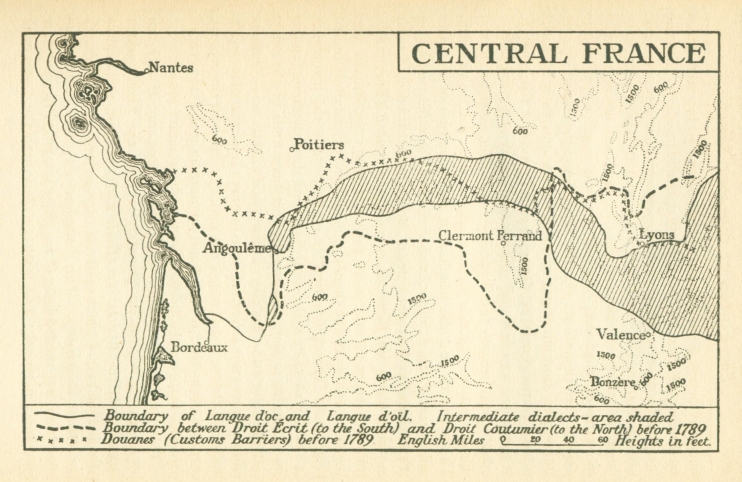
That this boundary is not an isolated phenomenon is well seen by comparing it with the boundary between the France which reintroduced the Roman law (Droit Écrit) early in the Middle Ages and the France which preferred to go on judging by customary law (Droit Coutumier). This boundary and that of language intertwine, but the influence of big cities as legal centres accounts for some differences. The legal boundary naturally keeps some distance north of the linguistic one near the great southern city of Bordeaux. On the other hand, the influence of valley cities like Clermont-Ferrand helped the northern law to penetrate up the slopes of the Central Plateau, so that the legal boundary is here the more southerly. Lyons, a southern city in so many ways, pushed the legal boundary far to the north of the linguistic one in the Rhone-Saone basin. The boundary line of old-time (pre-1789) Customs Dues, the boundaries of the various Salt Dues (Gabelles), of the Governments in existence in 1789, of the general prevalence of the Gothic style in architecture, of the general prevalence of (north) steep-roofed and (south) flat-roofed houses respectively and so on, are all related to the above lines, and can be followed in some detail to work out interesting divergences. The net result of a study of these lines is to show that the French people, apart from the German borderland, consist of two cultural elements, a southern with Roman survivals in cities, language, &c., and a more northern one which is much less Roman. Between them is an intermediate area with mixed allegiance. The study of such a set of boundaries can be given a special value, for it shows us that the linear boundary, however necessary it may be under our outworn system of aggressive states in politics, is an artificiality when applied to the study of peoples. Boundaries are zones, not lines, zones of intermediacy which with better political organization might become interpreters rather than causes of conflict as they have been in the past.
In order to understand the German borderlands better it would be well to use similar methods in studying them, though here we have difficulties due to political prejudice. We have seen that in the Paris basin the rural Franks adopted in modified form the Romanized language of the Gauls, and with this came in the influence of the Roman Church, the heir of the imperial tradition, not only here, but also along the old frontier of the Rhine-Danube. Under this influence civic life grew afresh, and the towns of the Paris basin with their market-places dominated by the cathedral are a most notable feature. As these towns grew, the enlargement of the churches under the influence of the great wave of mediaeval enthusiasm led to the adoption of what is called the Ogival or Gothic style of building, in the Ile-de-France, and soon in the Paris basin generally, as a substitute for a Romanesque style which had been tending to change under pressure of Eastern (Byzantine-Lombardic) influences. With the details of architecture we are not primarily concerned, but the spread of the Gothic over the Paris basin, its failure to oust the Romanesque in the south, its penetration along the Route de S. Jacques (Pilgrim Road to Compostella) to Bordeaux, Bayonne, Burgos, and Léon, its later spread through the Flemish lowland and also across the hills to Metz, Strasbourg, and Basle, are a useful indication of the spread of Gallic feeling. In the Rhine region it spread with difficulty, and the Romanesque is highly characteristic here; beyond the Rhine it spread only with much modification.
The contrasts between the boundary of the fully French Gothic and the intertwined boundary of French speech, over against German, are like the contrasts above noted between south and north in France, and one might further study the growth of the historic kingdom of France, the lines of Customs Dues, Gabelles, and so on, as well as facts about the occurrence and relative importance of Protestantism in various parts. All would show that between the Paris basin and the Rhine is a zone of people with mixed allegiances, and that, however convenient language may be as a distinctive mark, it by no means gives a full idea of the complexity of the case.
Flanders is Low German in speech, but profoundly affected by France in many ways, as its architecture suggests; its zealous Catholicism is a marked feature. Wallony is Celto-Romano-Gallic in foundation, marvellously altered by modern industrialism. Luxembourg is indefinitely debatable, Lorraine mainly French, Alsace Alemannic (Old High German) in speech, but in other respects deeply affected by France.
The study of the zone behind the old Roman frontier of the Danube could be worked out on somewhat similar lines, but with less profit, owing to complications connected with the spread of Asiatic peoples and armies in subsequent times.
The rise of the various peoples of Romance speech behind the ancient frontier is again best studied without too much concentration on the modern states, though language and state do correlate fairly closely.
In the Iberian peninsula, Basque spoken on either side of the western end of the Pyrenees, but over a larger area on their southern side, gives its name to a people physically not very different from their Spanish neighbours, save that probably there are among them more survivors of ancient (Aurignacian) types, especially, it is said, of the Cro-Magnon, than among the majority of the Spaniards. Economically they have a certain amount of distinctness as mountain dwellers on the one hand, and as sailors on the other. Historically, too, they have a certain distinctness; their connexion with the Carthaginians and the Romans, with the kingdom of the Wisigoths and later with the Arab Emirates, was much less close and continuous than that of regions immediately to the south. The people of the little Pyrenean republic of Andorra speak not Basque but Catalan, and are one of a number of instances (San Marino, the four original cantons of Switzerland, Lichtenstein, Montenegro) of the apartness of little mountain groups; there was a number of such groups a few centuries ago.
The main part of the peninsula uses languages that have arisen from Latin, one on the west coast which is known in the two forms of Portuguese and Galician, one along the northern portion of the east coast which is called Catalan, and is more nearly related to the langue d'oc than to Spanish, which is the language of the great plateau of the peninsula, and has become also the language of Andalusia and of the non-Catalan east coast.
In the early part of the eighth century, Islam, at first represented by Berbers and later by Saracens, occupied roughly what had once been Carthaginian Spain, only temporarily holding the north-western quadrant which became a centre of Christian resistance; it had previously remained, for a time at least, apart from the Wisigothic kingdom. The hold of Islam on the east coast north of Tarragona was also only temporary, but as a result of this the Barcelona region during the formative period of language was more in touch with South France than with the north-western and Christian part of Spain, whence its language came to have the kinship with the langue d'oc already noted. In the centuries of Iberian weakness in face of Islam the west coastal plain diverged in speech from the upper Douro basin. As Islam weakened in Spain the west coast language spread southward, while the plateau language (Spanish) spread south especially via Toledo, the Guadiana region being largely waste land for the time. As Spanish, the language of the defenders of Christianity, became the replacer of Islamic languages, it, rather than Catalan, spread over the parts of the east coast south of the Ebro as they were recovered for Christianity. When the north-west was the basis of resistance to Islam, the age-long sanctity of Compostella came into prominence, and the great shrine of St. James (Santiago da Compostella) became world famous, and later on, a centre of pilgrimages. Thus in spite of the kinship of Galician with Portuguese, Galicia became part of the kingdom of Spain, though its seafarers had much in common with the coast-dwellers of northern Portugal. One should note also that, whereas in Portugal the coastal plain has the severe barrier of the plateau edge to divide it from Spain, in Galicia the lines of hill spurs grade down to the sunken coast-line without any marked change.
Though Berber and Saracen elements have been suppressed, a good deal remains to attest their influence not only in cities and their buildings but in the cultivation of the south, and especially in the irrigated gardens (buertas) of the east coast and in many features of the people's life, even in some details of dialect. Arabic is now studied a good deal as a 'classical' language in these regions.
There are sharp contrasts in physical geography between the indented coast of Galicia, the narrow coastal strip of North Spain, the plateau-basin of the historic Léon and Castile, the lower lying dry eastern basin of Aragon, the Catalonian coastal plain with hills between it and Aragon, the barren plateau of New Castile, the southern trough of Andalusia, the east coastal regions of Murcia and Valencia. These contrasts have hindered the growth of intercommunication and of unity, and it is said that recently there were one thousand villages in Spain still lacking effective connexions with the road system. The distinctness of the people of the different regions is therefore a marked feature so far as custom and social inheritance is concerned, and the commercial Catalans have often thought of separating themselves from the old-fashioned agriculturists of Spain. The long duration of the struggle with Islam kept the Spaniards a people of leaders and common soldiers with, for a time, a Jewish middle class (Sephardim). But religious zeal led to expulsion of the Sephardim, though not a little of their blood remains, and they have taken a good deal of Spanish blood with them to their later homes in Salonika and elsewhere. Spain's development of a middle class thus lagged far behind that development among the other west European peoples in the Middle Ages, and the weakness of that class has been a factor of Spain's difficulties ever since, of her troubles in America, of her political weakness at home, of the subjection of her mining wealth to English exploiters, and of her long-continued financial troubles. The railway has improved matters to some extent by promoting communication, but such was the fear of France that the Spanish gauge is different from that of the rest of western Europe. The stoppage of the blood-drain of soldiers and governors formerly sent to maintain her old empire seems to have helped Spain greatly, and the importance of her products in the recent war made her prosper, and her peseta went up far above its old par value, which was 25-22½ pesetas = £1 expressed in English terms. Since the war, difficulties in Morocco, internal strains, resumption of imports, and payments for transport services have sent the peseta down again. It is now 28.50 = £1, but that is still nearly twice the value of its former French, three and a half times the value of its former Greek, and more than three times the value of its former Italian equivalent. The general spread of irritability and of the war spirit, however, seems to have increased the political difficulties between Spaniards and Catalans, as it has those between English and Irish, in both cases partly because the Continent has, elsewhere, so largely been settled on the principle of nationality based upon language, or tradition, or both.
The Portuguese of the north are rather distinct from those of the south, in part because among the latter there is a good deal of African blood derived from intermixture with slaves from the seventeenth century, an intermixture which does not appear to have had good effects. The steep edge of the Spanish plateau behind the Portuguese coastal plain, so sharp that its river-breaches are mostly deep and narrow, helps to keep Portuguese and Spanish distinct.
The old-fashioned agricultural life of the people, based upon corn and sheep in Castile and Aragon, and vines, oranges, and olives in Andalusia and in suitable parts of both east and west coasts; the paucity of harbours, save in Galicia; the ecclesiastical zeal derived from the long fight with Islam and the struggle with the schismatic Low Countries, have all helped the lack of communications to keep Spain old fashioned. The Counter-Reformation, arising out of the struggle with the Protestants of the Low Countries, has been anti-national everywhere, and has contributed its part in hindering the growth of modern nationalism in Spain. Further, owing to her weak middle-class life and her lack of coal, Spain has not utilized even the opportunities she had of industrial development, so she stands apart, in this way as well, from the life of modern Europe. Perhaps the modern development of hydro-electric power may alter this to some extent, and in any case the non-industrialization of the country in the coal age may prove an advantage to the country in the end. Memories of old unhappy far-off things are too apt to make Englishmen emphasize the religious persecutions by Catholics in Spain, forgetting too easily the religious and political persecutions barely extinct in the British Isles. We should remember, on the other side, the traditions of Salamanca University with its blending of Christian and Arab thought at the northern outlet of a mountain pass from Arab Spain, the glories of Santiago, and the part its pilgrimages played in the development of European literature, the galaxy of great names, among which Lull, Cervantes, Vives, and Velasquez are but the best known of many, and last, but not least, the influence of the early phases of Saracen civilization in the south on the then semi-barbaric peoples of Western Europe. We should also remember that Spanish remains one of the great world languages, current not only in the mother country, but also in the greater part of Latin America, with a fine tradition in literature and oratory, as well as in other forms of art. It is interesting that under the newly revised scheme (1921) Spain is added to the four nations (Britain, France, Italy, and Japan) which provide permanent members of the Council of the League of Nations.
South of the great curve of the western Alps the varying dialects have ultimately fused into the beautiful Italian language, the most direct descendant of Latin. Since Roman times there have been notable intrusions from without, such as that of the Longobards or Lombards into the Po basin in the sixth century, and those of Islam and of the Normans into the south, but the Latin element has assimilated all these, though in the Alps themselves the tendency is towards French on the west and German on the north, with the curious survival of Romansch and Ladin, already noted in the north-east. A small area of Italian speech near the coast (Mentone) has been included in France. In Calabria there are a few small Greek patches, and there are Albanian ones in various parts, while Slavonic (Slovene) is spoken in various parts of eastern Venetia and Istria.
The home tradition of Rome was that of the city-state, and it resurged during the period of mediaeval trade and operated against the growth of national consciousness. The influence of the other city-states, notably Venice, operated in the same way in the Middle Ages. This was further held back by the struggles of Germanic peoples to gain Rome and revive the Imperial tradition, and still more by the influence of the Church, particularly since the advent of the Counter-Reformation and the Jesuit power. But the railway made the old localism impossible, and the widespread nationalist movement of the nineteenth century had its effect in Italy as well as elsewhere. The struggle for the unification of Italy and the redemption of Italian lands from foreign dominion by Mazzini, Cavour, and Garibaldi is one of the romances of humanity, and from it has arisen the modern Italian kingdom (1870 onwards) with its promise of magnificent development.
The difficulties in the way include three large ones. Industrial power was lacking until hydro-electric schemes became practicable; they are remedying the position to some extent in the north, and the cleanliness of these schemes encourages high-grade industries. The deep social and even racial contrasts between the Po basin and the south of the peninsula are another difficulty. A third is that of the large and often neglected estates (latifundia) of the south. There neglected drainage has allowed accumulation of stagnant water, and the swamps are infested with malaria, which not only kills many children, but also weakens those who survive its pernicious attentions.
The Italians are among the best engineers of the world, and are minded to remove this difficulty by drainage works, as well as by social reorganization now proceeding actively and contributing an element of unrest that makes Italy's recovery from war sacrifices a complex problem. It is, however, a problem that cannot but be solved, and with the redevelopment of Mediterranean trade following the opening of the Suez Canal and the retreat of the Turk from non-Turkish lands, the future of the centrally placed kingdom of Italy should be a bright one.
Hydro-electric schemes during the past twenty years have drawn North Italy (Milan) and Switzerland, and to some extent South Germany, together, and Milan has grown in wealth and importance as one of the first-rank cities of Europe with her high-grade industries in the city, thanks to the transmissibility of power by cable. The city's long and powerful artistic tradition is an important factor of her industrial future. Of late these tendencies have been encouraged by the policy of the Western Powers, for it now pays Italy to import from Germany rather than from England, and this redevelopment of mid-European economic relations will help to rehabilitate the value of Italian money if internal social politics permit.
The fame of Italian workmen for road and bridge building as well as for cultivation is world wide, and they have spread in considerable numbers both to other European countries and to America. In every case, however, they have found the lands of immigration developed already beyond possibilities of language change, and so the Italian emigrant tends, in the long run, to change his heritage; but in the meantime he sends surplus earnings back home, and these remittances and the money brought in by emigrants returning are an important resource for Italy. It is interesting to contrast French and Italians in this respect; the Frenchman emigrates with the greatest reluctance, but has planted his language very firmly in such places as the St. Lawrence estuary and Mauritius, though political organization there has passed out of his hands. Those emigrations were made when the lands in question were not yet occupied at all by Europeans, and therein lies the difference. The French, Spanish, and Italian peoples of late years have been working to revive the idea of the Mediterranean as a Roman, or rather now a Romance, lake, and have spread their influence along the North African coast, Spain on the Moroccan coast. France into Morocco and Algeria, both France and Italy into Tunisia, and Italy into Tripoli and the Cyrenaica. These are fields of linguistic and cultural as well as administrative expansion, as the French and Italians, at least, appear likely to organize closer settlement and an economic life very different from that which they found.
The French-speaking and Italian-speaking parts of Switzerland can best be treated with Switzerland as a whole, and of the other outlying Romance groups only a few words need be said. In the Channel Isles, the pre-Norman basis was Celtic-speaking, and there are abundant indications of links with Brittany. Norsemen came in and Norse place-names are well in evidence, but the islands under this influence became merely an outlying fragment of Normandy, and Norman French became the language. The islands, in spite of very close settlement, have doggedly retained distinctive dialectical peculiarities. There are many other examples of this non-fusion in islands such as Ireland, Crete, Ceylon, and Java.
Guernsey has at least three varieties, for example. The importance of the roadstead of St. Peter Port in Guernsey for British commerce with Bordeaux in the Middle Ages was a powerful factor in the dissociation of the Channel Isles from Normandy and their retention by the kings of England, and their strong anti-French prejudices were long a feature. The growth of commerce with England and the fact that the local dialects have no literature make the islands one of the comparatively rare cases of modern language change long after the organization of close settlement. Of the islands of the western Mediterranean it may be said that in the Balearics a variant of Catalan is spoken, while the other islands, including Corsica, use Italian dialects, save that the Alghero district in Sardinia uses the same dialect as the Balearic Islands.
4 The Peoples of German Speech
Without attempting to estimate what was the speech of the early long-headed types of man on the European plain (the almost level belt from Calais via Vilna to the Urals), and without trying to dig back deeply into prehistoric time, it may be stated that in the early days of history the home of the Teutonic family of languages seems to have been on the western portion of the European plain and in the related parts of Scandinavia, no doubt with various Baltic extensions. Of its attempts to spread towards the Paris basin then, as in later times, there is little doubt, but its ultimate extension in this direction has already been discussed. It is most probable that the people who used these languages were mainly Nordic coast-dwellers and occupiers of the wet marsh and moorland country on the west side of the Elbe. In many parts their physique must have been Alpine-Nordic to a large extent.
The area of Teutonic speech historically falls into three: the Scandinavian area including Jutland north of Flensburg, the Low German plains from the Elbe to the mouths of Rhine and Maas, and the Highlands east of the Rhine, into which Teutonic speech spread, and in which it became enriched by mixture with Celtic, and, later on, with Latin and Romance elements, and so became Alemannic, and, ultimately, High German.
In Roman times Teutonic speech was thus most characteristic of the belt outside the Rhine frontier of the Roman Empire, and from this basis we may trace the Teutonic peoples onwards. The forests of Germany were dense and extensive, and apparently in post-Roman times they were being attacked in two ways: the hill people were moving down and making the population more Alpine in physical type and more Alemannic in language, and the Church was founding abbeys and spreading its influence across the Rhine from the erstwhile Roman frontier-cities then becoming cities of the Roman Church in most cases. The wave of Roman civilization interrupted by the barbarian movements was thus resumed under Church leadership, and with it went the growth of towns and of intercourse, after some time making the contrast between south and north in Germany not only a contrast between hills and plains and between High German and Low German, but also a contrast between a much more Romanized and civic south and a much less Romanized and more rural north, though the Church did establish itself in the north in due course.
Alemannic became characteristic of the hill belt next beyond the region of French speech, and there replaced a Brythonic Celtic language. But farther east the languages of the hill people had by this time taken Slavonic form, so that the Alemannic belt was of but moderate width, including the Alps and their northern flanks down to the Prussian plain, but not Bohemia and the Carpathian arc which were of Slavonic speech (p. 61). The downhill movement above mentioned characterized the Slavonic hill lands as well as the Alemannic, so that on the Prussian plain east of the Elbe old languages (probably of Lettic kinship, see p. 18) gave way to Slavonic, and in course of time the Elbe became the frontier between German and Slavonic, with the Altmark (old frontier territory) to the west of it.
The progress of Germanization eastwards to the Mittelmark, between Elbe and Oder, and the Neu-Mark farther east, towards but not up to the Vistula, must not be interpreted as meaning that these regions were still purely Slavonic in the days of the Elbe frontier. Probably German was already in use here and there, but Germanization and the spread of the Church involved agricultural development and closer settlement, and so changed the character of the country. It was done under German leadership, and brought in German settlers. In the early Middle Ages there was a recession of Slavonic on the Prussian plain, and now only one fully Slavonic region in the German area remains. This is the Wendish area, and the Wends are supposed to have spread down from the hill slopes on the northern frontier of Bohemia. The present area of the Wends is astride the upper Spree, and especially around Kottbus, and the district is called Lusatia, but in the Middle Ages they spread farther north. It is largely Germanized in speech at the present time, but preserves old features and Slav names. Slav place-names are as characteristic on the German plain east of the Elbe as are Celtic names in the non-Celtic speaking part of Scotland, and illustrate a change of language of a people already having some settled organization. This contrasts with the rarity of survival of Celtic town names on the English plain. The changes of language areas since the Middle Ages have probably been quite small. The zone west of the Vistula has remained a zone of admixture of German and Polish-speaking people, whence the 'Polish corridor to Danzig' of the recent treaties, linguistically and traditionally justifiable and yet admitted to be dangerous politically.
The relation of the Teutonic languages of Jutland to one another in origin is beyond our scope, but the dialect of the western side of the base of Jutland has remained fairly distinct as 'Frisian', and has attempted a literary development in the last century. The new treaty boundary between Germany and Denmark gives what was North Slesvig to Denmark, and is intended to run along a line in the linguistic frontier-zone. The Low German speech of the Rhine mouths, with the long isolation of the people of that region and their concentration on the work of fighting the sea, developed into Dutch.
We thus have Dutch, Frisian, Low German, High German or Alemannic, and naturally a Middle German developing between the two latter along the zone where the southern hills grade into the northern plain.
The complex topography of the south German hill country had given rise to an infinite muddle of small states, and at the end of the fifteenth century they agreed, as the people of South France had done centuries before, to 'receive' the Roman Law. This reception was effective over most of the hill country, but not in any considerable part of the plain, a natural consequence of the contrasts already noted, and a further accentuation of them for the succeeding period. In the early sixteenth century came the religious schism, during which the northern plain and the foothill region left the Catholic Church almost en bloc, while the people of the hill and valley country of South Germany remained attached to Rome. This, however, by no means adequately describes the territories of the two ecclesiastical systems, for the Roman influence on the Rhine seems to have kept the Ems region largely Catholic, while Protestantism occupied the south along the Cassel-Frankfort line, and spread through Württemberg and the Nürnberg district. The strongly Catholic regions are the Rhine (except about Mainz), the Ems basin, the upper Main area, focusing on Würzburg and Bamberg, and the upper Danube basin (the chief part of Bavaria proper). The Rhine and Danube, with the Roman frontier towns becoming ecclesiastical cities, stand out remarkably in this connexion.
The contrasts between north and south have been discussed for the Middle Ages, but they have diminished on the whole in later times. Germany's vernacular literature gained its great impetus from Luther's fine translation of the Bible. He used a Saxon dialect of mixed High and Middle German, and, as in other countries affected by the Great Schism, the language of the Bible became the literary and political language to a large extent, thanks in great part to the practice of requiring every confirmand to learn a portion of Scripture in the vernacular, and to the consequent spread of the reading habit and the demand for books. The growth of newspapers, schools, and public discussions has spread this Middle German as the standard speech of the whole country, but Frisian and Alemannic dialects do still survive within the borders of the new German republic.
Intermixture between Nordic and Alpine stocks has spread the dominant broad-headedness of the Alpine over most of what is now Germany, but it is often combined with characters derived from the Nordic side (fair colouring and certain facial features), and a good deal of Nordic physique survives in the north-west and in Württemberg, as well as on the forested Thuringian hills. This spread of broad-headedness may be thought of alongside of the spread of modified High German and of the spread of southern rulers like the Hohenzollerns northwards, and it will then be seen how, in many ways, the south has permeated the north in more modern as well as in more remote times. It is useful to bear these things in mind as an offset against the danger of over-emphasizing the effects of the spread of Prussian political organizations over the south in the nineteenth century; it is also well to remember how much of that organizing power is traceable directly and indirectly to the Huguenot refugees finding homes in the hospitable Brandenburg of the seventeenth century.
If the cathedrals are the sign and token of the people's effort in the Paris basin, the Universities, based upon that of Paris, are the characteristic feature of civilization in the hill region of Germany, and, if prose is the triumphant expression of the French genius, lyrics and music are the glory of the German. The sharp criticism and startling clarity of French thought, growing where all the racial stocks of Europe jostle one another in a good wine country, stands in unceasing contrast to the more laborious stodginess of the more or less Alpinized German with his heavier menu in both food and drink. The quick enterprising Nordic element is present here and there; but it is the Alpine patience and appetite for detail that has increasingly dominated the psychology of the German people, working out into a power of combination that has had remarkable results in the industrial period.
Just as we have had occasion to trace Romanization in the German belt, so we are able to follow Germanization in the Slavonic belt, but this time with differences. In the first place, there are settlements of Germans in forest clearings, as noted already for the plain east of the Elbe. But for the most part the western zone of the Slavonic belt had been Christianized, in large measure via Bohemia, before efforts at Germanization developed seriously, and so it was the next stage of social development that was affected by the German spread, namely the growth of towns. We thence find some areas of Germanized rural population, but also, through what have become Poland and Transylvania, German groups in the towns, and a similar movement into Russia has been a feature of the late eighteenth and nineteenth centuries.
The most important area of Germanized people in the Slavonic belt is what is now known as East Prussia, the disconnected province of the German Republic (1919). This is the zone of gradation from the broad-headed people of Central Europe to the long-headed Baltic folk speaking old languages, of which the now extinct Prussian was one, related to Lithuanian. Christianity had spread down the Vistula before the Germanizing process had got far across the Oder, so that agricultural organization, fixing the popular language, made the lower Vistula mainly Slavonic on its western side. The next stage of progress of the Roman tradition had now to be across the Vistula into East Prussia, and it took place at the suggestion of the ruler of Danzig and the monks of Oliva near by. It was carried out by the Teutonic Knights, and involved Germanization at least of the formerly Prussian-speaking people near the coast. The Masurians farther inland among their marshes were, and remained, more Slavonic, but felt the Germanizing influence sufficiently to secede, along with their northern Germanized neighbours, from the Roman Church in the sixteenth century. The result is a curious one: the modern East Prussians are mainly Polish-speaking, but largely Protestant, among the Masurian Lakes, and German-speaking, and, for Germans, rather unusually long-headed on the coastal plain. In the recent plebiscite even the Masurian Poles showed marked aversion to incorporation in the re-created and intensely Roman Catholic republic of Poland, and it seems probable that, when treaty allocations are finally made, the Masurians as well as the coastal peoples will remain under Germany. East Prussia is a rural region with large estates, and this fact, added to that of its position as a sort of German frontier outpost, has made it intensely patriotic and very conservatively minded. The East Prussian population becomes mixed with people of Lithuanian speech across the Niemen, but Memel, as a town, is naturally largely German. Its fate is (April 1922) not yet settled.
The other groups of German speech and associations in Eastern Europe beyond the Vistula and Austria are in no case sufficiently large to be described as peoples, though they form important communities, and it may be useful to give a short list here.
In Hungary they occur in numbers in the Pécs district (south-west), around Budapest, north-west of the Bakony Wald, &c.
In Yugoslavia there are groups in the Backa, between the lower Theiss and the Danube, and in the Banat.
The enlarged Rumania has a number of German groups in the metalliferous district east of the Banat, between the upper Maros and the upper Alt, especially near Sibiu (formerly Hermannstadt), around Cluj (formerly Kolozsvar) and Bistrita (Bistritz), in Bukovina, and also in southern Bessarabia.
Numerous groups are studded along the Bug and around the southern side of the Pripet Marshes. In South Russia there are again several groups in the Odessa region and north of the Sea of Azov. Still larger numbers live along the Volga in the Saratov region. The German settlements in Transylvania, often loosely styled Saxon, date in large part from the twelfth century, and the people came in considerable numbers from the Rhine in its 'Low German' section; the Bukovina and Russian areas received their German influx towards the end of the eighteenth century.
5 Some Peoples intermediate between Romance and Germanic in speech
Having now referred to Italians, French, and Germans, it seems appropriate to invite consideration of the Swiss people, so marked a unit in European life in spite of differences of language, religion, and economic activity. A very early but apparently incomplete development of the settled life on lake shores was correlated with a good deal of seasonal and other migration of people using the hill pastures in summer and developing dairying activities. Feudal localism came in as on the more open areas round about, but did not take such root as it did on the richer plains, so that though, with exceptions (p. 23), the form of speech approximated to that of surrounding lands (Italian, French, and Alemannic), political domination by the surrounding lands was strongly and, in the end, successfully resisted. The landed aristocracy in the end either left the poor territory (parts of Neuchatel) or gave up their privileges and merged in the people as leaders (especially in French and German Switzerland); they had to be a noblesse de campagne rather than a noblesse de cour, and the fate of the former, even in France, but much more in Norway and in Finland, has been to merge itself in the people. There has been a persistence of localism without the accompaniment of feudalism, and the cantons have democratized their government to a remarkable degree, developing pacific ideals combined with zeal for local defence. They now furnish a most interesting example of a strong union for defensive purposes with little possibility of the passing of defence into aggression. Centuries of poverty have led to emigration and to a keenness on intellectual equipment paralleled in Scotland, Denmark, and modern Wales, but reaching a unique level in Switzerland with its seven institutions of university rank and their relatively enormous student population. The value of the Swiss Universities has brought them students from all over the world, and the hospitality of Switzerland to refugees and to tourists has made the country a most important international centre, as the Red Cross and the League of Nations head-quarters testify. Side by side with this has grown the importance of Switzerland as a banking centre, this line of work being much promoted by the growing tension in economic relations in Europe, due to the huge development of militarist aggression since 1895. Another aspect of this development of banking has been that connected with the industrial transformation of several parts of Switzerland through application of hydro-electric power, a process which has brought Switzerland into closer relation with South Germany and North Italy, and has made her external commerce an important matter. It need hardly be said that Switzerland's hospitality to refugees has brought her craftsmen, thinkers, and artists for centuries, and has thus enormously enriched her life. The debts of Holland and of the British Isles to refugees from the intellectual elite of other lands may be compared with that of Switzerland. In Britain the families at the centre of the commercial and intellectual life of our cities are often closely bound up with groups of refugees, as their association with Unitarian Churches and the Society of Friends often shows.
Another region which may appropriately be treated after consideration of the Romance and the German Teutonic peoples is the British Isles. Reference has already been made to the British and Irish peoples in the chapter on races (p. 11) and the section on the Celtic languages (p. 18). It was there suggested that these islands were a remote fringing region in ancient times, and as such retain old types of long-headed men, with comparatively little alteration, such as the types of Combe Capelle man of Aurignacian times, the related river-bed types, and the long-barrow types of later, but probably still pre-Bronze Age, times.
At the dawn of the Bronze Age came others, mainly broad-headed types, among whom we can distinguish the brawny, rough-browed 'Beaker-making' people found in the round barrows and surviving, much refined in some cases, in the modern population, the strongly built and sometimes tall, dark broad-heads still found on patches along our western coasts and around the coasts of Ireland, and provisionally identified with the prospectors for tin and copper who spread from the eastern Mediterranean in the third and perhaps the second millennium before Christ, the broad-heads of the short cist graves of our east coasts especially from the Humber to Caithness, the tall longer-headed people of the Iron Age (La Tene) movements, and the descendants of Angles, Saxons, Jutes, Danes, and Vikings, all more or less tall and fair, and for the most part long-headed. The Norman Conquest seems to have brought in broad-heads from across the Channel, as one judges from contents of mediaeval ossuaries, which sometimes contrast strikingly with the modern populations of their districts. It seems likely that the growth of modern industrialism has led to a resurgence of the older and dark long-headed types, which seem able to withstand the evil conditions of the slums to some extent, while the tall, fair long-heads and the descendants of the beaker-makers seem inclined to drift off, unless circumstances allow them to rise to a position of leadership and comfort.
The study of language shows how completely Teutonic speech replaced Celtic, even as regards names of settlements, on the English plain, though eager etymology may have exaggerated this completeness and may have unduly emphasized the change of population supposed to be involved. The fractionation of old elements among the Welsh hills has permitted the old language to survive, though it is now spoken not so much by the physical heirs of the people who brought it to Britain as by the older stocks to whom they taught it. The openness and good centres of the Central Lowland of Scotland were unfavourable to the survival of Celtic, which it was so hard to mingle with Teutonic speech, but this compact region, well marked off from the English plain by the southern uplands, the Cheviots, and the moorlands of north England, kept a sufficient organization (largely of the Celtic Church) through the post-Roman centuries to hand on many of the old place-names and to develop an organized national consciousness at the earliest opportunity. Wales, lacking an administrative centre, has lost its law but kept its language. Scotland, with the great centres of its Central Lowland, has developed its own law, but its old languages are almost gone.
History follows out for us the growth of national consciousness on the English plain in Plantagenet times right up to its organization under the Tudors and its great outburst under Elizabeth, when the common revolt of the English plain and central Scotland against Rome drew the two historic units towards one another, helped by community of language and by the weakening of old ties between Lowland Scotland and Catholic Bourbon France. The rise of industrialism may be said to have consummated the union, albeit with an attendant loss of valuable elements of the population in the events following eighteenth-century highland rebellions and nineteenth-century evictions for the creation of deer forests. The remnants of old-time people and ways in the western Highlands and the Hebrides are nevertheless interesting and important from several points of view; they preserve valuable elements of traditional civilization, and possibly even distinctive spiritual faculties, which our industrial civilization seems to kill, or at any rate to damp down.
Ireland, it will be seen, was not led to co-operation with England in at all the same ways, and it also illustrates the diversity which is so apt to persist in off-shore islands, largely because of the diverse outlooks of their different shores (compare Ceylon, Java, Crete, &c.). In the case of Ireland the poverty of its centre has played a great part in maintaining disunion. But neither was it led to revolt against Rome along with England and Scotland, nor was it transformed as they were by industrialism, save in its north-east corner. So, mutatis mutandis, the small, if interesting survivals of old tradition and feeling noticed in the western Highlands are the characteristic of large areas of Ireland, and its Catholicism has been ever deeper rooted in the people's minds by the bitterly cruel persecutions maintained by England. The net result has thus been, as in Czechoslovakia, a tendency to redevelop separate and antagonistic national consciousness, and to make it likely that association rather than subordination is the line of solution of this difficult problem. The openness of Ireland to the sea and her many connexions with the Continent seem to have been, along with repressive politics, causes of loss of native language which, in any case, would have been difficult to adjust to modern needs, so that Ireland is a case of nationality in which the language basis is not a real vital fact, however much enthusiasts may try to insist on it. But apart from this the cases of Ireland and Czechoslovakia are remarkably analogous; the latter is as much within striking distance of the German centres as Ireland is within striking distance of us, they both have an industrial element which finds it difficult to co-operate with the agricultural majority and claims separate treatment, both look back to centuries of unhappy memories of undoubted wrongs, and both have strong claims on the thoughts of those who desire peace.
The Scottish people have found a modus vivendi, and with the recent growth of toleration a modus vivendi has almost been attained for the Welsh people, but in any case the matter of Wales is different from that of Ireland; the language difference in Wales does not cut so deep as the religious difference in Ireland, and the industrialized population is a majority in Wales, but a minority in Ireland. The gradation of Welsh into English on the Welsh side of the border is another important factor in the case of Wales, and that country is becomingly increasingly able to develop the spiritual heritage of her rural areas in pacific fashion. With moderation on the part of England there seems hope that Great Britain may thus be able to maintain and develop a scheme of unity-in-diversity, and recent developments hold out hopes for Ireland too.
Man with its Gaelic and Norse elements, the Hebrides with their immemorial survivals, Orkney and Shetland with their Norse background, are all of great interest to the ethnologist, and contribute interesting diversities to the enrichment of British civilization, but hardly constitute serious problems.
6 Peoples of Low German and Scandinavian Speech
We now come to the Low German and Scandinavian peoples.
The Dutch include the fair-haired Nordic and Nordic Alpine people of what may be called the mainland, and the dark broad-heads of the islands of the Rhine mouth. Whether these latter are Alpine peoples or maritime settlers of prehistoric time one does not know, but their strong seafaring interests, on the whole, support the latter hypothesis, in spite of the power of environment. The common effort and common sacrifices to fight the sea have been a cement for the people of Holland, and, beyond the Rhine, they were comparatively little influenced by Rome. Their absorption in the struggle with the sea and their apartness from Romance Europe of the Middle Ages have had results in their provision of refuge for Jews and heretics, in their secession from Rome during the religious schism, and in their increasing separateness from their Flemish linguistic cousins on the Roman side of the fateful river. The thoughtfulness encouraged by old-established, if incomplete, toleration has made Holland contribute to thought in a way quite disproportionate to her size; and her sea-beggars, becoming in time sailors of the world's seas, inherited the East Indies from the Portuguese, and inaugurated what, under the English name of New York, has become the biggest port of the world. If vulnerability to organized militarism beyond her borders and England's advantages of position for maritime primacy have led Holland, especially with the growth of British industrialism, to fall somewhat to the rear commercially, her people, nevertheless, remain a most important element both in the life of Europe and in the commercial relations of the world. Her language has developed a literary standard to which have been approximated the Flemish dialects of a people struggling for recognition, but unlikely to seek union with Holland because of religious divergence. This nevertheless increases the strength of the Dutch tradition, while the growth of German industry has meant almost as much for both Rotterdam and Amsterdam as it has for Antwerp. Further, the provisioning of the big centres of industry has given Holland new commercial opportunities, and she is thus in a position to play her part in relation to her big German and English neighbours, while nevertheless maintaining her own individuality, and, indeed, making that individuality rather a difficulty in connexion with the complex international problem of Antwerp and the Scheldt. That problem, being one of economics rather than of peoples, need not be discussed here beyond an indication of the extremely international development of that premier outlet for the European plain prior to 1914.
Standardized German has not ousted old forms of speech in the rural parts of the north-west German coasts, and there has been a tendency to give Frisian literary expression in the nineteenth century, but this movement, like that in favour of Provençal, has not gone far enough to have economic influence or to bear much upon politics. On the whole, with the growth of systems of education, Frisian has receded, and is now chiefly spoken on the west coast of Holstein and of the part of Slesvig which, by plebiscite, has recently decided to remain German.
Denmark at the Baltic entry, and linked to the life of that sea especially by its islands and the important passage of the Sound, makes with Norway and Sweden the Scandinavian sub-group in the Teutonic family of languages, and here nations and languages correspond reasonably closely.
Whereas Holstein, at the base of the peninsula of Jutland, became included in the Holy Roman Empire of the Middle Ages, Slesvig remained outside that attempted organization. German speech and thought pervaded South Slesvig as far north as the fjord which has Flensburg at its head, but in spite of political effort, 1864-1914, North Slesvig remained steadily Danish in feeling, and has now been liberated to rejoin the little kingdom. The boundary chosen seems to show a fair-minded interpretation of the recent plebiscite, though there are minorities on both sides of the line.
Denmark has a very long story from the days of her prehistoric kitchen-middens onwards, and she owes something to the fact that Jutland was in some sort a north-western terminus of a belt of loess, heath, and sand-hill, stretching westward from the steppe border of South Russia. Along this belt came to her the pre-Bronze Age immigrants distinguished by their 'Beaker pottery', and the amber trade seems to have used a part of this route.
The Danes have thus long been a racial complex, but the fair Nordic type predominates on the whole. Denmark's share, especially in the organizing aspects of the great maritime movements of post-Roman times, is well known, but Petersson's view that this occurred during a period of favourable climate and ice-free coasts in the northern seas helps one to realize the connexion of that activity with a particular period. The association of Denmark and Norway in maritime activity was long continued, and when the latter fell on bad times in the Middle Ages, the domination of the former became very marked. The political aspect of the matter is outside our scope, but with the nineteenth century the weakening of Denmark under German pressure loosed the bonds, and circumstances gave Norway in the end a remarkable opportunity. It thus came about that in 1864 Denmark saw the end of her ancien régime, and began a new career. The name of her Bishop Grundtvig stands out in company with that of Abbé of Jena and a few others in the drab century of commercial imperialisms. He set out to re-educate the Danish people in co-operation and simplicity, and, with his high schools for the development not so much of the technicalities as of the amenities of life, he became one of those who builded better than he knew. The sheer financial success of the new agriculture of Denmark, thanks to skilled co-operative organization, is an outstanding phenomenon, however much may be due to the general increase of prosperity of the stock-raiser in the regions round the manufacturing centres. Copenhagen has become a centre for the wholesale marketing of butter, with train ferries and other communications making links with Esbjerg, with Germany, with Sweden, and across to the east side of the Baltic. Like Switzerland and Holland, Denmark contributes in no small measure to the intellectual life of Europe, partly through the opportunities her sons find in Berlin and other large centres of the big nations.
Of the first peopling of Norway comparatively little is known, but the population must have been sparse indeed until man was fairly well equipped to cope with that region's serious difficulties. It is a country of ledges along a broken coast, fantastically cut by fjords which are deep valleys of the edge of a high plateau modified by ice and then partially submerged under the sea. The partial submergence has converted outlying hillocks into a maze of islands, between which and the land there is, for long distances, a fairly open channel, an old longitudinal valley no doubt. The men of the fjords are in large measure of the tall, fair, long-headed Nordic type, but around the seaward ends of the southern fjords are dark broad-heads, who in this case are almost beyond doubt settlers from the sea. The physical geography of Trondhjem Fjord, on land and water, helps to make clear its special early importance, particularly during a period of good climate, but the whole of Norway suffered sadly in the fourteenth century from bad harvests and Hanseatic interference, and from that time onwards to the nineteenth century Norway's fortunes were low.