THE TEMPLES OF PÆSTUM.
Reading edition
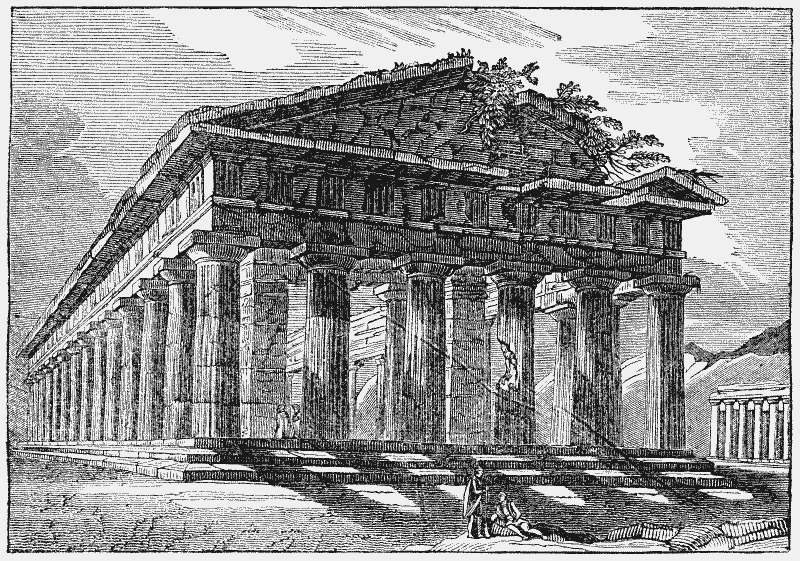
[The Temple of Neptune.]
These sublime relics of antiquity stand on the edge of a vast and desolate plain, that extends from the neighbourhood of the city of Salerno to the mountains of the Cilento, or nearly to the confines of Calabria. The approach to them across this wild is exceedingly impressive. For miles and miles scarcely a human habitation is seen, or any living creature, save herds of savage-looking buffaloes, that range the lords of the waste. And when you are within the lines of the ancient walls of the town—of the once opulent and magnificent Pæstum—only a miserable little taverna, or house of entertainment, a barn, and a mean modern edifice belonging to the nominal bishop of the place, and nearly always uninhabited, meet your eye. But there the three ancient edifices rise before you in the most imposing and sublime manner—they can hardly be called ruins, they have still such a character of firmness and entireness. Their columns seem to be rooted in the earth, or to have grown from it! The first impression produced on the traveller, when he arrives at the spot, has often been described. Even the critical and sceptical Forsyth exclaims, “On entering the walls of Pæstum I felt all the religion of the place—I trod as on sacred ground—I stood amazed at the long obscurity of its mighty ruins!”
These edifices have been called, rather by caprice or conjecture than from any good grounds for such names, the Temple of Ceres, the Temple of Neptune, and the Basilica. That of Ceres, which is the smallest of the 293three, first presents itself to the traveller from Naples. It has six columns in front, and thirteen in length; the columns are thick in proportion to their elevation, and much closer to each other than they are generally found to be in Greek Temples, “which,” says Mr. Forsyth, “crowds them advantageously on the eye, enlarges our idea of the space, and gives a grand, an heroic air to a monument of very moderate dimension.”
The second, or the Temple of Neptune, is not the largest, but by far the most massy and imposing of the three: it has six columns in front and fourteen in length, the angular column to the west, with its capital, has been struck and partially shivered by lightning. It once threatened to fall and ruin the symmetry of one of the most perfect monuments now in existence, but it has been secured by iron cramps. An inner peristyle of much smaller columns rises in the cella, in two stories, with only an architrave, which has neither frieze nor cornice between the columns, which thus almost seem standing the one on the capital of the other—a defect in architecture, which is, however, justified by Vitruvius and the example of the Parthenon. The light pillars of this interior peristyle, of which some have fallen, rise a few feet above the exterior cornice and the massy columns of the temple. Whether you gaze at this wonderful edifice from without or from within, as you stand on the floor of the cella, which is much encumbered with heaps of fallen stones and rubbish, the effect is awfully grand. The utter solitude, and the silence, never broken save by the flight and screams of the crows and birds of prey which your approach may scare from the cornices and architraves, where they roost in great numbers, adds to the solemn impression produced by those firmset and eternal looking columns.
The third structure, generally called a basilica, but sometimes an atrium, a curia, a market-place, or an exchange, is the most extensive, and, in point of architecture, the most curious, It has nine columns in front, and eighteen in length, and a row of pillars in the middle, parallel to the sides, which divide the temple, or whatever it may have been, into two equal parts. The diameter of these columns is somewhat larger than that of the columns of the first temple, but much smaller than the diameter of those of the second temple.
All the three structures are in the peculiar style called the Doric. They are all raised upon substructions forming three gradations or high steps—the columns without bases repose on the uppermost of these steps: the columns are not quite five diameters in height, they taper off about one-fourth as they ascend, they are fluted like all ancient Greek columns, their capitals are flat and prominent, and their intercolumniation, or the space from one to the other, little exceeds one diameter. The material of which they are built is the same throughout each of the temples and common to them all. It is an exceedingly hard, but porous and brittle stone, of a sober brownish-grey colour. It is a curious fact, that not only the ignorant people on the spot, but Neapolitan antiquaries (who, however, rarely travel to see things with their own eyes) wonder whence the ancients brought these masses of curious stone. They found them on the spot. “The stone of these edifices,” says Mr. Forsyth, “was probably formed at Pæstum itself, by the brackish water of the Salso acting on vegetable earth, roots, and plants; for you can distinguish their petrified tubes in every column.” And Mr. Mac Farlane, who passed a considerable time on the spot, adds, “The brackish water of the river Salso that runs by the wall of the town, and in different branches across the plain, has so strong a petrifying virtue that you can almost follow the operation with the eye; the waters of the neighbouring Sele (a considerable river—the ancient Silarus) have in all ages been remarkable for the same quality: in many places where the soil had been removed, we perceived strata of stone similar to the stones which compose the temples, and I could almost venture to say that the substratum of all the plain, from the Sele to Acropoli, is of the like substance. Curious petrifactions of leaves, pieces of wood, insects, and other vegetable and animal matters, are observed in the materials of the columns, walls,” &c.
These temples are the only ancient remains of any importance to be found at Pæstum, except the Cyclopean walls of the city, which are pretty well preserved on three sides, and only entirely obliterated on the side towards the sea. On the eastern side, indeed, they have suffered little, and fragments of towers, which seem to have flanked the walls at regular distances, yet exist. There is a gate in this part called La Porta della Sirena, or the Syren’s Gate (from a small rudely sculptured figure that looks like a dolphin, over the arch) which is very perfect, but mean and small; and here the ancient aqueduct is traced for some distance.
The origin of the city may safely be referred to remote antiquity; but those are probably in the right who would fix the period at which the existing temples were erected as contemporary with, or a little posterior to the building of the Parthenon at Athens. But even this calculation leaves them the venerable age of twenty-two centuries; and so firm and strong are they still, that, except in the case of a tremendous earthquake or some other extraordinary convulsion of nature, two thousand two hundred and many more years may pass over their mighty columns and architraves, and they remain, as they now are, the objects of the world’s admiration.
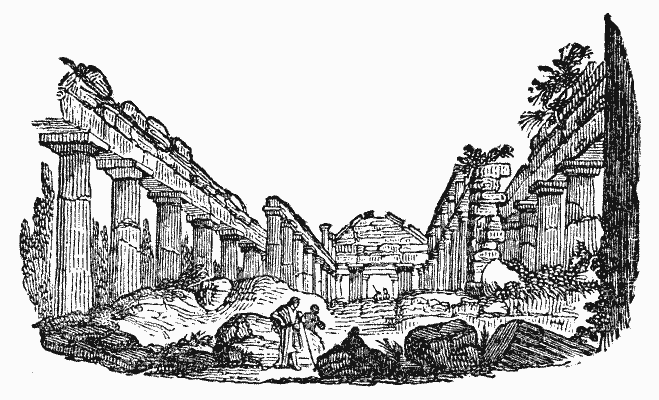
[Interior of the Temple of Neptune.]