BRITISH ANIMALS.
Reading edition
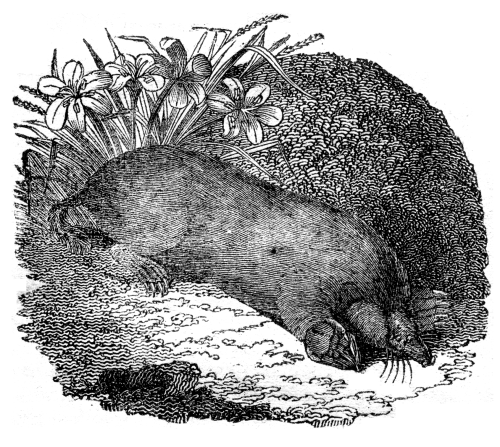
THE MOLE.
The Moles are beginning to throw up the earth, and to destroy the herbage of the light soils. What an extraordinary animal is the mole! We constantly see his traces of destructiveness, but how difficult is it to track him to his hiding-place. And no wonder: his excavations are galleries of many feet in length, worked out by his snout and strong fore-paws, with all the skill and expedition of a human miner; and when he is alarmed he retreats to his citadel, and defies all enemies. The mole, as is well known to our country readers, is destroyed by a trap of peculiar construction, which is discharged by the little animal passing through it. The mole-catcher—in general a quiet old man, who passes the winter in making his traps in his chimney corner—comes forth at this season with his implements of destruction. His practised eye soon discovers the track of the mole, from the mound which he throws up to some neighbouring bank, or from one mound to another. It is in this track or run that he sets his trap, a few inches below the surface of the ground. As the mole passes through this little engine of his ruin he disturbs a peg which holds down a strong hazel rod in a bent position. The moment the peg is moved the end of the rod which is held down flies up, and with it comes up the poor mole, dragged out of the earth which he has so ingeniously excavated, to be gibbetted without a chance of escape. The trap is very simple and effectual; but, somehow, the moles flourish in spite of their human enemies. Mole-catchers, a plodding, unscientific race, know little of their trade, which requires the most accurate study of the habits of the animal. There was a Frenchman of the name of Le Court, (he died about two years ago,) a man of great knowledge and perseverance, who did not think it beneath him to devote his whole attention to the observation of the mole. He established a school for mole-catching; and taught many, what he had acquired by incessant perseverance, the art of tracing the mole to his hiding-place in the ground, and cutting off his retreat. The skill of this man once saved a large and fertile district of France from inundation by a canal, whose banks the moles had undermined in every direction. Le Court alone saw the mischief, and could stop it. Doubts have been entertained whether moles are really so mischievous to the farmer as they are generally supposed to be. It has been said that they assist the draining of land by forming their excavations, and that they thus prevent the foot-rot in sheep.