BRITISH ANIMALS.
Reading edition
THE DORMOUSE
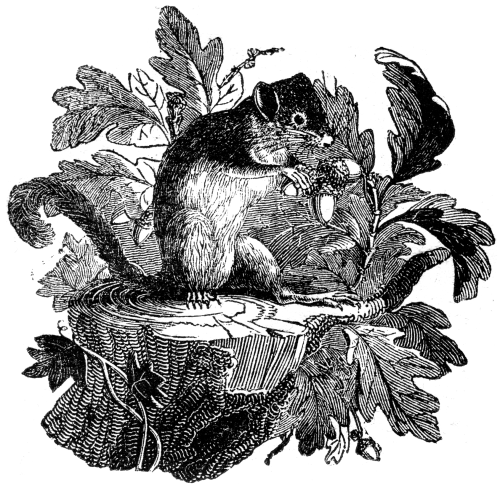
The little dormouse has now awakened from his fitful sleep. When the winds of March sweep away the lingering fogs of winter,—when the tender buds are first seen on the trees, and the primrose first shows its head in the green banks—before the swallow comes to our shores, or the rook has finished her nest—the dormouse rouses up from the bed where he has slept for several months. His sleep, however, is not constant through the cold season, like that of some other animals; for he wakes, at times, to eat of the store of nuts and beech-mast which he has provided for his sustenance in the autumn. The marmot, a quadruped inhabiting some mountainous parts of Europe, makes no provision of this kind in his subterranean galleries. He sleeps completely.
M. Mangili, an Italian naturalist, made some curious experiments upon the dormouse and other animals which sleep during the cold weather. He kept the dormouse in a cupboard in his study. On the 24th December, when the thermometer was about 40°, that is 8° above the freezing point, the dormouse curled himself up amongst a heap of papers and went to sleep. On the 27th December, when the thermometer was several degrees lower, M. Mangili ascertained that the animal breathed, and suspended his respiration at regular intervals;—that is, that after four minutes of perfect repose, in which he appeared as if dead, he breathed about twenty-four times in the space of a minute and a half, and that then his breathing was again completely suspended, and again renewed. As the thermometer became higher, that is, as the weather became less cold, the intervals of repose were reduced to three minutes. On the contrary, when the thermometer fell nearly to the freezing point, the intervals were then six minutes. Within ten days from its beginning to sleep (the weather then being very cold), the dormouse woke and ate a little. He then went to sleep again; and continued to sleep for some days, and then to awaken, throughout the winter; but as the season advanced, the intervals of perfect repose, when no breathing could be perceived, were much longer, sometimes more than twenty minutes. The effects of confinement upon this individual animal caused him to sleep much longer than in a state of nature.
When a dormouse is discovered asleep, in his natural retreat, he is cold to the touch, his eyes are shut, and his respiration is slow and interrupted, as just described. Torpid animals, in general, when thus found, may be shaken, or rolled, or even struck, without a possibility of arousing them. But as the fine weather advances, the heat of their bodies increases, as it decreases at the approaches of winter; till at length they shake off their drowsiness, and are again the busy and happy inhabitants of the fields and gardens, active in the search of food to gratify their appetite, which is now as keen as it was dull in the cold months. These movements of course depend upon the states of the atmosphere, and are different in individuals of the same species.
THE SWALLOW.
The swallow, and other birds of passage—that is, birds who fly from one country to another, as the weather becomes unsuited to their natures—now begin to return to us. The swallow is a general favourite. He comes to us when nature is putting on her most smiling aspect, and he stays with us through the months of sunshine and gladness. “The swallow,” says Sir H. Davy, “is one of my favourite birds, and a rival of the nightingale; for he glads my sense of seeing, as much as the other does my sense of hearing. He is the joyous prophet of the year, the harbinger of the best season, he lives a life of enjoyment amongst the loveliest forms of nature; winter is unknown to him, and he leaves the green meadows of England in autumn, for the myrtle and orange groves of Italy, and for the palms of Africa.”
Mr. White, a clergyman of Hampshire, who delighted to observe all the works of the creation around him, has thus accurately described the window swallow’s or martin’s mode of building:—
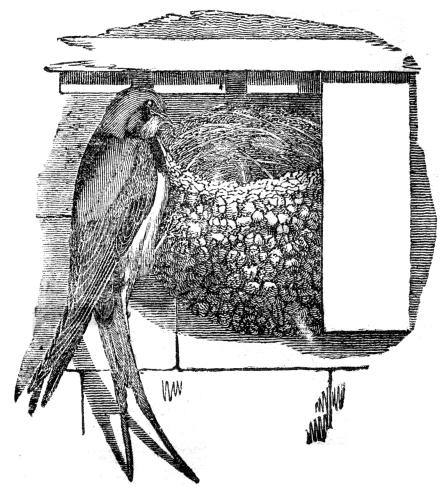
“About the middle of May, if the weather be fine, the martin begins to think in earnest of providing a mansion for its family. The crust or shell of this nest seems to be formed of such dirt or loam as comes most readily to hand, and is tempered and wrought together with little bits of broken straws to render it tough and tenacious. As this bird often builds against a perpendicular wall without any projecting ledge under, it requires its utmost efforts to get the first foundation firmly fixed, so that it may safely carry the superstructure. On this occasion, the bird not only clings with its claws, but partly supports itself by strongly inclining its tail against the wall, making that a fulcrum; and thus steadied, it works and plasters the materials into the face of the brick or stone. But then, that this work may not, while it is soft and green, pull itself down by its own weight, the provident architect has prudence and forbearance enough not to advance her work too fast; but by building only in the morning, and by dedicating the rest of the day to food and amusement, gives it sufficient time to dry and harden. About half an inch seems to be a sufficient layer for a day. Thus careful workmen, when they build mud-walls (informed at first perhaps by this little bird), raise but a moderate layer at a time and then desist, lest the work should become top-heavy, and so be ruined by its own weight. By this method, in about ten or twelve days, is formed a hemispheric nest with a small aperture towards the top, strong, compact, and warm, and perfectly fitted for all the purposes for which it was intended.
“The shell or crust of the nest is a sort of rustic-work, full of knobs and protuberances on the outside: nor is the inside of those that I have examined smoothed with any exactness at all; but is rendered soft and warm, and fit for incubation, by a lining of small straws, grasses and feathers, and sometimes by a bedding of moss interwoven with wool. They are often capricious in fixing on a nesting-place, beginning many edifices and leaving them unfinished; but when once a nest is completed in a sheltered place, after so much labour is bestowed in erecting a mansion, as nature seldom works in vain, the same nest serves for several seasons. Those which breed in a ready finished house, get the start in hatching of those that build new by ten days or a fortnight. These industrious artificers are at their labours in the long days before four in the morning; when they 13fix their materials, they plaster them on with their chins, moving their heads with a quick, rotatory motion.”