Part 2 — CHAPTER XIV. THE ARYAN LANGUAGE IN ASIA
Reading edition
253 : 1. See p. 158 and note. Also Peake, 2, p. 165; Breasted, 1, p. 176; Von Luschan, pp. 241–243; Zaborowski, 1, p. 112; DeLapouge, 1, p. 252, says: “Aryans were in India about 1500 B. C.”
253 : 10. See Peake, 2; also pp. 170–171 and 213 of this book.
406253 : 13. See the note to p. 225 : 11.
253 : 13–15. Eduard Meyer, Zur ältesten Geschichte der Iranier.
253 : 16 seq. See the note to p. 239 : 16 seq.
253 : 19. Zaborowski, 1, pp. 137 and 214.
254 : 1. See pp. 173 and 225 of this book.
254 : 3 seq. For Sacæ see the note to p. 259 : 21. Cahun, Histoire de l’Asie, says on p. 35: “The Sacæ and the Ephtalites and Massagetæ were from the Kiptchak.” See also Zaborowski, 1, pp. 94, 100–101, 215 seq.
254 : 6. Massagetæ. See the note to p. 259 : 21.
254 : 8. Ephtalites, or White Huns. Cahun, Histoire de l’Asie, pp. 43–55: “The Turks destroyed in the first half of the seventh century a powerful nation, the Ephtalites of Soghdiana, north of Persia. They were called Ephtalites, or White Huns or Tie-le-urn Turks.” See also the notes to pp. 119 : 15 and 224 : 3 of this book, and chap. XXVI in Gibbon on the Huns in general.
Procopius, vol. I, says in speaking of the Ephtalite Huns and describing their war with the Persians about 450 A. D.: “The White Huns are of the stock of the Huns in fact as well as in name, living in the territory north of Persia, and are settlers on the land in contrast to the Nomadic Huns who live at a distance.... They are the only ones among the Huns who have white bodies and countenances that are not ugly and they are far more civilized than are the other Huns.” The general impression gained from Procopius is that they were not true Huns. “Massagetæ” is used as another name for Huns by Procopius. He describes them as mounted bowmen. It is clear that in using this name he refers to Huns only.
254 : 13. Medes. The name Medes is variously applied by different authorities; by many the Medes are regarded as a branch of the Persians, one of two kindred tribes of Nordics. The author follows Zaborowski in applying the name to the round skulled population which was conquered by the Persians. See Zaborowski, 1, chaps. V and VI, especially part II and p. 125. Also Herodotus in the references given for Persia. Hall, Ancient History of the Near East, p. 459, gives an interesting bit of their story.
407254 : 15. Persians. The Persians were a branch of Nordics who invaded the territory of the round skulled Medes, and gradually imposed their language and much of their culture on the subjugated populations. See Herodotus, book I, especially 55, 71, 72, 74, 91, 95, 101, 107, 125, 129, 135, 136; and book VI, 19, where he discusses both Medes and Persians. For modern commentary the author follows Zaborowski, 1, pp. 138–139, 153 seq., chap. VI, and also pp. 212–214.
Von Luschan, pp. 233–234, describes the present day Persians, showing that there has been a resurgence of types and that the Nordic elements have been largely absorbed by the original inhabitants. He adds, however, on p. 234, that while he never saw Persians with light hair and blue eyes, he was told that in some noble families fair types were not very rare.
254 : 19. See the note on the Medes, and Zaborowski, p. 156, on the Magi.
254 : 26. Darius. Zaborowski, 1, p. 12. Herodotus, I, 209, says: “Now Hystaspes the son of Arsames was of the race of the Achæmenidæ and his eldest son Darius was at that time twenty years old.” Another name for Hystaspes was Vashtaspa, whose father was Arsames (Arsháma). He traced his descent through four ancestors to Achæmenes (Hakhámamish).
Von Luschan, p. 241, says: “Nothing is known of the Achæmenides who called themselves ‘Aryans of Aryan stock’ and who brought the Aryan language to Persia. About 1500 B. C. or earlier, there seems to have begun a migration of northern men to Asia Minor, Syria, Persia, Egypt and India. Indeed we can now connect even Further India with the Mitanni of central Asia Minor.”
See Zaborowski in regard to the Behistun tablet, etc., although practically any writers on Persia and Mesopotamia discuss this great monument.
255 : 2. Zaborowski, 1, pp. 116–117.
255 : 6. See the note on the Medic language, 255 : 13. Also Zaborowski, 1, pp. 34, 182–184.
255 : 7 seq. Zaborowski, 1, pp. 180–184; Feist, 5, p. 423.
408255 : 13. Bactria and Zendic. See the notes to pp. 119 : 15 and 257 : 12.
255 : 13. Zendic or the Medic language. See Zaborowski, 1, chap. VI. According to the Census of India, vol. I, pp. 291 seq., both Persian and Medic tongues belong to the Aryan stock. They are divided in the following table:
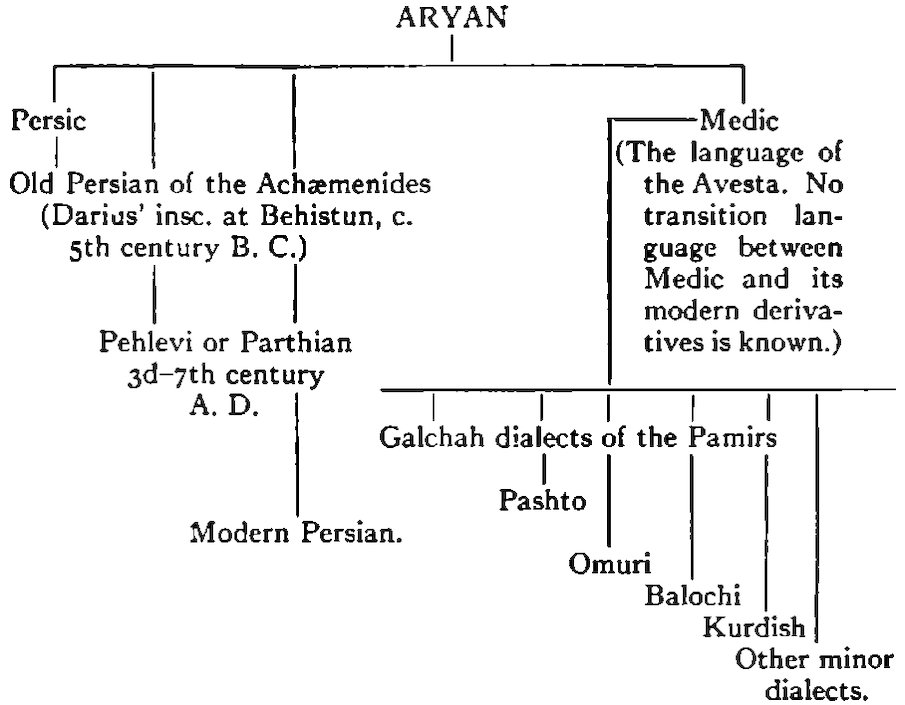
Zaborowski, 1, p. 146, positively identifies Medic as agglutinative, in which he agrees with Oppert. See chaps. V and VI, especially part II and p. 125. For early data on the Medes see the Herodotus references given under Persia. Zaborowski says, p. 121, that Medic was spoken until 600 B. C.
255 : 15. Kurdish. Von Luschan, p. 229: “The Kurds speak an Aryan language.... The eastern Kurds are little known.... They speak a different dialect from the western tribes, but both divisions are Aryan.” On the Kurds as a people, see the notes to p. 225 : 20.
255 : 20. Zaborowski, 1, p. 216–217.
409255 : 23. Von Luschan, p. 234, and the note to p. 225 : 19 of this book.
255 : 26–256 : 10. See Plutarch’s Life of Alexander; Historia Alexandri Magni de præliis; Zaborowski, 1, p. 171.
256 : 3. Alexander the Great and the Persians. Plutarch, Life of Alexander: “After this he accommodated himself more than ever to the manners of the Asiatics, and at the same time persuaded them to adopt some of the Macedonian fashions, for by a mixture of both he thought a union might be promoted much better than by force, and his authority maintained when he was at a distance. For the same reason he selected 30,000 boys and gave them masters to instruct them in the Grecian literature as well as to train them to arms in the Macedonian manner. As for his marriage with Roxana, it was entirely the effect of love.... Nor was the match unsuitable to the situation of his affairs. The barbarians placed greater confidence in him on account of that alliance.... Hephæstion and Craternus were his two favorites. The former praised the Persian fashions and dressed as he did; the latter adhered to the fashions of his own country. He therefore employed Hephæstion in his transactions with the barbarians and Craternus to signify his pleasure to the Greeks and Macedonians.”
256 : 11 seq. Armenians. Ridgeway, 1, p. 396, speaking of language, says: “That the Armenians were an offshoot of the Phrygians as mentioned in Herodotus VII, 73, is proved by the most modern linguistic results, which show that Armenian comes closer to Greek than to the Iranian tongues.” Cf. also Hall, Ancient History of the Near East, p. 475. This need not imply racial affinity, however. The following notes on Armenian were contributed by Mr. Leon Dominian: “The proof of Aryan affinities in the Hittite language has not yet been established. The great difficulty in establishing the pre-Aryan relation of Armenian is due to the fact that the earliest text dates only from the fifth century A. D.
“The Cimmerians and Scythians, coming from southern Europe by way of the Caucasus (Herodotus, IV, 11, 12), reached Armenia about 720 B. C. (see Garstang, The Land of 410the Hittites, p. 62). The old Vannic language antedating this invasion resembles the Georgian of the Caucasus, according to Sayce (Jour. Roy. As. Soc., XIV, p. 410), who has studied the local inscriptions. On p. 409 he infers that the Aryan occupation of Armenia was coeval with the victory of Aryanism in Persia at the end of the sixth century, B. C.
“The fact that Armenia is linguistically related to the western groups of the Indo-European languages and that the Persian element consists of loan words is corroborated by geographical evidence. The Armenian highland culminating in the 17000 foot altitude of Mt. Ararat has acted as a barrier dividing the plateau of Anatolia from that of Iran. Herodotus called the Armenians the ‘beyond’ Phrygians.” See also O. Schrader, Jevons translation, p. 430.
256 : 14 seq. Phrygians. See the note to p. 225.
256 : 15. Félix Sartiaux, Troie, la guerre de Troie, pp. 5–9.
256 : 16–17. See the note to p. 239 : 2 seq.
256 : 21 seq. See the table of languages to p. 242 : 5.
256 : 27–257 : 7. See pp. 20, 134, 238–239, of this book.
257 : 12. Bactria. See the note to p. 119 : 15.
257 : 16 seq. See the notes to pp. 158 and 253. Also Von Luschan, p. 243; Zaborowski, 1, p. 112; and the Indian Census, 1901, vol. I, p. 294.
257 : 19. Punjab. Panch—five, ab—river, in Hindustani. Cf. the Greek penta—five.
257 : 22. Dravidians. See pp. 148–149 of this book.
257 : 23. See the note to. p. 259 : 21 and Zaborowski, 1, pp. 113 seq.
257 : 28–258 : 2. See the note to p. 242 : 5. George Turnour’s edition in 1836, of the Mahavamsa, first made it possible to trace Sinhalese history and to prove that about the middle of the sixth century B. C. a band of Aryan-speaking people from India, under Vijaya conquered and settled Ceylon permanently. There are a number of later works on Ceylon, dealing with its archæology, flora, fauna, history, etc.
According to the British Indian Census of 1901 nearly two-thirds of the inhabitants of Assam were Hindus, and the language of Hinduism has become that of the province. The 411vernacular Assamese is closely related to Bengali. E. A. Gait has written a History of Assam (1906).
258 : 3. See the notes to pp. 158 and 253 of this book.
258 : 8. Zaborowski, 1, pp. 184–185. Compare de Morgan’s dates with those of Zaborowski, the Indian Census and Meillet.
258 : 19. See Meillet, Introduction á l’étude des langues européens. On p. 37 he claims that the relation between the two is comparable to that prevailing between High and Low German. Zaborowski, 1, p. 184, says: “The language of the Avesta, the Zend, is a contemporary dialect of the Persian of Darius (i. e., of Old Persian), from whence has come the Pehlevi and its very close relative. It even presents the closest affinities with the Sanskrit of the Vedas, from which was derived, in the time of Alexander, classical Sanskrit. This Sanskrit of the Vedas is itself so close to Old Persian that it can be said that one and the other are only two pronunciations of the same tongue.” See also the Indian Census for 1901, vol. I, p. 294.
258 : 25 seq. Zaborowski, 1, pp. 213–216; Peake, 2, pp. 165 seq. and especially pp. 169 and 172.
259 : 4. Ellsworth Huntington, The Pulse of Asia; Peake, 2, p. 170; and Breasted, passim.
259 : 9. See pp. 173, 237, 253–254 and 257 of this book.
259 : 16. See the notes to pp. 119 : 13 and 255 : 7.
259 : 21. Sacæ or Saka. The Sacæ or Saka were the blond peoples who carried the Aryan language to India. Strabo, 511, allies them with the Scythians as one of their tribes. Many tribes were called Sacæ, especially by the Hindus, who used the term indiscriminately to designate any northern invaders of India.
One tribe gained the most fertile tract in Armenia which was called Sacasene, after them.
Zaborowski, 1, p. 94, relates the Sacæ with the Scythians, and says: “The Tadjiks are a people composed of suppressed elements where blonds are found in an important minority. These blonds, saving an atavistic survival of more ancient or sporadic characters I can identify. They are the Sacæ.” He continues, in a note, that a great error has been committed 412on the subject of the Sacæ. “Repeating an assertion of Alfred Maury, whose very sound erudition enjoyed a merited reputation, I myself once repeated that the Sacæ who figures on the rock of Behistun was of the Kirghiz type. This assertion is completely erroneous. I have proved it and can say that the Sacæ and the Scythians were identical.”
Zaborowski, p. 216, also identifies the Sacæ with the Persians. On this whole subject see Herodotus, VII, 64; also Feist, 5.
259 : 21. Massagetæ. Zaborowski, 1, p. 285, says: “The first information of history concerning the peoples of Turkestan refers to the Massagetæ, whose life was exactly the same as that of the Scythians (Herodotus, I, 205–216). They enjoyed a developed industrial civilization while they remained nomads. They were doubtless composed of ethnic elements different from the Scythians, but probably already spoke the Iranian tongue, like them. And since the time of Darius, at least, there were in Turkestan with them and beside them, Sacæ, whom the Greeks have always regarded as Scythians come from Europe.”
Minns, Scythians and Greeks, p. 11, says: “The Scyths and the Massagetæ were contemporaneous and different. The Massagetæ are evidently a mixed collection of tribes without an ethnic unity; the variety of their customs and states of culture shows this and Herodotus does not seem to suggest that they are all one people. They are generally reckoned to be Iranian.... The picture drawn of the nomad Massagetæ seems very like that of the Scythians in a rather ruder stage of development.”
Herodotus, I, 215, describes them as follows: “In their dress and mode of living the Massagetæ resemble the Scythians. They fight both on horseback and on foot, neither method is strange to them.... The following are some of their customs,—each man has but one wife, yet all wives are held in common; for this is a custom of the Massagetæ and not of the Scythians, as the Greeks wrongly say. Human life does not come to its natural close with this people; but when a man grows very old, all his kinsfolk collect together 413and offer him up in sacrifice; offering at the same time some cattle also. After the sacrifice they boil the flesh and feast on it; and those who thus end their days are reckoned the happiest. If a man dies of disease they do not eat him, but bury him in the ground, bewailing his ill fortune that he did not come to be sacrificed. They sow no grain, but live on their herds and on fish, of which there is great plenty in the Araxes. Milk is what they chiefly drink. [Cf. the eastern Siberian tribes of the present day.] The only god they worship is the sun, and to him they offer the horse in sacrifice, under the notion of giving to the swiftest of the gods, the swiftest of all mortal creatures.”
D’Arbois de Jubainville, 4, t. I, p. 231 declares they were the same as the Scyths.
Horse sacrifices are said to prevail among the modern Parses. On the whole, the Massagetæ appear to have been largely Nordic.
259 : 24. Kirghizes. See Zaborowski, 1, pp. 216, 290–291.
259 : 25 seq. See the note to p. 119 : 15.
260 : 3. Gibbon, chap. LXIV. Also called the battle of Lignitz. Lignitz is the duchy, and Wahlstatt a small village on the battlefield.
260 : 8. See the notes to pp. 224 : 3 and 259 : 21.
260 : 17. Feist, 5, pp. 1, 427–431, says the Tokharian is related to the western rather than to the Iranian-Indian group of languages, and places the Tokhari in northeast Turkestan. (See the note to p. 119 : 13.) On p. 471 he identifies the Yuë-Tchi and Khang with Aryans from Chinese Turkestan, basing himself on Chinese annals, the date being given as 800 B. C. Cf. also the notes to p. 224 : 3 of this book.
260 : 21. See DeLapouge, 1, p. 248; Feist, 5, p. 520.
260 : 29–261 : 5. See Feist, above, in the note to 260 : 17.
261 : 6. Traces. See the note to p. 70 : 12.
261 : 17. Deniker, 2, pp. 407 seq.; G. Elliot Smith, Ancient Egyptians, p. 61; Ripley, p. 450.
415