THE PARENT'S ASSISTANT
Reading edition · Edition 2

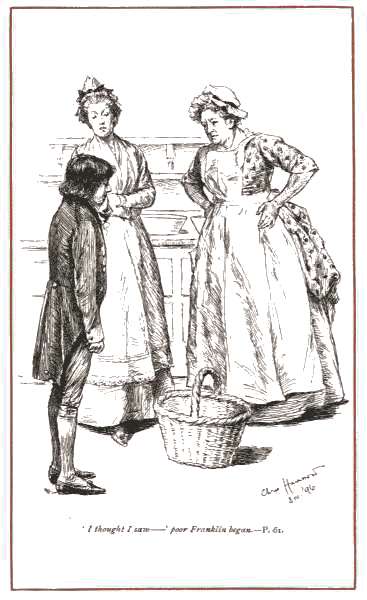
'I thought I saw——' poor Franklin began.—P. 61.
THE
PARENT'S ASSISTANT
or, Stories for Children
BY
MARIA EDGEWORTH
WITH AN INTRODUCTION
BY
ANNE THACKERAY RITCHIE
ILLUSTRATED
BY
CHRIS HAMMOND
LONDON: MACMILLAN AND CO, LIMITED
NEW YORK: THE MACMILLAN COMPANY
1903
First printed with Illustrations by Chris Hammond 1897. Illustrated Pocket Classics 1903.
INTRODUCTION
Once when the present writer was a very little girl she suffered for a short time from some inflammation of the eyes, which prevented her from reading, or amusing herself in any way. Her father, who had just then returned from the East, in order to help her to pass the weary hours began telling her the story of the 'Forty Thieves,' and when he had finished, and had boiled down the wicked thieves in oil, and when she asked him to tell it all over again, he said that he would try and find something else to amuse her, and looking about the room he took up a volume of the Parent's Assistant which was lying on the table, and began to read aloud the story of the 'Little Merchants.' The story lasted two mornings, and an odd, confused impression still remains in the listener's mind to this day of Naples, Vesuvius, pink and white sugar plums—of a darkened room, of a lonely country house in Belgium, of a sloping garden full of flowers outside the shutters, of the back of a big sofa covered with yellow velvet, and of her father's voice reading on and on. When she visited Naples in after days she found herself looking about unconsciously for her early playfellows.
Not only Francisco and Piedro, but all those various members of the Edgeworth family who play their parts in fancy names and dresses in Miss Edgeworth's stories, became her daily familiar companions from that day forth.
Many of the stories in the Parent's Assistant were written in a time when wars and rumours of wars were in the air; these quiet scenes of village life were devised to the sound of clarions. Rebels were marching and countermarching; volunteers were assembling; husbandmen, throwing away their spades, were arming and turning into soldiers; the French were landing in Ireland. 'I cannot be a Captain of Dragoons,' writes Miss Edgeworth, 'and it would not make any of us one degree safer if I were sitting with my hands before me.' So she quietly goes on with her stories. One or two of them were written at Clifton, and very early in her career an illustrated edition had been suggested by the publishers. A young Irish neighbour, with a taste for the fine arts, was asked to make the drawings to these stories, and it was this lady, Miss Beaufort, the daughter of the Rector of Colon, who afterwards became the fourth Mrs. Edgeworth. Not long after his third wife's death in 1797, Mr. Edgeworth wrote a letter to Dr. Darwin at Lichfield, in which he gives him various items of family news. He writes of portraits (Dr. Darwin, Mr. Thomas Day, and Mr. Edgeworth, had all sat for their portraits); he writes of Upas trees, of frozen frogs, of farming and rack-rents; of pipes for hot-houses to be heated by stable dung, of speaking machines, and finally in a postscript he announces the fact of his being engaged to be married for the fourth time, 'to a young lady of small fortune and large accomplishments, much youth, some beauty, more sense, uncommon talents, more uncommon temper, liked by my family, loved by me.'
These were stormy times for Ireland: a few days after the letter was written, a conspiracy was discovered in Dublin, and the city was under arms. Mr. Edgeworth set out immediately to join the Beauforts, who were there. The true-hearted daughter now admires her father for urging on the marriage. 'Instead of delaying, as some would have advised, my father urged for an immediate day. He brought his bride home through a part of the country in actual insurrection.'
There is a grim story of the new-married pair on their way to Edgeworthstown passing the suspended corpse of a man hanging between the shafts of a cart. Miss Edgeworth in her Memoirs of her father gives a striking account of the family assembled to receive the new wife. It is a grandson of this last Mrs. Edgeworth who is the present owner of Edgeworthstown.
The Parent's Assistant had just been written; but one or two of the stories in the present collection were not added till much later, such as 'The Bracelets,' which were written in Switzerland to make up a proper allowance of copy for a new edition. It is hard to make a choice among these charming and familiar histories. They open like fairy tales, recounting in simple diction the histories of widows living in flowery cottages, with assiduous devoted little sons, who work in the garden and earn money to make up the rent. There are also village children busily employed, and good little orphans whose parents generally die in the opening pages. Fairies were not much in Miss Edgeworth's line, but philanthropic manufacturers, liberal noblemen, and benevolent ladies in travelling carriages, do as well and appear in the nick of time to distribute rewards or to point a moral. Rosamond of the Purple Jar reappears in the Birthday Present, which gives one an odd picture of the customs of those days. We read of the little lace girl who leaves her pillow upon a stone before the door, and of the footman laced with silver, who having entangled the bobbins and kicked the pillow into the lane, jumps up behind his mistress's coach and is out of sight in a minute. Wise Laura, who had not, like Rosamond, spent her half-guinea upon filigree paper, consoles the little weeping lace-maker, and presses her golden coin into her hand.
Lazy Lawrence is one of the prettiest stories in the collection. Who could read the story of Dutiful Jim and his love for old Lightfoot unmoved? Lightfoot deserves to take his humble place among the immortal winged steeds of mythology along with Pegasus, or with Black Bess, or Balaam's Ass, or any other celebrated steeds.
Most children like the history of the Orphans; that quiet history in which the sister of twelve years old acts a mother's part by the little children. I believe the story is founded on some real and modest heroine of those bygone days. Then, again, who has not sympathised with 'Waste not, Want not,' and with thoughtful Ben and his careful assiduity? It would be curious to calculate how much good time has been sacrificed to saving worthless pieces of string in imitation of this thrifty but fascinating hero. But after all nothing is to compare to Simple Susan: how pretty the scene is where Susan, working in her arbour, hears the sound of her friend Philip's pipe and tabor; the children come across the green with their garlands, leading up Susan's lamb tied up with ribbons, the wicked agent skulks away; innocence and beauty triumph over wrong.
Friendship plays a no less important part in Miss Edgeworth's stories than it did in her own actual experience. Many of the scenes of Miss Edgeworth's stories are laid in manufacturing districts, and I have already quoted from the correspondence with Mr. Strutt, on whose sympathy and help she so greatly relied. Young Edward Strutt, afterwards Lord Belper, used to write to the young men at Edgeworthstown when he was a child of only nine years old. 'I shall not be satisfied with any letter from you that does not mention every member of your uncle's family and your own,' says one of the young Edgeworths, writing back in answer to the boy. Mr. Edgeworth sends his sons in succession to visit his friend Mr. Strutt, and quotes from Pliny, saying: 'The claim I now make to your favour is your having already done me favours. I introduce my fourth son to your notice simply upon the foundation of your having been very kind to his brothers.'
In 1823 Miss Edgeworth, who has been writing to Mr. Strutt for years, addresses him as 'my dear sir—my dear friend, I think I may venture to say!' She consults him upon details in her stories, and asks his advice on some matter connected with spinning-jennies. There also are many family events, charmingly chronicled in the orderly flowing characters of the lady, or the bolder writing of her correspondent; one letter concerns the election to Parliament of Mr. Edward Strutt in 1830.
The Strutts are all clever, Here's Edward for ever,
she writes, and defends her doggerel by the 'natural Irish spirits where the interests of a friend are concerned.' As time goes on Lord Belper's own letters appear, keeping up the family tradition of kindness and hospitality. The author's conscientious painstaking strikes one, as one realises the care she bestowed upon her work. La Triste Réalité, of which Mme. de Stael complained, has certainly its charm for the infant mind, and also for some maturer readers.
Archbishop Whately in one of his reviews upon Miss Edgeworth points out the change which has gradually come over story-telling. 'Instead of the splendid scenes of an imaginary world, striking representations of that which is daily taking place around us are set forth,' he says. 'We now turn to Flemish painting'—so he calls the descriptions; and he adds that a novel which makes good its pretensions of giving a perfectly correct picture of common life, becomes a far more instructive work than one of superior merit belonging to the imaginative class; for, as he tells us, 'It guides the judgment and supplies a kind of artificial experience of life.' It is also Whately who complains—not exactly as one would expect an archbishop to complain—that Miss Edgeworth's stories are too improving, too didactic. 'She would, we think, instruct more successfully, and we are sure please more frequently, if she kept the design of teaching more out of sight,' he writes. If Whately were alive to review the novels of our own day, he might after all prefer 'the splendid scenes of an imaginary world' to the favourite experiments in garbage of our present Laura Matildas. It is true the books sell by thousands. They certainly prove that the successful discovery of the age is not to point out what is right but what is wrong. Books used to be coarse and jocular; our books are earnest and indecent on principle. One hears of the revolting daughters who are so much to the front, the same word in a different sense may perhaps apply to a favourite school of authors now in vogue.
There is, however, a compensating balance in every adjustment of the scales of life: along with the minor virtues which are so much out of fashion, such as modesty, decency, good breeding, etc., follows the expulsion of a great many minor vices, such as affectation, disingenuousness, exclusiveness, and worldly wisdom. The latter qualities still exist of course, but in a rather shame-stricken, apologetic sort of way. Besides the gibes of literature, they have to contend with all sorts of opposing influences,—with omnibuses, depreciated investments, penny papers, county councils, all of which certainly place altruism and public spirit in the place of the more personal egotisms of our grandfathers.
CONTENTS
PAGE
Preface1
The Orphans5
Lazy Lawrence27
The False Key55
Simple Susan79
The White Pigeon141
The Birthday Present153
Eton Montem169
Forgive and Forget215
Waste not, Want not; or, Two Strings to your Bow231
Old Poz257
The Mimic273
The Barring Out; or, Party Spirit307
The Bracelets347
The Little Merchants373
Tarlton431
The Basket-Woman451
LIST OF ILLUSTRATIONS
PAGE
'I thought I saw——' poor Franklin began Frontispiece
Inquired what it was she most wanted10
'Well, and what have you done with the treasure you had the luck to find?'20
'See what you've done for me—look!—look, look, I say!'38
'What's the matter?' said his mistress. 'God bless the boy!' said his mother48
'You know this key? I shall trust it in your care'72
'It won't do,' said Barbara, turning her back85
Tried all her skill to fathom his thoughts100
Let it eat out of her hand for the last time116
'Stay! oh stay! don't chop his head off'144
The boy pulled off the cover, and saw a white pigeon painted upon the sign151
She twisted and untwisted, placed and replaced, the bobbins, while the footman stood laughing at her distress156
'I shan't spoil it; and I will have it in my own hands'161
'Then shake hands, my honest landlord'176
Enter Miss Bursal, in a riding dress181
'I say I saw him there take the jump which strained the horse.'209
'Talbot and truth for ever! Huzza'212
'Stay! Stand still, sir! or you will break your china jar'217
When Maurice saw his raspberry-plants scattered upon the ground, and his favourite tulip broken, he was in much astonishment228
Playing at cat's cradle236
He dragged poor Hal out of the red mud253
Lucy. What's this, papa? Just. Pshaw! pshaw! pshaw!—it is not melted, child—it is the same as no sugar260
'Five times have I commanded silence, and I won't command anything five times in vain—that's poz!'264
'And Mr. Smack, the curate, and Squire Solid, and the doctor, sir, are come, and dinner is upon the table'270
The next day Mrs. Theresa Tattle did herself the honour to wait upon Mrs. Montague276
'She dashed and splashed without minding exactness, or the recipe, or anything'284
'And like a man—and like a good man, I am sure thou wilt,' said the good Quaker, shaking Frederick's hand affectionately304
'What is become of my Livy?' 'Your sister Livy, do you mean?'313
Archer leaped up, and seizing hold of Fisher with a powerful grasp, sternly demanded 'What he meant by this?'335
He sneaked out, whimpering in a doleful voice345
'How?' cried Cecilia, catching hold of her352
'Oh, stay one minute!' said Cecilia363
'I saw him the other day miss selling a melon for his father by turning the bruised side to the customer'377
Piedro was hissed and hooted out of the market-place400
The Jew, who was a man old in all the arts of villainy, contrived to cheat both his associates413
Returned in safety over the lava, yet warm under his feet419
'Is it poison?' exclaimed Loveit, starting back with horror441
'May God bless you!'448
'But, oh, brother, look at this! this is not the same as the other halfpence'456
His master came in with a face of indignation, and demanded 'The guinea—the guinea, sir!'464