Part 2 — SOME REMARKABLE WOMEN.
Reading edition
I.—ISABELLA I.
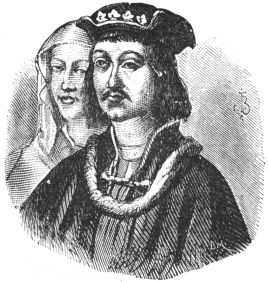
FERDINAND AND ISABELLA.
This remarkable woman, Isabella of Spain, lived four hundred years ago. Her name is always associated with that of her husband, Ferdinand, King of Castile and Aragon. Isabella was a woman of strong character and great resolution, as well as of remarkable talent. She married the one whom she wished to marry in spite of the opposition of her brother, and his threats of imprisonment. Upon the death of her brother, Henry the Fourth, Isabella was the heir to the throne. However, she met with opposition, and it was only after warring with the partisans of her rival that she gained her seat upon the throne. She reigned jointly with her husband, and their reign is spoken of as that of Ferdinand and Isabella. It was an eventful reign; many reforms were introduced, justice was firmly administered and crimes punished. The nobility were restrained from acts of oppression. Their reign is also conspicuous for the conquest of Granada; it is said that the honors of the Moorish war belonged by right to Isabella rather than her husband, for she personally directed the campaigns, and during the ten years the war lasted spent much of the time in camp. There are some dark spots which mar the brilliancy of this woman's record; one is the establishment of the Inquisition.
We find that when a certain cardinal of the Roman Church presented his plan of the "Spanish Inquisition" to the King and Queen, that while Ferdinand approved, Isabella hesitated for a time; it may be that her woman's heart made her hesitate to condemn all who did not agree with her in religious matters. Perhaps you do not know what is meant by the Inquisition.
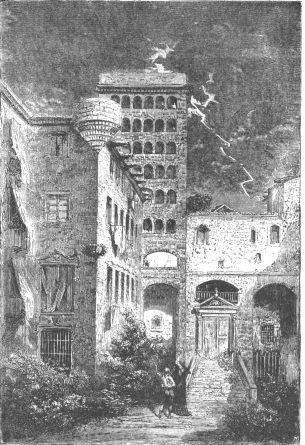
THE PRISON OF THE INQUISITION.
The Inquisition was a court established for the purpose of seeking out and punishing, or in some cases banishing, heretics. This meant all who were not Romanists. I cannot think that a woman so amiable, so kind and so devout, had other than good intentions in even this matter. The King and Queen doubtless had the best interests of their people at heart, and they looked also to the advancement of their church. They wanted too to gain the favor of the Pope. Doubtless there was a variety of motives urging them on; one writer says—
"Fear, piety, patriotism, absolutism and ambition" all influenced them.
And when we are inclined to condemn our beautiful queen, we must remember that she was educated by a bigoted mother, that she lived in bigoted times and that her advisers were sustained by the highest authority she recognized—the Papal court. Let us judge her leniently and put the blame of this act and of that other edict, the expulsion of the Jews, elsewhere.
Let us think of her interest in Columbus, for it was she who took an interest in his project of seeking a new world beyond the seas, and who offered even to part with her jewels in order to furnish means for the carrying out of his grand scheme.
We all know how it ended, and surely we as Americans will ever cherish her memory.
She was a most gracious queen, beautiful in face, pleasing in manner, and very loving as a wife and mother. And among the royal personages of her beloved Spain the name of Isabella stands foremost.
Faye Huntington.

Gunpowder, which is as you know a mixture of saltpetre, sulphur, and charcoal separately pulverized, then granulated and dried, and guns, were first invented by Swartz, a monk of Cologne, in 1340; Edward the Third had four pieces of cannon, which contributed to gain him the battle of Cressy, 1346; bombs and mortars were invented in the same year.
MUMMIES.—GAME FOR NEW YEAR'S NIGHT.
"DO you think you could pick out your papa, if you only saw his eyes?"
"Oh, what a question!" Ethel laughs in great amusement. "I guess I couldn't help knowing my papa, if I only saw one eye!"
Well, now you try it, Ethel, and let all the others try it—this funny and perplexing game of mummies.
Get the clothes-frame in from the kitchen, cover it nicely with newspapers, first taking the precaution to see that sheets or waterproofs conceal all the bottom of it, for of course if you saw your papa's boots sticking out, Ethel; or you, Fred, saw just an inch of mamma's blue gown that you think is just the prettiest gown in all the world, why, then you could guess the eyes that were above the boots or the gown!
If you have several pairs of eyes to guess at the same time, it is necessary to paste the newspapers securely together so as to admit back of them, a row of people. Now then, cut holes in your newspaper just large enough for a pair of eyes to see through. This is a nice job to do, as you will find out whoever does it for the first time. You will be quite surprised to see that your pair of holes look as if one eye was to be on the further side of the cheek, and, as the children say, "a mile too big," showing all the shading of eyelashes and brows. You must expect a shout at your expense as you triumphantly stand up to fit them to the one who is waiting to have them tried on him. But you will bear the fun nicely, and join in it, I hope, for let me tell you that no one who is unable to bear a joke or a bit of nice fun at himself, ought to play games. Why, the jolliest, loveliest companion in a frolic is the girl or boy who is sweet-tempered, and is so intent on making other people happy that he or she has no time to get suspicious in the mind that "somebody is laughing at him." The member of a family party who spoiled all the sweet fun of everybody, by resentment in this way at every bit of amusement started, thinking it pointed at him, was at last, all patience exhausted, dubbed "Old Porcupine," because his quills were always out, angrily trying to defend himself from nothing!
Don't you begin the New Year in this way, will you, dear Pansies, but play your games fairly, and in a kind, loving spirit.
Well, after you have your—not button-holes, but—eye-holes all ready, and your frame completed, you are all prepared for the company. If you want a row of people to exhibit their eyes, of course you must have a row of the holes. Supposing you have only one. The frame is placed in front of a door opening into another room or a hall, from which the actors are to come, the audience sitting on chairs on the other side of the frame. Now a boy or girl who is ready at speaking, and can say funny little things nicely, must stand before the frame, and introduce the strange beast or bird, or man or woman, or child, or mummy, just what the showman chooses to call it, to the assembled company. He must say, "Ladies and gentlemen, this creature is such a dangerous creature, that we can show you nothing of it but its eyes, for it might scare you. Walk up, ladies and gentlemen, and examine it at your leisure, and tell the name of this 'What is it?'" etc.
The audience after the conclusion of the speech, are allowed to walk in front of the paper frame, and give two guesses each, to whom the eyes staring at them through the eye-holes belong. If you make as wrong guesses as I do, you will distinguish yourselves!
Then after every one has guessed who the mummy is, and all wrongly, the showman commands it to step out and show itself. Then what shouts!
When all the mummies in the outer room have been exhibited, the audience can take their places, the former mummies taking the seats as guessers. If you choose, there can be a change of showmen, and Ben, who did so nicely and kept everybody laughing, will now, I am sure, be willing to give his place to cousin Louise, and the game will roll on fairly. May you have great sport in it.
Margaret Sidney.
In future, when the game is a long one, involving many words, there will be but one given. "Round the Evening Lamp" must not crowd out the other good things planned for the Pansies, and we must all respect the printer. When you grow up and write for magazines, dear children, you will understand this!
M. S.