LESSON 29
Reading edition
FOR STUDY AND COMPARISON
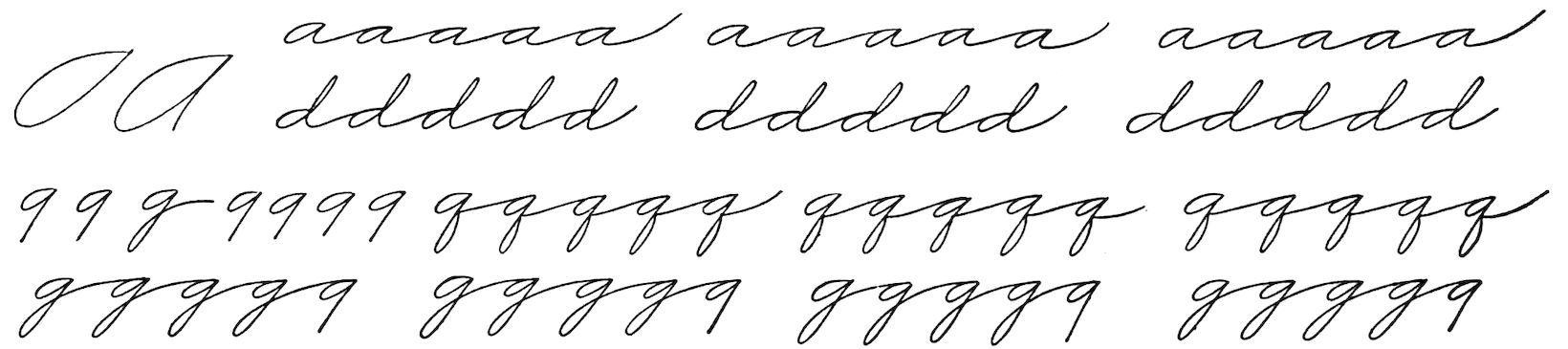
Small a is, in the main, a reduced copy of capital A, and the first parts of small d, g, and q are identical with it. Fix the resemblance in the mind; it will help you. In business writing it is best to make the looped small d. It is just as legible as the stem and can be made more rapidly. The loop below the base line in small g should be made without finger motion. We favor the blunt style of small g and y at the end of words, and this ending should be shorter than the loop. Fix in your mind the length of this abbreviated g. Small q is a little shorter below the base line than g. The g ending bluntly below the base line, is just like the figure nine.
39Drill 30

It will pay you to practice the small a drill a great deal. Try to make a half-dozen or more lines of letters as small and as uniform as the copy. Students should not forget to study the copy constantly and to make frequent comparisons of their work with it. A count of 1, 2, should be used for each small a, and in connecting five letters it is a good plan to count 1–2, 3–4, 5–6, 7–8, 9–10.
Small a in groups of five should be made at the rate of seventy a minute.