Front matter (continued 2)
Reading edition
"Got a father, sir, but my mother's dead."
We were now whirling up the street, the cab lighting up and growing pitch dark by turns, depending on the location of the street lamps.
"Where's your father?"
"Went away, sir." He spoke the words without the slightest change in his voice, neither abashed nor too bold, but with a simple straightforwardness which convinced me of their truth.
"Do you want to go to the asylum?"
"Yes, sir."
"Why?"
"Because I can learn everything there is to learn, and there isn't any other place for me to go."
This was said with equal simplicity. No whining; no "me mother's dead, sir, an' I ain't had nothin' to eat all day," etc. Not that air about him at all. It was merely the statement of a fact which he felt sure I knew all about.
"What's your name?"
"Ned."
"Ned what?"
"Ned Rankin, sir."
"How old are you?"
"I'm eight"—then, thoughtfully—"no, I'm nine years old."
"Where do you live?"
I was firing these questions one after the other without the slightest interest in either the boy or his welfare. My mind was on my lecture, and the impatient look on the faces of the audience, and the consulted watch of the chairman of the committee, followed by the inevitable: "You are not very prompt, sir," etc. "Our people have been in their seats," etc. If the boy had previously replied to my question as to where he lived, I had forgotten the name of the town.
"I live"—— Then he stopped. "I live in—— Do you mean now?" he added simply.
"Yes."
There was another pause. "I don't know, sir; maybe they won't let me stay."
Another foolish question. Of course, if he had left home for good, and was now on his way to the asylum for the first time, his present home was this hack.
But he had won my interest now. His words had come in tones of such directness, and were so calm, and gave so full a statement of the exact facts, that I leaned over quickly, and began studying him a little closer.
I saw that this scrap of a boy wore a gray woolen suit, and I noticed that the cap was made of the same cloth as the jacket, and that both were the work of some inexperienced hand, with uneven, unpressed seams—the seams of a flat-iron, not a tailor's goose. Instinctively my mind went back to what his earlier life had been.
"Have you got any brothers and sisters, my boy?"
"Yes, sir."
"Where are they?"
"I don't know, sir; I was too little to remember."
The pathos of this answer stirred me all the more.
"Who's been taking care of you ever since your father left you?" I had lowered my voice now to a more confidential tone.
"A German man."
"What did you leave him for?"
"He had no work, and he took me to the priest."
"When?"
"Last week, sir."
"What did the priest do?"
"He gave me these clothes. Don't you think they're nice? The priest's sister made them for me—all but the stockings; she bought those."
As he said this he lifted his arms so I could look under them, and thrust out toward me his two plump legs. I said the clothes were very nice, and that I thought they fitted him very well, and I felt his chubby knees and calves as I spoke, and ended by getting hold of his soft wee hand, which I held on to. His fingers closed tightly over mine, and a slight smile lighted up his face. It seemed good to him to have something to hold on to. I began again:—
"Did the priest send you here?"
"Yes, sir. Do you want to see the letter?" The little hand—the free one—fumbled under the jacket, loosened the two lower buttons, and disclosed a white envelope pinned to his shirt.
"I'm to give it to 'em at the asylum. But I can't unpin it. He told me not to."
"That's right, my boy. Leave it where it is."
"You poor little rat," I said to myself. "This is pretty rough on you. You ought to be tucked up in some warm bed, not out here alone in this storm."
The boy felt for the pin in the letter, reassured himself that it was safe, and carefully rebuttoned his jacket. I looked out of the window, and caught glimpses of houses flying by, with lights in their windows, and now and then the cheery blaze of a fire. Then I looked into his eyes again. I still had hold of his hand.
"Surely," I said to myself, "this boy must have some one soul who cares for him." I determined to go a little deeper.
"How did you get here, my boy?" I had leaned nearer to him.
"The priest put me on the train, and a lady told me where to get off."
"Oh, a lady!" Now I was getting at it! Then he was not so desolate; a lady had looked after him. "What's her name?" This with increased eagerness.
"She didn't tell me, sir."
I sank back on my seat. No! I was all wrong. It was a positive, undeniable, piteous fact. Seventy millions of people about him, and not one living soul to look to. Not a tie that connected him with anything. A leaf blown across a field; a bottle adrift in the sea, sailing from no port and bound for no haven. I got hold of his other hand, and looked down into his eyes, and an almost irresistible desire seized me to pick him up in my arms and hug him; he was too big to kiss, and too little to shake hands with; hugging was all there was left. But I didn't. There was something in his face that repelled any such familiarity,—a quiet dignity, pluck, and patience that inspired more respect than tenderness, that would make one want rather to touch his hat to him.
Here the cab stopped with so sudden a jerk that I had to catch him by the arms to steady him. Cabby opened the door.
"Morgan House, boss. Goin's awful, or I'd got ye here sooner."
The boy looked up into my face; not with any show of uneasiness, only a calm patience. If he was to walk now, he was ready.
"Cabby, how far is it to the asylum?" I asked.
"'Bout a mile and a half."
"Throw that trunk off and drive on. This boy can't walk."
"I'll take him, boss."
"No; I'll take him myself. Lively, now."
I looked at my watch. Twenty minutes of the hour had gone. I would still have time to jump into a dress suit, but the dinner must be brief. There came a seesaw rocking, then a rebound, and a heavy thud told where the trunk had fallen. The cab sped on round a sharp corner, through a narrow street, and across a wide square.
Suddenly a thought rushed over me that culminated in a creeping chill. Where was his trunk? In my anxiety over my own, I had forgotten the boy's.
I turned quickly to the window, and shouted:—
"Cabby! Cabby, you didn't leave the boy's trunk, too, did you?"
The little fellow slid down from the seat, and began fumbling around in the dark.
"No, sir; I've got 'em here;" and he held up the collar box and brown paper bundle!
"Is that all?" I gasped.
"Oh, no, sir! I got ten cents the lady give me. Do you want to see it?" and he began cramming his chubby hand into his side pocket.
"No, my son, I don't want to see it."
I didn't want to see anything in particular. His word was good enough. I couldn't, really. My eyelashes somehow had got tangled up in each other, and my pupils wouldn't work. It's queer how a man's eyes act sometimes.
We were now reaching the open country. The houses were few and farther apart. The street lamps gave out; so did the telegraph wires festooned with snow loops. Soon a big building, square, gray, sombre-looking, like a jail, loomed up on a hill. Then we entered a gate between flickering lamps, and tugged up a steep road, and stopped. Cabby sprang down and rang a bell, which sounded in the white stillness like a fire-gong. A door opened, and a flood of light streamed out, showing the kindly face and figure of an old priest in silhouette, the yellow glow forming a golden background.
"Come, sonny," said cabby, throwing open the cab door.
The little fellow slid down again from the seat, caught up the box and bundle, and, looking me full in the face, said:—
"It was too far to walk."
There were no thanks, no outburst. He was merely a chip in the current. If he had just escaped some sunken rock, it was the way with chips like himself. All boys went to asylums, and had no visible fathers nor invisible mothers nor friends. This talk about boys going swimming, and catching bull-frogs, and robbing birds' nests, and playing ball, and "hooky," and marbles, was all moonshine. Boys never did such things, except in story-books. He was a boy himself, and knew. There couldn't anything better happen to a boy than being sent to an orphan asylum. Everybody knew that. There was nothing strange about it. That's what boys were made for.
All this was in his eyes.
When I reached the platform and faced my audience, I was dinnerless, half an hour late, and still in my traveling dress.
I began as follows:—
"Ladies and gentlemen, I ask your forgiveness. I am very sorry to have kept you waiting, but I could not help it. I was occupied in escorting to his suburban home one of your most distinguished citizens."
And I described the boy in the cloth cap, with his box and bundle, and his patient, steady eyes, and plump little legs in the yarn stockings.
I was forgiven.
BETWEEN SHOWERS IN DORT
here be inns in Holland—not hotels, not pensions, nor stopping-places—just inns. The Bellevue at Dort is one, and the Holland Arms is another, and the—no, there are no others. Dort only boasts these two, and Dort to me is Holland.

The rivalry between these two inns has been going on for years, and it still continues. The Bellevue, fighting for place, elbowed its way years ago to the water-line, and took its stand on the river-front, where the windows and porticos could overlook the Maas dotted with boats. The Arms, discouraged, shrank back into its corner, and made up in low windows, smoking-rooms, and private bathroom—one for the whole house—what was lacking in porticos and sea view. Then followed a slight skirmish in paint,—red for the Arms and yellow-white for the Bellevue; and a flank movement of shades and curtains,—linen for the Arms and lace for the Bellevue. Scouting parties were next ordered out of porters in caps, banded with silk ribbons, bearing the names of their respective hostelries. Yacob of the Arms was to attack weary travelers on alighting from the train, and acquaint them with the delights of the downstairs bath, and the dark-room for the kodakers, all free of charge. And Johan of the Bellevue was to give minute descriptions of the boats landing in front of the dining-room windows and of the superb view of the river.
It is always summer when I arrive in Dordrecht. I don't know what happens in winter, and I don't care. The groundhog knows enough to go into his hole when the snow begins to fly, and to stay there until the sun thaws him out again. Some tourists could profit by following his example.
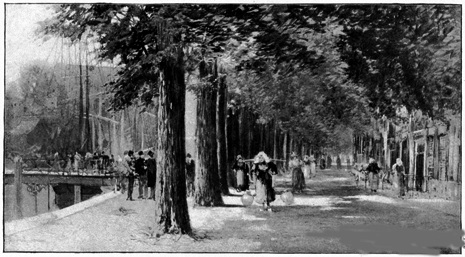
THROUGH STREETS EMBOWERED IN TREES
It is summer then, and the train has rolled into the station at Dordrecht, or beside it, and the traps have been thrown out, and Peter, my boatman—he of the "Red Tub," a craft with an outline like a Dutch vrou, quite as much beam as length (we go a-sketching in this boat)—Peter, I say, who has come to the train to meet me, has swung my belongings over his shoulder, and Johan, the porter of the Bellevue, with a triumphant glance at Yacob of the Arms, has stowed the trunk on the rear platform of the street tram,—no cabs or trucks, if you please, in this town,—and the one-horse car has jerked its way around short curves and up through streets embowered in trees and paved with cobblestones scrubbed as clean as china plates, and over quaint bridges with glimpses of sluggish canals and queer houses, and so on to my lodgings.
And mine host, Heer Boudier, waiting on the steps, takes me by the hand and says the same room is ready and has been for a week.
Inside these two inns, the only inns in Dort, the same rivalry exists. But my parallels must cease. Mine own inn is the Bellevue, and my old friend of fifteen years, Heer Boudier, is host, and so loyalty compels me to omit mention of any luxuries but those to which I am accustomed in his hostelry.
Its interior has peculiar charms for me. Scrupulously clean, simple in its appointments and equipment, it is comfort itself. Tyne is responsible for its cleanliness—or rather, that particular portion of Tyne which she bares above her elbows. Nobody ever saw such a pair of sledge-hammer arms as Tyne's on any girl outside of Holland. She is eighteen; short, square-built, solid as a Dutch cheese, fresh and rosy as an English milkmaid; moon-faced, mild-eyed as an Alderney heifer, and as strong as a three-year-old. Her back and sides are as straight as a plank; the front side is straight too. The main joint in her body is at the hips. This is so flexible that, wash-cloth in hand, she can lean over the floor without bending her knees and scrub every board in it till it shines like a Sunday dresser. She wears a snow-white cap as dainty as the finest lady's in the land; an apron that never seems to lose the crease of the iron, and a blue print dress bunched up behind to keep it from the slop. Her sturdy little legs are covered by gray yarn stockings which she knits herself, the feet thrust into wooden sabots. These clatter over the cobbles as she scurries about with a crab-like movement, sousing, dousing, and scrubbing as she goes; for Tyne attacks the sidewalk outside with as much gusto as she does the hall and floors.
Johan the porter moves the chairs out of Tyne's way when she begins work, and, lately, I have caught him lifting her bucket up the front steps—a wholly unnecessary proceeding when Tyne's muscular developments are considered. Johan and I had a confidential talk one night, when he brought the mail to my room,—the room on the second floor overlooking the Maas,—in which certain personal statements were made. When I spoke to Tyne about them the next day, she looked at me with her big blue eyes, and then broke into a laugh, opening her mouth so wide that every tooth in her head flashed white (they always reminded me somehow of peeled almonds). With a little bridling twist of her head she answered that—but, of course, this was a strictly confidential communication, and of so entirely private a nature that no gentleman under the circumstances would permit a single word of it to—
Johan is taller than Tyne, but not so thick through. When he meets you at the station, with his cap and band in his hand, his red hair trimmed behind as square as the end of a whisk-broom, his thin, parenthesis legs and Vienna guardsman waist,—each detail the very opposite, you will note, from Tyne's,—you recall immediately one of George Boughton's typical Dutchmen. The only thing lacking is his pipe; he is too busy for that.
When he dons his dress suit for dinner, and bending over your shoulder asks, in his best English: "Mynheer, don't it now de feesh you haf?" you lose sight of Boughton's Dutchman and see only the cosmopolitan. The transformation is due entirely to continental influences—Dort being one of the main highways between London and Paris—influences so strong that even in this water-logged town on the Maas, bonnets are beginning to replace caps, and French shoes sabots.
The guests that Johan serves at this inn of my good friend Boudier are as odd looking as its interior. They line both sides and the two ends of the long table. Stout Germans in horrible clothes, with stouter wives in worse; Dutchmen from up-country in brown coats and green waistcoats; clerks off on a vacation with kodaks and Cook's tickets; bicyclists in knickerbockers; painters, with large kits and small handbags, who talk all the time and to everybody; gray-whiskered, red-faced Englishmen, with absolutely no conversation at all, who prove to be distinguished persons attended by their own valets, and on their way to Aix or the Engadine, now that the salmon-fishing in Norway is over; school teachers from America, just arrived from Antwerp or Rotterdam, or from across the channel by way of Harwich, their first stopping-place really since they left home—one traveling-dress and a black silk in the bag; all the kinds and conditions and sorts of people who seek out precious little places like Dort, either because they are cheap or comfortable, or because they are known to be picturesque.
I sought out Dort years ago because it was untouched by the hurry that makes life miserable, and the shams that make it vulgar, and I go back to it now every year of my life, in spite of other foreign influences.
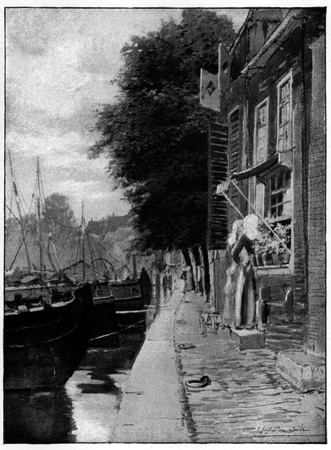
THE GOSSIPS LEAN IN THE DOORWAYS
And there is no real change in fifteen years. Its old trees still nod over the sleepy canals in the same sleepy way they have done, no doubt, for a century. The rooks—the same rooks, they never die—still swoop in and out of the weather-stained arches high up in the great tower of the Groote Kerk, the old twelfth-century church, the tallest in all Holland; the big-waisted Dutch luggers with rudders painted arsenic green—what would painters do without this green?—doze under the trees, their mooring lines tied to the trunks; the girls and boys, with arms locked, a dozen together, clatter over the cobbles, singing as they walk; the steamboats land and hurry on—"Fop Smit's boats" the signs read—it is pretty close, but I am not part owner in the line; the gossips lean in the doorways or under the windows banked with geraniums and nasturtiums; the cumbersome state carriages with the big ungainly horses with untrimmed manes and tails—there are only five of these carriages in all Dordrecht—wait in front of the great houses eighty feet wide and four stories high, some dating as far back as 1512, and still occupied by descendants of the same families; the old women in ivory black, with dabs of Chinese white for sabots and caps, push the same carts loaded with Hooker's green vegetables from door to door; the town crier rings his bell; the watchman calls the hour.
Over all bends the ever-changing sky, one hour close-drawn, gray-lined with slanting slashes of blinding rain, the next piled high with great domes of silver-white clouds inlaid with turquoise blue or hemmed in by low-lying ranges of purple peaks capped with gold.
I confess that an acute sense of disappointment came over me when I first saw these gray canals, rain-varnished streets, and rows of green trees. I recognized at a glance that it was not my Holland; not the Holland of my dreams; not the Holland of Mesdag nor Poggenbeck nor Kever. It was a fresher, sweeter, more wholesome land, and with a more breathable air. These Dutch painters had taught me to look for dull, dirty skies, soggy wharves, and dismal perspectives of endless dikes. They had shown me countless windmills, scattered along stretches of wind-swept moors backed by lowering skies, cold gray streets, quaint, leanover houses, and smudgy, grimy interiors. They had enveloped all this in the stifling, murky atmosphere of a western city slowly strangling in clouds of coal smoke.
These Dutch artists were, perhaps, not alone in this falsification. It is one of the peculiarities of modern art that many of its masters cater to the taste of a public who want something that is not in preference to something that is. Ziem, for instance, had, up to the time of my enlightenment, taught me to love an equally untrue and impossible Venice—a Venice all red and yellow and deep ultra-marine blue—a Venice of unbuildable palaces and blazing red walls.
I do not care to say so aloud, where I can be heard over the way, but if you will please come inside my quarters, and shut the door and putty up the keyhole, and draw down the blinds, I will whisper in your ear that my own private opinion is that even Turner himself would have been an infinitely greater artist had he built his pictures on Venice instead of building them on Turner. I will also be courageous enough to assert that the beauty and dignity of Venetian architecture—an architecture which has delighted many appreciative souls for centuries—finds no place in his canvases, either in detail or in mass. The details may be unimportant, for the soft vapor of the lagoons ofttimes conceals them, but the correct outline of the mass—that is, for instance, the true proportion of the dome of the Salute, that incomparable, incandescent pearl, or the vertical line of the Campanile compared to the roofs of the connecting palaces—should never be ignored, for they are as much a part of Venice, the part that makes for beauty, as the shimmering light of the morning or the glory of its sunsets. So it is that when most of us for the first time reach the water-gates of Venice, the most beautiful of all cities by the sea, we feel a certain shock and must begin to fall in love with a new sweetheart.
So with many painters of the Holland school—not the old Dutch school of landscape painters, but the more modern group of men who paint their native skies with zinc-white toned with London fog, or mummy dust and bitumen. It is all very artistic and full of "tone," but it is not Holland.
There is Clays, for instance. Of all modern painters Clays has charmed and wooed us best with certain phases of Holland life, particularly the burly brown boats lying at anchor, their red and white sails reflected in the water. I love these boats of Clays. They are superbly drawn, strong in color, and admirably painted; the water treatment, too, is beyond criticism. But where are they in Holland? I know Holland from the Zuyder Zee to Rotterdam, but I have never yet seen one of Clays's boats in the original wood.
Thus by reason of such smeary, up and down fairy tales in paint have we gradually become convinced that vague trees, and black houses with staring patches of whitewash, and Vandyke brown roofs are thoroughly characteristic of Holland, and that the blessed sun never shines in this land of sabots.
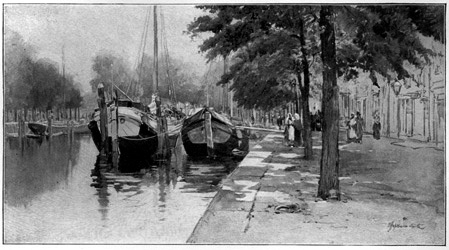
DRENCHED LEAVES QUIVERING
But doesn't it rain? Yes, about half the time, perhaps three quarters of the time. Well, now that I think of it, about all the time. But not continuously; only in intermittent downpours, floods, gushes of water—not once a day but every half hour. Then comes the quick drawing of a gray curtain from a wide expanse of blue, framing ranges of snow-capped cumuli; streets swimming in great pools; drenched leaves quivering in dazzling sunlight, and millions of raindrops flashing like diamonds.
II
ut Peter, my boatman, cap in hand, is waiting on the cobbles outside the inn door. He has served me these many years. He is a wiry, thin, pinch-faced Dutchman, of perhaps sixty, who spent his early life at sea as man-o'-war's-man, common sailor, and then mate, and his later years at home in Dort, picking up odd jobs of ferriage or stevedoring, or making early gardens. While on duty he wears an old white traveling-cap pulled over his eyes, and a flannel shirt without collar or tie, and sail-maker's trousers. These trousers are caught at his hips by a leather strap supporting a sheath which holds his knife. He cuts everything with this knife, from apples and navy plug to ship's cables and telegraph wire. His clothes are waterproof; they must be, for no matter how hard it rains, Peter is always dry. The water may pour in rivulets from off his cap, and run down his forehead and from the end of his gargoyle of a nose, but no drop ever seems to wet his skin. When it rains the fiercest, I, of course, retreat under the poke-bonnet awning made of cotton duck stretched over barrel hoops that protects the stern of my boat, but Peter never moves. This Dutch rain does not in any way affect him. It is like the Jersey mosquito—it always spares the natives.

Peter speaks two languages, both Dutch. He says that one is English, but he cannot prove it—nobody can. When he opens his mouth you know all about his ridiculous pretensions. He says—"Mynheer, dot manus ist er blowdy rock." He has learned this expression from the English sailors unloading coal at the big docks opposite Pappendrecht, and he has incorporated this much of their slang into his own nut-cracking dialect. He means of course "that man is a bloody rogue." He has a dozen other phrases equally obscure.
Peter's mission this first morning after my arrival is to report that the good ship Red Tub is now lying in the harbor fully equipped for active service. That her aft awning has been hauled taut over its hoops; that her lockers of empty cigar boxes (receptacles for brushes) have been clewed up; the cocoa-matting rolled out the whole length of her keel, and finally that the water bucket and wooden chair (I use a chair instead of an easel) have been properly stowed.
Before the next raincloud spills over its edges, we must loosen the painter from the iron ring rusted tight in the square stone in the wharf, man the oars, and creep under the little bridge that binds Boudier's landing to the sidewalk over the way, and so set our course for the open Maas. For I am in search of Dutch boats to-day, as near like Clays's as I can find. I round the point above the old India warehouses, I catch sight of the topmasts of two old luggers anchored in midstream, their long red pennants flattened against the gray sky. The wind is fresh from the east, filling the sails of the big windmills blown tight against their whirling arms. The fishing-smacks lean over like dipping gulls; the yellow water of the Maas is flecked with wavy lines of beer foam.
The good ship Red Tub is not adapted to outdoor sketching under these conditions. The poke-bonnet awning acts as a wind-drag that no amount of hard pulling can overcome. So I at once convene the Board of Strategy, Lieutenant-Commander Peter Jansen, Red Tub Navy, in the chair. That distinguished naval expert rises from his water-soaked seat on the cocoa-matting outside the poke bonnet, sweeps his eye around the horizon, and remarks sententiously:—
"It no tam goot day. Blow all dime; we go ba'd-hoose," and he turns the boat toward a low-lying building anchored out from the main shore by huge chains secured to floating buoys.
In some harbors sea-faring men are warned not to "anchor over the water-pipes." In others particular directions are given to avoid "submarine cables planted here." In Dort, where none of these modern conveniences exist, you are notified as follows: "No boats must land at this Bath."
If Peter knew of this rule he said not one word to me as I sat back out of the wet, hived under the poke bonnet, squeezing color-tubes and assorting my brushes. He rowed our craft toward the bath-house with the skill of a man-o'-war's-man, twisted the painter around a short post, and unloaded my paraphernalia on a narrow ledge or plank walk some three feet wide, and which ran around the edge of the floating bath-house.
It never takes me long to get to work, once my subject is selected. I sprang from the boat while Peter handed me the chair, stool, and portfolio containing my stock of gray papers of different tones; opened my sketch frame, caught a sheet of paper tight between its cleats; spread palettes and brushes on the floor at my side; placed the water bucket within reach of my hand, and in five minutes I was absorbed in my sketch.
Immediately the customary thing happened. The big bank of gray cloud that hung over the river split into feathery masses of white framed in blue, and out blazed the glorious sun.
Meantime, Peter had squatted close beside me, sheltered under the lee of the side wall of the bath-house, protected equally from the slant of the driving rain and the glare of the blinding sun. Safe too from the watchful eye of the High Pan-Jam who managed the bath, and who at the moment was entirely oblivious of the fact that only two inches of pine board separated him from an enthusiastic painter working like mad, and an equally alert marine assistant who supplied him with fresh water and charcoal points, both at the moment defying the law of the land, one in ignorance and the other in a spirit of sheer bravado. For Peter must have known the code and the penalty.
The world is an easy place for a painter to live and breathe in when he is sitting far from the madding crowd—of boys—protected from the wind and sun, watching a sky piled up in mountains of snow, and inhaling ozone that is a tonic to his lungs. When the outline of his sketch is complete and the colors flow and blend, and the heart is on fire; when the bare paper begins to lose itself in purple distances and long stretches of tumbling water, and the pictured boats take definite shape, and the lines of the rigging begin to tell; when little by little, with a pat here and a dab there, there comes from out this flat space a something that thrilled him when he first determined to paint the thing that caught his eye,—not the thing itself, but the spirit, the soul, the feeling, and meaning of the color-poem unrolled before him,—when a painter feels a thrill like this, all the fleets of Spain might bombard him, and his eye would never waver nor his touch hesitate.
I felt it to-day.
Peter didn't. If he had he would have kept still and passed me fresh water and rags and new tubes and whatever I wanted—and I wanted something every minute—instead of disporting himself in an entirely idiotic and disastrous way. Disastrous, because you might have seen the sketch which I began reproduced in these pages had the Lieutenant-Commander, R.T.N., only carried out the orders of the Lord High Admiral commanding the fleet.
A sunbeam began it. It peeped over the edge of the side wall—the wall really was but little higher than Peter's head when he stood erect—and started in to creep down my half-finished sketch. Peter rose in his wrath, reached for my white umbrella, and at once opened it and screwed together the jointed handle. Then he began searching for some convenient supporting hook on which to hang his shield of defence. Next a brilliant, intellectual dynamite-bomb of a thought split his cranium. He would hoist the umbrella above the top of the thin wall of the bath-house, resting one half upon its upper edge, drive the iron spike into the plank under our feet, and secure the handle by placing his back against it. No sunbeam should pass him!
The effect can be imagined on the High-Pan-Jam inside the bath-house—an amphibious guardian, oblivious naturally to sun and rain—when his eye fell upon this flag of defiance thrust up above his ramparts. You can imagine, too, the consternation of the peaceful inmates of the open pools, whose laughter had now and then risen above the sough of the wind and splash of the water. Almost immediately I heard the sound of hurrying footsteps from a point where no sound had come before, and there followed the scraping of a pair of toes on the planking behind me, as if some one was drawing himself up.
I looked around and up and saw eight fingers clutching the top of the planking, and a moment later the round face of an astonished Dutchman. I haven't the faintest idea what he said. I didn't know then and I don't know now. I only remember that his dialect sounded like the traditional crackling of thorns under a pot, including the spluttering, and suggesting the equally heated temperature. When his fingers gave out he would drop out of sight, only to rise again and continue the attack.
Here Peter, I must say, did credit to his Dutch ancestors. He did not temporize. He did not argue. He ignored diplomacy at the start, and blazed out that we were out of everybody's way and on the lee side of the structure; that there was no sign up on that side; that I was a most distinguished personage of blameless life and character, and that, rules or no rules, he was going to stay where he was and so was I.
"You tam blowdy rock. It's s'welve o'clook now—no rule aft' s'welve o'clook,—nopody ba'd now;"—This in Dutch, but it meant that, then turning to me, "You stay—you no go—I brek tam head him."—
None of this interested me. I had heard Peter explode before. I was trying to match the tone of an opalescent cloud inlaid with mother-of-pearl, the shadow side all purplish gray. Its warm high-lights came all right, but I was half out of my head trying to get its shadow-tones true with Payne's gray and cobalt. The cloud itself had already cast its moorings and was fast drifting over the English Channel. It would be out of sight in five minutes.
"Peter—Peter!" I cried. "Don't talk so much. Here, give him half a gulden and tell him to dry up. Hand me that sky brush—quick now!"
The High Pan-Jam dropped with a thud to his feet. His swinging footsteps could be heard growing fainter, but no stiver of my silver had lined his pocket.
I worked on. The tea-rose cloud had disappeared entirely; only its poor counterfeit remained. The boats were nearly finished; another wash over their sails would bring them all right. Then the tramp as of armed men came from the in-shore side of the bath-house. Peter stood up and craned his neck around the edge of the planking, and said in an undertone:—
"Tam b'lice, he come now; nev' mind, you stay 'ere—no go. Tam blowdy rock no mak' you go."
Behind me stood the High Pan-Jam who had scraped his toes on the fence. With him was an officer of police!
Peter was now stamping his feet, swearing in Dutch, English, and polyglot, and threatening to sponge the Dutch government from the face of the universe.
My experience has told me that it is never safe to monkey with a gendarme. He is generally a perfectly cool, self-poised, unimpressionable individual, with no animosity whatever toward you or anybody else, but who intends to be obeyed, not because it pleases him, but because the power behind him compels it. I instantly rose from my stool, touched my hat in respectful military salute, and opened my cigarette-case. The gendarme selected a cigarette with perfect coolness and good humor, and began politely to unfold to me his duties in connection with the municipal laws of Dordrecht. The manager of the bath, he said, had invoked his services. I might not be aware that it was against the law to land on this side of the bath-house, etc.
But the blood of the Jansens was up. Some old Koop or De Witt or Von Somebody was stirring Peter.
"No ba'd aft' s'welve o'clook"—this to me, both fists in the air, one perilously near the officer's face. The original invective was in his native tongue, hurled at Pan-Jam and the officer alike.
"What difference does it make, your Excellency," I asked, "whether I sit in my boat and paint or sit here where there is less motion?"
"None, honored sir," and he took a fresh cigarette (Peter was now interpreting),—"except for the fact that you have taken up your position on the women's side of the bath-house. They bathe from twelve o'clock till four. When the ladies saw the umbrella they were greatly disturbed. They are now waiting for you to go away!"
III
y room at Heer Boudier's commands a full view of the Maas, with all its varied shipping. Its interior fittings are so scrupulously clean that one feels almost uncomfortable lest some of the dainty appointments might be soiled in the using. The bed is the most remarkable of all its comforts. It is more of a box than a bed, and so high at head and foot, and so solid at its sides, that it only needs a lid to make the comparison complete. There is always at its foot an inflated eider-down quilt puffed up like a French soufflé potato; and there are always at its head two little oval pillows solid as bags of ballast, surmounting a bolster that slopes off to an edge. I have never yet found out what this bolster is stuffed with. The bed itself would be bottomless but for the slats. When you first fall overboard into this slough you begin to sink through its layers of feathers, and instinctively throw out your hands, catching at the side boards as a drowning man would clutch at the gunwales of a suddenly capsized boat.

The second night after my arrival, I, in accordance with my annual custom, deposited the contents of this bed in a huge pile outside my door, making a bottom layer of the feathers, then the bolster, and last the soufflé with the hard-boiled eggs on top.
Then I rang for Tyne.
She had forgotten all about the way I liked my sleeping arrangements until she saw the pile of bedding. Then she held her sides with laughter, while the tears streamed down her red cheeks. Of course, the Heer should have a mattress and big English pillows, and no bouncy-bounce, speaking the words not with her lips, but with a gesture of her hand. Then she called Johan to help. I never can see why Tyne always calls Johan to help when there is anything to be done about my room out of the usual order of things,—the sweeping, dusting, etc.,—but she does. I know full well that if she so pleased she could tuck the whole pile of bedding under her chin, pick up the bureau in one hand and the bed in the other, and walk downstairs without even mussing her cap-strings.
When Johan returned with a hair mattress and English pillows,—you can get anything you want at Boudier's,—he asked me if I had heard the news about Peter. Johan, by the way, speaks very good English—for Johan. The Burgomaster, he said, had that day served Peter with a writ. If I had looked out of the window an hour ago, I could have seen the Lieutenant-Commander of the Red Tub, under charge of an officer of the law, on his way to the Town Hall. Peter, he added, had just returned and was at the present moment engaged in scrubbing out the R. T. for active service in the morning.
I at once sent for Peter.
He came up, hat in hand. But there was no sign of weakening. The blood of the Jansens was still in his eye.
"What did they arrest you for, Peter?"
"For make jaw wid de tam bolice. He say I mos' pay two gulden or one tay in jail. Oh, it is notting; I no pay. Dot bolice lie ven he say vimmen ba'd. Nopoty ba'd in de hoose aft' s'welve 'clook."
Later, Heer Boudier tells me that because of Peter's action in resisting the officer in the discharge of his duty, he is under arrest, and that he has but five days in which to make up his mind as to whether he will live on bread and water for a day and night in the town jail, or whether he will deplete his slender savings in favor of the state to the extent of two gulden.
"But don't they lock him up, meanwhile?" I asked.
Boudier laughed. "Where would he run to, and for what? To save two gulden?"
My heart was touched. I could not possibly allow Peter to spend five minutes in jail on my account. I should not have slept one wink that night even in my luxurious bed-box with English pillows, knowing that the Lieutenant-Commander was stretched out on a cold floor with a cobblestone under his cheek. I knew, too, how slender was his store, and what a godsend my annual visit had been to his butcher and baker. The Commander of the Red Tub might be impetuous, even aggressive, but by no possible stretch of the imagination could he be considered criminal.
That night I added these two gulden (about eighty cents) to Peter's wages. He thanked me with a pleased twinkle in his eye, and a wrinkling of the leathery skin around his nose and mouth. Then he put on his cap and disappeared up the street.
But the inns, quaint canals, and rain-washed streets are not Dort's only distinctions. There is an ancient Groote Kerk, overlaid with colors that are rarely found outside of Holland. It is built of brick, with a huge square tower that rises above the great elms pressing close about it, and which is visible for miles. The moist climate not only encrusts its twelfth-century porch with brown-and-green patches of lichen over the red tones, but dims the great stained-glass windows with films of mould, and covers with streaks of Hooker's green the shadow sides of the long sloping roofs. Even the brick pavements about it are carpeted with strips of green, as fresh in color as if no passing foot had touched them. And few feet ever do touch them, for it is but a small group of worshipers that gather weekly within the old kirk's whitewashed walls.
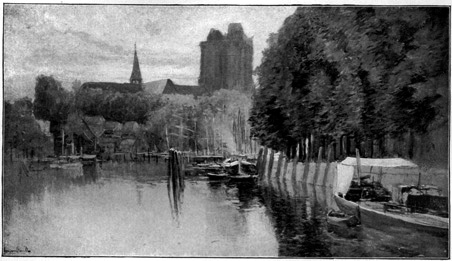
AN ANCIENT GROOTE KERK
These faithful few do not find the rich interior of the olden time, for many changes have come over it since its cathedral days, the days of its pomp and circumstance. All its old-time color is gone when you enter its portals, and only staring white walls and rigid, naked columns remain; only dull gray stone floors and hard, stiff-backed benches. I have often sat upon these same benches in the gloom of a fast-fading twilight and looked about me, bemoaning the bareness, and wondering what its ensemble must have been in the days of its magnificence. There is nothing left of its glories now but its architectural lines. The walls have been stripped of their costly velvets, tapestries, and banners of silk and gold, the uplifted cross is gone; the haze of swinging censers no longer blurs the vistas, nor the soft light of many tapers illumines their gloom.
I have always believed that duty and beauty should ever go hand in hand in our churches. To me there is nothing too rich in tone, too luxurious in color, too exquisite in line for the House of God. Nothing that the brush of the painter can make glorious, the chisel of the sculptor beautify, or the T-square of the architect ennoble, can ever be out of place in the one building of all others that we dedicate to the Creator of all beauty. I have always thanked Him for his goodness in giving as much thought to the flowers that cover the hillsides as He did to the dull earth that lies beneath; as much care to the matchings of purples and gold in the sunsets as to the blue-black crags that are outlined against them. With these feelings in my heart I have never understood that form of worship which contents itself with a bare barn filled with seats of pine, a square box of a pulpit, a lone pitcher of ice water, and a popular edition of the hymns. But then, I am not a Dutchman.
Besides this town of Dort, filled with queer warehouses, odd buildings, and cobbled streets, and dominated by this majestic cathedral, there is across the river—just a little way (Peter rows me over in ten minutes)—the Noah's Ark town of Pappendrecht, surrounded by great stretches of green meadow, dotted with black and white cows, and acres and acres of cabbages and garden truck, and tiny farmhouses, and absurdly big barns; and back of these, and in order to keep all these dry, is a big dike that goes on forever and is lost in the perspective. On both sides of this dike (its top is a road) are built the toy houses facing each other, each one cleaner and better scrubbed than its neighbor, their big windows gay with geraniums.
Farther down is another 'recht—I cannot for the life of me remember the first part of its name—where there is a shipyard and big windlasses and a horse hitched to a sweep, which winds up water-soaked luggers on to rude ways, and great pots of boiling tar, the yellow smoke drifting away toward the sea.
And between these towns of Dort, Pappendrecht, and the other 'recht moves a constant procession of water craft; a never-ceasing string of low, rakish barges that bear the commerce of Germany out to the sea, each in charge of a powerful tug puffing eagerly in its hurry to reach tide water, besides all the other boats and luggers that sail and steam up and down the forked Maas in front of Boudier's Inn—for Dort is really on an island, the water of the Rhine being divided here. You would never think, were you to watch these ungainly boats, that they could ever arrive anywhere. They look as if they were built to go sideways, endways, or both ways; and yet they mind their helms and dodge in and out and swoop past the long points of land ending in the waving marsh grass, and all with the ease of a steam yacht.
These and a hundred other things make me love this quaint old town on the Maas. There is everything within its borders for the painter who loves form and color—boats, queer houses, streets, canals, odd, picturesque interiors, figures, brass milk cans, white-capped girls, and stretches of marsh. If there were not other places on the earth I love equally as well—Venice, for instance—I would be content never to leave its shower-drenched streets. But I know that my gondola, gay in its new tenta and polished brasses, is waiting for me in the little canal next the bridge, and I must be off.
Tyne has already packed my trunk, and Johan is ready to take it down the stairs. Tyne sent for him. I did not.
When Johan, like an overloaded burro stumbling down the narrow defile of the staircase, my trunk on his back, disappears through the lower door, Tyne reënters my room, closes the door softly, and tells me that Johan's wages have been raised, and that before I return next summer she and—
But I forgot. This is another strictly confidential communication. Under no possible circumstances could a man of honor—certainly not.
Peter, to my surprise, is not in his customary place when I reach the outer street door. Johan, at my inquiring gesture, grins the width of his face, but has no information to impart regarding Peter's unusual absence.
Heer Boudier is more explicit.
"Where's Peter?" I cry with some impatience.
My host shrugs his shoulders with a helpless movement, and opens wide the fingers of both hands.
"Mynheer, the five days are up. Peter has gone to jail."
"What for?" I ask in astonishment.
"To save two gulden."
ONE OF BOB'S TRAMPS
had passed him coming up the dingy corridor that led to Bob's law office, and knew at once that he was one of Bob's tramps.

When he had squeezed himself through the partly open door and had closed it gently,—closed it with a hand held behind his back, like one who had some favor to ask or some confidence game to play,—he proved to be a man about fifty years of age, fat and short, with a round head partly bald, and hair quite gray. His face had not known a razor for days. He was dressed in dark clothes, once good, showing a white shirt, and he wore a collar without a cravat. Down his cheeks were uneven furrows, beginning at his spilling, watery eyes, and losing themselves in the stubble-covered cheeks,—like old rain-courses dried up,—while on his flat nose were perched a pair of silver-rimmed spectacles, over which he looked at us in a dazed, half-bewildered, half-frightened way. In one hand he held his shapeless slouch hat; the other grasped an old violin wrapped in a grimy red silk handkerchief.
For an instant he stood before the door, bent low with unspoken apologies; then placing his hat on the floor, he fumbled nervously in the breast pocket of his coat, from which he drew a letter, penned in an unknown hand and signed with an unknown name. Bob read it, and passed it to me.
"Please buy this violin," the note ran. "It is a good instrument, and the man needs the money. The price is sixty dollars."
"Who gave you this note?" Bob asked. He never turns a beggar from his door if he can help it. This reputation makes him the target for half the tramps in town.
"Te leader of te orchestra at te theatre. He say he not know you, but dat you loafe good violin. I come von time before, but vas nobody here." Then, after a pause, his wavering eye seeking Bob's, "Blease you buy him?"
"Is it yours?" I asked, anxious to get rid of him. The note trick had been played that winter by half the tramps in town.
"Yes. Mine vor veefteen year," he answered slowly, in an unemotional way.
"Why do you want to sell it?" said Bob, his interest increasing, as he caught the pleading look in the man's eyes.
"I don't vant to sell it—I vant to keep it; but I haf notting," his hands opening wide. "Ve vas in Phildelphy, ant ten Scranton, ant ten we get here to Peetsburgh, and all te scenery is by te shereef, and te manager haf notting. Vor vourteen tays I valk te streets, virst it is te ofercoat ant vatch, ant yestertay te ledder case vor veefty cents. If you ton't buy him I must keep valking till I come by New York."
"I've got a good violin," said Bob, softening.
"Ten you don't buy him?" and a look as of a returning pain crossed his hopeless, impassive face. "Vell, I go vay, ten," he said, with a sigh that seemed to empty his heart.
We both looked on in silence as he slowly wrapped the silk rag around it, winding the ends automatically about the bridge and strings, as he had no doubt done a dozen times before that day in his hunt for a customer. Suddenly as he reached the neck he stopped, turned the violin in his hand, and unwound the handkerchief again.
"Tid you oxamine te neck? See how it lays in te hand! Tid you ever see neck like dat? No, you don't see it, never," in a positive tone, looking at us again over the silver rims of his spectacles.
Bob took the violin in his hand. It was evidently an old one and of peculiar shape. The swells and curves of the sides and back were delicately rounded and highly finished. The neck, too, to which the man pointed, was smooth and remarkably graceful, like the stem of an old meerschaum pipe, and as richly colored.
Bob handled it critically, scrutinizing every inch of its surface—he adores a Cremona as some souls do a Madonna—then he walked with it to the window.
"Why, this has been mended!" he exclaimed in surprise and with a trace of anger in his voice. "This is a new neck put on!"
I knew by the tone that Bob was beginning now to see through the game.
"Ah, you vind day oud, do you? Tat is a new neck, sure, ant a goot von, put on py Simon Corunden—not Auguste!—Simon! It is better as efer."
I looked for the guileless, innocent expression with the regulation smile that distinguishes most vagabonds on an errand like this, but his lifeless face was unlit by any visible emotion.
Drawing the old red handkerchief from his pocket in a tired, hopeless way, he began twisting it about the violin again.
"Play something on it," said Bob. He evidently believed every word of the impromptu explanation, and was weakening again. Harrowing sighs—chronic for years—or trickling tears shed at the right moment by some grief-stricken woman never failed to deceive him.
"No, I don't blay. I got no heart inside of me to blay," with a weary movement of his hand. He was now tucking the frayed ends of the handkerchief under the strings.
"Can you play?" asked Bob, grown suddenly suspicious, now that the man dare not prove his story.
"Can I blay?" he answered, with a quick lifting of his eyes, and the semblance of a smile lighting up his furrowed face. "I blay mit Strakosch te Mendelssohn Concerto in te olt Academy in Vourteenth Street; ant ven Alboni sing, no von in te virst violins haf te solo but me, ant dere is not a pin drop in te house, ant Madame Alboni send me all te flowers tey gif her. Can I blay!"
The tone of voice was masterly. He was a new experience to me, evidently an expert in this sort of thing. Bob looked down into his stagnant, inert face, noting the slightly scornful, hurt expression that lingered about the mouth. Then his tender heart got the better of him.
"I cannot afford to pay sixty dollars for another violin," he said, his voice expressing the sincerity of his regret.
"I cannot sell him vor less," replied the man, in a quick, decided way. It would have been an unfledged amateur impostor who could not have gained courage at this last change in Bob's tone. "Ven I get to New York," he continued, with almost a sob, "I must haf some money more as my railroad ticket to get anudder sheap violin. Te peoples will say it is Grossman come home vidout hees violin—he is broke. No, I no can sell him vor less. Tis cost one hundret ant sefenty-vive dollar ven I buy him."
I was about to offer him five dollars, buy the patched swindle, and end the affair—I had pressing business with Bob that morning—when he stopped me.
"Would you take thirty dollars and my old violin?"
The man looked at him eagerly.
"Vere is your violin?"
"At my house."
"Is it a goot von? Stop a minute"—— For the third time he removed the old red silk handkerchief. "Draw te bow across vonce. I know aboud your violin ven I hears you blay."
Bob tucked the instrument under his chin and drew a full, clear, resonant tone.
The watery eyes glistened.
"Yes, I take your violin ant te money," in a decided tone. "You know 'em, ant I tink you loafe 'em too."
The subtle flattery of this last touch was exquisitely done. The man was an artist.
Bob reached for a pad, and, with the remark that he was wanted in court or he would go to his house with him, wrote an order, sealed it, and laid three ten-dollar bills on the table.
I felt that nothing now could check Bob. Whatever I might say or do would fail to convince him. "I know how hard a road can be and how sore one's feet can get," he would perhaps say to me, as he had often done before when we blamed him for his generosities.
The man balanced the letter on his hand, reading the inscription in a listless sort of way, picked up the instrument, looked it all over carefully, flecked off some specks of dust from the finger-board, laid the violin on the office table, thrust the soiled rag into his pocket, caught up the money, and without a word of thanks closed the door behind him.
"Bob," I said, the man's absolute ingratitude and my friend's colossal simplicity irritating me beyond control, "why in the name of common sense did you throw your money away on a sharp like that? Didn't you see through the whole game? That note was written by himself. Corunden never saw that fiddle in his life. You can buy a dozen of them for five dollars apiece in any pawn-shop in town."
Bob looked at me with that peculiar softening of the eyelids which we know so well. Then he said thoughtfully: "Do you know what it is to be stranded in a strange city with not a cent in your pocket, afraid to look a policeman in the face lest he run you in? hungry, unwashed, not a clean shirt for weeks? I don't care if he is a fraud. He sha'n't go hungry if I can help it."
There are some episodes in Bob's life to which he seldom refers.
"Then why didn't he play for you?" I asked, still indignant, yet somewhat touched by an intense earnestness unusual in Bob.
"Yes, I wondered at that," he replied in a musing tone, but without a shadow of suspicion in his voice.
"You don't think," I continued, "he's such a fool as to go to your house for your violin? I'll bet you he's made a bee line for a rum mill; then he'll doctor up another old scraper and try the same game somewhere else. Let me go after him and bring him back."
Bob did not answer. He was tying up a bundle of papers. The violin lay on the green-baize table where the man had put it, the law books pushed aside to give it room. Then he put on his coat and went over to court.
In an hour he was back again—he and I, sitting in the small inner office overlooking the dingy courtyard.
We had talked but a few moments when a familiar shuffling step was heard in the corridor. I looked through the crack in the door, touched Bob's arm, and put my finger to my lips. Bob leaned forward and watched with me through the crack.
The outer office door was being slowly opened in the same noiseless way, and the same man was creeping in. He gave an anxious glance about the room. He had Bob's own violin in his hand; I knew it by the case.
"Tey all oud," he muttered in an undertone.
For an instant he wavered, looked hungrily towards his old violin, laid Bob's on a chair near the door, stepped on tiptoe to the green-baize table, picked up the Cremona, looked it all over, smoothing the back with his hands, then, nestling it under his chin, drew the bow gently across the strings, shut his eyes, and began the Concerto,—the one he had played with Alboni,—not with its full volume of sound or emphasis, but with echoes, pulsations, tremulous murmurings, faint breathings of its marvelous beauty. The instrument seemed part of himself, the neck welded to his fingers, the bow but a piece of his arm, with a heart-throb down its whole length.
When it was ended he rubbed his cheek softly against his old comrade, smoothed it once or twice with his hand, laid it tenderly back in its place on the table among the books, picked up Bob's violin from the chair, and gently closed the door behind him.
I looked at Bob. He was leaning against his desk, his eyes on the floor, his whole soul filled with the pathos of the melody. Suddenly he roused himself, sprang past me into the other room, and, calling to the man, ran out into the corridor.
"I couldn't catch him," he said in a dejected tone, coming back all out of breath, and dropping into a chair.
"What did you want to catch him for?" I asked; "he never robbed you?"
"Robbed me!" cried Bob, the tears starting to his eyes. "Robbed me! Good God, man! Couldn't you hear? I robbed him!"
We searched for him all that day—Bob with the violin under his arm, I with an apology.
But he was gone.
ACCORDING TO THE LAW
I
he luncheon was at one o'clock. Not one of your club luncheons, served in a silent, sedate mausoleum on the principal street, where your host in the hall below enters your name in a ledger, and a brass-be-buttoned Yellowplush precedes you upstairs into a desolate room furnished with chairs and a round table decorated with pink boutonnières set for six, and where you are plied with Manhattans until the other guests arrive.
Nor yet was it one of your smart petticoat luncheons in a Fifth Avenue mansion, where a Delmonico veteran pressed into service for the occasion waves you upstairs to another recruit, who deposits your coat and hat on a bed, and who later on ushers you into a room ablaze with gaslights—midday, remember—where you and the other unfortunates are served with English pheasants cooked in their own feathers, or Kennebec salmon embroidered with beets and appliqued with green mayonnaise. Not that kind of a mid-day meal at all.
On the contrary, it was served,—no, it was eaten,—reveled in, made merry over, in an ancient house fronting on a sleepy old park filled with live oaks and magnolias, their trunks streaked with green moss and their branches draped with gray crape: an ancient house with a big white door that stood wide open to welcome you,—it was December, too,—and two verandas on either side, stretched out like welcoming arms, their railings half hidden in clinging roses, the blossoms in your face.
There was an old grandmother, too,—quaint as a miniature,—with fluffy white cap and a white worsted shawl and tea-rose cheeks, and a smile like an opening window, so sunny did it make her face. And how delightfully she welcomed us.
I can hear even now the very tones of her voice, and feel the soft, cool, restful touch of her hand.
And there was an old darky, black as a gum shoe, with tufts of grizzled gray wool glued to his temples—one of those loyal old house servants of the South who belong to a régime that is past. I watched him from the parlor scuffling with his feet as he limped along the wide hall to announce each new arrival (his master's old Madeira had foundered him, they said, years before), and always reaching the drawing-room door long after the newcomer had been welcomed by shouts of laughter and the open arms of every one in the room: the newcomer another girl, of course.
And this drawing-room, now I think of it, was not like any other drawing-room that I knew. Very few things in it matched. The carpet was a faded red, and of different shades of repair. The hangings were of yellow silk. There were haircloth sofas, and a big fireplace, and plenty of rocking chairs, and lounges covered with chintz of every pattern, and softened with cushions of every hue.
At one end hung a large mirror made of squares of glass laid like tiles in a dull gilt frame that had held it together for nearly a century, and on the same wall, too, and all so splotched and mouldy with age that the girls had to stoop down to pick out a pane clear enough to straighten their bonnets by.
And on the side wall there were family portraits, and over the mantel queer Chinese porcelains and a dingy coat-of-arms in a dingier frame, and on every table, in all kinds of dishes, flat and square and round, there were heaps and heaps of roses—De Vonienses, Hermosas, and Agripinas—whose distinguished ancestors, hardy sons of the soil, came direct from the Mayflower (This shall not happen again), and who consequently never knew the enervating influences of a hothouse. And there were marble busts on pedestals, and a wonderful clock on high legs, and medallions with weeping willows of somebody's hair, besides a miscellaneous collection of large and small bric-à-brac, the heirlooms of five generations.
And yet, with all this mismatching of color, form, and style,—this chronological array of fittings and furnishings, beginning with the mouldy mirror and ending with the modern straw chair,—there was a harmony that satisfied one's every sense.
And so restful, and helpful, and comforting, and companionable was it all, and so accustomed was everything to be walked over, and sat on, and kicked about; so glad to be punched out of shape if it were a cushion which you needed for some special curve in your back or twist of your head; so delighted to be scratched, or slopped over, or scarred full of holes if it were a table that could hold your books or paste-pot or lighted pipe; so hilariously joyful to be stretched out of shape or sagged into irredeemable bulges if it were a straw chair that could sooth your aching bones or rest a tired muscle!
When all the girls and young fellows had arrived,—such pretty girls, with such soft, liquid voices and captivating dialects, the one their black mammies had taught them,—and such unconventional, happy young fellows in all sorts of costumes from blue flannel to broadcloth,—one in a Prince Albert coat and a straw hat in his hand, and it near Christmas,—the old darky grew more and more restless, limping in and out of the open door, dodging anxiously into the drawing-room and out again, his head up like a terrapin's.
Finally he veered across to a seat by the window, and, shielding his mouth with his wrinkled, leathery paw, bent over the old grandmother and poured into her ear a communication of such vital import that the dear old lady arose at once and, taking my hand, said in her low, sweet voice that we would wait no longer for the Judge, who was detained in court.
After this the aged Terrapin scuffled out again, reappearing almost immediately before the door in white gloves inches too long at the fingers. Then bowing himself backwards he preceded us into the dining-room.
And the table was so inviting when we took our seats around it, I sitting on the right of the grandmother—being the only stranger—and the prettiest of all the girls next to me. And the merriment was so contagious, and the sallies of wit so sparkling, and the table itself! Solid mahogany, this old heirloom! rich and dark as a meerschaum, the kind of mahogany that looked as if all the fine old Madeira and choice port that had been drunk above it had soaked into its pores. And every fibre of it in evidence, too, except where the silver coasters, and the huge silver centrepiece filled with roses, and the plates and the necessary appointments hid its shining countenance.
And the aged Terrapin evidently appreciated in full the sanctity of this family altar, and duly realized the importance of his position as its High Priest. Indeed, there was a gravity, a dignity, and repose about him as he limped through his ministrations which I had noticed in him before. If he showed any nervousness at all it was as he glanced now and then toward the drawing-room door through which the Judge must enter.
And yet he appeared outwardly calm, even under this strain. For had he not provided for every emergency? Were not His Honor's viands already at that moment on the kitchen hearth, with special plates over them to keep them hot against his arrival?
And what a luncheon it was! The relays of fried chicken, baked sweet potatoes, corn-bread, and mango pickles—a most extraordinary production, I maintain, is a mango pickle!—and things baked on top and brown, and other things baked on the bottom and creamy white.
And the fun, too, as each course appeared and disappeared only to be followed by something more extraordinary and seductive. The men continued to talk, and the girls never ceased laughing, and the grandmother's eyes constantly followed the Terrapin, giving him mysterious orders with the slightest raising of an eyelash, and we had already reached the salad—or was it the baked ham?—when the fairy in the pink waist next me clapped her hands and cried out:—
"Oh, you dear Judge! We waited an hour for you"—it doubtless seemed long to her. "What in the world kept you?"
"Couldn't help it, little one," came a voice in reply; and a man with silver-white hair, dignified bearing, and a sunny smile on his face edged his way around the table to the grandmother, every hand held out to him as he passed, and, bending low over the dear lady, expressed his regrets at having been detained.
Then with an extended hand to me and, "It gives me very great pleasure to see you in this part of the South, sir," he sat down in the vacant chair, nodding to everybody graciously as he spread his napkin. A moment later he leaned forward and said in explanation to the grandmother,—
"I waited for the jury to come in. You received my message, of course?"
"Oh, yes, dear Judge; and although we missed you we sat down at once."
"Have you been in court all day?" I asked as an introductory remark. Of course he had if he had waited for the jury. What an extraordinary collection of idiocies one could make if he jotted down all the stupid things said and heard when conversations were being opened.
"Yes, I am sorry to say, trying one of those cases which are becoming daily more common."
I looked up inquiringly.
"Oh, a negro, of course," and the Judge picked up his fork and moved back the wine glass.
"And such dreadful things happen, and such dreadful creatures are going about," said the grandmother, raising her hand deprecatingly.
"How do you account for it, madam?" I asked. "It was quite different before the war. I have often heard my father tell of the old days, and how much the masters did for their slaves, and how loyal their servants were. I remember one old servant whom we boys called Daddy Billy, who was really one of the family—quite like your"—and I nodded toward the Terrapin, who at the moment was pouring a thin stream of brown sherry into an equally attenuated glass for the special comfort and sustenance of the last arrival.
"Oh, you mean Mordecai," she interrupted, looking at the Terrapin. "He has always been one of our family. How long do you think he has lived with us?"—and she lowered her voice. "Forty-eight years—long before the war—and we love him dearly. My father gave him to us. No, it is not the old house servants,—it is these new negroes, born since the war, that make all the trouble."
"You are right, madam. They are not like Mordecai," and the Judge held up the thin glass between his eye and the light. "God bless the day when Mordecai was born! I think this is the Amazon sherry, is it not, my dear madam?"
"Yes, Mordecai's sherry, as we sometimes call it. It may interest you, sir, to hear about it," and she turned to me again. "This wine that the Judge praises so highly was once the pride of my husband's heart, and when Sherman came through and burned our homes, among the few things that were saved were sixty-two bottles of this old Amazon sherry, named after the ship that brought it over. Mordecai buried them in the woods and never told a single soul for two years after—not even my husband. There are a few bottles left, and I always bring one out when we have distinguished guests," and she bowed her head to the Judge and to me. "Oh, yes, Mordecai has always been one of our family, and so has his wife, who is almost as old as he is. She is in the kitchen now, and cooked this luncheon. If these new negroes would only behave like the old ones we would have no trouble," and a faint sigh escaped her.
The Terrapin, who during the conversation had disappeared in search of another hot course for the Judge, had now reappeared, and so the conversation was carried on in tones too low for his ears.
"And has any effort been made to bring these modern negroes, as you call them, into closer relation with you all, and"——
"It would be useless," interrupted the Judge. "The old negroes were held in check by their cabin life and the influence of the 'great house,' as the planter's home was called. All this has passed away. This new product has no home and wants none. They live like animals, and are ready for any crime. Sometimes I think they care neither for wife, child, nor any family tie. The situation is deplorable, and is getting worse every day. It is only the strong hand of the law that now controls these people." His Honor spoke with some positiveness, I thought, and with some warmth.
"But," I broke in, "if when things became more settled you had begun by treating them as your friends"—I was getting into shoal water, but I blundered on, peering into the fog—"and if you had not looked upon them as an alien race who"——
Just here the siren with the pink waist who sat next me—bless her sweet face!—blew her conch-shell—she had seen the rocks ahead—and cried out:—
"Now, grandma, please stop talking about the war!" (The dear lady had been silent for five minutes.) "We're tired and sick of it, aren't we, girls? And don't you say another word, Judge. You've got to tell us some stories."
A rattle of glasses from all the young people was the response, and the Judge rose, with his hand on his heart and his eyes upraised like those of a dying saint. He protested gallantly that he hadn't said a word, and the grandmother insisted with a laugh that she had merely told me about Mordecai hiding the sherry, while I vowed with much solemnity that I had not once opened my lips since I sat down, and called upon the siren in pink to confirm it. To my great surprise she promptly did, with an arch look of mock reproof in her eye; whereupon, with an atoning bow to her, I grasped the lever, rang "full speed," and thus steamed out into deep water again.
While all this was going on at our end of the table, a running fire of fun had been kept at the other end, near the young man in the Prince Albert coat, which soon developed into heavy practice, the Judge with infinite zest joining in the merriment, exploding one story after another, each followed by peals of laughter and each better than the other, his Honor eating his luncheon all the while with great gusto as he handled the battery.
During all this the Terrapin neglected no detail of his duty, but served the fifth course to the ladies and the kept-hot courses to the Judge with equal dexterity, and both at the same time, and all without spilling a drop or clinking a plate.
When the ladies had withdrawn and we were seated on the veranda fronting the sleepy old park, each man with a rose in his buttonhole, the gift of the girl who had sat next him (the grandmother had pinned the rose she wore at her throat on the lapel of the Judge's coat), and when the Terrapin had produced a silver tray and was about to fill some little egg-shell cups from a George-the-Third coffee-pot, the Judge, who was lying back in a straw chair, a picture of perfect repose and of peaceful digestion, turned his head slightly toward me and said,—
"I am sorry, sir, but I shall be obliged to leave you in a few minutes. I have to sentence a negro by the name of Sam Crouch. When these ladies can spare you it will give me very great pleasure to have you come into court and see how we administer justice to this much-abused and much-misunderstood race," and he smiled significantly at me.
"What was his crime, Judge?" asked the young man in the Prince Albert coat, as he held out his cup for Mordecai to fill. "Stealing chickens?" The gayety of the table was evidently still with him and upon him.
"No," replied the Judge gravely, and he looked at me, the faintest gleam of triumph in his eyes. "Murder."
II
here are contrasts in life, sudden transitions from light to dark, startling as those one experiences in dropping from out the light of a spring morning redolent with perfume into the gloom of a coal mine choked with noxious vapors—out of a morning, if you will, all joy and gladness and the music of many birds; a morning when the wide, white sky is filled with cloud ships drifting lazily; when the trees wave in the freshening wind, and the lark hanging in mid-air pours out its soul for very joy of living!
And the horror of that other! The never-ending night and silence; the foul air reeking with close, stifling odors; the narrow walls where men move as ghosts with heads alight, their bodies lost in the shadows; the ominous sounds of falling rock thundering through the blackness; and again, when all is still, the slow drop, drop of the ooze, like the tick of a deathwatch. It is a prison and a tomb, and to those who breathe the sweet air of heaven, and who love the sunshine, the very house of despair.
I myself experienced one of these contrasts when I exchanged all the love and gladness, all the wit and laughter and charm of the breakfast, for the court-room.
It was on the ground floor, level with the grass of the courtyard, which a sudden storm had just drenched. The approach was through a cold, crypt-like passage running under heavy brick arches. At its end hung a door blocked up with slouching ragged figures, craning their woolly heads for a glimpse inside whenever some official or visitor passed in or out.
I elbowed my way past the constables holding long staffs, and, standing on my toes, looked over a sea of heads—a compact mass wedged together as far down as the rail outside the bench. The air was sickening, loathsome, almost unbreathable. The only light, except the dull gray light of the day, came from a single gas jet flaring over the Judge's head. Every other part of the court-room was lost in the shadow of the passing storm.
Inside the space where the lawyers sat, the floor was littered with torn papers, and the tables were heaped with bundles of briefs and law books in disorder, many of them opened face down.
Behind me rose the gallery reserved for negroes, a loft having no window nor light, hanging like a huge black shadow without form or outline. All over this huge black shadow were spattered specks of white. As I looked again, I could see that these were the strained eyeballs and set teeth of motionless negroes.
The Judge, his hands loosely clasped together, sat leaning forward in his seat, his eyes fastened on the prisoner. The flare of the gas jet fell on his stern, immobile face, and cast clear-lined shadows that cut his profile sharp as a cameo.
The negro stood below him, his head on his chest, his arms hanging straight. On either side, close within reach of the doomed man, were the sheriffs—rough-looking men, with silver shields on their breasts. They looked straight at the Judge, nodding mechanically as each word fell from his lips. They knew the litany.
The condemned man was evidently under thirty years of age, of almost pure African blood, well built, and strong. The forehead was low, the lips heavy, the jaw firm. The brown-black face showed no cruelty; the eyes were not cunning. It was only a dull, inert face, like those of a dozen others about him.
As he turned again, I saw that his hair was cut short, revealing lighter-colored scars on the scalp—records of a not too peaceful life, perhaps. His dress was ragged and dingy, patched trousers, and shabby shoes, and a worn flannel shirt open at the throat, the skin darker than the flannel. On a chair beside him lay a crumpled slouch hat, grimed with dirt, the crown frayed and torn.
As I pressed my way farther into the throng toward the bench, the voice of the Judge rose, filling every part of the room, the words falling slowly, as earth drops upon a coffin:—
—"until you be dead, and may God have mercy on your soul!"
I looked searchingly into the speaker's face. There was not an expression that I could recall, nor a tone in his voice that I remembered. Surely this could not be the same man I had met at the table but an hour before, with that musical laugh and winning smile. I scrutinized him more closely—the rose was still in his buttonhole.
As the voice ceased, the condemned man lifted his face, and turned his head slowly. For a moment his eyes rested on the Judge; then they moved to the clerks, sitting silent and motionless; then behind, at the constables, and then up into the black vault packed with his own people.
A deathlike silence met him everywhere.
One of the officers stepped closer. The condemned man riveted his gaze upon him, and held out his hands helplessly; the officer leaned forward, and adjusted the handcuffs. Then came the sharp click of their teeth, like the snap of a hungry wolf.
The two men,—the criminal judged according to the law, and the sheriff, its executor,—chained by their wrists, wheeled about and faced the crowd. The constables raised their staffs, formed a guard, and forced a way through the crowd, the silent gallery following with their eyes until the door closed upon them.
Then through the gloom there ran the audible shiver of pent-up sighs, low whispers, and the stretching of tired muscles.
When I reached the Judge, he was just entering the door of the anteroom opening into his private quarters. His sunny smile had returned, although the voice had not altogether regained its former ring. He said,—
"I trust you were not too late. I waited a few minutes, hoping you had come, and then when it became so dark, I ordered a light lit, but I couldn't find you in the crowd. Come in. Let me present you to the district attorney and to the young lawyer whom I appointed to defend the prisoner. While I was passing sentence, they were discussing the verdict. Were you in time for the sentence?" he continued.
"No," I answered, after shaking hands with both gentlemen and taking the chair which one of them offered me, "only the last part. But I saw the man before they led him away, and I must say he didn't look much like a criminal. Tell me something about the murder," and I turned to the young lawyer, a smooth-faced young man with long black hair tucked behind his ears and a frank, open countenance.
"You'd better ask the district attorney," he answered, with a slight shrug of his shoulders. "He is the only one about here who seems to know anything about the murder; my client, Crouch, didn't, anyhow. I was counsel for the defense."
He spoke with some feeling, and I thought with some irritation, but whether because of his chagrin at losing the case or because of real sympathy for the negro I could not tell.
"You seem to forget the jury," answered the district attorney in a self-satisfied way; "they evidently knew something about it." There was a certain elation in his manner, as he spoke, that surprised me—quite as if he had won a bet. That a life had been played for and lost seemed only to heighten his interest in the game.
"No, I don't forget the jury," retorted the young man, "and I don't forget some of the witnesses; nor do I forget what you made them say and how you got some of them tangled up. That negro is as innocent of that crime as I am. Don't you think so, Judge?" and he turned to the table and began gathering up his papers.
His Honor had settled himself in his chair, the back tipped against the wall. His old manner had returned, so had the charm of his voice. He had picked up a reed pipe when he entered the room, and had filled it with tobacco, which he had broken in finer grains in the palm of his hand. He was now puffing away steadily to keep it alight.
"I have no opinion to offer, gentlemen, one way or the other. The matter, of course, is closed as far as I am concerned. I think you will both agree, however, whatever may be your personal feelings, that my rulings were fair. As far as I could see, the witnesses told a straight story, and upon their evidence the jury brought in the verdict. I think, too, my charge was just. There was"—here the Judge puffed away vigorously—"there was, therefore, nothing left for me to do but"—puff—puff—"to sentence him. Hang that pipe! It won't draw," and the Judge, with one of his musical laughs, rose from his chair and pulled a straw from the broom in the corner.
The district attorney looked at the discomfited opposing counsel and laughed. Then he added, as an expression of ill-concealed contempt for his inexperience crept over his face:—
"Don't worry over it, my boy. This is one of your first cases, and I know it comes hard, but you'll get over it before you've tried as many of them as I have. The nigger hadn't a dollar, and somebody had to defend him. The Judge appointed you, and you've done your duty well, and lost—that's all there is to it. But I'll tell you one thing for your information,"—and his voice assumed a serious tone,—"and one which you did not notice in this trial, and which you would have done had you known the ways of these niggers as I do, and it went a long way with me in establishing his guilt. From the time Crouch was arrested, down to this very afternoon when the Judge sentenced him, not one of his people has ever turned up,—no father, mother, wife, nor child,—not one."
"That's not news to me," interrupted the young man. "I tried to get something from Crouch myself, but he wouldn't talk."
"Of course he wouldn't talk, and you know why; simply because he didn't want to be spotted for some other crime. This nigger Crouch"—and the district attorney looked my way—"is a product of the war, and one of the worst it has given us—a shiftless tramp that preys on society." His remarks were evidently intended for me, for the Judge was not listening, nor was the young lawyer. "Most of this class of criminals have no homes, and if they had they lie about them, so afraid are they, if they're fortunate enough to be discharged, that they'll be rearrested for a crime committed somewhere else."
"Which discharge doesn't very often happen around here," remarked the young man with a sneer. "Not if you can help it."
"No, which doesn't very often happen around here if I can help it. You're right. That's what I'm here for," the district attorney retorted with some irritation. "And now I'll tell you another thing. I had a second talk with Crouch only this afternoon after the verdict"—and he turned to me—"while the Judge was lunching with you, sir, and I begged him, now that it was all over, to send for his people, but he was stubborn as a mule, and swore he had no one who would want to see him. I don't suppose he had; he's been an outcast since he was born."
"And that's why you worked so hard to hang him, was it?" The young man was thoroughly angry. I could see the color mount to his cheeks. I could see, too, that Crouch had no friends, except this young sprig of the law, who seemed as much chagrined over the loss of his case as anything else. And yet, I confess, I did not let my sympathies for the under dog get the better of me. I knew enough of the record of this new race not to recognize that there could be two sides to questions like this.
The district attorney bit his lip at the young man's thrust. Then he answered him slowly, but without any show of anger:—
"You have one thing left, you know. You can ask for a new trial. What do you say, Judge?"
The Judge made no answer. He evidently had lost all interest in the case, for during the discussion he had been engaged in twisting the end of the straw into the stem of the pipe and peering into the clogged bowl with one eye shut.
"And if the Judge granted it, what good would it do?" burst out the young man as he rose to his feet. "If Sam Crouch had a soul as white as snow, it wouldn't help him with these juries around here as long as his skin is the color it is!" and he put on his hat and left the room.
The Judge looked after him a moment and then said to me,—
"Our young men, sir, are impetuous and outspoken, but their hearts are all right. I haven't a doubt but that Crouch was guilty. He's probably been a vagrant all his life."
III
ome weeks after these occurrences I was on my way South, and again found myself within reach of the sleepy old park and the gruesome court-room.

I was the only passenger in the Pullman. I had traveled all night in this royal fashion—a whole car to myself—with the porter, a quiet, attentive young colored man of perhaps thirty years of age, duly installed as First Gentleman of the Bedchamber, and I had settled myself for a morning of seclusion when my privacy was broken in upon at a way station by the entrance of a young man in a shooting jacket and cap, and high boots splashed with mud.
He carried a folding gun in a leather case, an overcoat, and a game-bag, and was followed by two dogs. The porter relieved him of his belongings, stowed his gun in the rack, hung his overcoat on the hook, and distributed the rest of his equipment within reach of his hand. Then he led the dogs back to the baggage car.
The next moment the young sportsman glanced over the car, rose from his seat, and held out his hand.
"Haven't forgotten me, have you? Met you at the luncheon, you know—time the Judge was late waiting for the jury to come in."
To my delight and astonishment it was the young man in the Prince Albert coat.
He proved, as the morning wore on, to be a most entertaining young fellow, telling me of his sport and the birds he had shot, and of how good one dog was and how stupid the other, and how next week he was going after ducks down the river, and he described a small club-house which a dozen of his friends had built, and where, with true Southern hospitality, he insisted I should join him.
And then we fell to talking about the luncheon, and what a charming morning we had spent, and of the pretty girls and the dear grandmother; and we laughed again over the Judge's stories, and he told me another, the Judge's last, which he had heard his Honor tell at another luncheon; and then the porter put up a table, and spread a cloth, and began opening things with a corkscrew, and filling empty glasses with crushed ice and other things, and altogether we had a most comfortable and fraternal and much-to-be-desired half hour.
Just before he left the train—he had to get out at the junction—some further reference to the Judge brought to my recollection that ghostly afternoon in the courtroom. Suddenly the picture of the negro with that look of stolid resignation on his face came before me. I asked him if any appeal had been taken in the case as suggested by the district attorney.
"Appeal? In the Crouch case? Not much. Hung him high as Haman."
"When?"
"'Bout a week ago. And by the way, a very curious thing happened at the hanging. The first time they strung Crouch up the rope broke and let him down, and they had to send eight miles for another. While they were waiting the mail arrived. The post-office was right opposite. In the bag was a letter for Crouch, care of the warden, but not directed to the jail. The postmaster brought it over and the warden opened it and read it to the prisoner, asking him who it was from, and the nigger said it was from his mother—that the man she worked for had written it. Of course the warden knew it was from Crouch's girl, for Crouch had always sworn he had no family, so the Judge told me. Then Crouch asked the warden if he'd answer it for him before he died. The warden said he would, and got a sheet of paper, a pen and ink, and sitting down by Crouch under the gallows asked him what he wanted to say. And now, here comes the funny part. All that negro wanted to say was just this:—
"'I'm enjoying good health and I hope to see you before long.'
'Sam Crouch.'
"Then Crouch reached over and took the pen out of the warden's hands, and marked a cross underneath what the warden had written, and when the warden asked him what he did that for, he said he wanted his mother to have something he had touched himself. By that time the new rope came and they swung him up. Curious, wasn't it? The warden said it was the funniest message he ever knew a dying nigger to send, and he'd hung a good many of 'em. It struck me as being some secret kind of a password. You never can tell about these coons."