ORPHEUS C. KERR PAPERS. (continued 2)
Reading edition
"Why, my future Jefferson," says I, feebly, "what are you going to do with McClellan, then?"
"Really," says he, just stepping across the ward to spit on a copy of the Tribune, which served as a window-curtain, "really, I forgot all about that manly form. Oh!" says the pleasant Democratic chap, replacing the Constitution in his hat, from which it had just fallen,—"Oh! what heroism do we find embodied in that youthful shape! The voice of a assembled universe asks: 'Shall G. B. McClellan go unrewarded?' There is no echo at the time. It asks again: 'Who, then, shall be President of the United States in 1865?' And echo triumphantly answers, General George Barnum McClellan!"
Here the affable Democratic chap took off his spectacles, my boy, and beamed undisguisedly at a small black bottle on the table.
"But," says I, softly, "his name is not George BarnumMcClellan at all. His middle name is not Barnum."
"Hem!" says the Democratic chap, with a severe aspect, "I don't know that it is. Really," says the Democratic chap, hastily picking up his umbrella and moving away, "really, I don't know that it is."
Mistakes, my boy, will happen in the best-regulated organizations; and, if we construe them maliciously, we deserve, like a parcel of scandal-mongering old Bohea-mians, to be confined all our lives to small coupsof Phineas T.
It was during my illness that the adoring citizens of Mugville discovered that the Venerable Gammon had been defeated ten times in the election for County Clerk in his youth, and frantically instigated an overflowing ovation therefore to that venerable man. I know not, my boy, what this aged and shirt-collared picture of perpetual beneficence had done to be such an idol. I cannot conceive why repeated defeats in his youth should entitle him to the adoration of a fond populace at the present exciting period; but the leading citizens presented him with a silver butter-knife and a serenade, my boy; and he made a benignant speech to show that he and Providence desired only the applause of their own consciences.
"My children," says the Venerable Gammon, waving benefactions in his fat and heartfelt manner, "I accept this butter-knife,—not for my own merits, but because it symbolizes the only true means of restoring that Union of which I am a part. This knife," says the Venerable Gammon, eying the costly gift with oily and benignant satisfaction,—"this knife teaches us that only fiendish Abolitionism would think of using the Sword of Radicalism to conquer the erring Confederacy which is still our sister, when the Butter-knife of Conservatism was to be had."
Then all the leading citizens of Mugville observed joyfully to each other that the country was redeemed at last, and four-and-twenty reliable morning journals published six columns each about the triumphant progress of the Venerable Gammon in the affections of the people.
Among those present at this sublime ovation was an aged chap selling apples, who immediately burst into tears when the voice of the venerable man fell upon his ears. On being asked to explain his emotions, he cast his dim eyes upward toward an American flag which was being used by a merchant near by to advertise some patent pills, and says he, brokenly:
"When I hear that woice, and see that flag, all my manhood crumbles into scalding tears."
He was an apple-seller of fine feelings, and had once served as a deserter in the Army of the Potomac.
Pathetic little incidents like these, my boy, humble though they may be, are pregnant with a deep and touching meaning, of which I have not the remotest conception.
There is a new Mackerel Hotel recently erected on the borders of Duck Lake, near Strategy Hall, for the benefit of Brigadiers who have not been accustomed to doing without a bar; and it was in one of the rooms thereof that the Conservative Kentucky Chap recently fell a victim to the most remarkable optical illusion of this distracted century. He was sitting with his back to a window, my boy, his head drooped upon his breast beneath the weight of the Emancipation Proclamation, and, with arms folded and legs screwed awry on his chair, he was contemplating the opposite wall from under his Conservative hat.
"Hum," says he, with subdued ecstasy, "How sweet it is to look upon the map of my native land, of which Kentucky is the guiding star! As I look upon that simple map," says the conservative Chap, thoughtfully, "and reflect upon the recent improvements in Kentucky, it becomes a question in my mind whether Kentucky is the United States, or the United States is Kentucky."
Following the direction of his eyes as he said this, I beheld upon the wall opposite where he was sitting:
A CONSERVATIVE KENTUCKY MAP OF ALL AMERICA.
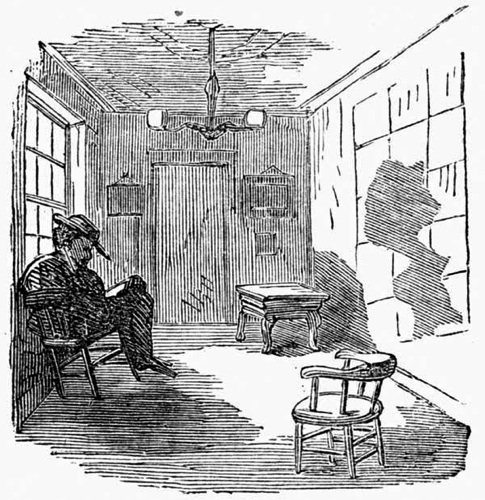
"Look here, my absorbed Talleyrand," says I, in astonishment, "that's not a map! It's only your own shadow on the wall."
He moved as I spoke, and then, for the first time, discovered his illusion.
"Hum!" says he, "it is a map of the Union in the sense that the Union is but a shadow of its former self."
The Conservative Kentucky Chap is actually so insufferably egotistical, my boy, and so imbued with the idea that Kentucky is the whole country, that it is almost impossible for him to sit on a chair without throwing his body into almost the exact shape of the American Continent.
Having induced a small Mackerel drummer to bring me my chaste architectual steed, the Gothic Pegasus, I mounted the roof of that walking country church, and moved off in an organ-waltz to inspect the national troops.
The Mackerel Brigade grows hoary with antiquity, and the capture of the Southern Confederacy is still delayed for the want of pontoons. And this reminds me that the Abolitionists of New England, who are entirely responsible for this war, with its taxes upon members of the Democratic Organization, have not yet sent any pontoons to the field. Whilst they would abridge the rights of white men, they even ignore white men's rights to a bridge. But let us not linger over such depravity, or we shall be delayed in our preparations for the Presidential canvass in 1865.
The last new General of the Mackerel Brigade is an officer of great age, named Cox,—known to the soldiery as the Grim Old Fighting Cox,—and I am happy to say, my boy, that he is an officer of great ability. Spurning all that vain pomp which too often makes our generals as clean in appearance as the military minions of the despotic powers of Europe, he makes it a practice to attire himself like the unostentatious dustman of a true Republic; and when he rides abroad to inspect the regiments, it is universally admitted that he is like a father visiting his children, whose great numbers make such demands upon his means that he can't afford to dress himself respectably.
Having assumed command of the Mackerel Brigade, the Grim Old Fighting Cox immediately summoned all his officers to his presence, and, having engaged each in single combat and defeated him, he proceeded to show his great ability. He beckoned to Captain Villiam Brown, who was at that moment taking the sun's altitude with his canteen, and, says he: "Tell me how many men are in the guard-house for beastly intoxication?"
Villiam smiled affably, and says he: "I don't remember just how many that Republican institution will hold."
"Release them all!" thundered the Grim Old Fighting Cox, violently rattling his sword, and firing a pistol in the air.
"Ah!" says Villiam, "here's Ability."
The next officer called was Captain Bob Shorty, and says the General to him: "How many slow-matches did my predecessor order for the Orange County Howitzers?"
Captain Bob Shorty took three steps in a break-down, and says he: "We have always ordered seventy-five."
"Make it seventy-six!" roared the Grim Old Fighting Cox, kicking over the writing-table and discharging a revolver over his shoulder.
Captain Bob Shorty gave a leap into the air, and says he:
"By all that's Federal! did I ever hear of so much Ability?"
As the Grim Old Fighting Cox was leaving his quarters, he came upon a Mackerel chap who was stooping down to tie his shoe, and gave him a kick that kindled conflagration in his vision. The poor chap rubbingly picked himself up, and, says he:
"It appears to me I never see so much Ability."
Ability, my boy, in its modern acceptation as applied to military men, appears to mean a peculiar capacity for surprising and startling everybody—except the enemy.
Yours, suspiciously.
Orpheus C. Kerr.
LETTER LXXXVII.
IN WHICH OUR CORRESPONDENT HAS A DEADLY AFFAIR OF HONOR WITH A GENTLEMAN FROM KENTUCKY; EXPERIENCES "CONTRABAND" HOSPITALITY AND MELODY; ATTENDS A GREAT MEETING IN ACCOMAC; AND WITNESSES A PRODIGIOUS NAVAL ACHIEVEMENT.
Washington, D.C., March 15th, 1863.
Kentucky, my boy, has considered herself a general boon to mankind ever since she was discovered by Colonel Boone; but there are different kinds of boons known to mankind, and if I should chance to mention the baboon as amongst the noisiest and least respectable of the species, my remark may not be regarded as entirely destitute of a personal bearing. It was in the honeyed accents of admiring friendship that I conveyed this chaste zoölogical idea to the Conservative Kentucky chap on Monday last, as we took Richmond together at Willard's bar, and I regret to say that he made it casus belli. Accidentally dropping his bowie-knife on the floor, and hastily replacing his ruffles over the handle of his pocket revolver, he polished the blade of his dirk with a blood-colored silk handkerchief, and says he:
"Kentucky fought for Washington in the Revolution; she has, thus far, prosecuted the present war without fear; nor will she shrink from even shedding personal gore where the provocation is the offspring of Yankee lowness."
He said this, with exceeding majesty, my boy, and I felt that I was indeed involved in complications with the Border States.
"I understand you, my warrior," says I, calmly; "but if this affair is to come off immediately, where are we to find our seconds?"
The Kentucky chap hastily called a small boy to him, and says he:
"Sonny, just run out into the street and ask any two gentlemen you meet to step in here for a moment." "You see," says he, turning to me, "it's better to have two brigadier-generals for seconds, as a battle might take place while we are away, and there are no private soldiers to spare at present."
"Yes," says I, thoughtfully, "that's very true."
The brigadiers were obtained, my boy, and, with murder in our hearts, we started forth to seek a spot appropriate for carnage in private. It was just the hour of mid-day, and we were wending our sanguinary way in silence, when, upon turning a corner of one of the public buildings, the sound of sweet music fell upon our ears, and we came suddenly upon a brass band and a party of singers, who were discoursing witching strains under one of the windows.
I listened for a moment, and then, says I: "What may be the occasion for this noonday melody?"
The Conservative Kentucky chap motioned for us to pause, and says he, feelingly: "It's a serenade to Secretary Welles of the Navy. Let us heed the voice of the singer."
Here a young vocal chap, under the window, commenced singing the following words, in a fine tenor manner:
SERENADE. "O lady, in thy waking glance There lurked a wondrous spell, To hold young Cupid in thine eye As in a prison cell. "And now, the god of Slumber finds Thy drooping lids so fair, He makes of them his chosen couch And dwells forever there."
As the last note of the singer fainted into the eternity of lost sounds, I looked at the Conservative Kentucky chap, my boy, and beheld that his eyes were suffused with the tears of an exquisite sensibility.
"Yes," says he, softly, "—'and dwells forever there.'" Here the Kentucky chap shed another tear to wash out the stain of the last one, and says he, "Mr. Welles is indeed a lady who offers some attraction to slumber. May he rest in peace!"
We were all too deeply affected to speak, but proceeded silently to a vacant lot across the river, where accommodations for law-breaking were ample. Everything about us here seemed fraught with the spirit of peace; on each side, and as far as the eye could reach behind and before, were the tents of the Army of the Potomac, growing in the spots where they were planted years ago. We alone, of all the human beings within sound of our weapons, were about to be breakers of the established war—to shed human blood. It seemed like a sacrilege, and I trembled with the cold.
At first, my boy, we had some trouble to keep the brigadier-generals with us, as it suddenly struck them that they had not drawn their pay for two whole hours, and were frantic to return; but when I suggested, that if they should be missed from their posts, they would probably be nominated for major-generalship, they consented to remain.
When the Conservative Kentucky chap took his position, I noticed that his countenance was contorted into a horrible expression of severity, and asked him why it was?
"Hem!" says he, "this is a solemn moment, young man. We are both about to fly into the face of our Maker." Here he pointed his weapon at me; and says he: "I think you are frightened."
"No," says I, making ready.
The Kentucky chap's face then assumed the most terrific expression I ever saw, and says he:
"Are you not alarmed at your awful position?"
"No," says I.
The Conservative Kentucky chap lowered his pistol, and, motioning for the brigadiers to come from behind their trees, advanced to my side.
"Hem!" says he, frowning majestically, "I think I understood you to intimate that you were terrified."
"No," says I.
Here the Conservative Kentucky chap took me suddenly by the arm in a very confidential manner, and, having led me a few paces back, says he, in a horrible whisper: "You find yourself frightened, as it were."
"Why, no," says I.
"Well," says the Conservative Kentucky chap, "I AM."
And we all went home together.
Since then, my boy, I have weighed and contrasted my own feelings and those of the Conservative Kentucky chap on that occasion, when I won an everlasting reputation for bravery; and I am satisfied that the bravery of a man in an affair of honor is a superior capacity for concealing terror.
It was toward the middle of the week that I went down to Accomac to attend a great Union meeting there, and it's my private opinion, my boy, my private opinion, that the human tongue is not without its province in this war. But before the meeting commenced, and whilst I was reflecting upon the fact that it was the day on which the Prince of Wales was to be married, a redeemed contraband saluted me, and says he:
"Mars'r, I hab been made a free man by Mars'r Lincoln, and hab opened a Refreshment Saloon on de European plan. If you want to dine, sar, here's my card. My name is Mister Negg."
I looked at the card as he left me, and found it to read thus:—
HAMAN NEGG'S
RESTAURANT.
ICH DIEN OYSTERS IN EVERY STYLE.
There was one thing about this inscription that I did not understand, and says I to a chap near me:
"See here, my patriotic friend, what does this mean? What kind of things are Ich Dien Oysters?"
"Oh," says he, obligingly, "you do not understand the Hanoverian tongue. 'Ich Dien' is the Prince of Wales' motto, and means 'I serve.' The phrase 'Ich Dien Oysters in Every Style' means, 'I serve oysters in every style.'"
Then it was, my boy, that I saw in Mr. Negg's device the despised African's testimonial of gratitude to Great Britain for the recent reaction of anti-slavery sentiment there. A more delicate compliment, my boy, was never offered to the mother country, who has given us all at least 2903reasons for loving her.
And speaking of redeemed contrabands, reminds me of the new African hymn, which the more pious colored Americans of South Carolina might denominate
DE GREAT HALLELUGERUM. "My mars'r's gwine away to fight With Mars'r Linkum's horde, An' now dis chile's at libaty To dance an' bress de Lord. Dar's no more swearin' round de house When missus cut up bad; Dar's no more kickin' niggers' shins, And, darfor', I is glad. "When mars'r take his horse to go, He kindly say to me: 'I hab such confidence in you, I leab you all, you see; Of all de niggers round de place, I trust to you alone.' By golly! dat's what mars'r say To eb'ry nig he own! "'Now if dem Bobumlitionists Should kill me dead,' says he, 'I hab instruct your missus kind To set you niggers free.' But mars'r say dat bery same Wheneber he get sick, And bresséd Jesus wrastle him To make him holy quick. "'Dem Yankees, dam um all,' says he, 'Am comin' down to steal You niggers, and to sell you then For Cuba cochineal. De Suvern chiverly,' says he, 'Am fightin' jist fo' you.' Now mars'r swearum when he lie, And, darfor', dat wont do! "Den mars'r trot away to war With 'Dolphus by his side,— A poor cream-colored, common dark Dat isn't worf his hide. He leab me and de other nigs To clar the place alone, With nuffin' but to play and shake De fiddle and de bone. "I hab a talk with Uncle Pete, De old plantation hand, And though he am intelligums Dis chile can understand. He say de Hallelugerum For cullud folks hab cum, And dat he bresséd Lord hab heard And beat his thunder-drum. "He say dat Northern buckra man Hab sent his gun an' ship To make de rebel chiverly Give up his nigger whip, He say dat now's de darkey's time To break de bonds of sin, And take his chil'en an' his wife To whar de tide comes in. "He say dat in de Norf, up dar, Whar Mars'r Greeley dwell, De white folks make de brack folks work, But treat them bery well; He says dey pay them for de work Dey's smart enuff to do, And nebber sells them furder Souf When sheriff put um screw. "I hab a wife an chil'en dear, And mars'r say to me He nebber sell them while he live,— He'd rather set them free; But dar's de mortgage on de house, If dat should hab to fall, Ole Uncle Pete hab told me dat He'd hab to sell us all. "I lub de ole plantation well, And missus she is kind; But den dis chile's inclined to try Another home to find. Now mars'r gwine away to war, And give me such a chance, I'll bress de Lord for libaty. And hab a Juba dance. "De Hallelugerum am cum With glory in his eye, And all de niggers in de Souf Am fit to mount de sky. My wife an' chil'en hab de spoons Dat's owned by—(here a cough)— I hab de sugar-tongs myself, And, darfor,' I is off."
Among the distinguished speakers invited to be present at the great meeting in Accomac, were: the Emperor of Russia, the Emperor of France, the Sultan of Turkey, Queen Victoria, the King of Sweden, the President of the United States, and Theodore Tilton; but, as the walking was very bad, they did not all come. The celebrated American patriot, Mr. Phelim O'Shaughnessy, took the chair in the absence of the President, and said, that as the Emperor of France was unavoidably absent, he would beg leave to introduce Mr. Terence Mulligan, whose ancestors were once Irishmen themselves.
Mr. Mulligan was received with prolonged applause, and said, that although he bore an Irish name, he had never been ashamed to associate with Americans. His father, while yet on his way from Ireland, had been elected a Justice of the Peace in New York, and his son should be the last one to neglect the Union in its hour of need. What we wanted now, was, that the example of our Irish citizens should be imitated by the others, and that the war should be prosecuted with vigor. (Continued cheering.) Irishmen need never despair of this glorious Union, which had often been a House of Refuge for them, and could not fall without carrying Ireland with it,—so closely were the two great nations knit together. The Irish would never despair:
"For Freedom's struggle once begun, Bequeathed from bleeding sire to son, Though baffled oft, is ever won."
When the enthusiasm had subsided, the chairman expressed his regret that the Emperor of Russia had not arrived yet; but felt confident that his place could not be better supplied than by Mr. Mickey Flanigan, whose forefathers were themselves the fellow-countrymen of Daniel O'Connell. (Great applause.)
Mr. Flanigan arose amidst great cheering, and said that it was a time when every Irishman should feel as though the eyes of the whole world were upon him. He had found the natives of this country intelligent, kind, and hospitable; and though they had not taken his advice as to the management of this war, he firmly believed that no Irishman would disagree with him when he said, that Irish arms and Irish hearts would finally conquer:
"For Freedom's battle once begun. Bequeathed by loyal sire to son, Though baffled oft is ever won."
As soon as the demonstrations of approval had sufficiently subsided, the chairman stated, that, for some unknown reason, Queen Victoria was behind time; yet he could not, for his part, feel sorry for an event which gave him an opportunity to introduce Mr. Figsey Korigan, who represented that element of the world's hidden, free spirit which had thundered in an Emmett and an O'Brien. (Great enthusiasm.)
Mr. Korigan acknowledged the glorious welcome he had received, and declared that this was a proud day for Ireland. Her sons were ever foremost in the ranks of human freedom, shedding their votes for the oppressed of all lands, and fighting all the time. He would say to that Irishman who despaired of this Union, that he was unworthy of any office, and should blush to call himself an American. The speaker's own family had always been Irish, though he himself was born in Cork, and he would be ashamed to stand on that platform if he did not believe that the freeborn Irish soul would eventually triumph:
"For Freedom's contest once begun, By bleeding sire bequeathed to son, Though baffled oft is ever won."
The chairman now arose, amid frantic applause, and said that the meeting was now at an end; but proposed that all the persons present should enroll themselves as members of a Union League for the Prevention of Distress among our Irish Soldiers in the Field. This was responded to with a thundering "Ay." He also proposed that each person present should contribute one dollar as a basis of a fund for the purpose. A gentleman here moved that the chairman's last suggestion should be amended by omitting the words "dollar" and "fund." Carried unanimously.
Then all the Accomackians went pleasantly home, my boy, except one seedy chap who had stood patiently before the platform during all the proceedings; and there he still stood, with his arms folded, when all the rest had gone. He was a somewhat loaferish chap, with some appearance of the philosopher.
The chairman looked at him, and says he:
"What are you waiting for, my friend?"
The chap gave an extra chew to his tobacco, and says he:
"I'm waiting for that ere Great Union meeting to come off."
"Why," says the chairman, "the meeting is all over."
"Yes, I know—thatmeeting," says the chap, explainingly; "but I mean the Great Unionmeeting."
It is astonishing, my boy, how much ignorance there is in this world. Here was a sane human being who had attentively stood all through a meeting in aid of our sacred national cause, and yet did not know that it was a Union meeting.
Thursday was the day when I reached the head-quarters of the Mackerel Brigade, at the ancient city of Paris, arriving just in time to witness one of those strategic naval exploits which will yet cause the American name to be respected wherever there is nothing particular against it.
It appears, that after his last successful experiment with his patent swivel gun, that stanch old sea-dog, Rear Admiral Head, devoted much of his time on Duck Lake fishing for bass, believing that noble expanse of waters to be free from all obstructions and open to the commerce of the world. The commerce did not come, my boy; but several insidious Confederacies did; and as our glorious old son of Neptune always sat with his back to their side of the lake when fishing, they constructed a pier which extended from the shore to the main deck of the iron-plated Mackerel Squadron, the "Secretary Welles," and had planted seven villanous horse-pistols to command the Admiral's fish-basket and umbrella before our hoary old salt discovered that the war was still going on.
"Riddle my turret!" says the grim old Triton, in his iron-plated manner, "I believe a blockade is established; dent my plates if I don't."
Heartily did that pride of our Navy call up the culpably inattentive Mackerel crew, who were eating clams in the stern-sheets, and quickly was the gallant "Secretary Welles" withdrawn out of the range of the Confederacies' murderous fire; her swivel gun raking the atmosphere fore and aft, whilst the fearless old sea-dog sat down upon a reversed pail amidships, and addressed a letter breathing future vengeance to the unseemly Copperheads of the North. "Sink my Monitor!" says he hotly; "let them beware of the time when the Navy returns to its peaceful home!"
But it was on Thursday, my boy, that the Rear Admiral was to run the blockade of the Confederacies' pier, and Captain Villiam Brown, Captain Bob Shorty, and myself, stood upon the edge of Duck Lake, with our pieces of smoked glass in our hands, to behold this triumph of consummate naval strategy.
At the hour appointed, we beheld Rear Admiral Head and his Mackerel crew slipping over the stern of the Mackerel squadron into the water, and immediately the "Secretary Welles" commenced to float past the Confederacies' batteries with the tide. Onward she went, despite the plunging fire from the horse-pistols, and, presently, we could see her go safely ashore. Never shall I forget the beautiful glow of triumph that overspread the noble countenance of Rear Admiral Head, as he and his crew waded through the water to the place where we stood.
"Unrivet my armor!" says he, in his stern, iron-plated manner; "I call that running a blockade in good style."
"Yes," says I, sceptically; "but how are you going to get the squadron back again?"
"Eh?" says he, "what was that question, young man?"
"Why," says I, anxiously, "now that the squadron has run the blockade, how are you going to get her back again?"
"By all that's iron-clad," says the grim old sea-dog, violently, "I forgot all about that."
"Ah!" says Captain Villiam Brown, pleasantly, "can't you dig a canal?"
At this moment there was a tremendous explosion; something was seen flying through the air, and then the swivel gun of the "Secretary Welles," with the Admiral's fish-basket and umbrella attached, fell beside us on the sand. In their haste to take possession of our squadron, the Confederacies had dropped some sparks from their pipes into the powder-magazine, blowing our entire armament back to us!
Providence, my boy, is evidently on our side in this war; which accounts for the fact that human naval genius has not yet entirely ruined us.
Yours, devoutly,
Orpheus C. Kerr.
LETTER LXXXVIII.
CONCERNING INTELLECTUAL GIANTS AND PINS; WITH A FEW WORDS AS TO CERTAIN DRAMATIC STREET-SCENES SUPPOSED TO BE OF DAILY OCCURRENCE; AN AFFECTING WESTERN POEM; AND A BRIEF GLIMPSE OF AN ORDINARY CAVALRY DASH.
Washington, D.C., March 22d, 1863.
Greatness of mind, my boy, like greatness of body, consists no less in a capacity for making good use of small things than in an ability to master vast ones; and the intellect sublime enough to grasp the whole system of the universe, may not disdain to draw a useful lesson in human nature even from so minute an object as the Secretary of the Interior. The elephant, in the full amplitude of his physical greatness, has been briefly and comprehensively characterized as an animal able to knock down a giant and pick up a pin; and how shall the glorious human mind boast its superiority over matter, if it be not also endowed with the power of stooping as well as soaring? I believe, my boy, in the mind that picks up pins intellectual; especially in these days, when there are so few intellectual giants to knock down. Indeed, so important to the general system of intellect is the system of taking no less note of small things than of great ones, that a multitude of writers who deal only in the smallest kind of matters all their lives may themselves be denominated intellectual pins. I hold Mr. Tupper to be an intellectual pin, and Mr. Willis has also become somewhat of a pin in these his later years.
To the youthful soul, still steeped in those romantic dreams, of which a supper of pig's feet is the best artificial provocative I know, this war is a vast phantasmagoria of almighty giants struggling together in the clouds. There was a time when I, too, was able to see it to that extent; but time, and some experience in Virginia, have reduced my giants in the clouds to brigadiers in the mud; and from seeing our national banner in the character of a rainbow dipped in stars, I have come to regard it as an ambitious attempt to represent sunrise in muslin, the unexpected scantiness of the material compelling the ingenious artist to use a section of midnight to fill up.
Down in Accomac, the other day, I overheard a sentimental Mackerel chap, to whom I had imparted this flagging idea, inflicting it upon another Mackerel as original; but he was anxious to improve upon the comparison, and says he:
"Our National Standard is so much like a beautiful sunrise, that I could almost wish the full idea of an eternal morning could be further expressed in it by something to represent the dew."
The inferior Mackerel scratched his head, and says he:
"Why, my pay has been due for some time, and I myself am eternally mourning for it."
If we cast pearls before swine, my boy, we must not be surprised to find them taken for the seeds of cabbage-heads. I once told a Wall-street broker that I considered the break of day one of Nature's most glorious sights; and he said that he didn't mind it himself, if he didn't happen to have any of Day's notes on hand at the time.
But, to return to the giants and the pins; the absence of all giants in the way of events for the past week has induced me to take note of the pins; and close observation of a few of the latter induces me to believe that a strong Union feeling is beginning to be developed amongst the loyal masses of the North. For instance: one of the passengers in one of the street-cars of Paris, the other day, was a venerable man of ninety-three years and seven months, who sat quietly between two lady-passengers, eating roast chestnuts, and permitting the shells to fall upon their laps. Upon his hoary locks rested a white hat, well worn and mashed-in with time; his once light overcoat buttoned close to his throat, represented a drawn battle between grease spots and torn places; his venerable lower members were encased in blue overalls, somewhat shaded about the knees; and the large feet, resting easily upon the cushions of the opposite seat of the car, wore one slipper and one disabled boot. With the exception of a scarcely heard hiccup between every two chestnuts that he ate, not a sound was emitted by this venerable and striking figure as he sat there thus unobtrusively in a public car, like any ordinary passenger.
Presently, a young and boisterous lieutenant, vain of his new regimentals, and full of the airs of a new Jack-in-office, entered the car, and egotistically attempted to make his way to a seat. A faint hiccup saluted his ear, and, looking down, he found his way barred by the aged legs of the venerable stranger, whose feet were upon the opposite cushions.
"Let me pass, old man?" says the vain youngster, with the smart air of one who wishes to get to his seat.
The venerable stranger hardly raised his stern old eyes at the flippant remark, but ate another chestnut, as though no one had spoken.
"Come, my friend," says the conceited stripling, with fresh arrogance, "Be kind enough to move for a moment. I am Colonel P——."
In an instant, the aged frame sprang to his feet, opened all the windows, turned the conductor out of the car, locked the doors, mashed his hat down over his eyes, and frantically tearing open his dilapidated overcoat, displayed the star of a major-general!
In an instant, the newly-fledged colonel lost all his knowing braggadocio, and cowered before the glorious old veteran, like a cowed cur (female of a bull-dog).
"Wr-r-r-etch!" exclaimed the hoary commander, in tones of thunder, relieved with the vivid lightning of a hiccup, "Do you know me!"
The abashed young boaster could only bow his head in shame, and took the first opportunity to dash himself from the vehicle wherein he had been taught such a lesson. And this should teach us all, my boy, that bad clothes are not always a sure sign of the wearer being only a reporter for the Tribune; nor do the ordinary symptoms of intoxication always indicate that the possessor lacks high rank in our national army.
Some hours later, on this same car, there transpired a somewhat different scene, but one equally calculated to prove that there is indeed a North. Twenty-three wealthy secessionists were in the swift vehicle, the only other passenger being a handsome lad of about sixteen, in the uniform of a brigadier. Rendered confident by their numbers, the enemies of our beneficent form of government entered into a venomous discussion of the siege of Vicksburg, asserting that the Yazoo Expedition had not yet captured forty-two steamboats of Confederacies, and that the announcement of the capture of the Mississippi River was premature.
The young soldier of the Republic went on with some candy he was eating, an apparently indifferent spectator of this symposium of treason; but the close spectator could not have failed to observe that his whole form was invisibly convulsed with a patriotic indignation. Presently, however, when one of the more hideous conspirators heartlessly remarked that we had not heard much of our army in Virginia lately, endurance ceased to be a virtue, and the young hero could no longer restrain himself.
In a moment his whole aspect changed; his eyes burst into a devouring blaze, and his cheeks were in flames before aught could be done to check the conflagration. Animated by the strength of a giant, in a cause which he believed to be a noble one, he shot the traitors one by one with his revolver, and buried them in an obscure swamp near the track; he paid the driver and conductor their wages, and induced them to enlist for three years; then, after selling both the horses at auction, he broke the car into kindling-wood for the use of the poor.
And this mere boy, who could make himself equal to an emergency,—what of him? I can fancy him a fond mothers pride, a venerable father's hope,—ay, even a tender sister's favorite snub. When this record of his glory reaches them, will they remember, in the midst of their proud exultation, the poor scribe whose humble pen relates to them the glories of their house? Will they drop one burning tear to the memory of him who at this moment does not know what on earth to write about next, and heartily wishes that he had been content to earn a respectable living as a reputable wood-sawyer, instead of turning writer? Will they sometimes give one idle thought to the unpretending litérateurwho has found the glorious reward of literary merit to be an assumption by one-horse country newspapers of the right to talk about him by his family name without troubling themselves to put in the civilized courtesy of "Mr."? Will they mention in their less urgent prayer, occasionally, the modest child of the quill, who would exceed all the horrors of the Inquisition with the foes of his country, by actually forcing them to write a column for a newspaper when they felt mentally incapable of penning a single coherent paragraph? Will they?
Ah! this is no country to appreciate genius; as they wrote upon the tomb of my early friend, the sweet-singing Arkansaw Nightingale, whose last sad manuscript to me described
"A BIG DOG FIT. "Lige Simmons is as cute a chap As ever you did see, And when the feller says a thing, It's sure as it can be. "He owns a dog—and sich a brute For smellin' round a chap, I never see in all my life, You'd better bet your cap. "Now Lige is proud of this here dog, And says the critter'll whip As many wild-cats in an hour As go to load a ship. "'But, law,' says Lige, 'that animile Is awful in a row, And other pups 'longside of him An't no account, nohow.' "In fact, one day, I saw the same Contemporaneous pup Pitch into a Newfounlander And chaw him slightly up. "He's such a plaguy little cuss, You'd laugh to see him come; But when there's chawin' up to do, I tell you, boss, he's some! "One day, a pedler came to town With ginger-beer and things, And patent clocks, and pious books, And fancy finger-rings. "And underneath his cart was tied A bull-dog of the kind That tears your musn't-mention-'ems, In angry frame of mind. "Now, Lige's dog was smellin' round, And when he see this here, He cocked his eye in agony, And acted awful queer. "The bull-dog gin a rousin' shout, As Lige's dog went by, And gev him such a sassy nip That fur began to fly. "Then Lige's dog unfurled his tail And gev the wound a lick, And then pitched into that ere dog A way that wasn'tsick. "The critters had it nip and tuck, And made such awful noise, That Lige himself came up to see, With all the other boys. "The pedler see him, and says he, Like one to fits inured: 'I'm sorry, strannger; but I hope Your yaller dog's insured.' "I tell you, boys, 'twas fun to see The grin that Lige put on, As in his cheek he put a chaw And winked his eye at one. "'Oh, let the varmints fit,' says Lige, 'My pup is awful thin, And this here row will make him look Jist like himself ag'in.' "And all this while the fit went on, With such a mess of dust We couldn't tell the upper dog, If all our eyes should bust. "'Twas yell and yowl, and shout and growl, And stompin' awful hard, And sometimes they'd a tail stick out From where the dust was bar'd. "Byme-by the noise began to die, And as it fainter grew, The dust began to settle down, And you could just see through. "At last it cleared away entire, But all that we could see Was Lige's dog a squattin' down Beneath the axletree. "'Law!' says the pedler, lookin' blue, 'What's happened to mypup?' Says Lige: 'It's my opinion, boss, My pup has eat him up.' "'But where's the chain I tied him with?' The pedler loud did call. And would you b'lieve me—Lige's dog Had swallowed chain and all! "One end was hangin' from his mouth And gev him such a cough, We had to fetch a chisel out And cut some inches off. "Then that ere brute, to show the joy That's nat'ral to dum brutes, Insulted that sad pedler there, By smellin' round his boots. "The pedler dropped a tear, and then Says he to Lige, says he: 'I'd like to buy that yaller pup And take him home with me.' "But 'no,' says Lige, with proud disdain And sot down on a log, 'That pup is plural now, you know— A dog within a dog.' "'He's twice as strong to fit,' says Lige; 'For if he's killed outside, I'll turn the critter inside out, And let yourcritter slide.' "'Well,' says the pedler, with a sigh, 'The pup's a trump, I think; But let us change the subject now; Say, strannger!—do you drink?'"
But let me not indulge in sentiment, my boy, while it is still before me to describe the recent successful reconnoissance of the Anatomical Cavalry, whose horses remind me of the celebrated war-horse described by Job, inasmuch as it is believed that the far-famed patience of that scriptural patriarch would have stood a very poor chance with them.
The Grim Old Fighting Cox, the new General of the Mackerel Brigade, having learned from the New York daily papers, of the week previous, that a few hundred thousand freshly-drafted Confederacies were massing themselves on his right, resolved to order a triumphant reconnoissance by the Anatomical Cavalry and the Orange County Howitzers, for the purpose of discovering whether the war was actually going on yet. As the steeds of the cavalry were widely dispersed through the various gravel meadows around the Mackerel camp, my boy, and had grown somewhat wild from long disuse, I was somewhat puzzled to know how they could all be caught quickly enough, and says I to Captain Villiam Brown, who was to command the combined expedition:
"Tell me, my Pylades, how will you manage to organize the equestrian bone-works without losing too many hours?"
"Ah!" says Villiam, briskly replacing the cork in his canteen, and startling his geometrical steed, Euclid, from a soft doze, "we must make use of our knowledge of natural history, which is the animal kingdom. Observe the device used in such cases by the scientific United States of America."
I looked, my boy, and beheld a select company of joyous Mackerels hoisting a huge board to the top of a lofty pole, which must have been visible for a mile distant. The board simply bore, in large letters, the simple words:
"THE OATS HAVE COME."
and scarcely had it reached the top of the pole, when the anatomical steeds came pouring into the camp with frantic speed, and from every direction.
"Ah!" says Villiam, thoughtfully, "how powerful is instink, even in a dumb animal. I once had a dog," says Villiam, reflectively, "whose instink was so powerful, that to stop his vocal barking it was only necessary to show him a good-sized piece of bark. He felt," says Villiam, explainingly, "that it was a larger bark than his, and it made him silent."
Truly, my boy, there is often a marvellous similarity between instinct and reason, the former serving as the foundation of the latter, and not unfrequently being entirely destitute of a superstructure in military men.
The Cavalry and Howitzers having been arranged in such order that each supported the other, and a prospect of some carnage supported them both, the word was given to advance, and the warlike pageant swept onward very much as we read in the reliable morning journals. I was proceeding at the head of the cavalcade, with Villiam, pleasantly discussing with him the propriety of digging a canal to Richmond, and using the Cavalry on the tow-path, when there rode forth from the cover of a wood near at hand a horseman, whose stately bearing and dishevelled hat announced Captain Munchausen, of the celebrated Southern Confederacy. He waved his sword courteously to Villiam, and says he:
"You bring your hordes to measure sabres with us, I presume?"
Villiam rattled his good sword Escalibar4in its scabbard, and says he, grimly, "We are met together for that purpose."
Captain Munchausen smiled superciliously, and says he, "Is this intended by your vandals to be what you call a brilliant cavalry dash?"
Villiam waved his hand majestically, and says he:
"That is the exciting phrase."
"Then," says Munchausen, with unseemly levity of tone, "I can tell you, before you go any farther, that you are out of ammunition."
Here Captain Samyule Sa-mith, of the Howitzers, who had come up while the talking was going on, suddenly slapped his knee, and says he:
"That's so. I knew I had forgotten something in this here expedition, and it's the ammunition."
So we all went back to camp, Captain Munchausen being too much demoralized by the bad example to pursue us.
Our latest cavalry dashes, my boy, being reduced to their simplest meaning, signify devised charges of cavalry, which are based upon charges of artillery, which have forgotten to bring any charges with them.
Yours, retreatingly,
Orpheus C. Kerr.
LETTER LXXXIX.
SHOWING HOW THE GREAT CITY OF ROME HAS BEEN RUINED BY THE WAR; CITING A NOTABLE INSTANCE OF CONTEMPT OF COURT; DESCRIBING REAR ADMIRAL HEAD'S WONDERFUL IMPROVEMENT IN SWIVEL GUNS; AND PROVING THAT ALL IS NOW READY FOR THE REDUCTION OF FORT PIANO.
Washington, D.C., March 29th, 1863.
After due consideration of the different points of the Compass, and a fair estimate of the claims of each to superiority, I am inclined to give the preference to the Great North-west. It is to the Great North-west that we are indebted for our best facilities of sunset; some of the greatest hogs of the day come from Cincinnati; the principal smells of the age belong to Chicago, and the whiskey of Louisville has almost entirely superseded the pump of our forefathers. Hence, my boy, it was with a feeling akin to reverence that I witnessed the arrival in Accomac of a delegation of high moral Democratic chaps from the Great North-west, the other day; their mission being, to protest against all further continuation of a war which was degenerated into a mere bloodshed for the sake of New England; and to suggest that a convention of all the States be at once held in Kentucky, to arrange a peace that shall be acceptable to the Great North-west. I was asking the thoughtful chairman of the delegation what were his particular grievances, and says he:
"This war is ruining much valuable Real Estate in the Great North-west, of which I and my fellow-beings are proprietors; and cannot continue without proving the entire destruction of some of our largest cities. Just before this war broke out," says the thoughtful chap, impressively, "I gave a three-years' note of seven hundred and sixteen dollars and fifteen cents for the city of Rome, situated on the future line of the Atlantic and Pacific Canal, and divided into four hundred water-lots of five fathoms each. As soon as the Atlantic and Pacific Canal was built, the water would have been drawn off by means of eighteen large hydraulic pumps supported by Eastern capital, leaving the lots all ready for building purposes. The main street would then have been graded, and paved with the new patent Connecticut sub-drainage pavement, and would have extended two miles in a perfectly straight line, with a horse-railroad through the centre. The various intersecting streets I should have named numerically, commencing with 'First Street,' which faces upon the Atlantic and Pacific Canal, and so going on to 'One Hundred and Seventy-sixth street,' and so on. These streets would have been occupied exclusively by brown-stone-front residences, with a flag-staff bearing our national banner on the roof of each one, and rented to small private families without children. The full lots on the main street would have been used for the City Hall, the Lunatic Asylum, the Custom House, the Home for Deranged Persons, the Merchants' Exchange, the Corn Exchange, the Refuge for the Insane, the Grain Elevator, the Institution for Friendless Maniacs, the Principal Pork-Packing Establishment, the Hall of Records, the Office of the Superintendent of Central Parks, the Madman's Snug Harbor, and the Municipal Bar-Room. The sixty-eight principal banks would have discounted bills of exchange at sight, for the benefit of the numerous foreign vessels constantly arriving at the principal pier by way of the Atlantic and Pacific Canal, and the Fire Department would have been limited to twenty-three hundred hose-carriages and engines, with an educated Chief Engineer." Here the thoughtful Democratic chap gnashed his teeth, and says he:
"But the City of Rome has been entirely retarded by this here Black Republican New England war upon the sunny South, with which the great North-west has no earthly quarrel whatsoever."
I was pondering a reply to this very reasonable speech, my boy, when word was suddenly brought that one of the Mackerel pickets had just assassinated a young Confederacy, who had only fired twice upon his inhuman murderer. No sooner did the thoughtful Proprietor of the City of Rome hear this sickening news than he at once formed the other Democratic chaps into a coroner's jury, and hastily proceeded to hold a high moral inquest upon the body of the lamented deceased.
There being no witnesses to examine, and nothing in the pocket-book found upon the body, the proprietor of Rome removed two tears with his red silk handkerchief, and briefly summoned up the case. Kneeling desolately beside the cold remains, and taking one of the lifeless hands within his own, he sniffed feelingly, and says he:
"The young man which is here before us is another of them noble souls that have fallen gory sacrifices to the Mulock of War."
"You mean 'Moloch of War,'" says a juryman.
Whereupon he was committed to custody for contempt of court.
"This young man," continued the Proprietor of Rome, "may have had good cause to hate and despise the radical abolition offsprings of New England; but he had no quarrel with the glorious Democratic party of the Great North-west, which is now blindly fighting for his wooden-nutmeg foes. I will venture to say," says the thoughtful Roman, with great emotion, "that he even loved the Great North-west in his heart. Behold how freely he permits me to clasp his left hand to my friendly buzzom, even though he is dead."
Just then there was a sudden silence, my boy, for the right hand of the deceased young Confederacy was observed to be slowly rising in the air! Overcome with awe, the jury gazed upon the strange spectacle, like men under a wizard's spell. Slowly, slowly, the hand arose, until nearly above the face of the slain Confederacy; then it descended until it reached the half-averted countenance of the dead, and convulsively seized the nose between the thumb and fore-finger.
The Proprietor of the City of Rome changed color, and says he: "Well—ahem!—it can't be that—" Here he looked more closely at the body, and says he:
"I am at a loss to explain this remarkable phenomena."
A venerable juryman, of much shirt-collar, coughed to attract attention, and says he: "I should take the present attitude of our departed Confederate brother to be that of a man who smells something obnoxious."
Here the Proprietor of Rome suddenly dropped the left hand of the deceased Confederacy, and says he:
"Why, he must mean to insult the Great North-west."
"Yes," says the venerable juryman, "there can be but one construction of the present offensive attitude of this dead young being."
The thoughtful Proprietor of the City of Rome deliberately took off his spectacles, blew his nose, buttoned his coat up to his chin, and says he: "I have always advocated a vigorous prosecution of the war, and believe that full nine-tenths of our gallant troops are Democrats. What's the werdict?"
The shirt-collared juryman waved his hand impressively, and says he: "We find the deceased guilty of contempt of court in the Last Degree."
Then the Democratic chaps from the Great North-west held an enthusiastic mass meeting on the spot, and unanimously resolved that neither Kentucky nor Indiana would resist the Conscription Bill, should it be found unsafe to do so.
Believe me, my boy, when I say that the great Democratic party is stanchly loyal at heart, however strangely its head may seem to err at times; and never will it take a side with the enemies of the country, even whilst those enemies make offers to it not only aside but affront.
Upon going down to Paris on Friday, I found the well-disciplined and spectacled Mackerel Brigade greatly excited and demoralized by the insidious report that their famous new General, the Grim Old Fighting Cox, had actually washed himself. This injurious rumor, my boy, suggested such humiliating national recollections of those days of consummate strategy, when a certain egotistical commander indulged in the vanities of soap and hair-oil, that the Brigade were naturally terrified. Finally, however, the absurd story received a decisive quietus, when the Grim Old Fighting Cox was seen riding slowly on his unostentatious steed, the "Pride of the Canal," dressed in the unassuming republican habiliments of a stern and inflexible coal-heaver. It is needless to say that he had not washed himself. This war is at length beginning in earnest.
It is beautiful to see how the Grim Old Fighting Cox is improving the morals of the venerable Mackerels, and winning their affection, confidence, and respect. Coming, unexpectedly, upon a Mackerel, who had just laid aside his umbrella, and removed his spectacles, in order that he might weep the more freely, he fired a pistol over his head, and says he:
"What is the matter, my dear sir?"
"Oh!" says the poor Mackerel, sobbing, "I am in sore need of the pay which is due me for two years' faithful strategy to the Union, and know not where to get it."
The Grim Old Fighting Cox was much affected, and says he, softly: "You must humbly kneel, and beseech Providence for it."
The afflicted chap toyed with his spectacles, and says he: "But suppose Providence should refuse?"
"Then come to ME!" thundered the Grim Old Fighting Cox, with the air of a stern national parent.
I could relate hundreds of such significant anecdotes as this, my boy; though when the Grim Old Fighting Cox tells them himself to all the reporters of the reliable morning journals, he invariably desires that they shall go no further; but other great events demand my immediate attention.
It was very shortly after the victorious but disastrous blowing up of the Mackerel iron-plated squadron, the "Secretary Welles," on Duck Lake, by the infatuated Confederacies of Pier No. 1,—it was shortly after this event, which I duly recounted at the time, that our unconquerable old sea-dog, Rear Admiral Head, invented an entirely new iron-clad after the model of a Quaker hat, the turret being of solid iron all through, and so arranged that it could be used to cover the gangway amidships. In fact, my boy, the turret was a movable block of iron, with the swivel-gun mounted on top; so that if the turret happened to be hit, the artillery would not be disabled, and if the artillery was disabled, the turret would still be as good as ever. (Patent applied for.) There was some discussion as to what name should be given to this formidable monster, nearly the whole six-barrelled Indian language having been almost exhausted by our national navy; but finally it was resolved to call her the "Shockingbadhat,"—an old Choctaw title of much simplicity, signifying originally "The Head what errs," but now understood as meaning "The Head waters."
There has also been a great improvement in the swivel-gun, my boy, which has been so reconstructed as to remedy the evil of immediate bursting so common to our heavier ordnance. A select committee of Mackerels having been appointed to examine our national ordnance system, and discover the cause of its inefficiency, stated in their able report that the causes of the frequent bursting of our larger guns are,—
First.The powder used in propelling the appropriate missile against the enemy.
Second.The addition of an incendiary spark to said powder.
It was further stated in the report, that, although the barrel of a gun was frequently fractured when it exploded, there was no record of the touch-hole ever having burst; and the committee believed that this curious fact should serve as a valuable suggestion to the manufacturers of future heavy ordnance.
Acting upon this truly valuable suggestion, our stern old Son of Neptune caused his swivel-gun to be reconstructed upon a novel principle; the touch-hole was extended to the usual size of a barrel, and the barrel was reduced to the usual size of a touch-hole; so that, although the terrible weapon looked precisely the same as ever, it was, in reality, completely reversed!
But while the "Shockingbadhat" was being built, and receiving her terrific new armament, the shameless Confederacies on their Pier in Duck Lake had been industriously building Fort Piano and mounting it with their villanous horse-pistols; so that when the new Mackerel iron-plated squadron was ready for carnage and fishing, there was a hostile projection in the way.
"Chip my turret!" says Rear Admiral Head, in his iron-plated manner, "I think I shall have to blow a few more Rebels into eternity—smash my casemate! if I don't."
I stood upon the shore of Duck Lake, with a bit of smoked glass to my eye as usual, when our new monster of the deep came abreast of Fort Piano, and Rear Admiral Head commenced to reconnoitre through his pocket-microscope. The venerable commander gazed steadfastly through it for a moment, and then, says he:
"Crack my plates! if I don't perceive an insect on the wall of the hostile work."
There was indeed a solitary Confederacy seated upon the front wall of Fort Piano, dining sumptuously upon some fresh hoe-cake, and says he:
"You can't pass here without a New Jersey ferry-ticket."
(New Jersey, my boy, is now a Southern Confederacy, or a Peace of one.)
I could hear the glorious old naval hero say, in a suppressed voice, to the intelligent Mackerel crew on top of the turret:
"Depress your weapon four points to windward, grease the ball, and fire at his stomach."
In another instant, the whole landscape shook with a tremendous explosion, jarring the Admiral so greatly that his spectacles fell off, and causing his blue cotton umbrella to tremble like a leaf. The ball ascended to the zenith in a parabolical curve, and was lost amongst the other planets. I do not think, my boy, that the Confederacy would have been offended at this, had not the sudden noise caused him to jump in such a manner that he dropped his hoe-cake into the dirt. Upon this occurrence, however, he sprang to his legs on the wall, drew up a long pole from behind him, disrespectfully cracked our glorious old Rear Admiral over the head with it, and then commenced shoving at the turret of the "Shockingbadhat."
Perceiving the great danger of the squadron, and unmindful of his own wound, the venerable sea-dog hastily grasped at the pole, and says he: "Ah, now, what do you want to do that for, Mr. Davis? What's the use of pushing my turret overboard?"
He said this so mildly that the Confederacy burst into a prodigious horse-laugh, and drew in his pole again.
"As no possible good could be attained by taking Fort Piano, the indomitable old Rear Admiral at once returned with the squadron to his original anchorage; having gained all that was required, and proved his iron-clad monster to be fully qualified for actual service. Everything is now ready for the anticipated conquest of Duck Lake."
I give you the above in quotation marks, my boy, because it is the official report as it appears in all the reliable morning journals, and clearly and satisfactorily explains everything. The first of April is close at hand.
Yours, fortuitously,
Orpheus C. Kerr.
LETTER XC.
GIVING A DEEP INSIGHT OF WOMAN'S NATURE; PRESENTING A POWERFUL POEM OF THE HEART BY ONE OF THE INTELLECTUAL FEMALES OF AMERICA; AND REPORTING THE SIGNAL DISCOMFITURE OF MR. P. GREENE.
Washington, D.C., April 5th, 1863.
Woman's heart, my boy, in its days of youthful immaturity and vegetable development, may be felicitously likened unto a delicate cabbage, with an invisible worm feeding upon its sensitive petals. To the eye of the ordinary and unfeeling observer, the cabbage is in perfect health, and its intense greenness is thoughtlessly accepted as a sure indication of an unravaged system. Man, proud man, with all his boasted human wisdom, would smile incredulously, if told that the tender vegetable—the magnified and nervous white rose, as it were—had beneath all its seeming verdancy, an insatiable and remorseless worm gnawing at its hidden core. Man, I say, would thus wallow in his miserable ignorance, and persist in his disgusting blindness. But mark that dainty little figure coming up the garden-walk, my boy. It does not walk erect, like boastful Man, does not spit tobacco-juice like haughty Man; and as it approaches nearer, we perceive that it is a hot-house Pig. Ay, my lord: I say to you, in all your glory of human understanding and trifling degree of snobbishness, it is a Pig. Yes, madam: I remark to you, in your jewels, and laces, and absurd new bonnet,—it is only a Pig. Onlya Pig! O-O-ONLY a Pig! And why should we say "only" a Pig; as though a Pig were so veryinferior to proud Man? We all accord to the awful and unfathomable German Mind a preternatural gift of philosophy, so far above the contemptibly-limited thing we call human understanding that no man can ever understand a word of it; and how does that German Mind express itself when it desires to describe the Vast, the Extensive, and the Somewhat Large? Why, it simply observes "Das is von 'Pig' thing." And is not this unaffected remark sufficient, my boy, to raise the wrongfully despised Pig to the dignity of an adjective, at least? But look once more at the hot-house Pig in question, as he stoops thoughtfully to the cabbage which derisive Man has esteemed perfectly sound. He pushes it once with his nose; he raises his eyes, blinking in the glorious sunshine; his tail vibrates a moment; a solemn wink,—a grunt of deep reflection,—and he turns to another cabbage!
Yes! this despised little roasting-pig, this unconsidered Flower, as it were, has surpassed all the vaunted wisdom of stuck-up Man, and discovered the worm at the core of the sensitive cabbage!
Woman's heart, my boy, in its days of youthful immaturity and vegetable development, is a metaphorical Cabbage with a figurative worm at its palpitating core. That worm is a passionate yearning for TRUE SYMPATHY. Heartless but wealthy Man comes along, and says: "This Cabbage is in perfect health, and I will Husband it." He doesHusband it my boy, and what is the consequence? Not knowing anything about the existence of the worm, he cannot, of course, furnish that TRUE SYMPATHY which is necessary to end its horrible gnawings; and so the worm keeps feeding until the Cabbage Heart becomes a mere shell, when the least zephyr will break it. How different the result had that Heart been—or, that is to say, how changed would the case have been had she—or, in other words, what an opposite spectacle might we—or, rather she—if he—if she—
Really, my boy, I am all in a cold perspiration; for I find that I must have made some dreadful mistake in my argument. Hem! There really mustbe some strange mistake in it, my boy; for I cannot follow it out without making it scandalously appear, that a man, to really understand a Woman's Heart, must be something of a Pig. This conclusion would be very insulting to the women of America, and there certainly must be some mistake about it.
What led me into this philosophical vein of analytical thought was a touching poem of the home affections, which was sent to me for perusal on Monday by one of the intellectual Young Women of America. It is one of those revelations of Woman's inner-self which move us to tearful compassion for a sex doomed to be the victim of man's selfishness and its own too-great sensibilities. The terrible picture of woe is called
"WOMAN'S HEART.5 "BY SAIRA NEVERMAIR. "We went to the world-loved Ball last night,— Claude and I, in our robes of gold; He in a coat as black as jet, And I in the jewels I wore of old. "Diamonds covered my head in pounds, Seventy large ones lit my neck,— Over my skirts they burned in quarts, Counting in all a goodly peck. "Hopped the canary 'neath the wires,— Spoke the canary not a word; When to my heart the chill has struck, How can I sing?—can ary bird? "We were together, Claude and I, Bonded together as man and wife; Little I thought, as I uttered my vows, What was the real Ideal of life. "He is my Husband to love and obey,— Those were the words of the priest, I think,— He is to purchase the clothes I wear, Order my victuals and order my drink! "Well, it is well if it must be so: Woman the slave and man the lord; She the scissors to cut the threads After the darning, and he the sword. "Was it for this I played my cards, Tuned the piano's tender din, Cherished a delicate health, and ate Pickles and pencils to make me thin? "Better it were to be born a serf, Holding a soul by a master's lease; Better than learning Society's law, Gaining a Husband and forfeiting peace. "Mortimer sighs as he sees me dance, Percy is sad as he passes by, Herbert turns pallid beneath my glance; All of them married—and so am I. "Well, if the world must have it so, Woman can only stand and endure; Ever the grossness of all that is gross Rises the tyrant of all that is pure. "Marriage, they say, is a sacred thing; So is the fetter that yields a smart. Give onecrumb to the starving wretch, And give oneObject to Woman's Heart. "Claude, they tell me, should own my love; Well, I have loved him nearly a week; Looking at one man longer than that Grows to be tiresome—so to speak. "What if he calls me Angel wife; Angels are not for the One to win; Yet is my passionate love like theirs,— Theirs is a love taking all men in. "Hops the canary 'neath the wires, Speaks the canary not a word; When to my heart the chill has struck, How can I sing?—can ary bird?"
Let us mingle our tears, my boy, in a gruel of compassion, as we conjointly reflect upon this affecting revelation of Woman's Heart.
On Thursday last, my architectural steed, the gothic Pegasus, conveyed me once more, by easy stages, to the outskirts of Paris, where I found the aged and respectable Mackerel Brigade cleaning their spectacles and writing their epitaphs preparatory to that celebrated advance upon the well-known Southern Confederacy which is frequently mentioned in ancient history. The Grim Old Fighting Cox, my boy, has rashly determined, that the unfavorable weather shall not detain our national troops another single year, and there is at last a prospect that our grandchildren may read a full and authentic report of the capture of Richmond in the reliable morning journals of their time. And here let me say to the grandchild Orpheus: "Be sure, my boy, that you do not permit your pardonable exultation at the triumph of your country's arms, to make you too severe upon the conquered foes of the Republic." I put in this little piece of advice to posterity, my boy, because I desire to have posterity magnanimous.
I was conversing affably with a few official Mackerels about several mutual friends of ours, who had been born, were married, and had expired of decrepitude during the celebrated national sieges of Vicksburg and Charleston, when a civilian chap named Mr. P. Greene came into camp from New York, with the intention of proceeding immediately to the ruins of Richmond. He was a chap of much spreading dignity, my boy, with a carpet-bag, an umbrella, and a walking-cane.
"Having read," says he, "in all the excellent morning journals, that Richmond is being hastily evacuated by the starving Confederacy, I have determined to precede the military in that direction. Possibly," says he, impressively, "I may be able to find a suitable place in the deserted city for the residence of my family during the summer."
Captain Villiam Brown listened attentively, and says he:
"Is your intelligence official, or founded on fact?"
The civilian chap drew himself up with much dignity, and says he:
"I find it in all the morning journals."
Certainly this was conclusive, my boy; and yet our supine military men were willing to let this unadorned civilian chap be the first to enter the evacuated capital of the stricken Confederacy. Facing toward that ill-fated place, he moved off, his carpet-bag in his left hand, his umbrella In his right, and his cane under one arm, a perfect impersonation of the spirit of American Progress. By slow and dignified degrees he grew smaller in the distance, until finally he was out of sight.
It was some six hours after this, my boy, that we were conversing as before, when there suddenly appeared, coming toward us from the direction of the capital of the Confederacy, the figure of a man running. Rapidly it drew nearer, when I discovered it to be Mr. P. Greene, in a horrible condition of dishevelment, his umbrella, cane, and carpet-bag gone, his hair standing on end, his coat-tails projective in the breeze, and his lower limbs making the best time on record. Onward he came, like the wind, and before we could stop him, he had gone by us, dashed frantically through the camp, and was tearing along like mad toward Washington.
"Ah!" says Villiam, philosophically, "he derived his information from the daily prints of the United States of America, and has seen the elephant. The moral," says Villiam, placidly, "is very obvious,—put not your trust in print, sirs."
If it be indeed true, that there is "more pleasure in anticipation than in reality," the war-news we find in our excellent morning journals should give us more pleasure than one poor pen can express.
Yours, credulously,
Orpheus C. Kerr.
LETTER XCI.
CONTAINING THE VENERABLE GAMMON'S REPORT OF THE MANNER IN WHICH THE WAR HAS CONDUCTED ITSELF UP TO THIS TIME; AND THE MOST SURPRISING EPITAPH OF A VICTIM OF STRATEGY.
Washington, D.C., April 12th, 1863.
Depressed, my boy, by that low-spirited sense of reverence for shirt-collared Old Age, which is a part of my credulous nature, I proceed to record that the Venerable Gammon has once more torn himself from idolatrous Mugville to beam venerably upon all the capital the nation has left; and as I mark how fatly he waves continual benediction to the attached populace, I am impressed anew with the conviction of the serious mental magnitude of large-sized Old Age. It was on Monday that a delegation of anxious civilian chaps grovelled around this aged idol of a mournful nation; and as soon as the awe-stricken spokesman of the party had crawled within speaking distance of the Venerable Gammon, he sniffed deferentially, and says he:
"Sire, we desire to know how soon we may expect an honorable peace to end the present war, which it is perpetual bloodshed."
The Venerable Gammon placidly placed his beneficent right hand between his patriarchal ruffles, and says he:
"My friends, this war is like a great struggle between two hostile armies; it will continue until it has ceased, and it will cease when it is no longer continued. Peace," says the Venerable Gammon,—waving indulgent permission for the sun to go on shining,—"peace is the end of the War, as war is the end of Peace; therefore, if we had no war, peace would be without end, and if we had no peace, war would be endless."
Then all the fond civilian chaps grovelled ecstatically at the time-honored feet of the benignant parent of his country, and four-and-twenty reliable morning journals immediately published a report that Richmond had been taken—for another year.
But what has particularly endeared the Venerable Gammon to the hearts of his distracted fellow-countrymen is, his able report of the manner in which the war has conducted itself since the First of April, 1862. I cannot exactly understand my boy, how this benignant benefactor of his species comes to know anything at all about military matters; nor am I prepared to state that he had any call whatever to report upon national strategy; but he has issued a startling statement, and I give the whole
REPORT.
"On the first of April, 1862, on the day immediately succeeding the 31st of May in the same year, a solitary horseman might have been seen approaching the camp of the Mackerel Brigade from Washington. He was a youth in the prime of life, and carried a carpet-bag containing the daily morning journals of that date. Upon reaching the tent of the General of the Mackerel Brigade, he sought an immediate interview with the latter, and at once revealed to him that it was reported in all the morning journals, that the celebrated Southern Confederacy had evacuated Manassas just two weeks previously, thereby rendering an advance upon that stronghold by our national troops a subject demanding immediate attention.
"Upon discovering that this news was indeed contained in the morning journals, the General of the Mackerel Brigade at once ordered a report of our national victory to be conveyed to the Mackerels who had gained it; and having made several promotions for bravery, and telegraphed to the excellent Democratic Organization in New York that he had rather capture Manassas than be President of the United States in 1865, he ordered an immediate advance upon Manassas. The advance took place without confusion or dismay, and on the following morning Captain Villiam Brown electrified the whole nation with the magical words:
"'We have met the enemy, and they are hours—ahead of us.'
"The backbone of the Rebellion being thus broken, the General of the Mackerel Brigade wrote to the Honest Abe at Washington, as follows:
"'Dear Sir,—I have at length successfully surprised the stronghold of Manassas, and consider myself strong enough to continue the war, if you can send me a few more troops. If you can spare 60,000 under Sergeant O'Pake, and 50,000 under Colonel Wobert Wobinson, from the defence of Washington, I can wait for the other hundred thousand until I push forward again.
"'The General of the Mackerel Brigade.'
"This was on the fourth of April. Owing to the continual storms, and the difficulty encountered in procuring umbrellas for the troops, the Mackerel Brigade was enabled to advance but thirty-three and a half feet during the ensuing four months, during which time several State elections took place. On the Fourth of July, the Honest Abe addressed the following: note to the General of the Mackerel Brigade:
"'General,—By your plan of drawing troops away from Washington, the capital would be left with fewer soldiers than it now possesses; and if the capital is weakened, it follows very clearly, that it will not be strengthened. My plan is directly the reverse of your plan, so that your plan is immediately opposite to my plan. Allow me to ask you the following questions:
"'I. If your plan is different from my plan, how can my plan be the same as your plan?
"'II. If my plan does not agree with your plan, wherein does your plan assimilate with my plan?
"'III. If your plan and my plan are not the same plan, how can my plan and your plan be one plan?
"'IV. If my plan, by opposing your plan, shows that my plan is not at all like your plan, how can your plan, by differing from my plan, save Washington according to my plan, which is not your plan?
H. Abe.'
"Both plans were adopted, and in the course of the succeeding two months the Mackerel Brigade shot a couple of Confederacies. Shortly after this, it was decided that an advance should be made upon the city of Paris by way of Duck Lake, the iron-plated squadron of Rear Admirable Head being detailed from the blockade to take the Mackerels across, as soon as a heavy rain should make the lake too deep for navigation by personal wading. The troops were at the landing at the appointed time, and were about to embark in good order, when it was discovered by the negro servant of one of the officers, that they had forgotten to bring any ammunition with them, and that the iron-plated squadron had not arrived. This unfortunate discovery made it necessary for the Mackerel Brigade to fall back thirty-three and a half feet, and the General thus wrote to the Honest Abe at Washington:
"'Dear Sir,—The safety of this Army depends entirely upon its immediate reënforcement by all the troops at Washington, as my plan is entirely different from your plan, and your plan differs somewhat from my plan. The importance of saving Washington by your plan, is as nothing when compared with the opposite tenor of my plan; which might, after all, be the saving of Washington by my plan, though my plan does not agree with your plan. I will stay with this army, and die with it, if need be, by my plan.
"'The General of the Mackerel Brigade.'
"Both plans were put in force, and during the period elapsing between this date and the middle of November, the troops were busily occupied in fortifying themselves—against the inclemency of the weather. Arrangements being made and completed for the decent interment of such troops as should die of old age before the next great movement took place, the General of the Mackerel Brigade had just opened a correspondence with his family on the subject of the Presidency of the United States in 1865, when he received the appended note:
"'General,—You will feel immediately relieved upon receiving this, and will report immediately to your wife at Hoboken. Colonel Wobert Wobinson is hereby ordered to take command of the Mackerel Brigade.
"'Adjutant.'
"Upon the assumption of command by General Wobinson, it was immediately observed that he possessed a great deal of Shape. He crossed Duck Lake on his Shape, and in pursuance of the plan of his predecessor, opened an instant attack upon Paris. Shortly after the attack, the whole Brigade was back across Duck Lake again, and the new General sent his resignation to Washington. It was refused, as unnecessary; and the General then devised a plan for startling the whole country, by organizing the Anatomical Cavalry upon an equestrian basis, and making a raid upon some Confederate oats known to be somewhere in the daily journals. The secret of this movement was confided to but three parties,—the Honest Abe, the Southern Confederacy, and the public; but before the move could take place it was divulged and frustrated. The General then sent in his resignation, which was refused as unnecessary. It was subsequent to this that a third great movement was arranged, when a shower came up suddenly, and it had to be abandoned. It was upon this occasion that the General sent in his resignation, when it was refused as unnecessary. Simultaneously, as it were, the officer popularly known as the Grim Old Fighting Cox, was appointed to the command, and here our exciting tale ends for the present.
"If the above record of a year of the war presents some discouraging features, it also offers many seeds of hope for the future, inasmuch as it would appear utterly impossible for the future to be less fruitful of national triumphs than the past has been. The greatness of our nation is sufficiently evidenced by the fact that we are spending two millions of dollars per day; and as soon as the present rebellion shall have been crushed, the final defeat of the celebrated Southern Confederacy will become a mere question of time, and we shall be prepared to commit immediate assault upon combined Europe.
"V. Gammon."
Alas! my boy, what can we say to such a revelation of national strategy? I was thinking over its developments as I wandered listlessly amongst the deserted Mackerel fortifications this side of Manassas on Thursday,—I was thinking about it, I say, when my attention was attracted by a soldier's grave located in the very midst of the dismantled earthworks. It bore a rude monument of pine-board, on which the companions of the strategic deceased had written the following inscription with chalk.
As I read this simple inscription, I could not help thinking how many Mackerels, like this poor fifer, had rushed from their homes to the war, panting for victory or honorable death, only to be slowly consumed by national strategy, and die of inglorious fortification and indigestion.
MUGGY JIM,
A MACKEREL FIFER,
LATE OF THE NEW YORK FIRE DEPARTMENT; TAKEN SICK OF INDIGESTION, HE COMMENCED TO THROW UP FORTIFICATIONS, AND DIED OF STRATEGY.
..........
Hic Jacet. 1..5-4.
0 .... 4 .... 1 .... 2 .... 8,
0 .... 4 .... 1 .... 2 .... 0;
0 .... 2 .... 80 .... 8,
0 .... 2 .... 45 .... 4.
It needs no Champollion's hieroglyphical skill to read the beautiful little verse of the fifer's epitaph, though that verse had to be inscribed figuratively, in order to get it all upon the narrow monument. In all its praise of that quiet sleep in which there are no anticipations to be disappointed, no gluttony to make sick, and no Confederacies to guard against,—the verse will be plain to all as reading:
"HERE LIES
ONE FIFER:
Nought for one to wait, Nought for one to sigh-for; Nought too weighty ate, Nought to fortify-for."
The Mackerel poet who wrote those lines, my boy, may have been no rhetorician; but his theme was an inspiration giving him more than ordinary mastery of the figures of speech.
Yours, gravely,
Orpheus C. Kerr.
LETTER XCII.
IN WHICH OUR ENTHUSIASTIC CORRESPONDENT SURPASSES ÆSCHYLUS IN THE WAY OF AN INVOCATION; AND DESCRIBES REAR ADMIRAL HEAD'S GREAT NAVAL DEMONSTRATION AGAINST FORT PIANO.
Washington, D.C., April 20th, 1863.
Stand aside, my boy, and realize your own civilian insignificance, while I invoke all the gods of Old Olympus to aid me with their inspiration, in the tale of naval grandeur it is my duty to unfold.
Fired with the soul to hail my country great, and write her honors endless to the world, full to the sun I wave the eager pen, invoking all the lightning of the gods. Descend on me, Olympian dews, descend! that this tired brain, where oft the new-born thought hath died unblossomed in the fainting soil, may catch fresh vigor from the grateful balm, and teem thrice glorious in a nobler youth. By all the fire that glows in Homer's song, to make all ages flame anew with Troy; by all the music stirred in Virgil's lay, to make Æneas ever march the world; by all the heav'nly fury of the theme, Æschylus-taken, picturing gods to men; by all the Art o'er nature raised sublime, and unto Xenophon revealed by night, to make Ten Thousand nobler in Retreat than thrice ten thousand by a Cæsar led; by All that unto All hath been their All, I charge thee, oh, thou impulse of the gods! grand as the storm and chainless as the wind, descend on me! as lightning from the cloud descends to beacon what the storm makes dark. That I may write, in words of thunder born, such deeds as strengthen while they shake the world; that I may write, in lines to trumpets tuned, such acts as make men brothers to the gods; that I may write, in notes to mock the lute, such feats of cunning as lull Fate to sleep; that I may dip th' immortalizing pen in bright Pactolus' ever golden stream, and write, in language sweeter to the ear than Hymet's honey to soft Dion's lips, glories of arms to first make Nature crouch—then leap to something higher than herself!
(If any man objects to that sort of thing, my boy, may he be whipped to death by the aged maidens of the Confederacy, and utterly perish per flagellationem extremam.)
And now I feel the Homeric inspiration in all my veins as I dip the impatient quill into the Black Republican ink, and hasten to record the deathless honors recently reaped by the Mackerel Iron-plated Squadron in a deathless attack upon Fort Piano.
You may remember, my boy, that the construction of a pier on Duck Lake by some shameless Confederacies, and the erection on the end thereof of Fort Piano, was first made known to our noble old sea-dog, Rear Admiral Head, whilst he sat on the quarter deck of his original iron-plated squadron fishing for bass, by the accidental knocking of the squadron against the end of the pier. His back being turned at the time, he had not noticed the building of the terrible fortification; and when the horrible jar of the collision caused him to look that way, he found six villanous horse-pistols so planted by the disrespectful Confederacies as to exactly command his fish-basket and box of bait. You may also remember my boy, how our glorious old Neptune subsequently caused the stanch "Secretary Welles" to run the blockade of the fort, to thoroughly test the invulnerability of the iron-clad principle; and how the result of that test satisfactorily proved the iron-clad principle to be entirely testaceous.
Since then, you have heard about the building of the new Mackerel iron-plated squadron, the "Shockingbadhat," with Rear Admiral Head's newly improved turret and reversed swivel-gun; but you have not yet heard, my boy, anything at all about the unique manufacture of six additional iron-plated squadrons, to participate with the "Shockingbadhat" in the recent severe attack on Fort Piano. You have not heard of these six new monsters before, my boy, and respect for the really decent families of the inventors forbids that I should tell you anything descriptive about them now, save their names.
It was intended that the name of the first should be something full of significance to perfidious England, and, at the same time, something never used in England. Hence, she was christened the "Aitch."
The second was to bear a name signifying the power of bending without breaking; and so she was called after that elastic tree, the "Yew."
In the name of the third, the Government wished to pay a complimentary tribute to Rear Admiral Head; and, in honor of his daughter, Emma, the squadron was named the "Em."
The fourth iron-plated invulnerable Mackerel monster it was deemed proper to decorate with a name expressive of industry coupled with a power to sting; and so she was called the "Bee."
There was some discussion about the proper title for the fifth patent iron-clad, each member of the generous Mackerel Naval Committee saying to the other: "Why can't she be named after you?" So, it was at length decided, to happily compromise the matter by calling her the "You."
By common consent the sixth invincible iron monster was adjudged to be known by the first of General George B. McClellan's initials, and was entitled the "Gee."
Add these new national champions of the deep, my boy, to the "Shockingbadhat," and you will have some idea of the glorious naval pageant prepared to administer wholesome correction to the irreverent Confederacies of Fort Piano, and teach the world that worn-out cooking-stoves can be sold to the sagacious Government of the United States of America for something better than old iron.
The "Shockingbadhat" was the flag-ship; and, on the morning of the attack, the hoary Rear Admiral Head repaired to the top of her turret with his umbrella, fishing-rod, and pocket-microscope, taking with him the Mackerel crew to work the improved swivel-gun, which was also up there; and giving orders to another unconquerable Mackerel to locate himself amidships with a quart measure, for the purpose of measuring the number of bushels of shots striking the turret during the first two seconds of the approaching sea-fight.
Ranged along the right shore of Duck Lake, my boy, to witness the battle and lend lustre to the landscape, was a land-force of virtuous Mackerels, under command of the venerable grandmother of Rear Admiral Head; and she was the one whose appearance gave rise to that rumor amongst the Confederacies in the Fort, that Secretary Welles was reviewing the troops in person.
On the opposite shore of the Lake was a delegation of European chaps, come to behold the engagement; including Fatti O'Murphy, candidate for the vacant throne of Greece; the Hon. Mr. New Troloppe, of England; and le Marquis Non Puebla, French Minister to Mexico.
At the head of the Lake, my boy, I stood myself, with my bit of smoked glass in my hand; and around me were the reporters of all the reliable and excellent morning journals, spitting on their hands, preparatory to writing their exciting descriptions of personal danger.
Precisely at noon the Mackerels of the land force raised their umbrellas, the Mackerel crews got aboard their respective squadrons, and exercises were commenced by the singing of—
"My country, 'tis of thee."
As the last strain died away, we could hear that grim old sea-dog, Rear Admiral Head, swearing in his iron-plated manner, and then the whole naval pageant swept magnificently to the front of Fort Piano; the "Shockingbadhat" leading, closely followed by the "Aitch," the "Yew," the "Em," the "Bee," the "You," and the "Gee." It was a glorious sight, my boy,—a glorious sight, and moved me like the First of May.
For the purpose of testing the range and drawing the fire of the unseemly Confederacies' Artillery, Rear Admiral Head carefully let down his old white hat into the waves, and suffered it to drift slowly past the north-east face of Fort Piano. We held our breath as we saw the artful decoy whirl for a moment in an eddy caused by a land-crab, and then drift against the pier, where it stuck. Immediately a hand was seen reaching down after it, the hat was drawn up, and a prodigious horse-laugh arose from the uncomely Confederacies in the Fort. They supposed the hat to be Mr. Greely's.
"Sink my Keokuk!" roared Rear Admiral Head, in his iron-plated manner,—"I really believe the treasonable insects have been and stolen my beaver,—obstruct my Ironsides, if I don't!"
Scarcely had the words passed his lips, my boy, when a Confederacy en barbettedischarged a double-barrelled fowling-piece at the "Aitch" knocking off two of her front covers, breaking several bars of her grates, and piercing her oven in numerous places. Instantly the cry arose of "One of the cooking-stoves is sinking!" which so bewildered Rear-Admiral Head that he discharged his swivel-gun one point too far to the windward, and immediately found his flagship entangled on several strings with which the Confederacies had obstructed the passage.
"Disable my Patapsco!" exclaimed the indomitable old Neptune, in his iron-plated manner, "the insects have tied us fast,—bend my turrets if they haven't."
At this time, my boy, the concentrated fire of the Fort was terrific, six horse-pistols being in full play at once, and the Mackerel with the quart measure amidships reporting that the turret of the "Shockingbadhat" had been hit three quarts of times in thirty seconds.
Such being the case, and the European delegation having gone home with a view to shaking off their inclination to fall asleep, the stern old commander ordered a wet blanket to be thrown over his swivel-gun, and such of the iron-plated squadron as had not sunk were immediately run ashore. The affair had been merely a reconnoissance.
Shortly after the conclusion of this terrible artillery duel, and a few minutes subsequent to a touching exchange of congratulations between the unconquerable Rear-Admiral and his venerable grandmother, there hastily arrived from Paris an obese middle-aged chap, in black cotton gloves and a scratch wig, and says he to the Admiral:
"Allow me to bless you, Sir,—My name is Hunter, Sir,—for your excellent iron-clad conduct. We should all be grateful, sir, that you have passed safely through 'a concentric fire that has never heretofore had a parallel in the history of warfare.'"
Never heretofore had a parallel! What could he have meant, my boy? How could a concentricfire have a parallelat any time?
Yours, questioningly,
Orpheus C. Kerr.
LETTER XCIII.
TEEMING WITH CONSUMMATE STRATEGY, AND RELATING AN EXTRAORDINARY GEOMETRICAL EFFORT OF MILITARY GENIUS.
Washington, D.C., May 10th, 1863.
As it was feared on Sunday last, my boy, that the venerable Mackerel Brigade was about to commit a breach of the peace by strategically assaulting the Confederacies established in the mud between the Mackerel camp and the ancient City of Paris, I mounted my architectural steed, the Gothic Pegasus, at an early hour in the morning, and perceptibly moved toward the scene of approaching tautology. The emaciated aspect of my architectural steed of the desert was so inviting to the fowls of the air, my boy, that divers disreputable crows circled suddenly around my hat, as my animal progressed with me by miscellaneously scattering his legs around beneath himself, and at each particular "caw" of the winged ministers of famine, a perceptible shudder passed through the entire framework of the deeply agitated Pegasus. Abstractedly waving my umbrella, to inspire the sable birds for loftier flights, I pondered deeply upon the lesson taught me by the evident emotions of my aged architectural servant; to ride upon whose fluted back may be likened to sitting astride the peaked roof of a small country chapel in the midst of a hard earthquake, and holding on by the steeple. If this Gothic creation, which is but a horse, thought I, is so agonized by the mere breakfast notes of a few demoralized crows in the atmosphere, how much more terrible must be the anguish of the fellow-beings known as Southern Confederacies, who must ever have a dreadful presentiment of being summarily expunged from the human race by any one of our brass-buttoned generals, who happens to board in their neighborhood for a few years. If I pity this architectural servant of mine, thought I, for his anguish at the proximity of crows in the abstract, how much more tender should be my feeling for Southern fellow-beings, who are continually endangered by the much louder crows emanating from adjacent hostile Major-General roosters. As I pondered thus, my boy, a crow of much plumage and large-sized mien, suddenly alighted upon the pommel of my saddle, as though impatient to breakfast upon some pounds of horseflesh. For an instant Pegasus trembled throughout his works; he paused suddenly in his peregrination, laid back his ears as though in deep thought, twisted his head suddenly about, and bit off the tail of the crow in the abstract!