THE HISTORY OF THE SPECTRE SHIP. (continued 2)
G. P. (George Payn) Quackenbos translation
Thus she spoke, and my brother Mustapha, although twice disappointed already in his expectations, once again took courage, and hoped with Allah’s assistance to carry out the plan of the slave. He promised to conduct her in safety to her native land, if she would assist him in entering the castle. But one thought still troubled him, namely, where he could find two or three faithful assistants. Thereupon the dagger of Orbasan occurred to him, and the promise of the robber to hasten to his assistance, when he should stand in need of help, and he therefore started with Fatima from the burying-ground, to seek the chieftain.
In the same city where he had converted himself into a physician, with his last money he purchased a horse, and procured lodgings for Fatima, with a poor woman in the suburbs. He, however, hastened towards the mountain where he had first met Orbasan, and reached it in three days. He soon found the tent, and unexpectedly walked in before the chieftain, who welcomed him with friendly courtesy. He related to him his unsuccessful attempts, whereupon the grave Orbasan could not restrain himself from laughing a little now and then, particularly when he announced himself as the physician Chakamankabudibaba. At the treachery of the little man, however, he was furious; and swore, if he could find him, to hang him with his own hand. He assured my brother that he was ready to assist him the moment he should be sufficiently recovered from his ride. Accordingly, Mustapha remained that night again in the robber’s tent, and with the first morning-red they set out, Orbasan taking with him three of his bravest men, well mounted and armed. They rode rapidly, and in two days arrived at the little city, where Mustapha had left the rescued Fatima. Thence they rode on with her unto the forest, from which, at a little distance, they could see Thiuli’s castle; there they concealed themselves, to await the night. As soon as it was dark, guided by Fatima, they proceeded softly to the brook, where the aqueduct commenced, and soon found it. There they left Fatima and a servant with the horses, and prepared themselves for the descent: before they started, however, Fatima once more repeated, with precision, the directions she had given; namely, that, on emerging from the fountain into the inner court-yard, they would find a tower in each corner on the right and left; that inside the sixth gate from the right tower, they would find Fatima and Zoraida, guarded by two black slaves. Well provided with weapons and iron implements for forcing the doors, Mustapha, Orbasan, and the two other men, descended through the aqueduct; they sank, indeed, in water, up to the middle, but not the less vigorously on that account did they press forward.
In a half hour they arrived at the fountain, and immediately began to ply their tools. The wall was thick and firm, but could not long resist the united strength of the four men; they soon made a breach sufficiently large to allow them to slip through without difficulty. Orbasan was the first to emerge, and then assisted the others. Being now all in the court-yard, they examined the side of the castle which lay before them, in order to find the door which had been described. But they could not agree as to which it was, for on counting from the right tower to the left, they found one door which had been walled up, and they knew not whether Fatima had included this in her calculation. But Orbasan was not long in making up his mind: “My good sword will open to me this gate,” he exclaimed, advancing to the sixth, while the others followed him. They opened it, and found six black slaves lying asleep upon the floor; imagining that they had missed the object of their search, they were already softly drawing back, when a figure raised itself in the corner, and in well-known accents called for help. It was the little man of the robber-encampment. But ere the slaves knew what had taken place, Orbasan sprang upon the little man, tore his girdle in two, stopped his mouth, and bound his hands behind his back; then he turned to the slaves, some of whom were already half bound by Mustapha and the two others, and assisted in completely overpowering them. They presented their daggers to the breasts of the slaves, and asked where Nurmahal and Mirza were: they confessed that they were in the next chamber. Mustapha rushed into the room, and found Fatima and Zoraida awakened by the noise. They were not long in collecting their jewels and garments, and following my brother.
Meanwhile the two robbers proposed to Orbasan to carry off what they could find, but he forbade them, saying: “It shall never be told of Orbasan, that he enters houses by night, to steal gold.” Mustapha, and those he had preserved, quickly stepped into the aqueduct, whither Orbasan promised to follow them immediately. As soon as they had departed, the chieftain and one of the robbers led forth the little man into the court-yard; there, having fastened around his neck a silken cord, which they had brought for that purpose, they hung him on the highest point of the fountain. After having thus punished the treachery of the wretch, they also entered the aqueduct, and followed Mustapha. With tears the two maidens thanked their brave preserver, Orbasan; but he urged them in haste to their flight, for it was very probable that Thiuli-Kos would seek them in every direction.
With deep emotion, on the next day, did Mustapha and the rescued maidens part with Orbasan. Indeed, they never will forget him! Fatima, the freed slave, left us in disguise for Balsora, in order to take passage thence to her native land.
After a short and agreeable journey, my brother and his companions reached home. Delight at seeing them once more, almost killed my old father; the next day after their arrival, he gave a great festival, to which all the city was invited. Before a large assemblage of relations and friends, my brother had to relate his story, and with one voice they praised him and the noble robber.
When, however, Mustapha had finished, my father arose and led Zoraida to him. “Thus remove I,” said he with solemn voice, “the curse from thy head; take this maiden as the reward which thy unwearied courage has merited. Receive my fatherly blessing: and may there never be wanting to our city, men who, in brotherly love, in prudence, and bravery, may be thy equals!”
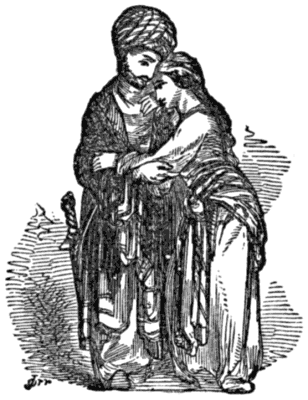
The Caravan had reached the end of the desert, and gladly did the travellers salute the green meadows, and thickly-leaved trees, of whose charms they had been deprived for so many days. In a lovely valley lay a caravansery, which they selected as their resting-place for the night; and though it offered but limited accommodations and refreshment, still was the whole company more happy and sociable than ever: for the thought of having passed through the dangers and hardships, with which a journey through the desert is ever accompanied, had opened every heart, and attuned their minds to jest and gayety. Muley, the young and merry merchant, went through a comic dance, and sang songs thereto, which elicited a laugh, even from Zaleukos, the serious Greek. But not content with having raised the spirits of his comrades by dance and merriment, he also gave them, in the best style, the story he had promised, and, as soon as he could recover breath from his gambols, began the following tale.
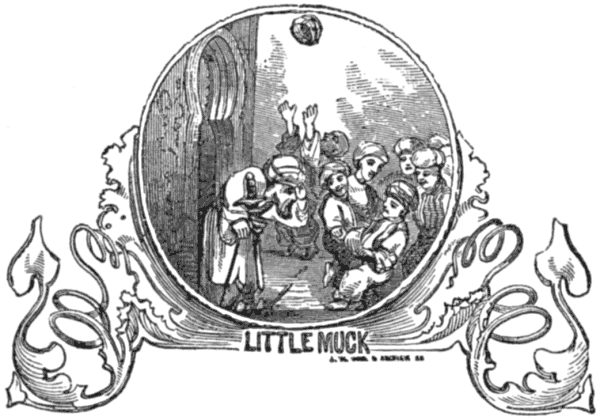
IN Nicea, my beloved father-city, lived a man, whom people called “Little Muck.” Though at that time I was quite young, I can recollect him very well, particularly since, on one occasion, I was flogged almost to death, by my father, on his account. The Little Muck, even then, when I knew him, an old man, was nevertheless but three or four feet high: he had a singular figure, for his body, little and smart as it was, carried a head much larger and thicker than that of others. He lived all alone in a large house, and even cooked for himself; moreover, it would not have been known in the city whether he was alive or dead, (for he went forth but once in four weeks,) had not every day, about the hour of noon, strong fumes come forth from the house. Nevertheless, in the evening he was often to be seen walking to and fro upon his roof; although, from the street, it seemed as if it were his head alone that was running around there.
I and my comrades were wicked fellows, who teased and ridiculed every one; accordingly, to us it was a holiday when the Little Muck went forth: on the appointed day we would assemble before his house, and wait for him to come out. When, then, the door opened, and at first the immense head and still larger turban peered forth, when the rest of the body followed covered with a small cloak which had been irregularly curtailed, with wide pantaloons, and a broad girdle in which hung a long dagger, so long that one could not tell whether Muck was fastened to the dagger, or the dagger to Muck—when in this guise he came forth, then would the air resound with our cries of joy; then would we fling our caps aloft, and dance round him, like mad. Little Muck, however, would salute us with a serious bow, and walk with long strides through the street, shuffling now and then his feet, for he wore large wide slippers, such as I have never elsewhere seen. We boys would run behind him, crying continually, “Little Muck! Little Muck!” We also had a droll little verse, which we would now and then sing in his honor; it ran thus:—
“Little Muck, oh Little Muck! What a fine, brave dwarf art thou! Livest in a house so tall; Goest forth but once a month, Mountain-headed, though so small. Turn thyself but once, and look! Run, and catch us, Little Muck.”
In this way had we often carried on our sport, and, to my shame, I must confess that I took the most wicked part in it, for I often plucked him by the mantle, and once trod from behind on his large slippers, so that he fell down. This was, at first, a source of the greatest amusement to me, but my laughter soon ceased when I saw the Little Muck go up to my father’s house; he walked straight in, and remained there some time. I concealed myself near the door, and saw Muck come forth again, escorted by my father, who respectfully shook his hand, and with many bows parted with him at the door. My mind was uneasy, and I remained some time in my concealment; at length, however, hunger, which I feared more than blows, drove me in, and ashamed and with downcast head, I walked in before my father.
“Thou hast, as I hear, insulted the good Muck,” said he with a very serious tone. “I will tell thee the history of this Muck, and then I am sure thou wilt ridicule him no more. But first, thou shalt receive thy allowance.” The allowance was five-and-twenty lashes, which he took care to count only too honestly. He thereupon took a long pipe-stem, unscrewed the amber mouthpiece, and beat me more severely than he had ever done before.
When the five-and-twenty were all made up, he commanded me to attend, and told me the following story of Little Muck.
The father of Little Muck, who is properly called Mukrah, lived here in Nicea, a respectable, but poor man. He kept himself almost as retired as his son does now. The latter he could not endure, because he was ashamed of his dwarfish figure, and let him therefore grow up in perfect ignorance. When the Little Muck was still in his seventeenth year, a merry child, his father, a grave man, kept continually reproaching him, that he, who ought long before to have trodden down the shoes of infancy, was still so stupid and childish.
The old man, however, one day had a bad fall, from the effects of which he died, and Little Muck was left behind, poor and ignorant. His cruel relations, to whom the deceased owed more than he could pay, turned the poor fellow out of the house, and advised him to go forth into the world, and seek his fortune. Muck answered that he was all ready, only asking them for his father’s dress, which they willingly granted him. His father had been a large, portly man, and the garments on that account did not fit him. Muck, however, soon hit upon an expedient; he cut off what was too long, and then put them on. He seemed, however, to have forgotten that he must also take from their width; hence the strange dress that he wears at the present day; the huge turban, the broad girdle, the wide breeches, the blue cloak, all these he has inherited from his father, and worn ever since. The long Damascus dagger of his father, too, he attached to his girdle, and seizing a little staff, set out from the door.
Gayly he wandered, the whole day, for he had set out to seek his fortune: if he saw upon the ground a potsherd shining in the sunlight, he took care to pick it up, in the belief that he could change it into a diamond of the first water; if he saw in the distance the cupola of a Mosque sparkling like fire, or the sea glittering like a mirror, he would hasten up, fully persuaded that he had arrived at fairy-land. But ah! these phantoms vanished as he approached, and too soon fatigue, and his stomach gnawed by hunger, convinced him that he was still in the land of mortals. In this way he travelled two days, in hunger and grief, and despaired of finding his fortune; the produce of the field was his only support, the hard earth his bed. On the morning of the third day, he espied a large city upon an eminence. Brightly shone the crescent upon her pinnacles, variegated flags waved over the roofs, and seemed to be beckoning Little Muck to themselves. In surprise he stood still, contemplating the city and the surrounding country.
“There at length will Klein-Muck find his fortune,” said he to himself, and in spite of his fatigue bounded in the air; “there or nowhere!” He collected all his strength, and walked towards the city. But although the latter seemed quite near, he could not reach it until mid-day, for his little limbs almost entirely refused him their assistance, and he was obliged to sit down to rest in the shade of a palm-tree. At last he reached the gate; he fixed the mantle jauntily, wound the turban still more tastily around his head, made the girdle broader, and arranged the dagger so as to fall still more obliquely: then, wiping the dust from his shoes, and seizing his cane, he marched bravely through the gate.
He had already wandered through a few streets, but nowhere did any door open to him, nowhere did any one exclaim, as he had anticipated: “Little Muck, come in and eat and drink, and rest thy little feet.”
He was looking very wistfully straight at a large fine house, when a window opened, and an old woman, putting out her head, exclaimed in a singing tone—
“Hither, come hither! The porridge is here; The table I’ve spread, Come taste of my cheer. Hither, come hither! The porridge is hot; Your neighbors bring with you, To dip in the pot!”
The door opened, and Muck saw many dogs and cats walking in. For a moment he stood in doubt whether he should accept the invitation; at last, however, he took heart and entered the mansion. Before him proceeded a couple of genteel kittens, and he resolved to follow them, since they, perhaps, knew the way to the kitchen better than himself.
When Muck had ascended the steps, he met the same old woman who had looked forth from the window. With frowning air she asked what he wanted.
“Thou hast invited every one to thy porridge,” answered Little Muck, “and as I was very hungry, I came too.”
The old woman laughed, saying, “Whence come you then, strange fellow? The whole city knows that I cook for no one but my dear cats, and now and then, as you see, I invite their companions from the neighborhood.” Little Muck told her how hard it had gone with him since his father’s death, and entreated her to let him dine, that day, with her cats. The old woman, on whom the frank relation of the little fellow made quite an impression, permitted him to become her guest, and gave him abundance to eat and drink. When he was satisfied and refreshed, she looked at him for some time, and then said:—
“Little Muck, remain with me in my service; you will have little to do, and shall be well taken care of.” Muck, who had relished the cat-porridge, agreed, and thus became the servant of the Frau Ahavzi. His duties were light but singular: Frau Ahavzi had two male, and four female cats; every morning Little Muck had to comb their hair, and anoint them with costly ointment. When the Frau went out, he had to give them all his attention; when they ate, he placed their bowls before them; and, at night, he had to lay them on silken cushions, and wrap them up in velvet coverings. There were, moreover, a few little dogs in the house, on which he was obliged to wait; but there were not so many ceremonies gone through with these as with the cats, whom Frau Ahavzi treated as her own children. As for the rest, Muck led as retired a life as in his father’s house, for with the exception of the Frau, he saw every day only dogs and cats.
For a long time it went very well with Little Muck; he had enough to eat, and but little to do; and the old woman seemed to be perfectly satisfied with him. But, by-and-by, the cats began to behave very badly; the moment the Frau went out, they ran around the rooms as if possessed, threw down every thing in confusion, and broke considerable fine crockery, which stood in their way. When, however, they heard their mistress coming up the steps, they would creep to their cushions, and wag their tails, when they saw her, as if nothing had happened. The Frau Ahavzi always fell in a passion when she saw her rooms so disordered, and attributed all to Muck; assert his innocence as he might, she believed her cats who looked so demure, in preference to her servant.
Little Muck was very sorry that here also he had been disappointed in finding his fortune, and determined in his own mind to leave the service of the Frau Ahavzi. As, however, on his first journey, he had learned how badly one lives without money, he resolved to procure, in some way, for himself the wages which his mistress had once promised him, but had never paid. In the house of the Frau Ahavzi was a room, which was always closed, and the inside of which he had never seen. Nevertheless, he had often heard the Frau making a noise therein, and he would have willingly risked his life to know what was there concealed. Reflecting upon his travelling-money, it occurred to him that there his mistress might conceal her treasures. But the door was always tightly closed, and therefore he could not get at them.
One morning, after the Frau Ahavzi had gone out, one of the little dogs who was treated by her in a very stepmother-like manner, but whose favor he had in a great degree gained by various acts of kindness, pulled him by his wide pantaloons, and acted as if he wanted Muck to follow him. Muck, who always gladly played with him, did so, and perceived that the dog was leading him to the sleeping apartment of his mistress; he stopped before a door, which the little fellow had never before observed, and which was now wide open. The dog entered, and Muck, following, was overjoyed at finding himself in the very chamber, which had so long been the object of his curiosity. He looked all around for money, but could find none: old garments only, and strangely-fashioned vases were scattered around. One of the latter, in particular, attracted his attention; it was of crystal, and fine figures were cut thereon. He lifted it up and turned it on all sides; but, oh horror! he had not observed that it had a lid, which was but insecurely fastened on: it fell to the floor, and broke into a thousand pieces.
For a long time stood Little Muck motionless through terror; now was his fate decided, now must he fly, or be killed by the old woman. His departure was immediately resolved on; he only looked around, to see if he could not use some of the goods of the Frau Ahavzi upon his journey. Thereupon, a formidable pair of huge slippers met his eye; they were not, it is true, beautiful, but his own could hold out no longer; moreover their size was an inducement, for when he had these upon his feet, people would see, he hoped, that he had cast off the shoes of childhood. He quickly took off his own slippers, and put on the others. A walking-stick, also, with a fine lion’s head cut upon the handle, seemed to be standing too idly in the corner; so he seized it, and hurried from the apartment. He hastened to his own room, put on his cloak, arranged his paternal turban, placed the dagger in his girdle, and ran as fast as his feet would carry him, out of the house, and out of the city. Fear of his old mistress drove him farther and still farther, until, from fatigue, he could scarcely run any more. He had never gone so quickly in his life; nay, it appeared to him as if he could not cease running, for an invisible power seemed propelling him on. At last he observed that this must be connected with the slippers, for they would continually shoot forward and bear him along with them. He endeavored in various ways, to stand still, but could not succeed; at last, in the greatest distress, he cried out to himself, as a man calls to his horse, “Wo—wo!” Then the slippers stopped, and Muck fell exhausted upon the earth.
The slippers were a source of great joy to him. Thus had he, by his services, gained something that would help him on his way through the world to seek his fortune. In spite of his joy, he fell asleep through fatigue; for the body of Little Muck, which had to carry so heavy a head, could not hold out long. In his dream the little dog appeared to him, which had assisted him to the slippers in the house of the Frau Ahavzi, and thus spoke:—
“Dear Muck, thou dost not still rightly understand the use of the slippers: know that if, in them, thou turnest thyself three times around upon the heel, thou canst fly wherever thou wilt; and with the staff thou canst find treasures, for, wherever gold is buried, it will beat three times upon the earth; where silver, twice.”
Thus dreamed Little Muck. When he awoke, he reflected on the singular vision, and resolved to make the experiment immediately. He put on the slippers, lifted one foot, and began to turn around upon his heel. But whoever has attempted to perform this manœuvre in an enormously wide slipper, will not wonder that the Little Muck could not succeed, particularly when he remembers that his heavy head kept falling on this side and on that.
The poor little fellow fell several times violently upon his nose; nevertheless, that did not deter him from making the trial again, and at last he succeeded. Like a wheel he went around upon his heel, wishing himself in the nearest large city, and—the slippers mounted into the air, ran with the speed of the wind through the clouds, and before Little Muck knew what to make of it, he found himself in a large market-place, where many stalls were erected, and innumerable men were busily running to and fro. He moved among the people, but considered it more prudent to retire into a less frequented street, for near the market one of the slippers bore him along so rapidly, that he almost fell down, or else ran against one and another with his projecting dagger, so that it was with difficulty he avoided their blows.
Little Muck now seriously reflected what he should set about, in order to earn a piece of money. He had, it is true, a staff which would show him concealed treasures, but how could he find a place where gold or silver was buried. He could, indeed, in this emergency, have exhibited himself for money, but for this he was too proud. At last the quickness of his gait occurred to him. Perhaps, thought he, my slippers can procure me support, and he determined to hire himself out as a courier. He ventured to hope that the king of the city rewarded such service well, so he inquired for the palace. Before the door of the palace stood a guard, who asked him what he sought there. On answering that he was in search of service, they led him to the overseer of the slaves. Before this one he laid his request, and entreated that he might be admitted among the royal couriers. The overseer measured him with his eyes from head to foot, and said: “How! with thy little feet, which are scarcely a span long, wishest thou to become a royal messenger? Away with thee! I cannot play with every fool.”
Little Muck assured him, however, that his proposal was made in perfect seriousness, and that he would let it come to a trial with the swiftest, upon a wager. The matter seemed very ludicrous to the overseer. He commanded him to hold himself in readiness for a race in the afternoon, and leading him into the kitchen, saw that he was furnished with proper meat and drink. He himself, however, repaired unto the king, and told him of the little man and his proposal. The king was a merry lord, and therefore it pleased him well that the overseer had kept the little man for their amusement. He directed him to make preparations in a large meadow behind the castle, that the race might be conveniently beheld by his whole court, and once more commanded him to take great care of the dwarf. The king told his princes, and princesses, what a pastime they were to enjoy that afternoon; these told it again to their attendants, and when the time arrived all were in great expectation; and as many as had feet poured into the meadow, where a scaffolding had been erected, in order to see the boastful dwarf run.
As soon as the king and his sons and daughters had taken their places upon the platform, the Little Muck walked forth upon the meadow, and made before the noble sovereign a very elegant bow. A universal cry of joy arose, the moment they beheld the little fellow; such a figure had they never seen. The small body with the mighty head, the little cloak, and the wide pantaloons, the long dagger in the broad girdle, the tiny feet in the immense slippers—no! it was so droll a sight they could not keep from laughing aloud. Little Muck, however, was not disconcerted by their laughter. He proudly walked forward, supported by his cane, and awaited his opponent. At Muck’s own desire, the overseer of the slaves had selected the best runner. Walking in, he placed himself near the dwarf, and both looked for the signal. Thereupon the Princess Amarza made a sign with her veil as had been preconcerted, and, like two arrows shot from the same bow, the racers flew over the meadow.
At first the courier took a tremendous bound, but Muck pursued him in his slipper carriage, overtook him, passed him, and had been standing for some time at the goal, when his opponent, gasping for breath, ran up. Amazement for a few moments enchained the spectators: the king was the first to clap his hands; then shouted the crowd for joy, all exclaiming, “Long live the Little Muck, the victor in the race!”
Meanwhile they had brought up the little man; he prostrated himself before the king, saying, “Most mighty King, I have here given thee but a small proof of my powers; allow them, I pray thee, to give me a place among thy couriers.” The king answered:—
“Nay, dear Muck, thou shalt be my favorite messenger, and shalt remain about my person; every year shalt thou have a hundred gold pieces as thy wages, and thou shalt sup at the table of my first attendant.”
Then Muck thought he had at last found the fortune, of which he had so long been in search, and was merry and light-hearted. Moreover, he rejoiced in the peculiar favor of the king, for the latter employed him on his quickest and most secret errands, which he performed with the greatest care, and with inconceivable rapidity.
But the other attendants of the king were not well affected towards him, because they reluctantly saw themselves displaced from their lord’s favor by a dwarf, who knew how to do nothing, but to run fast. They set on foot many a conspiracy against him in order to work his destruction, but all failed, through the confidence which the king placed in his private Oberleibläufer, (for to this dignity had he in so short a time arrived.)
Muck, upon whom these movements against himself produced no effect, thought not of revenge; for that he had too good a heart: no, he reflected upon the means of making himself necessary to his enemies, and beloved by them. Thereupon the staff, which in his good fortune he had forgotten, occurred to him; if he could find treasures, he thought the lords would be more favorably disposed towards him. He had before this often heard that the father of the present king had buried much of his gold, when the enemy had invaded the land; they said, moreover, that he had died without imparting the secret to his son. From this time Muck always carried his cane, in the hope that he would some time pass over the place where the money of the old king was buried.
One evening, chance led him into a remote portion of the castle-garden, which he seldom visited, when suddenly he felt the staff move in his hand, and three times it beat upon the ground. He knew in an instant what this indicated; accordingly he drew forth his dagger, made marks on the surrounding trees, and then slipped back into the castle. Then he procured a spade, and awaited night for his undertaking.
Treasure-digging, however, gave Muck more trouble than he had anticipated. His arms were very feeble, his spade large and heavy; he might perhaps have been laboring a couple of hours, without getting any farther down than as many feet. At length he hit upon something hard, which sounded like iron: he then set to work still more diligently, and soon brought up a large cover; he then descended into the hole, in order to examine what the cover concealed, and found a large pot completely full of gold pieces. His feeble wisdom, however, did not teach him to lift up the pot; but he put in his pantaloons and girdle as much as he could carry, filled his cloak, and then carefully covering up the rest, placed the load upon his back. But, indeed, if he had not had the slippers on his feet, he could not have stirred, so heavily did the gold weigh him down. Then, unobserved, he reached his room, and secured the money under the cushions of his sofa.
When the little man saw so much gold in his possession, he thought the tables would now be turned, and that from among his enemies at court, he could gain many well-wishers and warm friends. But even in this, one could see that the good Muck had enjoyed no very careful education; otherwise he would not have imagined that he could buy true friends with gold. Ah! that he had then put on his slippers, and with his mantle full of gold, scampered away!
The gold which from this time Little Muck distributed with lavish hand, awakened the envy of the other court-attendants. The kitchen-master, Ahuli, said, “He is a counterfeiter.” The slave-overseer, Achmet, said, “He has cajoled the king.” But Archaz, the treasurer, his most wicked enemy, who himself, even, now and then put his hand into his lord’s coffers, exclaimed, “He is a thief.” In order to be sure of the thing, they consulted together, and the head cup-bearer, Korchuz, placed himself one day, with a very sorrowful and depressed air, before the eyes of the king. He made his wo so apparent, that the king asked him what was the matter.
“Ah!” answered he, “I am sorry that I have lost the favor of my lord!”
“Why talkest thou idly, friend Korchuz?” rejoined the monarch. “Since when have I veiled from thee the sun of my favor?”
The cup-bearer answered, that he loaded his private Oberleibläufer with money, but gave his poor faithful servants nothing. The king was much astonished at this accusation, had the story of Muck’s gold-distribution told him, and the conspirators soon aroused in him the suspicion that the dwarf had, in some way or other, stolen the money from the treasure-chamber. Very pleasant was this turn of the matter to the treasurer, who would not otherwise have willingly submitted his accounts to examination. The king thereupon commanded that they should secretly watch all the movements of the dwarf, in order, if possible, to surprise him in the act. When, now, on the night which followed the fatal day, seeing his funds almost exhausted by his generosity, Muck crept forth, with his spade, into the castle-garden, to bring new supplies from his secret treasury, the watch followed him in the distance, led by Ahuli and Archaz; and, at the moment when he was removing the gold from the pot to his cloak, they fell upon him, bound him, and immediately led him before the king. The latter, whom, independently of any thing else, this interruption of his sleep would have enraged, received his poor dwarf very ungraciously, and ordered an immediate trial. Meanwhile they had dug the full pot out of the ground, and with the spade and cloak full of gold had placed it before the king. The treasurer said that he had surprised Muck with his guard, just as he had buried this vessel of gold in the earth.
The king thereupon inquired of the accused, whether it was true, and whence the gold had come.
Little Muck, conscious of innocence, answered that he had discovered this pot in the garden; that he had not buried it, but had brought it to light.
All present laughed aloud at this defence; the king, however, provoked in the highest degree by the supposed impudence of the dwarf, exclaimed, “How, wretch! wilt thou so stupidly and shamelessly lie to thy king, after having stolen from him? Treasurer Archaz, I command thee to say whether thou knowest this sum of gold to be the same that is missing from my treasury.”
The treasurer thereupon answered that he was sure of the thing; that so much and even more had been missing from the royal treasures; and he could take his oath that this was the stolen money. Then the king commanded them to place Little Muck in galling chains, and convey him to prison: to Archaz, however, he gave the gold, that he might restore it to the treasury. Delighted at the fortunate issue of the matter, the officer took it, and counted out, at home, the glittering gold pieces; but the bad man never disclosed that down in the pot lay a letter, to the following purport:—
“The enemy has overrun my land; therefore I here conceal a portion of my treasure. Whoever may find it, the curse of his king fall upon him, if he do not immediately deliver it to my son!
King Sadi.”
In his dungeon, poor Muck gave way to sorrowful reflections; he knew that for taking royal property death was the penalty; and yet—he could not betray the secret of his staff unto the king, because, in that case, he justly feared being deprived of both that, and his slippers. His slippers, alas! could render him no help, for there by close fetters he was fastened to the wall, and, torment himself as he might, he could not turn around upon his heel. When, however, on the next day, sentence of death was pronounced, he thought it would be better to live without the magic staff, than to die with it; and, having asked a private audience with the king, disclosed to him the secret. At first the king gave no credit to his assertions, but Little Muck promised him a proof, if he would respite him from death. The king gave him his word upon it, and having had some gold buried in the earth, unseen by Muck, commanded him to find it with his cane. In a few moments he succeeded in doing so, for the staff beat three times distinctly upon the ground. Then the king saw that his treasurer had betrayed him, and sent him, as is customary in the East, a silken cord, wherewith he should strangle himself. To Little Muck, however, he said:—
“I have indeed promised thee thy life, but it seems to me that this is not the only secret thou art possessed of, connected with this staff. Therefore thou shalt remain in everlasting captivity, if thou do not confess what relation exists between it and thy rapid running.”
Little Muck, whom one night in his dungeon had deprived of all desire for further confinement, acknowledged that his whole art lay in the slippers; nevertheless, he informed not the king of the wonderful effect of turning three times upon the heel. The king put on the slippers, himself, in order to make the experiment, and ran, like mad, through the garden; often did he wish to hold up, but he knew not how to bring the slippers to a halt, and Muck, who could not deny himself this revenge, let him run on, until he fell down exhausted.
When the king returned to consciousness, he was terribly angry at Little Muck, who had suffered him to run until so entirely out of breath. “I have promised thee thy freedom and life,” said he, “but within twelve hours must thou leave my land; otherwise will I have thee hung.” The slippers and cane, however, he commanded them to bear to his treasure-chamber.
Thus, poor as ever, wandered the little fellow forth through the land, cursing the folly which had led him astray, and prevented his playing an important part at court. The land from which he was banished, was fortunately not extensive, and accordingly eight hours brought him to the frontier; but travelling, now that he was used to his dear slippers, came very hard to him. Having arrived at the border, he chose the usual road for reaching the most lonely part of the forest, for he hated all men, and resolved to live there by himself. In a thick portion of the wood, he lighted on a place, which seemed to him quite suitable for the resolution he had taken. A clear brook, surrounded by large shady fig-trees, and a soft turf, invited him: he threw himself down, determined to taste food no more, but calmly to await his end. Amid his sorrowful reflections on death, he fell asleep; when he awoke, he was tormented by hunger, and began to think that starving to death was rather an unpleasant affair; so he looked around to find something to eat.
Fine ripe figs hung upon the tree beneath which he had slept; he stretched forth his hand to pluck some; their taste was delicious, and then he descended into the brook to slake his thirst. But what was his horror, when the water showed his head adorned with two immense ears, and a long thick nose! Amazed, he clapped his hands upon his ears, and they were really more than half an ell long.
“I deserve ass’s ears!” he exclaimed; “for, like an ass, have I trodden Fortune under my feet.” He wandered around among the trees, and feeling hunger again, was obliged to have recourse once more to the fig-tree, for he could find nothing else that was eatable. After the second portion of figs, it struck him that if his ears could find room beneath his large turban, he would not look so ridiculous, and, on trying it, he found that his ears had vanished. He ran straight back to the stream, in order to convince himself thereof; it was actually so; his ears had resumed their original figure, his long misshapen nose was no more! He soon perceived how all this had happened; from the first fig-tree he had received the long nose and ears, the second had relieved him of them: he saw with joy that kind destiny yet again placed in his hands the means of becoming fortunate. He plucked, therefore, from each tree as many figs as he could carry, and went back to the land which shortly before he had left. There, in the first town, he disguised himself by means of different garments; then, turning again to the city inhabited by the king, he soon arrived at it.
For about a year ripe fruit had been quite scarce; Little Muck, therefore, placed himself before the gate of the palace, for from his former residence there, it was well known to him, that here such rareties would be purchased by the kitchen-master for the royal table. Muck had not long been seated, when he saw that dignitary walking across the court-yard. He examined the articles of the traders who had placed themselves at the palace-gate; at length his eye fell upon Muck’s little basket.
“Ah! a dainty morsel!” said he, “which will certainly please his majesty: what wish you for the whole basket?” Muck set a high price upon them, and the bargain was soon struck. The kitchen-master gave the basket to his slave, and went his way: meantime Little Muck stole away, for he feared, when the change should show itself on the heads of the court, that he, as the one who sold them, would be sought for punishment.
At table the king was well pleased, and praised his kitchen-master more than ever, on account of his good kitchen, and the care with which he always sought the rarest morsels for his table; the officer, however, who well knew what dainties he had in the back-ground, smiled pleasantly, and let fall but few words: “The day is not all past till evening,” or “End good, all good;” so that the princesses were very curious to know what he would still bring on. The moment, however, he had the fine, inviting figs set upon the table, a universal “Ah!” escaped the lips of those who were present. “How ripe! how delicate!” exclaimed the king; “kitchen-master, thou art a whole-souled man, and deservest our peculiar favor!” Thus speaking, the king, who with such choice dishes took care to be very sparing, with his own hands distributed the figs around the table. Each prince and princess received two; the ladies of the court, the Viziers and Agas, each one; the rest he placed before himself, and began to swallow them with great delight.
“In the name of heaven, father, why lookest thou so strange?” suddenly exclaimed the Princess Amarza. All gazed in astonishment upon the king; vast ears hung down from his head, a long nose stretched itself bridge-like, over above his chin; upon themselves also they looked, one upon another, with amazement and horror; all, more or less, were adorned with the same strange headdress.
The horror of the court may be imagined. All the physicians in the city were immediately sent for; they came with a blustering air, prescribed pills and mixtures, but ears and noses remained. They operated on one of the princes, but the ears grew out again.
From the place of concealment into which he had withdrawn, Muck had heard the whole story, and perceived that it was now time for him to commence operations. He had already, with the money obtained by the sale of his figs, procured a dress which would represent him as a learned man; a long beard of goat’s hair completed the illusion. With a small sack full of figs he repaired to the royal palace, and offered his assistance as a foreign physician. At first they were quite incredulous; but when Little Muck gave a fig to one of the princes, and thereby restored ears and nose to their original shape, then were all eager to be cured by the stranger. But the king took him silently by the hand, and led him to his apartment; then, opening a door that led into the treasure-chamber, he made signs to Muck to follow.
“Here are my treasures,” said the king; “choose for thyself: whatever it may be, it shall be thine, if thou wilt free me from this shameful evil.” This was sweet music in the ears of Little Muck: at the moment of entering he had seen his slippers standing upon the floor, and hard by lay his little staff. He moved around the room, as if in wonder at the royal treasures; but no sooner had he reached his beloved shoes, than he hastily slipped into them, and seizing the little cane, tore off his false beard, and displayed to the astonished king the well-known countenance of his exiled Muck.
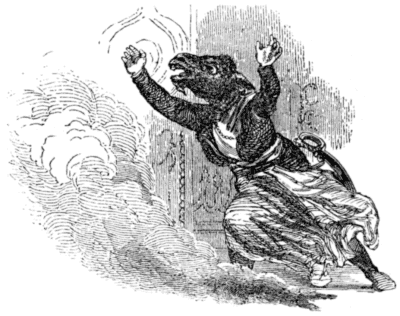
“False king!” said he, “who rewardest faithful service with ingratitude, take, as well-deserved punishment, the deformity which thou now hast. The ears I leave thee, that, each day they may remind thee of Little Muck.” Having thus spoken, he turned quickly around upon his heel, wished himself far away, and before the king could call for help Little Muck had vanished. Ever since, he has lived here in great affluence, but alone, for men he despises. Experience has made him a wise man—one who, though there is something offensive in his exterior, deserves rather your admiration than your ridicule.
Such was my father’s story. I assured him that I sincerely repented of my behavior towards the good little man, and he remitted the other half of the punishment which he had intended for me. To my comrades I told the wonderful history of the dwarf, and we conceived such an affection for him, that no one insulted him any more. On the contrary, we honored him as long as he lived, and bowed as low to him as to Cadi or Mufti.
The travellers determined to rest a day in this caravansery, in order to refresh themselves and their beasts for the rest of their journey. The gayety of the day before again prevailed, and they diverted themselves with various sports. After the meal, however, they called upon the fifth merchant, Ali Sizah, to perform his duty to the rest, and give them a story. He answered, that his life was too poor in remarkable adventures for him to relate one connected therewith, but he would tell them something which had no relation to it: “The story of the False Prince.”
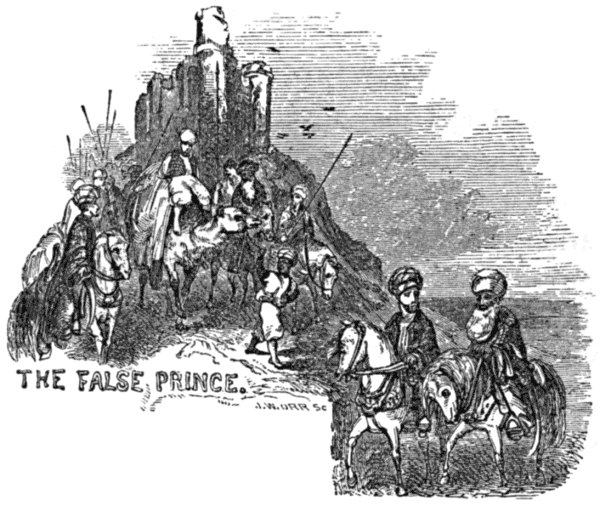
THERE was once an honest journeyman tailor, by name Labakan, who learned his trade with an excellent master in Alexandria. It could not be said that Labakan was unhandy with the needle; on the contrary, he could make excellent work: moreover, one would have done him injustice to have called him lazy. Nevertheless, his companions knew not what to make of him, for he would often sew for hours together so rapidly that the needle would glow in his hand, and the thread smoke, and that none could equal him. At another time, however, (and this, alas! happened more frequently,) he would sit in deep meditation, looking with his staring eyes straight before him, and with a countenance and air so peculiar, that his master and fellow-journeymen could say of his appearance nothing else than, “Labakan has on again, his aristocratic face.”
On Friday, however, when others quietly returned home from prayers to their labor, Labakan would come forth from the mosque in a fine garment which with great pains he had made for himself, and walk with slow and haughty steps through the squares and streets of the city. At such times, if one of his companions cried, “Joy be with thee!” or, “How goes it, friend Labakan?” he would patronizingly give a token of recognition with his hand, or, if he felt called upon to be very polite, would bow genteelly with the head. Whenever his master said to him in jest, “Labakan, in thee a prince is lost,” he would be rejoiced, and answer, “Have you too observed it?” or, “I have already long thought it.”
In this manner did the honest journeyman tailor conduct himself for a long time, while his master tolerated his folly, because, in other respects, he was a good man and an excellent workman. But one day, Selim, the sultan’s brother, who was travelling through Alexandria, sent a festival-garment to his master to have some change made in it, and the master gave it to Labakan, because he did the finest work. In the evening, when the apprentices had all gone forth to refresh themselves after the labor of the day, an irresistible desire drove Labakan back into the workshop, where the garment of the sultan’s brother was hanging. He stood some time, in reflection, before it, admiring now the splendor of the embroidery, now the varied colors of the velvet and silk. He cannot help it, he must put it on; and, lo! it fits him as handsomely as if it were made for him. “Am not I as good a prince as any?” asked he of himself, as he strutted up and down the room. “Has not my master himself said, that I was born for a prince?” With the garments, the apprentice seemed to have assumed quite a kingly carriage; he could believe nothing else, than that he was a king’s son in obscurity, and as such he resolved to travel forth into the world, leaving a city where the people hitherto had been so foolish as not to discover his innate dignity beneath the veil of his inferior station. The splendid garment seemed sent to him by a good fairy; resolving therefore not to slight so precious a gift, he put his little stock of money in his pocket, and, favored by the darkness of the night, wandered forth from Alexandria’s gates.
The new prince excited admiration everywhere upon his route, for the splendid garment, and his serious majestic air, would not allow him to pass for a common pedestrian. If one inquired of him about it, he took care to answer, with a mysterious look, that he had his reasons for it. Perceiving, however, that he rendered himself an object of ridicule by travelling on foot, he purchased for a small sum an old horse, which suited him very well, for it never brought his habitual quiet and mildness into difficulty, by compelling him to show himself off as an excellent rider, a thing which in reality he was not.
One day, as he was proceeding on his way, step by step, upon his Murva, (thus had he named his horse,) a stranger joined him, and asked permission to travel in his company, since to him the distance would seem much shorter, in conversation with another. The rider was a gay young man, elegant and genteel in manners. He soon knit up a conversation with Labakan, with respect to his whence and whither, and it turned out that he also, like the journeyman tailor, was travelling without purpose, in the world. He said his name was Omar, that he was the nephew of Elfi Bey, the unfortunate bashaw of Cairo, and was now on his way to execute a commission which his uncle had delivered to him upon his dying-bed. Labakan was not so frank with respect to his circumstances; he gave him to understand that he was of lofty descent, and was travelling for pleasure.
The two young men were pleased with each other, and rode on in company. On the second day, Labakan interrogated his companion Omar, respecting the commission with which he was charged, and to his astonishment learned the following. Elfi Bey, the bashaw of Cairo, had brought up Omar from his earliest childhood; the young man had never known his parents. But shortly before, Elfi Bey, having been attacked by his enemies, and, after three disastrous engagements, mortally wounded, was obliged to flee, and disclosed to his charge that he was not his nephew, but the son of a powerful lord, who, inspired with fear by the prophecy of his astrologer, had sent the young prince away from his court, with an oath never to see him again until his twenty-second birthday. Elfi Bey had not told him his father’s name, but had enjoined upon him with the greatest precision, on the fourth day of the coming month Ramadan, on which day he would be two-and-twenty years old, to repair to the celebrated pillar El-Serujah, four days’ journey east of Alexandria: there he should offer to the men who would be standing by the pillar, a dagger which he gave him, with these words, “Here am I, whom ye seek!” If they answered, “Blessed be the Prophet, who has preserved thee!” then he was to follow them—they would lead him to his father.
The journeyman tailor, Labakan, was much astonished at this information; from this time he looked upon Prince Omar with envious eyes, irritated because fortune conferred upon him, though already he passed for the nephew of a mighty bashaw, the dignity of a king’s son; but on him, whom she had endowed with all things necessary for a prince, bestowed in ridicule, an obscure lineage, and an every-day vocation. He instituted a comparison between himself and the prince. He was obliged to confess that the latter was a man of very lively aspect; that fine sparkling eyes belonged to him, a boldly-arched nose, a gentlemanly, complaisant demeanor, in a word, all the external accomplishments, which every one is wont to commend. But numerous as were the charms he found in his companion, still he was compelled to acknowledge to himself, that a Labakan would be no less acceptable to the royal father than the genuine prince.
These thoughts pursued Labakan the whole day; with them he went to sleep in the nearest night-lodgings; but when he awoke in the morning, and his eye rested upon Omar sleeping near him, who was reposing so quietly, and could dream of his now certain fortune, then arose in him the thought of gaining, by stratagem or violence, what unpropitious destiny had denied him. The dagger, the returning prince’s token of recognition, hung in the sleeper’s girdle; he softly drew it forth, to plunge it in the breast of its owner. Nevertheless, the peaceable soul of the journeyman recoiled before thoughts of murder; he contented himself with appropriating the dagger, and bridling for himself the faster horse of the prince; and, ere Omar awoke to see himself despoiled of all his hopes, his perfidious companion was several miles upon his way.
The day on which Labakan robbed the prince was the first of the holy month Ramadan, and he had therefore four days to reach the pillar El-Serujah, the locality of which was well known to him. Although the region wherein it was situated could at farthest be at a distance of but four days’ journey, still he hastened to reach it, through a constant fear of being overtaken by the real prince.
By the end of the second day, he came in sight of the pillar El-Serujah. It stood upon a little elevation, in the midst of an extensive plain, and could be seen at a distance of two or three leagues. Labakan’s heart beat high at the sight: though he had had time enough on horseback, for the last two days, to think of the part he was to play, still a consciousness of guilt made him anxious; the thought that he was born for a prince, however, encouraged him again, and he advanced towards the mark with renewed confidence.
The country around the pillar was uninhabited and desert, and the new prince would have experienced some difficulty in finding sustenance, if he had not previously supplied himself for several days. He lay down beside his horse beneath some palm-trees, and there awaited his distant destiny.
Towards the middle of the next day, he saw a large procession of horses and camels crossing the plain in the direction of the pillar El-Serujah. It reached the foot of the hill, on which the pillar stood; there they pitched splendid tents, and the whole looked like the travelling-suite of some rich bashaw or sheik. Labakan perceived that the numerous train which met his eye, had taken the pains to come hither on his account, and gladly would he that moment have shown them their future lord; but he mastered his eager desire to walk as prince; for, indeed, the next morning would consummate his boldest wishes.
The morning sun awoke the too happy tailor to the most important moment of his life, which would elevate him from an inferior situation, to the side of a royal father. As he was bridling his horse to ride to the pillar, the injustice of his course, indeed, occurred to him; his thoughts pictured to him the anguish of the true prince, betrayed in his fine hopes; but the die was cast: what was done could not be undone, and self-love whispered to him that he looked stately enough to pass for the son of the mightiest king. Inspirited by these reflections, he sprang upon his horse, and collecting all his courage to bring him to an ordinary gallop, in less than a quarter of an hour, reached the foot of the hill. He dismounted from his horse, and fastened it to one of the shrubs that were growing near; then he drew the dagger of Prince Omar, and proceeded up the hill. At the base of the pillar six persons were standing around an old gray-haired man, of lofty king-like aspect. A splendid caftan of gold cloth surrounded by a white Cashmere shawl, a snowy turban spangled with glittering precious stones, pointed him out as a man of opulence and nobility. To him Labakan proceeded, and bowing low before him, said, as he extended the dagger—
“Here am I, whom you seek.”
“Praise to the Prophet who has preserved thee!” answered the gray-haired one, with tears of joy. “Omar, my beloved son, embrace thine old father!” The good tailor was deeply affected by these solemn words, and sank, with mingled emotions of joy and shame, into the arms of the old noble.
But only for a moment was he to enjoy the unclouded delight of his new rank; raising himself from the arms of the king, he saw a rider hastening over the plain in the direction of the hill. The traveller and his horse presented a strange appearance; the animal, either from obstinacy or fatigue, seemed unwilling to proceed. He went along with a stumbling gait, which was neither a pace nor a trot; but the rider urged him on, with hands and feet, to a faster run. Only too soon did Labakan recognise his horse Murva, and the real Prince Omar. But the evil spirit of falsehood once more prevailed within him, and he resolved, come what might, with unmoved front to support the rights he had usurped. Already, in the distance, had they observed the horseman making signs; at length, in spite of Murva’s slow gait, having reached the bottom of the hill, he threw himself from his horse, and began rapidly to ascend.
“Hold!” cried he. “Hold! whoever you may be, and suffer not yourselves to be deceived by a most infamous impostor! I am called Omar, and let no mortal venture to misuse my name!”
Great astonishment was depicted on the countenances of the bystanders at this turn of the affair; the old man, in particular, seemed to be much amazed, as he looked inquiringly on one and another. Thereupon Labakan spoke, with a composure gained only by the most powerful effort.
“Most gracious lord and father, be not led astray by this man. He is, as far as I know, a mad journeyman tailor of Alexandria, by name Labakan, who deserves rather our pity than our anger.”
These words excited the prince almost to phrensy. Foaming with passion, he would have sprung upon Labakan, but the bystanders, throwing themselves between, secured him, while the old man said: “Truly, my beloved son, the poor man is crazed. Let them bind him and place him on one of our dromedaries; perhaps we may be of some assistance to the unfortunate.”
The anger of the prince had abated; in tears, he cried out to the old man, “My heart tells me that you are my father; by the memory of my mother, I conjure you—hear me!”
“Alas! God guard us!” answered he: “already he again begins to talk wildly. How can the man come by such crazy thoughts?” Thereupon, seizing Labakan’s arm, he made him accompany him down the hill. They both mounted fine and richly-caparisoned coursers, and rode at the head of the procession, across the plain. They tied the hands of the unfortunate prince, however, and bound him securely upon a dromedary. Two horsemen rode constantly by his side, who kept a watchful eye upon his every movement.
The old prince was Saoud, sultan of the Wechabites. For some time had he lived without children; at last a prince, for whom he had so ardently longed, was born to him. But the astrologer, whom he consulted respecting the destiny of his son, told him that, until his twenty-second year, he would be in danger of being supplanted by an enemy. On that account, in order that he might be perfectly safe, had the sultan given him, to be brought up, to his old and tried friend, Elfi Bey; and twenty-two sad years had lived without looking upon him.
This did the sultan impart to his supposed son, and seemed delighted beyond measure with his figure and dignified demeanor.
When they reached the sultan’s dominions, they were everywhere received by the inhabitants with shouts of joy; for the rumor of the prince’s arrival had spread like wildfire through the cities and towns. In the streets through which they proceeded, arches of flowers and branches were erected; bright carpets of all colors adorned the houses; and the people loudly praised God and his prophet, who had discovered to them so noble a prince. All this filled the proud heart of the tailor with delight: so much the more unhappy did it make the real Omar, who, still bound, followed the procession in silent despair. In this universal jubilee, though it was all in his honor, no one paid him any attention. A thousand, and again a thousand, voices shouted the name of Omar; but of him who really bore this name, of him none took notice: at most, only one or two inquired whom they were carrying with them, so tightly bound, and frightfully in the ears of the prince sounded the answer of his guards, “It is a mad tailor.”
The procession at last reached the capital of the sultan, where all was prepared for their reception with still more brilliancy than in the other cities. The sultana, an elderly woman of majestic appearance, awaited them, with her whole court, in the most splendid saloon of the castle. The floor of this room was covered with a large carpet; the walls were adorned with bright blue tapestry, which was suspended from massive silver hooks, by cords and tassels of gold.
It was dark by the time the procession came up, and accordingly many globular colored lamps were lighted in the saloon, which made night brilliant as day; but with the clearest brilliancy and most varied colors, shone those in the farthest part of the saloon, where the sultana was seated upon a throne. The throne stood upon four steps, and was of pure gold, inlaid with amethysts. The four most illustrious emirs held a canopy of crimson silk over the head of their mistress; and the sheik of Medina cooled her with a fan of peacock feathers. Thus awaited the sultana her husband and son; the latter she had never looked on since his birth, but significant dreams had so plainly shown her the object of her longings, that she would know him out of thousands.
Now they heard the noise of the approaching troop; trumpets and drums mingled with the huzzas of the populace; the hoofs of the horses sounded on the court of the palace; steps came nearer and nearer; the doors of the room flew open, and, through rows of prostrate attendants, hastened the sultan, holding his son by the hand, towards the mother’s throne.
“Here,” said he, “do I bring to thee, him for whom thou hast so often longed.”
The sultana, however, interrupted him, crying: “This is not my son! These are not the features which the Prophet has shown me in my dreams!”
Just as the sultan was about to rebuke her superstition, the door of the saloon sprang open, and Prince Omar rushed in, followed by his guards, whom an exertion of his whole strength had enabled him to escape. Breathless, he threw himself before the throne, exclaiming:—
“Here will I die! Kill me, cruel father, for this disgrace I can endure no longer!”
All were confounded at these words; they pressed around the unfortunate one, and already were the guards, who had hurried up, on the point of seizing him and replacing his fetters, when the sultana, who had thus far looked on in mute astonishment, sprang from the throne.
“Hold!” she cried; “this, and no other, is my son! This is he, who, though my eyes have never seen him, is well known to my heart!” The guards had involuntarily fallen back from Omar, but the sultan, foaming with rage, commanded them to bind the madman.
“It is mine to decide,” he cried with commanding tone; “and here we will judge, not by a woman’s dreams, but by sure and infallible signs. This,” pointing to Labakan, “is my son, for he has brought me the dagger, the real token of my friend Elfi.”
“He stole it,” cried Omar; “my unsuspicious confidence has he treacherously abused!” But the sultan hearkened not to the voice of his son, for he was wont in all things obstinately to follow his own judgment. He bade them forcibly drag the unfortunate Omar from the saloon, and himself retired with Labakan to his chamber, filled with anger at his wife, with whom, nevertheless, he had lived in happiness for five-and-twenty years. The sultana was full of grief at this affair; she was perfectly convinced that an impostor had taken possession of the sultan’s heart, so numerous and distinct had been the dreams which pointed out the unhappy Omar as her son. When her sorrow had a little abated, she reflected on the means of convincing her husband of his mistake. This was indeed difficult, for he who had passed himself off as her son, had presented the dagger, the token of recognition, and had, moreover, as she learned, become acquainted with so much of Omar’s early life from the lips of the prince himself, as to be able to play his part without betraying himself.
She called to her the men who had attended the sultan to the pillar El-Serujah, in order to have the whole matter exactly laid before her, and then took counsel with her most trusty female slaves. She chose, and in a moment rejected, this means and that; at length, Melechsalah, an old and cunning Circassian, spoke.
“If I have heard rightly, honored mistress, the one who bore this dagger called him whom thou holdest to be thy son, a crazy tailor, Labakan?”
“Yes, it is so,” answered the sultana; “but what wilt thou make of that?”
“What think you,” proceeded the slave, “of this impostor’s having stitched his own name upon your son? If this be so, we have an excellent way of catching the deceiver, which I will impart to you in private.”
The sultana gave ear to her slave, and the latter whispered to her a plan which seemed to please her, for she immediately got ready to go to the sultan. The sultana was a sensible woman, and knew not only the weak side of her husband, but also the way to take advantage of it. She seemed therefore to give up, and to be willing to acknowledge her son, only offering one condition: the sultan, whom the outbreak between himself and his wife had grieved, agreed thereto, and she said:—
“I would fain have from each a proof of his skill; another, perhaps, would have them contend in riding, in single conflict, or in hurling spears: but these are things which every one can do; I will give them something which will require both knowledge and dexterity. It shall be this; each shall make a caftan, and a pair of pantaloons, and then will we see at once who can make the finest ones.”
The sultan laughingly answered, “Ah! thou hast hit on a fine expedient! Shall my son contend with a mad tailor, to see who can make the best caftan? No! that cannot be.” The sultana, however, cried out, that he had already agreed to the condition, and her husband, who was a man of his word, at length yielded, though he swore, should the mad tailor make his caftan ever so beautiful, he would never acknowledge him as his son.
The sultan thereupon went to his son, and entreated him to submit to the caprices of his mother, who now positively wished to see a caftan from his hands. The heart of the good Labakan laughed with delight; if that be all that is wanting, thought he to himself, then shall the lady sultana soon behold me with joy. Two rooms had been fitted up, one for the prince, the other for the tailor; there were they to try their skill, and each was furnished with shears, needles, thread, and a sufficient quantity of silk.
The sultan was very eager to see what sort of a caftan his son would bring to light, but the heart of the sultana beat unquietly, from apprehension lest her stratagem might be unsuccessful. Two days had they been confined to their work; on the third, the sultan sent for his wife, and when she appeared, dispatched her to the apartments to bring the two caftans and their makers. With triumphant air Labakan walked in, and extended his garment before the astonished eyes of the sultan.
“Behold, father,” said he, “look, mother! see if this be not a masterpiece of a caftan. I will leave it to the most skilful court-tailor, upon a wager, whether he can produce such another.”
The sultana, smiling, turned to Omar:— “And thou, my son, what hast thou brought?”
Indignantly he cast the silk and shears upon the floor.
“They have taught me to tame horses, and to swing my sabre; and my lance will strike you a mark at sixty paces. But the art of the needle is unknown to me; it were unworthy a pupil of Elfi Bey, the lord of Cairo!”
“Oh, thou true son of my heart!” exclaimed the sultana. “Ah, that I might embrace thee, and call thee, son! Forgive me, husband and master,” she continued, turning to the sultan, “for having set on foot this stratagem against you. See you not now who is prince, and who tailor? Of a truth the caftan which your lord son has made, is magnificent, and I would fain ask with what master he has learned!”
The sultan was lost in deep reflection, looking with distrust, now on his wife, now on Labakan, who vainly sought to conceal his blushes and consternation at having so stupidly betrayed himself. “This proof pleases me not,” said he; “but, Allah be praised! I know a means of learning whether I am deceived.” He commanded them to bring his swiftest horse, mounted, and rode to a forest, which commenced not far from the city. There, according to an old tradition, lived a good fairy, named Adolzaide, who had often before this assisted with her advice the monarchs of his family, in the hour of need: thither hastened the sultan.
In the middle of the wood was an open place, surrounded by lofty cedars. There, the story said, lived the fairy; and seldom did a mortal visit this spot, for a certain awe connected with it had, from olden time, descended from father to son. When the sultan had drawn near he dismounted, tied his horse to a tree, and placing himself in the middle of the open space, cried with loud voice:—
“If it be true that thou hast given good counsel to my fathers, in the hour of need, then disdain not the request of their descendant, and advise me in a case where human understanding is too short-sighted.”
Hardly had he uttered the last word, when one of the cedars opened, and a veiled lady, in long white garments, stepped forth.
“I know, Sultan Saoud, why thou comest to me; thy wish is fair, therefore shall my assistance be thine. Take these two chests; let each of the two who claim to be thy son, choose; I know that he who is the real one, will not make a wrong selection.” Thus speaking, the veiled lady extended to him two little caskets of ivory, richly adorned with gold and pearls: upon the lids, which he vainly sought to open, were inscriptions formed by inlaid diamonds.
As he was riding home, the sultan tormented himself with various conjectures, as to what might be the contents of the caskets, which, do his best, he could not open. The words on the outside threw no light upon the matter; for on one was inscribed, Honor and Fame; upon the other, Fortune and Wealth. Saoud thought it would be difficult to make choice between these two, which seemed equally attractive, equally alluring. When he reached the palace, he sent for his wife, and told her the answer of the fairy: it filled her with an eager hope, that he to whom her heart clung, might select the casket which would indicate his royal origin.
Two tables were brought in before the sultan’s throne; on these, with his own hand, Saoud placed the two boxes; then, ascending to his seat, he gave the signal to one of his slaves to open the door of the saloon. A brilliant throng of bashaws and emirs of the realm poured through the open door: they seated themselves on the splendid cushions, which were arranged around the walls. When they had done this, Saoud gave a second signal, and Labakan was introduced; with haughty step he walked through the apartment, and prostrated himself before the throne with these words:—
“What is the command of my lord and father?” The sultan raised himself in his throne, and said:—
“My son, doubts are entertained as to the genuineness of thy claims to this name; one of these chests contains the confirmation of thy real birth. Choose! I doubt not thou wilt select the right one!” Labakan raised himself, and advanced towards the boxes; for a long time he reflected as to which he should choose, at last he said:—
“Honored father, what can be loftier than the fortune of being thy son? What more noble than the wealth of thy favor? I choose the chest which bears the inscription, Fortune And Wealth.”
“We will soon learn whether thou hast made the right choice; meanwhile sit down upon that cushion, near the bashaw of Medina,” said the sultan, again motioning to his slaves.
Omar was led in; his eye was mournful, his air dejected, and his appearance excited universal sympathy among the spectators. He threw himself before the throne, and inquired after the sultan’s pleasure. Saoud informed him that he was to choose one of the chests: he arose, and approached the table. He read attentively both inscriptions, and said:—
“The few last days have informed me how insecure is fortune, how transient is wealth; but they have also taught me that, in the breast of the brave, lives what can never be destroyed, HONOR, and that the bright star of RENOWN sets not with fortune. The die is cast! should I resign a crown, Honor and Fame, you are my choice!” He placed his hand upon the casket that he had chosen, but the sultan commanded him not to unclose it, while he motioned to Labakan to advance, in like manner, before his table. He did so, and at the same time grasped his box. The sultan, however, had a chalice brought in, with water from Zemzem, the holy fountain of Mecca, washed his hands for supplication, and, turning his face to the East, prostrated himself in prayer:
“God of my fathers! Thou, who for centuries hast established our family, pure and unadulterated, grant that no unworthy one disgrace the name of the Abassidæ; be with thy protection near my real son, in this hour of trial.” The sultan arose, and reascended his throne. Universal expectation enchained all present; they scarcely breathed; one could have heard a mouse crawl over the hall, so mute and attentive were all. The hindmost extended their necks, in order to get a view of the chests, over the heads of those in front. The sultan spoke: “Open the chests;” and they, which before no violence could force, now sprang open of their own accord.
In the one which Omar had chosen, lay upon a velvet cushion, a small golden crown, and a sceptre: in Labakan’s, a large needle, and a little linen thread. The sultan commanded both to bring their caskets before him: he took the little crown from the cushion in his hand, and, wonderful to see! it became larger and larger, until it reached the size of a real crown. Placing it on his son Omar, who kneeled before him, he kissed his forehead, and bade him sit upon his right hand. To Labakan, however, he turned and said:—
“There is an old proverb, ‘Shoemaker, stick to thy last;’ it seems that thou shouldst stick to thy needle. Thou hast not, indeed, merited much mercy at my hands, but one has supplicated for thee, whom this day I can refuse nothing; therefore give I thee thy paltry life; but, if I may advise, haste thee to leave my land.”
Ashamed, ruined as he was, the poor tailor could answer nothing: he threw himself before the prince, and tears came into his eyes.
“Can you forgive me, prince?” he said.
“To be true to a friend, magnanimous to a foe, is the pride of the Abassidæ!” answered the prince, raising him. “Go in peace!”
“My true son!” cried the old sultan, deeply affected, and sinking upon Omar’s breast. The emirs and bashaws, and all the nobles of the realm, arose from their seats, to welcome the new prince, and amid this universal jubilee, Labakan, his chest under his arm, crept out of the saloon.
He went down into the sultan’s stable, bridled his horse Murva, and rode forth from the gate towards Alexandria. His whole career as prince recurred to him as a dream, and the splendid chest, richly adorned with pearls and diamonds, alone convinced him that it was not all an idle vision. Having at last reached Alexandria, he rode to the house of his old master, dismounted, and fastening his horse to the door, walked into the workshop. The master, who did not even know him, made a low bow and asked what was his pleasure: when, however, he had a nearer view of his guest, and recognised his old Labakan, he called to his journeymen and apprentices, and all precipitated themselves, like mad, upon poor Labakan, who expected no such reception; they bruised and beat him with smoothing-irons and yard-sticks, pricked him with needles, and pinched him with sharp shears, until he sank down, exhausted, on a heap of old clothes. As he lay there, the master ceased, for a moment, from his blows, to ask after the stolen garments: in vain Labakan assured him that he had come back on that account alone, to set all right; in vain offered him threefold compensation for his loss; the master and his journeymen fell upon him again, beat him terribly, and turned him out of doors. Sore and bruised, he mounted Murva, and rode to a caravansery. There he laid down his weary lacerated head, reflecting on the sorrows of earth, on merit so often unrewarded, and on the nothingness and transientness of all human blessings. He went to sleep with the determination to give up all hopes of greatness, and to become an honest burgher. Nor on the following day did he repent of his resolution, for the heavy hands of his master, and the journeymen, had cudgelled out of him all thoughts of nobility.
He sold his box to a jeweller for a high price, and fitted up a workshop for his business. When he had arranged all, and had hung out, before his window, a sign with the inscription, Labakan, Merchant Tailor, he sat down and began with the needle and thread he had found in the chest, to mend the coat which his master had so shockingly torn. He was called off from his work, but on returning to it, what a wonderful sight met his eyes! The needle was sewing industriously away, without being touched by any one; it took fine, elegant stitches, such as Labakan himself had never made even in his most skilful moments.
Truly the smallest present of a kind fairy is useful, and of great value! Still another good quality had the gift; be the needle as industrious as it might, the little stock of thread never gave out.
Labakan obtained many customers, and was soon the most famous tailor for miles around. He cut out the garments, and took the first stitch therein with the needle, and immediately the latter worked away, without cessation, until the whole was completed. Master Labakan soon had the whole city for customers, for his work was beautiful, and his charges low; and only one thing troubled the brains of the people of Alexandria, namely, how he finished his work entirely without journeymen, and with closed doors.
Thus was the motto of the chest which promised fortune and wealth undergoing its accomplishment. Fortune and Wealth accompanied, with gradual increase, the steps of the good tailor, and when he listened to the praises of the young sultan Omar, who lived in every mouth; when he heard that this brave man was the object of his people’s pride and love, the terror of his enemies; then would the quondam prince say to himself, “Still is it better that I remained a tailor, for Honor and Fame are ever accompanied by danger.”
Thus lived Labakan, contented with himself, respected by his fellow-burghers; and if the needle, meanwhile, has not lost her cunning, she is still sewing with the everlasting thread of the good Fairy Adolzaide.
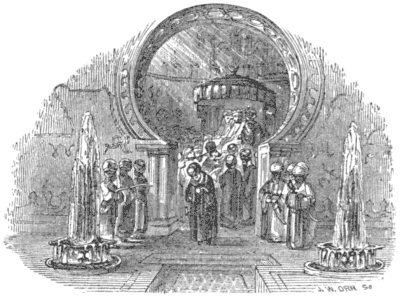
At sundown the Caravan set out, and soon reached Birket-el-had, or “the Pilgrims’ Fountain,” whence the distance to Cairo was three leagues. The Caravan had been expected at this time, and the merchants soon had the pleasure of seeing their friends coming forth from the city to meet them. They entered through the gate Bebel-Falch, for it was considered a good omen for those who came from Mecca to enter by this gate, because the Prophet himself had passed through it.
At the market-place the four Turkish merchants took leave of the stranger and the Greek Zaleukos, and went home with their friends. Zaleukos, however, showed his companion a good caravansery, and invited him to dine with him. The stranger agreed, and promised to make his appearance as soon as he should have changed his dress. The Greek made every arrangement for giving a fine entertainment to the stranger, for whom, upon the journey, he had conceived a deep feeling of esteem; and when the meats and drink had been brought in in proper order, he seated himself, waiting for his guest.
He heard slow and heavy steps approaching through the gallery which led to their apartment. He arose in order to meet him as a friend, and welcome him upon the threshold; but, full of horror, he started back as the door opened—the same frightful Red-mantle walked in before him! His eyes were still turned upon him; it was no illusion: the same lofty, commanding figure, the mask, from beneath which shone forth the dark eyes, the red cloak with embroidery of gold—all were but too well known to him, impressed upon his mind as they had been during the most awful moments of his life.
The breast of Zaleukos heaved with contending emotions; he had long since felt reconciled towards this too-well-remembered apparition, and forgiven him; nevertheless his sudden appearance opened every wound afresh. All those torturing hours of anguish, that wo which had envenomed the bloom of his life, rushed back for a moment, crowding upon his soul.
“What wishest thou, terrible one?” cried the Greek, as the apparition still stood motionless upon the threshold. “Away with thee, that I may curse thee not!”
“Zaleukos!” said a well-known voice from under the mask: “Zaleukos! is it thus that you receive your guest?” The speaker removed the mask, and threw back his cloak: it was Selim Baruch, the stranger! But still Zaleukos seemed not at ease, for he too plainly recognised in him the Unknown of the Ponte Vecchio: nevertheless, old habits of hospitality conquered; he silently motioned to the stranger to seat himself at the table.
“I can guess your thoughts,” commenced the latter, when they had taken their places: “your eyes look inquiringly upon me. I might have been silent, and your gaze would never more have beheld me; but I owe you an explanation, and therefore did I venture to appear before you in my former guise, even at the risk of receiving your curse. You once said to me, ‘The faith of my fathers bids me love him; and he is probably more unhappy than myself:’ be assured of this, my friend, and listen to my justification.
“I must begin far back, in order that you may fully understand my story. I was born in Alexandria, of Christian parents. My father, the youngest son of an ancient illustrious French family, was consul for his native land in the city I have just mentioned. From my tenth year I was brought up in France, by one of my mother’s brothers, and left my fatherland for the first time a few years after the revolution broke out there, in company with my uncle, who was no longer safe in the land of his ancestors, in order to seek refuge with my parents beyond the sea. We landed eagerly, hoping to find in my father’s house the rest and quiet of which the troubles of France had deprived us. But ah! in my father’s house I found not all as it should be: the external storms of these stirring times had not, it is true, reached it; but the more unexpectedly had misfortune made her home in the inmost hearts of my family. My brother, a promising young man, first secretary of my father, had shortly before married a young lady, the daughter of a Florentine noble who lived in our vicinity: two days before our arrival she had suddenly disappeared, and neither our family nor her own father could discern the slightest trace of her. At last they came to the conclusion that she had ventured too far in a walk, and had fallen into the hands of robbers. Almost agreeable was this thought to my poor brother, when compared to the truth, which only too soon became known. The perfidious one had eloped with a young Neapolitan, with whom she had become acquainted in her father’s house. My brother, who was exceedingly affected by this step, employed every means to bring the guilty one to punishment; but in vain: his attempts, which in Naples and Florence had excited wonder, served only to complete his and our misfortune. The Florentine nobleman returned to his native land, under the pretence of seeing justice done to my brother, but with the real determination of destroying us all. He frustrated all those examinations which my brother had set on foot, and knew how to use his influence, which he had obtained in various ways, so well, that my father and brother fell under suspicion of their government, were seized in the most shameful manner, carried to France, and there suffered death by the axe of the executioner. My poor mother lost her mind; and not until ten long months had passed, did death release her from her awful situation, though for the few last days she was possessed of perfect consciousness. Thus did I now stand isolated in the world: one thought alone occupied my whole soul, one thought alone bade me forget my sorrows; it was the mighty flame which my mother in her last moments had kindled within me.
“In her last moments, as I said, recollection returned; she had me summoned, and spoke with composure of our fate, and her own death. Then she sent all out of the room, raised herself, with a solemn air, from her miserable bed, and said that I should receive her blessing, if I would swear to accomplish something with which she would charge me. Amazed at the words of my dying mother, I promised with an oath to do whatever she should tell me. She thereupon broke forth in imprecations against the Florentine and his daughter, and charged me, with the most frightful threats of her curse, to avenge upon him the misfortunes of my house. She died in my arms. This thought of vengeance had long slumbered in my soul; it now awoke in all its might. I collected what remained of my paternal property, and bound myself by an oath to stake it all upon revenge, and, rather than be unsuccessful, to perish in the attempt.
“I soon arrived in Florence, where I kept myself as private as possible; it was very difficult to put my plan in execution on account of the situation which my enemy occupied. The old Florentine had become governor, and thus had in his hand all the means of destroying me, should he entertain the slightest suspicion. An accident came to my assistance. One evening I saw a man in well-known livery, walking through the streets: his uncertain gait, his gloomy appearance, and the muttered ‘Santo sacramento,’ and ‘Maledetto diavolo,’ soon made me recognise old Pietro, a servant of the Florentine, whom I had formerly known in Alexandria. There was no doubt but that he was in a passion with his master, and I resolved to turn his humor to my advantage. He appeared much surprised to see me there, told me his grievances, that he could do nothing aright for his master since he had become governor, and my gold supported by his anger soon brought him over to my side. Most of the difficulty was now removed: I had a man in my pay, who would open to me at any hour the doors of my enemy, and from this time my plan of vengeance advanced to maturity with still greater rapidity. The life of the old Florentine seemed to me too pitiful a thing, to be put into the balance with that of my whole family. Murdered before him, he must see the dearest object of his love, and this was his daughter Bianca. It was she that had so shamefully wronged my brother, it was she that had been the author of our misfortunes. My heart, thirsting for revenge, eagerly drank in the intelligence, that Bianca was on the point of being married a second time; it was settled—she must die. But as my soul recoiled at the deed, and I attributed too little nerve to Pietro, we looked around for a man to accomplish our fell design. I could hire no Florentine, for there was none that would have undertaken such a thing against the governor. Thereupon Pietro hit upon a plan, which I afterwards adopted, and he thereupon proposed you, being a foreigner and a physician, as the proper person. The result you know: only, through your excessive foresight and honesty, my undertaking seemed, at one time, to be tottering; hence the scene with the mantle.
“Pietro opened for us the little gate in the governor’s palace; he would have let us out, also, in the same secret manner, if we had not fled, overcome by horror at the frightful spectacle, which, through the crack of the door, presented itself to our eyes. Pursued by terror and remorse, I ran on about two hundred paces, until I sank down upon the steps of a church. There I collected myself again, and my first thought was of you, and your awful fate, if found within the house.
“I crept back to the palace, but neither of Pietro nor yourself could I discover a single trace. The door, however, was open, and I could at least hope that you had not neglected this opportunity of flight.
“But when the day broke, fear of detection, and an unconquerable feeling of remorse, allowed me to remain no longer within the walls of Florence. I hastened to Rome. Imagine my consternation, when, after a few days, the story was everywhere told, with the addition that, in a Grecian physician, they had detected the murderer. In anxious fear, I returned to Florence; my vengeance now seemed too great: I cursed it again and again, for with your life it was purchased all too dearly. I arrived on the same day which cost you a hand. I will not tell you what I felt, when I saw you ascend the scaffold, and bear all with such heroism. But when the blood gushed forth in streams, then was my resolution taken, to sweeten the rest of your days. What has since happened you know; it only now remains to tell you, why I have travelled with you. As the thought that you had never yet forgiven me, pressed heavily upon me, I determined to spend some days with you, and at last to give you an explanation of what I had done.”