THE OLIVE-BRANCH (continued 2)
Reading edition
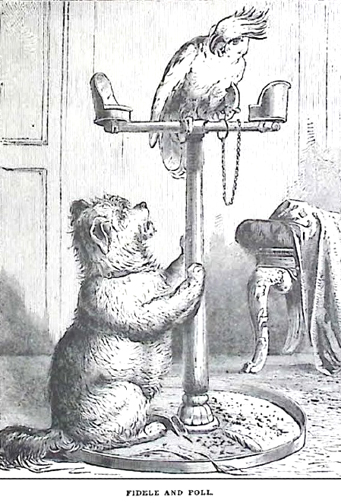
FIDELE AND POLL.
"Then how clever I am," continued Miss Parrot, after a nibble at her biscuit. "No human beings are likely to care for you, for you can't speak one word of their language."
"I wish that I could learn it," said Fidele.
"You've only to copy me." And then in her harsh grating voice the parrot cried, "What's o'clock?"
"Bow-wow!" barked Fidele.
"Do your duty!" screamed the bird.
"Bow-wow!" barked the dog.
"There's not a chance that any one will ever care for you, ugly stupid spaniel," cried Miss Poll. "You may just creep off to your kennel, you are not fit company for a learned beauty like me."
Poor Fidele made no complaint, but he felt sad as he trotted off to his corner. Before Poll's arrival at the Hall, the spaniel had been the favourite playmate of all Mrs. Donathorn's children. They had taught him to fetch and carry, to toss up a biscuit placed on his nose and catch it cleverly in his mouth, or to jump into the water and bring a stick that had been flung to ever so great a distance.
But as soon as pretty Poll came, no one seemed to care for Fidele any more. To teach the parrot to speak was the great delight of the children. They shouted and clapped their hands when she screamed out "Pretty Poll," "What's o'clock?" or, "Do your duty." Stupid Fidele! He could not be taught to speak. Ugly Fidele! Who could for a moment compare him to a beautiful parrot? So all the kind words, and soft pats, and sweet biscuits, were given to Poll. It is true that she made little Tommy once cry out with pain from a bite from her sharp beak—and that the least thing that displeased her would make her ruffle up her feathers in a very ill-tempered way, but still she was petted and praised for her cleverness and her beauty; and she quite despised poor Fidele, who was nothing but an ugly hairy dog.
One fine summer's day, the children carried the stand of their favourite to the bank of the pretty little river which flowed through their mother's grounds. Bessy and Jemmy amused themselves by feeding and chatting with the parrot, while little Tommy gathered daisies and buttercups, or rolled about on the grass. No one cared for Fidele; no one noticed what he was doing.
Presently Bessy and Jemmy were startled by a scream, and then a sudden splashing noise in the water. Poor little Tommy, eager to pull some blue forget-me-nots which grew quite close to the brink, had overbalanced himself and tumbled right into the stream. Oh, what was the terror of the children when they heard the splash, and saw the wide circles on the water where their poor little brother was sinking.
"Do your duty!" screamed the parrot, merely talking by rote, and not caring a feather for the danger of the child, or the distress of his brother and sister.
At that moment, there was heard another splash in the water, and then the brown nose and hairy back of Fidele were seen in the stream, as the little dog swam with all his might to save the drowning child. He caught little Tommy by his clothes; he pulled—he tugged—he dragged him towards the shore, just within reach of the eagerly stretched-out hands of Jemmy.
"Oh, he is saved! He is saved!" cried Bessy, as Tommy was dragged out of the river, dripping, choking, spluttering, crying, but not seriously hurt.
He was instantly carried back to the house, undressed, and put into a warm bed; and the little one was soon none the worse for his terrible ducking and fright.
"Oh, you dear—you darling dog!" cried Bessy, as she caught up Fidele, all wet as he was, and hugged him with grateful affection. "I will always love you, and care for you, for you were a true friend in need."
"Pretty Poll!" screamed the parrot, who did not like any one to be noticed but herself.
"Fidele is better than pretty; he is brave, and useful, and good," cried Bessy.
"Do your duty!" screamed out Miss Poll.
"Ah, Poll, Poll, it is one thing to prate about duty, and another thing to 'do it,'" said Bessy. "Fine words are good, to be sure, but 'fine acts' are a great deal better."
MORAL.
Beauty and cleverness may win much notice for a time, but it is he who is faithful, good, and true, who is valued and loved at the end.
XVII.
THE TWO STANDARD MEASURES.

"MAMMA, how tall was that great giant of whom papa was telling us?" said Harry, who, after standing with his back to the door, a pencil in one hand, and a ruler in the other, was busily engaged in examining some marks which he had made on the panel.
"He was nearly seven feet high, I believe," replied Mrs. Prince, without raising her eyes from her work.
"And how tall do you think that I am?" said the little boy, with a look of conscious pride.
"You? I should say about four feet, my dear."
"I am 'eight' feet high!" cried Harry, with exultation.
"Impossible!"
"I have just measured myself, mamma."
"You must have measured wrong."
"Oh I have been very careful; see, here is the mark for each foot up the door—one, two, four, six, eight."
"But what is your standard measure, Harry?" said his mother with a smile.
"This pretty little ruler, 'that I made for myself,'" cried the child, exhibiting his pasteboard measure, neatly marked with divisions for the inches, "but only half the proper length!" "You see, dear mamma, that I am taller than the giant!"
"Foolish child!" you say, and I should say so too, did I not fear that half the world act exactly as he did. We are all too apt to make our standard measures for ourselves, laying aside "the only true one," which we find in the Bible; and thus we often deem ourselves sensible and good, when our wisdom is folly, our actions full of sin.
The Bible tells us that "holiness" is absolutely necessary. "There is no need to be so very particular," cries the world. The Bible declares that we shall be judged for "every idle word." "My words are my own!" says the trifler.
It is clear that there are "two standard measures" before us: one short and easy, the other long and trying; one that makes us seem like giants, the other like dwarfs. Thus we are too ready to choose the standard "of our own making," and wilfully to deceive our own hearts. But oh! Let us ask ourselves one solemn question—"By which standard shall we be measured at the last day?"