THE DAYS OF THE SPINNING-WHEEL (continued 2)
Reading edition
About 1787 and 1788, spinning-wheel meetings seem to have been very popular. We copy notices of meetings of young ladies in Attleboro', Dighton, Gloucester, Rehoboth, Mass., and Providence and Johnston, R.I., all from the "Salem Mercury."
Attleboro', June 20. Yeſterday, 63 reſpectable young ladies, belonging to this town, aſſlembled, at 2 o'clock, P.M. at the houſe of Mr. Daniel Balkum, and, to the ſurpriſe and great ſatisfaction of all the friends to induſtry, ſpun, before ſunſet, 199 ſkeins of excellent linen yarn. Induſtry is the genuine ſource of all laudable pleaſure. On it depend all the conveniences of life. Health, the greateſt of bleſſings, depends on induſtry—beauty, on health. If ladies, then, wiſh to be beautiful, they muſt be induſtrious; they muſt animate their countenances with that blooming health which comes from the Spinning-wheel. The fair ſex, when rightly and induſtriouſly employed, are juſtly termed the beauty of this lower creation. Beauty without virtue is contemptible. Merit only gains the heart. Idleneſs is diſgraceful. Induſtry is the ornament of wealth, the ſupport and conſolation of poverty. We hope ſoon to ſee the time, when the fair daughters of America will be clothed in the manufactures of their own hands. Happy are we, that ſome have already ſet the example. May it never be ſaid, that American ladies riſe 15 minutes later than the ſun. May they ever have thread enough in their hands to make a halter for a Shays.
On Tueſday laſt, thirteen young ladies aſſembled, with their ſpinning-wheels, at the houſe of Mr. Joſeph Whipple, in North-Providence, and, between the hours of eight in the morning and ſix in the afternoon, completed fifty ſkeins of excellent linen yarn.
July 1, 1788.
The ſpinning-wheel, a few years ago imprudently neglected, begins to be held in general reputation by the Fair; and the exploits of ſome on that uſeful machine, are deſervedly celebrated, as worthy of imitation. To thoſe good works of female induſtry may be added the ſingular attachment of two young ladies in Dighton, who ſpun, the 11th inſtant, between the riſing and ſetting of the ſun, thirteen ſkeins and eleven lees of good linen yarn; one ſix ſkeins and ſeven, and the other ſeven ſkeins and four lees. The ſpirit of induſtry is becoming more prevalent, eſpecially among the fair ſex. They begin to lay aſide their uſeleſs and idle viſits, or, at leaſt, make them leſs frequent. When perſons become more induſtrious and mind their own buſineſs, they talk leſs, and to better purpoſe; they become more contented, and the world around them is more peaceable and happy.
Providence Gazette, July 1, 1788.
Providence, May 24. On the 7th inſt. 71 ladies met at the houſe of the Rev. Mr. Ellis, in Rehoboth, and lodged 187 ſkeins of good linen yarn, which they had ſpun for Mrs. Ellis; and others have ſince added 31. Solomon, in deſcribing a virtuous woman, ſays, "She ſeeketh wool and flax, and worketh willingly with her hands.—She layeth her hands to the ſpindle, and her hands hold the diſtaff." Induſtry is certainly a virtue, which, while it adorns, enriches, ſociety; it baniſhes the languid hue from the countenances of the fair, and adds vigour and vivacity to the mind.—The ſpirited exertions that the daughters of Columbia are making, to manufacture our wool and flax, which are neceſſary for our conſumption, are praiſe-worthy, and demand the approbation and aſſiſtance of every true patriot. We flatter ourſelves with the pleaſing expectation of ſeeing the virtuous fair clothed and ornamented in the genuine productions of their own labour.
We hear from Glouceſter, that on Thurſday laſt nearly thirty young ladies, inſpired with the love of induſtry, aſſlembled at the houſe of Capt. Philemon Haſkell, for the praiſe-worthy purpoſe of a Federal Spinning Match, when, to their honour, their ſpirited exertion produced 99 ſkeins of excellent yarn—practically declaring, that they neither laboured in vain or ſpent their ſtrength for nought. The day thus induſtriouſly concluded, finiſhed not the harmony of their federaliſm; in the evening, to crown the pleaſure of the day, with additional company, they regaled with an agreeable dance, and, at a modeſt hour, parted in love and friendſhip, with hearts convivial as they met, leaving others to admire their female patriotiſm, and to go and do likewiſe.
In Scotland, the farmers knit as well as the women of their families; but they do this while they are watching their ſheep or cattle, or while they are ſitting by their evening fire in winter. Why cannot our American farmers and their ſons adopt this frugal practice? Time is the moſt precious thing in the world. Its very fragments ſhould be ſaved.
Providence, May 17. Monday laſt, eighteen young ladies aſſembled, with their ſpinning-wheels, at the houſe of Captain Jonathan Treadwell, and ſpun 40 ſkeins of good linen yarn.
May 22. A correſpondent deſires us to mention, that at Johnſton, a few days ſince, four induſtrious young ladies, by "laying their fingers to the ſpindle, and their hands to the diſtaff," completed, in one day, the ſpinning and reeling of 21 fifteen-knotted ſkeins of good linen yarn. Would to God, that the Gentlemen at the head of our political affairs in this State, were half ſo zealous in encouraging our own manufactures, as the fair ſex are; who, at preſent, deſervedly bear the palm, as friends to their country.
"Spinning Bee. On the 1st inſt. aſſembled at the houſe of the Rev. Samuel Deane of this town, more than one hundred of the fair ſex, married and ſingle ladies, moſt of whom, were ſkilled in the important art of ſpinning. An emulous induſtry was never more apparent than in this beautiful aſſembly. The majority of fair hands gave motion to not leſs than ſixty wheels. Many were occupied in preparing the materials, beſides thoſe who attended to the entertainment of the reſt,—proviſion for which was moſtly preſented by the gueſts themſelves, or ſent in by other generous promoters of the exhibition, as were alſo the materials for the work. Near the cloſe of the day Mrs. Deane was preſented by the company, with two hundred and thirty-ſix, ſeven-knotted ſkeins of excellent cotton and linen yarn, the work of the day, excepting about a dozen ſkeins, which ſome of the company brought in ready ſpun. Some had ſpun ſix and many not leſs than five ſkeins apiece. She takes this opportunity of returning thanks to each, which the hurry of the day rendered impracticable at the time. To conclude and crown the day, a numerous band of the beſt ſingers attended in the evening and performed an agreeable variety of excellent pieces in psalmody. "The price of a virtuous woman is far above rubies, * * * She layeth her hands to the ſpindle and her hands hold the diſtaff."
Cumberland (Portland, Me.) Gazette, May 8, 1788, copied by Edw. H. Elwell, Esq., editor of the Transcript.
When spinning-wheels ceased to be used altogether, we are not able to say. Probably they were not in use for any great length of time after the opening of the present century; but possibly in some country places they were used down to the time of the War of 1812, and even later. We are informed that in some remote places in Rhode Island and in Maine spinning-wheels are in use to this day; but these are exceptional cases.
The "Massachusetts Centinel," April 30, 1788, has this advertisement:—
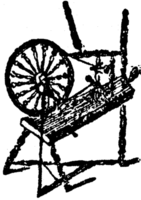
WILLIAM SCOTT, At the Sign of the SPINNING WHEEL, In MARLBOROUGH·STREET, (Reſolving to quit Trade in the Fall)
Will ſell all his GOODS on hand at the STERLING COST and CHARGES. Among which are,
Some elegant Merſailles Bed-Quilts, Merſailles Quilting in pieces, Iriſh Linens, Gauzes, Shawls and Luſtrings of a ſuperiour quality, &c., &c.
A large quantity of ſilk Gloves, Mitts and Fans
☞ CASH for POT-ASHES.
THE following very curious notice in the "Massachusetts Centinel" in reference to funerals shows what had been customary upon such occasions; the object of these "wholesome regulations" seemed to be to induce economy. Gloves and rings were given to mourners in Salem to within the last fifty or sixty years, and wines or liquors were also furnished.
TAKE NOTICE.
An economical plan of mourning was adopted, before the Revolution, and its ſalutary effects have been experienced by almoſt every family in this town; ſince which thoſe wholeſome regulations have been paſſed into a law: Notwithſtanding which, it has lately been broken in upon in ſeveral inſtances.—The Inſpectors of the Police—that no one may hereafter plead ignorance, have cauſed the law reſpecting the ſame to be publiſhed, and give notice, that any future breach of it, will be proſecuted without any favour or affection.
Boſton, April 30, 1788.
To prevent exceſs and vain expenſe, in Mourning, &c.
IT IS HEREBY ORDERED, That in future no scarfs, gloves or rings shall be given at any funeral in this town, nor shall any wine, rum, or other spirituous liquor, be allowed or given at, or immediately before or after, any funeral in this town, under pain that the person or persons giving, allowing or ordering the same shall respectively forfeit and pay the sum of twenty shillings for each offence.
And it is further ordered, That whatever male person shall appear or walk in the procession of any funeral in this town with any new mourning or new black or other new mourning coat or waistcoat, or with any other new black apparel, save and except a black crape around one arm, or shall afterwards on account of the decease of any relation, or other person or persons, put on and wear any other mourning than such piece of black crape around one arm, shall forfeit and pay the sum of twenty shillings for every day he shall put on and wear or appear in the same.
AND no female, of whatsoever degree, shall put on, wear or appear at any funeral in this town, in any other mourning or new black clothes whatever, other than a black hat or bonnet, black gloves, black ribbons and a black fan, on pain to forfeit and pay the sum of twenty shillings; and also forfeit and pay a like sum of twenty shillings for every day she shall at any time at, or after such funeral, put on wear or appear in such new black clothes, as or for mourning, other than black hat, bonnet, black gloves, black ribbons, and a black fan as aforesaid.
In 1790 the town of Salem published in the papers some regulations about funerals; among the fees fixed were these:—
"For each Tolling of the Bell 8d."
"The ſextons are deſired to toll the Bells only four ſtrokes in a minute."
"The undertakers service in borrowing chairs, waiting upon the Pall-holders and warning the Relations &c. to attend 8/."
"B. Daland and B. Brown are appointed by the Selectmen to ſee that Free Paſſages in the ſtreets are kept open." (This was before carriages were used at funerals.)
Extracts from Mr. Colman's Agricultural Address.
MANUFACTORIES AND THE SPINNING WHEEL.
"The establishment of extensive manufactories, and the introduction of power-looms and spinning-jennies, has nearly destroyed the usual household manufactures, and put our other Jennies out of employment. Our ears are seldom greeted now a days in the farmer's cottage with the flying of the shuttle, or the deep base of the spinning wheel. We confess that we have looked upon their departure with a strong feeling of regret; and deem it no small abatement of the advantages, which the establishment of extensive manufactures has obviously yielded to the country, that it removes the daughter from the shelter and security of the paternal roof, and places her in a situation, which certainly furnishes no means of qualifying her for the proper department of woman; to preside over our domestic establishments; to perform her part in the joint labors of the household; and to know how and when and where to use, prepare, and to apply to the best advantage within doors, the products of man's labor without doors. Many occupations of female industry, strictly domestic however, of a healthy and agreeable nature, are constantly presenting themselves, so that there is little danger that the race of industrious women, and accomplished wives, at least among the country girls, will soon be extinct; and the silk culture, fast gaining ground among us, promises to furnish an unexhausted resource and a profitable employment of female labor."
Salem Observer, 1834.
In one of the numbers of the London "Spectator" for 1884 is an interesting account of an attempt to revive the spinning-wheel industry in England, through the kind offices of Mr. Albert Flemming, for the purpose of helping poor women too old or blind to leave their homes for other work. After considerable difficulty, a wheel was discovered among a store of ancient articles; but no one at first knew how to use it. Spinning was one of the lost arts, apparently. At length, however, an old woman of eighty-four was found who understood the use of the wheel. She taught Mr. Flemming how to spin. A few more old wheels were found, and some new ones constructed. Then it was some time before a loom could be discovered. Eventually this was accomplished, and the art of weaving taught. The account says that twenty women who were unable otherwise to obtain a living, are now busily at work, happy in being able to provide for their families. They make, it may be added, a good strong, honest linen, specimens of which have been presented to Mr. Ruskin. This account is substantially from the "Living Age," Nov. 1, 1884.

University Press: John Wilson & Son, Cambridge.
Transcriber's note:
These are mainly excerpts from Newspapers. Original spelling was not corrected.