Chapter V · Babylonia At The Time Of Abraham.
Reading edition
The first dynasty of Babylon—The extent of its dominion—The Amorites—Life in Babylonia at this time—The religious element—The king—The royal family—The people—Their manners and customs as revealed by the contract-tablets—Their laws.
Much has been learnt, but there is still much to learn, concerning the early history of Babylonia.
During the period immediately preceding that of the dynasty of Babylon—the dynasty to which Amraphel (Ḫammurabi) belonged—there is a gap in the list of the kings, which fresh excavations alone can fill up. Before this gap the records, as far as we know them, are in the Akkadian language. After this gap they are in the Semitic-Babylonian tongue. To all appearance, troublous times had come upon Babylonia. The native rulers had been swept away by the Elamites, who, in their turn, had been driven out by the Semitic kings of Babylonia, but those Semitic kings were not Babylonians by origin, notwithstanding that the native scribes, who drew up the lists of kings, describe them as being a Babylonian dynasty.
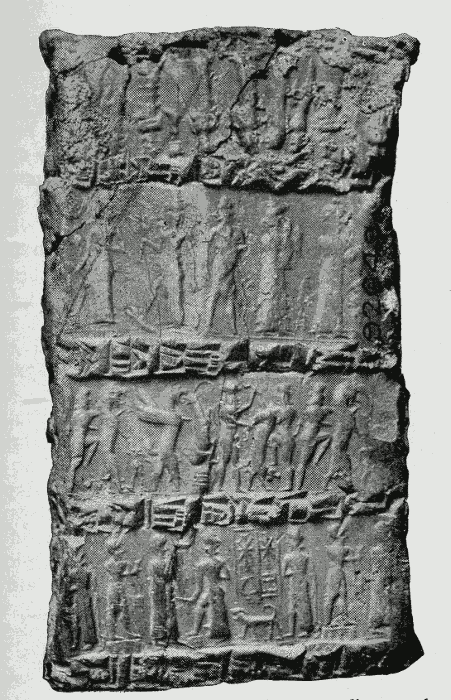
Envelope (Printed upside down on account of seal-impressions 2 to 4) of a contract-tablet recording a sale of land by Sin-êribam, Pî-sa-nunu, and Idis-Sin, three brothers, to Sin-ikîsam. Reign of Immerum, contemporary with Sumula-îlu, about 2100 b.c. Seal Impressions. 1. (Here reversed.) Two deities, one (in a flounced robe) holding a sceptre. On the left, a worshipper; on the right, a man overcoming a lion. This scene is repeated, less distinctly, on the left. 2. Left: Two deities, one holding a sceptre and a weapon; right: deity, divine attendant adoring, and worshipper (?). 3. Men overcoming lions; winged creature devouring a gazelle. 4. Figure on plinth, holding basket and cup; worshipper; deity, holding sword; lion (or dog); deity, holding weapon. Inscription: Aa (the moon-goddess), Samas (the sun-god). (Tablet 92,649 in the British Museum (Babylonian and Assyrian Room, Table-case A, No. 62). The edges have also some very fine impressions.)
The change may have been gradual, but it was great. Many of the small states which had existed at the time of Dungi, Bûr-Sin, Gimil-Sin, Ibi-Sin, and their predecessors had to all appearance passed away, and become part of the Babylonian Empire long before the dynasty of Babylon came to [pg 153] an end, though some at least were in existence in the time of the great conqueror Ḫammurabi. But the change was, as it would seem, not one of overlordship only—another change which had been gradually taking place was, by this, carried one step farther, namely, the Semiticizing of the country. Before the period of the dynasty of Babylon, the two races of Akkadians and Semitic Babylonians had been living side by side, the former (except in the kingdom of which Sippar was the capital) having the predominance, the records being written in the Akkadian language, and the kings bearing mainly Akkadian names, though there were, for the Semitic inhabitants, translations of those names. Translations of the inscriptions and legends, as well as the old Akkadian laws, probably did not (except in the Semitic kingdom of Agadé) exist.
How it came about is not known, but it is certain that, about 2200 years b.c., a purely Semitic dynasty occupied the throne of the chief ruler in Babylonia. The first king was Sumu-abi, who reigned 14 years. This monarch was followed by Sumu-la-ili and Zabû, 36 and 14 years respectively. Then come two rulers with Babylonian names—Abil-Sin and Sin-mubaliṭ, 18 years and 20 years. These are followed, in their turn, by Ḫammurabi (43), Samsu-iluna (38), Ebišum (25), Ammi-ṭitana (25), Ammi-zaduga (21), and Samsu-ṭitana (31 years). This dynasty, therefore, lasted about 28518 years, and with two exceptions, Abil-Sin and Sin-mubaliṭ, the names, though Semitic, are not Babylonian.
[pg 154]
Yet it was called by Babylonians “the dynasty of Babylon!”
And this, in all probability, is correct. The dynasty must, on account of the name given to it, have come from that city, but was, at the same time, of foreign origin, its kings being descended from another dynasty which came from some other part of the Semitic world of that time. This is indicated by the following facts.
Three of the tablets of which we shall learn something more farther on, and which are preserved in the British Museum, have invocations of a personage, apparently a king, named Anmanila. The name of this ruler naturally recalls the Anman of the dynasty following that of Babylon—namely, the dynasty of Uru-ku; but the style of the writing of these three documents is not that of the later period, but of the beginning of the dynasty of Babylon, and there is, on that account, every probability that Anmanila was one of the predecessors of Sumu-abi, the first king of the dynasty of Babylon. It is, of course, possible that this ruler was simply a co-regent with one of the kings already known, like Immerum, who lived at the time of Sumu-la-îla, or Buntaḫun-îla,19 another associate with Sumu-la-îla on the throne, but there is a certain amount of improbability in this, as Anmanila is named alone, and not in connection with any other. Moreover, it is probable that, in the case of the two co-regents here mentioned, we have examples of sons associated with their father, and one replacing the other on account of the early death of his brother. Another ruler, probably of the period preceding that of the dynasty of Babylon, is Manamaltel, whose name [pg 155] is found on a tablet belonging to the Rev. Dr. J. P. Way, head-master of Rossall School, and it is noteworthy that one of the tablets bearing the name of Anmanila gives, among the witnesses, a certain Sumuentel,20 a name having the same termination as Manamaltel, a component which seems to have been common at this early period, and rare or non-existent later. Most, if not all, the above are foreign names.
The next question that arises is, what was the nationality of these rulers, who, though belonging to what was called “the dynasty of Babylon,” were not really of Babylonian origin?
The key to the matter is probably furnished by the following inscription of Ammi-ṭitana, the ninth king of the dynasty—
“Ammi-ṭi(tana), his(?) ...
the powerful king, (in) a seat of gladness
king of Babylon, he has made him sit.
king of Kiš,
king of Šumer and (Akkad),
king of the vast land of Amoria,
am I; its wall.
descendant Asari-lu-duga (Merodach)
of Sumu-la-îli, has revealed him as his worshipper—
eldest son21 may his name be established
of Abēšu',22 am I, in heaven and earth.
Obedient(?) (to) Bel “(Inscription) of Bêl-ušallim,
the seat(?)” son of ... -bi, the enchanter.”
In this inscription, Ammi-ṭitana calls himself not only “king of Babylon,” and other important places in Babylonia, but “king of Amoria” (if the coining of a word for the district be allowed) also. Now, as we know from the Tel-el-Amarna tablets, Amurrū is [pg 156] the name that the Babylonians used for “the west,” which Assyriologists formerly read (on account of the polyphony of the Babylonian system of writing) Aḫarrū. In reality, however, this word, Amurrū, stands for the land of the Amorites, and the probability is, that the land of the Amorites belonged to the Babylonian Empire because it formed part of the original domain of the rulers of Babylonia at this time, who, if not of Amorite descent, may at least have had Amorite connections.
In any case, there is but little doubt that the population of Babylonia was very mixed 2000 years before Christ. As we know from the tablets, Amorites were, during this period, numerous in Babylonia, and the god whose name is written with the characters MARTU (a common group for Amurrū)—the fact is revealed by one of the tablets of late date published by Reisner—are to be read Amurrū, and the best translation is “the Amorite god,” whose name and worship seem to have been introduced into the Babylonian Pantheon at a much earlier date, and was known to the Akkadians under the name of Martu. It is noteworthy that, in the text in question (Mitteilungen aus den orientalischen Sammlungen, Heft. x. pl. 139, 147-81), the Akkadian Martu and Babylonian Amurrū is called “lord of the mountain,” probably because the country of the Amorites, especially when compared with Babylonia, is mountainous.
In addition to the god Amurrū, other deities of western origin appear in the inscriptions (generally in the names) from time to time. Thus we have Abdu-Ištara, interesting as giving an early form of the name Astarte (Ashtoreth), before it received the feminine termination; Ụsur-Malik, probably “protect, O Malik” (Moloch), Nabu-Malik, probably “Nebo is Malik” (Moloch), or “Nebo is king”; Ibi-Šân, probably “speak, O Shân,” which reminds the reader of Beth-Shean, the modern Beisan; and there are [pg 157] also, in all probability, other Amorite deities whom we cannot identify, on account of their names not occurring in other ancient literatures than the Babylonian. Ibaru, found in the name Arad-Ibari, “servant of Ibari,” Abâ, in the name Arad (Abdi)-Abâ, Alla, in the name Ur-Alla, “man of Alla” (though this is possibly a Babylonian [Akkadian] name), etc., are probably non-Babylonian, but not Amorite.
Besides the names of west Semitic deities, however, the names of west Semites themselves occur, and show that there was a considerable immigration in those ancient days into the country. Thus the word Amurrū, “the Amorite,” is exceedingly common, and one is not surprised to learn that, in consequence of the Amorites being so numerous, there was an Amorite district in the neighbourhood of Sippar. Other names of men which are apparently from the country spoken of are, Sar-îli, probably “prince of God,” and the same as Israel; Karanatum (probably for Qaranatum), which would seem to mean “she of the horned deity” (compare Uttatum, “he of the sun,” Sinnatum, “he of the moon”), and reminds us of Ashteroth Karnaim, “Ashteroth of the two horns,” the well-known site in Palestine. Besides these, we meet more than once with such names as Ya'kub, Jacob, with its longer form, Ya'kub-îlu, Jacob-el; and in like manner the name of Joseph and its longer form Joseph-el occur—Yasup and Yasup-îlu. Êsâ, the father of a man named Siteyatum, reminds us of Esau; Abdi-îli, “servant of God,” is the same as Abdeel; and Ya'zar-îlu, “God has helped” (compare Azrael), Yantin-îlu, “God has given” (compare Nethanel), with many others similar, receive illustration. In all probability, too, many of the bearers of names compounded with Addu (Hadad), Amurrū, and other names of deities naturalized in Babylonia, as well as some of the bearers of true Babylonian names, were, in reality, [pg 158] pure west Semites. Further examples will be found in the texts translated farther on, and the more noteworthy will be pointed out when they occur.
It will thus be seen that the population of Babylonia 2000 years before Christ had a considerable admixture of west Semites, many of whom would come under the designation of Amorites; besides other nationalities, such as Armenians or people of Aram-Naharaim (Mesopotamia)—at least two tablets refer exclusively to transactions between members of this northern race—Sutites, and Gutites, who were low-class people seemingly light-haired, “fair Gutian slaves” being in one place spoken of.
Life in Babylonia at this early period must have been exceedingly primitive, and differed considerably, as the East does even now, from what we in Europe are accustomed to. The city of which we can get the best idea, Sippar, the Sippara of the Greeks, generally regarded (though probably wrongly) as the Sepharvaim of the Bible, now represented by the mounds known as Abu-habbah, whence most of the early contract-tablets revealing to us the daily life of these ancient Babylonians came, was situated on the Euphrates, “the life of the land.” The name of this river is written, when phonetically rendered, by the characters Purattu (probably really pronounced Phuraththu), in Akkadian Pura-nunu, “the great water-channel,” often expressed (and then, of course, not phonetically) with characters meaning “the river of Sippar,” showing in what estimation the ancient Babylonians held both river and city. The mound of Abu-habbah is four miles from the river Euphrates, and situated, in reality, on the canal called Nahr-Malka, “the royal river,” which runs through it; but the tablets of the period of which we are now speaking refer not only to the city itself, but to the district all round from the Tigris on the east to the Euphrates on the west.
[pg 159]
The following paragraph from Mr. Rassam's Asshur and the Land of Nimrod will give a fair idea of what this district is like:—
“It is most interesting to examine this canal (the Nahr-Malka) all the way between the Euphrates and the Tigris, as it shows the magnitude of the Babylonian agricultural industry in days gone by, when it irrigated hundreds of miles of rich alluvial soil. The remains of countless large and small watercourses, which intersect the country watered by those two branches23 of Nahr-Malka, are plainly seen even now. Vestiges of prodigious basins are also visible, wherein a surplus supply must have been kept for any emergency, especially when the water of the Euphrates falls low in summer.”
The digging of canals, which was an exceedingly important work in those days, as indeed it is now, was evidently very systematically done, and the king often, to all appearance, made a bid for increased popularity by digging an important new canal for irrigation purposes, to which his name was attached. Thus we find the work of Sumu-la-ilu, Sin-mubaliṭ, Ḫammurabi, Samsu-iluna, and other kings recorded and chosen as the event of the year to date by. This, with the rebuilding or new decoration of the temples and shrines, endeared the king to the people and the priesthood, ensuring for him the faithful service of both, and willing submission to his rule. Indeed, there is but little doubt that the presence of foreign rulers in the country was often due to their having made friends of the priestly classes, and afterwards of the people, in this way.