Chapter III · PLOUGH AND FLOUR-MILL.
Reading edition
“Shortly after the formation of the Otawhao (Te Awamutu) station,” the missionary’s story continued, “in consequence of the difficulty of obtaining supplies of flour from the coast I procured some seed wheat. After the reaping of the first crop I sent Pungarehu, of Rangiaowhia, a few quarts of seed. This he sowed and reaped. The second year he had a good-sized field. Other natives now desired to share in the benefit, and the applications for seed became so numerous that I could not supply them all, and many obtained seed from Kawhia and Aotea (West Coast), where wheat had been introduced either by the Wesleyan missionaries or the settlers.
“As a large quantity of wheat was now grown at Rangiaowhia, and the natives had not purchased steel mills, I recommended them to erect a water-mill. At the request of Kimi Hori, I went to the millwright who was then building a mill at Aotea. In March, 1846, the millwright arrived, and I drew up a contract for the erection of a mill at a cost of £200, not including the carriage of timber, building of the mill dam, and the formation of the watercourse, all of which were performed by the natives themselves. Seven men were set to work, the natives promising to pay the first £50 instalment within a very short time. Instead of leaving immediately for Auckland with pigs to raise the required amount, they began to take up their potatoes and then the kumara to store them for winter use. They then promised to leave for town as soon as the crops were secured. An invitation, however, arrived from Maketu, and the entire tribe left Rangiaowhia to partake of a feast at that place, the millwright threatening to give up the contract. On their return they accepted a second invitation, and went to another distant village. It was with the greatest difficulty that I now detained the millwright. In this manner four months passed away. The millwright demanded compensation for loss of time, and a chief agreed to give him a piece of land of about 200 acres, but for which no Government grant has as yet been made. Still the natives delayed. The required sum (£200) was large for a tribe of New Zealanders to raise. The Aotea mill was now useless, and many feared that this (Rangiaowhia) would also be a failure, and there were several Europeans who had come up to trade in pigs who from interested motives freely gave their opinion that the whole scheme would fail. In this way two months passed away, and it required many personal visits to Rangiaowhia—first, to persuade the millwright, who was several times on the point of leaving, to remain, and, secondly, to urge the natives to take their pigs to town. At length they started. In a few weeks the £50 was raised, and paid into my hands to be paid to the millwright. After this I had no more trouble. The work went forward while the money was being collected, and the last instalment of £50 being paid into my hands, I had the pleasure of handing it to the millwright the day the work was completed.”
This water-driven flour-mill, it may be explained here, was built at Pekapeka-rau, the lower part of the swampy valley between Hairini Hill and Rangiaowhia, through which a watercourse flows toward the Mangapiko. Here a dam was constructed, and a lagoon was formed; the water collected here turned the mill-wheel.
Later, another mill was constructed, on the watercourse called Te Rua-o-Tawhiwhi, on the eastern side of Rangiaowhia village.
Mr Morgan, continuing his story of the new flour-mills, wrote:
“The Rangiaowhia mill was not completed before other tribes became jealous and wished for mills. I drew up two more contracts, one for the erection of a mill at Maunga-tautari, and the other at Otawhao, at the cost respectively of £110 and £120, not including native labour. Both of these mills have been erected. A new difficulty now arose at Rangiaowhia, that of finding a miller to take charge of the mill. In the arrangement I experienced more vexations and difficulty than in the erection of the mills. There was a person ready to take charge, but the natives, not knowing the value of European labour, refused to give him a proper remuneration. One old chief offered one quart of wheat per day! At length, after two months, this knotty point was settled. On the following day the miller commenced work. In the year 1848 the natives of Rangiaowhia took down some flour to Auckland, which they sold for about £70. The neighbouring tribes, seeing the benefit likely to arise from the erection of mills, began earnestly to desire them. One was contracted for at Kawhia, and the sum of about £315 has been paid on account. About 1850 a contract was entered into for the erection at Mohoaonui [near Otorohanga], on the Waipa, of the largest mill yet built, at a cost of £300. The natives of Kawhia are anxious for the erection of a second mill, and the natives at Whatawhata and two other villages on the Waipa, and of Kirikiriroa and Maungapa, on the Waikato, and also Matamata, propose to erect mills; at several of these places the funds are being collected.
THE OLD MISSION CHURCHES
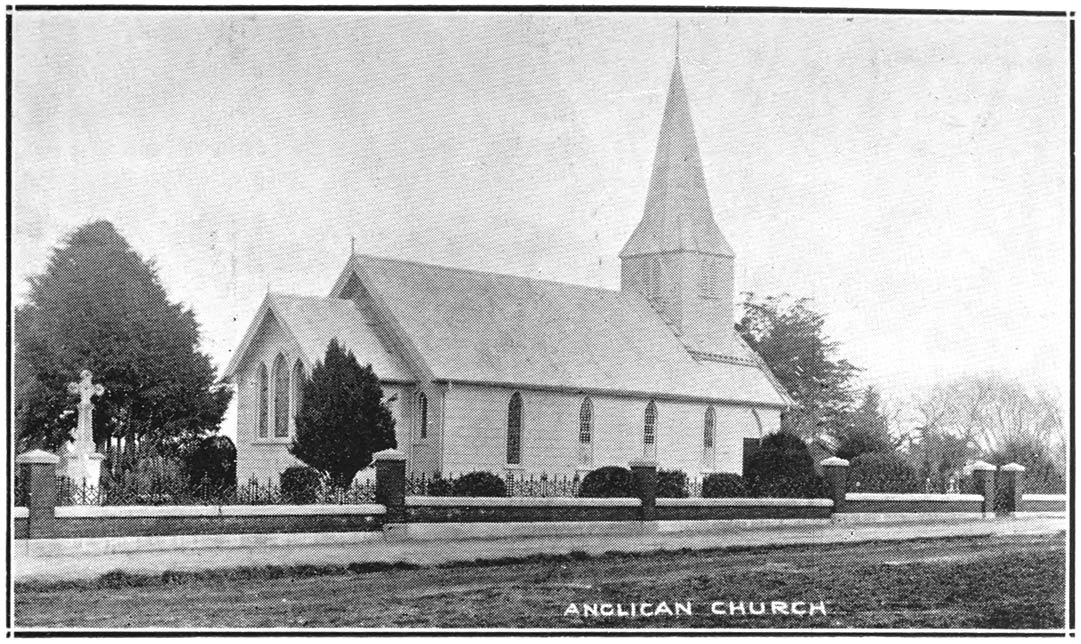
ST. JOHN’S CHURCH, TE AWAMUTU
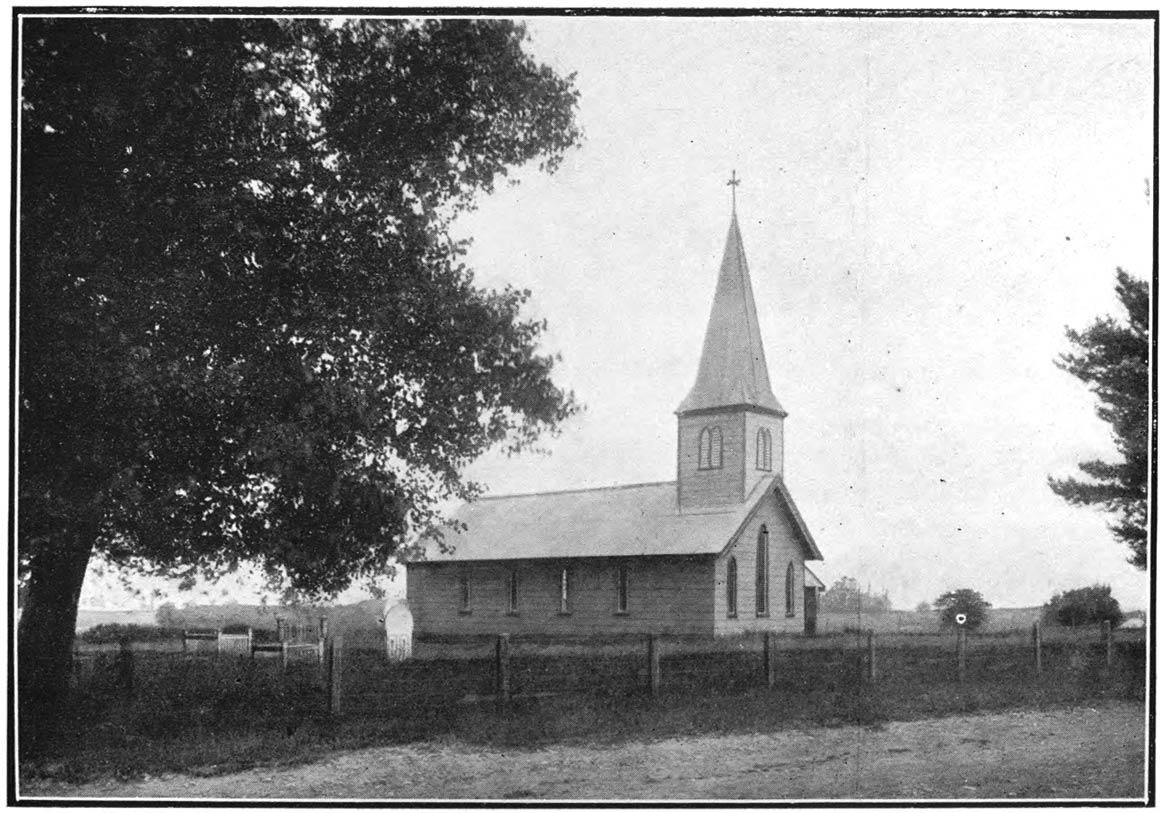
W. Beattie, Photo.
THE ENGLISH CHURCH AT RANGIAOWHIA
“Wheat is very extensively grown in the Waikato district. At Rangiaowhia the wheat fields cover about 450 acres of land. I have also introduced barley and oats at that place. Many of the people at various villages are now forming orchards, and they possess many hundreds of trees budded or grafted by themselves, consisting of peach, apple, pear, plum, quince, and almond; also gooseberry bushes in abundance. For flowers or ornamental trees they have no taste; as they do not bear fruit, it is, in their opinion, loss of time to cultivate them.”
The missionary, concluding his interesting narrative, described a visit paid to the district by Sir George Grey, Governor.
* * *
Such is the story of the very practical missionary work in this district. “Te Mokena” truly tamed the people; old cannibals followed the plough and spent days in discussing the Auckland market prices of wheat and flour. Distant white communities, too, came to depend largely on the Maori farmers of the Upper Waikato for their breadstuffs; and when the great gold rushes began in California and Victoria, in 1849–52, the cargoes of New Zealand produce sent to far-away San Francisco and to Melbourne often contained shipments from Rangiaowhia and other Maori farm-villages.
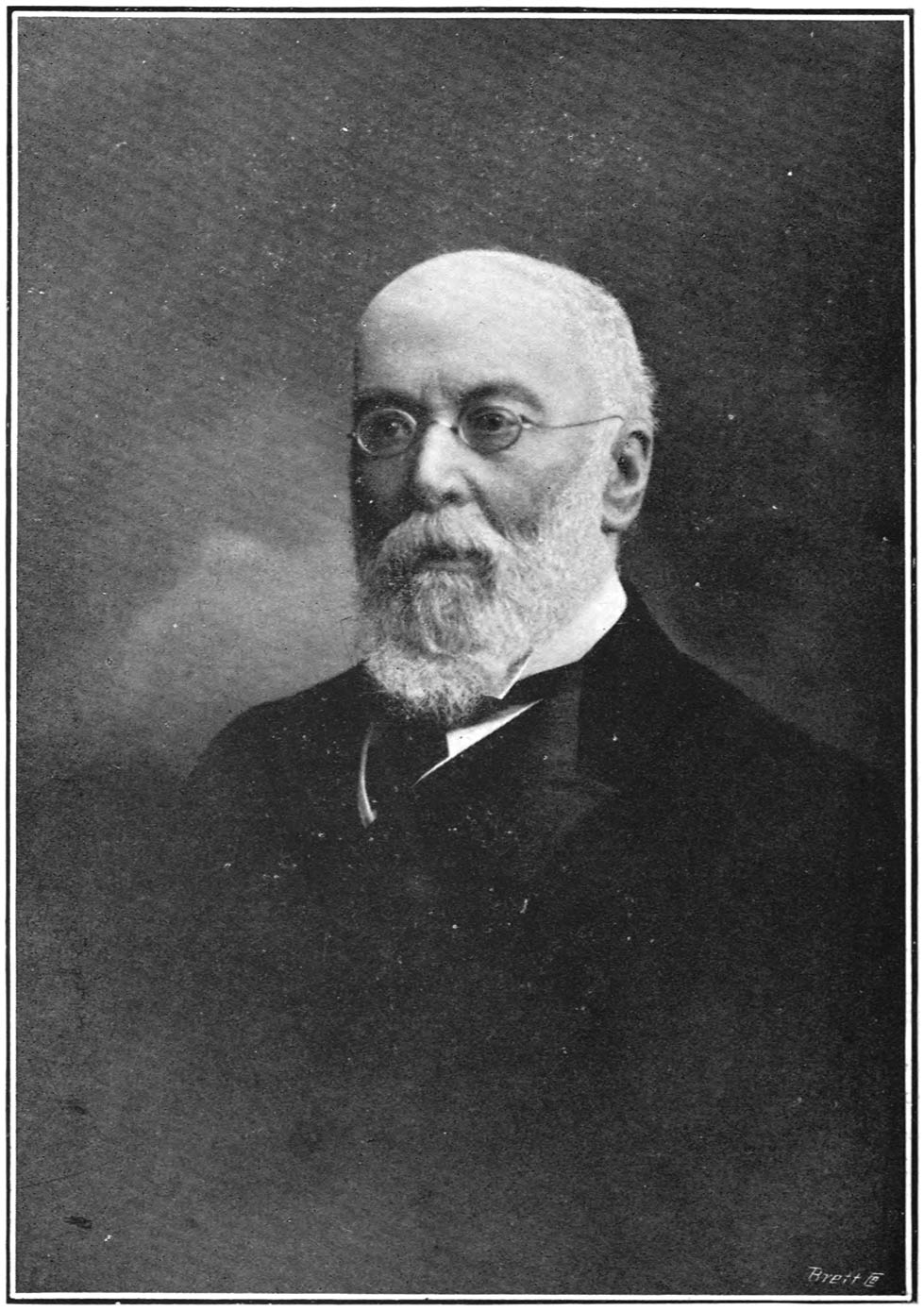
From a photo., 1906]
THE RIGHT HON. SIR JOHN E GORST
(Died 1916)