HISTORY OF NATURAL MAGIC AND PRESTIDIGITATION.
Reading edition
“Therefore made I a decree to bring in all the wise men of Babylon before me. . . . Then came in the magicians, the astrologers, the Chaldeans, and the soothsayers.”—Dan. iv., 6–7.
“What, Sir! you dare to make so free,
And play your hocus-pocus on us!”
—GOETHE: Faust, Scene V.
I.
The art of natural magic dates back to the remotest antiquity. There is an Egyptian papyrus4 in the British Museum which chronicles a magical seance given by a certain Tchatcha-em-ankh before King Khufu, B. C. 3766. The manuscript says of the wizard: “He knoweth how to bind on a head which hath been cut off; he knoweth how to make a lion follow him as if led by a rope; and he knoweth the number of the stars of the house (constellation) of Thoth.” It will be seen from this that the decapitation trick was in vogue ages ago, while the experiment with the lion, which is unquestionably a hypnotic feat, shows hypnotism to be very ancient indeed. Ennemoser, in his History of Magic, devotes considerable space to Egyptian thaumaturgy, especially to the wonders wrought by animal magnetism, which in the hands of the priestly hierarchy must have been miracles indeed to the uninitiated. All that was known of science was in {2} possession of the guardians of the temples, who frequently used their knowledge of natural phenomena to gain ascendancy over the ignorant multitude.
An acquaintance with stage machinery and the science of optics and acoustics was necessary to the production of the many marvelous effects exhibited. Every temple in Egypt and Greece was a veritable storehouse of natural magic. Thanks to ancient writers like Heron of Alexandria, Philo of Byzantium, and the Fathers of the early Christian Church, we are able to fathom some of the secrets of the old thaumaturgists. The magi of the temples were adepts in the art of phantasmagoria. In the ancient temple of Hercules at Tyre, Pliny states that there was a seat of consecrated stone “from which the gods easily rose.”
In the temple at Tarsus, Esculapius showed himself to the devout. Damascius says: “In a manifestation, which ought not to be revealed, . . . there appeared on the wall of a temple a mass of light, which at first seemed to be very remote; it transformed itself, in coming nearer, into a face evidently divine and supernatural, of severe aspect, but mixed with gentleness and extremely beautiful. According to the institutions of a mysterious religion the Alexandrians honored it as Osiris and Adonis.”
By means of concave mirrors, made of highly polished metal, the priests were able to project images upon walls, in the air, or upon the smoke arising from burning incense. In speaking of the art of casting specula of persons upon smoke, the ingenious Salverte says: “The Theurgists caused the appearance of the gods in the air in the midst of gaseous vapors disengaged from fire. Porphyrus admires this secret; Iamblichus censures the employment of it, but he confesses its existence and grants it to be worthy the attention of the inquirer after truth. The Theurgist Maximus undoubtedly made use of a secret analogous to this, when, in the fumes of the incense which he burned before the statute of Hecate, the image was seen to laugh so naturally as to fill the spectators with terror.”
A. Rich, in his Dictionary of Roman and Greek Antiquities, relates, under the heading of the word “Adytum,” that many of the ancient temples possessed chambers the existence of which was known only to the priests, and which served for the {3} production of their illusions. He visited one at Alba, upon the lake of Fucius. It was located amid the ruins of a temple, and was in a perfect state of preservation. This chamber of mysteries was formed under the apsis—that is to say, under the large semi-circular niche which usually sheltered the image of the god, at the far extremity of the edifice. “One part of this chamber,” says he, “is sunk beneath the pavement of the principal part of the temple (cella) and the other rises above it. The latter, then, must have appeared to the worshipers gathered together in the temple merely like a base that occupied the lower portion of the apsis, and that was designed to hold in an elevated position the statue of the god or goddess whose name was borne by the edifice. This sanctuary, moreover, had no door or visible communication that opened into the body of the building. Entrance therein was effected through a secret door in an enclosure of walls at the rear of the temple. It was through this that the priests introduced themselves and their machinery without being observed by the hoi polloi. But there is one remarkable fact that proves beyond the shadow of a doubt the purpose of the adytum. One discovers here a number of tubes or pipes which pierce the walls between the hiding-place and the interior of the temple. These tubes debouch at different places in the partitions of the cella, and thus permit a voice to be heard in any part of the building, while the person and place from which the sound issues remain unknown to the auditors.”
Sometimes the adytum was simply a chamber situated behind the apsis, as in a small temple which was still in existence at Rome in the sixteenth century. An architect named Labbacco has left us a description of the edifice. Travelers who have visited the remains of the temple of Ceres, at Eleusis, have observed a curious fact. The pavement of the cella is rough and unpolished, and much lower than the level of the adjacent porch, thereby indicating that a wooden floor, on a level with the portico, covered the present floor, and hid from view a secret vault designed to operate the machinery that moved the flooring. This view is confirmed by vertical and horizontal grooves, and the holes constructed in the side walls. Similar contrivances existed in India. Philostratus, in his Life of Apollonius (1, III, {4} Ch. v), says: “The Indian sages conducted Apollonius toward the temple of their god, marching in solemn procession and singing sacred hymns. Occasionally they would strike the earth in cadence with their staves, whereupon the ground moved like a sea in turmoil, now rising with them to the height of almost two feet, then subsiding to its regular level.” The blows from the wands were evidently the cue for the concealed assistants to operate the machinery that moved the soil. Says Brown, in his Stellar Theology: “Among the buildings uncovered at Pompeii is a temple of Isis, which is a telltale of the mysteries of the Egyptian deity, for the secret stair which conducted the priests unseen to an opening back of the statue of the goddess, through whose marble lips pretended oracles were given and warnings uttered, now lies open to the day, and reveals the whole imposition.”
The Bible has preserved to us the story of the struggle of Daniel with the priests of Bel, in which the secret door played its part. The Hebrew prophet refused to worship the idol Bel, whereupon the King said to him: “Doth not Bel seem to thee to be a living god? Seest thou not how much he eateth and drinketh every day?” Then Daniel smiled and said: “O King, be not deceived; for this is but clay within and brass without, neither hath he eaten at any time.” The King sent for his priests and demanded the truth of them, declaring his intention of putting them to the sword should they fail to demonstrate the fact that the god really consumed the offerings of meat and wine. And the priests of Bel said: “Behold, we go out; and do thou, O King, set on the meats, and make ready the wine, and shut the door fast, and seal it with thy own ring. And when thou comest in the morning, if thou findest not that Bel hath eaten up all, we will suffer death, or else Daniel that hath lied against us.” And they “little regarded it, because they had made under the table a secret entrance, and they always came in by it, and consumed those things.”
Daniel detected the imposture in a very original manner. He caused ashes to be sifted upon the floor of the temple, whereby the footsteps of the false priests were made manifest to the enraged King of Babylon. {5}
One reads in Pausanias (Arcadia, 1 VIII, Ch. xvi) that at Jerusalem the sepulcher of a woman of that country, named Helena, had a door which was of marble like the rest of the monument, and that this door opened of itself on a certain day of the year, and at a certain hour, by means of concealed machinery, thus antedating our time-locks. Eventually it closed itself. “At any other time,” adds the author, “if you had desired to open it, you would have more easily broken it.”
When Aeneas went to consult the Cumæan Sibyl, the hundred doors of the sanctuary opened of themselves, in order that the oracle might be heard.
“Ostia jamque domus patuere ingentia centum
Sponte sua, vatisque ferunt responsa per auras.”
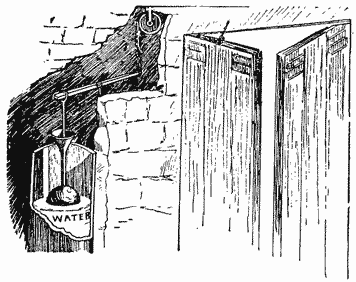
APPARATUS FOR BLOWING A TRUMPET ON OPENING A DOOR.
According to Pliny, the doors of the labyrinth of Thebes were constructed in such a manner that when they were opened a sound resembling that of thunder greeted the astonished worshipers.
Heron, in his Pneumatics, describes an apparatus for blowing a trumpet on opening the door of a temple, the effect of which must have been awe inspiring to the uninitiated common people.
It is hardly necessary to give a detailed translation of the text of the Greek engineer, as the modus operandi of the experiment is sufficiently explained by reference to the descriptive {6} picture. It will suffice to add: One sees that when the door of the temple is opened, a system of cords, rods and pulleys causes a hemispherical cap, to the upper part of which the trumpet is attached, to sink into a vase full of water. The air compressed by the water escapes through the instrument, causing it to sound.
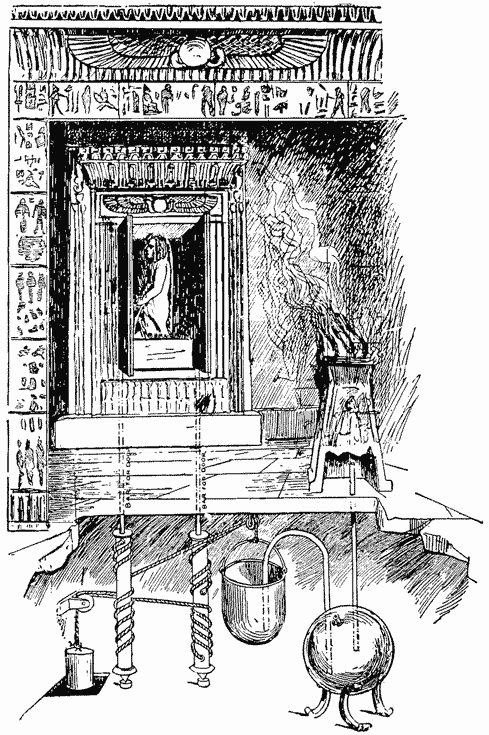
MECHANISM WHICH CAUSED THE TEMPLE DOORS TO OPEN WHEN A FIRE WAS LIGHTED ON THE ALTAR.
Another remarkable device is described in the Pneumatics of Heron, and consists of an apparatus which is entitled: “Construction of a chapel wherein, when fire is lighted upon the altar, the doors open, and when it is extinguished, they close.” {7}
The altar is hollow, and when a fire is lighted thereon, the air contained in the interior expands and begins to press upon the water with which the globe situated beneath is filled. The water then rises through a bent tube which leads to a species of pot, into which it falls. The pot is suspended upon a cord which passes along a pulley, doubling immediately, in order to enroll itself about two cylinders, which turn upon pivots, said cylinders forming the prolongation of the axes upon which the doors above turn. Around the same cylinders are enrolled in a contrary manner, two other cords, which also unite into one before passing along a pulley, and then hanging vertically for the support of a counterpoise.
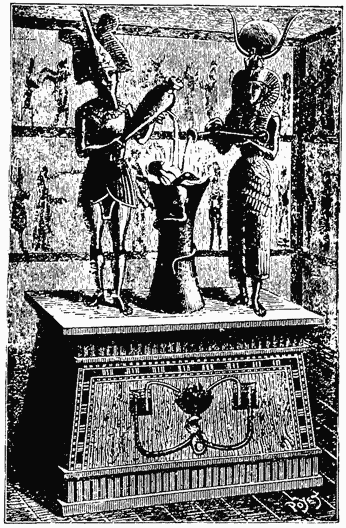
EGYPTIAN ALTAR
It is clear that when the water from the globe enters the pot, the weight of the latter will be augmented and it will sink, pulling upon the cord which has been wound about the cylinders {8} in such a way as to cause the doors to open, when it is drawn in this direction.
The doors close themselves in the following manner: The bent tube, which places in communication the globe and the pot, forms a siphon, the longest branch of which plunges into the globe. When the fire is extinguished upon the altar, the air contained in the latter and in the globe, cools, and diminishes in volume. The water in the pot is then drawn into the globe, and the siphon, being thus naturally influenced, operates until the water in the pot has passed over into the globe. In measure as the pot lightens, it remounts under the constraint of the counterpoise, and the latter, in its descent, closes the doors through the intermedium of the cords wound around the cylinders.
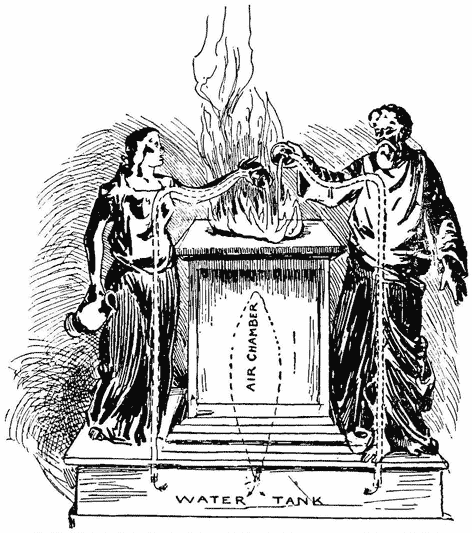
HOW THE STATUES WERE MADE TO POUR LIBATIONS WHEN A FIRE WAS KINDLED ON THE ALTAR.
Heron says that mercury was sometimes used in place of water, by reason of its superior weight. {9}
Certain altars were provided with such mechanism as to afford to the faithful even more astonishing spectacles. Here is another experiment from the learned Heron:
“To construct an altar so that when one kindles the fire thereon, the statues which are at the sides shall pour out libations.”
There should be a pedestal, upon which are placed the statues, and an altar closed on all sides. The pedestal should communicate with the altar through a central tube, also with the statues by means of tubes, the ends of the latter terminating in cups held by the statues. Water is poured into the pedestal through a hole, which is stopped up immediately afterward.
If, then, a fire be kindled upon the altar, the air within expanding, will penetrate the pedestal and force out the water; but the latter, having no other outlet than the tubes, mounts into the cups and the statues thus perform libations, which last as long as the fire does. Upon the fire being extinguished, the libations cease, and recommence as many times as it is rekindled.
The tube through which the heat is conveyed should be larger at the middle than at the extremities, to allow the heat, or more especially, the draft, which it produces, to accumulate in an inflation, in order to be most effectual.
The priests of the temples of old were truly masters of the arts of mechanics and pneumatics.
According to Father Kircher (Oed. Aegypt., Vol. II), an author, whom he calls Bitho, states that there was at Saïs a temple of Minerva containing an altar upon which, when a fire was kindled, Dionysos and Artemis (Bacchus and Diana) poured out milk and wine, while a dragon hissed. The use of steam is indicated here.
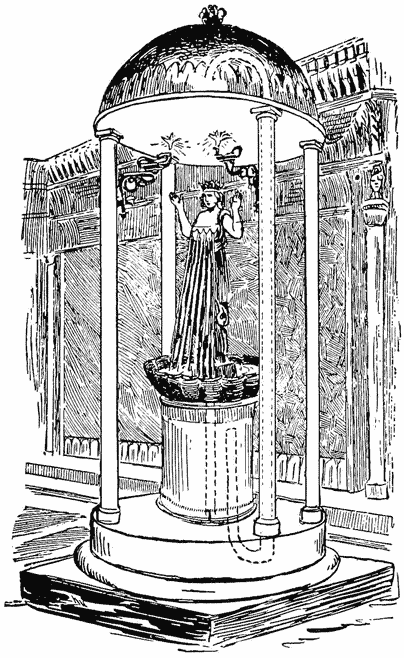
THE MIRACULOUS STATUE OF CYBELE.
The Jesuit savant possessed in his museum an apparatus which probably came from some ancient Egyptian temple. It consisted of a hollow hemispherical dome supported by four columns, and placed over the image of the goddess of the numerous breasts. To two of the columns were adjusted movable holders, upon which lamps were fixed. The hemisphere was hermetically closed beneath by a metallic plate. The small altar, into which the milk was poured, communicated with the interior {10} of the statue by a tube reaching nearly to the bottom; it was also connected with the hollow dome by a tube having a double bend. At the moment of sacrifice, the two lamps, which were turned by means of movable holders directly beneath the lower plate of the dome, were lighted, thereby causing the air inclosed in the dome to expand. This expanded air, passing through the tube, pressed upon the milk shut within the altar, forcing it to ascend the straight tube into the interior of the statue and up to the height of the breasts of the goddess. A series of little ducts, branching off from the principal tube, conveyed the liquid into the breasts. From these mammary glands of bronze the {11} lacteal fluid streamed out, to the great admiration of the spectators, who believed that a miracle had taken place. When the sacrifice was finished, the lamps were extinguished by the attendant priest of the shrine, and the milk ceased to flow.
There were many other mechanical devices of great interest, such as the miraculous vessels used in the temples of Egypt and Greece, and the apparatus that formed part of the Grecian puppet-shows and other theatrical performances; but these hardly come within the scope of this chapter. Philo of Byzantium and Heron of Alexandria both left exhaustive treatises on the mechanic arts as understood by the ancients. Philo’s work has unfortunately been lost, but Heron’s treatise has a world of interest to anyone who is attracted to the subject.
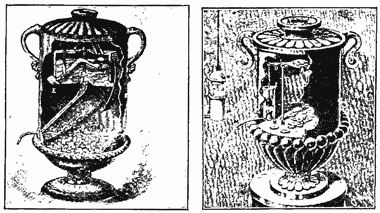
A RECENTLY PATENTED SLOT MACHINE ALMOST IDENTICAL WITH HERON’S WATER-VESSEL LUSTRAL WATER-VESSEL DESCRIBED BY HERON ABOUT 100 B.C.
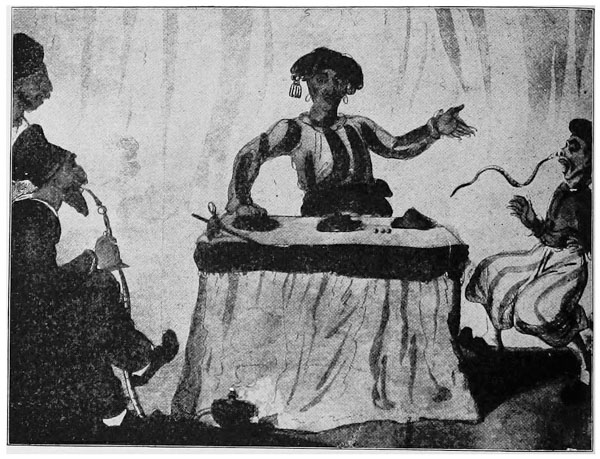
O
RIENTAL
C
ONJURER
P
ERFORMING
THE
C
UP-AND
-B
ALL
T
RICK,
WITH
S
NAKE
E
FFECT
I
NTRODUCED.
From an old and rare book called The Universal Conjurer or the Whole Art as Practised by the Famous Breslaw, Katerfelto, Jonas, Flockton, Conus, and by the Greatest Adepts in London and Paris, etc. London.
(From the Ellison Collection, New York.)
Besides the miracle-mongers of antiquity there were also cup-and-ball conjurers, who were called “acetabularii,” from the Latin word acetabulum, which means a cup, and professors of natural magic in general who laid no claim to supernatural powers. They wandered from place to place, giving their shows. The grammarian, Athenæus, in his Deipnosophists, or “Banquet of the Learned” (A. D. 228), mentions a number of famous conjurers and jugglers of Greece. He says: “The people of Histiæa and of Oreum erected in their theatre a brazen statue holding a die in its hand to Theodorus the juggler.” Xenophon, the conjurer, was very popular at Athens. He left behind him a pupil named Cratisthenes, “a citizen of Phlias; a man who {12} used to make fire spout up of its own accord, and who contrived many other extraordinary sights, so as almost to make men discredit the evidence of their own senses. And Nymphodorus, the conjurer, was another such man. . . . And Diopeithes, the Locrian, according to the account of Phanodemus, when he came to Thebes, fastened round his waist bladders full of wine and milk, and then, squeezing them, pretended that he was drawing up those liquids out of his mouth. And Noëmon gained a great reputation for the same sort of tricks. . . . There were also, at Alexander’s court, the following jugglers who had a great name: Scymnus of Tarentum, and Philistides of Syracuse, and Heraclitus of Mitylene.” (Deipn. Epit., B. 1, c. 34, 35.)
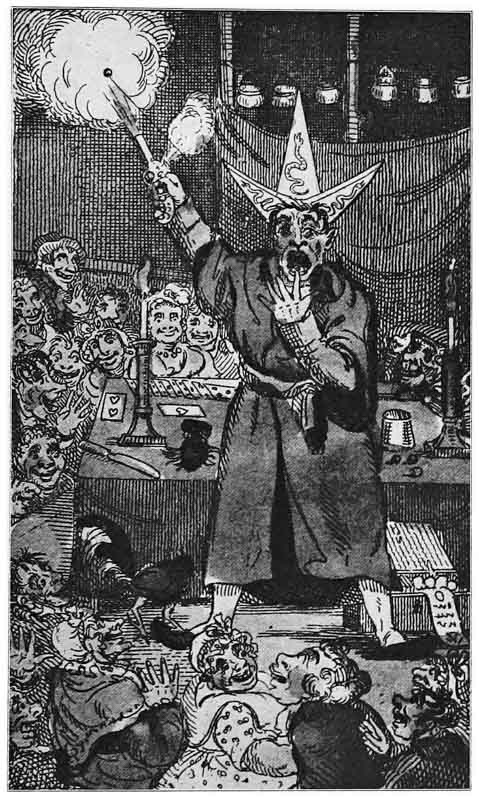
C
ONJUROR
P
ULLING
A
T
OOTH
BY
P
ISTOL.
From a rare book called The Whole Art of Hocus Pocus, Containing the Most Dexterous Feats of Sleight-of-hand Performed by Katerfelto, Breslaw, Boas, etc. London, 1812. (From the Ellison Collection, New York.)
{13}
II.
In the Middle Ages the art of magic was ardently cultivated, in spite of the denunciations of the Church. Many pretenders to necromancy made use of the secrets of optics and acoustics, and gained thereby a wonderful reputation as genuine sorcerers. Benvenuto Cellini, sculptor, goldsmith and man-at-arms, in that greatest of autobiographies,5 records a magical seance which reads like a chapter from the Arabian Nights.
He says: “It happened through a variety of singular accidents that I became intimate with a Sicilian priest, who was a man of very elevated genius and well instructed in both Latin and Greek letters. In the course of conversation one day, we were led to talk about the art of necromancy, à propos of which I said: ‘Throughout my whole life I have had the most intense desire to see or learn something of this art.’ Thereto the priest replied: ‘A stout soul and a steadfast must the man have who sets himself to such an enterprise.’ I answered that of strength and steadfastness of soul I should have enough and to spare, provided I found the opportunity. Then the priest said: ‘If you have the heart to dare it, I will amply satisfy your curiosity.’ Accordingly we agreed upon attempting the adventure.
“The priest one evening made his preparations, and bade me find a comrade, or not more than two. I invited Vincenzio Romoli, a very dear friend of mine, and the priest took with him a native of Pistoja, who also cultivated the black art. We went together to the Colosseum; and there the priest, having arrayed himself in necromancers’ robes, began to describe circles on the earth with the finest ceremonies that can be imagined. I must say that he had made us bring precious perfumes and fire, and also drugs of fetid odor. When the preliminaries were completed, he made the entrance into the circle; and taking us by the hand, introduced us one by one inside of it. Then he assigned our several functions; to the necromancer, his comrade, he gave the pentacle to hold; the other two of us had to look after the fire and the perfumes; and then he began his incantations. This {14} lasted more than an hour and a half, when several legions appeared and the Colosseum was all full of devils. I was occupied with the precious perfumes, and when the priest perceived in what numbers they were present, he turned to me and said: ‘Benvenuto, ask them something.’ I called on them to reunite me with my Sicilian Angelica.”
It seems the spirits did not respond. The magic spells were found inoperative, whereupon the priest dismissed the demons, observing that the presence of a pure boy was requisite to the successful accomplishment of the séance.
Another night Cellini and the sorcerer repaired to the ruins of the Colosseum. The artist was accompanied by a boy of twelve years of age, who was in his employ, and by two friends, Agnolino Gaddi and the before-mentioned Romoli. The necromancer, after describing the usual magic circle and building a fire, “began to utter those awful invocations, calling by name on multitudes of demons who are captains of their legions . . . ; insomuch that in a short space of time the whole Colosseum was full of a hundredfold as many as had appeared upon the first occasion.” At the advice of the wizard, Cellini again asked to be reunited with his mistress. The sorcerer turned to him and said: “Hear you what they have replied; that in the space of one month you will be where she is.” The company within the magic circle were now confronted by a great company of demons. The boy declared that he saw four armed giants of immense stature who were endeavoring to get within the circle. They trembled with fear. The necromancer, to calm the fright of the boy, assured him that what they beheld was but smoke and shadows, and that the spirits were under his power. As the smoke died out, the demons faded away, and Cellini and his friends left the place fully satisfied of the reality of the conjurations. As they left the Colosseum, the boy declared that he saw two of the demons leaping and skipping before them, and often upon the roofs of the houses. The priest paid no attention to them, but endeavored to persuade the goldsmith to renew the attempt on some future occasion, in order to discover the secret treasures of the earth. But Cellini did not care to meddle more in the black art. {15}
What are we to believe about this magic invocation? Was Cellini romancing? Though a vainglorious, egotistical man, he was truthful, and his memoirs may be relied on.
John Addington Symonds, one of the translators of Cellini’s autobiography, remarks: “Imagination and the awe-inspiring influences of the place, even if we eliminate a possible magic lantern among the conjurer’s appurtenances, are enough to account for what Cellini saw. He was credulous; he was superstitious.”
Sir David Brewster, who quotes Cellini’s narrative in his Natural Magic, explains that the demons seen in the Colosseum “were not produced by any influence upon the imaginations of the spectators, but were actual optical phantasms, or the images of pictures or objects produced by one or more concave mirrors or lenses. A fire is lighted and perfumes and incense are burnt, in order to create a ground for the images, and the beholders are rigidly confined within the pale of the magic circle. The concave mirror and the objects presented to it having been so placed that the persons within the circle could not see the aerial image of the objects by the rays directly reflected from the mirror, the work of deception was ready to begin. The attendance of the magician upon his mirror was by no means necessary. He took his place along with the spectators within the magic circle. The images of the devils were all distinctly formed in the air immediately above the fire, but none of them could be seen by those within the circle.
“The moment, however, the perfumes were thrown into the fire to produce smoke, the first wreath of smoke that rose through the place of one or more of the images would reflect them to the eyes of the spectators, and they would again disappear if the wreath was not followed by another. More and more images would be rendered visible as new wreaths of smoke arose, and the whole group would appear at once when the smoke was uniformly diffused over the place occupied by the images.”
Again, the magician may have been aided by a confederate amid the ruins, who manipulated a magic lantern, or some device of the kind. The magician himself may have been provided with a box fitted up with a concave mirror, the lights and figures of {16} the demons. The assertion of the boy that he saw demons skipping in front of him, etc., would be accounted for by the magic box being carried with them.
Says the Encyclopaedia Britannica, in speaking of Cellini’s adventure: “The existence of a camera at this latter date (middle of sixteenth century) is a fact, for the instrument is described by Baptista Porta, the Neapolitan philosopher, in the Magia Naturalis (1558). And the doubt how magic lantern effects could have been produced in the fourteenth century, when the lantern itself is alleged to have been invented by Athanasius Kircher in the middle of the seventeenth century, is set at rest by the fact that glass lenses were constructed at the earlier of these dates,—Roger Bacon, in his Discovery of the Miracles of Art, Nature and Magic (about 1260), writing of glass lenses and perspectives so well made as to give good telescopic and microscopic effects, and to be useful to old men and those who have weak eyes.”
Chaucer, in the House of Fame, Book III, speaks of “appearances such as the subtil tregetours perform at feasts”—images of hunting, falconry and knights jousting, with the persons and objects instantaneously disappearing.
Later on Nostradamus conjured up a vision of the future king of France in a magic mirror, for the benefit of Marie de Medeci. This illusion was effected by mirrors adroitly concealed amid hanging draperies.
In the sixteenth century conjurers wandered from place to place, exhibiting their tricks at fairs, in barns, and at the castles of noblemen. They were little more than strolling gypsies or vagabonds. Reginald Scott, in his Discoverie of Witchcraft (1584), enumerates some of the stock feats of these mountebanks. The list includes, “swallowing a knife; burning a card and reproducing it from the pocket of a spectator; passing a coin from one pocket to another; converting money into counters, or counters into money; conveying money into the hand of another person; making a coin pass through a table or vanish from a handkerchief; tying a knot and undoing it ‘by the power of words’; taking beads from a string, the ends of which are held fast by another person; making a coin to pass from one box to another; turning wheat into flour ‘by the power of {17} words’; burning a thread and making it whole again; pulling ribbons from the mouth; thrusting a knife into the head of a man; putting a ring through the cheek, and cutting off a person’s head and restoring it to its former position.”
Conjuring with cups and balls belongs to this list.
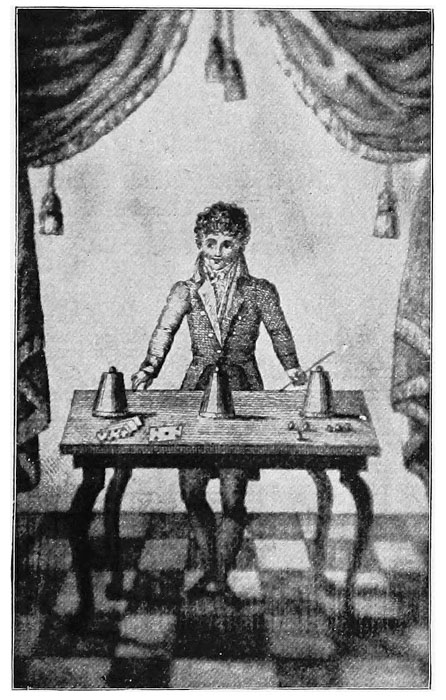
E
IGHTEENTH
C
ENTURY
C
ONJURER
P
ERFORMING
THE
C
UP-AND
-B
ALL
T
RICK.
(From an Old Print, Ellison Collection.)
The conjurer of the sixteenth century, and even of later date, wore about his waist a sort of bag, called gibécière, from its resemblance to a game bag, ostensibly to hold his paraphernalia. While delving into this bag for various articles to be used in his tricks, the magician succeeded in making substitutions and secretly getting possession of eggs, coins, balls, etc. It was a very clumsy device, but indispensable for an open-air {18} performer, who usually stood encircled by the spectators. Finally, the suspicious-looking gibécière was abandoned by all save strolling mountebanks, and a table with a long cloth substituted. This table concealed an assistant, who made the necessary transformations required in the act, by means of traps and other devices. Comus, the elder, in the eighteenth century, abandoned the long table covers and the concealed assistant for the servante. But his immediate competitors still adhered to the draped tables, and a whole generation of later conjurers, among whom may be mentioned Comte, Bosco and Phillippe, followed their example. Robert-Houdin struck the keynote of reform in 1844. He sarcastically called the suspiciously draped table a boite à compère (wooden confederate).
Conjurers in the seventeenth century were frequently known as Hocus Pocus. These curious words first occur in a pamphlet printed in 1641, in which the author, speaking of the sights of Bartholomew fair, mentions “Hocus Pocus, with three yards of tape or ribbon in his hand, showing his art of legerdemain.” The seventeenth century is the age of the strolling mountebank, who performed wherever he could get an audience—in the stable, barnyard, street or fair. From him to the prestidigitateur of the theatre is a long step, but no longer than from the barnstorming actor to the artist of the well-appointed playhouse. There is evolution in everything. It was not until the eighteenth century that conjuring became a legitimate profession. This was largely owing to the fact that men of gentle birth, well versed in the science of the age, took up the magic wand, and gave the art dignity and respectability.
It was not until the eighteenth century that natural magic was shorn of charlatanism, but even then the great Pinetti pretended to the occult in his exhibition of so-called “second sight.” He always avoided the Papal States, taking warning from the fate of Cagliostro. Magic and spiritism were in bad odor in the dominions of the Pope. Towards the middle of the century we hear of Jonas, Carlotti, Katerfelto, Androletti, Philadelphia, Rollin, Comus I and II. Comus II was famous for coining hard words. He advertised in London, “various uncommon experiments with his Enchanted Horologium, Pyxidees Literarum, {19} and many curious operations in Rhabdology, Steganography and Phylacteria, with many wonderful performances on the grand Dodecahedron, also Chartomantic Deceptions and Kharamatic Operations. To conclude with the performance of the Teretopaest Figure and Magical House; the like never seen in this kingdom before; and will astonish every beholder.” These magical experiments were doubtless very simple. What puzzled the spectators must have been the names of the tricks.
Rollin, a Frenchman, after accumulating a fortune, purchased the chateau of Fontenoy-aux-Roses, in the department of the Seine. He was denounced under the Red Terror, and suffered death by the guillotine, in 1793. When the warrant for his execution was read to him, he remarked, with a smile, “That is the first paper I cannot conjure away.”
III.
I now come to the Count Edmond de Grisy, Pinetti’s great rival in the field of conjuring.
The duel for supremacy between these eminent magicians is told in the chapter on Pinetti. The father of De Grisy, the Count de Grisy, was killed at the storming of the Tuilleries, while defending the person of his king, Louis XVI, from the mob. Young De Grisy was in Paris at the time, and, profiting by the disorders in the capital, was enabled to pass the barriers and reach the small family domain in Languedoc. Here he dug up a hundred louis, which his father had concealed for any unforseen accident; to this money he added some jewels left by his mother. With this modest sum, he proceeded to Florence, where he studied medicine, graduating as a physician at the age of twenty-seven. He became a professional magician, and had an adventure at Rome which is well worth relating. He was requested to perform before Pius VII, and ransacked his brains to devise a trick worthy of a Pope. On the day before the mystic séance he happened to be in the shop of a prominent watchmaker, when a lackey came in to ask if His Eminence the Cardinal de ’s watch was repaired. {20}

“It will not be ready until this evening,” answered the watchmaker. “I will do myself the honor of personally carrying it to your master.”
The lackey retired.
“That is a handsome watch you have there,” said De Grisy.
“Yes,” replied the jeweler, “it is valued at more than ten thousand francs. It was made by the celebrated Bréguet. Strangely enough, the other day I was offered a similar timepiece, by the same artist, for one thousand francs.”
“Who was he?” asked the Count.
“A young prodigal and gambler, belonging to a noble family, who is now reduced to selling his family jewels.”
Like a flash of lightning, a scheme for working a splendid mystification passed through De Grisy’s mind. He nonchalantly said:
“Where is this young rake to be found?”
“In a gaming house, which he never quits.”
“Well, then, I will buy this masterpiece of Bréguet’s. Have the kindness to purchase it for me, and engrave upon it the Cardinal’s coat-of-arms, so that it will be a replica of His Eminence’s chronometer.”
The jeweler, assured of De Grisy’s discretion and honor, though probably suspecting the use to which the timepiece would be subjected, immediately left his shop, and returned after a little while with the gambler’s watch.
“Here it is,” he cried. “To-night I shall have it ready for you.”
At the appointed hour he brought the two watches for De Grisy’s inspection. They were facsimiles. The conjurer took his purchase, and the next day appeared at the pontifical palace, where a most distinguished audience greeted him. The Pope sat on a raised dais; near him were the cardinals in their brilliant robes of crimson.
After performing a series of magical feats, De Grisy came to his pièce de résistance. The difficulty was to obtain the loan of the Cardinal’s watch, and that without asking him directly for it. To succeed the conjurer had recourse to a ruse. At his {21} request several watches were offered to him, but he returned them as not suited to the experiment.
“I desire a timepiece that will be easily identified. I should prefer one of rather large size,” said De Grisy.
“Cardinal,” said His Holiness, “oblige me by lending your watch to M. de Grisy.”
With great reluctance the Cardinal de handed his precious chronometer to the conjurer. It seems he set great value on its exaggerated size, alleging, with considerable show of reason, that the works acted better in a large case.
In order to prove the solidity and excellence of the chronometer, De Grisy let it fall to the ground. A cry of alarm arose on all sides. The Cardinal, pale with rage, bounded from his chair, exclaiming: “This is a sorry jest, sir!”
“Do not be alarmed, monsignor,” said De Grisy, “the watch will escape scathless from its many trials.” He handed the broken timepiece to the Cardinal. “Do you recognize this as your watch?”
The prelate gazed anxiously at the coat-of-arms engraved inside of the case, and replied, with a profound sigh:
“Yes, that is my watch.”
“You are certain of it?”
“Quite certain! But I seriously doubt your power to restore it.”
“We shall see!” said the conjurer.
De Grisy’s assistant now brought in a brass mortar and pestle. The watch was cast into the mortar and pounded to atoms. Some magic powder was poured into the receptacle and a torch applied. There was a detonation, followed by a cloud of smoke. The spectators were invited to examine the ingot of gold—all that remained of the precious chronometer. Pius VII peered curiously into the mortar. De Grisy, seizing the opportunity, adroitly popped the duplicate timepiece into a pocket of the Pope’s robe. At the proper moment he pretended to pass the ingot into the pontiff’s pocket, which resulted in the discovery of the Cardinal’s watch, made whole again. This clever trick created a great sensation in Rome, and drew crowds to De Grisy’s performances. Poor De Grisy seemed doomed to {22} misfortune. His young son was killed accidentally by a spectator, during an exhibition of the pistol trick at Strasburg. A real bullet got mixed up with the false bullets, and was loaded into the weapon. De Grisy was tried and convicted of “homicide through imprudence,” and sentenced to six months’ imprisonment, during which time his wife died. On his release, he assumed the name of Torrini, which was that of his brother-in-law and faithful assistant. He retired to the provinces of France, and never appeared again in the large cities. He died a brokenhearted man at Lyons.
Torrini was a skillful performer with cards, as Robert-Houdin testifies. He invented a trick which he called “The Blind Man’s Game of Piquet.” While blindfolded he would play piquet and defeat adepts at the game. This trick was one of the features of his entertainments, and always gained him great applause. The secret consisted in substituting a prepared pack for the ordinary pack used. After the spectator had shuffled the cards and handed them to Torrini to cut, the conjurer would rest his hand momentarily upon the pack, while he made some observation to his opponent. Then it was that the substitution was artfully effected by means of a “magic box,” which the prestidigitateur had concealed in the sleeve of his coat. Pressure upon the table caused a spring in the box to shoot out a prepared pack of cards, while a pair of pincers at the same time seized the recently shuffled pack and drew it up into the hidden receptacle. This ingenious piece of apparatus Torrini had obtained from a gambler named Zilbermann.
While attempting to cheat an opponent, the apparatus had hung fire, and Zilbermann was detected in flagrante delicto. A duel was the result, and Zilbermann was mortally wounded. He sent for Torrini, whose conjuring abilities he greatly admired, and presented him with the box. Soon afterwards he died.
Torrini never used the apparatus except in his conjuring performances. He was a man of honor and not a chevalier d’industrie.