DESCRIPTION OF NEW SPECIES OF STRATIOMYIDAE WITH NOTES ON OTHERS.
Reading edition
Jas. S. Hine.
In a collection of several species of Stratiomyidae from Ohio, and a number of western species, I find something which may be of interest to students of the family.
Specimens of Allognosta fuscitarsis, Say, show some degree of variation in the extent of the pale color on the disc of the abdomen. Some of the females have the abdomen nearly or wholly black. Specimens of A. obscuriventris, Loew, have the body entirely black; the legs are darker and the form is considerably smaller than fuscitarsis. Both species are common at Columbus during May.
Ptecticus (Sargus) trivittatus, Say.
A species of Ptecticus taken abundantly at Cincinnati by Chas. Dury agrees so well with Say’s Sargus trivittatus that I cannot convince myself that it is anything else. Specimens when first taken agree more closely with Say’s description than the same specimens do after they have been in the cabinet awhile and have become dry. The green color that Say mentions is present in some while others are yellowish or brownish. The broad, dusky band that Say described as appearing on the basal part of each abdominal segment beyond the second is conspicuous, being of greatest extent on the fifth and sixth.
Euparyphus major n. sp.
Female, length 9mm. Head yellow; vertex, a wide stripe from vertex to mouth, widened at antennae and spreading out on the cheeks in the region of the mouth, antennae and occiput, black; eyes hairy. Thorax shining; apical two-thirds of scutellum including the spines, an irregular spot each side between the scutellum and base of the wing, four longitudinal lines abbreviated behind, a triangular spot before the base of the wing, and two spots beneath it, bright yellow. There is also a minute yellow spot on each side of the thorax posterior to the lower corner of the eye, the yellow markings on the disc of the thorax extend for one-fifth of their length behind the transverse suture, while those on the sides extend from the humerus to the transverse suture. The femora except at base and apex are black, and the last three tarsal joints are brown, remaining parts of the legs are yellow; wings hyaline, veins dull yellow, halteres bright yellow. Abdomen black; a spot under the scutellum, a spot each side on the lateral part of the second segment, 113an elongate oblique band nearly meeting its fellow of the opposite side of each of the third and fourth segments, and apex, yellow. On the venter the hind margins of the third and fourth segments are yellow for their entire width, nearly the whole of the middle part of the second segment and a narrow band on the posterior margin of the first segment are also yellow. The lateral margins of the segments of the abdomen are black between the yellow markings, and there is no connection between the yellow markings on the abdomen.
A female specimen taken by E. J. Oslar at Boulder, Colorado, August 19, 1899.
In many respects this species agrees with Osten Sacken’s decem-maculatus, but it cannot be that species as the markings are very different. Aside from the hairy eyes it appears to belong to Euparyphus. The third joint of the antennae is composed of six rings with the last ring the longest. The fifth posterior cell meets the discal and its general form agrees very closely with bellus and tetraspilus.
Akronia n. gen. (Fig. 1.)
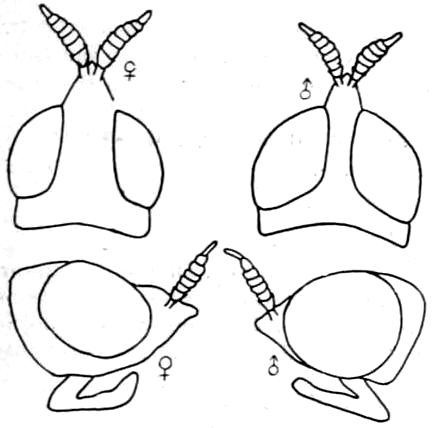
Fig. 1.
Head conically produced. Front in the female noticeably wider than the eye, in the male about half as wide as in the female. Antennae three-jointed, first and second joints about equal in length, third much longer than the other two together and composed of six rings. Posterior orbits wide in both sexes, but widest in the female, scutellum without spines, four posterior veins arising from the discal cell, abdomen short and broad, nearly circular in outline.
Named for Akron, Ohio, in which vicinity I have procured many rare species.
Akronia frontosa n. sp.
Length 4–4½ mm. Dull black, sparsely clothed with very short, light-colored hair; eyes widely separated in both sexes, naked; antennae entirely in front of the eyes; front produced more in the female than in the male, posterior orbits present in both sexes, widest in the female; thorax nearly equally four-sided, scutellum without spines, wings hyaline, veins bounding costal, basal, marginal, and 114first and second sub-marginal cells heavy and dark colored; discal cell rather small emitting four posterior veins; legs black, knees and tarsi lighter colored than the other parts; abdomen short and wide. Five males and four females taken at Hawkins, near Akron, Ohio, May 21, 1899.
This is so distinct from species of Nemotelus in general appearance, and structure of the head, especially in the male, that it seems best to make it the type of a new genus.
Chrysochroma nigricornis Loew.
This is a common species in southern Ohio. Specimens may be found resting on the upper side of leaves and are easily approached. In the female the white fronted line which Loew mentions is very conspicuous and extends from one eye to the other above the antennae. In some specimens the white lateral, thoracic lines are very easily seen, but in others these lines are brownish. The male has much the appearance of the female, the eyes are broadly contiguous, leaving a small vertical triangle which is largely occupied by the ocelli; the lateral thoracic lines in this sex are dark brown and therefore are not such a contrast to the bright green thorax as in the female.
I had some trouble in locating the genus of this species by Dr. Williston’s key. The species is not elongate, but of much the same form as Microcrysa polita. A comparison was made with the type.