A COMPARATIVE STUDY OF GOMPHUS FURCIFER AND VILLOSIPES.
Reading edition
James S. Hine.
It seems that nearly every author who has considered these two species has compared them. Considering general appearances they are much alike but can be separated easily by several details and as I have good material of both sexes of the two species before me, I thought it might be of consequence to consider in a comparative way some of their characteristics.
The occiput in both sexes of villosipes bears a prominent tooth at the middle of its upper edge. This tooth varies some in different specimens, it ends above in a single point or it may be widened and end above in three or more points. In furcifer there is no tooth on the occiput in either sex.
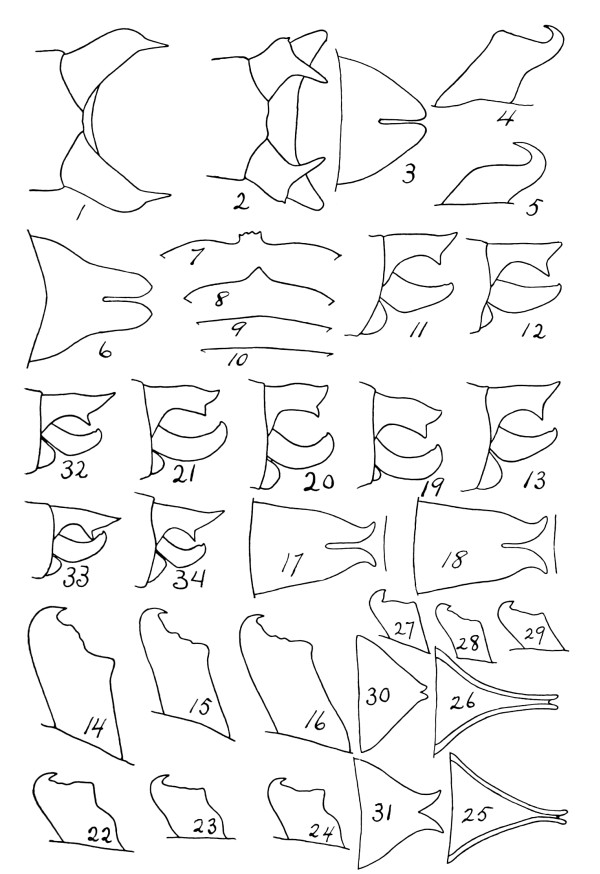
The vulvar scales are very different, in villosipes the part may be said to be triangular with the free sides curved and the apical part divided for about half the length of the scale. In furcifer its basal part is similar but the apical part is produced, giving quite a different form. In the former species the scale is about one-third as long as the ninth segment, while in the latter it is about three-eighths as long as that segment.
The abdominal appendages of the male are different. From dorsal view those of furcifer are rectangular with the inner distal angle very much produced inward and backward; in villosipes they are wide at base, oblong, with the outer distal part broadly rounded and the corresponding inner part produced directly backward. The hamules are characteristic and may be explained best by reference to the figures.
The two species are colored much alike but furcifer is darker. The tenth abdominal segment may be said to be yellow in both but in furcifer the sides of the segment are dark, oftentimes black.
They agree in habits, both preferring to fly over stagnant water where the males come to rest on floating objects or on the ground at the water’s edge. I have observed the female of furcifer ovipositing in stagnant water among lily pads and other aquatic plants. Her flight is slow while thus engaged, and her actions more like a Libellula than the usual Gomphus.
EXPLANATION OF PLATE.
Gomphus villosipes—1, dorsal view of male appendages; 3, vulvar scale; 5, hamule; 7, occiput of female; 8, occiput of male.
Gomphus furcifer—2, dorsal view of male appendages; 4, hamule; 6, vulvar scale; 9, occiput of male; 10, occiput of female.
Gomphus viridifrons—11, 12, 13, dorsal view of male appendages—13 from Pa., 11, 12 from Ohio; 14, 15, 16, hamules; 17, 18, vulvar scales—18 from Pennsylvania, 17 from Ohio.
Gomphus brevis—19, 20, 21, dorsal view of male appendages—specimens from Maine and Pennsylvania; 22, 23, 24, hamules; 25, 26, vulvar scales.
Gomphus abbreviatus—27, 28, 29, hamules; 30, 31, vulvar scales; 32, 33, 34, dorsal view of male appendages—specimens all from Maine.
Plate 5.
HINE—GOMPHINE STUDIES.