Chapter VIII
Reading edition
ACALEPHÆ, OR SEA NETTLES.
"In nova fert animus mutatis dicere formas corpora."—Ovid, Met.
The class Acalephæ, from ἀκαλήφη, a nettle, so called from the stinging properties which many of them possess, include a great number of radiate animals of which the Medusæ are the type. They form the third class of Cuvier's zoophytes. The Acalephæ, forming the first order, are characterised as floating and swimming in the sea by means of the contraction and dilation of their bodies, their substance being gelatinous, without apparent fibres.
The great genus Medusa is characterised by having a disk, more or less convex above, resembling a mushroom or expanded umbrella—the edges of the umbrella, as well as the mouth and suckers, being more or less prolonged into pedicles, which take their place in the middle of the lower surface; they are furnished with tentacula, varying in form and size, which have given rise to many subdivisions, with which we need not concern ourselves.
The substance of the disk presents an uniform cellular appearance internally, but the cellular substance being very soft, no trace of fibre is observable. Taken from the sea and laid upon a stone, a Medusa weighing fifty ounces will rapidly diminish to five or six grains, sinking into a sort of deliquescence, from which Spalanzani concluded that the sea-water penetrated the organic texture of its substance, and constituted the principal volume of the animal. Those which have cilia round their margins have also cellular bands running along their bases, and most of the projectile and extensile tentacula and filaments have sacs and canals containing fluids at their roots. Suckers are also found at the extremities, and along the sides of these tentacles in several genera are suckers, by which they are able more securely to catch their floating prey, or to anchor themselves when at rest. The indications of nerves or nervous system are too slight to be received as evidence, although Dr. Grant observed some structure which he thought could only belong to a nervous system, and Ehrenberg thought he observed eyes in Medusa aurita, as well as a nervous circle formed of four ganglion-like masses disposed round the mouth. But most naturalists seem to be of opinion that touch is the only sense of which any conclusive proof can be advanced.
Here we behold a class of bell-shaped semi-transparent organisms, which float gracefully in the sea—a great family of soft, wandering animals, constituted in a most extraordinary manner. They look like floating umbrellas, breeches, or, better still, floating mushrooms, the footstalk replaced by an equally central body, but divided into divergent lobes at once sinuous, twisted, and fringed, so that one is at first tempted to take them for a species of root. The edges of the umbrella or mushroom are entire or dentate, sometimes elegantly figured, often ciliate, or provided with long filiform appendages which float vertically in the water.
Sometimes the animal is uncoloured, and limpid as crystal; sometimes it presents a slightly opaline appearance, now of a tender blue, or of a delicate rose colour; at other times it reflects the most brilliant and vivid tints.
In certain species the central parts only are coloured, showing brilliant reds and yellows, blues or violets, the rest being colourless. In others the central mass seems clothed in a thin iridescent or diaphanous veil, like the light evanescent soap-bubble, or the transparent glass shade which covers a group of artificial flowers.
The Acalephæ are animals without consistence, imbued with much water, so that we can scarcely comprehend how they resist the agitation of the waves and the force of the currents; the waves, however, float without hurting them, the tempest scatters without killing them. When the sea retires, or they are withdrawn from their native waters, their substance dissolves, the animal is decomposed, they are reduced to nothing; if the sun is ardent, this disorganisation occurs in the twinkling of an eye, so to speak.
When the Medusæ travel, their convex part is always kept in advance, and slightly oblique. If they are touched while swimming, even lightly, they contract their tentacula, fold up their umbrella, and sink into the sea. Like Ehrenberg, M. Kölliker thought he discovered visual and auditory organs in an Oceania, and Gegenbauer thought he detected them in other genera, such as Rhizostoma and Pelagia. The eyes are said to consist of certain small, hemispherical, cellulose, coloured masses, in which are sunk small crystalline globules, the free parts of which are perfectly naked. The supposed auditory apparatus is seated close to these organs; they are small vesicles filled with liquid; the eyes having neither pupil nor cornea, and the ears without opening or arch.
But it is in their reproduction that these evanescent beings present the most marvellous phenomena. At one period of the year the Medusæ are charged with numbers of very minute eggs, of the most lively colours, which are suspended in large festoons from their floating bodies. In some cases these eggs develop themselves grafted to their bodies, and are only detached at maturity. In other cases the larvæ produced bear no resemblance to the mother; they are elongated and vermiform, broad at their extremity; we speak of the microscopic leeches, which have vibrating cilia, scarcely perceptible, by which they execute the most lively motions. At the end of a certain time they are transformed into polyps, and furnished with eight tentacula. This preparatory sort of animal seems to possess the faculty of reproduction by means of certain buds or tubercles which develop themselves on the surface of the body, and also by filaments which start up here and there, so that a single individual originates a numerous colony. This polyp is subjected to a transformation still more remarkable; its structure becomes complex, its body articulate, and it seems to be composed of a dozen disks piled one upon the other, like the jars of a voltaic pile; the upper disk is convex, and is separated from the colony after a convulsive effort; it becomes free, and an excessively small, star-like Medusa is the result; every disk, that is, every individual, is isolated one after the other in the same manner.
Thus of the sexual zoophytes which propagate their kind according to the usual laws; but others engender young which have no resemblance to the parent zoophyte at all: in this respect they are neuter, that is, non-sexual, or agamous. These are produced by budding, or fissiparity, from individuals like themselves. They can also give sexual distinctions; but before this change takes place the creature, which was simple, is transformed into a composite animal, and it is from its disaggregation that individuals having sexual organs are produced, the process being that which has been called alternate generation. It goes on in a perfectly regular manner, although it is a fact that the young never resemble their mothers, but their grandmothers.
This great family of Zoophytes Gosse divides into—
Discophora, having the body in the form of a circular disk, more or less convex and umbrella-shaped, moving by alternate contractions and expansions of the disk.
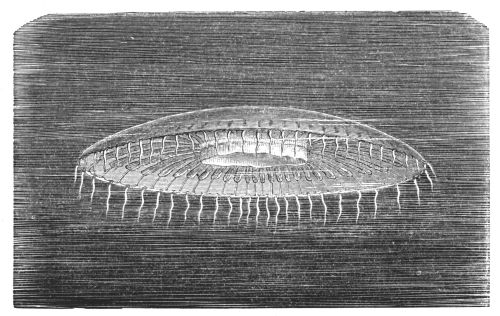
Fig. 84. æquerea violacea, natural size (Milne Edwards).
Ctenophora, body cylindrical, moving by means of many parallel rims of cilia set in longitudinal lines on the surface.
Sophonophora, body irregular, without central digestive cavity like the others, having sucking organs, and moving by means of a contractile cavity, or by air-vessels.
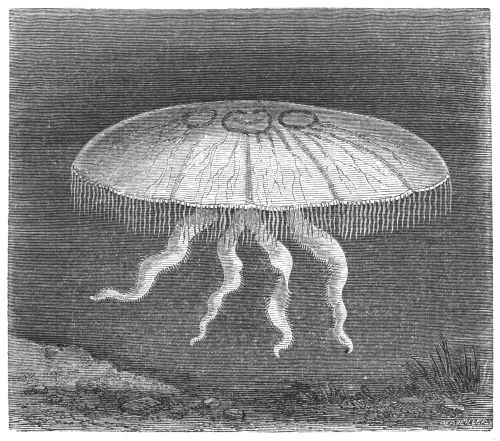
Fig. 85. Aurelia aurita (Lamarck). Cyanea aurita (Cuvier). One-third natural size.
The Discophora are again subdivided into Gymnophthalmata, having the eye-specks uncovered or wanting, a great central digestive cavity, circulating vessels proceeding to the margin quite simple or branched; and Steganophthalmata having the eye-specks protected by membranous hoods, or lobed coverings, circulating vessels much ramified, and united with a network. Of the Gymnophthalmata we have an example in æquerea violacea (Fig. 84), in which the disk is slightly convex, glass-like in appearance, and furnished all round with very short, slender, thread-like, violet-coloured tentacula; with circulating vessels, eight in number, quite simple, and ovaries placed on them; peduncle wide, expanding into many broad and long fringed lobes. The Steganophthalmata include the Medusadæ proper, in which the umbel is hemispherical, with numerous marginal tentacles, eight eyes covered by lobes, four ovaries, four chambers, four fringed arms, with a central and four lateral openings. Aurelia aurita (Fig. 85) is here represented as a type of the group; it is plentiful in the Baltic, and has been carefully studied by the Swedish naturalists. Rosenthal has made its anatomy his special study. Sars has also made it the subject of observations. In the same group we find the Pelagia cyanella of Péron, whose body is globose, scolloped with eight marginal tentacles, peduncles ending in four leaf-like, furbelowed arms, united at the base, having four ovaries, and appendages to the stomach, without orifices.
The Pelagia, as the name implies, belong to the deep sea. P. noctiluca has a transparent, glass-like disk, of a reddish-brown colour and warty appearance. It is found in the Mediterranean, about the coast near Nice, and is still more plentiful on the coast of Sicily, and on the African coast. Another species, P. panopyra, is very common in the Atlantic and Pacific, between the Tropics. The naturalist Lesson met whole banks of them in the equatorial ocean, about the twenty-seventh degree north latitude and the twenty-second degree west longitude. During the night, this species emits a brilliant phosphoric light, and living individuals, which Lesson succeeded in preserving, exhibited great luminosity in the dark. This medusa is remarkable for its semi-spherical disk, slightly depressed, umbilicate at the summit, a little compressed at the edges, and densely bristling on the surface with small elongated warts, but regularly festooned along the edges. In colour it is a delicate rose.
The animals which constitute this class of Zoophytes, and, in former times, so curious and so imperfectly known, were designated Polypomedusæ, in order to remind us that at one time they were called Medusæ, and at others ranged among the Polyps. It has, however, been recently discovered that, shortly after they issue from the egg, these zoophytes show themselves in the form of polyps, and that, at a later period, they assume the animal form, to which we give the name of medusæ. These animals are, then, true proteans: hence the very considerable difficulty of studying them—difficulties which have long reduced naturalists to despair. Even now their history is too obscure and too complicated to justify us in presenting it, except in its general features. We shall, therefore, content ourselves here with a description of the best known species of the class only—those, namely, which have particularly attracted the attention of naturalists, and which are, at the same time, of a nature to interest our readers.
The class of Discophoræ may be divided into four orders or families, namely:—
I. The Hydraidæ, having single, naked, gelatinous, sub-cylindrical, but very contractile
stems, mutable in form, mouth encircled with a single series of granulous filiform tentacula.
II. Sertulariadæ, plant-like and horny, rooted and variously branched, filled with semi-fluid organic pulp, the polyps contained within sessile cells disposed along the sides of the main stem or branchlets, but never terminal.
III. Medusadæ. Umbel hemispherical, with marginal tentacula; having eight eyes covered by lobes, four ovaries, four cells, four fringed arms, a central opening, and four lateral openings.
IV. Siphonophora, having the animals double, and bell-shaped, one fitting into the cavity of the other; in Dyphyes the animal has a large air-vessel with numerous tentacula; in Physalia, the animal stretches over a cartilaginous plane.
The true form of the Medusa does not appear in the two first orders.
Hydraidæ.
The Hydraidæ are, according to modern naturalists, Discophoræ arrested in their development. They comprehend the single genus Hydra, of which many species are known, whose habits and metamorphoses it will be our object to particularise.
Hydra vulgaris inhabits stagnant ponds and slowly-running waters. It is of an orange-brown or red colour, the intensity of the colour depending on the nature of its food, becoming almost blood-red when fed on the small crimson worms and larvæ to be found in such places. M. Laurent even succeeded in colouring them blue, red, and white, by means of indigo, carmine, and chalk, without any real penetration of the tissue, the buds from them acquiring the same colour as the mother, while the colour of the ova retains its natural tint, even when the Hydra mother has been fed with coloured substances during the progress of this mode of reproduction. The tentacula, usually seven or eight in number, never exceed the length of the body, tapering insensibly to a point.
Hydra viridis, the fresh-water polyp, being more immediately within the sphere of our observation, naturally presents itself to our notice. It is common in ponds and still waters. It was noticed by Pallas, who was of opinion that offspring was produced from every part of the body. De Blainville, on the contrary, was of opinion that offspring was always produced from the same place; namely, at the junction of that part which is hollow and that which is not. Van der Höven, the Leyden professor, agrees with Pallas, and Dr. Johnston's opinions accord with Pallas. The green Hydra is common all over Europe, inhabiting brooks filled with herbage—attaching itself particularly to the duckweed of stagnant ponds, and more especially to the under surface of the leaf. The animal is reduced to a small greenish tubular sac, closed at one of its extremities, open at the other, and bearing round this opening from six to ten appendages, very slender, and not exceeding a line in breadth. The tubulous sac is the body of the animal (Fig. 87). The opening is at once its mouth and the entrance to the digestive canal; the appendages, the tentacula or arms.
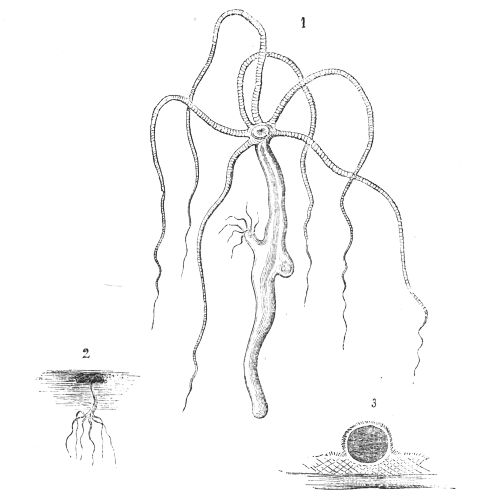
Fig. 86. Hydra vulgaris. 1. Hydra with ova and young, unhatched. 2. Hydra of natural size attached to a piece of floating wood. 3. Egg ready to burst its shell.
The Hydras have no lungs, no liver, no intestines, no nervous system, no heart. They have no organ of the senses, except those which exist in the mouth and the skin. The arms or branches are hollow internally, and communicate with the stomach. They are provided with vibratile cells, furnished with a great number of tuberosities disposed spirally, and containing in their interior a number of capsules provided each with a sort of fillet. These threads, which are of extreme tenacity, are thrown out when the animal is irritated by contact with any strange body. We may see these filaments wrapping themselves round their prey, sometimes even penetrating its substance, and effectually subduing the enemy. The green Hydra has thus a very simple organisation. Nevertheless, it would be a mistake to say the animal was imperfect, for it possesses everything necessary for its nourishment and for the propagation of its species.
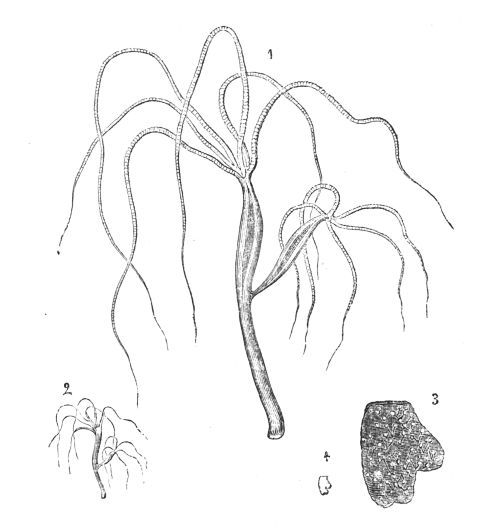
Fig. 87. Hydra viridis (Trembley). 1. Hydra magnified, bearing an embryo ready to detach itself. 2. Animal, natural size. 3. Bud much magnified. 4. Bud, natural size.
There are learned men who have composed hundreds of volumes, who have published whole libraries—naturalists and physicists who have written more than Voltaire ever penned, but whose names are utterly forgotten. On the other hand, there are some who have left only two or three monograms, and yet their names will live for ever. Of this number is the Genevois, A. Trembley. This writer published in 1744 a "Memoir on the Fresh-water Polyps." In this little work he recorded his observations on some of these animals of smallest dimensions. He limited himself even to two sets of experiments: he turned the fresh-water polyp outside in, and he multiplied it by cutting it up. These experiments upon this little creature, which few persons had seen, have sufficed to secure immortality to his name. Trembley was tutor to the two sons of Count de Bentinck. He made his observations at the country-house of the Dutch nobleman, and he had, as he assures us, "frequent occasion to satisfy himself, in the case of his two pupils, that we can even in infancy taste the pleasures derivable from the studies of Nature!" Let us hope that this thought, uttered by a celebrated naturalist, who spoke only from what he knew himself, may remain engraved on the minds of our younger readers.
Trembley established by his observations, a thousand times repeated, that Hydra viridis can be turned outside in, as completely as a glove may be, without injury to the animal, which a day or two after this revolution resumes its ordinary functions. Such is the vitality of these little beings, that what was once the outer surface soon fulfils all the functions of a stomach, digesting its food, while the intestinal tube expanding its exterior performs all the functions of an outer surface; it absorbs and respires. But we shall leave Trembley to relate his very remarkable experiments. "I attempted," he says, "for the first time to turn these polyps inside out in the month of July, 1741 but unsuccessfully. I was more successful the following year, having found an expedient which was of easy execution. I began by giving a worm to the polyp, and put it, when the stomach was well filled, into a little water which filled the hollow of my left hand. I pressed it afterwards with a gentle pinch towards the posterior extremities. In this manner I pressed the worm which was in the stomach against the mouth of the polyp, forcing it to open—continuing the pinching pressure until the worm was partly pressed out of the mouth. When the polyp was in this state I conducted it gently out of the water, without damaging it, and placed it upon the edge of my hand, which was simply moistened, in order that the polyp should not stick to it. I forced it to contract itself more and more, and, in doing so, assisted in enlarging the mouth and stomach. I now took in my right hand a thick and pointless boar's bristle, which I held as a lancet is held in bleeding. I approached its thicker end to the posterior extremity of the polyp, which I pressed until it entered the stomach, which it does the more easily since it is empty at this place and much enlarged. I continued to advance the bristle, and, in proportion as it advanced, the polyp became more and more inverted. When it came to the worm, by which the mouth is kept open on one side, and the posterior part of the polyp is passed through the mouth, the creature is thus turned completely inside out; the exterior superficies of the polyp has become the interior."
The poor animal would be justified in feeling some surprise at its new situation—disagreeably surprised we may add, for it makes every imaginable effort to recover its natural position, and it always succeeds in the end. The glove is restored to its proper form. "I have seen polyps," says Trembley, "which have recovered their natural exterior in less than an hour." But this would not have served the purpose of our experimenter. He wished to know if the polyps thus turned outside in could live in this state; he had consequently to prevent it from rectifying itself, for which purpose a needle was run through the body near the mouth—in other words, he impaled the creature by the neck.
"It is nothing for a polyp only to be spitted," says Trembley. It is in fact a very small thing, as we shall see, for thus reversed and spitted they live and multiply as if nothing had happened.
"I have seen a polyp," says this ingenious experimenter, "turned inside out, which has eaten a small worm two days after the operation. I have fed one in that state for more than two years, and it has multiplied in that condition.
"Having experimented successfully myself, I was desirous of having the testimony of others capable of forming opinions on the subject. M. Allamand was persuaded to put his hand to the work, which he did with the same success I had met with. He has done more, having succeeded in permanently turning specimens which had been previously turned, and which continued to live in their re-inverted state; he has seen them eat soon after both operations; finally, he has turned one for the third time, which lived some days, but perished without having eaten anything, although it did not appear that its death was the result of the operation."
We have said that the Hydra viridis has neither brain, nervous system, heart, muscular rings, lungs, nor liver; the organs of the senses—namely, those of sight, hearing, and of smell—have also been denied them. Nevertheless, they act as if they possessed all these senses. Oh Nature! how hidden are thy secrets, and how the pride of man is humbled by the mysteries which surround thee—by the spectacles which strike his eyes, and which he attempts in vain to explain!
Trembley states that the fresh-water polyps, having no muscular ring, can neither extend nor contract themselves, nor can they walk. If touched, or if the water in which they are immersed is suddenly agitated, they are certainly observed to contract more or less forcibly, and even to inflect themselves in all directions; and by this power of extension, of contraction and inflection, they contrive to move from place to place; but these movements are singularly slow, the utmost space they have been observed to traverse being about eight inches in the twenty-four hours.
Painfully conscious of his powers of progression, however, he has found means of remedying it, and the aquatic snail is his steed; he creeps upon the shell of a Planorbis, or Limnæa, and by means of this improvised mount he will make more way in a few minutes than he would in a day by his own unassisted efforts.
The Hydra viridis, although destitute of organs of sight, are nevertheless sensible of light; if the vase containing them is placed partly in shade and partly in the sun, they direct themselves immediately towards the light; they appreciate sounds; they attach themselves to aquatic plants and other floating bodies. Without eyes, without brain, and without nerves, these animals lie in wait for their prey, recognize, seize, and devour it. They make no blunder, and only attack where they are sure of success. They know how to flee from danger; they evade obstacles, and fight with or fly before their enemies. There are, then, some powers of reflection, deliberation, and premeditated action in these insignificant creatures; their history, in short, is calculated to fill the mind with astonishment.
Trembley insists much upon the address which the Hydra employs to secure its prey: by the aid of its long arms, small animals, which serve to nourish it, are seized, for it is carnivorous, and even passably voracious. Worms, small insects, and larvæ of dipterous insects are its habitual prey. When a worm or woodlouse in passing its portals happens to touch them, the polyp, taking the hint, seizes upon the wanderer, twining its flexible arms round it, and, directing it rapidly towards its mouth, swallows it. Trembley amused himself by feeding the Hydra, while he observed the manner in which it devoured its prey. "When its arms were extended, I have put into the water a woodlouse or a small worm. As soon as the woodlouse feels itself a prisoner it struggles violently, swimming about, and drawing the arm which holds it from side to side; but, however delicate it may appear, the arm of the polyp is capable of considerable resistance; it is now gradually drawn in, and other arms come to its assistance, while the polyp itself approaches its prey; presently the woodlouse finds itself engaged with all the arms, which, by curving and contracting, gradually but inevitably approach the mouth, in which it is soon engulfed." Frédol also notices a singular fact. "The small worms, even when swallowed by the polyp," he says, "frequently try to escape; but the ravisher retains them by plunging one of its arms into the digestive cavity! What an admirable contrivance, by which the worms are digested while the arm is respected!"
The food of the fresh-water Hydra influences the colour of their bodies in consequence of the thinness and transparency of their tissues; so that the reddish matter of the woodlouse renders them red, while other food renders them black or green, according to its prevailing colour!
The multiplication of these creatures takes place in three different ways: 1. By eggs. 2. By buds, after the manner of vegetables. 3. By separation, in which an individual may be cut into two or many segments, each reproducing an individual.
We shall only say a few words on the first mode of reproduction. The eggs, according to Ehrenberg, come to maturity in the H. viridis at the base of the feet, where the visceral cavity terminates. They are carried during seven or eight days, and determine by their fall the death of the animal. When the Hydra has laid its eggs, according to M. Laurent, it gradually lowers itself until it covers them with half its body, which, spreading out and getting proportionably thin, passes into the condition of a horny substance, that glues the eggs disposed in a circle round the body to plants and other foreign substances. She ends her career by dying in the midst of her ova.
Trembley has studied with great care the mode of reproduction by budding—a process which seems to prevail in the summer months. The buds which are to form the young polyp appear on the surface of the body as little spherical excrescences terminating in a point. A few steps further towards maturity, and it assumes a conical and finally a cylindrical form. The arms now begin to push out at the anterior extremity of the young animal; the posterior extremity by which it is attached to the mother contracting by degrees, until it appears only to touch her at one point. Finally, the separation is effected, the mother and the young acting in concert to produce the entrance of this interesting young polyp into the world. Each of them take with their head and arms a strong point of support upon some neighbouring body; and a small effort suffices to procure the separation: sometimes the mother charges herself with the effort, sometimes the young, and often both.
When the young polyp is separated from the mother, it swims about, and executes all the movements peculiar to adult animals. The entrance into life and maturity takes place with these beings at one and the same moment. Infancy and youth are suppressed in this little world.
So long as the young polyp remains attached to the mother, she is the nurse; by a touching change, the young polyp nurses her in his turn. In short, the stomach of the mother and her young have communication; so that the prey swallowed by the parent passes partially into the stomach of her progeny. On the other hand, while still attached to the mother, the little ones seize the prey, which they share in their turn with their parent by means of the communication Nature has arranged between the two organisms.
In the course of his experiments Trembley states another fact still more remarkable.
Upon a young polyp still attached to its parent he observed a new polyp or polypule, and upon this unborn creature was another individual. Thus three generations were appended to the parent, who carried at once her child, her grandchild, and great-grandchild.
"In observing the young polyps still attached to their parent," says Trembley, "I have seen one which had itself a little one which was just issuing from its body; that is to say, it was a mother while yet attached to its own parent. I had in a short time many young polyps attached to their parents which had already had three or four little ones, of which some were even perfectly formed. They fished for woodlice like others, and they ate them. Nor is this all. I have seen a mother-polyp which had carried its third generation. From the little one which she had produced issued another little one, and from this a third."
Charles Bennet, the naturalist of Geneva, says wittily, that a polyp thus charged with all its descendants constitutes a living genealogical tree.
We have just spoken of turning polyps inside out! If one of these creatures is thus operated upon while it bears its young on the surface of its body, such of them as are sufficiently advanced continue to increase; although they find themselves in this sudden manner imprisoned in an internal cavity, they re-issue subsequently by the mouth. Those less advanced at the moment of reversal issue by little and little from the maternal sac, and complete their career of development on the newly-made exterior.
The third and most extraordinary mode of reproduction in the polyps has been discovered by Trembley in the case of the green Hydra. So surprised was this naturalist at the strange anomalies which surrounded these creatures, that he began to have doubts, and gravely to ask the question, Was this polyp an animal? Is it a plant?
In order to escape from this state of indecision, it occurred to him to cut a Hydra into pieces. Concluding that plants alone could reproduce themselves by slips, he waited the result of the experiment for the conclusion he sought. On the 25th of November, 1740, he cut a polyp into sections. "I put," he tells us, "the two parts into a flat glass, which contained water four or five lines in depth, and in such a manner that each portion of the polyp could be easily observed through a strong magnifying glass. It will suffice to say that I had cut the polyp transversely, and a little nearer to the anterior. On the morning of the day after having cut the polyp, it seemed to me that on the edges of the second part, which had neither head nor arms, three small points were issuing from these edges. This surprised me extremely, and I waited with impatience for the moment when I could clearly ascertain what they were. Next day they were sufficiently developed to leave no doubt on my mind that they were true arms. The following day two new arms made their appearance, and, some days after, a third appeared, and I could now trace no difference between the first and second half of the polyp which I had cut."
This is assuredly one of the most startling facts belonging to natural history. Divide a fresh-water polyp into five or six parts, and at the end of a few days all the separate parts will be organized, developed, and form so many new beings, resembling the primitive individual. Let us add, that the polyp which should thus have lost five-sixths of its body, the mutilated father of all this generation, remains complete in itself; in the interval, it has recuperated itself and recovered all its primitive substance.
After this, if a Hydra vulgaris wishes to procure for itself the blessings of a family, it has only one thing to do: cut off an arm; if it desire two descendants, let it cut the arm in two parts; if three, let it divide itself into three; and so on ad infinitum. "Divide one of the animals," says Trembley, "and each section will soon form a new individual in all respects like the creature divided." "A whole host of polyps hewn into pieces," says Frédol, "will be far from being annihilated." "On the contrary," we may say, in our turn, "its youth will be renewed, and multiplied in proportion to the number of pieces into which it has been divided." "The same polyp," says Trembley, "may be successively inverted, cut into sections, and turned back again, without being seriously injured."
If a green Hydra is cut into two pieces, and the stomach is cut off in the operation, the voracious creature will, nevertheless, continue to eat the prey which presents itself. It gorges itself with the food, without troubling itself with the loss which it has sustained; but the food no longer nourishes it, for it merely enters by one opening, passes through the intestinal canal, and escapes by the other. It realizes Harleville's pleasantry of M. de Crac's horse, in the piece of that name, which eats unceasingly, but never gets any fatter.
All these instances of mutilation, resulting in an increase of life, are very strange. The naturalists to whom they were first revealed could scarcely believe their own eyes. Réaumur, who repeated many of Trembley's experiments, writes as follows: "I confess that when I saw for the first time two polyps forming by little and little from that which I had cut in two, I could scarcely believe my eyes; and it is a fact that, after hundreds of experiments, I never could quite reconcile myself to the sight."
In short, we know nothing analogous to it in the animal kingdom. About the same period Charles Bennet writes: "We can only judge of things by comparison, and have taken our ideas of animal life from the larger animals; and an animal which we cut and turn inside out, which we cut again, and it still bears itself well, gives one a singular shock. How many facts are ignored, which will come one day to derange our ideas of subjects which we think we understand! At present we just know enough to be aware that we should be surprised at nothing."
Notwithstanding the philosophic serenity which Bennet recommends, the fact of new individuals resulting from dividing these fresh-water polyps was always a subject of profound astonishment, and of never-ending meditation.
Sertulariadæ.
All Hydraidæ, with the exception of the Hydra and a few other genera, are marine productions, varying from a few lines to upwards of a foot in height, attaching themselves to rocks, shells, sea-weeds, and corallines, and to various species of shell-fish. Many of them attach themselves indiscriminately to the nearest object, but others show a decided preference. Thuiaria thrya attaches itself to old bivalves; Thoa halecuia prefers the larger univalves; Antennularia antennina attaches itself to coarse sand on rocks; Laomedea geniculata delights in the broad frond of the tangle; Plumularia catherina attaches itself in deep water to old shells, corallines, and ascidians, growing in a manner calculated to puzzle the naturalist, as it did Crabbe, the poet, who writes of it:—
"Involved in sea-wrack, here you find a race Which science, doubting, knows not where to place; On shell or stone is dropp'd the embryo seed, And quickly vegetates a vital breed."
Sertularia pumila, on the other hand, loves the commoner and coarser wracks. "The choice," says Dr. Johnston, "may in part be dependent on their habits, for such as are destined to live in shallow water, or on a shore exposed by the reflux of every tide, are, in general, vegetable parasites; while the species which spring up in deep seas must select between rocks, corallines, or shells." There seems to be a selection even as to the position on the rocks. According to Lamouroux, some polyps always occupy the southern slopes, and never that towards the east, west, or north; others, on the contrary, grow only on these exposures, and never on the south, altering their position, however, according to the latitude, and its relation to the Equator.
The Sertulariadæ have a horny stem, sometimes simple, sometimes so branching that they might readily enough be mistaken for small plants, their branches being flexible, semi-transparent, and yellow. Their name is derived from Sertum, a bouquet. Each Sertularia has seven, eight, twelve, or twenty small panicles, each containing as many as five hundred animalcules; thus forming, sometimes, an association of ten thousand polyps. "Each plume," says Mr. Lister, in reference to a specimen of Plumularia cristata, "might comprise from four to five hundred polyps;" "and a specimen of no unusual size now before me," says Dr. Johnston, "with certainly not fewer cells on each than the larger number mentioned, thus giving six thousand as the tenantry of a single polypidom, and this on a small species." On Sertularia argentea, it is asserted, polyps are found on which there exist not less than eighty to a hundred thousand.
Each colony is composed of a right axis, on the whole length of which the curved branches are implanted, these being longest in the middle. Along each of these branches the cells, each containing a polyp, are grouped alternately. The head of the animal is conical, the mouth being at the top surrounded by twenty to twenty-four tentacles. These curious beings have no digestive cavity belonging to themselves; the stomach is common to the whole colony—a most singular combination, a single stomach to a whole group of animals! Never have the principles of association been pushed to this length by the warmest advocates of communism.
Certain species belonging to the colony, which seem destined to perpetuate the race, have not the same regular form. Destitute of mouth and tentacles, they occupy special cells, which are larger than the others. The entire colony is composed exclusively of individuals, male or female. "We have traced Sertularia cupressina through every stage of its development," say Messrs. Paul Gervais and Van Beneden. "At the end of several days, the embryos are covered with very short vibratile cells; their movement is excessively slow; then, from the spheroid form which they take at first, they get elongated, and take a cylindrical form, all the body inclining lightly sometimes to the right, sometimes to the left. The vibratile cells fading afterwards, the embryo attaches itself to some solid body, a tubercle is formed, and the base extends itself as a disk. At the same time that the first rudiments of the polyp appear, the disk-like tubercle throws out on its flanks a sort of bud, and a second polyp soon shows itself; its surface is hardened; the polyp appears in its turn, and the same process of generation is repeated; a colony of Sertulariadæ is thus established at the summit of a discoid projection. At the end of fifteen days the colony, which has been forming under our eyes, consists of two polyps and a bud, which already indicates a third polyp. The sea-cypress, as this species is called, is robust, with longish branches decidedly fan-shaped, the pinnæ being closer and nearly parallel to each other. The cells form two rows, nearly opposite, smooth and pellucid. The branches in some specimens are gracefully arched, bending as it were under the load of pregnant ovaries which they carry, arranged in close-set rows along the upper side of the pinnæ. They are found in deep water on the coast of Scotland, and as far south as the Yorkshire coast and the north of Ireland. The cells, which are the abode of the polyps, are not always alike in their distribution. Sometimes they are ranged on two sides, sometimes on one only. Sometimes they are grouped like the small tubes of an organ, at other times they assume a spiral form round the stem, or they form here and there horizontal rings round it."
Medusadæ.
The Medusæ comprehend, not only the animals so designated in the days of Cuvier under that name, but also the polyps known as Tubulariadæ and Campanulariadæ.
If we walk along the sea shore, after the reflux of the tide, we may often see, lying immovable upon the sands, disk-like, gelatinous masses of a greenish colour and repulsive appearance, from which the eye and the steps instinctively turn aside. These beings, whose blubber-like appearance inspires only feelings of disgust when seen lying grey and dead on the shore, are, however, when seen floating on the bosom of the ocean, one of its most graceful ornaments. These are Medusæ. When seen suspended like a piece of gauze or an azure bell in the middle of the waves, terminating in delicate silvery garlands, we cannot but admire their iridescent colours, or deny that these objects, so forbidding in some of their aspects, rank, in their natural localities, among the most elegant productions of Nature. We could not better commence our studies of these children of the sea than by quoting a passage from the poet and historian Michelet: "Among the rugged rocks and lagunes, where the retiring sea has left many little animals which were too sluggish or too weak to follow, some shells will be there left to themselves and suffered to become quite dry. In the midst of them, without shell and without shelter, extended at our feet, lies the animal which we call by the very inappropriate name of the Medusa. Why was this name, of terrible associations, given to a creature so charming? Often have I had my attention arrested by these castaways which we see so often on the shore. They are small, about the size of my hand, but singularly pretty, of soft light shades, of an opal white; where it lost itself as in a cloud of tentacles—a crown of tender lilies—the wind had overturned it; its crown of lilac hair floated about, and the delicate umbel, that is, its proper body, was beneath; it had touched the rock—dashed against it; it was wounded, torn in its fine locks, which are also its organs of respiration, absorption, and even of love.... The delicious creature, with its visible innocence and the iridescence of its soft colours, was left like a gliding, trembling jelly. I paused beside it, nevertheless: I glided my hand under it, raised the motionless body cautiously, and restored it to its natural position for swimming. Putting it into the neighbouring water, it sank to the bottom, giving no sign of life. I pursued my walk along the shore, but at the end of ten minutes I returned to my Medusa. It was undulating under the wind; really it had moved itself, and was swimming about with singular grace, its hair flying round it as it swam; gently it retired from the rock, not quickly, but still it went, and I soon saw it a long way off."
Of all the zoophytes which live in the ocean there is none more numerous in species or more singular in their matter, more odd in their form, or more remarkable in their mode of reproduction, than those to which Linnæus gave the name of Medusa, from the mythical chief of the Gorgons.
The seas of every latitude of the globe furnish various tribes of these singular beings. They live in the icy waters which bathe Spitzbergen, Greenland, and Iceland; they multiply under the fires of the Equator, and the frozen regions of the south nourish numerous species. They are, of all animals, those which present the least solid substance. Their bodies are little else than water, which is scarcely retained by an imperceptible organic network; it is a transparent jelly, almost without consistence. "It is a true sea-water jelly," says Réaumur, writing in 1701, "having little colour or consistence. If we take a morsel in our hands, the natural heat is sufficient to dissolve it into water."
Spallanzani could only withdraw five or six grains of the pellicle of a medusa weighing fifty ounces. From certain specimens weighing from ten to twelve pounds, only six to seven pennyweights could be obtained of solid matter, according to Frédol. "Mr. Telfair saw an enormous medusa which had been abandoned on the beach at Bombay; three days after, the animal began to putrefy. To satisfy his curiosity, he got the neighbouring boatmen to keep an eye upon it, in order to gather the bones and cartilages belonging to the great creature, if by chance it had any; but its decomposition was so rapid and complete that it left no remains, although it required nine months to dissipate it entirely."
"Floating on the bosom of the waters," says Frédol, "the Medusa resembles a bell, a pair of breeches, an umbrella, or, better still, a floating mushroom, the stool of which has here been separated into lobes more or less divergent, sinuous, twisted, shrivelled, fringed, the edges of the cap being delicately cut, and provided with long thread-like appendages, which descend vertically into the water like the drooping branches of the weeping willow."
The gelatinous substance of which the body of the Medusa is formed is sometimes colourless and limpid as crystal; sometimes it is opaline, and occasionally of a bright blue or pale rose colour. In certain species the central parts are of a lively red, blue, or violet colour, while the rest of the body is of a diaphanous hue. This diaphanous tissue, often decked in the finest tints, is so fragile, that when abandoned by the wave on the beach, it melts and disappears without leaving a trace of its having existed, so to speak.
Nevertheless, these fragile creatures, these living soap-bubbles, make long voyages on the surface of the sea. Whilst the sun's rays suffice to dissipate and even annihilate its vaporous substance on some inhospitable beach, they abandon themselves without fear during their entire life to the agitated waves. The whales which haunt round the Hebrides are chiefly nourished by Medusæ which have been transported by the waves in innumerable swarms from the coast of the Atlantic to the region of whales. "The locomotion of the Medusæ, which is very slow," says De Blainville, "and denotes a very feeble muscular energy, appears, on the other hand, to be unceasing. Since their specific gravity considerably exceeds the water in which they are immerged, these creatures, which are so soft that they probably could not repose on solid ground, require to agitate constantly in order to sustain themselves in the fluid which they inhabit. They require also to maintain a continual state of expansion and contraction, of systole and diastole. Spallanzani, who observed their movements with great care, says that those of translation are executed by the edges of the disk approaching so near to each other that the diameter is diminished in a very sensible degree; by this movement a certain quantity of water contained in the body is ejected with more or less force, by which the body is projected in the inverse direction. Renovated by the cessation of force in its first state of development, it contracts itself again, and makes another step in advance. If the body is perpendicular to the horizon, these successive movements of contraction and dilatation cause it to ascend; if it is more or less oblique, it advances more or less horizontally. In order to descend, it is only necessary for the animal to cease its movements; its specific gravity secures its descent."
It is, then, by a series of contractions and dilatations of their bodies that the Medusæ make their long voyages on the surface of the waters. This double movement of their light skeleton had already been remarked by the ancients, who compared it to the action of respiration in the human chest. From this notion the ancients called them Sea Lungs.
The Medusæ usually inhabit the deep seas. They are rarely solitary, but seem to wander about in considerable battalions in the latitudes to which they belong. During their journey they proceed forward, with a course slightly oblique to the convex part of their body. If an obstacle arrests them, if an enemy touches them, the umbrella contracts, and is diminished in volume, the tentacles are folded up, and the timid animal descends into the depths of the ocean.
We have said that the Medusæ constitute in the Arctic seas one of the principal supports of the whale. Their innumerable masses sometimes cover many square leagues in extent. They show themselves and disappear by turns in the same region, at determinate epochs—alternations which depend, no doubt, on the ruling of the winds and currents which carry or lead them. "The barks which navigate Lake Thau meet," says Frédol, "at certain periods of the year with numerous colonies of a species about the size of a small melon, nearly transparent—whitish, like water when it is mixed with a shade of aniseed. One would be tempted to take these animals at first for a collection of floating muslin bonnets."
The Medusæ are furnished with a mouth placed habitually in the middle of the neck. This mouth is rarely unoccupied. Small molluscs, young crustaceans, and worms, form their ordinary food. In spite of their shape, they are most voracious, and snap up their prey all at one mouthful, without dividing it. If their prey resists and disputes with it, the Medusa which has seized it holds fast, and remains motionless, and, without a single movement, waits till fatigue has exhausted and killed its victim, when it can swallow it in all security.
In respect to size, the Medusæ vary immensely. Some are very small, while others attain more than a yard in diameter. Many species are phosphorescent during the night.
Most Medusadæ produce an acute pain when they touch the human body. The painful sensation produced by this contact is so general in this group of animals, that it has determined their designation. Until very recently all the animals of the group have been, after Cuvier, designated under the name of Acalephæ, or sea nettles, in order to remind us that the sensation produced is analogous to that occasioned by contact with the stinging leaves of the nettle.
According to Dicquemare, who made experiments on himself in this matter, the sensation produced is very like that occasioned by a nettle, but it is more violent, and endures for half an hour. "In the last moments," says the abbé, "the sensation is such as would be produced by reiterated but very weak prickings. A considerable pain pervaded all the parts which had been touched, accompanied by pustules of the same colour, with a whitish point." "The sea-bladder," says Father Feuillée, "occasions me, on touching it, a sudden and severe pain, accompanied with convulsions."
"During the first voyage of the Princess Louise round the world," to quote Frédol, "Meyen remarked a magnificent physalia, which passed near the ship. A young sailor leaped naked into the sea, to seize the animal. Swimming towards it, he seized it; the creature surrounded the person of its assailant with its numerous thread-like filaments, which were nearly a yard in length; the young man, overwhelmed by a feeling of burning pain, cried out for assistance. He had scarcely strength to reach the vessel and get aboard again, before the pain and inflammation were so violent that brain fever declared itself, and great fears were entertained for his life."
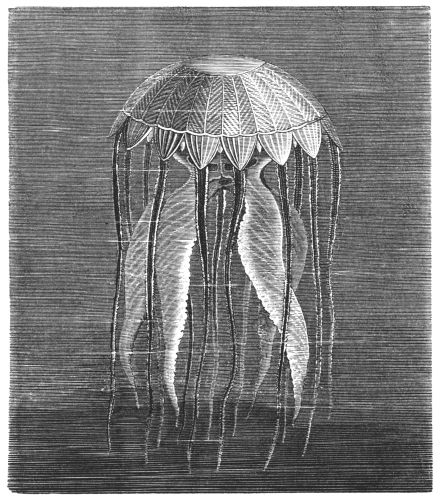
Fig. 88. Chrysaora Gaudichaudi.
The organization is much more complicated than early observers were disposed to think it. During many ages naturalists were inclined to imagine, with Réaumur, that the Medusæ were mere masses of organized jelly, of gelatinized water. But when Courtant Dumeril tried the experiment of injecting milk into their cavities, and saw the liquid penetrating into true vessels, he began to comprehend that these very enigmatical beings were worthy of serious study—the study of subsequent naturalists, such as Cuvier, De Blainville, Ehrenberg, Brandt, Makel-Eschscholtz, Sars, Milne Edwards, Forbes, Gosse, and other modern naturalists, who have demonstrated what richness of structure is concealed under this gelatiniform and simple structure in the Medusæ; at the same time they have revealed to us most mysterious and incredible facts as connected with their metamorphoses.
Among the Medusæ proper, the most common are Aurelia, Pelagia, and Chrysaora. In the latter, C. Gaudichaudi (Fig. 88), the disk is hemispherical, festooned with numerous tentacles, attached to a sac-like stomach, opening by a single orifice in the centre of the peduncle, with four long, furbelowed, unfringed arms. Gaudichaudi's chrysaora is found round the Falkland Islands. The disk forms a regular half-sphere, very smooth, and perfectly concave, forming a sort of canopy in the shape of a vault. The circle which surrounds it is divided into sections by means of vertical lines, regularly divided, of a reddish-brown colour, which forms an edging to the umbrella-like disk. Twelve broad regular festoons form this edging. From the summit of these lobes issue twelve bundles of very long, simple, capillary tentacles, of a bright red. The peduncle is broad and flat, perforated in the middle, to which are attached four broad foliaceous arms.
Rhizostoma.
The Medusæ which bear the name of Rhizostoma have the disk hemispherically festooned, depressed, without marginal tentacles, peduncle divided into four pairs of arms, forked, and dentated almost to infinity, each having at their base two toothed auricles. Such is Rhizostoma Cuvieri of Péron (Fig. 89), the disk of which is of a bluish-white, like the arms, and of a rich violet over its circumference. This beautiful zoophyte is found plentifully in the Atlantic, living in flocks, which attain a great size. It is common in the month of June on the shores of the Saint Onge; in August on the English coast; and along the strand of every port in the Channel they are seen in the month of October in thousands, where they lie high and dry upon the shore, on which they have been thrown by the force of the winds.
Such also is R. Aldrovandi (Fig. 90), which appears all the year round in calm weather. It is an animal much dreaded by bathers. It possesses an urticaceous apparatus, which produces an effect similar to the stinging-nettle when applied to the skin. If the animal touches the fisherman at the moment of being drawn from the water, it is apt to inflame the part and raise it into pustules.
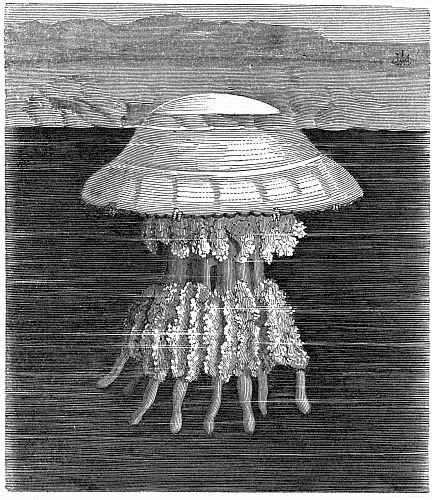
Fig. 89. Rhizostoma Cuvieri.
Cassiopea and Cephea are two other types belonging to the same group. In Cassiopea Andromeda (Fig. 91), belonging to the first, the disk is hemispherical, but much depressed, without marginal tentacles or peduncle, but with a central disk, with four to eight half-moon-shaped orifices at the side, and throwing off eight to ten branching arms, fringed with retractile sucking disks. Cephea Cyclophora, Péron (Fig. 92), is another very remarkable form of these strangely-constituted organisms.
Having presented to the reader certain characteristic types of Medusadæ, we proceed to offer some general remark upon the organization and functions of these strange creatures. We have, in short, selected these types because they have been special objects of anatomical and physiological study to some of our best naturalists.
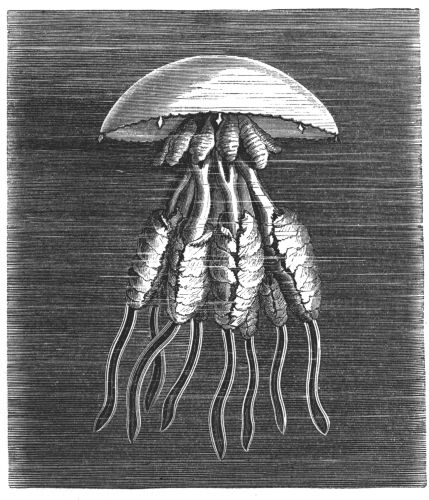
Fig. 90. Rhizostoma Aldrovandi.
The Medusæ have no other means of breathing but through the skin. We remark all over the body of these zoophytes certain cutaneous elongations, disposed so as to favour the exercise of the breathing function. Certain marginal fringes of extended surface, as well as the tentacle, are the special seats of the apparatus. The organs of digestion also present arrangements peculiar to themselves; the mouth is placed on the lower part of the body, and is pierced at the extremity of a trumpet-like tube, hanging sometimes like the tongue of a bell. The walls of the stomach, again, are furnished with a multitude of appendages, which have their origin in the cavity of the organ, and which are very elastic. The stomach, furnished with these vibratile cells, appears to secrete a juice whose function is to decompose the food and render it digestible.
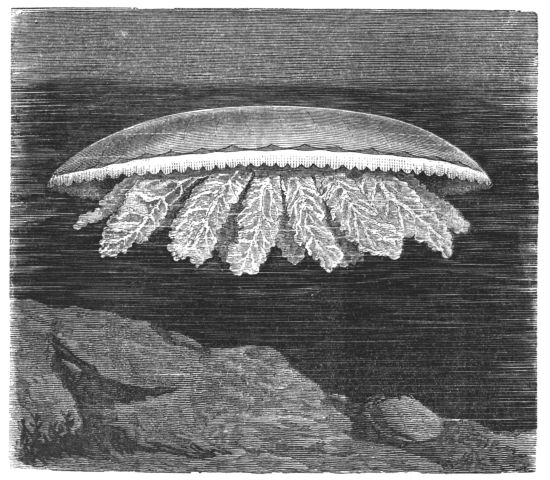
Fig. 91. Cassiopea Andromeda (Tilesius).
In some of the Medusadæ the central mouth is absent altogether. With the Rhizostoma, for instance, the stomachal reservoir has no inferior orifice; it communicates laterally with the canals which descend through the thickness of the arms, and open at their extremities through a multitude of small mouths. These are the root-like openings from which the animals derive their name of Rhizostoma, from the Greek words ῥίζα, root, and στόμα, mouth.
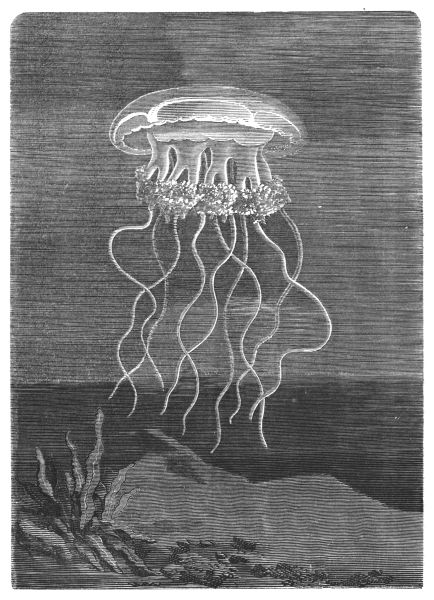
Fig. 92. Cephea Cyclophora.
The arms of the Rhizostoma are usually eight in number, the free extremities of each being slightly enlarged: in these arms many small openings or mouths occur, which are the entrances to so many ascending canals communicating with larger ones, as the veins do in the higher animals: the common trunk canal is thus formed, which directs itself to the stomach, receiving in its way thither all the lateral branches.
A very distinct circulation exists in the Medusæ. The peripheric part of the stomach suffers the nourishing liquid which has been elaborated in the digestive cavity to pass: this fluid then circulates through numerous canals, the existence of which have been clearly traced.
It is also a singular fact, that organs of sense seem to have been discovered in these Medusæ, which early observers believed to be altogether destitute of organization. "During my sojourn on the banks of the Red Sea," says Ehrenberg, in his work on the Medusa aurita, "although I had many times examined the brownish bodies upon the edge of the disk of the Medusæ, it is only in the month past that I have recognized their true nature and function. Each of these bodies consists of a little yellow button, oval or cylindrical, fixed upon a thin peduncle. The peduncle is attached to a vesicle, in which the microscope reveals a glandular body, yellow when the light traverses it, but white when the light is only reflected on it. From this body issue two branches, which proceed towards the peduncle or base of the brown body up to the button or head. I have found that each of these small brown bodies presents a very distinct red point placed on the dorsal face of the yellow head; and when I compare this with my other observations of similar red points in other animals, I find that they greatly resemble the eyes of the Rotifera and Entomostraca. The bifurcating body placed at the base of the brown spot appears to be a nervous ganglion, and its branches may be regarded as optic nerves. Each pedunculated eye presents upon its lower face a small yellow sac, in which are found, in greater or smaller numbers, small crystalline bodies clear as water." The presence of a red pigment in very fine grains is an argument in favour of the existence of visual organs in these zoophytes, for the small crystals disseminated in the interior of the organ would no doubt perform the part of refracting light which is produced by crystalline in the eyes of vertebrated animals. Moreover, it is found that there are marginal corpuscles analogous to these brown spots in other species of Medusæ. They are of a palish yellow, or quite colourless, and enclose sometimes a single, sometimes many calcareous corpuscles. When they are colourless, some naturalists have rather taken them for ears reduced to their most simple expression.
The Medusæ are not absolutely destitute of nervous system. We have seen that they have ganglions, and probably optic nerves. Ehrenberg also states that they have ganglions at their base, which furnish them with nervous filaments.
Without entering further into the details of their delicate and complicated structure, we shall pause briefly on their mode of reproduction. We shall find here physiological phenomena so remarkable as to appear incredible, had not the researches of modern naturalists placed the facts beyond all doubt. "Which of us," says M. de Quatrefages, "would not proclaim the prodigy, if he saw a reptile issue from an egg laid in his court-yard, which afterwards gave birth to an indefinite number of fishes and birds? Well, the generation of the Medusæ is at least as marvellous as the fact which we have imagined." Let us note, for example, what takes place with the Rose Aurelia, a beautiful Medusa, of a pale rose colour, with nearly hemispherical disk, from four to five inches in diameter, whose edge is furnished with short russet-brown tentacles; taking for our guide the eloquent and learned author of the "Metamorphosis in Men and Animals," M. de Quatrefages.
The Medusa, designated under the name of Rose Aurelia, lays eggs which are characterised by the existence of three concentric spheres. These eggs are transformed into oval larvæ, covered with vibratile cells, having a slight depression in front. They swim about for a short time with great activity, much like the infusoria, which they strikingly resemble in other respects.
At the end of forty-eight hours the movements decrease. Aided by the depression already noted, the larvæ attaches itself to some solid body, fixing itself to it at this point by the assistance of a thick mucous matter. A change of form soon takes place: it becomes elongated; its pedicle is contracted, and its free extremity swells into a club-like shape. An opening soon presents itself in the centre of this extremity, through which an internal cavity appears. Four little mammals have now appeared on the edge, which are elongated in the manner of arms. Others soon follow: these are the tentacles of a polyp: the young infusoria has become a polyp!
The polyp increases by buds and shoots, just like a strawberry plant, which throws out its slender stems in all directions, covering all the neighbouring ground.
The young Medusa lives some time under this form. Then one of the polyps becomes enlarged and its form cylindrical. This cylinder is divided into from ten to fourteen superposed rings. These rings, at first smooth, form themselves into festoons, and separate into bifurcated thongs; the intermediate lines become channeled. The animal now resembles a pile of plates, cut round the edges. In a short time each ring is stirred at the free edge of its fringe: this becomes contractile. The rings are individualised. Finally, these annular creatures, obscure in their lives, isolate themselves. When detached, they begin to swim: from that time they have only to perfect and modify their form. From being flat, they become concave on the one side and convex on the other. The digestive cavity—the gastro-vascular canals—become more decided; the mouth opens, the tentacles are elongated, the floating marginal cirri become more and more numerous; and now, after all these metamorphoses, the Medusa appears: it perfectly resembles the mother.
Tubularidæ.
We have already said that recent researches have led to a separation of a class of animals from the Sertularia, and to their being united with the Medusæ. Of these creatures we formerly only knew one of the forms, namely, the polyp form; or, rather, the first stage of it. During their earliest days they possess a polyp, furnished with tentacles, and a bell-shaped body. During their medusoid age, they present a central stomach, with four canals in the form of a cross, and four to eight tentacles with cirri. The animals constitute the Tubularidæ, comprehending many genera; among others the Tubularia and Campanularia, in studying which Van Beneden of Louvain discovered most interesting facts connected with the subject of alternate generation.
The class of zoophytes ranged among the Tubularia have the power of secreting an inverting tube of a horny nature, in which the fleshy body can move up and down, expanding its tentacles over the top. Others of them give forth buds, each of which takes the form of a polyp, and these, being permanent, give it a shrub-like or branched appearance; it is now a compound polyp. The tube is branched, and the orifices from which the polyps expand usually dilate into cups or cells. This is the condition of the Tubulari-campanulariadæ groups, which are numerous round our own coast and in the Channel. The Tubularia are plant-like and horny, rooted by fibres, tubular, and filled with a semi-fluid organic pulp; polyps naked and fleshy, protruding from the extremity of every branchlet of the tube, and armed with one or two circles of smooth filiform tentacles; bulbules soft and naked, germinating from the base of the tentacles; embryo medusiform. "Some modern authors," says Frédol, "assure us that the tree-like form of these polyps is a degraded and transitory form of the Medusæ. The Medusa originates the polyp, the polyp becomes a Medusa." Tubularia ramea so perfectly resembles an old tree in miniature, deprived of its leaves, that it is difficult to believe it is not of a vegetable origin; it is now a vigorous tree in miniature, in full flower, rising from the summit of a brown-spotted stem, with many branches and tufted shoots, terminating in so many hydras of a beautiful yellow or brilliant red. T. ramosa, of a brownish colour and horny substance, rising six inches, is rooted by tortuous, wrinkled fibres, with flexible, smooth, and thread-like shoots, branching into a doubly permeate form. In T. indivisa the tubes are clustering; its numerous stems are horny, yellow, and from six to twelve inches in height, about a line in diameter, and marked with unequal knots from space to space, like the stalk of the oat-straw with the joints cut off. Their lower extremity is tortuous, attaching itself readily to shells and stones in deep water, flourishing in deep muddy bottoms, and upright as a flower, fixed by the tapering root-like terminations of its horny tube: a flowering animal, having, however, neither flower nor branch. At the summit of each stem, a double scarlet corolla is developed of from five to thirty-five petals, in rows, the external one spreading, those in the interior rising in a tuft; a little below, the ovarium appears, drooping when ripe like a bunch of orange-coloured grapes. After a time the petals of the corolla fade, fall, and die, and a bud replaces them, which produces a new polyp; and so on. This succession determines the length of the stem. Each apparent flower throws out a small tube, which terminates it, and each addition adds one joint more to the axis, which it increases in length.
The Campanulariæ differ considerably from the above, the ends of their branches, whence the polyps issue, being enlarged into a bell-like shape, whence their name. C. dichotoma is at once the most delicate and most elegant of the species. It presents a brownish stem, thin as a thread of silk, but strong and elastic. The polyps are numerous: upon a tree eight or nine inches high there may be as many hundreds. C. volubilis is a minute microscopic species, living parasitically on corallines, seaweed, and shelled animals. The stem is a capillary corneous tube, which creeps and twists itself upon its support, throwing out at alternate intervals a long slender stalk, twisted throughout or only partially, which supports a bell-shaped cup of perfect transparency, and prettily serrated round the brim. Dr. Johnston found the antennæ of a crab so profusely infested with them as to resemble hairy brushes. It is furnished, according to Hassall, with a delicate joint or hinge at the base of each little cup—a contrivance designed, it is imagined, to enable the frail zoophyte the better to elude the rude contact of the element in which it lives, by allowing it to bend to a force which it cannot resist.
The Campanulariæ increase by budding, the buds being found in much the same manner as in the Hydræ. It is a simple excrescence, which, in due time, takes the form of the branch from which it proceeds. These buds have their birth at certain distances, and form a new polyp.
Siphonophora.
Alongside the Medusæ naturalists place certain marine zoophytes which are equally remarkable for their beauty and for their curious structure, the latter being so complicated that their true organization long remained unknown. They were known, until very recently, under the designation of Hydrostatic Acalephæ, or Hydra-medusæ. They are known in our days as Siphonophoræ. These inhabitants of the deep are graceful in form, and are distinguished by their delicate tissues and brilliant colours. Essentially swimmers, supported by one or many vessels filled with air—true swimming-bladders, more or less numerous, and of variable form—they float upon the waves, remaining always on the surface, whatever may be the state of the sea. They are natural skiffs, and quite incapable of immersion. The Siphonophoræ form four orders or families; namely, the Diphydæ, double-bell-shaped animals, one fitting into the cavity of the other; Physaliadæ, having large oblong air-vessels and numerous tentacles of several forms, long, and pendent from one end of the shell, with a wrinkled crest; Vilelladæ, animals stretching over a cartilaginous plate with a flat body, an oblique, vertical, cartilaginous crest above, a tubular mouth below, and surrounded by numerous short tentacles; Physophora, consisting of a slender and vertical axis, terminating in an air-bladder, carrying laterally swimming-bladders, which lose themselves amongst a bundle of slender white filaments.
Vilelladæ.
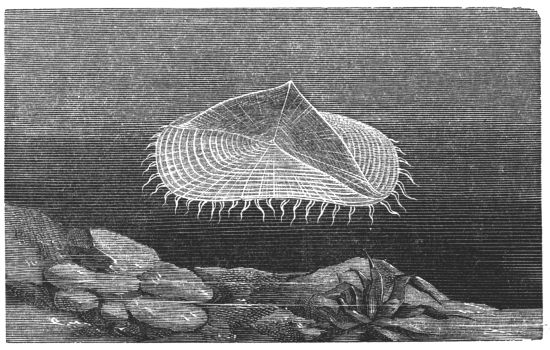
Fig. 93. Vilella limbosa (Lamarck).
The Vilellæ assemble together in great shoals; in tropical seas and even in the Mediterranean they may be seen in fine weather floating on the surface of the waves. As described by De Blainville, the body is oval or circular, and gelatinous, sustained in the interior of the dorsal disk by a solid sub-cartilaginous frame, provided on the lower surface of the disk with extensible tentacular cirri. The family includes four genera; namely, Vilella, the Holothuria of the Chinese, which the reader will most readily comprehend from the brief description we shall give of the Mediterranean Vilella (V. limbosa—Fig. 93), which has been very minutely examined by M. Charles Vogt, of Geneva, from whose work on the "Inferior Animals of the Mediterranean" our details are borrowed. V. spirans, sometimes called V. limbosa, was discovered in the Mediterranean, between Monaco and Mentone, by Forskahl, who most erroneously took it for a holothuria. On the upper surface of the animal is a hydrostatic apparatus, the object of which is to maintain its equilibrium in the ambient element. This apparatus consists of a shield and a crest, organs of which M. Vogt gives a very detailed description; but it is on the under surface that the principal organs of the Vilella are exhibited. These are not seen when the animal swims, because under such circumstances the vertical, oblique crest only is visible. The lower surface is concave, with a sort of mesial nucleus, presenting at the extremity of a trumpet-like prolongation, whitish and contractile, a sort of central mouth, surrounded by tentacular cirri, the external row being much longer than the internal ones. This was formerly thought to be the stomach of the Vilella. In the present day, this appendage is known to be the central polyp around which are grouped other whitish and much smaller appendages, the base being surrounded by little yellow bunches. These are supposed to be the reproductive organs. Between the crest and the shield numerous free tentacles present themselves, vermiform in appearance, cylindrical, and of a sky-blue colour, which are kept in continual motion.
The Vilella is therefore not an isolated individual, but a group or colony, in which the individuals intended to be reproductive are the most numerous, and occupy the inferior parts.
The central polyp, by its size and structure, is distinguishable at the first glance from all the other appendages of the lower surface of the body. It is a cylindrical tube, very contractile and pear-shaped, swollen into a round ball, or considerably elongated. Its mouth is round and much dilated; it opens in the cylindrical or trumpet part, which is contained in a sac in the form of elongated fusci, clothed in the whitish integuments which formed the body of the polyp when perfect. At the bottom of the sac two rows of openings are observed, which lead to a vascular network extending over the whole body; the membranous parts, while affecting various conditions in their arrangement, are nevertheless in direct communication with all the reproductive individuals.
It is a general characteristic of all colonies of polypi that the digestive cavities of the individuals composing them meet and inosculate in a common vascular system. The Vilellæ present the same conformation. Only in their case the vascular system is extended horizontally, this being the essential character of the union of all the individuals constituting the colony, with the canals common to all, in which the nourishing fluids circulate, elaborated for all and by all. It is a true picture of social communism realized by Nature.
The central polyp is alone destined to absorb the food. M. Vogt has always found in its interior cavity fragments of the shells of crustaceans, the remains of small fishes; and he has often seen the hard parts which resist digestion discharged through the trumpet-like opening. This central polyp nourishes itself and also all the others, but is itself sterile.
The tentacles are hollow cylinders, completely closed at the extremity. These are strong muscular tubes of considerable thickness, the interior of which is filled with a transparent liquid. They are enveloped in a strong membrane of a deep-blue colour. The epidermis is furnished with small stinging capsules, formed of a sac with comparatively thick walls. If this sac is compressed under the microscope it explodes, opening at a determinate part, and throwing out an apparatus forming a long stiff filament, which is implanted on a conical channel and surrounded with points. "I know not," says M. Vogt, "if all this machinery can re-enter the capsule after it has exploded; but I presume that the animal can extend itself and withdraw at pleasure. A tentacle of Vilella sufficiently compressed presents a surface bristling with these cirri, so as to resemble a brush. The tentacles themselves are in continual motion, and I have no reason to doubt that the observation of Lesson, who saw them cover small crustaceans and fishes, may be perfectly true. These stinging organs doubtless serve the same purpose as with other animals of the same class; namely, to kill the prey which the tentacles have enabled them to secure." Thus the Vilellæ have their javelins, as the Greek and Roman warriors had, and a lasso, as the cavaliers of Mexico and Texas have.
The reproducing individuals form the great mass of the appendages attached to the under surface of the Vilella. The form of the individuals is much more varied, inasmuch as they are extremely contractile. Nevertheless, they have considerable resemblance to the corolla of a hyacinth.
These reproductive individuals are, then, at the same time nurses. The Medusæ originating by budding in the case of those reproductive individuals, constitute the sexual state of the Vilellæ. They exist, in short, in two alternate states: the one sexual, producing eggs; in this state they are isolated individuals of the Medusadæ, which never group themselves or form colonies: the other aggregate state is non-sexual, and in it they form swimming colonies, under the special designation of Vilellæ.
The Vilellæ, so called by Lamarck, are found widely diffused in the seas of Europe, Asia, America, and Australia. One species, V. limbosa, is often taken on the southern coast of England. The animals are also met with far at sea, and often huddled together in considerable masses, old and young together.
Such is a brief account of the strange facts to which the careful study of the lower class of marine animals initiates us. Naturalists range along with them the Rataria and Porpita.
The Rataria have the body oval or circular, sustained by a compressed sub-cartilaginous framework, much elevated, having a muscular, movable, longitudinal crest below, and provided in the middle with a free proboscidiform stomach and a single row of marginal tentacular suckers. De Blainville was inclined to consider the very small animals which Eschscholtz termed Ratariæ as young and undeveloped Vilellæ. M. Vogt doubts not that the Ratariæ are young Vilellæ which have acquired, by little and little, the elliptical form, but that the limb is only furnished at a later period to the reproductive individuals. These Ratariæ are engendered, according to Vogt, by the naked-eyed Medusæ born of the Vilellæ, and owe their existence to the eggs produced by these Medusæ.
The Porpitæ constitute, like the Vilellæ, colonies of floating animals furnished with a cartilaginous, horizontal, and rounded skeleton, but they are destitute of crest or veil. The body is circular and depressed, slightly convex above, with an internal circular cartilaginous support, having the surface marked by concentric striæ crossing other radiating striæ, the upper surface being covered by a delicate membrane only. The body is concave below; the under surface is furnished with a great number of tentacles, the exterior ones being longest, and also with small cilia, each terminating in a globule, which sometimes contains air; the interior tentacles are shorter, simple, and fleshy. In the centre of these tentacula is the mouth, in form of a small proboscis, leading to a simple stomach surrounded by a somewhat glandular substance. The editors of the last edition of the "Règne Animal" only mention one species—P. Gigantea, a native of the Mediterranean and other warm seas, of a beautiful blue colour. Lamarck gives four species. De Blainville and others consider with Cuvier that they are only varieties, which Eschscholtz reunites under one species. In Fig. 94 we have represented P. Pacifica (Lesson), the disk of which is twelve lines in diameter, without comprehending the tentacles. This disk is finely radiated on the under surface with a brilliant argentine nacre. The membranous fold which surrounds it is cut into, leaving light and perfectly straight festoons. It is of a clear celestial blue colour, and very transparent. The tentacles are much compressed, very thin and cylindrical, of a light blue, and the glands are of an indigo blue colour. All the reproductive individuals, which are placed in the lower part of the body, are of a perfect hyaline white.
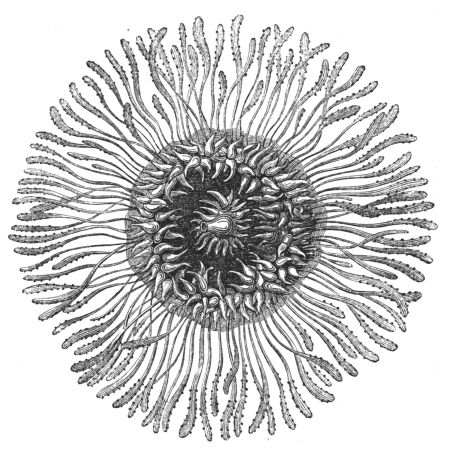
Fig. 94. Porpita pacifica (Lesson).
This beautiful Porpita was discovered by Lesson on the Peruvian coast, where it occurs in swarms closely packed on the surface of the sea. "Its manner of life," says Lesson, "is perfectly analogous to that of the Vilella. Their locomotion on the sea is purely passive, at least in appearance. Their disk laid flat on the surface upon the water-line, leaves them to float freely and in a horizontal direction, the irritable arms hanging all round them."
Physophora.
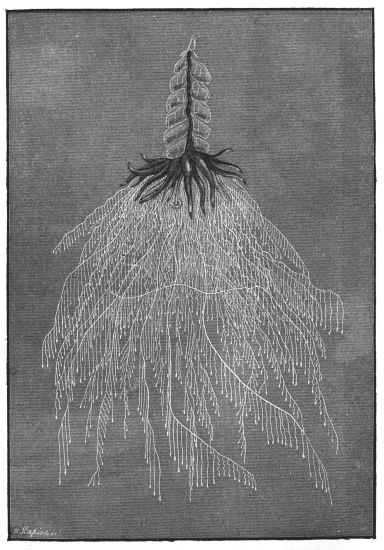
Fig. 95. Physophora hydrostatica (Forskahl).
This family includes the Physophora, properly so called, the Agalina, and the Stephanomina, for the history of which we are indebted to the curious observations of M. Vogt. Fig. 95 is a representation of Physophora hydrostatica, after M. Vogt's memoir. We see that the animal is composed of a slender vertical axis, terminating in an aërial bladder, carrying laterally certain vesicles, known as swimming-balls, which terminate in a bundle of whitish slender threads.
The aërial bladder is brilliant and silvery, punctured with red spots. The swimming-bladders are encased in a transparent and somewhat cartilaginous capsule, which is continued into the common median trunk, the latter being rose-coloured, hollow, and very contractile; in short, it presents very delicate muscular fibres, which expand themselves on the external fan of the capsule, and is closed on all sides.
The swimming-bladders are of a glass-like transparency, and of a firm, compact tissue. They are attached obliquely and alternately upon a common axis, presenting an exterior curvature, a round opening, furnished with a fine, muscular, and very contractile limb, and arranged like the iris of the eye. Their power of resistance is increased by certain horny hollow threads, which are in direct communication with the cavity of the vertical trunk, and have their origin in a common circular canal.
"The animal," says Vogt, "is enabled to guide itself in any direction by means of the swimming apparatus or air-bags. These, on opening, are filled with water, which is again ejected in the contractile movement, for their movements may be compared to that of the umbrella of the Medusæ. It is the violent expulsion of this liquid which enables the animal to advance diagonally through the water, a kind of motion which is the consequence of its organization; for where both rows of air-bags are working in the direction of the axis of the trunk, the organism will incline to the side which works most, but always in such a manner that the aërial vesicle will be borne forward."
In its lower parts the trunk expands, becomes flat, and winds itself in a spiral. It is hollow, and encloses a transparent viscous liquid, in which very small granules are observed, which appear to be the result of digestion. This disk is attached to three different sorts of appendages; we shall first address ourselves to the tentacles.
These form a crown or bundle of vermiform appendages, of a reddish colour, over an inch in length, and which are kept continually in motion: these are formed of a glass-like cartilaginous substance; they are conical tubes, closed on all parts except at the point where the tentacle is attached to the disk. Their cavity is filled with the granulous liquid already mentioned. On the under surface of the disk, and to the inside of these tentacles, the polyps and fishing-lines are attached.
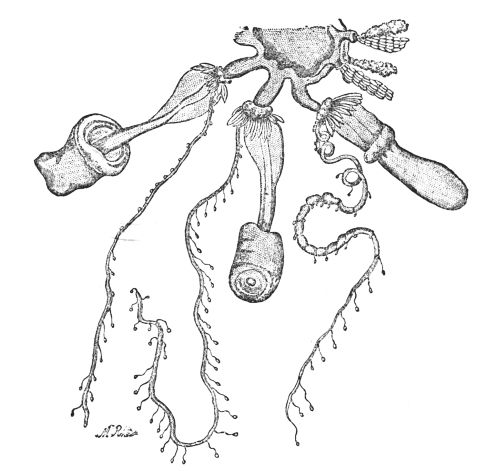
Fig. 96. P. hydrostatica, with a portion of the disk, three polyps, and reproductive clusters attached.
The anterior part of the polyp is formed of a glass-like substance, which changes its form in the most varied and surprising manner. It bears a roundish mouth at its summit. In its posterior part the polyp presents a straight hollow stem, of reddish colour; but near to this red stem we find a thick tuft of cylindrical appendages, from the middle of which springs the extensible and contractile filaments which Vogt calls the fishing-lines (fil pêcheur), and of which he has given the following very strange account:
"Each of these appendages consists of an assemblage of cylindrical tubes somewhat resembling and analogous to a filament of confervæ. All these tubes are traversed by a continuous canal, which originates in the internal cavity of the stem of the polyp. Each fragment of the line is capable of a prodigious extent of elongation and contraction; but where completely drawn back the pieces fold themselves up somewhat in the manner of a pocket foot-rule. It is to the combined effect of contraction and the unfolding of the pieces that these lines owe the marvellous changes of length which they present." In Fig. 96 are represented the polyps and fishing-lines of P. hydrostatica, with a portion of the disk and two pairs of reproductive clusters.
In this figure it will be observed that each fragment or joint has implanted, near the articulation, a secondary line, which bears the stinging organ. Each of these filaments consists of three parts: a straight stem, muscular, contractile, and hollow, the cavity of which communicates with that of the trunk which carries it; a middle part, a sort of tube containing, in a considerable internal cavity, a transparent liquid; finally, an inflated stinging organ, which terminates the apparatus. This last is egg-shaped, and consists internally of a hyaline substance of cartilaginous consistence, in the interior of which we find a great cavity, which opens from within, near the base of the capsule; to the inside of this cavity a second muscular sac is attached all round the opening of the capsule, in such a manner that the opening leads directly into the cavity of the sac. This cavity conceals in its interior a long filament usually rolled up in a spiral, as illustrated in Fig. 97, where the two urticant capsules of the stinging apparatus of Physophora hydrostatica are represented, one of them being a section, magnified by twelve diameters. This spirally rolled-up filament consists of a large quantity of very small, hard, sabre-shaped, corpuscular bodies, supported the one against the other, and having their points turned inwards. These objects Vogt terms "urticant sabres:" the extremity of the filament consists of curved corpuscles, larger, of a brownish yellow, very strong, and with a double point. M. Vogt had also opportunities of observing the action of these stinging capsules. He has seen them burst naturally, and he has also obtained artificially the same result. In the former case the filament issues from the opening left at the base of the capsule with a sort of explosion. "The use," he says, "of the fishing-lines" becomes evident when we see a Physophora in repose in a vase large enough for its full development; then it takes a vertical position; the lines elongate themselves more and more, by unfolding one by one the secondary lines with stinging capsules, and the Physophora now resembles a flower posed upon a tuft of roots, with extremely long and delicate rootlets reaching the bottom of the vase. But in the case of the Physophora the living roots are in continual motion. Each line is elongated, foreshortened, and contracted in a thousand ways. The least movement of the water causes the stinging capsules to be suddenly drawn up, the lines hauled in most rapidly being those near the crown of tentacles. This continuous play of the lines has no other object than to attract the prey destined to feed the polyp, and we cannot find any better comparison for them than the fishing-lines to which they have been compared. The moment that some small microscopic medusæ, larvæ, or crustaceans come within the sphere of those redoubted lines, it is at once surrounded, seized, and led with irresistible force towards the mouth of this polyp by a gentle and gradual contraction of the line; the stinging organs, complicated as we have seen them to be in the Physophora, thus serve the same purpose as the stinging organs disposed on the arms of the Hydræ, or on the external surface of the tentacles and prolific polyps of the Vilellæ.
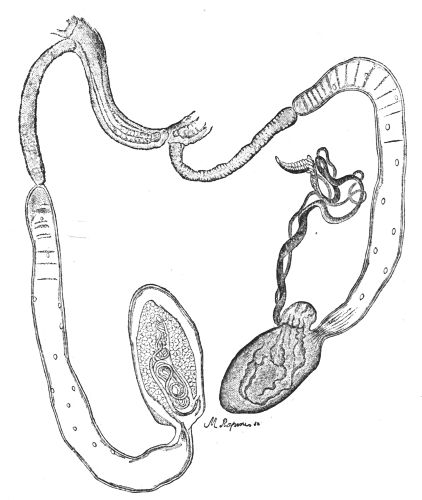
Fig. 97. Offensive apparatus of Physophora hydrostatica.
Can there be any animal form more graceful than Agalma rubra, which is reproduced in Plate VII. from Vogt's Memoir? This beautiful creature is common in the Mediterranean, on the coast near Nice, from November till the month of May. Towards the middle of December Vogt found nearly fifty individuals in the space of an hour, opposite to the Port of Nice, all following the same current, a prodigious quantity of Salpæ, Medusæ, and small Pteropodean Mollusks accompanying them.
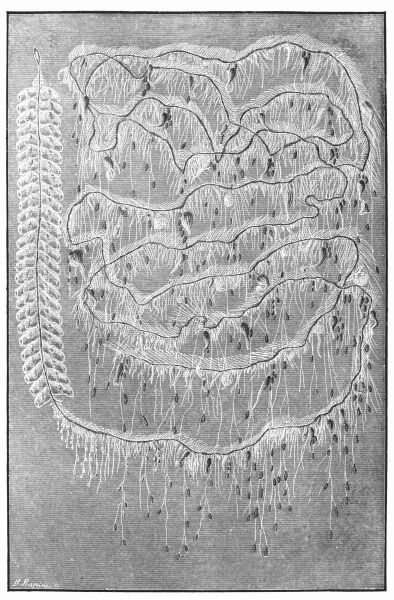
Plate VII.—Agalma rubra, three-fifths natural size.
"I know nothing more graceful," says Vogt, "than this Agalma as it floats along near the surface of the waters, its long, transparent, garland-like lines extended, and their limits distinctly indicated by bundles of a brilliant vermilion red, while the rest of the body is concealed by its very transparency; the entire organism always swims in a slightly oblique position near the surface, but is capable of steering itself in any direction with great rapidity. I have had in my possession some of these garlands more than three feet in length, in which the series of air-bags measured more than four inches, so that in the great vase in which I kept them the column of swimming bags touched the bottom, while the aërial vesicle floated on the surface. Immediately after its capture the columns contracted themselves to such a point that they were scarcely perceptible, but when left to repose in a spacious vase, all its shrunken appendages deployed themselves round the vase in the most graceful manner imaginable, the column of swimming-bladders remaining immovable in their vertical position, the air-bags at the surface, while the different appendages soon began to play. The polyps, planted at intervals along the common trunk of rose-colour, began to agitate themselves in all directions, taking a thousand odd forms; the reproductive individuals, like the tentacles, were contracting and twisting themselves about like so many worms; the tentacles were stirred, the ovarian clusters began to dilate and contract, the spermatic air-bells agitated the waters with their umbrellas, like the Medusæ; but what most excited my curiosity, was the continuous action of the fishing-lines, which continued to unroll and contract in a most surprising manner, retiring altogether sometimes with the utmost precipitation. All who have witnessed these living colonies detach themselves reluctantly from the strange spectacle, where each polyp seems to play the part of the fisherman who throws his line, furnished with baited hooks, withdrawing it when he feels a nibble, and throwing again when he discovers his disappointment. These efforts continue in full vigour for two or three days, and I have succeeded sometimes in feeding them with the small crustaceans which swarm on our coasts."
Of the "personelle" of these colonies a few words will not be misplaced. The common axis of the Agalma is a hollow muscular tube, the length of which may be three feet, and its breadth an eighth or tenth of an inch; it is traversed by a double current of granulous liquid; at its summit is the aërial vesicle; beneath are the swimming vessels. These are disposed along the trunk in a double series, attaining sometimes the number of sixty; their structure is analogous to the same organs in the Physophora.
In examining the posterior portion of the trunk, traversing polyps are observed at intervals, whose base is surrounded by a cluster of reddish grains, each of which is armed with a line, and with its surrounding filament, terminating in a tendril of a red vermilion colour, which is a perfect arsenal of offensive and defensive arms. There we find "sabres" of divers sizes, and poniards of various forms, the whole constituting a truly formidable stinging apparatus.
These warlike engines, these arms of attack and defence with which man surrounds himself, Nature has freely bestowed on these little creatures with which the ocean swarms in some places. It might be said that, after having created these graceful creatures to ornament and decorate the depths of the ocean, the Creator was so pleased with His work that He furnished them with arms for their protection and defence against all attacks from without.
Among these creatures we may note the pretty Apolemia contorta of Milne Edwards (Fig. 98), which also inhabits the Mediterranean, and particularly the coast of Nice, and is no less admirable in its structure than Agalma rubra. This elegant species is often met with in the Gulf of Villafranca, near Nice, and has been figured and described by Milne Edwards, Charles Vogt, and also by M. de Quatrefages, who asks the reader "to figure to himself an axis of flexible crystals, sometimes more than a mètre (forty inches), all round which are attached, by means of long peduncles or foot-stalks equally transparent, some hundreds of bodies, sometimes elongated, sometimes flat, and formed like the bud of a flower. If we add to this garland of pearls of a vivid red colour, an infinity of fine filaments, varying in thickness, and give life and motion to all these parts, we have even now only a very slight and imperfect idea of the marvellous organism." The air-bells in Apolemia contorta consist of a mass having the form of an elongated egg cut in the middle. They are arranged in a vertical series of twelves, and the axis which supports them is terminated by the aërial vesicle. This axis is always arranged in a spiral form, even in its greatest expansion, is of a fine rose tint, and flattened into the form of a ribbon; it is marked in all its length with asperitics or hollow dimples, in which the filamental appendages originate.
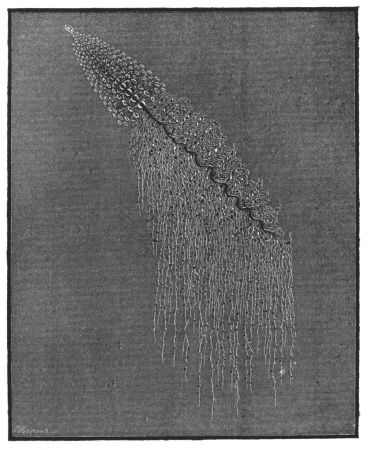
Fig. 98. Apolemia contorta, one-third natural size (Milne Edwards).
The nursing polyps have been called poboscidiferous organs by Mr. Milne Edwards, who has studied them carefully. They are rendered conspicuous at a glance by the bright-red colour of their digestive cavity and their extreme dilatability. At the base of their stems the very delicate filaments called fishing-lines are attached, which are furnished with a multitude of stinging tendrils of a reddish colour. These tendrils slightly resemble those of the Agalmæ, and the sabre-like weapons are not wanting.
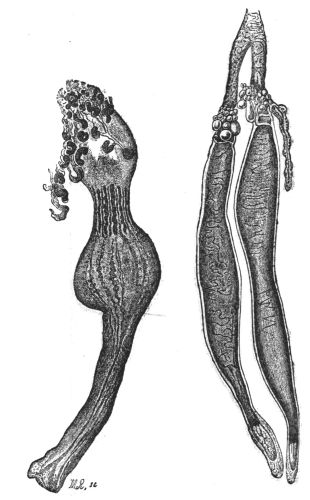
Fig. 99. Fig. 100. Apolemia contorta,Apolemia contorta, magnified 12 times. reproductive pair, magnified 12 times.
Between the nursing polyps are placed in pairs the reproductive individuals, having the form of an elongated tube very dilatable, and closed at the free end. They have, then, no mouth! Milne Edwards calls these "vesicular appendages," and M. Kœlliker, tentacles. The buds arranged at the base of each prolific individual vary; but, according to M. Vogt, they are always there in pairs—a male and female at the base of each stem. Figs. 99 and 100 represent the colony we have endeavoured to describe, 99 being the nursing individual of Apolemia contorta magnified twelve times, 100 representing the reproductive pair under the same magnifying power.
The Diphydæ.
We have seen that the Physophora, the Agalma, and the Apolemia have for the use of the colony a vast number of swimming vesicles and a terminal aërial vesicle. It is much the same in the Prayæ or Diphydæ. In this family a great number of natatory vesicles are connected with the terminal aërial vesicle, as in Fig. 101, Praya diphys. This species is widely diffused in the sea which bathes the Nicean coast, but it is very difficult to procure perfect specimens. M. Vogt found fragments more than three feet long which swam on the surface, and was in its state of contraction not more than a finger's length. This species has been met with at Porta della Praya and at San Yago, one of the Cape de Verde islands.
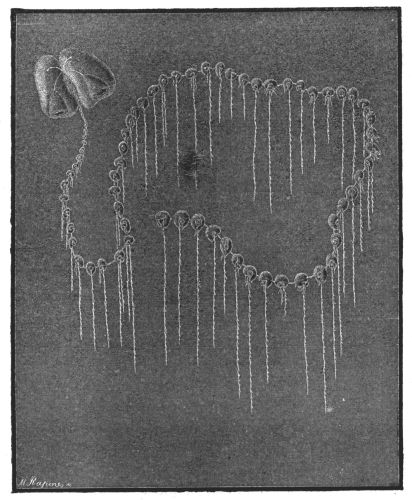
Fig. 101. Praya diphys (Blainville).
The colony of the Praya presents two great locomotive bell shaped masses, between which the common trunk is suspended, and to which it can retire. This cylindrical trunk, which is thin and transparent, carries from space to space certain groups very exactly circumscribed and individualised. Each of these groups consists of a nursing polyp, having its fishing-line with a special floating air-bladder, a reproductive bud male or female, and a protecting casque enveloping the whole.
Another species having a great resemblance to the Praya is Galeolaria aurantiaca (Plate VIII.), or orange Galeolaria, which is represented on the opposite page, borrowed from the fine "Memoir of the Inferior Animals of the Mediterranean," by Carl Vogt. Here we find only two great floating bladders placed at each extremity of a common trunk, and serving the purpose of a locomotive apparatus to the whole colony. This trunk carries in like manner polyps placed at regular intervals forming isolated groups, provided each with its protecting plates. But there is no special swimming apparatus for each of these groups. Moreover, each colony is either male or female.
Physalia.
Let us finally note among the Siphonophoræ a zoophyte which has attracted great attention, and has been described under many names. Sailors call it the sea-bladder, from its resemblance to that organ; it is also known as the Portuguese man-of-war, from its fancied resemblance to a small ship as it floats along under its tiny sail. Naturalists after Eschscholtz call it Physalia utriculus, from the Greek word φυσαλὶϛ, a bubble, and utriculus from its stinging powers. It was long thought that the Physalia was an isolated individual. But, according to recent researches, they form, like the species already described, an animal republic.
Let us imagine a great cylindrical bladder dilated in the middle, attenuated and rounded at its two extremities, of eleven or twelve inches in length, and from one to three broad. Its appearance is glassy and transparent, its colour an imperfect purple, passing to a violet, then to an azure above. It is surmounted by a crest, limpid and pure as crystal, veined with purple and violet in decreasing tints. Under the vesicle float the fleshy filaments, waving and contorted into a spiral form, which sometimes descend perpendicularly like so many threads of celestial blue. Sailors believe that the crest which surmounts the vesicle performs the office of a sail, and that they tell the navigator "how the wind blows," as they say. With all respect to the sailors, the bladder-like form, with its aërial crest, is only a hydrostatic apparatus, whose office is to lighten the animal, and modify its specific gravity. Mr. Gosse thinks otherwise, however.