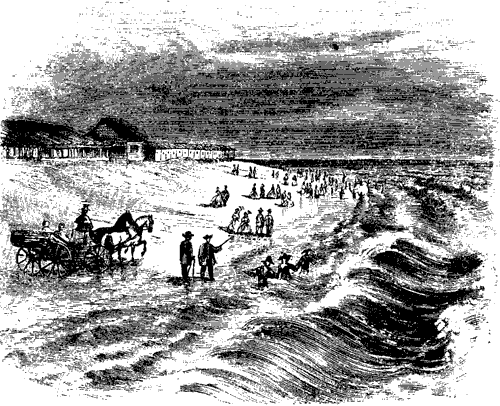
NEDDY'S SAND-BANK.
Reading edition
On lovely summer afternoons, when the sky is blue, and the sea bluer, I take my books or work, and go out to sit under a great oak-tree that stands at the top of a sand-bank, which slopes gently down to a broad, white, beach.
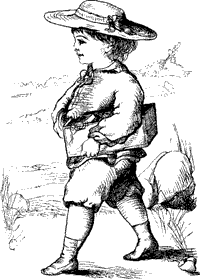
This sand-bank is a wonderful place for the children. Every fine day Neddy takes his box of playthings, and marches off to the sand-bank; and I think, as I kiss his dear rosy cheeks, what a nice, clean boy he is in his linen blouse, broad-brimmed hat with blue ribbons, white stockings, and neat buttoned boots. He returns after a few hours, looking like a little savage.
"Just fit to go into the wash-tub," Dinah says; and she is right.
What do they play on the sand-bank? I will tell you what they did yesterday, while I sat under the oak-tree and worked, and listened to their prattle.
"Let's build cities to-day," said Tommy Abbott. "Oh, yes!" said Jamie Newton. "I will build Boston," chimed in Neddy: "I don't know much about other places." After each had selected a city to build, they were silent for some time.
But by and by Neddy looked up, and called to me, "Oh, do come down here, mamma, and see my Boston!" So I climbed down the bank to visit his city. He had scooped a hole in the sand, lined it with clay, filled it with sea-water, and stocked it with his shining tin fish. Of course I knew at once this was the pond on Boston Common.
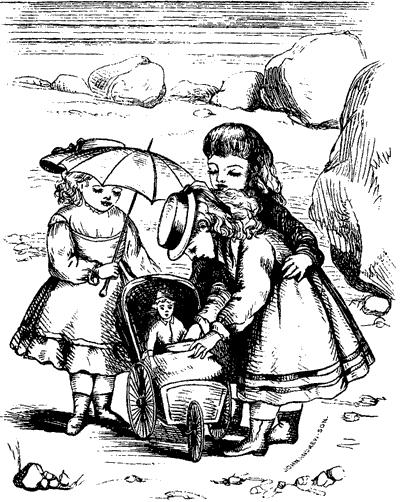
Jamie Newton, who studies geography, and knows all about great cities everywhere, made a model Philadelphia, with its long, wide streets. Jamie's streets were so clean, and so beautifully shaded with sprigs of evergreen, that Mary Whitman said her grandest doll, Arabella Rosetta, should take a nice ride through them. So Rosetta was set up in her carriage, and one tucked the crimson afghan about her dainty feet, while another opened her very best sky-blue parasol, (for Rosetta is particular about her complexion), and Mary put on her hat with the blue plumes, and pink roses, smoothed down her flounces, and said, "Be a good girl, Rosy. Don't stay out after dark, for the dew will spoil your clothes."
By and by it grew late. The sun sank down into the sea; while the moon, broad and full, rose from behind the hill; and I said, "Come, Neddy, we must run home to tea."
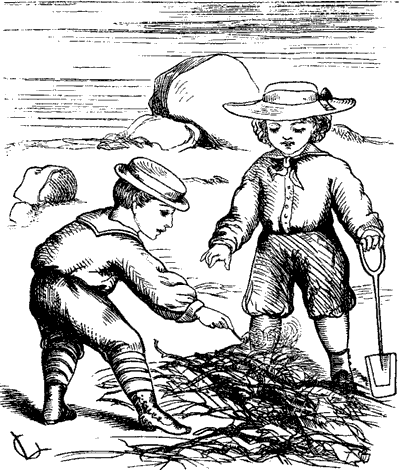
But Tommy Abbott, who had built a most wonderful Chicago, begged for a match to burn his city with. So the children gathered a heap of sticks and dry leaves; and Tommy set fire to the pile, and up and away flamed the beautiful city. Then we all went up to the hotel together, and very soon tea was ready; and it was a wonderful thing to see how the children disposed of bread and milk, baked sweet apples, and gingerbread.
After we went up to our room, I wrote this story, and read it to Neddy. How his eyes sparkled with delight! "It's just as true as I live, every word of it," he said as I finished.
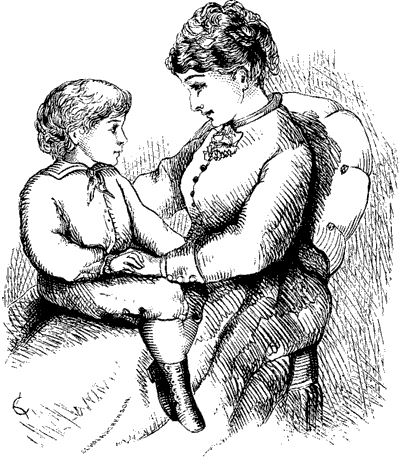
"But, mamma, you forgot little Rose Ellsworth's town. She made a real hill, and covered it with grass, and dotted it all over with violets; and Daisy lent her a cow from her 'Noah's Ark;' and we made it stand up under a tree, and, if it had only whisked its tail, it would have looked almost alive.
"I think, mamma," he continued, "that Rose is the nicest little girl here. I've painted her picture in my album."
So I was not surprised, while looking over Neddy's pictures, to see that he had wasted a great deal of paint in trying to display Rose's pink cheeks and lovely golden hair: He had painted her cheeks redder than the reddest cherries you ever saw.
S. B. T.