APPENDICES
Reading edition
APPENDIX I PHYSICAL CHARACTERISTICS
Physically, as may be judged from the accompanying tables, there is a wide margin for dissimilarity among these tribes. Their appearance is nearly as varied as their speech, more so in fact, in that there is much diversity of type even among individuals of the same speaking-group. I have seen a Boro as dark as a Witoto, while his fellow-tribesmen may be yellow as a Chinaman. It is, of course, possible that the darker Boro are sons of Witoto women. The custom prevalent in all the tribes of adopting the young children captured from their enemies, makes of necessity for great changes in type even in one household, so that despite the preference for group endogamy that undoubtedly exists there are few households where cross-breeding is not in evidence.
In stature the Indian is small, which I take to be a result of depression due to his forest environment; but the body is well-balanced and upright. Among the tribes I visited the Andoke as a speaking-group were, so far as I could observe, the largest in build and the tallest. The Okaina may possibly come into the same scale. The Karahone represent the mean, while the Maku are invariably small, a low class and badly-fed people. The average measurements of the tribes are best gathered from the types tabulated. I made the average height to be for men 5 feet 6 inches; and for women 4 feet 10 inches.[417] I certainly remember one case of a man among the Andoke nearly 6 feet high, but can recall no other. The women were never much over the average of the female type. I give my measurements for what they are worth, but unfortunately I did not know the correct way in which they should have been taken; they were made with a centimetre rule, but not on the correct anthropometrical principles. The Indians stood against the side of the house to be measured, and I registered their height by the simple process of placing the ruler on the head and measuring its distance from the ground.[418]
The bone of the Indian’s skull is thick, and both dolichocephalic and brachycephalic types are in evidence.[419]
The Indian does not run to fat, rather is he inclined to be thin, but strong, muscular and healthy, with rounded outline and finely-developed chest. The Witoto, however, though broad and strong, fail in the limbs, their legs especially lack development. On this point my observations tally with Robuchon’s notes. The Tukana have a magnificent physique. The Andoke, though some are tall, with large frames, as a group incline more to breadth of both face and figure. The tribes of the Tikie are of a low grade.
The Indians as a rule, have hands of an average size, with stumpy fingers, and short, spatulate nails. Constant manual labour of some sort would seem to keep the nails naturally of a normal length. I never remember seeing an Indian pare his nails, but fear this is a point that may have escaped my observation. The men’s arms are frequently distorted, and the shoulders gain an artificial breadth by the use of ligatures to swell the muscles of the upper arm by means of constriction.
The natural symmetry of the Indian’s person is further enhanced by slight hips, flat buttocks. The abdomen seldom protrudes though the navel is prominent, but not to the same extent as is found among negroes.
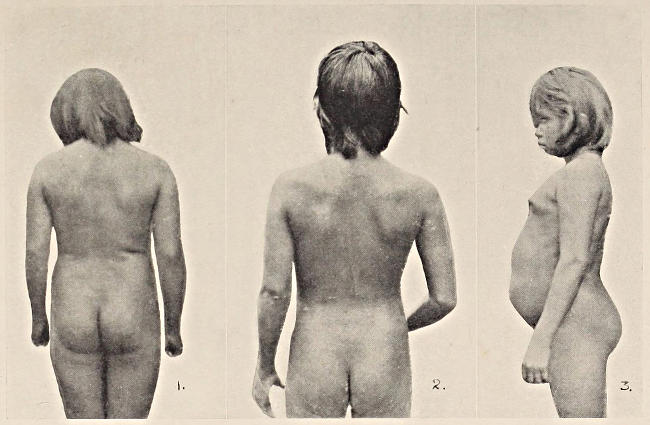
PLATE LI.
1 & 2. WITOTO TYPES. 3. WITOTO FROM KOTUE RIVER
The men generally have large feet,[420] with long toes. Both men and women have very prehensile toes, and will pick up objects off the ground with their feet rather than trouble to stoop. They are flat-footed.
The Indian does not extend his legs when he walks, as Europeans do. He moves rather with the action of an unathletic woman. His step is on an average about two-thirds of an ordinary man’s thirty-inch pace. The foot is of necessity raised well above the ground, on account of the lianas which would trip the slovenly walker. This does not make for rapid progression. But though he walks more slowly than the white man, the Indian can keep up a jog-trot of about five miles an hour for tremendous distances. Moreover his wind is far better than any white man’s. At a push, to get away from hostile neighbours for example, he is capable of going sixty miles a day. In ordinary circumstances he walks nowhere, except about the house and compounds. Consequently he has developed a different set of muscles from the ordinary pedestrian.
As the Boro are more harassed than the Witoto they march as a rule in silence, while the Witoto are noisy generally; but a march in country that might prove hostile is done in silence by every tribe for obvious reasons. In friendly country the Indians go along chattering and joking, or in silence, just as the spirit moves them: there is no rule. The necessity for walking in single file, and the invariable difficulties of the route, do not, however, altogether encourage conversation. These restricted paths have a further influence upon the Indian. Often enough it is necessary to place one foot directly in front of the other in order to find any footway at all. This is the probable reason, or one of the reasons, why the men walk with a straight foot, a specially needed precaution on the narrow bridges, that are merely formed of single trees. The women walk in rather a stilted fashion, with the toes turned inwards at an angle of some thirty degrees, on account of the tight ligatures they wear below the knee and above the ankle, which cause the calf to swell to enormous proportions, as has been noted. This may not inconceivably have a contracting effect in the angle of the foot. It is regarded as a sign of power if the muscles of the thighs are made to come in contact with each other when walking.
That the men run and jump well is due to their good wind, but they have no pace, and could easily be outstripped over a limited course by an average white man in good condition. But the women neither run nor jump with any facility, as they all suffer from varicose veins, caused by the ligatures to some extent, but also by the burdens they carry, and from labouring in the fields when in a condition unsuited to such physical exertion. As weights are carried on the back suspended by a strap across the forehead, the tendency to stoop or grow round-shouldered is counteracted, for the pull of the strap brings the head back, and the strain is taken by the muscles of the neck.[421] Water is always carried in vessels balanced on the head, and though the Amazonian Indian may not have the superb carriage of her sisters in the East, yet the young girls at least are very well set up, though with advancing age a lifetime of field work and burden-bearing may bow the elder women till they walk, as described by Robuchon, “in an inclined position.”
The Indian woman has generally a beautiful figure, well proportioned and supple, with high, straight shoulders. Untrammelled by dress she is graceful and free in her actions. Before marriage the women have very small breasts, but after they have borne a child the breasts develop considerably. Old women, probably on account of poorer nourishment, are very flat-chested, and one never sees a woman with very pendent breasts. In the older women they atrophy.[422]
There is great individuality in the faces of the Amazonian Indians. A tribe is no herd of sheep, differentiated only to the experienced eye of the shepherd; the dissimilarities of countenance are immediately apparent, and even to the most casual observer Indians show marked variety of face and colour and feature. Like all savages the Indians admire most the lightest coloured skins. The divergence of colour is both tribal and racial; and as a rule it will be found that the higher the type the better the physical development, and the greater the mental capacity, the lighter will be the skin. On account of the saturation of the atmosphere the Indians mostly have skins of a good texture. I never found rough skins on Indians in these districts.[423] Of all the tribes the Menimehe have the lightest complexions, and they are invariably fatter and in better condition than the surrounding tribal groups.
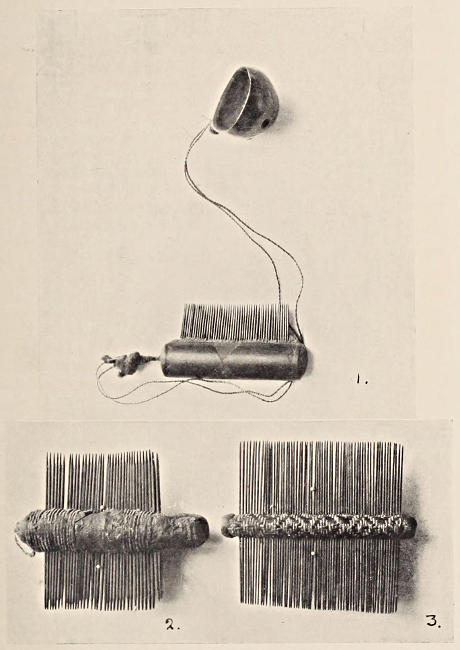
PLATE LII.
COMBS—1. ANDOKE COMB WITH NUTSHELL CUP FOR RUBBER LATEX
2. WITOTO COMB
3. BORO COMB
I have mentioned the custom of covering a new-born infant with rubber milk either for warmth or to protect the skin; the women daub themselves with gum and a yellow clay because it is supposed to preserve the skin; but none of these peoples use any oil for lubricating purposes, and they are free from any noxious-smelling secretion. The smell of a negro they consider most offensive, but do not extend this dislike to the white man. The Indian owes his immunity from this unpleasant trait in part because he does not perspire at all freely, perhaps to difference of glandular secretion, and in part to frequent ablutions. Yet, though even a dirty people like the Witoto will bathe at least three times a day and most tribes far more often, these Indians, as has already been noted, are by no means free of body parasites. Head lice may be said to be universal, and in addition jiggers and the red tick that drops off leaves in the forest and burrows under the human skin, there is another burrowing parasite that invades the human body to lay its eggs, which is extremely common among these people. One is apt to be infested with these pests merely from touching an Indian, certainly by lying in an Indian hammock. The parasite causes considerable irritation, and the local remedy is to apply babasco juice.
Except in the case of a medicine-man, who never depilates, hair is looked upon as dirt; therefore it is always removed, only the hair of the head being permitted to grow. Depilation is usually done just before a dance. The method of removal adopted is to cover the hirsute parts with rubber latex. This is allowed to dry, so that a grip can be obtained and the hair removed simply with the forefinger and thumb or by means of two small pieces of cane. Two persons will, as far as facial hairs are concerned, depilate one another. It is universally considered a sign of cleanliness to remove all the body hairs, and even to pull out the eyebrows and eyelashes.[424] That the eyebrows are not removed for æsthetic purposes is proved by the fact that the effect is promptly reproduced with paint. It is not easy to get information with regard to the removal of body hair,[425] but I was able to obtain a little from a Karahone slave boy who was with an Andoke tribe I met. He told me that the Karahone did not depilate the hair of the face. This is the one exception among these tribes.
On the authority of Schomburgh, im Thurn states that occasionally when there is great demonstration of grief at a burial “the survivors crop their hair.” So far as my experience went none of the Indians of the Upper Amazons ever “crop” the hair close, except that of young girls when danger threatens. Should there be any reason to suppose that some man is inclined to steal a girl, her hair might be closely cut as a preventive measure to save the child from being kidnapped, for a hairless woman is looked upon as a social outcast among the tribes. The young Indians have long hair that often reaches to below the small of the back, but this length does not continue, and it is a varying quantity among the adults.
The hair is uniformly scattered over the scalp, and is coarse in texture, lank, and very abundant. Baldness is unknown, and greyness, as with the negroes, is very rare. I have only seen grey hair on a few people of apparently unusual age. In colour it is almost uniformly black, a red- not a blue-black, which gives it an occasional brown glint. Some of the children are lighter-haired, but such a variation as red hair is unknown, though in the sunlight the women’s hair may take a reddish gleam. Both women and children have finer hair than the men, and with young children it is often quite downy. As a rule it is straight, but among the Tukana wavy hair is more evident.
Among the greater part of these peoples the hair is not cut, either by the men or women. The Karahone men cut their hair to the shoulders; the Boro women, and in some cases the men, trim theirs round very much as is often seen among our small girls. Sometimes the Witoto women trim their lank locks. This is done with a knife if they have one, otherwise it is singed. With the Menimehe and Karahone it grows very low on the forehead. The Tikie tribes have most untidy and ill-kept hair.
Owing to race—possibly of Mongoloid origin—and to the prevalence of depilatory customs, the men have scanty beards, if any.
On the whole these Indians hold their own in the matter of good looks, even the lowest types are not repulsive in appearance. I mean, of course, to the eye of the stranger, not according to their individual standard of beauty. In feature both the various language-groups and the tribes of each group show many grades. It may be taken as usual that with a lighter skin the nose and lips are thinner than among those with darker colouring. The Boro and the Resigero, both comparatively light-skinned groups, have thin lips. This naturally follows from what I have already said as to colour and type, the higher type possessing, as would be expected, the more refined features. The Boro, taken as a group, are the best looking, many of them are very handsome, and some of the Andoke also are notably well favoured in appearance. “Noble” is Koch-Grünberg’s decision on the question of the Tukana tribesmen’s appearance. The Okaina, also, must be classed as good looking.
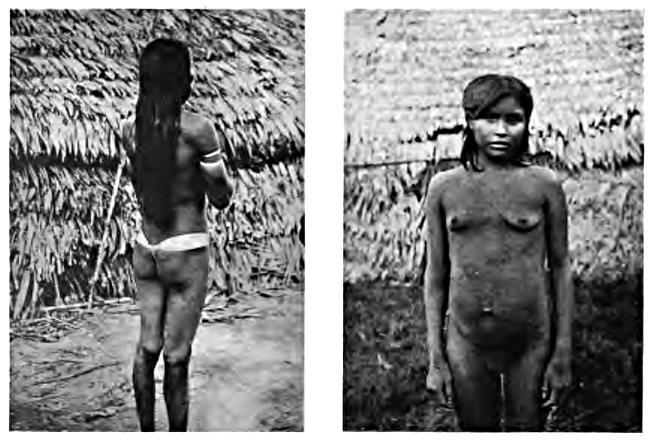
PLATE LIII.
BORO TRIBESMAN FROM THE PAMA RIVER
A MENIMEHE CAPTIVE
It seems somewhat of a contradiction after this to remark that a squint is so common a trait among these tribes that one cannot but notice immediately any one with normal eyes. This is, however, with the exception of the Tukana, very prevalent among all these tribes. The eyes are not large, and are deeply set. They are black in colour with occasional yellowness of the eyeball, but never to the degree seen in the bilious eye of the negro. Both eyesight and hearing are very acute. In the bush, or in the dark, the tribesmen have most penetrating sight, and can distinguish details at a glance where the ordinary white man can see nothing of any description. In the sun, or any strong light, their sight is inferior.
It is difficult to judge what an Indian’s ears would be like if left to Nature’s fashioning, as they are invariably distorted to more or less degree by artificial means. They are frequently prominent, and do not appear to be set close to the head in any case. The large ear-plugs will pull the lobe of the ear half-way down the neck and more. Nose-boring is not carried to so disfiguring an extent. The Boro, especially the women of those tribes, bore the wing of the nose—a custom peculiar to this people—as well as the septum, which is also bored by Muenane and Witoto women, but the nose pins are small, and do not distort the feature as the ear-plugs do the ear. The Tukana’s nose has naturally large alæ. The tribes on the Tikie also have broad noses, with prominent cheek-bones, a characteristic noted by Wallace among the Kuretu.[426]
The Indian’s chin is narrow, small, rounded, and, especially in the case of the women, retreating. There is no dimple or cleft. The teeth are big and even, and very rarely found projecting.
The Indian’s expression is stolid enough ordinarily, but when talking he has much play of feature, and he will gesticulate freely under the influence of coca. Among the tribes to the south of the Japura a man will look a stranger straight in the face, but north of that river the native has a more furtive glance. The Indian’s gaze is intense.
They are never demonstrative of affection, and, though they will touch a white man as a salutation, never touch each other. By this I mean that when friendlily disposed an Indian would return a white man’s salute, the offer of the hand, but no Indian would grasp a fellow-tribesman’s hand, or put an arm around his neck. Kissing is unknown among these people. Crevaux records that he saw children among the Calina kiss to show affection, but the nearest approach to an embrace I ever witnessed was a slap on the shoulder, probably under the shoulder-blade, which is the salutation between great friends. Mothers of course fondle their children, and I have even seen a woman with her arm round her husband, but such an exhibition is considered barely decent. Neither do they exhibit grief by weeping. The girl children cry occasionally, but no child ever screams; and adults may whine but never shed tears.
As regards brain-power, the Boro group are the most intelligent, with the possible exception of the Menimehe. I invariably found the Boro exceedingly anxious to learn from me anything they judged might be of utility to themselves. They evinced a definitely intelligent interest, not to be confounded with the ordinary curiosity of the untaught. Among all these peoples the power of mental development ceases after they have attained puberty.
One limitation that is to be noticed with all of them is their inability to grasp any chronological data. They have nothing in the way of a tally of any description, and in speaking use the vaguest expressions only for reckoning. It is my opinion, based on observation of the number of generations still living at any one time, that these people live to an advanced age. They grow elderly at from twenty-five to thirty years, and may, under favourable conditions, live another half-century or more. This is borne out by the fact that I found occasionally a man with grey hair—a sign in all coloured peoples, and I believe in Mongoloid peoples, of great age. But no Indian can give any information as to his own age, or the age of his children. For him age is non est, time of little value. He cannot tell you when he came to the neighbourhood in which you find him, though obviously only a year or two may have been passed there. His day is regulated to some extent by the rising and the setting of the sun, portioned only by its height in the heavens. If but occasion serve, one or other of the warriors, drunk with coca, will talk the whole night through, excitedly recounting some folk-tale, or endlessly boasting his feats in the hunt or on the war-path. The interruption is not resented by his comrades, nor does it seem to interfere with their slumber. Indians, in fact, never appear to sleep much, or rather they sleep little and often, as chance offers. Night is no more the time of repose than day, except in so far as darkness puts a stop to certain of their avocations. When sleeping on the ground an Indian curls up on one side with his knees to his chin, or he sleeps on his stomach, seldom lying on the back.[427]
Though, as has been noted, they sleep with no wrap or covering, these Indians are most sensitive to climatic changes. They are decidedly susceptible to a difference of locality, and, more than this, in a land where the extreme contrast of temperature is no more than twenty degrees throughout the year, with an average of half that total, they are affected by even slight variations of temperature. They fear the cold of the early morning, and, accustomed as they are to the half-lights of the forest, they dislike sunshine, and prefer to keep in the shade, fearful of sun-sickness if exposed to the sun.
It has been suggested by some travellers that the curious habit of the Indians of inducing sickness every morning by means of a feather was based on the idea that any food which was retained in the stomach all night must be unwholesome and ought to be removed immediately.[428] I have often seen the Indians do this, but always put it down to a desire to rid the stomach of the non-absorbent constituents of the coca powder, as only the men, who alone may take coca, resort to this practice. The Indian in the early morning drinks an infusion of herbs, as I have already mentioned, which induces the removal of such substances by vomiting, although not taken primarily for this purpose.
Sickness is also secured with the fingers after a prohibitive quantity of cahuana has been drunk, as afore noted, during a big dance. Having imbibed to his utmost capacity, the Indian adopts this simple expedient to enable him to drink again.
The tribes of the upper Amazons are, comparatively with others, very cleanly. But it is only comparatively. The Boro are the cleanest, and the Witoto unquestionably the most dirty. Immediately on rising all Indians resort to the river, but except among the Boro and the Resigeros, who rub themselves with sand, the performance can hardly be called washing, it is simply bathing. The Nonuya and Muenane are cleanly, like the Resigero. Even the Andoke, though they use no sand, are cleaner than the Witoto, for this tribe never wash, and only take a dip two or three times a day, while at least five times is the ordinary rule with the majority.[429]
The first duty of the morning is a visit, as has been said, to the bathing-place. Thither troop the old and the young, both male and female, to wash and revive in the water. They do not attempt to rub their bodies dry, but are content to let the moisture evaporate when they emerge from the stream. When on a march or out hunting Indians will always bathe in any water available on the route. They go in streaming with perspiration, but seem to suffer no ill-effects. Bates has described them as “taking merely a sitz-bath” like a dog,[430] but they seemed to me to bathe as any ordinary person would who went into the water to get cool.
After returning from war the Indians bathe scrupulously before they re-enter the house. It is in the nature of a ceremonial washing, and possibly is a subconscious act of purification, though the Indians, when asked the reason, told me only that it was pia, our custom. In fact lustration with the Indian is too frequent an action to keep any ceremonial significance it may ever have had.
It follows as a matter of course with people so familiar with water that one and all are expert swimmers. The Indian of the Amazons invariably swims as naturally as he walks, and with as little tuition. From the hour of his birth he has been conversant with the river, and in a climate where the temperature of the water varies but little from 75° to 80° or more, he regards a dip as his chief solace. He never passes a stream without taking advantage of its proximity to bathe, and the fact that he may have recently fed, or that he is perspiring freely, does not hinder him from a plunge, and makes no difference to his enjoyment.
In swimming the Indian paddles like a dog, and does not attempt to attain to anything approaching the breast-stroke of the European, nor does he extend the legs widely. He flexes the legs sharply upon the trunk, and, suddenly stretching them in a straight line, drives the body forward. The stroke is not a tiring one, and the native is capable of undergoing long immersion without suffering exhaustion, but the speed he can acquire is not remarkable. For that matter there are no reasons why the Indian should desire to make rapid progression. Swimming to him is an adjunct to bathing, or a means to cross a stream; its finer developments trouble him not at all. In the muddy rivers of the Amazons there is nothing to tempt the native to dive, nor are there suitable places to jump off the banks. The Indian slips in as best suits the occasion, and does not aspire to exhibition feats, or to water games.
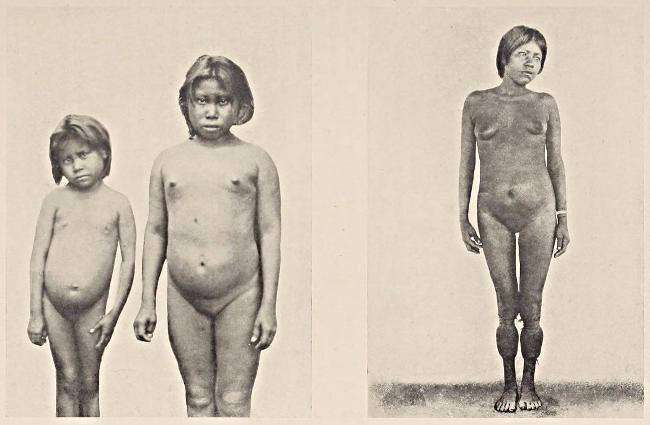
PLATE LIV.
WITOTO TYPES
WITOTO WOMAN WITH LEG LIGATURES
When bathing the Indian is exposed to a certain element of danger from fish that inflict varying degrees of injury. There is the stinging eel, and skate of some sort and another stinging fish,[431] the caneiro, and the piranha. Electric fish are less common in the upper rivers than in the main streams, and I never noticed one Indian of the Issa-Japura tribes take any special precaution against them, though elsewhere the natives will beat and prod the water with rods before they bathe, to discover, if possible, whether any eels are lurking in the vicinity. The caneiro’s method of attack is by suction, not shock. They are very plentiful in all these rivers, and their power of suction is most extraordinary. I am not likely to forget the first time I made acquaintance with one of these voracious little fish. It suddenly attacked, or rather attached itself with its sucker-like mouth, to the inner side of my leg. The sensation was most alarming. I made with all possible speed to land. The caneiro certainly sucks up the flesh rapidly and painfully, but I am doubtful if it really “tears off pieces of the skin and flesh,” as it is said to do.[432] The piranha, though quite a small fish,[433] is even more ferocious. It will attack anything, and is said to be capable of reducing a large animal to a skeleton in the space of a few minutes. There is a story, repeated elsewhere, that one very small fish is actually a human parasite. The Indians aver that it will enter the body of a man when bathing. Orton mentions this fish, which according to him is “a slender silurid fish (Vandellia)” but remarks that he never met “with one confirmatory case.”[434] Neither did I. But I found that all Indians take precautions against it when bathing.
APPENDIX II MONGOLOID ORIGIN
On the vexed question of original Asiatic extraction what little evidence I have to offer is in general support of the theory that some at least of the ancestral stock probably found their way hither from Asia, or—what is more in accordance with the laws of migration as so far ascertained—spread from the American to the Asiatic continent. There is undeniably a marked prevalence of what are recognised as Mongoloid traits among these peoples. I fully accept Ratzel’s dictum, “We may hold firmly to the relationship of the Americans with the East Oceanic branch of the Mongoloid race.”[435] To quote another writer, “As Burton remarks, this strain demonstrates itself in big round Calmuck skulls, flat faces, with broad, prominent cheek-bones, oblique oriental eyes, rather brown than black. They have also dark thick eyebrows, and thin moustaches fringing large mouths, with pointed teeth and sparse beards hardly covering the long pointed chin.”[436] The truth of this description can be judged from the illustrations in this volume. The most casual observer must notice the prevalence of Mongoloid facial characteristics prevalent among the South American Indians, such as obliquity of eye, prominent cheek-bones, broad flat nose. My own observations led me to conclude that the Mongoloid type was very pronounced in individual cases, so much so that I estimated at least one per cent to be of a pure Chinese type, and my common name for them (vide my note on secrecy of individual names, p. 154) was Chin-Chin. I would refer to such illustrations as that facing p. 254 in the second volume of Spruce’s Notes of a Naturalist. (See again Spruce, i. 328; Orton, p. 170, for references to prevalent obliquity of eye.) On the other hand, Bates remarks of the Tupuyo that “their eyes are black and seldom oblique like those of the Tartar races” (Bates, i. 78); and Wallace remarks, “I never could discern an unusual obliquity of the eyes” (Wallace, p. 332). I cannot agree with this statement. The latter, however, noted the prominent cheek-bone among the Curetu (p. 354); and Orton refers to it and to the flat nose (Orton, p. 170).
Further characteristics in common among Mongoloid peoples and these tribes are the customs of shaving or depilating facial hair, and a prolonged period of suckling the young (vide Westermarck, p. 484).
APPENDIX III DEPILATION
All tribes south of the Japura remove hair, except that on the head.
Tukana depilate body hair.
Tuyuha men depilate armpits, not pudenda: women depilate pudenda.
Kuretu—all depilate.
Purakato, according to Koch-Grünberg, do not depilate.
Karahone are said not to depilate. This (see text) is debatable. I believe that they pluck out the hair of the chin and whiskers, but leave eyebrows and moustache.
Bara—women only depilate.
Menimehe—all depilate, but the women are not so careful about it as the Boro.
Boro—all depilate.
Witoto—men more careless, women depilate.
Tuhana, according to Koch-Grünberg, do not depilate.
Okaina—all depilate.
Resigero—all depilate.
Muenane—all depilate.
These tribes have no body hair, except pubic hair, which is very scanty. The Indian women are most particular about the removal of all pubic hair. The men are less careful, though it is supposed to be done, but as that part of their bodies is never voluntarily exposed they are more heedless than the women.
APPENDIX IV COLOUR ANALYSIS AND MEASUREMENTS
Colour
(Vide Colour Curve. Tintometer.)
1. Menimehe—lightest.
2. Resigero.
3. Okaina.
4. Boro.
5. Nonuya.
6. Andoke.
7. Karahone.
8. Muenane.
9. Witoto.
Robuchon gives the colours of the Witotos as brown-copper colour, varying between twenty-nine and thirty of the chromatic scale of the Anthropologicas of Paris.
Colour Analysis Unexposed Part—Armpit
Substance examined. Matching Standards. Colour developed.
Red. Yellow. Blue. Black. Orange. Red.
Witoto 3.6 2.8 1.6 1.6 .2 .8
Muenane
Karahone
Andoke
Nonuya
Boro 3.3 2.7 1.5 1.5 .2 .6
Okaina
Resigero
Menimehe
Mean average attempted by means of colour markings and identified according to Lovibond’s tintometer scale.
There was practically no tribal differentiation of pigmentation in the units of these groups, as far as the unexposed part of the body is concerned. This is understandable. The palm of the nigger’s hand differs little from his white brother’s.
Colour Analysis Exposed Part—Back
Substance examined. Matching Standards. Colour developed.
Red. Yellow. Blue. Black. Orange. Red.
9. Witoto 10.6 9.2 6.2 6.2 3.0 1.4
8. Muenane
7. Karahone 8.7 7.5 4.5 4.5 3.0 1.2
6. Andoke
5. Nonuya 8.0 7.0 4.0 4.0 3.0 1.0
4. Boro 4.9 4.4 1.5 1.5 2.9
3. Okaina .5
2. Resigero Yellow.
1. Menimehe 3.4 4.1 .7 .7 2.7 .7[437]
There is here more differentiation. The tribes numbered 1-9 are in order of shade, from the lightest according to personal observation. This is borne out by data except the grouping which was not so apparent to the eye.
Apparently in one tribe only is red non-existent, free yellow taking the place—No. 1 (vide curve).
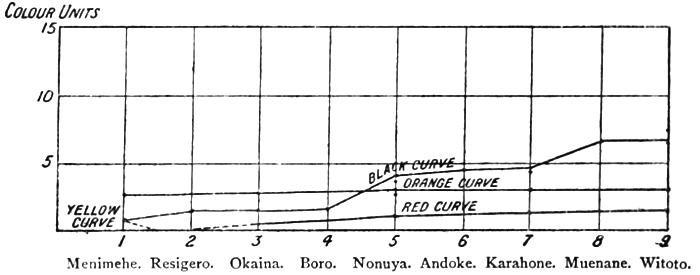
Colour Curves of Skin Pigmentation (Indians of the Middle Issa and Japura Valleys)
Note.—It will be seen at a glance that differentiation is caused by increased “sadness” or excess of black, and by the amount of free red. These are the two governing factors. Orange is constant throughout.
N.B.—There is extraordinary variation amongst individuals of the same tribe, as well as amongst tribes of the same language-group and language-groups themselves.
Huis’ Measurements of Samples of Women’s Hair
No. 1. Maturity.
No. 2. Ante-pubertal.
Note.—The lighter tips of latter which become eliminated after puberty, i.e. elimination of orange.
Red. Yellow. Blue. Black. Green. Yellow.
No. 1 19.5 31.5 28.0 = 19.5 8.5 3.0
No. 2 18.5 26.0 17.0 = 17.0 Orange. 1.5 7.5
Light tips 19 26.0 25.0 = 19.0 Green. 6.0 1.0
Dark ends
Descriptive Characters
Eye.—1. Dark, i.e. black-brown iris. Note.—Outer angles of eyes visibly elevated; deep-set; eyeball thick; covers the caruncle; outer angle slightly compressed and pointed.
Hair.—Colours—1. Black, not coal black. 2. Children’s hair is some shade lighter than adults’, but still “black.”
Form of Face.—1. Face inclined to be square and wedge-shaped. 2. Inclined to concavity. 3. Compare photographs. 4. Chinese, Fig. 6, but not so pronounced. (N.B.—There is great variation.) 5. Chin small, round, retreating. 6. Cheek-bones broad. Face flat (inclination to, vide photographs). 7. Medium lips—great variation. 8. Ears medium-sized—flat. 9. Lobes sometimes attached.
Measurements of Types[438] in Centimetres
Tribe. Head—Round. Head—Across.
Male. Female. Male. Female.
1. Resigero 56 53 14 14
2. Nonuya 56 51 16 14
3. Boro 56 52 18 15
4. Andoke 57 53 17 16
5. Witoto 54 — 15 —
Tribe. Head-Length. Neck.
Male. Female. Male. Female.
1. Resigero 20 18 Short Short
2. Nonuya 21.5 19 Long Short
3. Boro 24 20 Short Long
4. Andoke 22 19 Medium Short
5. Witoto 21 — Short —
Tribe. Cheek-Bones. Mouth.
Male. Female. Male. Female.
1. Resigero High, not pronounced High, not pronounced Moderate Large
2. Nonuya Very high High, not pronounced Large Large
3. Boro Wide, high Wide, high Small Small
4. Andoke — — Small Small
5. Witoto Wide, high — Large —
Tribe. Teeth. Eyes.
Male. Female. Male. Female.
1. Resigero Large Large Oblique Oblique
2. Nonuya — — Deep-set Oblique
3. Boro — — Deep-set Oblique
4. Andoke — — Slightly oblique Oblique
5. Witoto Large, even — Oblique —
Tribe. Nose. Height.
Male. Female. Male. Female.
1. Resigero Straight Broad, bridged 160 138
2. Nonuya Aquiline Flat 168 149
3. Boro Depressed Depressed 162 146
4. Andoke Aquiline Depressed 171 146
5. Witoto Flat — 164 —
Tribe. Chest—Round. Waist.
Male. Female. Male. Female.
1. Resigero 85 75 73 71
2. Nonuya 87 79 73 75
3. Boro 88 75 77 65
4. Andoke 89 82 76 76
5. Witoto 90 — 77 —
Tribe. Hips—Round. Tip Shoulder-Tip Elbow.
Male. Female. Male. Female.
1. Resigero 82 79 35 28
2. Nonuya 83 88 35 32
3. Boro 87 81 34 30
4. Andoke 90 87 38 33
5. Witoto 84 — 36 —
Tribe. Elbow to Top Middle Finger. Eminence Buttock to Tip Flexed Knee.[439]
Male. Female. Male. Female.
1. Resigero 45 39 52 44
2. Nonuya 47 41 53 48
3. Boro 46 42 47 45
4. Andoke 48 40 53 48
5. Witoto 44 — 52 —
Tribe. Crutch to Tip of Flexed Knee. Eminence Knee to Ground.
Male. Female. Male. Female.
1. Resigero 37 28 51 44
2. Nonuya 40 31 53 45
3. Boro 36 32 51 45
4. Andoke 41 33 55 44
5. Witoto 38 — 52 —
Tribe. Feet. Distance between Nipples.
Male. Female. Male. Female.
1. Resigero Broad, large Broad, small 20 23
2. Nonuya Long Broad 21.5 23
3. Boro Large Small 23 22
4. Andoke Large, broad Medium 22 20
5. Witoto Large, broad — 22 —
Tribe. Length from Centre Nipples to Navel. Navel to Crutch.
Male. Female. Male. Female.
1. Resigero 23 24 19 19
2. Nonuya 25 22 24 20
3. Boro 21 22 20 20
4. Andoke 25 25 24 23
5. Witoto 26 22 — —
Tribe. Remarks.
Male. Female.
1. Resigero Moderate Plump
2. Nonuya Lean Fat
3. Boro Well-nourished Well-nourished
4. Andoke Well-nourished Very plump
5. Witoto Well-nourished —
Essential Measurements Two Cases, Women, Witoto
Centimetres.
1. Head Maximum length 17.3 18.15
2. Maximum breadth 13.85 13.9
3. Nose Length from base to root 4.3 4.0
4. Breadth across nostrils 3.0 3.0
5. Projection of head From vertex to root of nose 9.2 10.0
6. ” ” mouth 16.0 14.2
7. ” ” chin 19.0 17.4
8. ” ” tragus of ear 10.7 12.0
9. Bizygomalic breadth of face 12.75 12.0
9. Face length from nasim to chin 10.2 9.3
10. Length of upper limb 60.0 [440]
11. ” cubit 38.0
12. ” hand along its back 15.0
13. ” foot 23.0
14. Sitting height 72.0
15. Kneeling height 103.75
16. Standing height 139.5
17. (Obvious) height to chin 120.5
18. Height to sternal notch 117.0
19. Height from internal malleolus to ground 6.4
20. Span of arms 140.5
Extra Notes on Two Women, Witoto (chosen types)
No. 1. Very short neck; short sternum; straight shoulders. When standing at ease the middle finger of hand is half-way between flexion of knee and hip-joint. Thighs short.
No. 2. Neck short; shoulders straight; good teeth—very large and even.
General Description of Two Indian Women for evolving a Type. Both Witoto-speaking
No. 1. Woman full grown. No. 2. Still growing, of pubertal age. According to Schedule, pp. 11, Anatomical Observation.
External Characters.—General condition well nourished—healthy. No. 1. Stout. No. 2. Medium.
Descriptive Characters.
A. Colour of skin.
No. 1. Exposed part light reddish-brown.
No. 2. Unexposed part—very much lighter, and tintometer curve, etc.
B. Colour of eyes. Black.
No. 1. Dark-brown iris.
No. 2. Black iris.
C. Fold of skin at inner angle of eyes.
No. 1. Covering the caruncle.
No. 2
D. Colour of hair.
No. 1. Black, brown in sunlight, i.e. brown-black.
No. 2.
E. Character of hair (vide Section of Hair).
No. 1. Straight and coarse (horse hair but finer).
No. 2.
F. Amount of hair.
No. 1. Body very very scanty, depilation not recent.
No. 2. Face nil. Body nil.
G. Shape of face.
No. 1. Short. Broad.
No. 2. Pyramidal. Wedge-shaped.
H. Profile of nose.
No. 1. Chinese type.
No. 2. Chinese type, but not so pronounced, between this and European.
I. Prognathism.
No. 1. Slight.
No. 2. Very slight.
J. Lips.
No. 1. Medium—slightly everted.
No. 2. Medium European type.
K.
No. 1. Platyoprosopic not excessive.
No. 2.
APPENDIX V ARTICLES NOTED BY WALLACE AS IN USE AMONG THE UAUPES INDIANS THAT ARE FOUND WITH THE ISSA-JAPURA TRIBES
Household Furniture and Utensils
Hammocks.
Baskets, flat and deep.
Calabashes and gourds.
Earthenware water-pots.
Earthenware cooking-pots.
Manioc graters.
Manioc squeezers.
Wicker sieves.
Weapons
Bows and arrows.
Quivers.
Blow-pipes.
Small pots and calabashes for poison.
Spears.
Nets.
Rods, lines, and palm-spine hooks.
Wicker fish-traps.
Musical Instruments
Fifes and flutes of reeds—Menimehe and Napo tribes.
Dress and Ornaments
Feather head-dress.
Palm-wood combs.
Necklaces of seeds, beads, and teeth.
Wooden ear-plugs.
Armlets.
Painted aprons.
Rattles and ornaments for legs.
Knitted garters.
Calabashes of red pigment.
Painted earthen pot for caapi.
Small pot of dried peppers.
Dancing rattles.
Balls of string.
Baskets for edible ants.
Small dug-out canoe.
Paddles.
Pestles and mortars.
Bombax silk-cotton for arrows.
Stone axes.
APPENDIX VI NAMES OF DEITIES
Many writers have stated that the Indians of the Upper Amazon forests have no words in their languages to express a Supreme Being. (See, for example, Bates, i. 162; Wallace, p. 354; Nery, p. 273; Orton, p. 316; Bates, ii. 137, 162-3; Markham.) It therefore seemed to me worth while to make the following list of words expressive of some idea of a superior, non-human being, good or bad.
Tribe. Good Spirit. Bad Spirit.
Amazon (proper) Curupira
Diabo do mato (Spruce, ii. 437)
Atabayoo, Inivida (Orinoco tribes) Cachimana (Humboldt, ii. 362) Iolokiamo (Humboldt, ii. 362)
Baniwa Diotso Yenauepena (Koch-Grünberg)
Ienahabapen (Tavera-Acosta)
Baré Diose (Sp. Dios.) (Koch-Grünberg, p. 92) Iyehe (Koch-Grünberg)
Oayaba (Spix)
Bororo Bope[443] (Cook, p. 55)
Casiquiari Yamadu (Spruce, ii. 437)
Equatorial Andes Munyia (Spruce, ii. 437)
Guayana Yawahoo (Bancroft and Stedman, Spruce, ii. 437)
Hypurina Kamiri (Steere, p. 379)
Imihita Miranya Nawene (Koch-Grünberg, Z. 9081)
Karutana Inei (Koch-Grünberg, p. 93)
Katapolitani Iyemi, Koai (Koch-Grünberg, p. 93)
Puru Ara, Carimade (Clough, p. 117) Arabuny, Camery, Mendy (Clough, p. 117)
Quichua Apunchi-yaya[444] (Orton, p. 628)
Siusi Yaperikuli[445] Koch-Grünberg, p. 92) Iyeimi (Koch-Grünberg, p. 93)
Tamanac Amulivaca[446] (Humboldt, ii. 473-474).
Tariana Yaperikuli (Koch-Grünberg, p. 93) Iyei (Koch-Grünberg, p. 93)
Iapiricure (Crevaux) Inhat (Crevaux)
Ticuna Nanuloa (Markham) Locazy (Markham)
Uaupes Tupanau (Wallace, p. 348)
Uarekena Kue (Koch-Grünberg, p. 92)
Witoto Usiyamoi,[449] Husinaimui (Koch-Grünberg) Taifeno, Taifa, Taegfeno (spirit), Foremo (phantom) (Koch-Grünberg)
Yagua Tupana (Orton, p. 628)
Yukuna Hiya (Koch-Grünberg, p. 93)
Zaparo Piatzo[450] (Orton, p. 628) Mungia (black spectre) (Orton, p. 170)
Zamaro (Simson, p. 175)
Samaro (Simson, p. 263)
APPENDIX VII VOCABULARIES AND LISTS OF NAMES
Note re Pronunciation.—Vowels as in Italian and consonants as in English. The system adopted by the Anthropological and Geographical Societies has been followed.
SOME WITOTO TRIBES OF THE ISSA-JAPURA WATERSHED
Achopego.
Aifuya.
Aiguya.
Aigwene.
Aimene.
Aiyofo.
Amenane.
Angarofo.
Aniliene.
Arama.
Aronia.
Baienise.
Chaigero.
Chepeye.
Choria.
Dedinuia.
Diguene.
Eguidafo.
Eifuya.
Eikifo.
Emerai.
Emuidifo.
Enao.
Enenea.
Enifofo
Enokaise.
Erai.
Erifo.
Fainya.
Feyagene.
Fitia.
Foetano.
Fueragero.
Futekwene.
Gidone.
Gimene.
Guidua.
Gwamareya
Hane.
Hedua.
Hegero.
Hemui.
Heone.
Heya.
Hifikuine.
Hikoniai.
Himene.
Himua.
Hipunya.
Hitamene.
Homaguya.
Huieku.
Hui-Hui.
Hurae.
Husinene.
Iagero.
Iane.
Iconya.
Ifekwene.
Ipunya.
Isikifo.
Itomangero.
Iyane.
Kaiduya.
Kaio.
Kaniane.
Kaniene.
Kitopeise.
Kokoya.
Kotuene.
Kotwine.
Kuito.
Kumaiere.
Machifuri.
Megiya.
Menia.
Merekweine.
Mereta.
Mikagwe.
Minwa.
Mofuinista.
Mokine.
Monane.
Monanisei.
Monanuise.
Monawike.
Muidofege.
Muititefa.
Muitofeiche.
Naikwene.
Naimene.
Naiuiene.
Nefesa.
Nemuigaro.
Nigwerene.
Nimaita.
Nofuinista.
Nirafo.
Nomene.
Nomuene.
Nongone.
Nonuya.
Nufuidai.
Nufuya.
Nuisai.
Nuiuene.
Owapirei.
Owapure.
Pofaito.
Pueneisa.
Puinaise.
Puineita.
Puruia.
Raikene.
Riai.
Rochegero.
Ruiraga.
Sebua.
Seguene.
Sigwene.
Sikibia.
Sikitaise.
Taigwene.
Taikebua.
Tiase.
Torifa.
Uane.
Uchopego.
Uekanise.
Uguine.
Uiguene.
Uhiya.
Urafo.
Urama.
Utiguene.
Yaaniani.
SOME TRIBES OF THE OKAINA GROUP
Aniokasa.
Dukaiya.
Ekanocha.
Enoya.
Fatite.
Harabahanako.
Konega.
Movanio.
Netarako.
Nimone.
Ofofo.
Pikaha.
Tokoia.
Tonhanoija.
Zohonoija.
SOME BORO TRIBES OF THE ISSA-JAPURA WATERSHED
Atehl.
Bachiwame.
Bakiehe.
Bakohe.
Chemaio.
Chenome.
Chibame.
Dossamehe.
Ibamahe.
Ikepake.
Imene.
Inege.
Itiage.
Ivamehe.
Kontadura.
Kugwamihe.
Kugweme.
Megwae.
Megwamehe.
Mememue.
Metakwe.
Nabeme.
Nevahe.
Nonuya.
Nuremehe.
Oha.
Okaina.
Paheime.
Pei.
Pirehamuena.
Teiere.
Tichibamuene.
Ugwame.
Uhemehe.
Uratefo.
Uwame.
Wanahe.
Warime.
Warine.
Warume.
Wawako.
WITOTO CHIEFS AND MEDICINE-MEN
Aikikwe.
Ainenatofe.
Amenatofe.
Amuiyena.
Bogana.
Diehi.
Diomao.
Eavama.
Echu.
Efuyaima.
Etokwenami.
Fenamena.
Forina.
Hename.
Henatoba.
Hifaro.
Hirevaina.
Huguraitoma
Husinachire.
Itomakuto.
Kaimarigero.
Kutina.
Kutofirima.
Kwegado.
Kwegare.
Magui.
Maiji.
Maiu.
Mayi.
Meinyitofo.
Monagara.
Naimekwe.
Okaima.
Okainama.
Puinanyete.
Puinayeni.
Puineima.
Riaduema.
Sekwana.
Sotaro.
Suneirokwe.
Tifecheamena.
Wamue.
NAMES OF BORO CHIEFS AND MEDICINE-MEN
Adiama.
Adiwako.
Agepa.
Akteume.
Ativa.
Ativatahe.
Bugwaheio.
Chevetahgwe.
Chiako.
Chikaho.
Darapade.
Dekio.
Dihidihe.
Ekeniba.
Evahihaia.
Evahikie.
Gwanebe.
Ibaje.
Ibapakama.
Imenepa.
Inateraka.
Kadokuri.
Katinere.
Kivape.
Magapamena.
Matremiko.
Mewago.
Mucheochime.
Muchichigwako.
Nehevaio.
Nevamarime.
Nevame.
Nipemeiwako.
Nivagwa.
Nivahna.
Poachiiba.
Rimetagwa.
Tchitchitaga.
Teripa.
Tikaame.
Tirakagwako.
Tirakawako.
Uvatipa.
Wadikova.
WITOTO
Darkness (devil) Apuehana
Fire Ireiki
God Usiyamoi
Moon Fuibui
Sky Mona
Sun Itoma
Water Heinowei
Hunger Ameniti, naimede
Laugh Sateide, seteide
Metal Okkupe
Paper (book) Kwerape (literally my leaves)
Paper (leaves) Rape
Paper, a speaking leaf Kwede, hweyarape
Powder (dust) Himuisa
Sleep Inude, unyude, kwinyakate
Sleep, dream Inie
Bush, the Aisikumo
Cliff Ifere
Compound Gicheipwere
Palm jungle Amena
Plantation Akafo
River Imane
River, a large Ichue
Road Io
Stream Hurete
Streamlet Ichemo
Alligator pear Nomedo
Coca Hibia
Cocoa Museje
Fruit (general) Rie
Grape fruit Hurekoi
Gum (rubber milk) Hittie
Leaves Rape
Maize Bechado
Mango palm Himeki
Mango palm drink Hayabei, hagapui
Manioc (poisonous) Maika
Palm Amena
Palm Himepile, hitiji
Palm drink (pjnayo) Himepwi
Palm-spines Edo
Pepper Ifigo
Pineapple Rosiji
Plantain Ogoda
Plum Nemawsi
Rubber Isire
Rubber latex Hittagei
Sugar-cane Kananoganei, kononga
Sugar-cane juice Kananogan’heinowei, kononochiki
Tobacco Deui
Tree Inya
Trees, felled Amena
Tree poles Neda
Withe Vineihi
Bird (small generally) Siji
Bird (small unknown species) Iguyitoi
Bird, cock Eitaba
Birds (small game) Ataba
Birds, chickens Ataba hissa
Capybara Okeina
Curassoa Eifoke
Deer (one species) Kito
Deer (generally) Chaota
Eggs (generally) Herga
Eggs (one kind) Ataba hige
Fish (general) Jukua
Jaguar Hekko
Monkey (general) Homa
Monkey (one species) Hemwi
Monkey, small Hidobe
Parrot Kwiyoto
Parrot (another kind) Kweko, Uiyike
Pig Mero
Pig, small Emo
Spider Humakinyo
Tapir Zuruma
Tiger, dog, etc. Hekko
Turkey Muitoka, muito
Turkey (another kind) Egwe
Turkey Buzzard Eifoke
Boy Toii
Girl Rinyosa
Lad Hivisa
Man Rema
Man, old Weikiroma-superoma
Man, strong Reima
Men, white (Europeans) Riei, riama
People Komweine
Stranger Oikommo
Stranger, an enemy Ikagmake
Stranger, a friend Cheinama
Woman Rinyo
Woman, old Weirinyo-irokwe
Brother—
Man speaking Ama
Woman speaking Tio
Brother-in-law Oima
Child Hito
Father Moma
Grandfather Marama
Grandmother Einyoko
Husband Une
Mother Einyo
Nephew—
Brother’s child Enasai
Sister’s child Komona
Niece—
Brother’s child Enasanyo
Sister’s child Momonio
Sister—
Man speaking Mirinyo
Woman speaking Epunyo
Sister-in-law Ofanyo
Uncle—
Father’s brother Iso
Mother’s brother Vichama
Wife Ei
Anus Sirafo
Arm Onawji
Fore-arm Onefai
Belly Ero
Blood Dueidi
Body Namaseapwi
Bowels Hepe
Clitoris Hito
Ears Efo
Eyes Uise
Face Uyeko
Feet Elba, epa
Finger Onoko
Flesh Jukua
Hair Ifoterai
Hair (body) Heinektere (!), heineitere
Hair (face) Eimago
Hair (pubic) Hueke
Hand Ono
Head Ifo
Heart Komeke
Limbs Rueisi, reesi
Mouth Fue
Nails Onokobi, onopeko
Nails (toe) Ekobe
Navel Modda
Neck Kimo
Nose Dofo
Penis Hechina
Pudenda Jana
Semen Uke
Skull Ifoku
Teeth Isido, isife
Testicles Hinyergo
Tongue Hufe
Urine Poji
Vagina Berirafo
Ague Fuibuiko
Diarrhœa Nuimuisa, Jui, chui
Illness Duide, tuike
Small-pox Guiyoko, tutuko
Bark cloth Vinei
Beads Sirie
Breech cloth Mokoto, makuto iroi, hinoi-giroi
Clothes (general) Uiniroi
Cord (belt) Kirige
Feather head ornaments Eniago
Necklace, dance Chikai
Necklace of seeds Imaidu
Necklace, of teeth Efoke
Slippers, boots Epa iko
Socks Epa iko (see Feet and Cap)
White man’s cap Ifoigiko, ifoiko, iko
White man’s shirt Kaifofero
Baking-pan Sipe
Cassava Tano
Firewood Rege
Hammock Kunei
House Hofo
House, large Ejo hofo
Hut Hiochupe
Light (artificial) Maha
Lighted torch Maha
Mat Duriei
Pot Inogo, ichuki
Thatch Ereije
Tobacco-pot Kuruke
Torch Rekekawdo, rekeketo, recheki
Axe Chovema
Blow-pipe Obidiake
Fish-hook Fakawasi
Knife Chovefa, chovetera
Drum Hugwe
Drum mallet Quaki
Pan pipes Piabami
Sword Chovega
Trap, animal Iregi
Weapons, stones, shot Chowefi, jowefi, chowefei
Signal-drum Ware
Afternoon Nawipe
Morning Wiremoni
Morning, early Monanyeno
Night Nagona
Night, last Nago, hahe nago
Night before last Beinawife
To-day Beiruido
To-morrow Wiremonei (see Morning)
To-morrow, day after Dawire
Twilight Naruide, nagona-yakate
Yesterday Nawire
Yesterday, day before Beinawire
All Nana
Before Fuere
Before (position) Uikota
Before (long time) Heiyei
Behind Moina
Behind (position) Moina
Enough Asirete
Farther Beife
For Mero
Full, carefully, good measure Einue
Full Moniteidi, monite
Here Benomo
How many? Nigama?
How much? Niga?
Much Eijo
Much, enough Monome
Nobody Buna
Now Monokoi
Only Dama
Then, afterwards Achue
There Batinomo
This Pie
Together Fofona (?)
Well? Mei?
What? Nifote?
Where? Ninomo?
Who? Bu?
Why? Nibaji, nibeiji?
No Damaita
Not Inyete
Yes Huhh, U (ventral)
I Kwe
Thou O
He, she, him Afima
We Koko
You Omei
They, them Afimaki
Bad Figonigete
Big Eijue
Bitter Neimenete
Black Ituide
Cold Rosirete
Cool Maneide
Dark Hitirite
Dead Teide
Deeper Nane efarite
Dry Daherede
Good Figora
Hard Agarrite
Heavy Merete
Hot Usirete
Light (sun) Hite
Light (weight) Fekote
Long Are
Red Larede
Short Hiannare
Small, little Yewrete
Soft Itieide
Straight Huchinyete
Strong Agarrite
Thick Herie
Thin Henite
Twisted Huchite
Well (in health) Gagritte
White Userede
Early, soon Ono
Slowly Puiya
Soon Reiri
To bathe Noise
To bring Ate
To carry Ui
To come down Anabi
To come up Kifobi
To cool Rosirete
To cry Ede
To dry Nokitenyete, nohipuinyete
To eat Oko, gunyo
To go down Anahei
To go quickly Reiri maka
To go up Kifohei
To hear, listen, understand Kekate
To heat Usirete
To hurt Isirete
To like, love, desire (persons) Dwere-uite
To like, love, desire (things) Oyakate
To know Onote
To make Nenyo, fuiho
To rain Nokitede, nokipuite
To sit down Anarana
To sleep Mei-ine
To speak Naitode
To stay Fuipire
To take Gweipi
To urinate Chowei, pochite
To wait Anafue
To wash Hokoa
To work Biefono
I am Iti kwe
Thou art Iti-o
He is Afima ite
We are Iti koko
You are Iti omoi
They are Afimaki ite
I was Kwe ia
Thou wert Ia o
He was Afima ia
We were Koko ia
You were Ia omoi
They were Afimaki ia
One Dahe
Two Mena
Three Dahe-amene
Four Menahere
Five Dapekwiro
Ten Nagapekwiro
Ask me Kwemohikka
Give me Kweme
Give me food Eka
A few days ago Tika irue
It is dark Nawite
It is going to rain Teyakate
Puiyakate
What tribe do you belong to? O Komweine?
O Memeka bu?
Move along! Hei!
Ifo!
Come! Bi!
It is very far Hikka Ite
Hikka Are
It is near Hiannare
It is very near Hikka-iannare
It is very much farther Hikka-fe
Be quick Reiri
Be slow Pwia hei
Pwia ifo
You do not want me Kwena dueruenyeteo
I am about to punish you O feitakkwe
What do you want? Nifote oyakateo
How much do you want? Niga oyakateo
I want to see Eroi yakatekwe
I want to eat Okoyakatekwe
I want to sleep Iniyakatekwe
I do not want to sleep Iniyakanyetekwe
Let us sleep Meikoko ini
Let us walk Manyakoko maketchi
Let us bathe Manya koko noi
Go and wash Hokorise
What are you doing? Nefoteo nia?
What are they doing? Nefoteo nietimeke?
What have you done? Nefoteo nieteo?
What have you others done? Nefoteo omoi nieteo?
Are you sick? O seicha?
Tuiko teiteo?
What is the matter with you? Neisoi o icha?
What pains you? O nino isiritte?
He is dead Ei e teide
He is well again Ei e hichoet
Put water to boil Heinoi kokoita
We are nearly there Duki-eikateki
We have not arrived Duki nieteke
It is a long way yet Nia areiti
It is a very long way Nia are are are
It is very short Wei iannare
Put on more wood Nane rege honne
Fill it full Nue oruita
Be careful not to break it Chitesai
Remove the leaves Rape honne
Open it carefully Nue ekonotta
Cook only manioc and plantains Dama seteo meika ogoto
Eat the skins Igore ine
Take some crushed maize Pechato tuta hisano ui
How many women are there? Niga rinyona hisa ite?
From what cause has your brother died? Nipeiche tio teide?
Why did you leave the child outside? It will be eaten by the dogs Nipeiche hito hino o fuaka ia daria
Go soon and guard the women Mei rieri rinyona hofona ipeise
Do not do it again Mene amanyete omoi
An unmoral Indian woman Rinyo Rei-irage
An immoral Indian woman Rinyo Kachirete
With whom have you been having intercourse? Bu tika beriteo?
How many husbands have you had? Nigama bettora-o?
Are you (a virgin) married? Nia rutanyega-o?
Who ravished you? Bu-o rutaka?
You are blind (a fool) O ui nirite
Do not delay Fwepi neri
Give me something Feka
Do not give anything Fekanyete
Walk Mekkate
Do not walk Mekanyete
I do not understand Kehanyete
That’s my business (common expression without intention of rudeness) Pia
My body aches Kwe apui isirete
Let me go Kwe-mosueta
Hold me Kwe-mojeno
Turn round Jireno
Do not move Weihoi
Why do you shout? Nipeiche kicheteyo?
It is big Ei ichwe
It is small Hurete
Eichonyete
It is not good Fogonyete
Do you like it? Kimmarueteo?
Do you not like it? Kimmaruenyeteo?
You are pretty Nuen otego
You are ugly Nuenonyeteo
You are dirty Oapwi gagrette
I want you Ona dueruetckwe
I do not want you Ona dueruenetckwe
Tie well (the cross poles) Nue kwina
Tie higher Keifofe kwina
Take care not to break Titeise
Well done, you thatch well Mei omoi ita
Is everything clean? Nana ganino fuinore?
That is dirty, I shall punish you Vie gagrette a kioiteo o feitikwe
It is very sweet Eicho nimerettega
I do not like it hot Usirete ittinyetekwe
I like it warm Chiei maneide ittitekwe
Look well in front of you Nue oroi
The plantation is a good one Nue akafo icha
The plantation is a bad one Akafo fogonyete
Let us go and build a house Manya ofo koko fuinoche
There are not sufficient palisades Nia amena nana inyete
All of you bring timber Omoi amena atiche
You make the thatches Are niite omoi
These boys will bring canes Bie hettanitino are gweichi
These others will bring palm leaves Bimeke ererite
Those will make holes Bimeichino iffweirakte
I do not want it there Batinomo ittinyetekwe
Open it here Benomo ekkono
Send me the small boy Urettema kwemo hito
Go and throw away that water Mei ba i heinoi dota
Wash it well Nue hokorii
Do not delay Are enyeno bi
You are dirty Nia gagrette
Put it there Batinomo honne
Put it here Benomo honne
Put it yonder One honne
Do not put it over there Batinomo honne nieno
Why are you sad? Nipeiche sure iteo?
Who hurt you? Bu o faga?
When did you come? Nirueteo viteo?
When did you go? Nirueteo heito?
It is so firm I cannot move it Are agagrette ekkononyette
Bring the wood Itofie nue omoi ire
Do not throw them away Oni tinyeno nue ofitare
I am going to see A chimitekwe
If you do not bring them, I shall punish you Omoi pweya fachiomoi
Plant them carefully Nue omoi haire
Go and clean up Mei omoi reitiseiri
Place all the sticks together Reitekinyo nue omoi ofitare
You have left the plantation untidy Akkafo gagritte omoi fueka
Why don’t you bring it? Nipeiche atinyeta omoi?
Make enough cassava Eichwe tano fuinore
Let it be good Nuere finoiche
Bring a little Yewre atitomoi
Not enough Dutenyete
It is soft Itieide
What are you doing? Nifote niecomoi?
What are you eating? Nifote okoteomoi?
Where are they—the rest of you? Ninomo iteomoi?
Why have they (the others) gone without telling me? Nipeiche kwe jonyeno heite omoi?
Bring it to the light Useritenomo ate
To-morrow go and see the tribe and then return here together Weirimoni dama komweine hoke teiteo nana fofona orerire
Split it with the knife Chovefa do ekkono
Take out the cane early Monanyano kononwe ono
It is rich Kei maritte
Wash the pot well before boiling water in it I chiko nue hoko heinowei hoku-itechi
Do not put much fruit in it Eicho rie dotenyino
It is very inconvenient Y otirette
I am unable Kwe mona
Hitinyete
I shall carry it Diuitikwe
Do not carry it Uinyetekwe
I am tired Aeeiontekwe
You are going to carry manioc Meika omoi ui
BORO
Brother Tanyabe
Chief Abihibya
Chief’s wife Abihilya
Child Chemene
Father Iero
Fellow-tribesman Miamuina
Husband Tahe
Liar Aliraje
Man Gwapime
Medicine-man Chekobe
Mother Gwaro
People Akime
Sister Tanyali
Sluggard Ubeye
Son Chukije
Wife Tapa
Woman Gwame
Abdomen Mebigwa
Arm Menejeko
Back Meatche
Belly Epae
Blood Tibune
Body Kepe
Bone Pukene
Bosom Neghpane
Buttocks Medehe
Cheek Mekwa
Ear Menimeo
Eye Ajike
Finger Utsigwako, mechiko
Flesh Iyame
Foot Tia
Hair Nikwako
Hand Meuche
Head Nikwa
Heart Meebe
Knee Mimoko
Leg Take
Mouth Mehe
Navel Icheba
Neck Metchke
Nose Metiko
Penis Nomeo
Testicles Domiba
Thigh Kibaje
Tongue Menigwa
Tooth Igwahe
Vagina Elyapo, diugwa
Ague Chinabe
Prickly heat Nikemoi
Smallpox Maraipa
Tick Chichihe
Wound Pepene
Dance Machiba
Falsehood Achipe
Fear Apichune
Grief Abiyene
Ill Chemei
Remedy (in general) Tabota
Smell Tukine
Truth Imiane
Agouti Bute
Anaconda Bua
Ant-eater Ehe
Armadillo Tie
Bird Karaha
Capybara Uba
Deer Nibigwa
Fish Amome
Flea Ikookwa
Frog Nihagwa
Hawk Ane
Head-louse Knawni
Jigger-flea Mipahe
Land crab Nekwalige
Monkey Kemuime
Mosquito Nee
Paca Tahe
Parrot Yabe
Pig Mene
Tapir Ukahe
Tiger, wild dog Wipe
Tucan Neiche
Turkey-buzzard Pikahe
Wild turkey Imiko
Cane Imuepa
Cassava Mao
Cassava (cake) Topohe
Coca Ipe
Fruit Kome
Grain Tsokome
Guarana fruit Inye
Guava Tuche
Gum Makhine
Leaf (letter) Gwahake-ane
Lemon Teheba
Maize Ihio
Manioc (flour) Chobéma
Manioc (Poisonous) Pika
Manioc (Sweet) Baheri
Millet Matsaka
Palm needle Aneto
Peppers Dio
Pine-apple Kitsea
Plantain Uhiko
Plantation Emiye
Stinging-herb Ate
Twig Katine
Withe Ahéba, mo
Yam Kate
Basket Minyeba
Baulks of timber Imei
Comb Pidogwa
Cooking pot Iguanye
Door Cheugwa
Drinking gourd Jirijo
Firewood Kuba
Grater Chilye
Hammock Gwapa
House Ha-a
Manioc squeezer Buahe
Mirror Mekeme
Oil Diripa
Platter Patahe
Salt Kanama
Small timber Igwa
Soap Nishtie, tagwa
Spoon Daihigwa
Tobacco Banye
Tobacco stick-match Kugwao
Torch Diripa
Water jar Ijo
Arrow Beremehe
Arrow-poison Bakua
Boat, canoe Kihikwame
Blowpipe Dodike
Dance rattle Tekie
Fish-net Tsene
Gun Anihe
Head feathers Aboka
Knife, sword Nitsikwa
Mallet Imepachura
Paddle Bodugwa
Rope (vegetable cable) Igwanye
Signalling drum Kimwe
Sword Pitoho
Whip Gwachike
Beads Ichkabe
Clothes Kwaiame (loin-cloth)
Garment Kameha
Head ornament Gwatako
Loin-cloth Ike, pakehe, kwaiame
Man’s bracelet Manyame
Metal Tsitsi
Bush, the Bahe
Dawn Tsitsibeko
Death Tsihibeko
Devil Navena
Dust Anijio
Fire Kihigwa
God Neva
Good Spirit Neva
Gunpowder Anijio
Morning Neva
Night Beko
Plantation Emie
Rain Nihava
Shadow Nave
Star Mikirigwa
Stream Te-e
Sun Neva
Thunder Tsitsi
Water Nepakio
Now Ikuka
To-morrow Pekore
Yesterday Aiupe
Yes Eh
No Cha
To call attention of a man Mupe!
To call attention of a woman Muije!
All Bemere
Enough, much Lirane
Other Chipe
Same Tedere
Slowly Tsikene
Quickly Chukure
Far Chiejene
Far away Kamine
Here Iji
Near Perine
There Eji
What Itsebane, ina
When Mukoka
Where Kia
Why Ivekie
Angry Kaiyupa
Bad Nemine, imitine
Black Kiribebe
Cold Tsigore
Good Imine
High Kame
Higher Kame-kame
Lazy Urenere
Little Neku
Long, big Kameme
Low Paa
Lower Paa-paa
Old Kieme
Purple Chepanye
Small Chuchine
Strong Kupene
Thin Arenegwe
Warm Kogore
White Alijimuinya
Young Balyika
I O
Me
We
Us, Mine
Ours
You Di
Yours
My Ta
One Tsanere, tsape
Two Mieke
Three Tsape-mieke
Four Mieke-mieke
Five Sause
One-half Tiamie
To advance Ikeyi
To bathe Maboigete
To beat flat Kihigwa
To bind, sew Tsiko
To break wind Nepo
To bring Tsate
To call Pibwa
To catch hold Dekeba
To come Dichabe
To crush Megwasako
To cut, shorten Gwatairo
To drink Mado
To eat Macho
To go Opeko
To go away Gwadipe
To hang Nehigwa
To make, do Mene
To move Chinye
To open Paiyeke
To rain Nihaba
To rest Paribe
To run away Imiba
To scratch Medonakons
To search Neku
To see Aktime
To speak Dibaje
To strike Kaboko
To throw Wago
To tie Chichi
To wait Ubi
To wash Nitie
To work Wakimei
Where are you going? Kia bwipe ite?
Where do you come from? Kia-te itse?
Minekwe?
Do not go away Tsa petine
Stand still Tachure
Sit down Takebe
Bring here Chibahe
Let us go Mahu Mepei
Leave me alone Ubiédere
Give me Okedake
Where (is it?) Kia
Whose (is this?) Mu
There is none Tsa ikatine
I do not know Ureta
Tsa quaha Kétine
How many? Muitemeko?
What is the matter? Ina ichabie?
What is hurting you?
What are you called? Muipa dimene?
Are you willing? Imeje?
Cover it up Gwatako
Hold your tongue Kéktere
It is well Imine
Good-bye Opeko
APPENDIX VIII
Oikommo is within the hofo,[451] With our tribe there is Oikommo, And whence cometh Oikommo, And from where does he come? He comes from the clouds, From the clouds he comes; And why does he come so far? And why does he come? In his land are no bread and few women In his land is no bread; And what is the name of the stranger, And what is his name? His name is Whiffena Ri-e-i,[452] His name is Whiff-en-a, And partly his name is Itoma,[453] Itoma is also his name; And what is he called by his man friends. And what is his other name? His privy name is Ei-fo-ke,[454] Ei-fo-ke is his privy name;[455] And why is he called Ei-fo-ke?