ILLUSTRATIONS
Reading edition
YOUNG WOMAN’S MASKFrontispiece
FACING PAGE
YOUNG MAN’S MASK70
DEMON MASK152
THE ANGEL IN HAGOROMO176
IZUTSU216
THE DRAGON LADY IN AMA234
YŪYA READING THE LETTER238
YAMAUBA (THE LADY OF THE MOUNTAINS)244
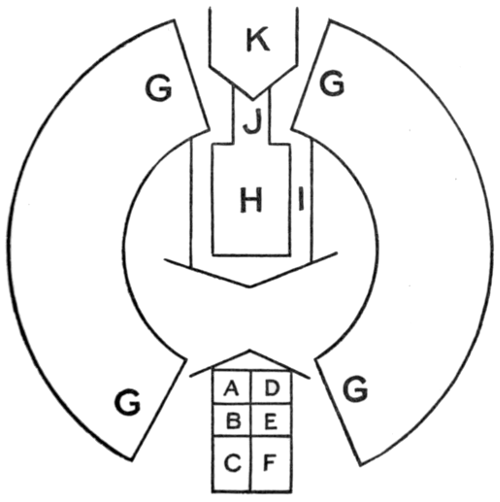
KEY TO PLAN I
Theatre set up in the river-bed at Kyōto in 1464; Onami’s troupe acted on it for three days “with immense success.”
A The Shōgun.
B His attendants.
C His litter.
D His wife.
E Her ladies.
F Her litter.
G Auditorium.
H Stage.
I Musicians.
J Hashigakari.
K Gakuya, served as actors’ dressing-room and musicians’ room.
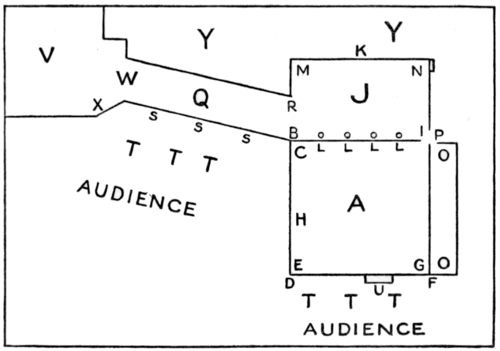
KEY TO PLAN II
Modern Stage
A The Stage.
B The shite’s Pillar.
C Shite’s seat, also called “Name-saying seat.”
D Metsuke-bashira, Pillar on which the actor fixes his eye.
E Sumi, the corner.
F Waki’s Pillar, also called the Prime Minister’s Pillar.
G Waki’s seat.
H Waki’s direction-point. (The point he faces when in his normal position.)
I Flute-player’s Pillar.
J Atoza, the Behind-space.
K Kagami-ita, the back-wall with the pine-tree painted on it.
L The musicians. (Represented by the four small circles.)
M The stage-attendant’s place. (A stage-hand in plain clothes who fetches and carries.)
N Kirido, “Hurry-door,” also called “Forgetting-door” and “Stomach-ache-door”; used by the chorus and occasionally by actors making a hurried exit. Vide Hōkazō, p. 174.
O Chorus, the leader sits near P.
P The Nobles’ door (now seldom used).
Q The Hashigakari.
R The kyōgen’s seat.
S The three pine-branches.
T Shirasu, a gravel-path.
U Kizahashi, steps from stage to auditorium, formerly used by an actor summoned to speak with the Shōgun.
V Actors’ dressing-room.
W Curtain between Q and V.
X Dressing-room window.
Y Musicians’ room.