Chapter IV
Reading edition
Niagara Bond and Free
No one acquainted with the Niagara of to-day can imagine what were the conditions existing here before the days of the New York State Reservation and Queen Victoria Park. That old Niagara of private ownership, with a new fee for every point of vantage, was a barbarous incongruity only matched by the wonder and beauty of the spectacle itself. The admission to Goat Island was fifty cents, and to the Cave of the Winds, one dollar. To gain Prospect Park, the "Art Gallery," the inclined railway, or the ferry, the charge was twenty-five cents. It cost one dollar to go to the "Shadow of the Rock," or go behind the Horseshoe Fall. The admission to the Burning Spring was fifty cents, likewise to Lundy's Lane battle-ground, the Whirlpool Rapids, the Whirlpool. It cost twenty-five cents to go upon either of the suspension bridges. In addition to this a swarm of pedlars were hawking their wares at your elbows, and tents were pitched at every vantage point, containing the tallest man or the fattest woman, or the most astonishing reptile then in a state of captivity in all the world.
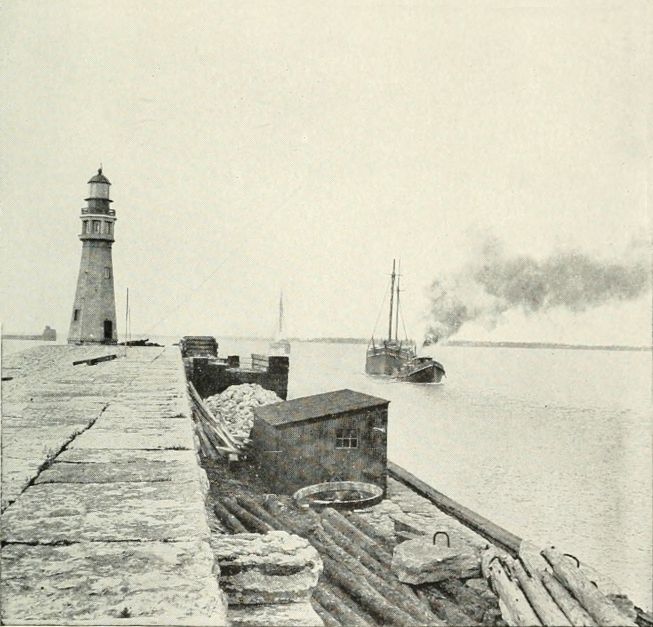
Beacon on Old Breakwater at Buffalo.
Not even the five-legged calves missed their share of plunder at Niagara, according to Mr. Howells, who paid his money out to assure himself, as he affirms, that this marvel was in no wise comparable to the Falls. "I do not say that the picture of the calf on the outside of the tent," he observes, "was not as good as some pictures of Niagara I have seen. It was, at least, as much like." A writer of a decade before this (1850) speaks very strongly of the impositions to which a traveller is subjected at Niagara. How early in the century complaints began to appear cannot be stated; it would be interesting to be able to get information on this point since it would determine a more important matter still—the time when the Falls began to attract visitors in sufficient proportions to bring into existence the evils we find very prevalent at the middle of the century. The latter writer observes:
It would be paying Niagara a poor compliment to say that, practically she does not hurl off this chaffering by-play from her cope; but as you value the integrity of your impression, you are bound to affirm that it hereby suffers appreciable abatement; you wonder, as you stroll about, whether it is altogether an unrighteous dream that with the slow progress of culture, and the possible or impossible growth of some larger comprehension of beauty and fitness, the public conscience may not tend to ensure to such sovereign phases of nature something of the inviolability and privacy which we are slow to bestow, indeed, upon fame, but which we do not grudge, at least, to art. We place a great picture, a great statue, in a museum; we erect a great monument in the centre of our largest square, and if we can suppose ourselves nowadays building a cathedral, we should certainly isolate it as much as possible and subject it to no ignoble contact. We cannot build about Niagara with walls and a roof, nor girdle it with a palisade; but the sentimental tourist may muse upon the chances of its being guarded by the negative homage of empty spaces, and absent barracks, and decent forbearance. The actual abuse of the scene belongs evidently to that immense class of iniquities which are destined to grow very much worse in order to grow a very little better. The good humour engendered by the main spectacle bids you suffer it to run its course.
There was at least no bettering of conditions at Niagara between 1850 and 1881, when more or less active steps began to be taken for the freeing of the beautiful shrine. True, Goat Island was kept ever in its primeval beauty, which by far counterbalanced the Porter mills on Bath Island; as William Dean Howells wrote, while these "were impertinent to the scenery they were picturesque with their low-lying, weatherworn masses in the shelter of the forest trees beside the brawling waters' head. But nearly every other assertion of private rights in the landscape was an outrage to it."