Front matter
Reading edition
Being Some Account of a Woman's Journey through Canada to the Arctic
BY AGNES DEANS CAMERON
WITH MANY ILLUSTRATIONS FROM PHOTOGRAPHS BY THE AUTHOR
Published November, 1909
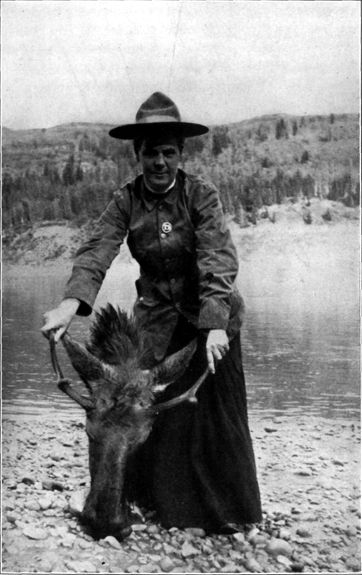
A Magnificent Trophy
TO THE MEMORY OF MY MOTHER, JESSIE ANDERSON CAMERON
AND
TO ALL THOSE WHO TRY TO LIVE OUT HER SIMPLE RULE: "WE MUST JUST TRY TO DO THE VERY BEST WE CAN"
PREFACE
It is customary to write a preface. Mine shall be short. Out of a full heart, I wish to thank all the splendid people of the North who, by giving me so freely information and photographs, and chapters out of their own lives, have facilitated the writing of this story. For their spontaneous kindness to me and mine no acknowledgment that I can here make is adequate. What we feel most strongly we cannot put into words.
AGNES DEANS CAMERON.
August, 1909.
CONTENTS
CHAPTER I: THE MENDICANTS REACH WINNIPEG
The Mendicants leave Chicago—The invisible parallel of 49 where the eagle perches and makes amorous eyes at the beaver—Union Jack floats on an ox-cart—A holy baggage-room—Winnipeg, the Buckle of the Wheat-Belt—The trapper and the doctor—Mrs. Humphry Ward speaks—Boy Makers of Empire—The vespers of St. Boniface
CHAPTER II: WINNIPEG TO ATHABASCA LANDING
The 1,000-mile wheat-field—Calgary-in-the-Foothills—Edmonton, the end of steel—The Brains of a Trans-Continental—Browning on the Saskatchewan—East Londoners in tents—Our outfit—A Waldorf-Astoria in the wilderness—The lonely cross of the Galician—Height of Land—Sergeant Anderson, R.N.W.M.P., the sleuth of Lesser Slave
CHAPTER III: ATHABASCA LANDING
Athabasca Landing, the Gateway of the North—English gives place to Cree—Limit of the Dry Martini—Will the rabbits run?—The woman printer—Hymn-books by hand in the Cree syllabic—Baseball even here—Rain and reminiscences—The World's Oldest Trust
CHAPTER IV: DOWN THE ATHABASCA ONE HUNDRED AND SIXTY-FIVE MILES TO GRAND RAPIDS
"Farewell, Nistow!"—The rainy deck of a "sturgeon head" under a tarpaulin—Drifting by starlight—The wild geese overhead—Forty-foot gas-spout at the Pelican—The mosquito makes us blood-brothers—Four days on our Robinson Crusoe Island in the swirling Athabasca—Nomenclature of the North—Sentinels of the Silence
CHAPTER V: NINETY MILES OF RAPIDS
The Go-Quick-Her takes the bit in her mouth—Mallards on the half-shell—We set the Athabascan Thames afire—Sturgeon-head breaks her back on the Big Cascade—Fort McMurray—A stranded argosy, wreckage on the beach—Miss Christine Gordon, the Free Trader—A land flowing with coal and oil and gas and tar, timber and lime
CHAPTER VI: FORT CHIPEWYAN PAST AND PRESENT
Old Fort Chipewyan—In the footsteps of Mackenzie and Sir John Franklin—Sir John turns parson—Grey Nuns and brown babies—Where grew the prize wheat of the Philadelphia Centennial—Militant missionaries fight each other for souls—The strong man Loutit—Wyllie at the forge—An electric watch-maker—Where the Gambel sparrow builds—"Out of old books"
CHAPTER VII: LAKE ATHABASCA AND ITS FOND DU LAC
Farewell to the Mounted Police—Our blankets on the deck—Fern odours by untravelled ways—Typewriting and kodaking in 20 hours of daylight—Navigating Lake Athabasca by the power o' man—A 23-inch trout—First white women at Fond du Lac—Carlyle among the Chipewyans, a Fond du Lac library—The hermit padre and the hermit thrush—Worn north trails of the trapper—Caribou by the hundred thousands—The phalarope and the suffragette
CHAPTER VIII: FOND DU LAC TO FORT SMITH
World's records beaten on the Athabasca—Down the Slave to Smith's Landing—Priests sink in the Rapid of the Drowned—The Mosquito Portage—Fort Smith, the new headquarters—Lady-slippers and night-hawks—Steamer built in the wilderness—Last stand of the wood bison—The grey wolf persists—Fur-trade and the silver-fox—Breeding pelicans.
CHAPTER IX: SLAVE RIVER AND GREAT SLAVE LAKE
"Red lemol-lade" kiddies—Tons of crystal salt—Great Slave Lake and its fertile shores—Yellow-Knife and Dog-Rib, subjects of the Seventh Edward—Hay River and its annual mail—Ploughing with dogs—Bill balked—The Alexandra Falls—Bishop Bompas as a surgeon; amputations while you wait.
CHAPTER X: PROVIDENCE TO SIMPSON, ONE HUNDRED AND FIFTY MILES DOWN THE MACKENZIE
Drowning of De-deed—Fort Simpson, the old headquarters—A mouldy museum—The shrew-mice that were not preserved in rum—The farthest north library—Gold-seekers and grub-staked brides—Bishop Bompas, the Apostle of the North—Owindia, the Weeping One—Fort Simpson in the first year of Victoria the Good.
CHAPTER XI: FORT GOOD HOPE ON THE ARCTIC CIRCLE
Tenny Gouley tells us things—Mackenzie River, past and present—The fringed gentian at Fort Wrigley—The fires Mackenzie saw—The weathered knob of Bear Rock—Great Bear Lake—Orangeman's Day at Norman—The Ramparts of the Mackenzie—Fort Good Hope under the Arctic Circle—Mignonette and Old World courtesy—We meet Hagar once more—Potatoes on the Circle—The Little Church of the Open Door
CHAPTER XII: ARCTIC RED RIVER AND ITS ESKIMO
Arctic Red River—Wilfrid Laurier, the merger—Mrs. Ila-la-Rocko, the danseuse—Marriage as the Oo-vai-oo-aks see it—Orange-blossoms at Su-pi-di-do's—Trading tryst at Barter Island—Floating fathers—By-o Baby Bunting—Wild roses and tame Eskimo—Midnight football with walrus bladder and enthusiasm—Education that makes for manliness
CHAPTER XIII: FORT MACPHERSON FOLK
Sir John Franklin's lobsticks at Point Separation—We reach Fort Macpherson on the Peel—Sergeant Fitzgerald, R.N.W.M.P., eulogizes the Eskimo—An Eskimo wife must make boots that are waterproof—She ariseth also while it is yet night and cheweth the boots of her household—Cribbage-boards the link between Dick Swiveller and the Eskimo—Linked sweetness long drawn out—Chauncey Depew of the Kogmollycs
CHAPTER XIV: MORALIZING UNDER THE MIDNIGHT SUN
The Midnight Sun—Our friend the heathen—"We want to go to hell"—Catching fish by prayer—The Eskimo and the Flood—Pink tea at the Pole—Always a balance in the Eskimo Bank—Marriage for better and not for worse—Christmas carols even here
CHAPTER XV: MAINLY CONCERNING FOOD
Jurisprudence on ice—The generous Innuit—Emmie-ray, the Delineator pattern—Weak races are pressed south—Roxi, a re-incarnation of Sir Philip Sidney—Blubbery bon vivants—Eskimo knew the Elephant—We write the last chapter of the story of McClure, the navigator—Cannibalism at the Circle
CHAPTER XVI: THE TALE OF A WHALE
Circumpolar Bowhead makes his last stand—Whales here and elsewhere—The Yankee peddler at Canada's back-door—Thirteen and a half million in whale values—Wind-swept Herschel, the Isle of Whales—One wife for a thousand years—Baleen, Spermaceti, and Ambergris—Save the Whale
CHAPTER XVII: SOUTH FROM THE ARCTIC TO CHIPEWYAN
Lives lost for the sake of a white bead—The stars come back—The Keele party from the Dollarless Divide—"Here and there a grayling"—Across Great Slave Lake—The first white women at Fort Rae—Land of the musk-ox—Tales of 76 below—Two Thursdays in one week—Rabbits on ice
CHAPTER XVIII: TO MC MURRAY AND BACK TO THE PEACE
The nuptials of 'Norine—Ladies round gents and gents don't go—The fossil-gatherers—I give my name to a Cree kiddie—A solid mile of red raspberries—The typewriter an uncanny medicine—The Beetle Fleet leaves for Outside—Shipwrecked on a batture
CHAPTER XIX: UP THE PEACE TO VERMILION
Ho! for the Peace—One break in 900 miles of navigation—A grey wolf—Bear-meat and the Se-weep-i-gons—Ninety-foot spruces—Tom Kerr and his bairns—The fish-seine that never fails—Our lobsticks by Red River—The Chutes of the Peace
CHAPTER XX: VERMILION-ON-THE-PEACE
The farthest north flour-mill—The man who made Vermilion—Wheat at $1.25 a bushel—An Experimental Farm in latitude 58° 30'—An unoccupied kingdom as large as Belgium—Where the steamer Peace River was built—The hospitable home of the Wilsons—Vermilion a Land of Promise Fulfilled—Culture and the Cloister—Thomas of Canterbury on the Stump
CHAPTER XXI: FORT VERMILION TO LESSER SLAVE
Se-li-nah of the happy heart—My premier moose—The rare and resourceful boatmen of the North—Alexander Mackenzie's last camp
CHAPTER XXII: PEACE RIVER CROSSING TO LESSER SLAVE LAKE
Pleasant prairies of the Peace—We tramp a hundred miles—The Angelus at Lesser Slave—Poole coats and Norfolk shooting-jackets—Roast duck galore—Alec Kennedy of the Nile—Louise the Wetigo, she ate nineteen
CHAPTER XXIII: LESSER SLAVE LAKE TO EDMONTON
Jim wins: Allie Brick can't run—100,000,000 acres of wheat-land—Jilly-Loo bird still lacks a rib—100 moose in one month—Peripatetic judges but no prisoners—The best-tattooed man in the Province of Alberta—The-Man-Who-Goes-Around-and-Helps
CHAPTER XXIV: HOMES AMONG THE YELLOW WHEAT
Edmonton again—Wyllie goes out on the Long Journey—Donaldson killed by a walrus—Two drowned in the Athabasca—Steel kings and iron horses—Wheat-plains the melting-pot of a New Nation
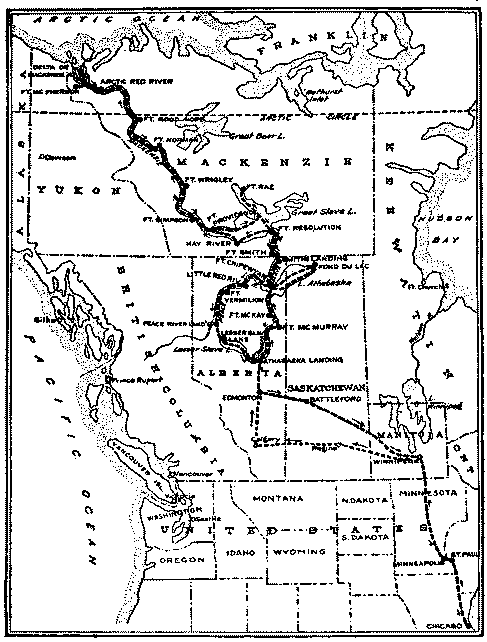
ROUTES OF TRAVEL
LIST OF ILLUSTRATIONS
A magnificent trophy
Map showing the Author's Route
Sir Wilfred Laurier
Earl Grey, Governor-General of Canada
Winnipeg, the Buckle of the Wheat Belt
The Canadian Women's Press Club
A section of Edmonton
The Golden Fleece of Saskatchewan
Irrigation ditch, Calgary, Alberta
A Waldorf-Astoria on the prairie's edge
Athabasca Landing
Necessity knows no law at Athabasca
The Missionary Hymnal for the Indians
C.C. Chipman, Commissioner of the H.B. Co.
A "sturgeon-head" on the Athabasca
"Farewell, Nistow!"
Grand Rapids, on the Athabasca River
Portage at Grand Rapids Island
Our transport at Grand Rapids Island
Cheese-shaped nodules, Grand Rapids Island
Scouts of the Royal Northwest Mounted Police
Towing the wrecked barge ashore
The scow breaks her back and fills
Miss Gordon, a Fort McMurray trader
The steamer Grahame
An oil derrick on the Athabasca
Tar banks on the Athabasca
Fort Chipewyan, Lake Athabasca
Three of a kind
Woman's work of the Far North
Lake Athabasca in winter
Bishop Grouard
The modern note-book
Tepee of a Caribou-eater Indian
A bit of Fond du Lac
Birch-barks at Fond du Lac
Fond du Lac
Father Beibler carrying water to a dying Indian
Smith's Landing
A transport between Fort Smith and Smith's Landing
Lord Strathcona, Governor of the Hudson's Bay Company
The world's last buffalo
Tracking a scow across mountain portage
The "red lemol-lade" boys
Salt beds
Unloading at Fort Resolution
Coming to "take Treaty" on Great Slave Lake
On the Slave
Dogs cultivating potatoes
David Villeneuve
Hudson's Bay House, Fort Simpson
A Slavi family at Fort Simpson
A Slavi type from Fort Simpson
Interior of St. David's Cathedral
Fort Simpson by the light of the Aurora
Indians at Fort Norman
Roman Catholic Church at Fort Norman
The ramparts of the Mackenzie
Rampart House on the Porcupine near the Mackenzie mouth
A Kogmollye family
Roxi and the Oo-vai-oo-ak family
Farthest North football
Two spectators at the game
An Eskimo exhibit
Constable Walker and Sergeant Fitzgerald in Eskimo togs
Two wise ones
A Nunatalmute Eskimo family
Cribbage-boards of walrus tusks
Useful articles made by the Eskimo
Home of Mrs. Macdonald
Eskimo kayaks at the Arctic edge
A wise man of the Dog-Ribs
A study in expression
We tell the tale of a whale
Two little ones at Herschel Island
Breeding grounds of the seal
The Keele party on the Gravel River
The first typewriter on Great Slave Lake
The bell at Fort Rae mission
The musk-ox
A meadow at McMurray
Starting up the Athabasca
On the Clearwater
Evening on the Peace
Our lobsticks on the Peace
The chutes of the Peace
Pulling out the Mee-wah-sin
The flour mill at Vermilion-on-the-Peace
Articles made by Indians
The Hudson's Bay Store
Papillon, a Beaver brave
Going to school in winter
My premier moose
Beaver camp, on Paddle River
The site of old Fort McLeod
Jean Baptiste, pilot on the Peace
Fort Dunvegan on the Peace
Fort St. John on the Peace
Where King was arrested
Alec Kennedy with his two sons
Cannibal Louise, her little girl and Miss Cameron
A Peace River Pioneer
Three generations
A family at the Lesser Slave
A one-night stand
A rye field in Brandon, Manitoba
Charles M. Hays, President of the Grand Trunk Railway
William Mackenzie, President of the Canadian Northern Railway
Donald D. Maun, Vice-president of the Canadian Northern Railway
William Whyte, Second Vice-president of the Canadian Pacific Railway
In the wheat fields
Hon. Frank Oliver, Minister of the Interior
Threshing grain
Doukhobors threshing flax
Sir William Van Horne, first President of the Canadian Pacific Railway
Map of the Author's Route