WEBSTER'S VINDICATION.
Reading edition
BY HON. STEPHEN M. ALLEN.
The first great National success of the Whig party was in the election of their candidates for President and Vice-President in 1840, William Henry Harrison, of Ohio, and John Tyler, of Virginia, being the successful nominees. The previous influence of the party in many States of the Union, their ability to carry out great local measures in their respective locations, and their party power in Congress, but made the political contest which was long and bitter, the more active and important. Party strife ran to the highest pitch throughout the whole country, and Mr. Webster, who was the acknowledged head in the North, and one of the principal originators of the National Whig organization in the United States, was looked up to as a most important personage in the contest, and his influence was deeply felt and appreciated. General Harrison early selected Mr. Webster for one of his Cabinet, and offered him the choice between the Treasury and the State Department. Mr. Webster chose the latter, and during the short month of General Harrison's life, laid out the ground plan of that important work which kept him so busily employed for the next two years, and which under no circumstances during the contest between Mr. Tyler, the succeeding President, and the Whig party, did he feel willing to leave to the chances of a settlement by a successor less familiar and perhaps less skilled in National affairs with foreign governments than himself. Although Mr. Webster was generally sustained by the party friends in Congress, and in part by the whole country, the shortsighted, less skilful, and more selfish of Whig partisans denounced him in unmeasured terms through the press and upon the stump, for not forsaking his post and leaving the President with the rest of the Cabinet. It was here, at the great pivotal turn of the Whig party, so far as Mr. Webster was concerned, and not at a later period, while in the Senate where he delivered his seventh of March speech, or in the Cabinet of President Fillmore, that the great coalition of radical partisans was made against him. The most bitter denunciations were launched by this premeditated alliance of selfish politicians, who, not having been able to bit, bridle, and drive Mr. Webster, were determined to rule or ruin, through his political disfranchisement, from the great party he was virtually the father of. All this, too, by false pretence; for a cool review of Mr. Webster's course has satisfied the country that the great depth of motive, prescience of danger to the Union and in fact, purpose of that speech, was, in the highest sense, proper and patriotic, and in no way at variance with the interpretation of either the old or new Constitution as now understood. The occasion was seized upon, having failed in their first effort to denounce and defame him, in the hope of thus building up an influence with some candidate for President, whom they could control for their own selfish purposes. It will be remembered that some of Mr. Webster's friends, or, at least, those who claimed to be such, took occasion to forsake him at that time. He, however, went into the Cabinet of President Fillmore after the death of General Taylor, where he remained until his death. The bill pending before Congress when he left it, was altered after Mr. Webster's speech, and he stated to his friends that he should have proposed amendments to it on its final passage, if he had been in the Senate. It was at this time that he prepared the following paper, which I have always designated as "Webster's Vindication." This document, as shown by the endorsement, in the handwriting of Colonel Fletcher Webster, was proposed to the Cabinet by Mr. Webster, in October, 1850, who intended it as a mandate to the United States officials in all the States, but it was rejected by President Fillmore, who did not wish thus to be committed. There is no doubt about the genuineness of the document itself. It was found in looking over Mr. Webster's papers before the Webster mansion was burned, and was presented to the writer by Mrs. Fletcher Webster, some years before it was made public, at the Webster Centennial Celebration at Marshfield in 1882, where it was first read in the presence of President Arthur, who was at the meeting. It speaks strongly for itself, and is all that will be needed, at this late day, to convince every dispassionate lover of justice and truth, of Webster's sincerity and singleheartedness of motive, and his unswerving loyalty to the Constitution and the Union.
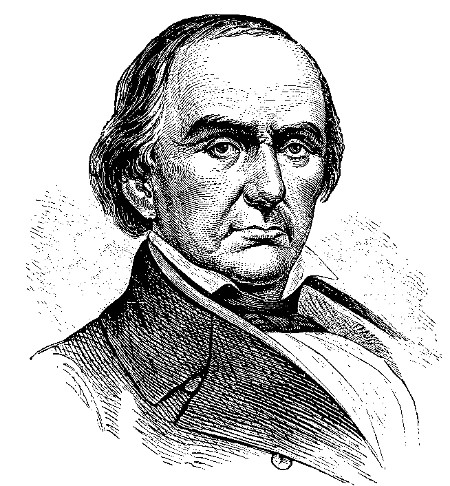
DANIEL WEBSTER.[1]
"PROPOSED
"CABINET CIRCULAR OF DANIEL WEBSTER, OCTOBER, 1850.
"The open manner in which disunion, secession, or a separation of the States, is suggested and recommended in some parts of the country, naturally calls on those to whom are confided the power and trust of maintaining the Constitution, and seeing that the laws of the United States be faithfully executed, to reflect upon the duties which events not yet indeed probable, but possible, may require them to perform. In the Northern and Eastern States, these sentiments of disunion are espoused principally by persons of heated imaginations, assembling together and passing resolutions of such wild and violent character as to render them nearly harmless. It is not so in other parts of the country. There are States in the South in which secession and dismemberment are proposed or recommended by persons of character and influence, filling stations of high public trust, and, it is painful to add, in some instances, not unconnected with the Government of the United States itself. Legislatures of some of the States have directed the government of those States to reassemble them in the contingency of the passage of certain laws by Congress. While these occurrences do not constitute an exigency calling for any positive proceeding either by the Executive Government of the United States or by Congress, yet they justly awaken attention, and admonish those in whose hands the administration of the government is placed, not to be found either unadvised, surprised, or unprepared, should a crisis arrive. The Constitution of the United States is founded on the idea of a division of power between the general government and the respective State governments; and this division is marked out and defined by the Constitution of the United States with as much distinctness and accuracy as the nature of the subject and the imperfection of language will admit. The powers of Congress are specifically enumerated, and all other powers necessary to carry these specified powers into effect are also expressly granted. The Constitution was adopted by the people in the several States, acting through the agency of conventions chosen by themselves; the Legislatures of the States had nothing to do with this proceeding, but to regulate the time and manner in which these conventions thus chosen by the people, the true source of all power, should assemble. The Constitution of the United States purports to be a perpetual form of government; it contains no limits for its duration, and suggests no means and no form of proceeding by which it can be dissolved, or its obligations dispensed with; it requires the personal allegiance of every citizen of the United States, and demands a solemn oath for its support from every man employed in any public trust, whether under the Government of the United States, or any State government. This obligation and this oath are enjoined in broad and general terms without qualification or modification, and with reference to no supposed possible change of circumstances or events.
"No man can sit in a State Legislature, or on the bench of a State court, or execute the process of such court, or hold a commission in the militia, or fill any other office in a State government, without having first taken and subscribed an oath to support the Constitution of the United States. Without looking, therefore, to what might be the result of forcible revolution, since such cases can, of course, be governed by no previously established rule, it is certainly the manifest duty of all those who are entrusted with the Government of the United States in its several branches and departments to uphold and maintain that government to the full extent of its constitutional power and authority, to enact all laws necessary to that end, and to take care that those laws be executed by all the means created and conferred by the Constitution itself. We are to look to but one future, and that a future in which the Constitution of the country shall stand as it now stands; laws passed in conformity to it to be executed as they have hitherto been executed, and the public peace maintained as it has hitherto been maintained. Whatsoever of the future may be supposed to lie out of this line, is not so much a thing to be expected, as a thing to be feared and dreaded, and to be guarded against by the firmest resolution and the utmost vigilance of all who are entrusted with the conduct of public affairs; no alternative can be presented which is to authorize them to depart from the course which they have sworn to pursue. In conferring the necessary powers on the general government, it was foreseen that questions as to the just extent of those powers might occur, and that cases of conflict between the laws of the United States and the laws of individual States might arise. It was of indispensable necessity, therefore, that the manner in which such questions should be settled, and the tribunal which should have the ultimate authority to decide them, should be established and fixed by the Constitution itself: and this has been clearly and amply done. By the Constitution of the United States, that instrument itself, all acts of Congress passed in conformity to it, and public treaties, constitute the supreme law of the land, and are to be of controlling force and effect, anything in any State constitution or State law to the contrary notwithstanding; and the judges in every State, as well as of the courts of the United States, are expressly bound thereby. The supreme rule, then, is plainly and clearly declared and established: it is the Constitution of the United States, the laws of Congress passed in pursuance thereof, and treaties made under the authority of the United States. And here the great and turning question arises, Who in the last resort is to construe and interpret this supreme law? If it be alleged, for example, that a particular act of a State Legislature is a violation of the Constitution of the United States, and therefore void, what tribunal has authority finally to determine this important question? It is evident that if this power had not been vested in the tribunals of the United States, the government would have wanted the means of its own preservation; all its granted powers would have depended upon the variable and uncertain decisions of State courts.
"It is a well-established maxim in political organization, that the judicial power must be made co-extensive with the constitutional and legislative power; otherwise there can be no adequate provision for the interpretation and execution of the laws. In conformity with this plain and necessary principle, the Constitution declares that the judicial power of the United States shall extend to all cases in law and equity arising under the Constitution, the laws of the United States and treaties, no matter in what court such a case arises. Whenever and wherever such a case comes up, the judicial power of the United States extends to it, and attaches upon it; and if it arise in any State court, the acts of Congress have made provision for its transfer to the Supreme Court of the United States, there to be finally heard and adjudged. This proceeding is well known to the profession, and need not now be particularly stated or rehearsed. Finally, the President of the United States is by the Constitution made commander-in-chief of the army and navy, and of the militia when called into the actual service of the United States; and all these military means are put under his control in order that he may be able to see that the laws be faithfully executed. The Government of the United States, therefore, though a government of limited powers, is complete in itself, and, to the extent of those powers, possesses all the faculties for legislation, interpretation and execution of the laws, and nothing is necessary but fidelity in all those who are elected by the people to hold office in its various departments to cause it to be upheld, maintained, and efficiently administered.
"The Constitution assigns particular classes of causes to the original jurisdiction of the Supreme Court, and other courts are to exercise such powers and duties as are or may be prescribed by Congress. Congress has not as yet found it necessary or expedient to confer on the circuit or other inferior courts all the jurisdiction created or authorized by the Constitution; thus there are many cases in which a summary jurisdiction usually belonging to courts, such as that of mandamus and injunction, are not provided for by general law, but some such cases are provided for. Thus by the act of March 2, 1833, it is declared that the jurisdiction of the Circuit Courts of the United States shall extend to all cases in law or equity arising under the revenue laws of the United States; and if any person be injured in his person or property on account of any act by him done under any revenue law of the United States, he may bring suit immediately in the Circuit Court of the United States; and if he be sued in any State court for such act, he may cause such suit to be immediately removed into the Circuit Court of the United States; and if the State court refuse a copy of its record, that record may be supplied by affidavit; and if the defendant be under arrest, or in custody, he is to be brought by habeas corpus before the Circuit Court of the United States. Under the first part of these provisions, writs of mandamus and injunction may be issued, and all other writs and processes suitable to the case; and any judge of any court of the United States is authorized to grant writs of habeas corpus in all cases of prisoners committed or confined for any act done in pursuance of a law of the United States, or of any order, process or decree of any court of the United States. These provisions are all found in the permanent sections of the act of Congress already referred to. The importance and efficiency of these provisions, if events were to arise in which obstruction to the collection of revenue should be attempted or threatened, are too obvious to require comment. The several district attorneys of the United States will take especial care to inform themselves of these enactments of law, and be prepared to cause them to be enforced in the first and in every case which may arise, justly calling for their application.
"Declarations merely theoretical, or resolutions only declaratory of opinions, from however high authority emanating, cannot properly be made the subject of legal or judicial proceedings. They may be very intemperate, they may be very exceptional, they may be very unconstitutional; but until something shall be actually done or attempted, hindering or obstructing the execution of the laws of the United States, or injuring those employed in their execution, the officers of the government will remain vigilant indeed, and prepared for events, but without any positive exercise of authority. It is most earnestly to be hoped that the returning good sense of the people in all the States, and an increase of harmony and brotherly good will everywhere, may prevent the necessity of resorting to the exercise of legal authority; it is to be hoped that all good citizens will be much more inclined to reflect on the value of the Union and the benefits which it has conferred upon all, than to speculate upon impracticable means for its severance or dissolution. No State legislation, it is evident, is competent to declare such severance or dissolution—the people of no State have clothed their Legislature with any such authority; any act therefore proclaiming such severance by a Legislature, would be merely null and void as altogether exceeding its constitutional powers. No State was brought into the Union by the Legislature thereof, and no State can be put out of the Union by the Legislature thereof. Doubtless it is to be admitted that revolution, forcible revolution, may produce dismemberment more or less extensive; but there is no power on earth competent, by any peaceable or recognized manner of proceeding, to discharge the consciences of the citizens of the United States from the duty of supporting the Constitution. The government may be overthrown, or the Union broken into fragments by force of arms or force of numbers, but neither can be done by any prescribed form or peaceable existing authority."