Volume 1 — HERALDRY.
Reading edition
HERALDRY.
In preparing this article we have consulted various writers on the subject of Heraldry, and not only selected our thoughts from theirs, but used their language when it appeared best adapted to our object. For a more full account of Heraldry in all its branches, we refer our readers to Guillim's Banner Displayed, Camden's British Remains, Kent's Grammar of Heraldry, Edmonson's Complete Body of Heraldry, Leigh's Accidence of Armorie, Playfair's British Baronetage, Burke's Peerage and Baronetage, Noble's History of the College of Arms, Lower's Curiosities of Heraldry, Dallaway's Inquiries, Newton's Display of Heraldry, Broun's Baronetage, Collins's Peerage of England, Betham's Baronetage of England, and the various Encyclopædias.
DEFINITION.
Heraldry is the science of conventional distinctions impressed on shields, banners, and other military accoutrements; or it is the art of armory and blazoning, or the knowledge of what relates to the bearing of arms, and the laws and regulations appertaining thereto. Arms in heraldry are ensigns armorial or marks of honor borne upon shields, banners, and coats of mail, in order to distinction. The science of Heraldry consists particularly in the appropriation of figurative representations, designed, by suitable emblems, to exhibit the achievements of valor, the descent of hereditary honors, and the distinctions appertaining to nobility.
The Degrees of Honor existing in England in 1597, were nine; of which five were noble, as Gentleman, Esquire, Knight, Baron, and Lord; and four were excellent, as Earl, Marquess, Duke, and Prince.—The Degrees of Honor existing in the British nation in 1847 are eleven; namely, Gentleman, Esquire, Knight, Baron, Baronet, Lord, Viscount, Earl, Marquess, Duke, and Prince.
ORIGIN AND HISTORY.
Arms may belong to individuals, to families, or to countries. Badges and emblems on shields and helms occurred in the earliest times. In Numbers, (chap. i: 52,) the children of Israel are enjoined to pitch their tents, "every man by his own camp and every man by his own standard," with the ensigns of his father's house. The Greek and Roman poets speak of paintings and devices on shields and helmets. These symbols were, moreover, hereditary. Thus Xenophon relates that the kings of the Medes bore a golden eagle on their shields. Suetonius asserts that Domitian had a golden beard for his coat of arms; and Tacitus says of the ancient Germans, that they marked their shields with brilliant colors, and that certain standards were borne before them in battle. Notwithstanding these traces of armorial bearings in the ancient world, our heraldry is no older than the tournaments. That armory first became common and regulated by certain rules at these solemn festivals, is corroborated by the following reasons. In the first place, we find no tomb or monument with escutcheons, older than the eleventh century. The most ancient monument of this kind is said to be the bearings of a certain Varmond, count of Vasserburg, in the church of St. Emmeran, at Ratisbon. The shield is coupé of argent and sable; over it is a lion, with the words "Anno Domini MX." On most of the other tombs, even of the eleventh century, no arms are found; and the use of them seems to have first become common in the twelfth century. The first pope who can be proved to have had a coat of arms, is Boniface VIII., who filled the papal see from 1294 to 1303. All the earlier papal arms are the fanciful inventions of later flatterers. On coins, also, no armorial ensigns are found till the thirteenth century. A second proof of our assumed origin of coats of arms is the word blason, which denotes the science of heraldry in French, English, Italian, and Spanish. This word has most probably its origin in the German word blasen, (to blow the horn;) for whenever a new knight appeared at a tournament, the herald had to sound the trumpet, and, because all appeared with close visors, to proclaim and explain the bearing of the shield or coat of arms belonging to each. Because this was performed by the herald, this knowledge was called heraldry; and because, in doing so, he blew the trumpet, it was called blazoning the arms. That this was a prevailing practice at tournaments, may be proved from the poetry of the Troubadours of the twelfth and thirteenth centuries. Thence it came, that those knights, whose right to appear at tournaments had already been announced by blazoning their arms, bore two trumpets on their crest. From the Germans, this custom was transmitted to the French; for there is no doubt, that tournaments were usual in Germany much earlier than in France. But the French carried to far greater perfection the tournament, and the blazon or heraldry connected with it, as they did the whole system of chivalry. Since, moreover, the French language prevailed at the court of the Norman kings in England, pure French expressions have been preserved in British heraldry. Thus the green tincture, (color,) in a coat of arms, is termed vert, (though in French sinople, which originally denoted a reddish brown;) bright red is termed gueules, probably with an allusion to the bloody revenge of wild animals, which play so conspicuous a part in heraldry; the divided shield is, moreover, called coupé; and passant, regardant, dormant, couchant, &c., are used. German heraldry, on the contrary, contains almost pure German expressions. In a coat of arms, the helm is placed upon the shield, and the latter is surrounded by the wreath. At a tournament, the mantle of the knight, with the helm and shield, was suspended in the lists. The colors or tinctures of the shields had their foundation in the custom of the most ancient Germans, of giving their shields various colors—a custom which received a tender meaning in the tournaments of the middle ages; the knight, bound to defend the honor of dames, and devote himself to their protection, wearing their colors on his shield. By degrees, the partitions or sections on shields came into use; for when, as often occurred, a knight was the champion of several ladies, he bore several colors on his shield, which had therefore to be divided into fields. When the martial youth of almost all Europe left their homes, about the end of the eleventh century, inspired with religious enthusiasm, to conquer the Holy Land, the use of arms became still more general and necessary. In order to distinguish the nations, armies, and families, the princes and commanders chose their symbols, sometimes in commemoration of the exploits and events of the campaign, or of the dignity of the commander, and sometimes from mere fancy or passing humor.
BLAZONING, HISTORIFYING, AND MARSHALLING ARMS.
Blazoning is the methodical description of a bearing. In the first place, the shield is described according to its tinctures, figures, and partitions. The inferior parts of an escutcheon are then blazoned—the helm, with its insignia, which are trumpet, wings, and plumes, men and animals, or their members; then the wreath and its tinctures; after which the coronet cap, &c.; finally the supporters, the mantle, the device, and other secondary things. Such terms for the color must be used as are agreeable to the station and quality of the bearer. All persons below the degree of noble must have their coats blazoned by colors and metals; noble men by precious stones; and kings and princes by planets.
In emblazoning shields of arms, metals, colors, and furs are used to depict the device, the technical terms of which are these;—of metals, gold, called or, and silver, argent, only are employed;—of colors, red, called gules, blue, azure, black, sable, green, vert, and purple, purpure;—and of furs, principally the skin of the little animal called ermine, and a combination of grey and white squirrel skins, called vair.
In blazoning arms it is an established rule with heralds, that animals are always to be interpreted in the best sense, that is, according to their most noble and generous qualities, that the most honor may redound to the bearers. Thus the fox, being reputed witty and given to filching for his prey, if this be the charge of an escutcheon, we are to conceive the quality represented to be his wit and cunning, and not his theft.
All savage beasts are to be figured in their fiercest action: as a lion erected, his mouth wide open, his claws extended; and thus formed he is said to be rampant. A leopard or wolf is to be portrayed going as it were pedetentim, which form of action suits their natural disposition, and is called passant. The gentler kinds are to be set forth in their noblest and most advantageous action, as a horse running or vaulting, a greyhound coursing, a deer tripping, a lamb going with smooth and easy pace.
Every animal is to be represented as moving or looking to the right side of the shield; and it is a general rule, that the right foot be placed foremost, because the right side is reckoned the beginning of motion. The upper part is nobler than the lower, and things that are constrained either to look up or down, ought rather to be designed looking upwards. We observe however that notwithstanding such precepts of Guillim and other masters of armory, there are lions passant, couchant, dormant, as well as rampant, and most animals in arms look down and not up. Birds are esteemed a more honorable bearing than fish, and wild and ravenous birds than tame ones. When their bills and feet are of a different color from the rest, they are said to be membered. Birds of prey are more properly said to be armed. In the blazoning of fowls much exercised in flight, if the wings be not displayed, they are said to be borne close, for example, he beareth an eagle, a hawk, or a swallow, close. Fish are borne different ways, upright, embowed, extended, endorsed, surmounted of each other, fretted, triangled. Those borne feeding should be termed devouring. Those borne directly upright are termed Hauriant, and those borne traverse the escutcheon, naiant.
To historify, in heraldry, is to explain the history of a coat of arms, its origin, and the changes it has undergone. If the herald is to explain a bearing historically, he must show that this figure is the proper emblem of the family or country. He derives, for instance, from historical sources, the proof that the double-headed eagle of the Roman king was first introduced in the beginning of the fourteenth century, under Albert I., and that previously, from the time of Otho II., the royal eagle had but one head; that the three leopards in the English arms were first derived in 1127, under Henry I., from the Norman house.—The marshalling of arms consists in the preparation of new escutcheons. In this matter, the herald either follows the orders of a sovereign, or he invents the idea, and makes the plan of the escutcheon according to his own judgment, or he composes a new escutcheon from several coats of arms.
DIFFERENT KINDS OF ARMS.
In heraldic science, arms are distinguished by different names, to denote the causes of their being borne, such as arms of dominion, of pretension, of concession, of community, of patronage, of family, of alliance, of succession, and of assumption. Those of dominion and sovereignty are those which emperors, kings, and sovereign states constantly bear, being, as it were, annexed to the territories, kingdoms, and provinces they possess. Thus there are the arms of England, of France, of the United States, &c. Arms of pretension are those of kingdoms, provinces, or territories, to which a prince or lord has some claim, and which he adds to his own, although such kingdoms or territories are possessed by another prince or lord. Arms of concession, or augmentation of honor, are entire arms, as the fortress of Gibraltar on the escutcheon of Lord Heathfield. Arms of community belong to bishoprics, cities, companies, &c. Arms of patronage, to governors of provinces, lords of manors, &c. Arms of family are the property of individuals; and it is criminal in any persons not of the family to assume them. Arms of alliance show the union of families and individuals. Arms of succession are taken up, by those who inherit certain estates, manors, &c., either by will, entail, or donation, and which they impale or quarter with their own. This multiplies the titles of some families from necessity, and not from ostentation. Arms of assumption, or assumptive arms, are taken up by the caprice or fancy of persons who assume them without a legal title. They are also such as a man of his proper right may assume, with the approbation of his sovereign and of the king of arms.
PARTS OF A COAT OF ARMS.
The parts of arms are the escutcheon, the tinctures, charges, and ornaments. Heralds distinguish nine different points in escutcheons, in order to determine exactly the positions of the bearing they are charged with, as in the figure.
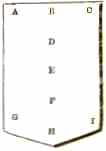
A, dexter chief; B, precise middle chief; C, sinister chief; D, honor point; E, fess point; F, nombril point; G, dexter base; H, precise middle base; I, sinister base. The tinctures mean the variable hue common both to the shields and their bearings; and there are seven tinctures—yellow or gold, expressed by dots; white or argent; red, by perpendicular lines; blue or azure, by horizontal lines; purple, by diagonal lines from right to left; green, by the same from left to right; black by horizontal and perpendicular lines crossing; and orange and blood colors are expressed by diagonal lines crossing each other. The charges are the emblems occupying the field of the escutcheon, or any part of it. All charges are distinguished by the name of honorable ordinaries, sub-ordinaries, and common charges. Honorable ordinaries, the principal charges in heraldry, are made of lines only, which, according to their disposition and form, receive different names. Sub-ordinaries are ancient heraldic figures frequently used in coats of arms, and which are distinguished by terms appropriated to each of them. Common charges are composed of natural, artificial, and even imaginary things, such as stars, animals, trees, ships, &c. The ornaments that accompany or surround escutcheons were introduced to denote the birth, dignity, or office of the person to whom the arms appertain. They are used both by clergy and laity. Those most in use are of ten sorts; namely, crowns, coronets, mitres, helmets, mantlings, chapeaux, wreaths, crests, scrolls, and supporters. The crest is the highest part of the ornaments of a coat of arms. It is called crest from the Latin word crista, which signifies a comb or tuft, such as many birds have upon their heads, as the peacock, &c. Crests were anciently marks of great honor, because they were worn only by heroes of great valor and high rank, that they might be the better distinguished in an engagement, and thereby rally their men if dispersed. They are at present considered as mere ornaments. The scroll is an ornament usually placed below the shield and supporters, containing a motto or sentence, alluding to the bearing or to the bearer's name.
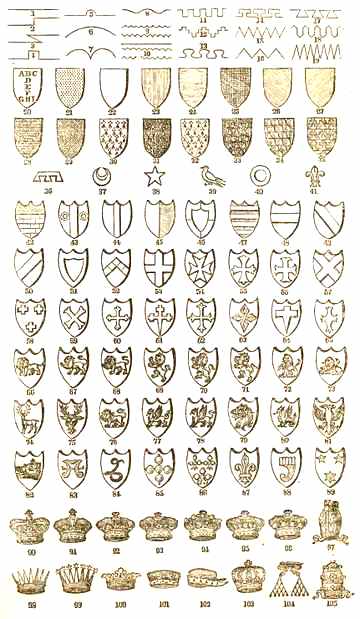
Explanation of the Plate on the following page, taken from Brande's Dictionary of Science, Literature, and Art.
I. Lines.
1. Horizontal or straight. 2. Angled. 3. Bevelled. 4. Escartele. 5. Nowy or Franche. 6. Arched or enarched. 7. Double arched. 8. Wavy or undee. 9. Invected. 10. Engrailed. 11. Battled-embattled, or crenellee. 12. Battled-embattled. 13. Nebuly. 14. Potent. 15. Indented. 16. Dancettec. 17. Dove-tailed. 18. Urdee. 19. Rayonnee, or radiant.
II. Points of the Escutcheon, Colors, and Furs.
20. Escutcheon, points of. 21. Or. 22. Argent. 23. Gules. 24. Azure. 25. Sable. 26. Vert. 27. Purpure. 28. Tenne. 29. Sanguine. 30. Ermine. 31. Ermines. 32. Erminois. 33. Peau. 34. Vair. 35. Varry cuppy.
III. Differences, or Filiations.
36. (First son) Label of three points. 37. (Second) Crescent. 38. (Third) Mullet. 39. (Fourth) Martlet. 40. (Fifth) Annulet. 41. (Sixth) Fleur-de-lis.
IV. Ordinaries, &c.
42. Chief. 43. Pale (between two annulets.) 44. Pallet. 45. Party per pale. 46. Border. 47. Bars. 48. Fess. 49. Bend. 50. Bend sinister. 51. Border. 52. Chevron. 53. Cross. 54. Cross of St. John of Jerusalem, or Malta. 55. Cross patonce. 56. Cross moline. 57. Cross of St. Andrew. 58. Crosses humettee. 59. Cross moline in saltier. 60. Cross bottonee or trefoil. 61. Cross crosslet, fitchee. 62. Cross flory. 63. Cross mascle. 64. Cross fitchee. 65. Lozenge, fleury.
V. Miscellaneous Bearings.
66. Lion, statant guardant. 67. Passant. 68. Passant guardant. 69. Rampant. 70. Rampant guardant. 71. Rampant reguardant. 72. Sejant. 73. Couchant. 74. Stag at gaze. 75. Stag's head caboshed. 76. Tiger, heraldic. 77. Dragon. 78. Griffin. 79. Dragon's head erased. 80. Wivern. 81. Eagle displayed, with two heads. 82. Boar's head erased. 83. Water budgets. 84. Snake, bowed debruised. 85. Quatrefoil. 86. Trefoils. 87. Fleur-de-lis. 88. Clarion, or rest. 89. Mullets.
VI. Crowns, Coronets, &c.
90. Crown of England. 91. Coronet of the Prince of Wales. 92. Coronet of a duke. 93. Marquis. 94. Earl. 95. Viscount. 96. Baron. 97. Mitre of a bishop. 98. Eastern, or antique coronet. 99. Celestial crown. 100. Crown of Edward I. 101. Mortier, or cap of state. 102. Chapeau, or cap of maintenance. 103. Crown of France. 104. Cardinal's hat. 105. Crown triple, or tiara of the pope.
[back]