Volume 1 — HISTORY OF THE PILGRIM SOCIETY,
Reading edition
WITH A BRIEF ACCOUNT OF THE EARLY SETTLEMENT OF PLYMOUTH COLONY.
As introductory to a notice of the Pilgrim Society, the narration of a few facts in reference to the early settlement of New England may be neither inappropriate nor uninteresting. It will serve also to elucidate more fully the objects of the Society.
Religious persecution was the chief cause of the emigration of our forefathers to this country. The memorable Reformation, effected principally by the instrumentality of Luther and Calvin, appeared in England in 1534, under Henry VIII. During its progress, in the reigns of Mary, Elizabeth, and James I., those who were denominated Puritans[B] were subjected to the most cruel oppression. Thousands suffered martyrdom; many were banished; and others were doomed to perpetual imprisonment.
Those Puritans who lived in the north of England were, on account of their dispersed state, divided, in the year 1606, into two distinct churches. With one of these was connected the celebrated John Robinson, who afterwards became its minister. Persecuted for non-conformity to the established church, he, with a part of his congregation, that they might worship God according to the dictates of their consciences, removed in 1607-8 to Amsterdam, in Holland, where religious toleration was then sanctioned by law; and soon after, (in 1609,) they went to Leyden, where they formed themselves into a church, according to the pattern prescribed, as they supposed, by the word of God. In that place they remained till their removal to America. "Their motives for this," (their removal,) "were to preserve the morals of their youth; to prevent them, through want of employment, from leaving their parents and engaging in business unfriendly to religion; to avoid the inconveniences of incorporating with the Dutch; to lay a foundation for propagating the gospel in the remote parts of the world; and, by separating from all the existing establishments in Europe, to form the model of a pure church, free from the admixture of human additions." What Lord Brougham, of England, has said of the North American colonies in general, is most strictly and emphatically true of these individuals in particular. "All idea of wealth or pleasure was out of the question. The greater part of them viewed their emigration as taking up the cross, and bounded their hopes of wealth to the gifts of the Spirit, and their ambition to the desire of a kingdom beyond the grave. A set of men more conscientious in their doings, or simple in their manners, never founded any commonwealth."
Such were the reasons which induced the founders of New England to leave all that was dear to them in England and Holland, and to remove to these then inhospitable shores; reasons sufficient to affect the minds, hearts, and conduct of some of the best men that ever lived. Speaking of them, Governor Stoughton remarked, "God sifted a whole nation that he might send choice grain over into this wilderness."
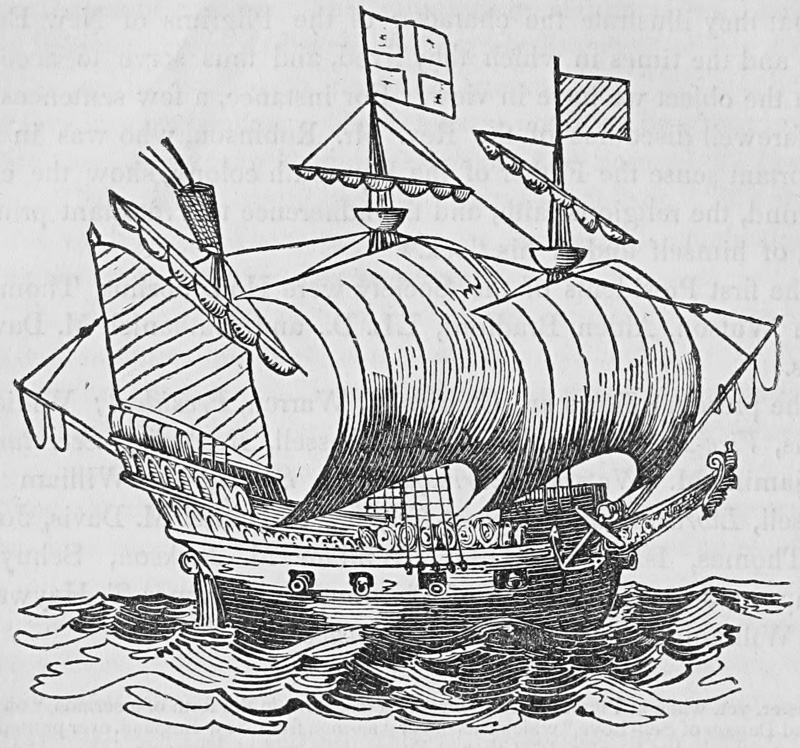
In accomplishing their object, "it was agreed by the English congregation at Leyden, that some of their number should go to America to make preparation for the rest. Mr. Robinson,[C] their minister, was prevailed on to stay with the greater part at Leyden; Mr. Brewster,[D] their elder, was to accompany the first adventurers, but these and their brethren remaining in Holland were to continue to be one church, and to receive each other to Christian communion without a formal dismission, or testimonial. Several of the congregation sold their estates and made a common bank, which, together with money received from other adventurers, enabled them to purchase the Speedwell,[E] a ship of sixty tons, and to hire in England the May Flower, a ship of one hundred and eighty tons, for the intended enterprise."[F]
The following graphic description of the attachment of the Pilgrims to each other, and of their pious views and feelings on the occasion of their separation, is found in Morton's New England Memorial.
"Being prepared to depart, they had a solemn day of humiliation, the pastor teaching a part of the day very profitably, and suitably to the present occasion; the text of Scripture was Ezra viii:21. The rest of the time was spent in pouring out of prayers unto the Lord, with great fervency, mixed with abundance of tears.—When they came to the place," (Delftshaven,) "they found the ship and all things ready; and such of their friends as could not come with them, followed after them, and sundry came from Amsterdam to see them shipped, and to take their leave of them. One night was spent with little sleep with the most, but with friendly entertainment, and Christian discourse, and other real expressions of Christian love. The next day, the wind being fair, they went on board, and their friends with them, where truly doleful was the sight of that sad and mournful parting, to hear what sighs, and sobs, and prayers did sound amongst them; what tears did gush from every eye, and pithy speeches pierced each other's heart, that sundry of the Dutch strangers, that stood on the quay as spectators, could not refrain from tears: Yet comfortable and sweet it was, to see such lively and true expressions of dear and unfeigned love.—Their reverend pastor falling down on his knees, and they all with him, with watery cheeks, commended them with most fervent prayers unto the Lord and his blessing; and then with mutual embraces and many tears, they took their leave one of another, which proved to be the last leave to many of them."
On the 6th of September, 1620, the adventurers sailed from Plymouth, in the May Flower, and, on the 9th of November, they arrived, after enduring a perilous voyage, in sight of Cape Cod. Having entered the harbor, they, on the 11th day of the month, after prayer and thanksgiving, subscribed a written instrument, by which they were made a body politic. The covenant entered into was signed by forty-one individuals, who, with their families, amounted to one hundred and one persons. Mr. John Carver was unanimously elected Governor of the colony for one year.[G] Though these adventurers undertook their enterprise under the authority and sanction of a royal charter, yet they commenced their political existence as a republic. December 22, 1620, they disembarked and went on shore. The place where they landed, called by the Indians Patuxet, they named Plymouth, after the town in England from which they last sailed.
Such was the origin of the settlement of the Plymouth colony.
Sentiments of high respect for the principles and character of the first settlers of New England have been cherished in every succeeding generation of their descendants. They have been eager to reward their inestimable service by commemorating their virtues and piety, and by preserving a recollection of their sufferings, resolution, and noble deeds, in so glorious a cause. In doing this they have been actuated by the dictates of nature, reason, and gratitude.
On January 13, 1769, when the storm of British oppression was gathering, and the time for open and decided resistance to the crown was at hand, an association called the "Old Colony Club" was formed at Plymouth, consisting of some of the principal men of that place and vicinity; and on December 22, of that year, the "Landing of the Forefathers" was first celebrated.[H] The Winslows, Watsons, and Howlands were among those who were the most prominent. Major-General John Winslow of Marshfield, who had been an eminent officer in the war between England and France, in 1754-1762, General Peleg Wadsworth, Colonel Gamaliel Bradford, and Hon. George Partridge of Duxbury, Hon. William Sever and General John Thomas of Kingston, Colonel Alexander Scammell, then a teacher of youth in Plymouth, and afterwards a distinguished officer in the American Revolution, were original or early members of the Society.
"In the year 1773 the Association was dissolved, in consequence of conflicting opinions existing among its members, in relation to the American Revolution," and two of the early members of the Club left the country, from attachment to the British government.
The following gentlemen have delivered sermons or addresses, by the request of the "Old Colony Club," or of the inhabitants of the town, or of the members of some one of the religious societies, at the times of the anniversary at Plymouth, on the 22nd of December. Edward Winslow, Jr., Esq., Plymouth; Rev. Chandler Robbins, D. D., Plymouth; Rev. Charles Turner, Duxbury; Rev. Gad Hitchcock, D. D., Pembroke; Rev. Samuel Baldwin, Hanover; Rev. Sylvanus Conant, Middleborough; Rev. Samuel West, D. D., Dartmouth; Rev. Timothy Hilliard, Barnstable; Rev. William Shaw, D. D., Marshfield; Rev. Jonathan Moore, Rochester; Doct. Zaccheus Bartlett, Plymouth; Hon. John Davis, LL. D., Boston; Rev. John Allyne, D. D., Duxbury; Hon. John Quincy Adams, LL. D., Quincy; Rev. John Thornton Kirkland, D. D., Cambridge; Rev. Jonathan Strong, D. D., Randolph; Rev. James Kendall, D. D., Plymouth; Alden Bradford, LL. D., Boston; Rev. Abiel Holmes, D. D., Cambridge; Rev. James Freeman, D. D., Boston; Rev. Adoniram Judson, Plymouth; Rev. Thaddeus Mason Harris, D. D., Dorchester; Rev. Abiel Abbot, D. D., Beverly; Rev. John Elliot, D. D., Boston; Rev. James Flint, D. D., Salem; Rev. Ezra Goodwin, Sandwich; Rev. Horace Holley, LL. D., Boston; Hon. Wendell Davis, Sandwich; and Hon. Francis Calley Gray, Boston.
As the "Old Colony Club" had for many years ceased to act as a society, and had, in fact, ceased to exist, that the object of the annual celebration of the "Landing of our Forefathers" might be better accomplished, a society was formed, November 9, 1819, by the name of the "Old Colony Pilgrim Society," and immediately went into operation. The Hon. Joshua Thomas, William Jackson, and Nathaniel M. Davis, Esqs., were chosen a committee on behalf of the Society, to petition the General Court for an act of incorporation. On February 24, 1820, the Society was incorporated and made a body politic, by the name of the "Pilgrim Society." The design of the institution may in part be learned from a clause in the first section of the act of incorporation, which is, "to perpetuate the memory of the virtues, the enterprise, and unparalleled sufferings of their ancestors."
The "Landing of our Forefathers" was first celebrated by the Pilgrim Society, December 22, 1820, that being the completion of the second century since the settlement of New England, or the landing of the Pilgrims. This event, which, in a most important sense, gave existence to the nation, with all that is valuable in its civil, literary, and religious establishments, was observed that year with more than usual solemnity and interest. The Hon. Daniel Webster delivered an address[I] on the occasion, worthy of himself and the memory of those whose character and sufferings he so eloquently portrayed. A large concourse of people attended the celebration, and were escorted to the place of public service by the Standish Guards, a military company so called in honor of Capt. Miles Standish.[J]
There were present on the occasion, a delegation from the Massachusetts Historical Society, and from the American Antiquarian Society. The Hon. Judge Davis addressed the Pilgrim Society on behalf of the former institution, and the Hon. Levi Lincoln on behalf of the latter. The Rev. Dr. Kendall replied to the one, and Alden Bradford, Esq., replied to the other. The kindest sentiments and feelings universally prevailed, and the occasion was one of great satisfaction and rejoicing.
The Pilgrim Society, as such, annually commemorates the day on which our Forefathers landed at Plymouth. On some of these anniversaries, addresses have been delivered; in 1820, by Hon. Daniel Webster; in 1824, by Hon. Edward Everett; in 1829, by Hon. William Sullivan; in 1834, by Rev. George Washington Blagden; in 1835, by Hon. Peleg Sprague; in 1837, by Rev. Robert B. Hall; in 1838, by Rev. Thomas Bobbins, D. D.; and in 1845, by Joseph R. Chandler, Esq. Since 1820, at the request of some religious society or association, the following gentlemen have delivered addresses on these anniversary occasions, though not specially before the Pilgrim Society; Rev. Richard S. Storrs, D. D., Braintree; Rev. Lyman Beecher, D. D., Boston; Rev. Samuel Green, Boston; Rev. Daniel Huntington, North Bridgewater; Rev. Benjamin B. Wisner, D. D., Boston; Rev. John Codman, D. D., Dorchester; Rev. Convers Francis, D. D., Watertown; Rev. Jonathan Bigelow, Rochester; Rev. Samuel Barrett, Boston; Rev. William T. Torrey, Plymouth; Rev. John Brazier, D. D., Salem; and Rev. Mark Hopkins, D. D., Williamstown. In the addresses which have been delivered, the principles, motives, intentions, and character of the Forefathers have been exhibited and approved; the causes of their emigration, the interposition of God in their behalf, and the glorious results which have followed, have been glowingly described.
The Society erected in the year 1824 a monumental edifice; the corner-stone of which was laid with appropriate solemnities, and in an excavation made in it for the purpose, was deposited, with other articles, a plate having the following inscription: "In grateful memory of our Ancestors, who exiled themselves from their native country, for the sake of religion, and here successfully laid the foundation of Freedom and Empire, December 22, A. D. MDCXX., their descendants, the Pilgrim Society, have raised this edifice, August XXXI. A. D. MDCCCXXIV."
The edifice is built of unwrought split granite, and is seventy feet in length by forty in width, and is two stories in height. It has a handsome Doric portico in front, eight feet wide, supported by six pillars sixteen feet high. The whole expense of the building and its appurtenances was more than $15,000. Its location is pleasant and presents a full view of the outer harbor of the town. The principal hall is adorned by a magnificent painting, representing our Forefathers. This picture, valued at $3,000, was a donation to the Pilgrim Society by the artist, Henry Sargent, Esq., Boston. It is a splendid representation of the Pilgrims at their arrival on these western shores. Pilgrim Hall is the most suitable receptacle for it; and Col. Sargent has exhibited a noble generosity in placing it within its walls. The dimensions of the picture are sixteen feet by thirteen. It contains several groups of individuals attired in the costume of their day. 1. Governor Carver and his wife and children; 2. Governor Bradford; 3. Governor Winslow; 4. Wife of Governor Winslow; 5. Mr. William Brewster, the presiding Elder; 6. Capt. Miles Standish; 7. Mr. William White and his child Peregrine; 8. Mr. Isaac Allerton and his wife; 9. Mr. John Alden; 10. Mr. John Turner; 11. Mr. Stephen Hopkins, his wife, and children; 12. Mr. Richard Warner; 13. Mr. Edward Tilley; 14. Mr. Samuel Fuller; 15. Wife of Capt. Standish; 16. Samoset, an Indian Sagamore; 17. Mr. John Howland, of Governor Carver's family, who married his daughter.
In the edifice there is a room set apart for a Library and a Cabinet of curiosities. It is already supplied with a number of volumes and many manuscripts of early date. It is desirable that a copy of all the works published by the Pilgrims and their descendants should be deposited in the Library.
"Among the antiquities in the Cabinet of the Pilgrim Society are the following:
"A chair which belonged to Gov. Carver. The sword of Miles Standish, presented by William S. Williams, Esq. A pewter dish which belonged to Miles Standish, presented by the late Joseph Head, Esq. An iron pot which belonged to Miles Standish, presented by the late John Watson, Esq. A brass steelyard, owned by Thomas Southworth. A cane which belonged to William White; presented by Hon. John Reed. A dressing-case which belonged to William White. The gun-barrel with which King Philip was killed, presented by Mr. John Cook of Kingston. The original letter of King Philip to Gov. Prince, written in 1662. A china mug and leather pocket-book which belonged to Thomas Clark. A piece of ingenious embroidery, in a frame, executed by Lora Standish, a daughter of Miles Standish; presented by Rev. Lucius Alden of East Bridgewater. Many curiosities are still in the hands of individuals and families, which might add much to the interest of Pilgrim Hall."
The following Portraits embellish Pilgrim Hall: "1. of Edward Winslow, painted in London in 1651, copied from the original, by C. A. Foster. 2. of Josiah Winslow, the first native Governor of the Old Colony, painted in London in 1651, copied from the original, by C. A. Foster. 3. of Gov. Josiah Winslow's wife, Penelope Pelham, copied from the original, by C. A. Foster. 4. of General John Winslow, copied from the original, by C. A. Foster. The portrait of Gov. Edward Winslow is the only one preserved, of those individuals who came in the Mayflower. The originals of these paintings belong to Isaac Winslow, Esq., of Boston, and are now in the rooms of the Massachusetts Historical Society. 5. A portrait of the Hon. Ephraim Spooner, presented by Thomas Davis, Esq., of Boston. 6. A portrait of John Alden, Esq., of Middleborough, who died in 1821, aged 102 years, who was the great-grandson of John Alden, who came in the Mayflower; painted and presented by Cephas Thompson, Esq. 7. A portrait of Hon. John Trumbull, presented by Col. John Trumbull. This portrait was painted in 1781. The face was executed by Mr. Stewart, and the other parts by Mr. Trumbull himself, while a student with him. 8. A portrait of James Thacher, M. D., late Librarian and Cabinet-Keeper of the Pilgrim Society. It was painted by Mr. Frothingham, in January, 1841, by order of the Pilgrim Society, pursuant to a vote expressing their sense of the valuable services he had rendered, in promoting the objects of said society.[K]
"The Hall contains also a bust of Hon. Daniel Webster, presented by James T. Hayward, Esq., of Boston; and the bust of Hon. John Adams, presented by Samuel Nicholson, Esq."
For an account of "Forefathers' Rock" and the beautiful monument erected by the Pilgrim Society for its preservation, we make the following extract from Dr. Thacher's History of Plymouth.
"The inhabitants of the town," [1774] "animated by the glorious spirit of liberty which pervaded the Province, and mindful of the precious relic of our Forefathers, resolved to consecrate the Rock on which they landed to the shrine of liberty. Col. Theophilus Colon and a large number of the inhabitants assembled, with about twenty yoke of oxen, for the purpose of its removal. The rock was elevated from its bed by means of large screws; and in attempting to mount it on the carriage, it split asunder, without any violence. As no one had observed a flaw, the circumstance occasioned some surprise. It is not strange that some of the patriots of the day should be disposed to indulge a little in superstition, when in favor of their good cause. The separation of the rock was construed to be ominous of a division of the British Empire. The question was now to be decided whether both parts should be removed, and being decided in the negative, the bottom part was dropped again into its original bed, where it still remains, a few inches above the surface of the earth, at the head of the wharf. The upper portion, weighing many tons, was conveyed to the liberty-pole square, front of the meeting-house, where, we believe, waved over it a flag with the far-famed motto, 'Liberty or death.' This part of the rock was, on the 4th of July, 1834, removed to 'Pilgrim Hall,' and placed in front of that edifice, under the charge of the Pilgrim Society. A procession was formed on this occasion, and passed over Cole's hill, where lie the ashes of those who died the first winter.
"A miniature representation of the Mayflower followed in the procession, placed in a car decorated with flowers, and drawn by six boys. The procession was preceded by the children of both sexes of the several schools in town. On depositing the rock in front of the Hall, a volley of small arms was fired over it by the Standish Guards, after which, an appropriate address was delivered by Doct. Charles Cotton, and the services were closed with a prayer by Rev. Dr. Kendall.
"It affords the highest satisfaction to announce, that the long desired protection of the 'Forefathers' Rock' is at length completed; and it may be pronounced a noble structure, serving the double purpose of security to the rock and a monument to the Pilgrims. The fabric was erected in June of the present year, [1835,] and consists of a perfect ellipse, forty-one feet in perimeter, formed of wrought iron bars, five feet high, resting on a base of hammered granite. The heads of the perpendicular bars are harpoons and boat-hooks alternately. The whole is embellished with emblematic figures of cast iron. The base of the railing is studded with emblems of marine shells, placed alternately reversed, having a striking effect. The upper part of the railing is encircled with a wreath of iron castings, in imitation of heraldry curtains, fringed with festoons; of these there are forty-one, bearing the names in bass-relief of the forty-one Puritan fathers who signed the memorable compact while in the cabin of the Mayflower, at Cape Cod, in 1620. This valuable and interesting acquisition reflects honor on all who have taken an interest in the undertaking. In the original design by George W. Brimmer, Esq., ingenuity and correct taste are displayed; and in all its parts, the work is executed with much judgment and skill. The castings are executed in the most improved style of the art. This appropriate memorial will last for ages, and the names and story of the great founders of our nation will be made familiar to the latest generation. This monument cost four hundred dollars. The fund was obtained by subscription; Lieut. Gov. Armstrong heading the paper, and Samuel T. Tisdale, Esq., of New York, contributing one hundred dollars. The author of this work" (Dr. Thacher,) "had the honor and satisfaction of being the active agent in its execution."
This account of the Pilgrim Society we conclude, by expressing our high commendation of its object. To be affected at the sufferings of the Pilgrims of New England; to exercise gratitude for their inestimable labors and sacrifices; to venerate their virtue and piety; to revere their principles of religious and civil liberty; and to hand down a suitable memorial of them to succeeding generations, is at once the duty and privilege of their descendants. Most cordially can we adopt the expressive language of President Dwight, in speaking of our ancestors. "When I call to mind," says he, "the history of their sufferings on both sides of the Atlantic, when I remember their preëminent patience, their unspotted piety, their immovable fortitude, their undaunted resolution, their love to each other, their justice and humanity to the savages, and their freedom from all those stains which elsewhere spotted the character, even of their companions in affliction, I cannot but view them as illustrious brothers, claiming the veneration and applause of all their posterity. By me the names of Carver, Bradford, Cushman,[L] and Standish, will never be forgotten, until I lose the power of recollection."
Our apology for appending so many notes to this historical notice is, that they illustrate the character of the Pilgrims of New England and the times in which they lived, and thus serve to accomplish the object we have in view. For instance, a few sentences in the farewell discourse of the Rev. Mr. Robinson, who was in an important sense the Father of the Plymouth colony, show the cast of mind, the religious faith, and the adherence to Protestant principles, of himself and of his flock.[M]
The first Presidents of the Society were Hon. Joshua Thomas, John Watson, Alden Bradford, LL. D., and Nathaniel M. Davis, Esqs.
The present officers are Charles H. Warren, President; William Davis, Vice-President; Andrew L. Russell, Recording Secretary; Benjamin M. Watson, Corresponding Secretary; William S. Russell, Librarian and Cabinet-Keeper; Nathaniel M. Davis, John B. Thomas, Isaac L. Hedge, William M. Jackson, Schuyler Sampson, Joseph Cushman of Plymouth, and James T. Hayward and William Thomas of Boston, Trustees.
FOOTNOTES: