LIST OF ILLUSTRATIONS. (continued 2)
Reading edition
This room was as light as day, for it was lit by a lamp which the old man himself had made, and in which no oil or wick was burning, but every day it was filled with sunbeams, and held them at night after the sun had set.
So the whole room was brilliant, and in the middle sat the wizard, who was a wonderful old man to look on, for he was all white. His beard was white as snow, and from afar you could not tell which was beard and which gown, but when you came near you saw that the beard flowed nearly to his feet, and his skin was as white as either beard or gown. And his eyes were quite colourless, but as bright as two candles.
When Michael entered he sat looking at an enormous book full of coloured pictures of little men and women about three inches high each. They were not like other pictures, for they walked and moved over the page as though they were alive.
"It is I, father. What book are you looking at?" said Michael, stepping up to the old man's side.
"In this book," said the wizard, "I keep the portraits of all the men and women in the world, and they are living portraits too, for they move, and look just like the originals."
"That must be very amusing," cried Michael. "Pray show me the portraits of all the Kings, and Queens, and Princesses. This will be delightful," and he knelt down by the old man and looked over his shoulder.
The sorcerer muttered to himself and turned over the pages, and then stopped at one on which Michael saw little figures of Kings and Queens of all sorts, some of which he knew, and some of which he had never seen before.
"'Tis their daughter, Princess Joan," said the wizard with a sigh. "But do not look at her, my son, for she will bring nothing but trouble to all who know her."—P. 87.
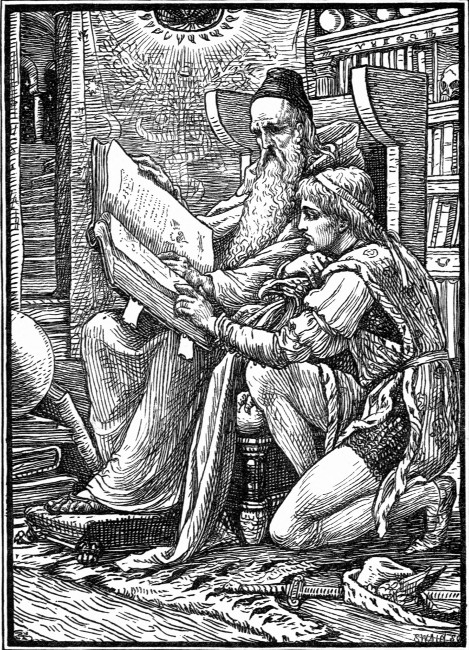
"There," he cried, "is old King Réné who came to our court last year, and that is Queen Constance, and that is their nephew Prince Guilbert, who will be king when they are dead, and here are our neighbours the King and Queen of the next country, and oh, my father, who is this lovely Princess next to them?"
"'Tis their daughter Princess Joan," said the wizard with a sigh. "But do not look at her, my son, for she will bring nothing but trouble to all who know her."
"I don't care if she bring trouble or happiness," cried the Prince. "But for certain she is the most beautiful creature in the world," and he seized the book and looked long at the tiny figure of the Princess. Truly it was very beautiful. It was dressed in white, with a golden girdle round the waist, and a wreath of golden daisies on its head, and as Michael looked, it turned upon the pages, and smiled at him till he smiled back again, and could not move his eyes from it.
When the wizard saw this, he took the book from the young man's hands, and hid it away, saying,
"Think no more of Princess Joan, however beautiful she be, or one day you will rue it dearly."
Prince Michael made no answer, but he thought all the more of the little picture of the Princess. After he had left the tower, and returned to the palace, he could not forget her, but dreamt of her all night, and thought of her all day.
Next morning he went to the King and said, "My father, I am come to beg that you will send to the King of the next country and ask if I may have his daughter, Princess Joan, for my wife, for I have seen her portrait, and there is no one in the world whom I love so well."
When the King heard this he was delighted.
"Our good neighbours," he said, "are rich and powerful, and it will be a capital thing for our son to marry their daughter." So he at once sent off an ambassador to beg for the hand of Princess Joan for Prince Michael.
Joan's father and mother were delighted with the offer, and at once resolved to accept it; but the Queen's heart sank within her, for she thought, "Our poor Joan is not like any other maid who ever lived before, and perhaps when Prince Michael sees her and finds this out, he will refuse to wed her after all;" but she said nothing of her fears, and the ambassador returned to the court, loaded with presents, and bearing a message of acceptance.
Till his return Prince Michael knew no peace or rest, but wandered about among the hills by himself, thinking of Joan, and still, in his heart, he wondered what the magician had meant when he said that if he thought much of Princess Joan, one day he would rue it.
At last he said to himself, "I will disguise myself as a poor man, and go and see my Princess for myself before the ambassador returns, then shall I know what the wizard means."
So he dressed himself as a peasant, and started alone without telling any one whither he went, and he travelled day and night till he came to the country where Joan dwelt and to her father's palace. Then he walked near the palace gardens, and no one noticed him, and he saw a group of lovely ladies, who sat together on the grass.
His heart beat high as he looked at them, for in their midst, most beautiful of all, sat the Princess Joan. Her yellow hair fell to her waist, her face was like a blush rose, and her eyes were blue as forget-me-nots, but when she lifted them, he saw that they were clear and hard as glass, and her voice when she spoke was like a bright cold bell.
There ran up to her a little serving-maid, crying bitterly, and said,
"I beg of you, Princess, to let me return to my own home for a time, for my father, the huntsman, has broken his leg and is very ill."
"Why should you cry for that?" said the Princess. "'Tis your father and not you that is hurt; but you may go, for when you cry and your eyes look red you are ugly, and I don't like to see you, so be sure that when you return you are pretty and bright as ever."
When her ladies heard her they looked angry, but no one spoke, and the little maid went crying away.
Up there came a groom from the palace and said,
"Your Royal Highness, the horse that you rode yesterday is dead, and we think it is because you would ride so far when it was already tired, as we told you."
"Dead is it?" cried the Princess. "Then see quickly and get me another, that I may ride again to-morrow, and be sure this time that it is a good strong horse, or it may give way beneath me and so my ride be shortened."
The groom went away muttering, and the Princess's ladies looked even graver than before, but the Princess's own face was bright as a summer sky, and she talked on without heeding their sad looks.
Prince Michael turned away with a heavy heart.
"The magician spoke truly," he said to himself, "and there will be nothing but sorrow for all those who love my poor Princess Joan."
Yet he could not bear to leave her and return at once to his own home, and still he remained near the palace, and for some days watched her unnoticed, when she walked and rode, and listened to all she said, and each day he grieved more and more, for she never said one kind loving word to any one; yet each day when he saw how beautiful she was he loved her more and more.
When he again returned to his own home he found great rejoicings everywhere, for the ambassador had returned with a message from Joan's father promising she should marry the Prince, and everywhere preparations were being made for the entry of the Princess to her new home.
"And now, my son," said the King, "all is arranged for you to journey in state to her father's court and bring back your bride, so now I hope that you are happy and wish for nothing more."
On hearing this Prince Michael's face was sad and grave, and his father and mother wondered what ailed him. But he said to himself, "I will never marry my Joan till she loves me as I do her, and how can she ever do that when she loves no one, not even her own father and mother?"
At the court of Joan's father grand preparations had been made, and all was in excitement when Prince Michael arrived with servants, and horses, and presents for the bride.
The King and Queen sat in state to receive him, and beside them was Joan, and she looked so beautiful, in a dress as blue as her eyes, that every one said, "How glad he will be when he sees how lovely she is."
There was a blowing of trumpets and ringing of bells when Prince Michael, followed by his attendants, entered, and the King and Queen and all the courtiers rose.
He passed up the hall to the thrones on which they sat, and kneeling on one knee, kissed their hands, and last he kissed the hand of the Princess, but he did not lift his eyes from the ground or look in her face, and his own was so sad that the people whispered to each other, and said, "What is the matter, and why does he look so unhappy? Surely he ought to be content when he sees how beautiful she is."
At night when the merrymakings were over the Prince sent a message to the Queen, begging she would speak with him alone, and when she heard this her heart sank, and she thought, "He must know that there is something amiss with Joan, and perhaps he comes to say he will not marry her after all."
So she sent every one away, except the old nurse and bid the Prince to come.
When he came in and saw her sad looks he said, "You have guessed then, Queen, why I come to speak to you. Tell me truly what ails Princess Joan, and why is she unlike any one I ever saw." The Queen cried bitterly, and said, "I know not; would I did!" but the old nurse said,
"I know and will tell you, Prince. Princess Joan is under a spell. A bad fairy enchanted her when she was a tiny baby, and till this charm is broken, she will never be like other people."
"And what is the charm?" asked the Prince.
"Nay, that I don't know," said the nurse. Then she told Michael of the yellow woman and the whistling the Queen had heard at night; and as he listened the Prince sighed and said, "There is no charm which cannot be broken if one does but know how, but this is hard to do, for we do not know what the spell is, or who is the fairy who cast it. But bid the people cease their preparations, Queen, and stop the wedding rejoicings, for there will be no wedding. No, not till I have found the fairy who has wronged my Joan, and made her set her free. To-morrow I shall start at break of day, and journey to the farthest ends of the world, to search for what can break the charm. But I pray, Queen, that Joan may wait for me for seven years, and if, when they are past, I have not returned, and you have heard nothing of me, you must think that I am dead and gone, and marry her to whom you will, for if I be alive, I will return before then. And till seven years are past remember that Joan is still mine."
On hearing this the Queen wept still more, and begged the Prince either to remain and marry Joan, or to leave her and return to his home and forget her; but if he wandered away to lands of goblins and fairies, no one would know what had become of him, and he would never find the fairy who had charmed Joan or learn how to break the spell; but Prince Michael only shook his head, and said, "I have sworn that I will not marry Joan till she loves me as I do her, neither can I return to my home and forget her, so bid her be ready at dawn to-morrow to bid me farewell, and tell none that I am going till I have gone. Also I beg you to send a messenger to my father and mother to tell them why I do not return, for I will not see them first, lest they too should try to dissuade me." The Queen said no more, but she cried very bitterly; but the old nurse smiled and nodded to Michael and said,
"You do well. You are a noble Prince, and would well deserve our Princess's love."
Next morning at break of day the Queen awoke the Princess and bade her rise, for Prince Michael waited to bid her good-bye. The Prince stood at the door of the palace, and when Princess Joan came out looking lovelier than ever in the dim morning light, the tears filled his eyes, and he thought, "Most likely I shall never see her again, and then she will never know how much I have loved her."
"Good-bye, Joan," he said; "do not quite forget me for seven years, for perhaps I may yet come back and marry you."
"And why do you go?" said Joan; "I had thought there would be a grand wedding, and I should have all the gifts that are being prepared for me, and now I shall have nothing; but good-bye, if go you must."
Michael sighed as he mounted his horse and bade her farewell. When he looked back at the palace, the Queen and Joan still stood at the door, and the Queen sobbed; but Princess Joan looked quite happy and contented, and smiled brightly.
Prince Michael rode and rode, till he came to his own home, and then he turned at once to the tower in which dwelt the magician. He climbed the tower and found the old man sitting alone as before, but he had no book before him, and he looked very grave.
"I know why you are come," he said, as soon as Michael entered the room. "So you have seen Princess Joan; and do you still wish to marry her?"
"I will marry her, or no one," said Michael. "But not till I have found out who has bewitched her, and have broken the charm."
"You will have to search far for that," said the wizard; "And it may be years ere you could set her free. Forget her, my son, and return to your own home, and do not waste your life in a fruitless quest."
"I will seek to break the charm, even if it take my whole life," said Michael. "But tell me what it is, and how shall I find out how to break it."
"A fairy has stolen her heart," said the wizard, "and that is why she loves no one, and can feel no sorrow; she has no heart with which to love or pity, and till it is found and restored to her, she will be hard and cold as stone. The fairy swore she would be revenged on her mother for her pride, and so she is."
"Then I will go and seek her heart, and bring it back to her," said Michael. "But where shall I look for it? Tell me at least where has the fairy hidden it."
"She has taken it to a castle in which are kept all the hearts of men and women, that fairies steal, or that they themselves throw away; and this castle is very far from here; moreover, it is guarded by an old gnome, who is spiteful and cruel, and who pays no heed to those who beg him to let them enter. Give up the Princess and return to your home, for if you go, you will only die, or be enchanted like poor Princess Joan."
"Nevertheless, I shall go," said Michael. "So tell me what path to take, and I will start at once."
On hearing this the sorcerer took from his bosom a small round piece of glass, and gave it to the young man. "Take this," he said; "It is all that I can give you, to help you, and through it you must look at the stars, and you will see that they are all of different colours—blue, green, red, and yellow; look for the one which is the deepest, brightest red, and follow it; it will lead you many miles both by land and sea, but follow steadily, and let nothing turn you from your course, and you will surely come to the castle wherein is imprisoned the heart of your Princess."
The Prince thanked the magician, and took the glass; then bidding him "Good-bye," he left the strangely lighted chamber, and went down the dark staircase, and stood again on the hill outside, with the dark sky overhead filled with shining stars.
Michael raised the glass and looked at them through it, and then he almost shouted with surprise, for they looked wonderful. They were like jewels of all colours—green, blue, yellow, pink—and in the south was one of a deep glowing red, like a blood-red rose, and Michael knew that that was the star he must follow.
Then he looked back towards his father's palace. "Farewell," he said; "some day I will return, and bring with me my Princess Joan." So he set off, and journeyed and journeyed, till he had reached towns and villages which he had never seen before. All that night he travelled while the stars shone, and he could see the rosy star to follow. But when the stars grew pale, and the sun rose, and people began to wake up and turn to their work, he lay down under a tree and slept soundly. When he woke the day was almost done, and the sun was sinking. So he went to a little town near and bought food, and rested till again the stars shone in the sky. Then he rose and went on all night, still following the crimson star. So passed many days and nights, and he journeyed through strange lands, and his heart sank when he thought, "So may I wander all round the world, and come no nearer to the star, or to the castle where they keep the heart of my poor Joan."
At last he came to the sea-shore, and in front of him lay a great cold sea, and beyond it he saw no sign of land. But the star shone right over it, and he knew that he must cross, if he still would follow it. It was in the evening, the sun had set, but some fishermen still remained on the beach, resting beside their boats. Michael went up to them, and taking some money from his pocket, asked for how much they would sell him one of their boats.
At this the men looked surprised, and one of them said, "Why do you wish to buy a boat? We use them to fish near the shore, but no boat or ship has ever crossed this sea, for no one knows what land is beyond."
"Then I will be the first to find out," said Michael. "Tell me how much you want, and give me your largest boat." On this the men muttered together, and one said, "He is mad." "Yes," said another, "but his money is good, for all that. Let the madman have his way. It will hurt him, not us." So they gave Michael their best boat, and he paid them well, and he set sail and steered where the red star shone. He sailed all night till he had left every trace of land behind him, and saw no shore in front, only the cold, gray sea on every side. By day he kept the boat still, afraid lest he should get out of the track of the star, but when the second night came he was so weary that in spite of himself he fell asleep. When he awoke he found the sun had risen, and his boat was drifting close to land. It was a flat, lonely shore, without trees or grass growing in sight, and facing him was an immense castle. It was built of black marble, and a more gloomy place could not be, for the windows were small and high up, and were all barred across, with heavy iron bars, and the castle had no spires or towers, but was one square black block, and looked more like a prison than a castle. Around it was a high wall, and outside this a moat, without a bridge.
Michael steered his boat to shore, and stepped from it, and looked about for some way by which he could cross the moat, and try for entrance to the castle. Then he saw a little hut near, and beside it lay an old man apparently fast asleep. He was small and dark, and his face was gray and wrinkled as a monkey's, and he had no hair on his head. Close beside him coiled up was a large snake, also asleep. Michael stood watching them both, afraid to wake them, when, without a word, the gray man raised his head, and opening a pair of dull, gray eyes, fixed them on him. Still he did not speak, and at last the Prince, growing impatient, went up to him and said, "Friend, I beg you to tell me how I am to enter the castle; or if you have the key, to give it to me."
On this the old man answered, "I have the key, and no one can enter without my leave. What will you give me for it?"
"Why," said Michael, "I have nothing but money," and he took some coins from his pocket as he spoke.
At this the old man laughed. "Your money is nothing to me," he said; "But look yonder. Over there I am building a wall of heavy stones, and I am old, and my strength fails me; stay and work for me at that wall, and in return I will give you the key of the castle."
"But how long must I work?" said Michael, "For unless I can enter the castle before seven years are over, it will be no use to me.
"Look at that serpent," said the old man; "It is sitting on its eggs. When they are hatched you shall have the key and open the castle door. Till then you must be my slave."
"Gladly," said Michael, who was delighted; "for no snake could take seven years hatching its eggs."
Then the old man rose, and beckoning to him to follow, went into the little cottage. From a nail upon the wall he took a pair of manacles fastened together by a heavy iron chain. These he slipped over Michael's wrists, and stooping down over them, muttered a few words, and at once the manacles fastened together as if they had been locked, and Michael could not move them, or draw out his hands. Then the old man took down another heavy chain and passed it over the first and fastened it with more iron rings to his ankles, so that he could only move his arms and hands a little way, and could not raise them high, and could only walk with slow careful steps. This done, he pointed to where, on the wall high up, hung a gleaming golden sword, the handle of which was set with precious stones.
"That," said he, "is the key of the castle, and you need only push the doors with its point and they will all fly open; but while your hands are chained you cannot reach it to lift it down, but when the serpent's eggs are hatched your iron rings will fall off, and you yourself may take the sword down from its place, and push your way into the castle. Now get you to your work, and work hard, or you may rue it."
Then he showed Michael how he was to move the heavy stones, and where to build with them, and he himself sat down by the serpent and watched him, while the Prince went to work with a light heart, for he thought, "It is hard work while it lasts, but 'twill not be for long, and 'tis not much to do to win my Joan." So he worked hard till the sun had set, and then the old man rose, saying, "Enough," and called him into the hut and gave him food and drink, but he ate nothing himself, and then he showed him where he could sleep in one corner, and Michael lay down and slept soundly and dreamed of Joan.
At break of day he was waked by the old man, who again gave him plenty to eat, and again ate nothing, but what he gave to him he took from an urn in the corner, and when he had done he put into the urn the fragments that were left.
All day Michael worked hard, and in the evening as he passed by the snake, he looked at it as it lay coiled over its eggs, and said,
"How soon will your work be done, and mine also, good snake? Make haste, I pray, that I may find my way into the castle, and return to my Princess."
So the days passed. Each morning the old man awoke Michael and gave him food, and set him to work, and all day he laboured hard. Then when night approached, he called "Enough," and beckoning him into the hut, gave him plenty to eat and drink, but never ate himself, and beside that one word never spoke, but crouched all day beside the snake, with closed eyes as if asleep.
Meantime, the doors of the castle never opened, and no one was seen going in, or coming out; but sometimes, towards night, strange noises might be heard from within its walls; sometimes there were wails and moans, which it filled Michael with horror to hear, and sometimes there was sweet singing, so sweet that it drew tears to his eyes.
But the days passed, and the serpent never moved from its eggs, and Michael's heart began to be oppressed with fear, lest the old man was deceiving him, and they should never be hatched at all. As each day passed, he put aside a stone on a bare rock, and one day when he counted over the stones to see how many days were gone, he found that more than a year had passed since his boat had brought him to the shore. His hands had grown hard and brown and cracked, with working at the heavy stones, and his face and neck were blistered and sunburnt with the fierce sun that beat upon them as he worked. His clothes were cut and torn and soiled, and yet he seemed to be no nearer entering the castle. Then he rose and went into the cottage, and looked longingly at the sword which hung high up, on the walls, and raised his arms to try and reach it, but the chains held him down, and as he turned from it in despair he saw the old man standing in the doorway watching him with his cold dull eyes.
"What would you do here?" he asked; "have I not bid you serve me till the serpent's eggs are hatched, and then the sword shall be yours?"
"And when will the serpent's eggs be hatched?" cried Michael in despair.
"That," said the old man, "I cannot tell, but a bargain is a bargain; keep you your part and I will keep mine." Then he turned again to where the serpent lay, and lying down beside it closed his eyes, and Michael returned to his work mournfully.
Time passed, but there came no change. Michael despaired in his heart, but he could not have escaped even if he would, because of the chains which hung from his arms.
"I will work here," he said, "till the seven years are out, then I will climb on the wall which I have built and throw myself into the sea and end my troubles."
Sometimes at night he would take from his bosom the piece of magic glass which the wizard had given him and would gaze through it at the star which still looked a bright crimson colour.
"Why have you led me here, cruel star," he asked sadly, "if you cannot help me more? Are you shining over my home and my Princess, and does she remember me? The seven long years will soon be passed, and they will wed her to another king, and it will be all of no avail that I have given up everything to find her heart, since I have only broken my own."
So the time passed. Michael worked hard by day, but by night he lay and wept. One day, when the seven years had nearly worn themselves away, he bent over a pool of water, and in it saw his own form, and he saw that his hair was thin and streaked with gray, and his face furrowed and seamed, and his eyes dim with crying, also his shoulders were bowed with hard work, and his clothes, once so gorgeous, now hung mere rags upon his bent form.
"Now all is in vain," said he, "for if even I returned to my own home no one will know me, so changed am I. I will go and kill the snake that has caused my misery, and then I will slay the old man who has deceived me."
So he went up to the snake, who lay motionless coiled over its eggs as usual, and reached out his hand to grasp its throat, but as he did so his tears fell and dropped upon its head, and it writhed fearfully and then glided away so fast that he could not see where it went, and left the heap of gray eggs bare beneath his hand. The old man lay beside them as still as usual, and did not move or open his eyes, even when the snake glided hissing past him.
"If the snake has escaped me," cried Michael, "then at least I can destroy the eggs;" and lifting his heel he struck them with all his might, but his foot left no mark upon them, nor even moved them from their place. They might have been made of iron, and each one nailed to the ground, so hard and firm they stood.
Michael burst out weeping afresh. "How foolish I am," he said, "Yes, and wicked too. It is not the fault of the poor snake that its eggs are not hatched. Perhaps it is enchanted like me, and waits as patiently for them;" and he bent his head till his tears fell upon the eggs. No sooner did they touch them, than the shells broke, and the pieces fell asunder, and from each egg came a small moving thing, though what it was Michael did not see, for he leaped to his feet with a shout of joy, which filled the air, and echoed again from the castle. At this the old man opened his eyes, and raising himself gazed, as if thunderstruck, with astonishment at the eggs.
"Tis a miracle," he cried, chuckling with joy.
But out of the eggs, there came no one fully formed animal, but from one egg came a foot, from another a leg, from another a tail, and from one a head, and each looked as though it belonged to some different beast, yet all these drew themselves together, and joined so well that the join was not to be seen. And they made a hideous monster of many colours. Then the manacles on Michael's wrists burst asunder, and the chains fell to the ground.
"Now," he cried, "I will go and take for myself the sword from the wall, and win my way into the castle, and nothing shall hinder me more." And he turned and rushed into the hut. There, upon the wall hung the shining sword, and Michael reached out his hand and seized it firmly, and drew it down from its place.
"I will swear a vow," he cried, "upon this sword, that when I enter the castle, I will say not one word for good or for ill to any one, save to ask for what I come to seek, lest I should again be kept for years. Moreover, I will not taste food or drink, till I have found the heart of my Joan to take back to her." Then, with the sword in his hand, he passed the old man, who still sat chuckling over the monster, too busy to heed him, and he went straight on to the bridgeless moat. It was not wide, and he swam it easily, and scrambled up the bank by the stone wall. He pushed with the point of the sword at the gate, and it at once flew open, and he stood in the outer court. Then he saw a heavy door in the wall of the castle, and went up to it, nothing fearing, and, on touching it with the sword's point, it too flew open at once, and he entered.
He stepped into a passage filled with flowers and hung with silken hangings. He trod upon a velvet carpet, and the air was laden with sweet scents, and from afar he heard sweet voices singing. He strode on through another door, and yet another, and at each step he took all things became lovelier, till at last he passed into a splendid chamber, the like of which he had never seen before. In the ceiling were precious stones set in patterns of flowers and crowns, on the walls were soft velvet hangings and embroideries. The furniture was of carven gold and silver and ivory, and everywhere grew flowers of wonderful beauty, which sprang from the floor and crept along the walls, and filled the air with sweet scents, and hanging on the walls were cages which held what Michael thought were birds, which sang most sweetly.
On a table in the centre of the room was a banquet all laid ready, and as Michael looked at it and wondered where he should go farther, a curtain was drawn aside, and there stepped forth a stately dame dressed in black velvet, who came smiling towards him and held out her hand, saying, "I am indeed glad to see you, I am mistress of this castle, and you are very welcome; but I beg that before you tell me from where you come and what you seek, you will sit down and share this feast with me." Michael was beginning to answer, when he felt the sword in his hand, and remembered his oath, and looking full in the face of the new-comer, said, "I seek the heart of Princess Joan."
"And you shall find it," answered the grand lady. "But first you must rest and eat, for you must be both tired and hungry;" and so saying she sat at one end of the table, and signed to Michael to sit at the other, and took the golden covers from the dishes, and prepared to begin the feast. Michael knew not what to do, but he sat at the table in silence, and all at once bethought him of the magic glass in his bosom, and drawing it forth when she was not looking, gazed through it at her, and then he beheld no finely-dressed lady, but a wizened old woman, robed in yellow, with an evil yellow face and evil yellow eyes. He hid the glass again, and sat still as stone, though the yellow woman pressed on him the different dishes again and again. He saw that her face grew white with rage. Then all of a sudden she disappeared, and the lights went out, and he was left alone in the darkness. He rose and searched for the door by which he had entered, but could not find it nor any way out of the room; so there he was, a prisoner alone with the singing-birds.
"Never mind," quoth he to himself cheerily; "I have at last reached the inside of the castle, and surely shall find the heart of my Joan, and if I keep my vow and neither eat nor drink here or say aught but ask for that which I seek, nothing can harm me."
So he sat down contentedly to wait for what might come. There he sat the whole night, and no one came near him, but the birds sang so beautifully that he almost forgot how the time passed.
When morning dawned and light again shone through the windows, he searched everywhere for some way out of the room, but the door had quite disappeared. Moreover, the feast had gone from the table. The day passed, and still he was all alone, and as evening again drew in he sat and lamented, quite wearied out and faint for want of food. But when the darkness came, the lamps about the room were suddenly lit as if by magic, and all was brilliant, and a curtain was drawn aside, and there came in a little child with bright eyes and hair, who held in one hand a goblet and in the other a well-filled plate. These she placed before Michael, saying, "My mistress sends you these, and begs that you will eat and drink, for you must be both hungry and thirsty;" but Michael pushed away the goblet and the plate, and said,
"I seek the heart of Princess Joan; I beg you to give it to me."
To this the seeming child answered nothing, but still pressed on him the food and wine. Then Michael took from his bosom the magic glass and looked through it, and saw no lovely child, but the same yellow hag with shrivelled face and evil eyes. With a cry of rage she disappeared, and though Michael searched everywhere, he could not find the way by which she went.
Now indeed he began to feel that unless he ate he could not live much longer, and wept from very weakness.
"Still I will neither eat nor drink," he said, "till I have found what I came to seek, and the fairy cannot refuse me much longer."
Night passed and day came, and he lay upon a couch quite still, too weak to move, yet he feared to sleep lest some spell should be thrown upon him.
So he lay all day, and as evening again drew near he began to feel despair, for he knew that in another day he would be dead of hunger.
"Oh! Why have I toiled for seven years," he cried aloud, "and at last won my way into the castle, if now I am to be starved to death, and Joan will never know how I have laboured for her sake?"
"And why should you be starved to death, my Prince?" said a voice; and at once the lights lit themselves, and into the room stepped the figure of the Princess Joan just as he had seen her last, dressed in white and gold, and in one hand bearing a golden goblet filled with clear ruby-coloured wine.
Michael gave a cry of joy and held out his arms to clasp her in them, but as he did so the sword sprang as it hung at his side, and he remembered his vow and drew back and gazed at her without speaking.
She knelt down beside him and raised the goblet to his lips, saying softly, "My poor love, how long you have worked for me! Pray drink now, that you may be refreshed ere we two start for our home."
Then as he looked at her face and saw how beautiful she was his heart wavered, and he thought, "Can it be my Joan, and that I have truly won her?" and almost had he let her place the wine at his lips, while with one hand she stroked his hair and murmured to him the while in a soft voice, when the cup struck against the magic glass in his bosom, and he drew it forth and looked at her, and he trembled with horror and disgust, for there he saw no lovely Princess Joan, but the same yellow hag, who held in one skinny hand a goblet, formed from a skull, from which she would have him drink.
Michael sprang to his feet and dashed it from him, and the ruby wine poured on the floor, and there followed an awful noise like a peal of thunder, and the room was full of smoke, and wild cries were heard.
He grasped the sword and sat still, trembling all over; but when the smoke cleared away the whole aspect of the room was changed; the silken hangings, and gold, and pearls, and flowers, were all gone, and he was sitting in a grim gray chamber like a vault, and in front of him stood the yellow hag, whose eyes shone spitefully and her lips laughed wickedly; but in one hand she held what it made Michael rejoice to see. It was a soft pink feathery thing, with wings, but shaped like a heart, and it trembled and quivered in her hand.
"Take it," she cried, "for well have you won it. Take it, and tell the Queen how many years of toil and labour her proud words and boasting have cost. Then when you see her, from whom it was stolen, let it fly, but first say over it these words:—
"Heart of Joan Lost and won Fly back home, Thy journey's done. Take back joy Take back pain Heart of Joan, Fly home again."
and it will fly to her side, and you will see it no more; and now begone."
Michael seized the heart with a cry of joy and exultation, and then turned and fled from the room through an open iron door, and passed through the passages, no longer softly carpeted and hung with silk, but dreary and bare, made of cold stone, down which his foot-steps echoed and clashed.
He hurried from the castle as quickly as might be, and once outside did not stop to look for the old man or the monster, but swam the moat, and went straight to where his boat lay moored as he had left it, nearly seven years before, and never paused till he had rowed so far that the gray castle and the shore had almost passed from view. At last he came again to the shore where he had bought his boat of the fishermen, and here he went on land, and started to walk till he had reached Joan's country, and her father's castle.
He had no money, and his clothes were rags, his hair was thin and gray, and his shoulders bent. He looked like a poor beggar, and he had to beg food as he went, or he would have been starved. Still, he was ready to cry for joy, because he took with him the little soft heart he had gone so far to find.
He trudged on both day and night, making great haste, for he knew that the seven years were almost gone, and he was afraid lest already he might be too late, and find that Joan had married some one else. At last, after many weary miles, he reached her country, and drew near to the palace where she lived, and here he found that the people were all decorating their houses, and making preparations as if for some great festival.
He stopped and begged for food from a woman who stood by a cottage door, and when she had given him some bread, as he ate it he asked her to tell him what went on in the country, and why there was such rejoicing.
"It is for the marriage of the King's daughter Joan," said the woman; "To-morrow she is to be married to old King Lambert, and the wedding will be very grand, but none of the country folk like it, for he is old and ugly, and they say he does not love her at all, but only marries her that he may be king of this country as well as his own. The Queen is in sore distress about it, and for seven years refused her consent; but they will be over to-morrow, and so they will be wed, and the guests are already beginning to arrive at the palace, and each one brings some splendid gift."
"I will be a guest at that wedding," cried Michael; "And I bring the best gift of all for the bride;" and he hurried on again, not heeding the woman's scorn and laughter.
When he came to the palace, he found that it was hung with flags, and arches of flowers were erected in front of it, and grand lords and ladies, and servants stood at the door to receive the guests who came.
Michael went as near as he dared, afraid lest he should be driven away by the servants, and then he saw a little foot-page, and he went to him and said,
"Please tell me where is the Princess Joan, and what she is doing."
"She is sitting with the King and Queen and King Lambert in the state-room, to receive the guests and accept the presents they bring," said the page.
"I am a guest, and I bring a present for her," cried Michael; "Tell me how I shall get into the palace that I may give it to her."
On hearing this the page burst out laughing, and told the other servants what he said. And they were very angry, and seized Michael, and some would have ducked him in the pond, and some would have taken him before the King, but they said, "Not now—wait till the wedding is over to-morrow, and then we will see how he will punish the beggar-man for his impertinence."
So they took him off to a stone tower outside the garden gates and thrust him into it, and locked the door, and there was only one little window high up and barred across with bars, and from it he could see the palace and the gardens.
Then at last he gave way to despair. "Of what avail were all my years of toil, and for what am I gray and old before my time," he cried, "if after all, when I have earned that for which I worked so long, I may not give it to Joan, but must remain a prisoner and see her pass by to marry some one else?" and he threw himself on the ground and cried aloud.
At night as he lay and mourned, he heard sounds of merrymaking, and music and laughter from the castle. Sometimes he called out, "Joan! Joan! I am here—I who have worked for you for years, and brought home your stolen heart, and now will you wed King Lambert in spite of all?" sometimes he beat against the bars of the prison window, but all in vain, and at last, when all sound had ceased from the castle, he lay silent upon the ground, caring no more for life.
When the sun rose, and there was again a stir without, he got up and looked from the window, and saw the old nurse who walked by herself in the garden, and she looked very sad. Then Michael called out, "Do you not know me? You at least, who bid me go, and praised me then, should remember me now." On hearing this the old nurse drew near the prison window, and looked at him, and said, "Who are you, and why are you here? My eyes are old, and my ears are deaf, but I think I have seen you, and heard your voice before."
"Seven years ago," said Michael, "I too was a bridegroom, who came to wed your Princess, and for seven long years have I worked, that I might bring home to her the heart she had not. Go and ask your Queen, why she has broken her pledge to wait for seven years, till Prince Michael should return."
"Prince Michael! Is it really Prince Michael?" cried the old nurse joyfully. "And you come in time, for our Princess is not married yet, and she must pass by here, on her way to church. So you shall call to her as she passes by, and speak for yourself."
"Then keep near and tell me when she comes," said Michael, "lest she go by without seeing me."
Presently the whole castle was astir, and trumpets were sounding, and clarions ringing. Then when the sun was high, Michael heard the tramping of horses, and the sound of music, and the old nurse said to him, "Here she is," and he looked between the bars of the prison window and saw a grand procession, and his heart gave a bound, for in their midst, in a golden gown, and seated on a white palfrey, was Princess Joan, and she looked just as lovely as when he went away seven years before.
On one side of her rode her father and mother, and the Queen's face was most mournful, and her eyes were red with crying. On the other rode an ugly old man, whom Michael guessed to be King Lambert, and he smiled and bowed to the people, but they muttered and grumbled, when they looked at him, and saw how ugly and wicked, he looked.
When Michael saw them coming, he took from his bosom the little pink heart, and stroked it fondly as he whispered over it,
"Heart of Joan Lost and won Fly back home, Thy journey's done. Take back joy Take back pain Heart of Joan, Fly home again;"
and at once it spread its wings and fluttered through the bars of the prison, and over the heads of the people, who shouted, "Look at the pink bird!" For a moment it rested at the side of the Princess Joan, and then disappeared. She gave a scream, and cried,
"My mother! My father! What has happened? Oh see, it is Michael who has returned!" and ere they could stop her she had turned her palfrey's head towards the prison window, and pushed her white arms through the bars to clasp the Prince.
——and ere they could stop her she had turned her palfrey's head towards the prison window, and pushed her white arms through the bars to clasp the Prince."—P. 128.
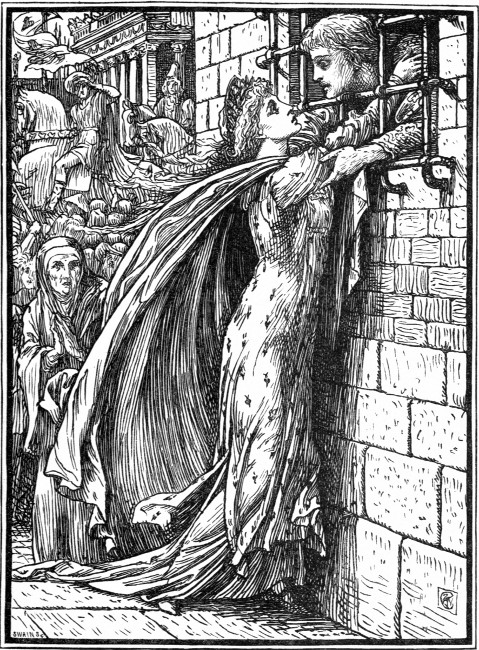
"Michael, my love!" she cried, "How gray and worn you are now. How hard you must have laboured for me through these long years. Now, how shall I pay you, save by loving you all my life!" and she tried to beat down the bars of the prison window.
When the people heard her, they cried, "It is Prince Michael, who went seven years ago, and who we all thought was dead, and he is returned in time to marry our Princess. Now will we indeed have a wedding, and she shall marry the Prince who has toiled so long for her;" and King and Queen and people laughed for joy. 'Twas in vain for King Lambert to rage, and cry that the Princess was betrothed to him.
"Nay!" said the Queen, "She has been pledged to Prince Michael for seven years. We are grieved for your sake, King Lambert, but we cannot break our royal word."
Then the people burst into the prison and brought out Michael, all torn and gray as he was, and Princess Joan kissed him before them all, and begged that he would marry her at once, that every one might see how well she loved him and how grateful she was. So they brought a fine white horse with a grand gold saddle, and jewelled bridle, and placed Michael upon it, and he rode to church beside the Princess, and married her, and the people threw flowers before them, and bells rang and trumpets sounded, and all were glad.
And when it was done Michael was dressed in purple and gold, and messengers were sent to his father and mother and the old wizard, that they might come and see how he had come home victorious, and rejoicings filled the whole country.
"For now we are sure of a good King," the people said. "See, he has already shown what he can do. Surely no one else could ever have found the heart of Princess Joan."
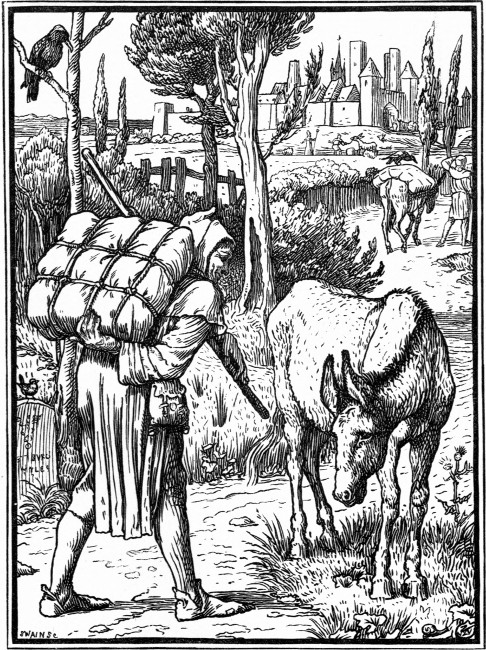
"Good-day, friend," said he. "If you have nothing to do, perhaps you would not mind carrying my load for me for a little."—P. 131.
THE PEDLAR'S PACK
A pedlar was toiling along a dusty road carrying his pack on his back, when he saw a donkey grazing by the wayside.
"Good-day, friend," said he. "If you have nothing to do, perhaps you would not mind carrying my load for me for a little."
"If I do so, what will you give me?" said the donkey.
"I will give you two pieces of gold," said the pedlar, but he did not speak the truth, for he knew he had no gold to give.
"Agreed," said the donkey. So they journeyed on together in a very friendly manner, the donkey carrying the pedlar's pack, and the pedlar walking by his side. After a time they met a raven, who was looking for worms in the roadside, and the donkey called out to him,
"Good-morrow, black friend. If you are going our way, you would do well to sit upon my back and drive away the flies, which worry me sadly."
"And what will you pay me to do this?" asked the raven.
"Money is no object to me," said the donkey, "so I will give you three pieces of gold." And he too knew he was making a false promise, for he had no gold at all to give.
"Agreed," said the raven. So they went on in high good humour, the donkey carrying the pedlar's wares, and the raven sitting on the donkey's back driving away the flies.
After a time they met a hedge-sparrow, and the raven called out to it,
"Good-day, little cousin. Do you want to earn a little money? If so, bring me some worms from the bank as we go along, for I had no breakfast, and am very hungry."
"What will you give me for it?" asked the hedge-sparrow.
"Let us say four pieces of gold," said the raven grandly; "for I have saved more during my long life than I know how to spend." But he knew this was not true, for he had not saved any gold at all.
"Very well," said the hedge-sparrow, and so on they went, the donkey carrying the pedlar's pack, and the raven keeping the flies away from the donkey, and the hedge-sparrow bringing worms to the raven.
Presently they saw in the distance a good-sized town, and the pedlar took out from his pack, some shawls and stuffs and hung them over the donkey's back that the passers-by might see, and buy if they were so disposed. On the top of the other goods lay a small scarlet blanket, and when he saw it the hedge-sparrow said to the pedlar,
"What will you take for that little blanket? It seems to be a good one. Name your price and you shall have it whatever it is, for I am badly in want of a blanket just now;" but as the hedge-sparrow had not a penny in the world, he knew he could not pay for it.
"The price of the blanket is five pieces of gold," said the pedlar.
"That seems to me to be very dear," said the hedge-sparrow. "I don't mind giving you four pieces of gold for it, but five is too much."
"Agreed," said the pedlar, and he chuckled to himself and thought, "Now I shall be able to pay the donkey, otherwise I might have had some trouble in getting rid of him."
The hedge-sparrow flew to the raven's side and whispered in his ear, "Please to pay me the four pieces of gold you owe me, for we are coming to a town, and I must be turning back."
"Four pieces of gold is really too much for bringing a few worms," said the raven. "It is absurd to expect such payment, but I will give you three, and you shall have them almost immediately," and he bent down over the donkey's ear and whispered,
"My friend, it is time you paid me the three pieces of gold which you promised, for the pedlar will stop at this town, and you will not have to go farther with him."
"On thinking it over," said the donkey, "I have come to the conclusion that three pieces of gold are really a great deal too much to give for having a few flies driven away. You must have known that I was only joking when I said it, but I will let you have two, though I consider that it is much more than the job was worth;" and the donkey turned again to the pedlar, saying, "Now, good sir, your two pieces of gold, if you please."
"In a moment," said the pedlar, and turning to the hedge-sparrow, said, "I really must have the money for the blanket at once."
"So you shall," answered the hedge-sparrow, and cried angrily to the raven, "I want my money now, and cannot wait."
"In an instant," answered the raven, and again whispered to the donkey, "Why can't you pay me honestly? I should be ashamed of trying to slip out of my debts in such a way."
"I won't keep you waiting a second," said the donkey, and he turned once more to the pedlar and cried, "Come, give me my money. For shame! a man like you trying to cheat a poor beast like me."
Then the pedlar said to the hedge-sparrow, "Pay me for my blanket, or I'll wring your neck."
And the hedge-sparrow cried to the raven, "Give me my money or I'll peck out your eyes."
And the raven croaked to the donkey, "If you don't pay me, I'll bite off your tail."
And the donkey again cried to the pedlar, "You dishonest wretch, pay me my money or I'll kick you soundly."
And they made such an uproar outside the walls of the town, that the beadle came out to see what it was all about. Each turned to him and began to complain of the other loudly.
"You are a set of rogues and vagabonds," said the beadle, "and you shall all come before the mayor, and he'll settle your quarrels pretty quickly, and treat you as you deserve."
At this they all begged to be allowed to go away, each one saying he did not care about being paid at all. But the beadle would not listen to them, and led them straight away to the market-place, where the mayor sat judging the people.
"Now, whom have we here?" cried he. "A pedlar, a donkey, a raven, and a hedge-sparrow. A set of worthless vagabonds, I'll be bound! Let us hear what they have to say for themselves."
On this the pedlar began to complain of the hedge-sparrow, and the hedge-sparrow of the raven, and the raven of the donkey, and the donkey of the pedlar.
The mayor did not heed them much, but he eyed the pedlar's pack, and at length interrupted them, and said,
"I am convinced that you are a set of good-for-nothing fellows, and one is quite as bad as the other, so I order that the pedlar be locked up in the prison, that the donkey be soundly well thrashed, and that the raven and the hedge-sparrow both have their tail-feathers pulled out, and then be turned out of the town. As for the blanket, it seems to me to be the only good thing in the whole matter, and as I cannot allow you to keep the cause of such a disturbance, I will take it for myself. Beadle, lead the prisoners away."
So the beadle did as he was told, and the pedlar was locked up for many days in the prison.
"It is very sad to think to what straits an honest man may be brought," he sighed to himself as he sat lamenting his hard fate. "In future this will be a warning to me to keep clear of hedge-sparrows. If the hedge-sparrow had paid me as he ought, I should not be here now."
Meantime the donkey was being soundly well thrashed, and after each blow he cried,
"Alas! alas! See what comes to an innocent quadruped for having to do with human beings. Had the pedlar given me the money he owed, I should not now be beaten thus. In future I will never make a bargain with men."
The raven and the hedge-sparrow hopped out of the town by different roads, and both were very sad, for they had lost all their tail feathers, which the beadle had pulled out.
"Alas!" croaked the raven, "my fate is indeed a hard one. But it serves me right for trusting a donkey who goes on his feet and cannot fly. It is truly a warning to me never again to trust anything without a beak."
The hedge-sparrow was quite crestfallen, and could scarcely keep from tears. "It all comes of my being so taken in by that raven," he sighed. "But I should have known that these large birds are never honest. In future I will be wise, and never make a bargain with anything bigger or stronger than myself."
THE BREAD OF DISCONTENT
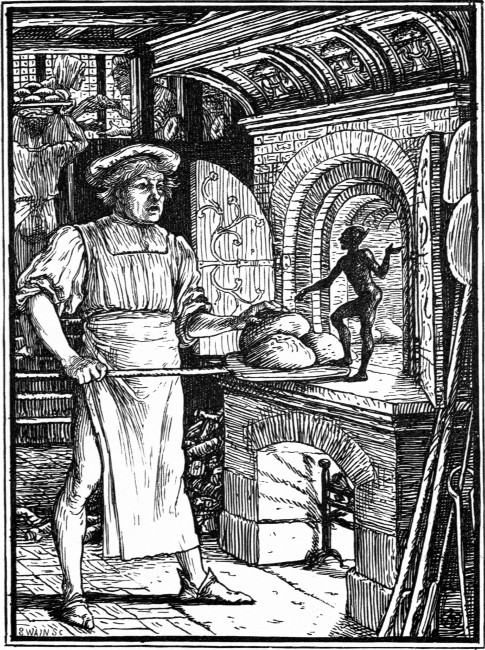
Once there was a baker who had a very bad, violent temper, and whenever a batch of bread was spoiled he flew into such a rage, that his wife and daughters dared not go near him. One day it happened that all his bread was burnt, and on this he stamped and raved with anger. He threw the loaves all about the floor, when one, burnt blacker than the rest, broke in half, and out of it crept a tiny thin black man, no thicker than an eel, with long arms and legs.
"What are you making all this fuss about, Master Baker?" said he. "If you will give me a home in your oven I will see to the baking of your bread, and will answer for it that you shall never have so much as a loaf spoiled."
"If you will give me a home in your oven I will see to the baking of your bread, and will answer for it that you shall never have so much as a loaf spoiled."—P. 141.
"And pray what sort of bread would it be, if you were in the oven, and helped to bake it?" said the baker; "I think my customers might not like to eat it."
"On the contrary," said the imp, "they would like it exceedingly. It is true that it would make them rather unhappy, but that will not hurt you, as you need not eat it yourself."
"Why should it make them unhappy?" said the baker. "If it is good bread it won't do any one harm, and if it is bad they won't buy it."
"It will taste very good," replied the imp, "but it will make all who eat it discontented, and they will think themselves very unfortunate whether they are so or no; but this will not do you any harm, and I promise you that you shall sell as much as you wish."
"Agreed!" said the baker. So the little imp crept into the oven and curled himself into the darkness behind, and the baker saw no more of him.
But next day he made a great batch of bread, and though he took no heed of the time when he put it in, and drew it out, just as he wanted it, it was done quite right—neither too dark nor too light—and the baker was in high good humour.
The first person who tasted the bread was the chief justice. He came down to breakfast in high spirits, for he had just heard that an old aunt was dead, and had left him a great deal of money. So he kissed his wife and chucked his daughters under the chin, and told them that he had good news for them. His old aunt had left him twenty thousand pounds in her will. On this his wife clapped her hands for joy, and his daughters ran to him and kissed him, and begged him to let them have some of it. So they all sat down to breakfast in great glee, but no sooner had the justice tasted the bread than his face fell.
"This is excellent bread," he said, taking a large slice; "I wish everything else were as good;" and he heaved a deep sigh.
"Why?" cried his wife, who had not yet begun to eat. "This morning, I am sure, there is nothing for you to complain of."
"Nay!" said the mayor; "it is very nice to have twenty thousand pounds, but think how much nicer it would have been if it had been thirty. How much more one could have done with that! Or even if it had been twenty-five thousand pounds, or even twenty-one. Twenty-one thousand pounds is a very nice sum of money, but twenty thousand pounds is no good at all. I am not sure that it would not be better not to have had any."
"Nonsense!" cried his wife, who was now eating her breakfast also; "you are very wicked to be so discontented; but one thing I do say. It would have been much nicer if we had had it when we were young and better able to enjoy it. Money is very little use to people at our time of life. It would have been really nice if we had had it fifteen years ago. As it is, I can't say I care much for it, and it makes me sad to think we did not get it before."
"Nay," cried the daughters; "in that case how much better it would have been for us to have it instead of you; we are young, and able to enjoy ourselves, and we could have given you a little of it if you'd liked, but we could have been very happy with the rest; as it is, it is no pleasure to us."
So they fell to quarrelling about the money, and by the time breakfast was done, they all had tears in their eyes, and felt discontented and unhappy.
The next person to eat the bread was the village doctor. All night long he had been sitting up with a man who had broken his leg, and he had feared lest he should die, but as morning came he saw he would live, so he returned home to his wife in very good spirits, although he was sadly tired. The wife had already had her breakfast, but she had made all ready for her husband, with a loaf of the baker's new bread.
"See, dear husband," she said, "here is your breakfast, and some nice bread quite new, because I know you like it. How glad we ought to be, that this poor man is likely to live."
"Yes, indeed," said the doctor; "being up all night is tiring work, but I don't grudge it when I know that it does some good," and then he began to eat. "I am not sure, after all, that I have done such a good thing in curing this man. It is true that his broken leg hurt him very much, but perhaps when he is well again, he may break his back, and that would be much worse. Perhaps I had better have left him to die. I daresay when he is quite well, all kinds of misfortunes will befall him; I had much better have let him alone."
"Why," cried his wife in surprise, "what are you saying, husband? Are you not a doctor, and is it not your business to cure people? And when you succeed ought you not to be glad?"
"I wish I were not a doctor," said the husband, sighing. "It would be much better if there were no doctors at all;" and he sat and lamented, and nothing his wife could say, could cheer him.
In a pretty little cottage near the doctor's house lived a young couple, who were newly married, and were as happy as the day was long. Their cottage was covered with roses, and filled with pretty things, and they had everything their hearts could desire. This morning they both came down smiling and happy, and the young wife kissed her husband, and sang for joy. So they sat down to breakfast, chattering like two birds in a nest; but no sooner had the husband tasted the bread than his face fell, and he was silent for a time; then he said,
"It is a very terrible thing to think how happy we are, for it cannot last. Something melancholy is sure to happen to us, and till it comes we shall live in dread of it; for we know happiness never lasts, and this is a thought that makes me very sad."
The wife had now also taken some bread.
"What is this you are saying?" she said. "How can you think such dreadful things? I do not like you when you talk like that; and I think it is very hard for me to be married to a man who wants to be unhappy."
"The best thing we can hope for," said the husband, sighing, "is for some great misfortune to befall us; then we should be all right, for we should know then, that we knew the worst that could come. As it is we shall live in suspense all our days."
"Now," cried his wife, "I am indeed unfortunate. What could be worse than to have a husband who does not like being happy? I wish I had married some one else; or indeed had no husband at all."
So both began to grumble, and at last to quarrel, and finally both were crying with anger.
Not far out of the village was a large pleasant farmhouse, standing amongst fields, and the farmer was a hale, bright man, with a good wife and pretty children. He was very busy just now getting in the corn, for it was autumn, and he stood among his men, directing them as they worked in the fields. He had not had time to have a proper breakfast before going to work, but his wife sent some out to him with some of the baker's new bread, and he sat down under a tree to eat it. As he did so he looked up at the farmhouse, and thought, with pride, that it was the largest farm in all the country round, and that it had belonged to his father, and his grandfather, and his great-grandfather, before him.
"'Tis a fine old house, for sure," thought he, as he took a large piece of bread, "'Tis so well built and strong;" but no sooner had he swallowed a mouthful than his thoughts changed.
"What should I do if it were to fall down and crush me some day," he said to himself. "After all, 'tis only built of brick, and might tumble any day. How much stronger it would have been if it had been built of stone. Then it would not have been nearly so likely to give way. Really when my great-grandfather built it he should have thought of this. How selfish all men are;" and he became quite unhappy lest his house should fall, and lamented while he ate.
In the kitchen the farmer's wife was very busy cooking and cleaning, and scarcely stopped to eat till near mid-day. Then she took up a piece of bread and cheese, and leant against the window as she ate it, that she might watch for her eldest girl and boy, Janey and Jimmy, who would now be returning from school.
"Our baker really bakes very decent bread," said she; "'tis almost as good as my own;" and she went on eating till she saw her two children coming through the fields together.
"Here they come," said she; "How bonny they look. Really I ought to be very proud of them. I don't know which is the prettier, Janey or Jimmy, but 'tis a pity, for sure, that Janey is the eldest. It would be much better if Jimmy were older than she. 'Tis a bad thing for the sister to be older than the brother. Now, if he were her age, and she were his, that would be really nice, for then he could take care of her and see after her; but, as it is, she will try to direct him, and boys never like to obey their sisters; I really almost think I had better not have had any children at all," and the tears filled her eyes, and when her girl and boy ran in to her, her face was very sad, and she seemed to be scarcely glad to see them.
So things went on all over the village. Each one as he tasted the bread grew discontented and angry, till at last all the people went about grumbling and complaining, or else shedding tears outright. Only the baker himself was cheerful and merry, and sang as he kneaded his dough, and sold it to his customers with a light heart, for his trade had never been so good. Every atom of bread he made was sold at once, so he cared not one whit for the trouble of the other people, and laughed to himself when he heard them complaining, and thought of the words of the dark little elf.
One day as he stood kneading at the door and whistling to himself, the doctor walked past and looked angrily at him.
"What on earth are you making that whistling for?" he asked. "I declare one would think that you were as happy as a man could be."
"And so I am," said the baker, "And so I should think were you too, for you have nothing to trouble you."
"Nothing to trouble me, forsooth!" cried the doctor in a rage. "How dare you insult me in this way? I tell you what it is, my fine fellow, I think you are very impertinent, and if I have any more of your impudence I will take my stick and thrash you soundly. It really is not to be borne, that one man should be allowed to tell another that he has nothing to complain of."
"Nay, you can have as much to complain of as you like, so long as I have not," cried the baker, and he laughed loudly. This only made the doctor angrier still, and he was just going to seize the baker when up came the farmer.
"Was there ever such a village as this?" he cried. "It is not fit for any one to live in, there is always such fighting and quarrelling going on. What is the matter here?"
"Matter enough," cried the doctor. "Here is a fellow dares to tell me I have nothing to complain of, nor he either."
"This is monstrous!" said the farmer; "he deserves to be hung. How dares he say such a thing on such a wretched day as this, with such a blue sky and such a bright sun?"
"Why, Master Farmer," cried the baker, "yesterday you grumbled because it was raining, and now you grumble because it is fine."
"And I tell you that it is enough to make one grumble," said the farmer. "It should have been fair yesterday, and should have rained to-day. You ought to be ashamed of such talk, Master Baker, and I think it would serve you justly right if we took you before the Justice and let us see what he thinks of your conduct."
"Nay!" cried the baker, beginning to be frightened, "what have I done that I am to be taken before the Justice?"
"What have you done, indeed!" said the doctor. "We will see if the Justice cannot find that out pretty quickly." So they seized the baker and dragged him away in spite of himself, and as they pulled him through the village the people thronged about them, and followed till there was quite a large crowd.
The Justice sat at his door smoking a pipe, with tears in his eyes.
"Now what is all this uproar for?" cried he. "Am I never to be left in peace? How hard is the life of a Justice!" but he got up and came out on the steps to meet them.
"See here," cried the doctor; "here is a man who says he has nothing to complain of, and we have brought him to you, to know if he is to be punished, or to be allowed to go on talking like this."
"Certainly not," cried the Justice, "or we shall soon have the whole village in an uproar. Let him be taken to the market-place, and I will order that he be publicly flogged by the soldiers."
At this the poor baker burst out crying, and entreated to be let off, saying that now indeed he had plenty to complain of, but at this the justice was angrier still. "Then," said he, "you certainly deserve to be flogged for having told an untruth before, when you said you had not. Take him away, and do as I bid."
So they dragged the baker off to the market-place, and made a ring round him, so that he could not escape, and then there came down two or three soldiers with ropes in their hands, and they seized him, and began to beat him before all the crowd.
But by this time all the people were so enraged against him, that a number of them cried, "Let us go to his house and pull it down." So off they ran to the baker's house, and broke the windows and knocked about the furniture, and then some of them fell on the oven, and wrenched off the door, and others seized the pokers and tongs, and smashed in its sides, and in the hurry and scuffle, the little dark man crept out of the oven and scuttled away unseen by any one. But no sooner had he gone than a great change came across the people.
The soldiers on the green stopped beating the baker, and looked at each other aghast, and the Justice called out,
"Stop! What is all this uproar about? And what has this man done that you are beating him without my orders?" and the people in the crowd whispered to each other; "It is true,—what has he done?" and they slunk away, looking ashamed.
The Justice also at first looked somewhat ashamed of himself, but he drew himself up, and looking very important, said, "There, my man, you are forgiven for this once, and now go your way, and see that you behave better in future;" and then he walked away with much dignity.
So the baker was left alone in the market-place, and he cried for rage and pain.
"This all comes of the oven imp," cried he, as he limped home. "Directly I get home I will drive him out of my oven, and away from my house. Better to have a hundred batches of bread spoiled than to be flogged for saying one is happy." But when he reached his house the little dark man was nowhere to be found; there was nought but the broken oven with its sides battered in.
The baker mended the oven, and from that time forth his bread was just like other people's; but for all that he had learnt to be quite contented, for now he knew that there were worse things than having his loaves burnt black, and he was only too well pleased to take his chance with other people, without the help of fairy folk. As for the little black imp, he was never heard of more, and the people in the village soon recovered their good humour, and were just as happy and contented as they had been before they tasted the bread of discontent.
Ye Three Clever Kings
Old King Roland lay upon his death-bed, and as he had no son to reign after him he sent for his three nephews, Aldovrand, Aldebert, and Alderete, and addressed them as follows:—
"My dear nephews, I feel that my days are now drawing to an end, and one of you will have to be King when I am dead. But there is no pleasure in being King. My people have been difficult to govern and never content with what I did for them, so that my life has been a hard one, and though I have watched you all closely, still I know not, which is most fit to wear the crown; so my wish is that you should each try it in turn. You, Aldovrand, as you are the oldest, shall be King first, and if you reign happily, all well and good; but if you fail, let Aldebert take your place; and if he fail, let him give it up to Alderete, and then you will know which is the best fitted to govern."
On this the three young men all thanked their uncle, and each one declared that he would do his best, and soon after old King Roland died and was buried with great state and ceremony.
So now Aldovrand was to be King, and he was crowned, and there were great rejoicings everywhere.
"'Tis a fine thing to be King," cried he in much glee; "Now I can amuse myself and do just as I please, and there will be no one to stop me, and I will lie in bed as late as I like in the morning, for who dares blame one, if one is King?"
Next morning the Prime Minister and the Chancellor came to the palace to see the new King and settle affairs of state, but they were told that his majesty was in bed and had given orders that no one should disturb him.
"This is a bad beginning," sighed the Prime Minister.
"Very bad," echoed the Chancellor.
When they came back to the palace later in the day the King was playing at battledore and shuttlecock with some of his gentlemen, and was very angry at being interrupted in his game.
"A pretty thing," he cried, "That I the King am to be sent for hither and thither as if I were a lacquey. They must go away and come another time;" and on hearing this the Prime Minister and Chancellor looked graver still.
But next morning there came the Commander-in-Chief and the Lord High Admiral, as well as the Prime Minister and the Chancellor, all wanting to have an audience with the King, and as he was not out of bed and they could not wait any longer, they all stood outside his bedroom door, and knocked to gain admittance, and at last he came out in a towering rage, and throwing them his crown, cried,
"Here, let one of my cousins be King, for I will not bear this longer. It is much more trouble than it is worth, so Aldebert or Alderete may try it and see how they like it, but as for me, I have had enough of it," and he ran downstairs and out of the palace door, leaving the Prime Minister and the Chancellor and the General and Admiral staring at each other in dismay.
Aldovrand walked out of the town unnoticed, and turned towards the country, whistling cheerily to himself. When he had gone some way in the fields, he came to a farmhouse, and in a meadow near, the farmer stood talking to his men. Aldovrand went straight up to him, and, touching his hat, asked if he could give him any work.
"Work?" cried the farmer, little thinking he was talking to his late king. "Why, what sort of work can you do?"
"Well," said Aldovrand, "I am not very fond of running about, but if you want any one to mind your sheep, or keep the birds from your corn, I could do that nicely."
"I tell you what you can do if you like," said the farmer. "I am wanting a goose-boy to take care of my geese. See, there they are on the common. All you will have to do is to see that they don't stray away, and to drive them in at night."
"That will suit me exactly," cried Aldovrand. "I will begin at once;" and he went straight on to the common, and when he had collected the geese together lay down to watch them in high good humour.
"This is capital," he cried, "and much better than being King at the palace. Here there is no Prime Minister or Chancellor to come worrying;" and he lay watching the geese all day very contentedly.
When the Prime Minister and the Chancellor knew that Aldovrand was really gone, they went in a great hurry to Aldebert to tell him that it was his turn to be King. But when he heard how his cousin had run away, he looked frightened.
"I will do my best," quoth he; "but I really know very little about the matter. However, you must tell me, and I will do whatever you direct."
At hearing this the Prime Minister and the Chancellor were delighted.
"Now we have got the right sort of King," they said; and both wagged their heads with joy.
So King Aldebert was crowned, and there were great rejoicings all over the country.
Early next morning he was up all ready to receive his Ministers, and first came the Prime Minister.
"Your Majesty," said he, "I come to you on an affair of much importance. A great part of our city is falling down, and it is very necessary that we should rebuild it at once. If you will command it, therefore, I will see that it is done."
"I have no doubt you are right," said the King; "pray let them begin building at once;" and the Prime Minister went away delighted.
Scarcely had he gone when in came the Commander-in-Chief.
"Your Majesty," said he, "I wish to lay before you the state of our army. Our soldiers have had a great deal of fighting to do lately, and are beginning to be discontented, but the late King, your uncle, would never attend to their wants."
"Pray do what you like," said King Aldebert.
"To satisfy them," said the Commander-in-Chief, "I think that we should double their pay. This would keep them in a good humour, and all will go well."
"By all means, that will certainly be the best way," said Aldebert. "Let it be given to them at once;" and on hearing this, the Commander-in-Chief went away right merrily.
When he had gone, there came in the Chancellor with a long face.
"Your Majesty," he said, "I have this morning been to the treasury, and I find that there is scarcely any money left. The late King, your uncle, spent so much in spite of all I could say, that now it is almost all gone. Your Majesty must now save all you can for the next year or two, and you ought also to lower the soldiers' pay, and stop all public works."
"I have no doubt you are quite right," cried the King. "You know best, let it be done as you wish."
But next morning in came the Prime Minister with a frowning face. "How is this, your Majesty?" cried he. "Just as we are beginning our buildings, the Chancellor comes and tells us that we are not to have any money to build with." He had not done speaking when the Commander-in-Chief burst into the room unable to conceal his rage.
"Yesterday your Majesty told me that all the soldiers should have double pay, and this morning I hear, that instead of that, their wages are to be lowered!" Here he was interrupted by the Chancellor, who came running in looking much excited,
"Your Majesty," he cried, "did you not yesterday say we were now to begin saving, and that I was not to allow any more money to be spent, and that the army must do with less pay?"
And then all three began to quarrel among themselves. When he saw how angry they were, King Aldebert took off his crown and said, "I am sure you are each of you quite right; but I think I am scarcely fit to be a King. Indeed I think you had better find my cousin Alderete, and let him be crowned, and I will seek my fortune elsewhere." And he had slipped out of the room, and run downstairs and out of the palace, before they could stop him.
He went briskly down the highroad into the country, the same way that Aldovrand had gone.
After he had gone some way, he met a travelling tinker who sat by the roadside mending tin cans, with his little fire at his side.
Aldebert stood watching him, and at last said, "How cleverly you mend those holes! You must lead a pleasant life, going from house to house in the green lanes mending wares. Do you think I could learn how to do it if you would teach me?"
The tinker, who was an old man, looked at him and said,
"Well, I don't mind giving you a trial if you like to come with me, for I want a strong young man sometimes to help me wheel my little cart, and I'll teach you my trade, and we'll see what you can make of it."
So Aldebert was delighted, and went with the tinker.
When they knew he was really gone the Prime Minister and the Chancellor looked at each other in dismay.
"This will never do," cried they; "we must go at once to Prince Alderete; and let us hope he may do better than his cousins."
When Prince Alderete heard that it was his turn to reign he jumped for joy.
"Now," cried he, "at last I will show what a king should really be like. My cousins were neither of them any good, but they shall now see how different I will be."
So he was crowned, and again there were great rejoicings all over the country.
Next day he sat in state to receive the Chancellor and Prime Minister and hear what they had to say.
"My friends," said he to them, "a good King ought to be like a father to his people, and this is what I mean to be. I mean to arrange everything for them myself, and if they will only obey me, and do as I direct, they are sure to be both prosperous and happy."
On hearing this both Prime Minister and Chancellor looked anxious, and the Chancellor said,
"I fear, your Majesty, your people will not like to be too much meddled with." At this the King was very angry, and bid them see about their own business, and not presume to teach him his.
When they had gone he went to take a drive in his city, that he might see it and know it well; but directly he returned to the palace he sent for the Prime Minister, and when he had arrived, said,
"I already see much to be altered in my kingdom. I do not like the houses in which many of the people dwell, nor indeed the dresses they wear; but what strikes me most of all is, that wherever I go I smell a strong smell of pea soup. Now, nothing is so unwholesome as pea soup, and therefore it would not be right in me to allow the people to go on eating it. I command, therefore, that no one shall again make, or eat pea soup, within my realm on pain of death."
Again the Prime Minister looked very grave, and began to say,
"Your Majesty, your subjects will surely not like to be hindered from eating and drinking what pleases them!" But the King cried out in a rage,
"Go at once and do as I bid you." So the Prime Minister had to obey.
Early next morning when the King arose he heard a great hubbub under his window, and when he went to see what it was, he saw a vast mob of people all shouting, "The King, the King! Where is this King who would dictate to us what we shall eat and drink?"
When he saw them he was terribly frightened, and at once sent off for the Prime Minister and Chancellor to come to his aid.
"Pray go and tell them to eat what they like," he cried when they arrived; "But, do you know, I find it will not at all suit me to be King. You had best try Aldovrand, or Aldebert, again;" and, so saying, he took off his crown and laid it down, and slipped away out of the palace before either Prime Minister or Chancellor could stop him.