PART I.
Reading edition
Haleb, or, as we call it, Aleppo, the present metropolis of Syria[1], though greatly inferior to the cities of Constantinople and Cairo in extent, number of inhabitants, riches, and perhaps several other circumstances, yet, in respect to buildings, yields to none in the Turkish empire.
This city and suburbs stand on eight small hills or eminences, none of them considerable, except that in the middle of the place, on which the castle is erected. This mount is of a conic form, and seems, in a great measure, to be artificial, and raised with the earth thrown up out of a broad deep ditch that surrounds it. The suburbs, called Sheih il Arab, to the N. N. E. are next in height to this, and those to the W. S. W. are much lower than the parts adjacent, and than any other parts of the city.
An old wall not a little decayed, and a broad ditch now in most places turned into gardens, surround the city, the circumference of which is about three miles and an half; but, including the suburbs, which are chiefly to the North East, the whole may be about seven miles[2].
The houses, are composed of apartments, on each of the sides, of a square court all of stone, and consist of a ground floor which is generally arched, and an upper story which is flat on the top, and either terraced with hard plaister, or paved with stone. Their ceilings are of wood neatly painted, and sometimes gilded, as are also the window-shutters, the pannels of some of their rooms, and the cupboard doors, of which they have a great number: these, taken together, have a very agreeable effect. Over the doors and windows within the houses of the Turks, are inscribed passages out of the Koran, or verses either of their own composition, or taken from some of their most celebrated poets. The Christians generally borrow theirs from scripture.
In all their houses the court yard is neatly paved, and, for the most part, has a bason with a jet d’eau in the middle, on one or both sides of which, a small spot is left unpaved for a sort of garden, which often does not exceed a yard or two square; the verdure, however, which is here produced, together with the addition of a few flowers in pots, and the fountains playing, would be a very agreeable sight to the passenger, if there were openings to the street through which these might be discovered, but they are entirely shut up with double doors so contrived, as that, when open, one cannot look into the court yard; and there are no windows to the street, except a very few in their upper rooms; so that nothing is to be seen but dead walls, which make their streets appear very disagreeable to Europeans.
Most of the better sort of houses have an arched alcove within this court open to the north, and opposite to the fountain; the pavement of this alcove is raised about a foot and an half above that of the yard, to serve for a divan[3]. Between this and the fountain the pavement is generally laid out in mosaic work, with various coloured marble; as is also the floor of a large hall with a cupola roof, which commonly has a fountain in the middle, and is almost the only tolerably cool room in their houses during the summer.
The people of fashion have in the outer court but one or two rooms below stairs for themselves, the rest are for servants and stabling; the pavement of this is but rough, as their horses stand there all the summer, except a few hours in the middle of the day. Above stairs is a colonade, if not round the whole court, at least fronting the west, off from which are their rooms and kiosks[4]; these latter are a sort of wooden divans, that project a little way from the other part of the building, and hang over the street; they are raised about one foot and an half higher, than the floor of the room, to which they are quite open, and, by having windows in front and on each side, there is a great draught of air, which makes them cool in the summer, the advantage chiefly intended by them. Beyond this court is another, containing the womens apartments, built much in the same manner that I have described the other houses; some few of them have a tolerable garden, in which, as well as in the outer yard, there is generally a tall cypress tree.
The mosques in Aleppo are numerous, and some few of them magnificent; before each is a square area, in the middle of which, is a fountain for the appointed ablutions before prayers, and behind some of the larger mosques there is a little garden.
Besides these open spaces there are many large khanes or (as most travellers call them) caravan seraijs, consisting of a capacious square, on all sides of which are built on the ground floor a number of rooms, used occasionally for stables, warehouses, or chambers. Above stairs a colonade occupies the four sides, to which opens a number of small rooms, wherein the merchants, as well strangers as natives, transact most of their business.
The streets are generally narrow, but, however, are well paved, and kept remarkably clean.
The market places, called here bazars, are properly, long, covered, narrow streets, on each side of which are a number of small shops just sufficient to hold the tradesman (and perhaps one or two more) with all the commodities he deals in about him, the buyer being obliged to stand without. Each separate branch of business has a particular bazar allotted them, and these, as well as the streets, are all locked up an hour and an half after sunset, and many of them earlier, which is a great security from house-breakers. It deserves to be remembered, how odd soever it may appear, that though their doors are mostly cased with iron, yet their locks are made of wood.
In the suburbs, to the eastward, are their slaughter-houses, in a very airy place, with a large open field before them. The tanners have a khane, where they work, in the south west part of the town near the river.
To the southward, just without the walls in the suburbs, they burn lime; and a little way further is a small village, where they make ropes and catgut, which last manufacture is, at some seasons, extremely offensive.
In Mesherka, which is part of the suburbs on the opposite side of the river to the westward, is a glass-house, where they make a coarse kind of white glass, but they work only a few months in the winter, the greatest part of this manufacture being brought from a village called Armenass, about thirty-five miles to the westward, from whence also they bring the sand used in their glass-house at Aleppo.
The city is supplied with very good water from some springs near the banks of the river at Heylan, about five miles to the north north east, which is conveyed from thence by an aquæduct, and distributed to the different parts of the town by earthen pipes. There is a tradition, that this aquæduct was the work of the empress Helena, and that from her the springs took their present name: this water is sufficient for the necessary purposes of drinking, cookery, &c. Besides this, almost every house has a well, but the water of these, being brackish, is only employed for washing their court yards, and filling the reservoirs for their fountains.
The fuel, used in their houses, is wood and charcoal; for heating their bagnios, they burn the dung of animals, leaves of plants, parings of fruit, and such like, which they employ people to gather and dry for that purpose.
The markets are well supplied with provisions, of which we shall have occasion to give a more particular account.
For at least four or five miles round Aleppo, the ground is very stony and uneven, having a number of small eminences, most of which are as high as any part of the city. From the west south west to the north west by west, this sort of country continues for at least twenty miles, with a number of small fertile plains interspersed. To the northward and southward, after about six or seven miles, the country is level and not stony. To the eastward a vast plain commences, which, though it is called the desart, yet for a great many miles beyond Aleppo, affords a fine fertile soil.
In clear weather, the top of mount Cassius, bearing west by south, and part of the mountains, called Amanus, are to be seen from several places in the city; but, as the nearest of these, viz. that part of Amanus, which stretches to the eastward and approaches to Killis, is at least thirty miles distant from Aleppo, they can be supposed to have but very little influence upon the air of the place, any more than a small conical rocky hill, called Sheih Barakat, at about twenty miles to the west by north, and a narrow chain of low rocky hills, usually named the Black Mountains, to the south south east, at about ten miles distance.
The river Coic[5] (if a stream scarce six or eight yards wide deserves that name) passes along the western part of the city within a few yards of the walls, and barely serves to water a narrow slip of gardens upon its banks, reaching from about five miles north to about three miles south of the town. Besides these gardens, there are a few more near a village called Bab Allah, about two miles to the north-east, which are supplied by the aquæduct.
The rising-grounds above the gardens, to which the water cannot be conveyed, are in some places laid out in vineyards interspersed with olive, fig, and pistachio trees, as are also many spots to the eastward, where there are no gardens.
Inconsiderable as this stream and these gardens may appear, yet they contain almost the only water and trees that are to be met with for twenty or thirty miles round, for the villages are all destitute of trees, and most of them only supplied with water by what rain they can save in cisterns.
The latitude of Aleppo, as fixed by a French mathematician who was there in the year 1753, is thirty-six degrees twelve minutes N. latitude, which, though some minutes different from the observations of others, yet is probably the most exact, as he was not only a man of eminence in his profession, but was also furnished with the best instruments, an advantage which perhaps the other observators had not. The longitude is said to be 37 D. 40 M. east from London. Its distance from the sea, in a direct line is about sixty miles, and its height from thence is considerable, but not yet accurately ascertained.
Having thus finished what was thought necessary concerning the situation of Aleppo, with respect to the parts adjacent, let us now take a general view of the face of the country throughout Syria.
The coast in general is bordered by very high mountains, except near Seleucia, and there from mount Pieria to mount Cassius, which is ten or fifteen miles, is quite level, leaving a passage for the river Orontes to empty itself into the Mediterranean. Those mountains are covered with trees, shrubs, and a number of plants; so that, different from the plains, they retain their verdure all the summer. As they abound with springs these collect into little rivulets, and in a few places on that side next the sea rivers, which plentifully irrigate the plains that are between them and the sea. Behind them, on the land side, are generally extensive plains which receive great benefit from the streams that descend from the mountains, nigh to which they are well cloathed with myrtle, oleander, and other shrubs. The opposite boundaries of those plains are for the most part low, barren, rocky hills, and behind them other large plains, which though they have no water but the rain which falls in the winter, yet are exceeding fertile; and this is not improbably occasioned by the quantity of soil which must necessarily be washed down into them from the surrounding little rocky hills, by the violent rains of the winter. This intermixture of rocky eminencies and plains reaches within land about sixty or seventy miles, after which the country is generally level, from what I have been told, all the way to Bassorah, and is properly Arabia Deserta.
In all Syria there is but one river, (the Orontes) that having its rise on the land side of the high mountains, finds its way to the sea; the rest, which indeed are but few and inconsiderable, being soon absorbed by the thirsty plains through which they run, more especially as they receive but very few supplies in their passage: and even the Orontes, though it be swelled by a number of little brooks from the high mountains behind which it runs, and derives a farther supply from the lake of Antioch, yet seems as considerable a great many miles above Antioch, as where it empties itself into the Mediterranean.
The seasons in this country, generally speaking, are exceeding regular, particularly at Aleppo, where the air is usually very healthy, and so pure and free from damps that all the inhabitants, of what rank soever, sup and sleep in their court-yards, or upon the house tops, exposed to the open air, from the end of May to the middle of September, without suffering any inconveniency from it. However, as I shall hereafter have occasion to be more particular on this subject, I will at present only mention in general the changes of the seasons as they appear to our senses.
The natives reckon the severity, of the winter to last but forty days, which they call Maarbanie, beginning from the twelfth of December, and ending the twentieth of January; and in fact this computation comes near the truth. The air, during this time, is excessively piercing, particularly to strangers, even though they are but just come from a cold climate. In the thirteen years that I resided there, it happened not above three times that the ice was of sufficient strength to bear a man, and that too with caution, and only in a situation where the sun-beams never reached it. The snow, excepting three years, never lay above a day, and even in the depth of winter, when the sun shines out and there is no wind, it is warm, nay sometimes almost hot, in the open air. Narcissus’s are in flower during the whole of this weather, and hyacinths and violets at the latest appear before it is quite over.
As February advances, the fields which were partly green before, now by the springing up of the later grain become entirely covered with an agreeable verdure, and though the trees continue in their leafless wintery state till the end of this month, or the beginning of March, yet the almond, when latest, being in blossom before the middle of February, and quickly succeeded by the apricot, peach, &c. gives the gardens an agreeable appearance. The spring now becomes extremely pleasant, and has no defect but its short duration, for as March brings it on with rapidity, so April advances with like haste towards summer, and the gay livery that the fields wore in those two months, and indeed most of the winter, fades before the middle of May; and before the end of this month the whole country puts on so parched and barren an aspect, that one would scarce think it was capable of producing any thing but the very few robust plants which still have vigour enough to resist the extreme heats. From this time not so much as one refreshing shower falls, and scarce a friendly cloud appears to shelter us from the excessive heat of the sun till about the middle of September, when generally a little rain falling, either in Aleppo, or the neighbourhood, refreshes the air greatly.
From these first rains till the second, an interval of at least between twenty and thirty days, the weather is temperate, serene, and extremely delightful, and if the rains have been at all plentiful, though but of a few hours duration, the country soon assumes a new face; after the second rains the weather becomes variable, and winter approaches by degrees, not with so swift a pace as the summer, for the greater part of the trees retain their leaves till the middle of November; the most delicate never make fires till about the end of this month, and some few pass the whole winter without them.
It is seldom that Aleppo is troubled with very hard gales of wind; the coldest winds in the winter are those that blow from between the north west and the east, and the nearer they approach to the last-mentioned point, the colder they are during winter and part of the spring. But from the beginning of May to the end of September, the winds blowing from the very same points bring with them a degree and kind of heat which one would imagine came out of an oven, and which, when it blows hard, will affect metals within the houses, such as locks of room doors, nearly as much as if they had been exposed to the rays of the sun; yet it is remarkable that water kept in jars is much cooler at this time than when a cool westerly wind blows. In this season the only remedy is to shut all the doors and windows, for though these winds do not kill as the sumyel, (which are much of the same nature) do on the desart, yet they are extremely troublesome, causing a languor and difficulty in respiration to most people. Many summers pass without any of these winds, and, during my stay, in no summer have there been more than four or five days of them; for though the easterly and northerly winds reign most in the winter, yet providence has wisely ordered it that the westerly winds are the most frequent in the summer, without which, considering the intense heat of the sun’s rays, and the reflection from a bare rocky tract of ground, and from the white stone walls of the houses, the country would scarcely be habitable.
Where the town is situated it is, as most of the other rising grounds, rocky, and the soil just round it a white light earth, very stoney, and not fertile; but in most other parts of the country, the soil is a redish, or sometimes blackish light mold, and produces the fruits of the earth in great abundance.
A considerable part of the country lies uncultivated, from the tyranny of their government, the insecurity of property, and the consequent indolence of the inhabitants; but very little is allowed to lie fallow with a view to culture, nor do they use much manure.
They begin to plough about the latter end of September, and sow their earliest wheat about the middle of October. The frosts are never severe enough to prevent their ploughing all the winter, so that they continue to sow all sorts of grain to the end of January, and barley sometimes after the middle of February. No harrow is used, but the ground is ploughed a second time after it is sown, in order to cover the grain; in some places where the soil is a little sandy they plough but once, and that is after sowing. The plough is so light, that a man of a moderate strength may easily carry it with one hand: a little cow, or at most two, and sometimes only an ass, is sufficient to draw it in ploughing, and one man both drives and holds it with so much ease that he generally smokes his pipe at the same time.
Besides Turkey wheat, barley, and cotton[6], they sow in the fields, cicers[7], lentils[8], beans[9], chickling[10], small vetch[11], sesamum, ricinus, hemp, a green kidney bean[12], called by the natives mash, and much eat; musk melon[13] water melon[14], a small sort of cucumber called ajour, fennel-flower[15], fœnugreek[16], bastard-saffron[17], Turkey millet.
About Aleppo they sow no oats, their horses being all fed with barley; but near Antioch, and on the coast of Syria, I have seen some few fields of them.
Near the city tobacco[18] is planted in the gardens only, but in the villages about ten or fifteen miles off a large quantity is planted in the fields, and all the hills from Shogre to Latachia produce such plenty of this vegetable that it makes no inconsiderable branch of trade, particularly with Egypt.
The harvest commences with the barley about the beginning of May, and that, as well as the wheat, is generally all reaped by the twentieth of the same month. The more wet the spring the later the harvest and the more plentiful the crop. As soon as it is cut down, or rather pluck’d up, (for this is their more usual way) it is carried to some neighbouring spot of hard even ground, and there dislodged from its hulk by a machine like a sledge, which runs upon two or three rollers, drawn by horses, cows, or asses. In these rollers are fixed low iron wheels, notched like the teeth of a law, and pretty sharp, at once cutting the straw and separating the grain.
Their granaries are even at this day subterraneous grottos, the entry to which is by a small hole or opening like a well, often in the high way, and as they are commonly left open when empty, they make it not a little dangerous riding near the villages in the night.
The cotton is not gathered till October, and such spots as are sown with it yield a pleasant verdure when every thing else seems to be burnt up. In the neighbourhood of Aleppo there is no great quantity.
The olives produced about the city are, as I apprehend, very little more than sufficient for pickling for the use of the inhabitants. But at Edlib, about thirty miles to the south west, and the other villages near it, they have large plantations affording yearly abundance of oil, with which, and the ashes brought by the Arabs from the desart, a very considerable quantity of soap is annually made, some at Aleppo, but the greatest part at Edlib.
When proper care is taken, the oil is very good, but as the people of the country are not nice in their taste, they are less disposed to be attentive about it.
The ricinus furnishes an oil which serves the common people for burning in their lamps, and from the sesamum an oil likewise is extracted called seerage, consumed chiefly by the Jews.
The vineyards round the city produce several sorts of tolerably good grapes, sufficient for the supply of the markets. I need scarce mention that the Turks make no wine, but the Christians and Jews are allowed to make sufficient for their own use, upon payment of a certain tax; and the grapes for this purpose, as well as raisins, are all brought from some distance. Their white wines are palatable, but thin and poor, and seldom keep sound above a year. The red wine is deep-coloured, strong, and heady, without any flavour, and much sooner produces sleep or stupidity than mirth and elevation of spirits.
From the raisins, usually mixed with a few aniseeds, they draw an ardent spirit, which they stile arrack, and of this the Christians and Jews drink pretty liberally.
The inspissated juice of the grape[19], called here dibbs, is brought to the city in skins, and sold in the publick markets; it has much the appearance of coarse honey, is of a sweet taste, and in great use among the people of all sorts.
Though use seems the chief thing consulted in the laying out of their gardens (except in a few where they have small summer-houses) and they have not either fine walks, or any sort of ornament, yet, after what has been said of the country, it will be easily imagined how agreeable their verdure and shade must be in the hot weather, and consequently how much they must be resorted to at that season. But this is not the only refreshment they afford the inhabitants, for the markets are from them plentifully supplied with several sorts of fruits, pot-herbs, roots, and sallading; though, as they are obliged to use a great deal of water (which they raise with the Persian wheel) it must be owned that their fruits in general have very little flavour, nor do they often stay till they are ripe before they gather them. The following are all the variety here produced.
Cherries three sorts; the common red cherry[20], the white heart cherry[21], and Visnia cherry[22]; apricots two sorts, one of which has a sweet kernel, and is an exceeding good fruit, they ingraft it upon the almond, and reckon its delicacy proceeds from that particular circumstance[23]. Peaches but indifferent[24]; several sorts of plumbs[25]; cornelian cherry[26]; two or three sorts of apples, but very bad[27]; some indifferent good pears[28]; quinces[29]; pomegranates of three sorts, sweet, sour, and another between both[30]; almonds[31]; black mulberries[32]; white mulberries in great abundance; with the leaves of this tree the silk-worms are fed[33]; walnuts[34]; figs[35] of four kinds; hazel-nuts[36], the kernels of which they parch and eat between meals. Pistachio nuts[37], of a very good quality, and of which a considerable quantity is yearly sent to Europe; jujubs[38]; olive[39]; sumach, used much as a relisher in many of their dishes[40]; one tree only of St. John’s bread[41], is to be found in the gardens, though it is very common on the coast, and the fruit sold in the bazars at Aleppo.
These trees are all standards planted promiscuously, and very little obliged to culture. In some places they are thrown together in thickets, in others they form inclosures for the beds of garden-stuff, in which inclosures are also found the plane tree[42], white poplar[43], common white willow[44]; another willow that bears a sweet-scented flower, called by the natives baan, from whence they distill a simple cordial water much used[45]. Horn-beam[46], a very few oaks[47], ash[48], lilac[49], bead tree[50], a very few of the nettle trees[51], oleaster[52], tamarisk[53], turpentine tree[54], a very few medlars[55], elder[56], roses of various kinds[57], thorn[58], balaustine tree[59], forming on the whole a wild and irregular but agreeable prospect. The cypress trees[60] are generally planted nigh the house; the black-berry[61] also grows wild all over the gardens. They have neither goosberries nor currants now, though in Rawolf’s time there seems to have been a few.
The pot-herbs, &c. produced by the gardens will be best ranged according to the seasons in which they are most plentiful, in order to give a clear idea of the food of the inhabitants in the different seasons, for which reason also I shall here take the liberty to mention several that have been already enumerated.
From the beginning of November to the end of March, cabbage[62], spinnage[63], endive[64], radishes of two sorts[65], turnips[66], beet[67], carrot[68], are in great plenty; collyflowers[69] make their appearance towards the end of January, are in great abundance in February and part of March, by the end of which month they become scarce. April and May produce lettuces of different kinds[70], beans[71], truffles[72], artichoaks[73], which are very small, and chiefly eat by the natives when very young, so as when stew’d they eat the whole; and pease[74].
The two last-mentioned remain in season all the month of June. Purslane[75], and cucumbers[76] come in season also in May, and are in plenty till the end of July; in September and October the latter are again brought to market in great abundance, and towards the end of this last mentioned month the young ones are gathered for pickling.
The months of June, July, and August produce musk melons[77] in great abundance; and a small cucumber called ajoor, which is often extremely bitter. To these, in the month of July, are added water melons[78], which we have in great perfection; Jews mallows[79]; kidney beans[80]; adders cucumbers[81]; Syrian mallow[82]; lupines[83]; as also several kinds of gourds[84]; three species of mad apples[85], called by the natives badinjan; which remain all September, and the latter as far as the middle of November, making the principal part of the food of the inhabitants during the months of July, August, September, and October; and they are so fond of them, that they preserve them various ways, so as to afford occasionally a dish through the whole year. Squash[86] comes in towards the end of September, and continues all the year. The orange-shaped pumpion[87] we have more common in the summer-months. They have none of the colocassia at Aleppo, but great quantities at Tripoli; where the shopkeepers use the leaves (as Rawolf mentions of Aleppo) instead of paper, for putting up their wares.
The few following are to be met with at all seasons; parsley[88], cress[89], mint[90], onions[91], and garlick[92]; which though they come last in the list, yet they are far from being the least in use or esteem among the natives.
In the gardens they also cultivate carraway[93], coriander[94], dill[95], cypress canes[96], and common reed[97], both much used by the manufacturers of silk and cotton stuffs, by way of reels, &c.
Besides what have been already mentioned, which are produced by culture, the fields afford the bugloss[98], mallow[99], and asparagus[100], which they use as pot-herbs; the capper[101], which they pickle; the dandelion[102], and water cresses[103], used in sallading; and the summer savory[104], which, dried and powdered, and mixed with salt, they call zater, and often eat as a relisher with bread, serving many of the natives by way of breakfast in the winter-season; also the Spanish nut[105]; and a species of hartwort[106], called by them secacul; both which they eat crude.
In their little gardens they cultivate, besides the roses already mentioned, the Dutch hundred-leaf rose[107]; monthly rose[108], which, by proper management, flowers about ten months in the year; a few plants of the passion flower[109]; and several kinds of jasmin[110]: oleander[111], and myrtle[112], grow plentifully in all the water’d parts of Syria, but here only by culture. Henna[113] is kept in pots, and preserved with great care from the inclemency of the winter, being much esteemed on account of its sweet-scented flowers; Spanish broom[114], vervain mallow[115], night-shade[116], winter cherry[117]; and abundance of flowers, several of which have been brought there by the Europeans, and of which they are very fond, the women in particular, who decorate their head-dress with them: of these the chief are the ranunculus and anemony, carnation, hyacinth, narcissus, violet, tuberose[118], African marigold[119], lupines, sow-bread, Indian bellflower[120], marvel of Peru[121], columbine, stock-gelliflower. They also raise in these little gardens Guinea pepper[122], which they use as a pickle; and love apples[123], which are but little ate by any of the natives, except the Jews; rosemary[124], basil[125], flower gentle[126], female balsamine[127], musk scabious, rue[128], wormwood[129]. The common Seville orange[130], the sweet Seville orange[131], China orange[132], common lemon[133], sweet lemon[134], and citron[135], are also with care preserved here by the natives, for they will not bear a severe winter in Aleppo; though they are in great abundance at Byas, Latachia, Tripoly, and other places on the coast of Syria; from whence the city is plentifully supplied with these fruits.
Neither my time, nor knowledge in botany, even though assisted by my brother, who had a great deal more of both, were equal to the task of making a compleat list of all the plants growing round Aleppo; but though several may have been omitted, great care has been taken that none should be inserted in the following account but what have been determined with as much accuracy as possible.[136] It may not be improper to observe, that the plants in general are of a much humbler growth here than in most other parts.
Several plants have been already mentioned as flowering early in the year, as hyacinth[137], daffodil[138], tulip[139], and violet[140]; but the Spanish nut is what may be called the harbinger of the spring, and esteemed so by the natives, who are fond of its roots, which are sold at this season in the publick streets in great quantities; and from this time the botanizing season commences. Towards the middle of February the banks of the river are covered with a small cranesbill[141]; and about the same place is found the daizy[142], mentioned by Rawolf. To these are quickly joined a profusion of plants, but chiefly in the gardens and low grounds, meadow saffron[143]; flower-de-luce several species[144], bulbous flower-de-luce[145], snow drop[146], ox eye[147], marigold[148], archangel[149], fumitory[150], shepherds purse[151], dandelion[152], hypecoon[153], grape hyacinth[154], saffron[155], great variety of crowfoot[156], particularly one species (ranuncul. vern. rotundifol. minor), that generally covers all the marshy parts of the gardens.
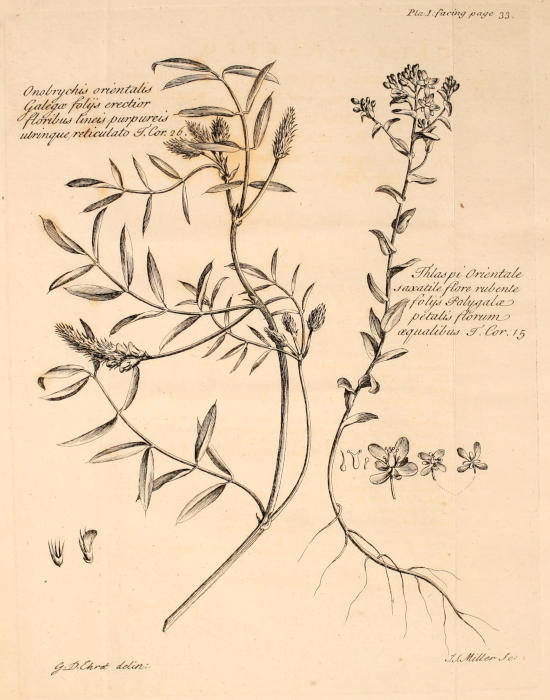
Pla 1: facing page 33.
Onobrychis orientalis Galegæ folijs erectior floribus lineis purpureis utrinque reticulato T. Cor. 26.
Thlaspi Orientale saxatile flore rubente folijs Polygalæ petalis florum æqualibus T. Cor. 15.
G. D. Ehret delin: J. S. Miller Sc:
As the spring advances, the following come on with surprising rapidity. Madder[157], cleavers[158], periwinkle[159], plantain[160], androsace[161], burnet[162], speedwell of many species[163], wake robin[164] several species, dragons[165], several kinds of toad flax[166], clary[167], sow bread[168], which near Aleppo is chiefly cultivated in their little gardens, but very common on the mountains; various sorts of clarey[169], three species of charlock[170], Mithridate mustard[171], bastard Mithridate mustard[172], stock-gellyflower[173], dames violet[174] four species, wild radish[175], two species of chickweed[176], four kinds of mouse-ear[177], house-leek[178], caltrops[179], two species of anemony[180], parsley[181], petty madder[182], hartwort[183], shepherds needle[184], clove-gellyflower[185], various species of garlick[186], bindweed two kinds[187], spurges several species[188], horehound[189], field Basil[190], treacle-mustard[191], woad[192], hemlock[193], water parsnip[194], navel-wort[195], brank ursine[196], gold of pleasure[197], flix-weed[198], horned wild cumin[199], sweet fern[200], bastard parsley[201], shrub hartwort[202], scorching carrot[203].
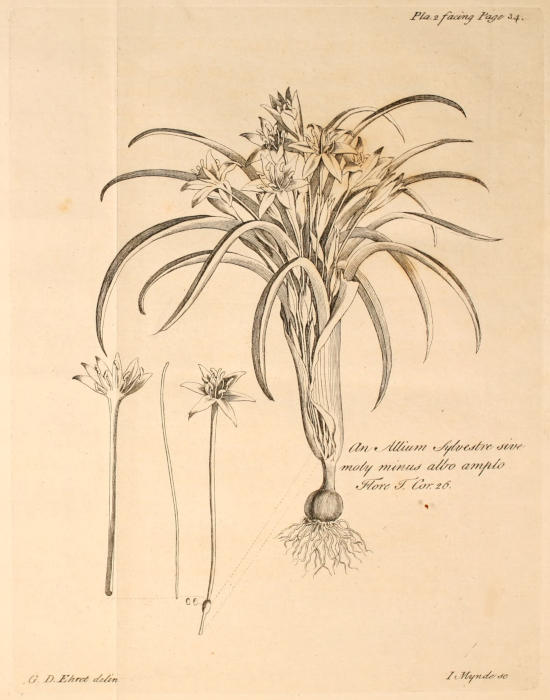
Pla. 2 facing Page 34.
An Allium Sylvestre sive moly minus albo amplo Flore T. Cor. 26.
G. D. Ehret delin: I. Mynde sc:
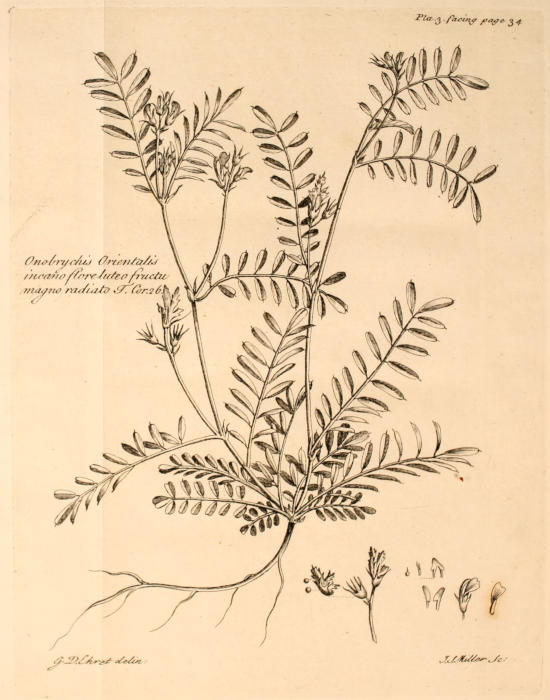
Pla. 3. facing page 34
Onobrychis Orientalis incano flore luteo fructu magno radiato T. Cor. 26.
G. D. Ehret delin: J. S. Miller Sc:
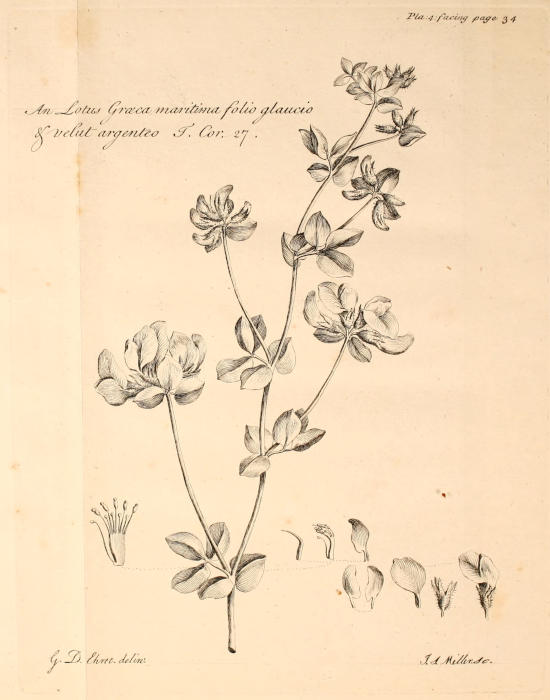
Pla: 4: facing page 34
An Lotus Græca maritima folio glaucio & velut argenteo T. Cor. 27.
G. D. Ehret delin: J. S. Miller sc:
And towards the middle of April the country is in its full bloom, the verdure of the fields being beautifully variegated by poppies[204], bellflower[205], gromel[206], comfrey[207], mullein[208], sage[209], rocket[210], hedge-mustard[211], mustard[212], horned poppy[213], great variety of campions[214], pimpernel[215], figwort[216], berry bearing chickweed[217], flax[218], corn-flag[219], lilly daffodil[220], larkspur[221], bugloss[222], ladies bed-straw[223], birthwort[224], ironwort[225], skull-cap[226], trifoil[227], melilot[228], calves snout[229], Moldavian balm[230], medick[231], rest harrow[232], goats rue[233], bastard rocket[234], kidney vetch[235], corn sallet[236], two species of satyrion[237], knapweed[238], hatchet vetch[239], columbine[240], scabious[241]. Nor are the stoney, uncultivated rising grounds without their plants; as thyme[242], vipers buglos[243], ground pine[244], cress[245], common whitlow grass[246], madwort[247], eryngo[248], St. Foin several species[249], birds foot[250], horse-shoe vetch[251], birds foot trefoil[252], moon trefoil[253], vetch several kinds[254], milk vetch[255], betony[256], knapweed[257].
Among the rank herbage in the gardens are found at this season, borage[258], German madwort[259], hounds tongue[260], broom rape[261], mint[262], rush[263], balm[264], thyme[265], vervain[266], dittander[267], hollyhock[268], cinquefoil[269], lilly[270], burdock[271], but in small quantity; mug-wort[272]. But among the plants that adorn the fields at this season, no one is more conspicuous or common than the lion-leaf[273]: nor should we here omit a beautiful species of henbane[274], with a strong musk smell; which seems to be the hyosciamus rubello flore, C. B. P. 169. though the peculiarity of its smell I do not find has been mentioned.
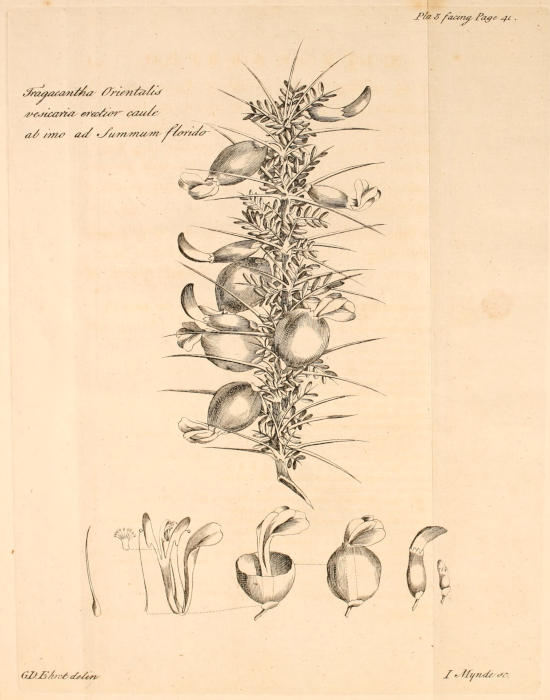
Pla 5 facing Page 41.
Tragacantha Orientalis vesicaria erectior caule ab imo ad Summum florido
G. D. Ehret delin: I. Mynde sc:
As the heats come on, the few following plants being of a hardier nature, are the only ones that are capable of resisting them. Wild or Syrian rue[275], bean capers[276], capers[277], which grow in plenty on the tops of old houses; kings spear[278] several species; a variety of stars of Bethlem[279], liquorice[280], night-shade[281], fennel[282], blessed thistle[283], wild cucumber[284]. Nothing now remains of the spring-plants in the open fields.
Of the plants that belong to the summer, except the following, al hagy[285], a very low kind of acacia[286], goats thorn[287], kali[288], several species of thistles[289], and the gundelia[290], the greatest part are to be found under the shade, or nigh the little channels where the water runs in the gardens. Molucca balm[291], base horehound[292], bastard horehound[293], dwarf oleander[294], ricinoides[295], thorn apple[296], turnsole[297], leadwort[298], pimpernel[299], teasel[300]. After the first rains in the autumn, the fields every where throw out the autumnal lilly daffodil; and the few plants which had stood the summer now glow with fresh vigour.
Besides what plants have been already enumerated, the country produces the camomile-like ox-eye[301], sneezwort[302], yarrow[303], cats foot[304], fleabane[305], several sorts of grass[306], ragweed[307], stinking orach[308], wild orach[309], vipers grass[310], ox-eye[311], May weed[312], corn marigold[313], goats beard[314], Achilles’s yarrow[315], American night-shade[316], chickling[317], chickling vetch[318], French honeysuckle[319], fever-few[320], chamomile[321], hemp[322], sharp-pointed dock[323], bloodwort[324], pellitory of the wall[325], true maiden-hair[326], nettle[327], starry hawkweed succory[328], groundsell[329]. The weeping willow[330] should likewise have been mentioned before, which is very common in the gardens.
And the river affords plenty of the yellow water-lilly[331], from whence the natives distil a cordial-water much used by them.
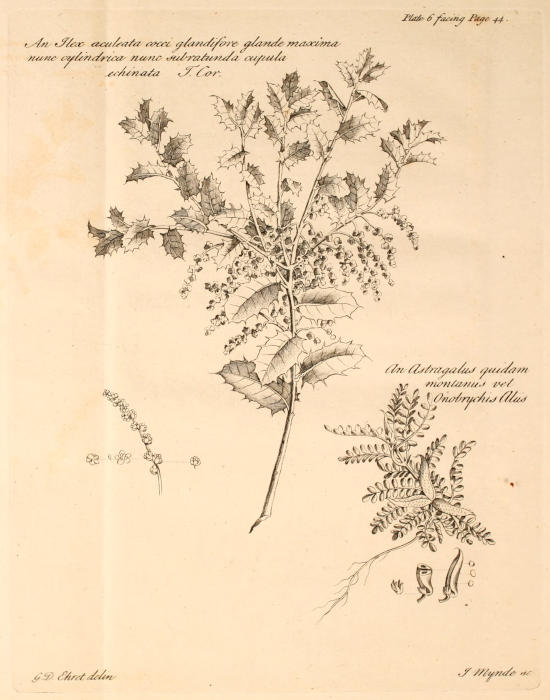
Plate 6 facing Page 44.
An Ilex aculeata cocci glandifore glande maxima nunc cylindrica nunc subrotunda cupula echinata T. Cor.
An Astragalus quidam montanus vel Onobrychis Aliis
G. D. Ehret delin: J. Mynde sc:
I never travelled through Syria, either with a botanical view, or at the proper season; so that I cannot pretend to give any tolerable account of the plants growing at any distance from Aleppo. The few, however, that came to my knowledge, I shall just mention. On the mountains grow several sorts of oaks, pines, myrtle, juniper, bay, St. John’s bread, kermes, azarole, the fruit of which is brought to market in the autumn; and the andrachne in such plenty, that it affords nigh one half of the wood used for fuel in Aleppo. The shining red of its bark, together with the beauty of its flowers and fruit, will, I doubt not, make it esteemed as a valuable acquisition to the British gardens, if it agree with our climate, which the thriving condition of several plants raised here seems to promise. The bindweed[332], from whence the Aleppo scammony of the shops is procured, does not grow near the city, but chiefly on the mountains. This drug is the inspissated milky juice that flows from the root by incision; and each produces but a very small quantity. As the plant grows wild, it is the property of any one that will take the trouble to look for it, which is the employment of some peasants at the proper season; and having collected what they can of the milky liquor, they carry it to the nearest village of any note, where there are always some traders (chiefly Jews) ready to purchase it of them; and these people generally mix it with wheat flour, sand, ashes, &c. so that at present very little is brought quite pure to market at Aleppo. It does not appear that any thing it is adulterated with increases its violence in operating; on the contrary, the purer the scammony, the smaller I have always found the dose: so that the notion of its being mixed with the juice of the spurge seems without foundation. However, the proportion of the heterogeneous substances mixed with it being various, renders the dose of the medicine as found in the shops very uncertain, and so occasions its being seldomer prescribed than so safe and efficacious a purgative otherwise deserves. For further particulars relating to this plant, see Medical Observations and Inquiries, Vol. I.—At the bottom of the page is a catalogue of such other plants as have come within my observation on the mountains, and in other parts of Syria[333].
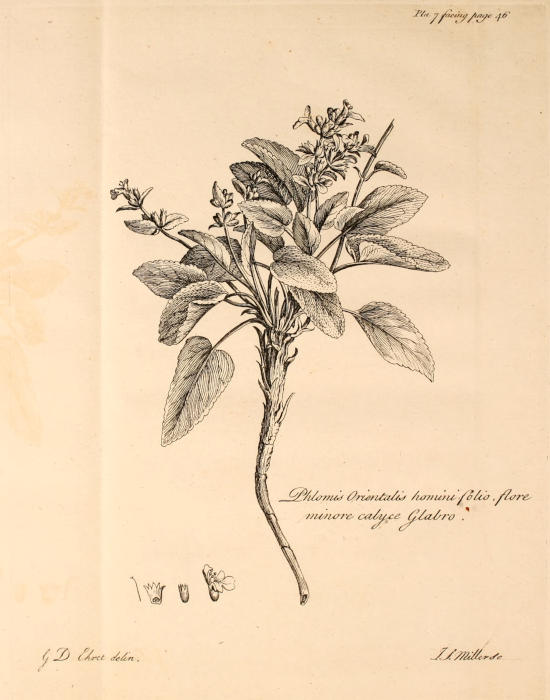
Pla 7 facing page 46
Phlomis Orientalis hormini folio flore minore calyce Glabro.
G. D. Ehret delin: J. S. Miller sc:
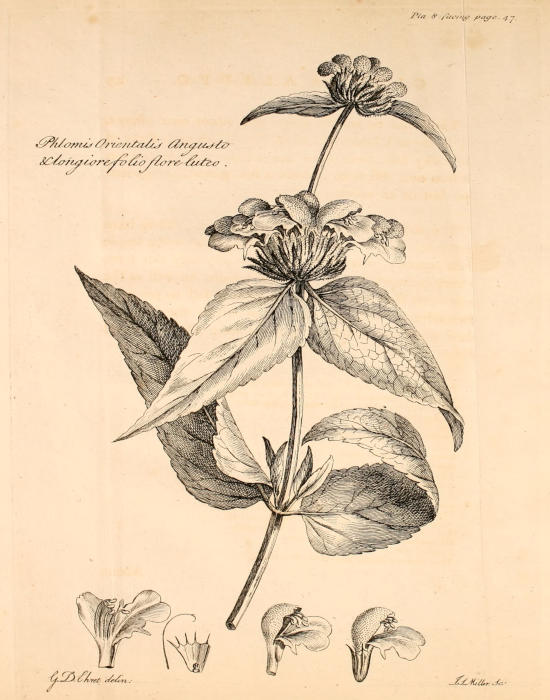
Pla 8: facing page 47.
Phlomis Orientalis Angusto & longiore folio flore luteo.
G. D. Ehret delin: J. S. Miller sc:
There are no metals found any where near Aleppo, or, so far as I know of, in all Syria; though some of the rocky hills from their appearance seem to contain an iron ore. Nigh to Antioch a few garnets are picked up, but of an inferior quality.
The soil has been already mentioned. They have scarce any clay; and, what they do meet with, has so little tenacity, that it is with difficulty they can form a very ordinary sort of bricks; which, as well as the water-jars they make of it, frequently fall to pieces of themselves. The potters clay, of which the holes of their pipes are made, is brought from Damascus and Sidon.
About six hours from Aleppo is found a sort of fullers earth, called by the natives bayloon, which is often used in the bagnio instead of soap, and particularly by the women for cleansing their hair; for which purpose it is kept in balls, made up with rose-leaves, to give it an agreeable smell. I may add, that a good deal of it is ate by longing women, and such as have a depraved appetite from a chlorosis.
For common buildings they make use of a white gritty stone, every where plenty about the town; and is very proper for the purpose, as it is easily cut, and grows hard afterwards. For the gateways, pillars, and pavements of their best buildings, they employ a yellow marble, which is capable of a tolerable polish, and is likewise the produce of this country. This is often intermixed with a red, white, and coarse black marble in their buildings, by way of ornament. None of the three last mentioned are found in the neighbourhood of Aleppo; being brought, the first from Damascus; the second, either from Italy, or extracted from old buildings, chiefly about Antioch; and the last, both from Damascus and Killis. When they are in want of the red, they can dye the yellow marble of Aleppo, so as to have much the same appearance, by rubbing it over with oil, and then putting it into a moderately-hot oven for some hours. The slight partition-walls are built of a coarse sort of chalk, of which there is abundance to the northward of the city.
Lime-stone is met with in plenty near the city, affording them good cement for their buildings; which they carry on with great ease and dexterity, and generally without any scaffolding. A few hours distance is found the gypsum in small quantities, of which their plaister of Paris is made. This is chiefly used in cementing the earthen pipes employed in carrying water, and for a few other purposes about their best buildings.
About eighteen miles south-east from Aleppo, is a large plain, which we generally call the Valley of Salt, bounded with low, rocky hills, so as to form a kind of natural bason, which keep in the rains descending from them, together with the water derived from a few springs in the neighbourhood, and cause the whole to be entirely covered with water in the winter. The extent and evenness of the surface, however, prevents this water from collecting to any great depth; so that it is soon evaporated by the summer’s heat, and leaves a cake of salt in some places not less than half an inch thick, but it is more or less in proportion to the quantity of rain that falls in the winter; and with this crust the whole inclosed plain is covered. The soil of this plain is a stiff clay, and strongly impregnated with salt; but I could not discover that the springs above mentioned had any taste communicated by this mineral.
In the month of August a number of people are employed in gathering this salt; which is of a good quality, and in quantity proves sufficient to supply all this part of the country.
What few black cattle they have near the city, are chiefly used for the plough, or drawing water for the gardens. The greatest part of those employed for this purpose are very large, with remarkably long legs, and a gaunt belly, such as we often see on antique intaglios. The other cattle of this species are small, and all in general have very short horns.
The Turks or Jews scarce ever eat beef, and it is but of late that the Christians have begun to be fond of it; so that what is killed is chiefly for the Europeans, who have it tolerably good at all seasons, but best in summer, as the natives to this day religiously observe the ancient custom of allowing the oxen employed in separating the corn from the straw to eat what they please.
In some parts of Syria there are abundance of buffaloes, but near Aleppo very few, and these chiefly kept for milk. Mutton is plentiful, fat, and good the whole year, except a few weeks in the spring, and makes by far the greater part of the animal food of all ranks of people. Lamb is also to be had in every season, but in greatest plenty in February, March, and April.
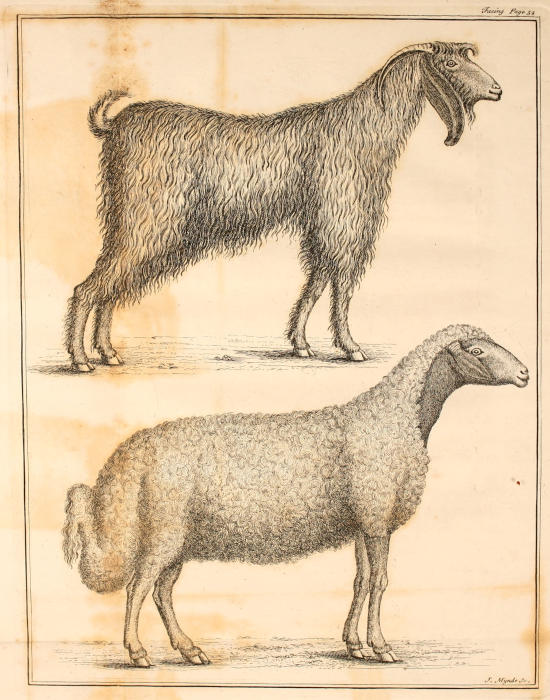
They have two sorts of sheep in the neighbourhood of Aleppo: the one called Beduin sheep, which differ in no respect from the larger kinds of sheep in Britain, except that their tails are somewhat longer and thicker: the others are those often mentioned by travellers on account of their extraordinary tails; and this species is by much the most numerous. This tail is very broad and large, terminating in a small appendix that turns back upon it. It is of a substance between fat and marrow; and is not eaten separately, but mixed with the lean meat in many of their dishes, and also often used instead of butter. A common sheep of this sort, without the head, feet, skin, and entrails, weighs about twelve or fourteen Aleppo rotoloes[334], of which the tail is usually three rotoloes or upwards; but such as are of the largest breed, and have been fattened, will sometimes weigh above thirty rotoloes, and the tails of these ten; a thing to some scarce credible. These very large sheep being about Aleppo kept up in yards, are in no danger of injuring their tails; but in some other places, where they feed in the fields, the shepherds are obliged to fix a piece of thin board to the under part of the tail, to prevent its being torn by bushes, thistles, &c. as it is not covered underneath with thick wool like the upper part; and some have small wheels, to facilitate the dragging of this board after them; whence, with a little exaggeration, the story of having carts to carry their tails.
This thin skin on the under part of the tail is much used by the natives for pains and swellings of all sorts, being applied warm to the part affected, and allowed to remain on till it stinks abominably; and as they are very often applied to the head and abdomen in fevers, this last circumstance makes them prove generally detrimental: and indeed I have seldom, if ever, seen much benefit received by their application, except in some old rheumatic pains.
Facing Page 52
J. Mynde sc.
They have also two kinds of goats; one that differs little from the common sort in Britain; the other as remarkable for the length of its ears, as the sheep above mentioned for the largeness of their tails. The size of the animal is somewhat larger than ours; but their ears are often a foot long, and broad in proportion. They are chiefly kept for their milk, of which they yield no inconsiderable quantity; and it is sweet, and well-tasted. Great numbers of them are brought to the city about the beginning of April, and are drove through the streets every morning, and their milk sold as they pass, till September. The other part of the year they are generally supplied with cows milk, such as it is; for as they are commonly kept at the gardens, and fed with their refuse, the milk generally tastes so strong of garlick or cabbage leaves, as to be very disagreeable. Besides the milk of the goats, their kids add some part to the diet of the inhabitants, a few being killed in the spring and autumn.
Butter and cheese, both of which are bad, are made indiscriminately of the milk from cows, buffaloes, sheep, or goats: and the city is supplied with these things, as well as with cattle of all kinds, by the Arabs, Rushwans, or Turkmen; all of whom place their wealth, or at least derive their subsistence from those animals, and travel about the country with their flocks, much in the same way as the patriarchs did of old.
Leban[335] is brought in great plenty to the city during the winter and spring, and is a favourite dish with the inhabitants.
The country round Aleppo abounds with antelopes; which are of two sorts: that which is called the mountain antelope is the most beautiful; its back and neck are of a dark brown colour: the antelope of the plain is not either so swift or well-made, and is of a much lighter colour. Both sorts afford no small diversion to the sportsmen; but are so extremely fleet, that the greyhounds, though very good, can seldom take them without the assistance of a falcon, unless in soft deep ground. In the sporting season they are lean, but have a good flavour. In the summer, when fat, they may vie even with our venison in England. But this is to be understood of such as are caught abroad, for those that have been fattened in the houses are not so delicious. From this account it will easily be conceived, that such dainties only make their appearance at the tables of the Europeans, and a few of the more considerable Turks.
Hares are in great plenty, and also afford good sport; but the natives are not fond of them, except the Arabs, whose method of dressing them is particular, and said to be very good. They dig a hole in the earth, which they fill with such light brushwood as they can pick up, and set it on fire: when thoroughly lighted, the hare, the flue, the entrails, and all together just as it was taken, is thrown into it; and, after the flame has ceased, they cover the hole up with the loose earth that had been dug out of it, and which at first had been laid round the verge of the fire, so as to grow hot: thus it is left till they judge it to be sufficiently roasted, when throwing a quantity of salt over it, they eat it without any further dressing.
A few tame rabbits are kept in the city, chiefly for the tables of the Europeans; and now and then a wild hog is brought from abroad, which, though seldom fat, yet is esteemed by us, as it is a rarity.
The country also affords a few porcupines, which are sometimes, though seldom, ate by the Europeans; and land-turtle and frogs in great abundance, which furnish a dish for the Franks of the Romish religion, and for many of the native Christians, in their lents.
These are the animals which are commonly dressed for food by the inhabitants of Aleppo; for the camel, though reckoned a delicious morsel by the Arabs, makes no part of their diet. This creature, however, is of the utmost consequence to them in transporting from place to place every thing for which they have occasion; there being no such thing as a wheel-carriage in all this part of the country, except a very clumsy machine, now and then used for bringing large pillars, or other stones of great weight, from the quarry.
There are four sorts of camels known here, viz. the Turkman camel, the Arab camel, the dromedary, and the camel with two bunches on its back.
The Turkman camel is much stronger, larger, more woolly or hairy, and of a darker colour, than any of the others. Their common load is 160 rotoloes, or 800 pounds; but sometimes it carries much more. This animal cannot bear heat, and therefore they never work it in the months of June, July, and August.
The Arab camel is much smaller than the former, of a lighter colour, and not so hairy. This seldom carries above 100 rotoloes, but can bear the heat and thirst much better than the Turkman; nor is there any need that the Arab camel be fed with barleyflour and chopp’d straw; for the dry thistles, and other plants which grow on the desart, are almost all it requires, and it feeds as it goes along with its burthen. I remember an instance, where, in a caravan from Bussorah, the camels which were of this sort travelled without water for fifteen days; but the quantity they drank as soon as they could come at any, proved fatal to many of them.
The dromedary, by all I could ever discover, is nothing but a high breed of the Arab camel. The only distinction observed is, that it is of a lighter and handsomer make; and, instead of the solemn walk to which the others are accustomed, it paces, and is generally esteemed to go as far in one day as the others do in three.
The camel with two bunches on its back is of Persian breed, and, except a few that come in the caravans from Bagdad and Bussorah, is but seldom seen here. The only distinction between it and the Arab camel seems to be its having two bunches, whereas the other sorts have but one.
In mentioning their beasts of burthen, the ass ought not to be omitted: of which they have two sorts; one very large, with remarkably long ears; the other small, and much like ours in England; both of no contemptible use in carrying all lighter burdens to and from the parts adjacent to the city.
Formerly this part of the country was famous for fine horses; and though many good ones are still bred here, it may be said they are much degenerated. Those of the Arab breed are slight, and not very handsome, but esteemed for their fleetness. The Turkman horses are larger, of a stronger make, and more sightly appearance; and therefore more valued by the people of fashion among the Turks, whose large furniture does not show to advantage upon a small horse. They are for the most part very well broke, and particularly taught to go off in full speed at once, and stop as quickly; so that in the space of a few yards the rider can lay them out at full stretch, and stop and turn them. Far the greater part are stone-horses, but in general not vicious; and it is observed of most of their animals, that they are exceeding gentle and familiar with the human species.
Among the rocky hills there are hyænas; but they are not so large as those which are found in the mountains[336].
If this animal could formerly imitate the human voice, and learn some of the shepherds names, so as to call them out and devour them, as some writers have reported, it is more than they do at present, being, so far as I can learn, fonder of the flocks than of the shepherd. However, though they will not attack men but in their own defence, or through excess of hunger; yet they still retain the character of robbing sepulchres when they have an opportunity.
Wolves and foxes are found in the champaign, but smaller than those in Europe; and jackalls are in so great plenty about the gardens, that they pass in numbers like a pack of hounds in full cry every evening, giving not only disturbance by their noise, but making free with the poultry and other provisions, if very good care is not taken to keep them out of their reach.
I might be excused from mentioning their dogs, which abound in the streets without any owner, were it not that I think it worth observing, that though they live upon the most putrid substances, have but little water, and in so excessive hot a climate as this is in the summer, yet no instance has been known of any of them running mad. Their wolves however seem to be subject to madness; for the rusticks talk much of an animal called a sheeb, which they imagine to be generated between a wolf and a dog; but, from their description of it, viz. that it is so like a wolf as not to be distinguished from it; that it attacks every person or animal that comes in its way, all of whom die raving mad, &c. I think it would appear that this animal is no other than a mad wolf.
Their greyhounds are of a very light, slender make, and remarkably fleet. Their ears are longer than ours in Britain, and, as well as their tail, covered with a long, soft hair, which adds very much to their beauty.
Though Mount Taurus, near to Maraash, gives shelter to the ounce, and some few tygers are found in most of the high mountains, the lion on the Euphrates between Bagdad and Bussorah, and the jerboa on the desart, and perhaps on examination many other animals in the same places; yet my present purpose only comprehending the parts adjacent to Aleppo, what I have already said on this subject may perhaps be thought sufficient.
As to reptiles, insects, &c. time would not permit me to be minute; so that I shall just mention such as are hurtful or of use to the inhabitants, and a few of those that are most commonly met with. Of the first sort are the serpents of various kinds, with which the country abounds, many of them of the most venomous nature; but as they all fly from man, and the barrenness of the fields in summer, the only season in which they are abroad, prevents either their being surprised, or people’s treading upon them undesignedly, no great number of accidents happen. In the houses there are often found large white snakes; but I never knew any one bit by them. The scolopendra and scorpion however very often sting the natives in their houses, causing pain for several hours, but attended with no farther bad consequences.
Of the noxious kind may well be reckoned the locust, which sometimes arrive in such incredible multitudes, that it would appear fabulous to relate, destroying the whole of the verdure where-ever they pass: but though there are always in the spring and summer some of two or three different species to be met with about Aleppo, yet none of these destructive flights of them appeared during my stay there. It may not be amiss to mention that the Arabs eat this insect when fresh, and also salt them up as a delicacy.
Of insects for use, we have only the bee, which produces excellent honey, and the silk-worm, now sufficiently known all over Europe, as well as the method of managing them in order to procure the silk; of which there is but very little made nigh Aleppo: though that being the market to which it is brought from all parts of Syria, great quantities are sent from thence yearly to Britain.
Various sorts of lizards are found in great abundance over the whole country, and in the gardens a few tree-frogs[337]. It is worth observing, that toads are scarce ever seen here, though common enough upon the coast.
The view with which these sheets were composed, it is hoped, will sufficiently apologize for beginning the account of the feathered tribe with such as are used for food by the inhabitants. Of domestic fowls, they have in their markets, the dunghill cock and hen[338]; the Bagdad fowl which is of a large breed; the rumkin[339], or cock and hen without rumps; the turkey[340], goose[341], and duck[342]. Of game there are on the river in winter, the water hen[343], water rail[344], wild goose[345], plenty of common wild duck and mallard[346], several kinds of widgeon[347], coot[348], spoon-bill[349], and various sorts of teal[350], with which the tables of the Europeans are plentifully supplied, and some ate also by the natives.
In the winter there are also plenty of wood-cocks[351]; spring and autumn produce abundance of quails[352] and rails[353]. In the last mentioned season the witwall[354] and becca figos are both in season, and (the last in particular) esteemed as delicacies.
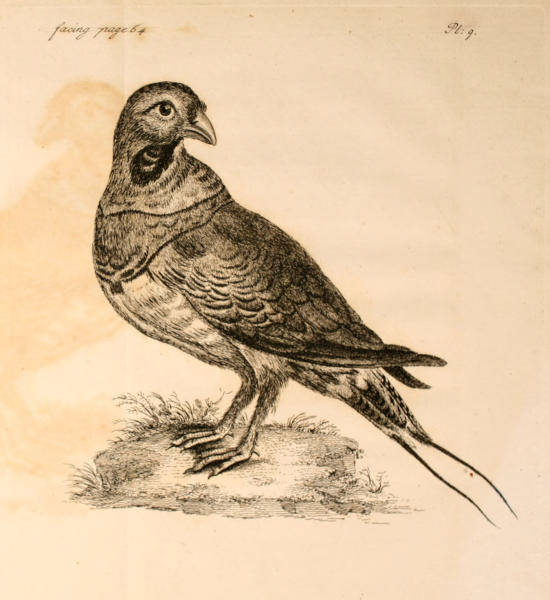
facing page 64 Pl: 9.
In the months of May and June great numbers of a bird, called by the natives kata (which are also to be met with at all seasons, though not in so great plenty), are brought to market, and much ate by them; but their flesh is so black, hard, and dry, that the Europeans never touch them. As this bird has not as yet been described, a figure and description of it are annexed[355]. Other game in the neighbourhood are, the bustard[356] of two kinds; red-legg’d partridge[357]; frankolin[358], the flesh of which is delicious, but this bird is not to be met with at less than a day’s journey from the city; common sky-lark[359], wood-lark[360], crested lark[361], calandra[362]; hortulanes[363], and citrils[364], chiefly ate by the French; snipe[365], gird or jack snipe[366], song-thrush[367], wind-thrush[368], turtle-dove[369]; a brown-coloured dove, which builds in the windows, &c. of the houses in the city; and another much like it, only speckled on the neck and pinions, which is very common when the corn is ripe, but disappears as soon as that is reaped; wild pigeon, wood pigeon[370]. They have also variety of tame pigeons, and particularly the carrier[371], formerly made use of by the Europeans for conveying expeditiously the news of a ship’s arrival at Scanderoon; but this practice has been disused for many years. The pigeon thus employed was one that had young at Aleppo. Upon enquiring into their method of training them, some asserted, that they were sent down to Scanderoon in an open cage, and, as soon as let go there, would fly directly to Aleppo. But I am more apt to believe what others affirmed, that the bird was brought to this by first letting it return from shorter distances on the Scanderoon road. All agree, that if the pigeon had been a fortnight at Scanderoon, it was not afterwards to be trusted to fly back, lest it should have forgot its young, and consequently not be so eager to get home. A small piece of paper, with the ship’s name, day of arrival, and what else material could be contained in a very narrow compass, was fixed so as to be under the wing, to prevent its being destroyed by wet. They also used to bathe their feet in vinegar, with a view to keeping them cool, so as they might not settle to drink or wash themselves, which would have destroyed the paper. And I have heard an English gentleman, who remembered that practice, say, that he has known them arrive in two hours and an half.
Shooting, as a sport, is rarely followed by any of the natives, though many practise it to gain a livelihood; but the diversions of coursing and hawking are in great esteem among the people of fashion. They have both in great perfection; but the latter exceeds any thing of the kind that I have ever met with. The falcons bred for taking hares and antelopes are the Baraban and Sefy, both large falcons; and, though caught wild, they train them in a few days to fly at their prey.
For antelope-hawking, they chuse such of these hawks as they find to be fierce, and eager to seize their prey; and they are taught to fix upon the cheek of the animal, which retards its motion, so that the greyhounds come in.
Though the falcons used for hare-hawking will sometimes, when very hungry, strike the hare dead at once; yet for this sport they prefer such as are not disposed to fix upon the animal, but who, by repeated buffetting on the head with their pounces (rising in the air between each blow), retard the hare, till an ordinary greyhound can come up and seize it.
For bird-hawking, they use a large falcon, with long legs, somewhat like the goshawk, which they call espeer; and two smaller falcons, stiled the one zanous, and the other shaheen. This latter must be taken out of the nest, for when old they cannot be trained, and is so fierce that it will fly at any thing. If there were not several gentlemen now in England who can attest it, I should scarce venture to mention, that with the shaheen, which is about the size of a pigeon, they often take the largest eagles, of which in this country there are plenty. They formerly were trained to seize the eagle under the wing: and so depriving him of the use of that part, they fell to the ground together: but their present method, as I am informed, is to seize him on the back between the two wings, which has the same effect, but brings him down more slowly, and so gives the falconer time to come in to his hawk’s assistance; in which if he is not very expeditious, the hawk is in either case speedily destroyed.
They have also a small hawk, which they train to fly at quails; it much resembles the spar-hawk.
Besides those already mentioned for food and sport, the country produces the black vulture[372], some few pelicans[373], the kestrel[374], white stork[375], black stork[376], great eagle-owl[377], several other kinds of smaller owls, the crane[378]; another beautiful sort of crane[379], called by the natives querky, which they have often tame in their houses or court-yards; the common heron[380], the flamingo[381] at some seasons, the cormorant[382], the stone curlew[383], the raven[384], the Royston crow[385], the common or carrion crow[386], the jackdaw[387], the magpye[388], the night raven[389], the starling[390], the common blackbird[391]; a kind of jay, whose feathers are beautifully variegated with blue, green, and a sort of brown; as also in the summer the locust bird[392].
The black caps[393], a sort of gull, are in great numbers about the city all the winter, and so tame that the women call them from the terraces, throwing up pieces of bread, which these birds catch in the air. The house-swallow[394], martin[395], and swift[396], of which, besides the common, there is one with a white belly, come about the end of February; and having hatched their young, disappear about the end of July. The swallow returns again the beginning of October, but stays not above a fortnight. The hopooe[397] and bee-eater[398] come in the spring, and remain all the summer and autumn.
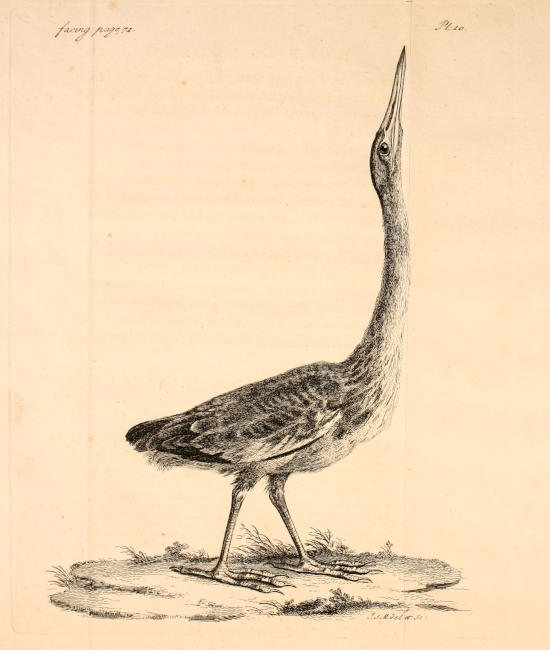
facing page 71. Pl: 10.
J. S. M. del et. Sc:
Of small birds the following are what I have observed. The house-sparrow[399], the chaffinch[400], the goldfinch[401], the common linnet[402], the field-fare[403], the white water-wagtail[404], the cuckow[405], the king-fisher[406], the greater spotted wood-pecker[407], the stone-chatter[408], the wren[409], a Brasilian bird a-kin to the king-fisher[410], green plover[411], grey plover[412]; and abundance of nightingales[413], which not only afford much pleasure by their song in the gardens, but are also kept tame in the houses, and let out at a small rate to divert such as chuse it in the city; so that no entertainments are made in the spring without a concert of these birds.
There are also several other birds, which I could not determine from any books I had, and my occasions did not allow me to preserve; besides which I doubt not there are many others which escaped my searches: so that I can only add a remarkable sort of bittern[414], and a bird somewhat like a lapwing[415], with a remarkable spur in its pinnion: the figure and description of both which are annexed.
From the Euphrates and Orontes in the winter, particularly the Lent of the Christians, are brought a sufficient quantity of fish for their consumption; but the Turks seldom eat any: and indeed most of them taste so muddy, that they are disagreeable.
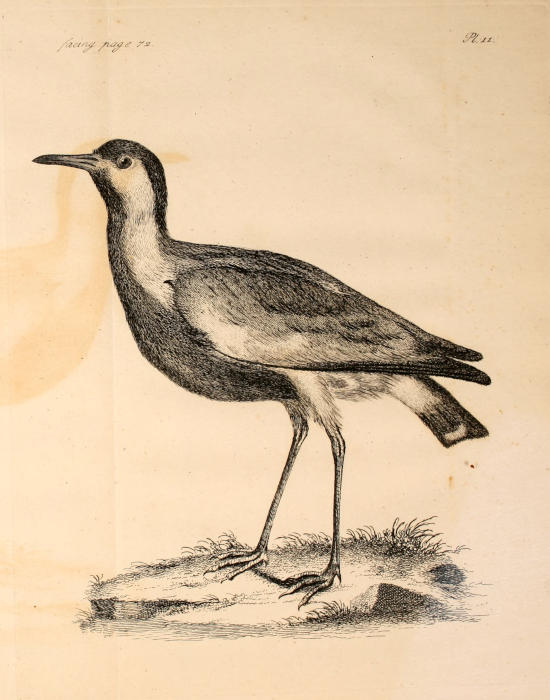
facing page 72. Pl: 11.
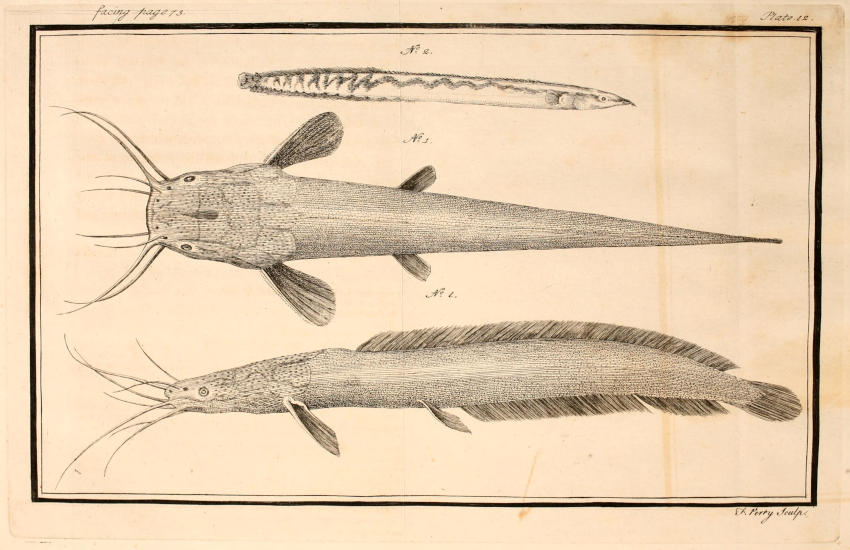
facing page 73. Plate 12.
F. Perry Sculp.
The different kinds that I have observed are carp[416], Mystus Niloticus Bellonii[417], barbel[418], nasus[419], tœnia cornuta Schonfeldii[420], eel[421]; and there are likewise some other sorts that I had not an opportunity of examining; but none are in such abundance as what are called the black fish, with which the markets are plentifully supplied from the entrance of the winter till the beginning of March; when they are esteemed out of season. As this fish, to the best of my knowledge, is of a genus not yet described, a figure and description of it are inserted[422].
Besides the fish which we have mentioned, most of those that are found in the Aleppo river, are likewise brought from abroad, and known in town by the same names.
The sheat fish[423] is also sometimes to be met with, and is caught in a lake near Marash.
I did not imagine, from the appearance of the river Coic, or indeed from what is commonly met with at the tables of the inhabitants, that our list of fish caught there would have swelled to any thing worth mentioning; and yet, upon examination, they were found to amount to no less than seventeen, and even some of these not yet described. They are in general very small, occasioned in part by the assiduous industry of the fishermen; for at Hylan, and the Fountain of Fish, where they remain unmolested, they grow to larger sizes, though very rarely so large as in other parts of the world.
The loche[424] is the most common; the barbel is less than those brought from abroad. The bleak[425] is known by two names; that is, there are two sorts of fish that appear to agree in every characteristic with the bleak, which nevertheless are esteemed different; the first called mirmeed, seven or eight inches long; the second, tiftaf, is not above one and a half or two inches, and, they say, never exceeds. Chub[426] are plenty; roches[427] seldom large; gudgeons[428] of three sorts; the first is much spotted on the back, and called tuckle; the second, kureety, has fewer spots; the third, kalloor, scarce any, and is smaller than the other two. The mugilis[429] I am less certain of than the rest, but yet it agrees tolerably well with the description; dace[430], carassius[431], the phoxinus[432]; also a fish called by the natives simak il inglese[433], from a corruption, I suppose, of anguilla, as it has been commonly imagined to be a kind of eel; though, upon examination, it is found to be a genus hitherto undescribed; and two species of mystus[434][435]: of which three, as I have met with nothing like them in other authors, I have given descriptions and drawings. There are also, on the banks of the river, crabs in abundance, which are much eat by the native Christians, and which often furnish the tables of the Europeans with a delicate dish.
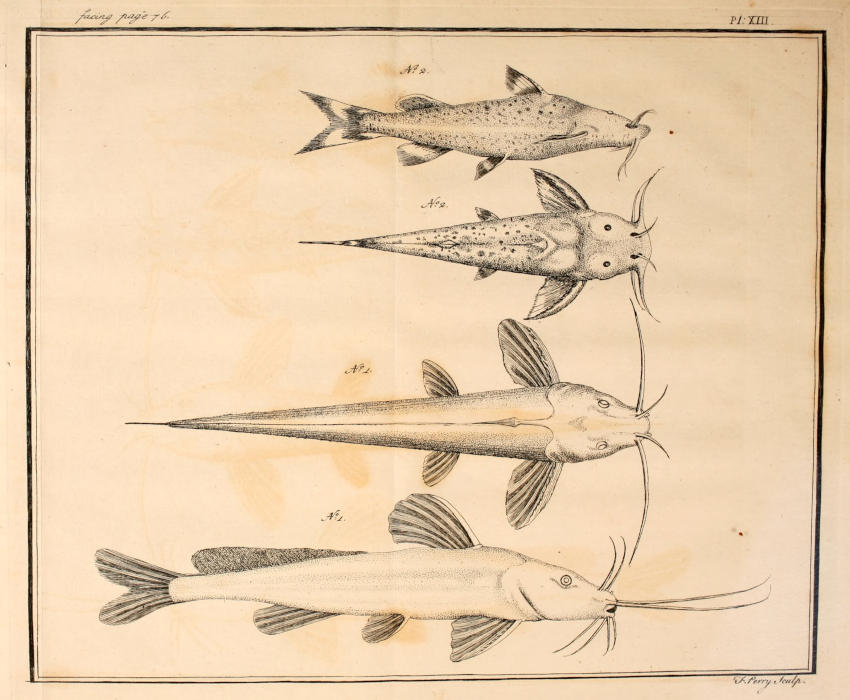
facing page 76. Pl: XIII.
F. Perry Sculp.
The inhabitants of Aleppo, though of different religions, yet seem to be much the same people. I wish I could say that those who profess Christianity were better than their neighbours. The number of souls in the city and suburbs is computed at about 235,000, of whom 200,000 are Turks, 30,000 Christians, and 5000 Jews[436]. Of the Christians, the greater number, are Greeks; next to them the Armenians, then the Syrians, and lastly the Maronites; each of whom have a church in the suburbs called Judida; in which quarter, and parts adjacent, most of them reside. The language generally spoke is vulgar Arabic. The Turks of condition use the Turkish. Most of the Armenians can speak Armenian, some few Syrians understand Syriac, and many of the Jews Hebrew; but scarce one of the Greeks understand a word of Greek, either ancient or modern.
The people in general are of a middle stature, rather lean than fat, indifferently well made, but not either vigorous or active. Those of the city are of a fair complexion; but the peasants, and such as are obliged to be much abroad in the sun, are swarthy. Their hair is commonly black, or of a dark chesnut-colour; and it is very rare to see any other than black eyes amongst them. Both sexes are tolerably handsome when young; but the beard soon disfigures the men; and the women, as they come early to maturity[437], fade also as soon, and in general look old by the time they reach thirty. The greater part of the women are married from the age of fourteen to eighteen, and often sooner. The tender passion of love can have very little share in promoting matrimony among them, for the young folks never see one another till the ceremony is performed. A slender waist, far from being admired, is, on the contrary, rather looked on as a deformity in the ladies of this country; so that they do all they can to make themselves plump and lusty.
The men are girt very tight round the middle with a sash. The womens girdles are not only very slight and narrow, but loosely put on; which, with the warmth of the climate, and frequent use of the bagnio, is probably one principal reason why their labours are much easier than those in Britain; the most delicate being seldom confined above ten or twelve days, and those of the villages are rarely hindered from going about their usual employments the next day. Women of all conditions suckle their own children, and seldom wean them, till either the mother is again with child, or they arrive at the age of three, and sometimes four years.
The people of distinction in Aleppo may justly be esteemed courteous and polite, if allowance is made for that superiority which the Mohammedan religion teaches those who profess it to assume over all who are of another faith. And as this prejudice is observed to encrease among the people in proportion to their vicinity to Mecha, the natives of Aleppo have still a much greater proportion than those of Constantinople, Smyrna, and other parts at a greater distance; though, even here, it has greatly declined within these few years, insomuch that several bashaws have conferred many public honours and civilities on the Europeans, that formerly would have caused great popular discontent. As to the common people, an affected gravity, with some share of dissimulation, is too much their characteristic. And though few in the world are more given to harsh language and quarrelling, yet none are less guilty of fighting. One can seldom pass a few yards in the street without being witness to some noisy broil; yet in many years you may perhaps never see one blow struck, except the person who gives it is very well assured that it will not be returned. But though they are so prone to anger upon the most trifling occasions, yet no people in the universe can be more calm when it is their interest so to be. This, I am sorry to say, is but too generally a true representation: but it would be very ungrateful, as well as unjust in me, not to acknowledge that there are many amongst them of all sects who deserve a much better character, and whom I know, from repeated experience, to be persons of the utmost honour and integrity.
Their usual bread is of wheat flour, not well fermented, made into thin flat cakes ill-baked, and for the most part ate soon after it comes out of the oven. The better sort have small loaves of a finer flour, well fermented, and well baked. Besides these, there are a variety of rusks and biscuits, most of which are either strowed on the top with the seeds of sesamum or fennel-flower. The Europeans have very good bread, baked in the French manner.
Coffee made very strong, and without either sugar or milk, is a refreshment in very high esteem with every body; and a dish of it, preceded by a little wet sweet-meat (commonly conserve of red roses, acidulated with lemon-juice), and a pipe of tobacco, is the usual entertainment at a visit. If they have a mind to use less ceremony, the sweet-meat is omitted; and, if they would shew an extraordinary degree of respect, they add sherbet, (some syrup, chiefly that of lemons, mixed with water) a sprinkling of rose or other sweet-scented water, and the perfume, with aloes-wood, which is brought last, and serves as a sign that it is time for the stranger to take his leave. This is looked upon as an entertainment sufficient for the greatest men in the country, only that such have a piece of embroidered or flowered silk thrown over their knee when they drink the coffee and sherbet: and if it is a visit of ceremony from a bashaw, or other person in power, a fine horse, sometimes with furniture, or some such valuable present, is made him at his departure. People of inferior rank (or even others, if they have any favour to ask) commonly bring a small present (a flower is frequently thought sufficient) when they visit.
Tobacco is smoked to excess by all the men, and many of the women. Even the labourers or handicraft-tradesmen have constantly a pipe in their mouths, if they can afford it. Those pipes are made of the twig of a rose-bush, cherry-tree, &c. bored for that purpose: those of the better sort are five or six feet long, and adorned with silver. The bole is of clay, and often changed; but the pipes themselves last for years. Many who are in easy circumstances have lately adopted the Persian manner of smoking the nargeery[438]; which is an instrument so constructed, that the smoke of the tobacco passes through the water before it comes into the mouth. The method of drawing it is different from that of a pipe; and a good part of the smoke seems to descend some way into the breast. The Persian tobacco is what they use in this instrument, which has an agreeable flavour; attended with this further advantage, that, when smoked in this way, neither the taste or smell of it remain after washing the mouth.
The vulgar, in imitation of their superiors, have at the coffee-houses an ordinary instrument of the same construction: in this they use the common tobacco, wetted a little with dibbs and water, or an infusion of raisins, adding at times sheera[439], to make it intoxicating; and they will draw in such vast quantities of smoke, that when they throw it out again at the mouth and nostrils, it appears surprising where they found room to contain it.
Opium is not of so high esteem with the inhabitants of Aleppo as at Constantinople, and some other places; nor could I ever find the taking it so general a practice in Turky as is commonly apprehended, being chiefly practised only by debauchees. They who take it to excess are commonly stiled teriaky; and the Theriac. Andromach. is called in Turkish teriack, which perhaps may countenance a conjecture that this was the original form they used it in. At present they not only use it in that form, but have various other electuaries or confections wherein it is mixed with aromatics. Some few use it pure; and the greatest quantity I ever knew taken was three drachms in twenty-four hours. The immediate effects that I observed it to have upon such as were addicted to it was, that their spirits were exhilarated, and, from a dosing, depressed state which they fell into after passing the usual time of taking their dose, they became quite alert. The consequences of a long use of it are, that they soon look old and besotted, like such as in Europe have ruined their constitutions by hard drinking. And it may be considered as point of fact, that they but seldom live to a good old age: though they are rarely carried off by dropsies, or such other diseases, the usual consequences of hard drinking amongst us; but rather having first lost their memory, and most of their intellectual faculties, they decline, in all appearance, in the same way as those who sink under the weight of years.
In Aleppo there are a number of public bagnios, which are frequented by people of all sects and conditions, except those of a very high rank, who have mostly baths in their own houses. The first entrance in the public bagnio is a large, lofty room; in the middle of which is a fountain, with a bason, which serves for washing the linen, that hangs upon lines at a considerable height all over the room. In this first apartment are broad benches, where they dress and undress; and the air is here not at all influenced by the heat of the bath, except it be just at the door, by which you pass into a small room, which is pretty warm, and from thence into a larger very hot. About the sides of these two rooms are placed round stone-basons, of about two feet and a half diameter, with two cocks, one of hot, and the other of cold water; so that you may temper it according to your own pleasure, and there are copper-bowls for you to lave it upon your body. In the corners of the inner room there are small retiring-chambers; in one of which there is frequently a cistern of warm water, about four feet deep, and large enough for bathing the whole body. All these rooms are surmounted by cupolas; and the inner receive their light from small openings in their domes, which are covered with glasses. The outer room receives its light, not only from the lanthorn of its dome, but also from windows. Some few bagnios are solely for the men, others are appropriated to the women only; yet the generality of them admit both sexes, though at different times; that is, the men in the forenoon, and women in the afternoon.
When a man goes into the hot room, the first thing he does is to apply the dewa[440], (or medicine for taking off the hair), to the pubis and armpits. This is suffered to remain till the hair is quite loose, and then must be immediately washed clean away with great care. After this, one of the servants of the bagnio begins with chaffing, or kneading violently, first the tops of the shoulders, and then by degrees the whole body. When he comes to the hand, he pulls the joints of the fingers, so as to make each crack separately; then laying the person on his back, with his arms across his breast, he raises him forcibly by the back part of the neck, so as to make the greatest part of the vertebræ crack. He then chaffs the back a little more, and, throwing a quantity of warm water over the whole body, rubs him hard with a bag made of a fort of coarse camelot, which is drawn over the servant’s hand, for some time. He is next rubbed over with a soap-lather; and the whole being washed clean off, he puts one towel round his middle, another round his head, and perhaps a third over his shoulders; in which manner he goes out to the great room, where he generally smokes a pipe, drinks coffee, and perhaps eats some fruit, before he dresses.
The women having the additional trouble of combing and washing, as well as unplaiting and plaiting their hair, besides very frequently that of a number of children to wash, remain generally in the hot room for a considerable time; but refresh themselves at intervals, by going out into the other rooms, where they smoke, converse, and drink coffee, with one or other of the various parties that are commonly there. Every company of two or three are attended by an old woman, whose business it is to rub and wash them; but do not chaff and crack their joints as the men, and their bag for rubbing is much finer. They also use the dewa.
Each company, generally speaking, has its collation, which they eat in the middle room before dressing: and as the bagnio is the principal place where they have an opportunity of showing their fine cloaths, seeing a number of company, or enjoying the freedom of conversation, though with their own sex only, it is not to be wondered that they are very fond of it, though their entertainment may not be so elegant as Europeans might expect.
The first time a woman of the country (whether Christian, Turk, or Jew) goes to the bagnio after child-bearing, she must have what they call the shdood; which is thus performed. She is set down in one of the washing-places of the inner room, and the midwife rubs her over with a composition of ginger, pepper, nutmegs, and other spices, made into a sort of ointment, or rather electuary, with honey. In this manner she sits for some time, the other women in the mean while singing and warbling with their voices in a particular tone, which is their usual way of rejoicing in this country. After this the lady is washed clean, and the ceremony finished. This they imagine strengthens them, and prevents a great many disorders that would otherwise ensue after delivery; and they use it also after recovery from any very severe fit of sickness.
The people here have no notion of the benefit of exercise, either for the preservation of health, or curing diseases; and it is with reluctance that they use much, either for business or pleasure. To walk or ride to the gardens once or twice a-week at the proper seasons, is as much as most of them do for the last mentioned purpose; and the other is different, according to the nature of their employments.
The people of condition, and their dependents, should however be excepted in some instances, they being commonly very active on horseback, and in sporting, or the jareed[441], using very violent exercise. This however is but seldom, and hardly compensates for the time they spend in that indolent indulgence, of lolling on their divans, which is the way the generality pass much the greatest part of their time.
As they have no coaches, persons of condition ride on horseback in the city, with a number of servants walking before them, according to their rank; which, though it may not be so convenient in bad weather, has certainly a more manly, if not a grander appearance, than our coaches. The ladies, even of the greatest figure, are obliged to walk on foot, both in the city, and when they go to any garden, if it is but at a moderate distance. In longer journies, the women of rank are carried by mules in a litter, close covered up; and those of inferior condition on these occasions are commonly stowed one on each side of a mule, in a sort of covered cradles.
Most of the natives go to bed in good time, and rise early in the morning. They sleep in their drawers, and at least one or two waistcoats, and some of them in winter in their furs. Their bed consists of a matrass laid on the floor, and over this a sheet (in winter a carpet, or some such woollen covering), the other sheet being sowed to the quilt. A divan-cushion often serves for a bolster and pillow; though some have a bolster and pillow as we have. When the time for repose draws nigh, they sit down on this matrass, and smoke their pipe, till they find themselves sleepy; then they lay themselves down, and leave their women or servants to cover them when asleep; and many of the people of fashion are lulled to rest by soft music, or stories told out of the Arabian Nights Entertainment, or some other book of the same kind, which their women are taught to repeat for this purpose. If they happen to wake in the night, they sit up, fill their pipe, have a dish of coffee made, and sometimes, especially in the long winter-nights, eat some of their sweet pastry, and so sit till they drop asleep again. In the summer their beds are made in their court-yard, or on the house-top; in the winter they chuse for their bed-chamber the smallest and lowest-roofed room on the ground-floor. There is always a lamp burning, and often one or two pans of charcoal; which sometimes proves of bad consequence even to them, and would certainly suffocate such as have not been accustomed to this bad practice.
The coffee-houses are only frequented by the vulgar. The masters of these houses have often, for the entertainment of their customers, a concert of music, a story-teller, and, in time of Ramadan particularly, an obscene, low kind of puppet-show, and sometimes tumblers and jugglers; and these, properly speaking, are all their public diversions.
Their amusements within doors are playing at chess, in which they are very expert, and a fort of backgammon, both borrowed from the Persians; draughts, mankala, tabuduk, and the play of the ring, as they call it, which is what the great men often amuse themselves with in the winter-evenings. It consists merely in guessing what coffee-cup, out of a number that are placed on a large salver, the ring is hid under. They have several engaged in the play on each side; and the parties that win have the privilege of blacking the faces of their antagonists, putting fools caps on their heads, and making them stand before them while they sing extempore songs in their own praise, and in derision of the losers. But it is only their servants, or ordinary people, that they treat in this manner; and some of these, especially if they have any turn to buffoonry, are always of the party on purpose.
Though some Christians have learned of the Europeans to play for money; yet these games are only used by the Turks for amusement, and chiefly to pass the long winter-evenings. Sometimes, ’tis true, they will go so far as to play for an entertainment.
Dancing is not, as in Europe, reckoned an accomplishment for people of fashion, and is scarce practised, even among the vulgar, but by such as make a trade of it. Their dexterity does not consist in agility, but chiefly in the motion of the arms and body, putting themselves in different attitudes, many of which (particularly of the women) are none of the most decent. Their manner is not ill described by Juvenal[442].
At their festivals they have also wrestlers as a part of their entertainment. They have still a resemblance to the athletæ of the ancients, in anointing their naked bodies, having nothing on but a pair of breeches, and strut and vaunt so much at their entry as seems to promise great matters; but they make but very sorry figures in their performance.
I should not omit among their amusements to mention buffoons, who are the constant attendants at all merry-makings, and without whom their mirth and conversation would soon languish, or conclude.
The music of the country is of two sorts; one for the field, the other for the chamber. The first makes part of the retinue of the bashaws, and other great military officers, and is used also in their garrisons. It consists of a sort of hautboy[443], shorter, but shriller than ours; trumpets[444], cymbals[445], large drums[446], the upper head of which is beat upon with a heavy drum-stick, the lower with a small switch. A vizir-bashaw has nine of these large drums, while a bashaw of two tails has but eight, the distinction by which the music of one may be known from that of the other. Besides these, they have small drums[447], beat after the manner of our kettle-drums. This music at a distance has a tolerable good effect.
Their chamber-music consists of a dulcimer[448], guittar[449], dervises flute[450], blown in a very particular manner; Arab fiddle[451], a couple of small drums, and the diff[452], which serves chiefly to beat time to the voice, the worst of all their music; for they bellow so hideously, that it spoils what without it would be in some degree harmonious. This diff is a hoop, (sometimes with pieces of brass fixed in it to make a jingling) over which a piece of parchment is distended. It is beat with the fingers, and is the true tympanum of the ancients; as appears from its figure in several relievos, representing the orgies of Bacchus, and rites of Cybele. It is worth observing, that, according to Juvenal, the Romans had this instrument first from hence[453]. They also have a kind of flute, like the ancient syrinx; but it is not much used among them, there being but few that can play upon it.
Besides the above mentioned instruments, they have likewise a sort of bagpipe, which numbers of idle fellows play upon round the skirts of the town, making it a pretence to ask a present of such as pass.
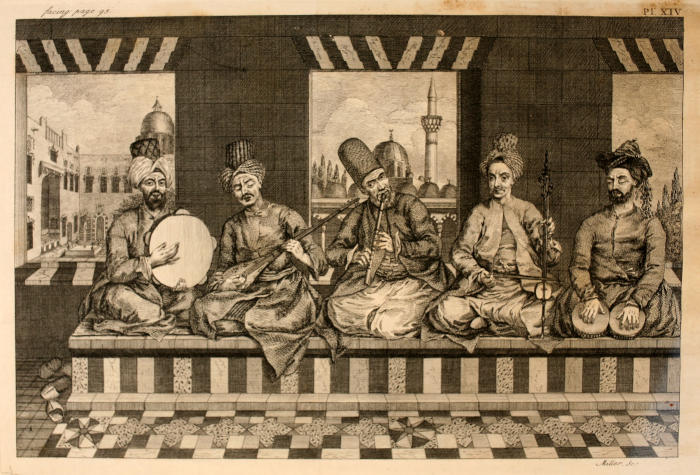
facing page 95. Pl. XIV
Miller Sc:
Though they understand the different measures in music, and have names for them; yet they have no method of writing the notes. They learn entirely by the ear; yet it is observable, that when several persons play together they keep time very exactly. They have neither bass, nor other different parts in music, all playing the same.
The print annexed represents a Turkish concert, drawn from the life; in which care has been taken also to show, through a window, the inner court-yard of a house, with the little garden, fountain, &c. and through another is seen part of a mosque, with the minaret, from whence the imaums call the people to prayers. The dress of the performers also show the different kinds wore by the ordinary people, according to their sect, &c. The first, who beats the diff, represents that of an ordinary Turk; the next a slovenly ordinary Christian; the middle figure is a Dervise; the fourth is a Christian of a middle rank, playing upon the Arab fiddle. What is peculiar in his dress, is, that the sash of the turbant is strip’d with, blue, and his slippers red. The last is an ordinary fellow, beating the small drums with his fingers, as they often do, instead of drumsticks. His head-dress is such as is worn by many Janizaries, and commonly by the Arabgarlees, a race of Armenians, who attend upon the Europeans.
Whatever figure the inhabitants of this country made formerly in literature, they are at present very ignorant. Many bashaws, and even farmers of the customs, and considerable merchants, cannot either read or write. It must be observed, however, that their youth of late years are better taught than formerly; though, even at this time, their education seldom extends farther than just to read a little of the Koran, and write a common letter, except such as are bred to the law or divinity, which are closely allied in this country. The professors of both usually pretend likewise to some skill in physic. In the time I lived there, only one inhabitant of the place understood enough of astronomy to be able to calculate the time of an eclipse; for which he was looked upon as a very extraordinary person. Numbers there are who imagine they understand judicial astrology, in which the natives have great faith: but it would take up too much time even so much as to mention their various superstitions in this and many other respects.