NATIONAL GEOGRAPHIC MAGAZINE. (continued 2)
Reading edition
We can see, from what has been said above, that chances for disagreement in the rendering of geographic names, originating in countries that do not use the Roman alphabet for their literature, are numerous, and hence, the occurrence of errors in the application of a new system should not be too harshly condemned; nor would the culprits deserve to be dealt with according to the law laid down by the municipal council of the good old Swiss town of Küssnacht, which not very long ago issued a decree that the final t in the name of their town should be dropped in all official communications, and that any local official failing to obey this decree should be fined.
MR. BAKER: In the preparation of a map, the last things to go on are the names. If the map covers a region of country long known or thickly settled most of its features already have names. But comparison of several maps of, or writings about, a region almost invariably reveals confusion, contradictions and errors in the names. The same feature often bears different names on different maps. The same name has various spellings, and the names on the map may in their turn not agree with local usage. Examples of this confusion abound everywhere, and are a source of constant perplexity to the geographer.
The names are often misapplied. The name of one cape or mountain peak through accident, carelessness, ignorance, or by intent is often found attached to some other cape or mountain peak. A small feature's name may be extended to cover much more than that to which it fittingly belongs; or a name rightly applicable to a large tract may be wrongly restricted to a small one. In the hands of the map-maker geographic names may be regarded as labels loosely attached and easily misplaced. Handled by many writers, both careful and careless, these labels become misplaced or lost; and in replacing these misplaced labels or in restoring lost ones much confusion and many errors arise. The newspaper writer writing hurriedly, the magazine writer without hurry, or the book writer working deliberately, each in turn finds that the investigation of questions relating to geographic names carries him away from his subject. If a question arises respecting a non-geographic term the dictionary can be appealed to and, right or wrong, followed without discredit. But with many or most of the questions about geographic names, in the United States at least, we have no adequate dictionary or "authority" to appeal to. As a consequence in most cases the writer takes indifferently what is nearest to mind or hand and thus produces new varieties in names, variants upon old ones or quite new ones. Such names are called corrupt until usage and familiarity removes the stigma and the corrupted name having grown respectable is adopted.
A foreign name may be transliterated by one writer and translated by another. This course gives rise to two or more forms. The absence of uniform usage in transliterating, causes diversity in one case, and in the other as several translations are possible, and mistakes probable, various forms arise.
The progress of all science is intimately associated with questions of nomenclature. Modern progress in biologic science dates from the adoption of the binomial system, and it is not too much to expect that progress in geographic science will similarly be found to be intimately associated with a study of geographic names and the principles which should control in their adoption and use.
The object aimed at in these notes is to draw attention to the importance of the subject and to arouse discussion; the purpose of the discussion being to ascertain if there be not certain guiding principles which may serve to aid in solving the numerous and perplexing questions relating to geographic nomenclature.
What is a geographic name? Without attempting a categorical answer to this question I would say that geographic names seem to me to bear a strong resemblance to the names used in biology. They are generic and specific. To designate any specific geographic feature we usually use two words, one a descriptive term, such as river, island, lake, pond or mountain, and the other, a specific name indicating what particular pond, lake, or mountain is designated. The term Mississippi River is a compound name, in which river may be regarded as a part of a proper name. It is the name of a genus, whereas the term Mississippi is the specific designation. Of course it will happen in geographic names, as in biologic, that certain features or objects become so well known that a single name, either the generic or the specific will be used by itself to designate the object. We speak of Maine without prefixing the generic term "State of," the specific name being sufficiently characteristic. On the other hand here in Washington references to "the Avenue" meaning Pennsylvania Avenue are familiar to all. In this case the generic term is used for particular specification. These exceptional usages, however, do not appear to me to invalidate the general principle that the designation of geographic features consists in general of a specific and of a generic name.
The origin of generic terms has been much studied. The origin of specific names has been studied but little and the present notes relate chiefly to this class. Specific names may be said to have two distinct origins, first, those of formal origin where the name has been given pro forma and published in a book or map relating to the region by its discoverer, or by the earliest explorers. This covers the case for a small body of names. Second, there is a very large body of names which appear to have arisen without such formal origin, and to have, as it were, grown up by common consent in the usage of the people of the region.
That which it seems profitable to discuss here, and now, is the principles which should be adopted and followed in the selection of the names which are to go upon the map; principles which will enable one to discriminate when usage is divided, between that which should be adopted and that which should be rejected. To make this clear, a few instances of the peculiar questions which arise may be cited, and then some of the guiding principles stated which it might be possible to adopt and to follow.
The river which flows along the western edge of New York City is locally known as the North River. Shall this be called the North River, or Hudson River, or Hudson's River? And if this geographic name is printed in the text of a book, will you print river with a capital letter or a small letter? It must be borne in mind that this question is asked not for the purpose of immediate or categorical answer, but for the purpose of eliciting thought and discussion upon the principles which should control the answer.
In 1793 Vancouver entered and mapped Port Townsend, which he formally named Port Townshend. At the present time the city situated upon that harbor, as well as the harbor itself, is universally known as Port Townsend, the "h" in the original being omitted. This is a clear and specific case, where the name formally applied by the original explorer is now modified in its orthography by usage. What form of the name shall be adopted? The former or original name or the present modified name? And if the original name is to be adopted, shall we proceed similarly in all cases and go back to the original form?
In the case of names which have undergone transformations through ignorance or through usage, shall an attempt be made to restore the original orthography? Take the case in Missouri of the stream called Bois Brule, or burnt wood, and which has become in the usage of the residents in that part of the world Bob Ruly, and is so spelled in the local publications, and so pronounced in the local usage.
When Champlain sailed along the heel of Cape Cod and discovered the extensive shoals which vex the navigation in those waters, he put upon his chart the statement mal barre, and a number of later maps applied this name to the southernmost point of the heel of Cape Cod as Malabar, and so it stood for 100 years or more as Malabar and may even be found upon some current publications. In the Coast Survey publications it is uniformly called Monomoy.
Again on the north shore of Martha's Vineyard is a place formerly known by the Indian word Kiphiggon. On the modern maps this place is called Cape Higgon. Shall we in this case adopt the practice of the purists and restore the earlier form? In this same locality are four small harbors, called by the sailors Holes; namely Holmes' Hole, Wood's Hole, Robinson's Hole, and Quick's Hole. In current usage, except among seamen, Holmes' Hole has disappeared and been replaced by Vineyard Haven. Wood's hole has been converted into Wood's Holl, though still pronounced hole; while Robinson and Quick still remain holes. In this case shall we attempt to be consistent, or in other words to be uniform?
In the vicinity of New Haven there is a hill occupied many years ago by Coast Survey parties, and called in their records Rabbit Rock. Surveying parties last year in searching for this station inquired diligently in the vicinity and failed to find any information respecting it for some time. The place, however, is well known to all the people for many miles around as Peter's Rock, and this name appears on the county atlas of New Haven, published in 1856. I suppose the name Rabbit Rock has found earlier publication on Coast Survey charts or in its reports, though I have not verified this supposition. But assuming that it has been so published, shall we now call that hill Rabbit Rock or Peter's Rock?
Allegany County, New York, is spelled Allegany. A post office in Sierra County, California, is spelled Alleghany; the city of Allegheny near Pittsburg, Pennsylvania, is spelled Allegheny. Shall these names be allowed to stand unchanged, or should an attempt be made to reduce them all to one form?
In the last century, the place we now know as Sitka was known to the English as Norfolk Sound, to the French as Tchinkitane Bay, and to the Russians as New Archangel. The earliest of these names being Norfolk Sound. Is there any doubt in this case as to the advisability of retaining the name Sitka?
The great sea between Northeastern Asia and Northwestern America, at one time known as the Sea of Kamchatka, and now known as Bering Sea, has been variously written Bhering Sea, Behring Sea, Beering Sea, Bering Sea, as well as all these forms with the addition of the apostrophe "s." I will not ask what is the correct name, as the question in this form seems to imply that there is a correct form, and all other forms are erroneous. The question should rather be, what form is it advisable to adopt with the view, let us hope, of securing its general adoption?
And this leads up to the question of possessives generally in specific geographic names. Many specific geographic names have the possessive form, while many others do not. Is it advisable to attempt to secure uniformity of usage in this regard? I will frankly avow my own conviction which has resulted from more or less consideration and study of the matter to be, that the use of the possessive form should be discouraged and abandoned as far as practicable. While it seems to me unwise to lay down a hard and fast rule, yet there are a very large number of cases in which the possessive form may be dropped to advantage and without, I think, arousing any general opposition to the practice. When the theory held that the King owned all, and geographic features were named for the royal family or for the nobility, the possessive form was very frequently used indicating possession or ownership, and this in cases where such possessive form has now disappeared from the maps. Why should not the possessive form be used to denote possession only? A pond, a hill, a swamp, lying on Smith's land may be properly designated as it often is, as Smith's pond, Smith's hill, etc. But nobody would think of saying Madison's Place, or Washington's Monument. There appears to be a certain principle involved. Those particular features which are of a public character, such as states, counties, towns, streets, parks, etc., which are named for individuals are almost universally named without the possessive form. And this commends itself as a reasonable practice. Without, therefore, cutting off possessives from all names where usage has now fixed them with considerable firmness, there yet remains a considerable body of geographic names in which the possessive form remains, but which are not strongly intrenched in public usage. In such cases it seems to me we may advantageously drop the possessive form. Let us say Donner Lake, not Donner's Lake, Hudson Bay, not Hudson's Bay, James Bay, not James' Bay, Baffin Bay, not Baffin's Bay, etc., etc.
MR. THOMPSON: I hardly know how I came to be brought into this discussion. The Secretary caught me in his net unawares and unprepared. I do not propose to trespass long on your time, nor do I suppose I shall add anything to a philosophical discussion of geographic nomenclature. I only wish to call your attention to a few principles that obviously should be followed in the selection of new geographic names and to show some absurdities and difficulties which are liable to occur if the sentiment in favor of Indian nomenclature is allowed full liberty. A geographic name should be short, euphonic, pronounced as spelled, and have a meaning or express some sentiment to help fix it in the memory. Especially should these principles govern when we consider that in childhood, in our school-days, we obtain by far the greater portion of our geographic knowledge.
The old Spanish explorers followed these rules largely in their geographic nomenclature, and although "Saint" and "Sierra" occur with alarming frequency, there is always some reason for the appellation; either they saw a line of peaks cut the horizon or the christening occurred on the natal day of the holy martyr. "Rio Dolores" and "Las Animas" are certainly better than "Sorrow Creek" or "Soul Wash," and even "Purgatoire"—though the Colorado cow-boy corrupts it into "Picket Wire"—is better than "Cottonwood Creek."
Some Indian names are very expressive, characterizing topographic features. In northern Arizona is a steep volcanic neck or needle, its sharp sides rising in one step twelve hundred feet above the surrounding country. From the base of this pinnacle, two long lava dykes stretch on either hand in a gentle curve across the mesa. The resemblance to the spreading wings of a bird is striking, and the Navajo Indian calls the rock "A-ga-thla"—the "Flying Bird." A name well worthy, it seems to me, of being placed on the maps of that region, as it is on the one I hold in my hand. But on the same map, close along side, is "Te-ze-ba-a-kit Lake," a barbarous appellation—unspellable, unpronounceable and unlovely. Nor can I say less in denunciation of "Zilh-le-ji-ni Mesa"—a name that needs intimate acquaintance with wigwam smoke and Navajo gutturals to handle lingually. But what shall we say of "Boo-koo-dot-klish Cañon;" the Navajo name for what the white man calls with better propriety, it seems to me, for our maps, "Bluestone Wash." "To-go-hol-tas-e Spring" could hardly be worse in English. And here is "Sa-hot-soid-be-azh-e Cañon" (pronounce it as you please or can) sandwiched between "Gothic Wash" and "Gypsum Valley"—one hardly knows which to prefer, Indian or English.
"Cañon del Muerto"—the Cañon of the Dead—so named from the discovery of mummified or rather dessicated Indian bodies in its cliffs—seems very appropriate, but its brother cañon—"Cañon de Chelly," pronounced Cañon de Shay, will be neither spoken nor written correctly.
On this same map are shown two small mesas, crowned with forests and standing beautiful and symmetric in the landscape. They attract attention at once and the Indian, with a fine sense of appropriateness, names them "Son-sa-la"—the "Twin Stars"; another name well worthy of being retained. Some patriotic American has named the deep gorge separating the "Stars" "Washington Pass," a good example of the right name in a wrong place.
The sense of broad humor that often characterizes the Indian leads him to sometimes give the inquirer a name expressive of contempt or bearing a meaning hardly translatable to ears polite—"Nic-doit-so-e Peak" is an example—and I confess, with considerable humiliation, that I was the victim in this case.
I present these instances, Mr. Chairman, to emphasize the necessity of adopting some guiding principles to aid us in the selection of geographic names.
APPENDIX.
RULES FOR THE ORTHOGRAPHY OF GEOGRAPHIC NAMES.
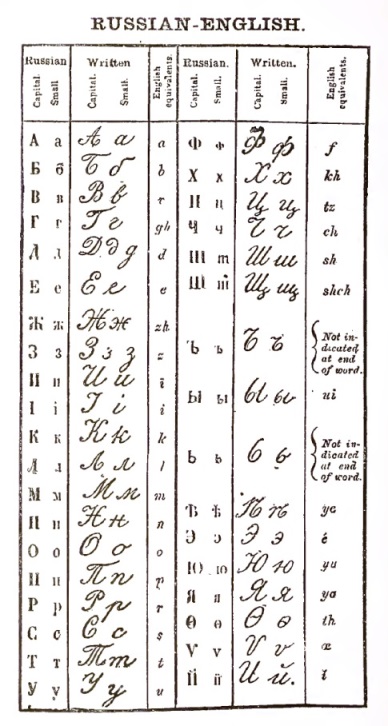
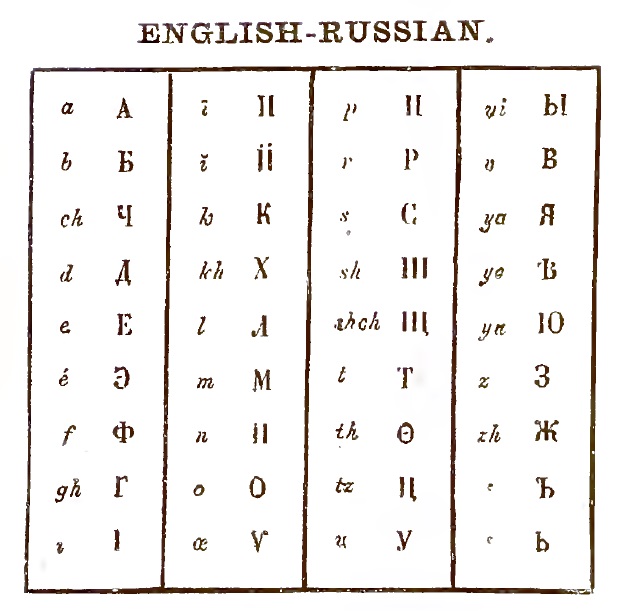
CONTRIBUTED BY MR. HERRLE. British System—French System—German System—Alphabets, Russian-English; English-Russian.
BRITISH SYSTEM.
Rules adopted in 1885, by the Royal Geographical Society at London, for the Orthography of Native Names of Places.
Taking into consideration the present want of a system of geographical orthography, and the consequent confusion and variety that exist in the mode of spelling in English maps, the Council of the Royal Geographical Society have adopted the following rules for such geographical names as are not, in the countries to which they belong, written in the Roman character. These rules are identical with those adopted for the Admiralty charts, and will henceforth be used in all publications of the Society.
1. No change will be made in the orthography of foreign names in countries which use Roman letters: thus Spanish, Portuguese, Dutch, etc., names will be spelt as by the respective nations.
2. Neither will any change be made in the spelling of such names in languages which are not written in Roman character as have become by long usage familiar to English readers: thus Calcutta, Cutch, Celebes, Mecca, etc., will be retained in their present form.
3. The true sound of the word as locally pronounced will be taken as the basis of the spelling.
4. An approximation, however, to the sound is alone aimed at. A system which would attempt to represent the more delicate inflections of sound and accent would be so complicated as only to defeat itself. Those who desire a more accurate pronunciation of the written name must learn it on the spot by a study of local accent and peculiarities.
5. The broad features of the system are that vowels are pronounced as in Italian and consonants as in English.
6. One accent only is used, the acute, to denote the syllable on which stress is laid. This is very important, as the sounds of many names are entirely altered by the misplacement of this "stress."
7. Every letter is pronounced. When two vowels come together, each one is sounded, though the result, when spoken quickly, is sometimes scarcely to be distinguished from a single sound, as in ai, au, ei.
8. Indian names are accepted as spelt in Hunter's Gazetteer.
The amplification of the rules is given below:—
Letters. Pronunciation and Remarks. Examples.
a ah, a as in father Java, Banána, Somáli, Bari.
e eh, e as in benefit Tel-el-Kebír, Oléleh, Yezo, Medina, Levúka, Peru.
i English e; i as in ravine; the sound of ee in beet. Thus, not Feejee, but Fiji, Hindi.
o o as in mote Tokio.
u long u as in flute; the sound of oo in boot. Thus, not Zooloo, but Zulu, Sumatra.
All vowels are shortened in sound by doubling the following consonant. Yarra, Tanna, Mecca, Jidda, Bonny.
Doubling of a vowel is only necessary where there is a distinct repetition of the single sound. Nuulúa, Oosima.
ai English i as in ice Shanghai.
au ow as in how. Thus, not Foochow, but Fuchau.
ao is slightly different from above Macao.
ei is the sound of the two Italian vowels, but is frequently slurred over, when it is scarcely to be distinguished from ey in the English they. Beirút, Beilúl.
b English b.
c is always soft, but is so nearly the sound of s that it should be seldom used. If Celebes were not already recognized it would be written Selebes. Celebes.
ch is always soft as in church Chingchin.
d English d.
f English f. ph should not be used for the sound of f. Thus, not Haiphong, but Haifong, Nafa.
g is always hard. (Soft g is given by j) Galápagos.
h is always pronounced when inserted.
j English j. Dj should never be put for this sound. Japan, Jinchuen.
k English k. It should always be put for the hard c. Thus, not Corea, but Korea.
kh The Oriental guttural Khan.
gh is another guttural, as in the Turkish Dagh, Ghazi.
l m n As in English.
ng has two separate sounds, the one hard as in the English word finger, the other as in singer. As these two sounds are rarely employed in the same locality, no attempt is made to distinguish between them.
p As in English.
q should never be employed; qu is given as kw Kwangtung.
r s t v As in English.
w As in English. Sawákin.
x As in English.
y is always a consonant, as in yard, and therefore should never be used as a terminal, i or e being substituted. Thus, not Mikindány, but not Kwaly, but Kikúyu. Mikindáni. Kwale.
z English z. Zulu.
Accents should not generally be used, but where there is a very decided emphatic syllable or stress, which affects the sound of the word, it should be marked by an acute accent. Tongatábu, Galápagos, Paláwan, Saráwak.
FRENCH SYSTEM.
Rules adopted in April, 1886, by the Société de Géographie at Paris, for the orthography of native names of places.
The geographic names in countries in which the Roman character is employed in writing (which includes the néo-Latin, Germanic, and Scandinavian languages) shall be written in the orthography of the country to which they belong.
The following rules apply solely to geographic names in countries without a written language, and to geographic names in countries where another than the Roman character is employed in writing.
Names of places for which the orthography, through long usage, has become consecrated shall, however, be excepted from the rules. Examples: La Mecque, Naples, Calcutta.
The rules in detail are:
1. The vowels a, e, i, and o are pronounced as in French, Spanish, Italian, and German. The letter e shall never be mute.
2. The French sound of u shall be represented by u with a tréma like the German ü.
3. The French sound ou shall be represented by u, as in Italian, Spanish, and German.
4. The French sound eu shall be represented by the character oe [ligated] and be pronounced as in oeil.
5. The lengthening of a vowel sound shall be indicated by the 'accent circonflexe' (^), and the shortening by an 'apostrophe' (').
6. The consonants b, d, f, j, k, l, m, n, p, q, r, t, v, and z are pronounced as in French.
7. g and s have always the hard French sound, as in gamelle, sirop.
8. The sound represented in France by ch shall be written sh. Examples: Kashgar, Shérif.
9. Kh represents the strong and gh the soft Arabic guttural.
10. Th shall represent the articulation in the English word path (Greek theta), and dh the sound of th in the English word those (Greek delta).
11. Unless the letter h is employed to modify the sound of the letter preceding it, it shall always be aspirated; it should, therefore, never have an apostrophe in names beginning with it.
12. The i semi-vowel shall be represented by an y, pronounced as in yole.
13. The semi-vowel w is to be pronounced as in the English word Williams.
14. The double sounds dj, tch, ts shall be written with the letters which represent the sounds of which they are composed. Example: Matshim.
15. The ñ, n with a tilde, is to be pronounced like gn in seigneur.
16. The letters x, c, and q are not to be employed as duplicates, but the letter q may serve to represent the Arabian qaf, and the aïn could be represented by a double dot.
The idea is to indicate, by means of the characters above given as near as possible the local pronunciation without attempting a complete reproduction of all sounds heard.
GERMAN SYSTEM.
Rules adopted in 1888 by the Imperial German Hydrographic Office, for the orthography and pronunciation of foreign geographic names.
The names from nations who use the Roman or German alphabet are to be rendered in the native form, excepting such for which a German orthography has been generally adopted, as Kopenhagen, Neapel, Genna, etc. Other foreign names which are generally known and whose orthography has been generally adopted, as Zanzibar, not Sansibar; Zulu, not Sulu, will not be changed.
The letters are pronounced as follows:
a, as a in Vater.
å, between a and o (Åland's Inseln).
e, as in Eden.
i, as in Ida.
o, as in Brot.
u, as in nur.
ä, (æ, Ae) retain their German sounds.
ö, (oe, Oe) retain their German sounds.
ü, (ue, Ue) retain their German sounds.
ai, as in Kaiser.
au, as in auch.
ao, not quite as one sound.
ei, as in Ei.
b, d, g, h, j, k, l, m, n, p, r, s, t, w, x and z retain their German sounds.
f, retains its German sound; also for ph, but the latter will not be used.
c, always soft (as z). For the sound of k, c is not to be used.
j [with umlaut], for the English j (dj).
q, will not be used; it is replaced by k; respectively by ku.
ch, as tsch.
sh, as sch.
y, is only used for the consonantal sound, not for i.
gh, oriental guttural sound (Dagh, Ghazi).
kh, oriental guttural sound (Khan).
v, is always soft; not to be used to give the sound of f.
When a vowel is to be pronounced clear and open the following consonant will be doubled: (Tanna, Mekka, Bonny). To lengthen a vowel sound, it will not be doubled, but if the vowel is repeated each will be pronounced separately (Nuuluha, Oosima).
But one accent (') will be used to indicate if particularly necessary, that is, in exceptional cases, the syllable on which stress is to be laid (Matupí).