V. COMPLEXITIES AND PRIORITIES
Reading edition
A river basin is a good functional unit of topography, admirably suited for study and for certain types of resource planning. Because of this, there is a temptation for those who undertake such study and planning to assume that river basins have, or ought to have, human unity as well—unity in politics, economics, and culture—with a consequent "basin public" inclined to think in basin terms. Basin identity of this sort would facilitate conservation, development, and management. It would "make sense," and clearly enough a a great deal of sense needs to be made, and soon, if people are going to have any hope of balancing their use of resources against the inevitable continuing requirements of the long future.
Small watersheds often do have unity of this human sort, but very few major river basins. And usually the question of whether they ought ideally to have it or not becomes irrelevant in the face of the rock-hard reality of the forces working against it. In the Potomac Basin, the boundaries that ramble among the various political subdivisions—the District of Columbia and portions of four separate States, with all or part of some 39 counties and a number of independent cities—only accidentally and occasionally follow watershed ridges. More often they reflect the caprice of Stuart kings and Fairfax lords, the accidents of history, the fortunes of war, and the trampings of young George Washington and the Messrs. Mason and Dixon and hundreds of less renowned linemakers. These boundaries, some of them sanctified by centuries of existence, are one of the Basin's most fundamental sets of facts, creating genuine differences in the interests, activities, viewpoints, and even accents of the people. And they emphasize a healthy political diversity and complexity that in many ways is simply not amenable to change.
None of the capitals of the four Basin States lies within the Basin's limits. This means that some of the strongest political loyalties and energies of the region are directed outward toward Richmond and Annapolis and Charleston and Harrisburg, and that much action relating to the Potomac must be sought in those cities, or is decided on incidentally there by legislators, many of whose strongest interests may lie along the James or the Susquehanna or the Ohio or other streams.
The fact that the capital of the United States, together with its attendant metropolis, is located solidly within the Basin at the Fall Line is of immense if problematic significance. For one thing, it fosters a concentrated Federal interest in the Potomac and the Potomac region, in both esthetic and utilitarian terms and at both legislative and administrative levels, which have led to some special amenities in the way of parks and such things and to some Federal efforts to treat the river in "model" terms, however these terms may have been defined at various points. On the other hand, it has also led to a special concern with the river on the part of the almost innumerable interest groups that possess leverage in Washington, from wilderness conservationists to industrial lobbyists, who exercise pulls in a number of different directions.
And the presence of the capital has set up other special currents of influence and sympathy that bypass normal political channels. Many Basin towns and counties look more toward Washington for certain kinds of action than toward their State agencies and legislatures. Federal programs have long been active here close to the main-office sources of expertise and cash, building up respect and trust through local agents, and Basin Congressmen who hardly have to leave home to exercise their legislative function have further strengthened these ties.
The metropolitan jurisdictions, especially, in many ways find more common cause with one another and the Federal Government than with communities and governing bodies elsewhere in their own States. Politically, this sense of collective identity gets official expression in the Metropolitan Washington Council of Governments, a regional body which, like its counterparts in other urban conglomerations throughout the country, is geared to work directly with the Federal Government in dealing with its own regional problems rather than having to come at Federal programs and agencies along the more lengthy traditional route through the States. The implications of this new kind of alignment are still a matter for debate and conjecture.
Other forces at work along the Potomac similarly have less to do with boundary lines, drainage limits, or Basin thinking than with human ways of being. There are a number of kinds of country here, as we have seen, in various stages of development and with various sorts of people inhabiting them. Yeoman tillers of the Shenandoah's limestone soils may find scant occasion to identify their interests with those of the Washington slums, or even with those of the fox-hunting Piedmont gentry just across the Blue Ridge. Coalmining Potomac Appalachia has more common economic and cultural outlook with eastern Kentucky than with the Potomac Tidewater; southern Maryland and the Northern Neck and the Monocacy's dairy farmers all have their own ways of interpreting human existence and defending themselves against its pitfalls. Within the county governments and the Congressional and State-legislative districts, these local and regional viewpoints choose political leaders who joust for them in higher arenas, often aligning there with forces from outside the Basin. Hence a metropolitan Maryland Congressman may vote in the House with kindred souls from Long Island and Pasadena, and his Basin colleagues with agricultural constituencies may oppose him on some issues in alliance with representatives from Wyoming or Arkansas.
Despite the Basin's special ties to the Federal Government, many rural Basinites are suspicious of Washington and the metropolis, often out of a traditional distrust of "big government" and sometimes because they see the accumulation of city folk at the head of the estuary as a menace to rural modes of existence. Thus they may oppose water projects designed to help the metropolis, or recreational development that threatens to bring down on them large numbers of pleasure-bound outsiders, though local businessmen's hope for a boom sometimes offsets such opposition. The reapportionment of legislative districts now in progress, plus the growing political muscle of metropolitan areas, is probably going to cut down on the power of rural areas and rural viewpoints—though just how much and in what way no one is yet sure. Some prophets claim that these influences are going to erode rural influence utterly; others that they will merely shape an alliance between middle-class suburbs and rural areas against the beleaguered central cities with their slums and other huge specific problems.
Worth noting also is the fact that many erstwhile "rural areas" are getting less rural by the year. With population pressures and industry and pollution and looming water deficits, they have more and more in common with the Washington metropolis, and more need for "big government" programs. In the long run, an overwhelming majority of the Basin's future population will probably be city-dwellers, with a consequent effect on general attitudes toward Basin planning and projects—though exactly what effect is not at all certain.
Public attitudes toward environmental action
One reason it is not certain is that the average person's set of attitudes toward the world around him is not totally determined by the circumstances of his life—by whether he is a city-dweller or a farmer or a small townsman, an engineer or a poet or a hardware salesman or a factory worker. Southern or Northern, black or white, poor or rich or pleasantly salaried. These things have great weight in coloring people's attitudes, but so do individual tastes and individual ways of interpreting the fact and ideas that flood in upon all of us these days. And so also do the vast and shifting currents of emotional and philosophical response that sway our society in one direction or another from year to year, from decade to decade.
In relation to the environment, certain differing philosophical currents of this kind have surfaced to view at various points in this report, if only briefly. They have influenced the fate of past proposals for dealing with the Potomac river system and landscape, and they are still here to continue exerting influence. In individual citizens' minds, they often mix and balance with one another in various ways, but they are discernible as separate forces.
Stout among them is the traditional American—and human—view that the natural world exists for the primary purpose of bettering the lot of such human beings or groups of human beings as may have the ingenuity and the vigor to extract its treasures or to adapt it to their use. Quite often the activities for which this view provides justification are exploitative—they use up natural resources or they bring about other irreversible changes in the world roundabout. Some conservationists think this makes them automatically evil, but things are not quite that simple. Such exploitative activities have led our species the full length of the road from the Stone Age to the sophisticated and powerful technological civilization of present times. The idea that we have a full right to engage in them is deeply ingrained, particularly in this country whose memories of the frontier—a hardy, exultant line of subjugation and exploitation moving across the virgin continent—are not remote but fresh.

Certainly in its crasser manifestations—this utilitarian philosophy has widely destructive effects nowadays. Strip mines gouged out without thought of restoration, wanton land speculation and development, the casual dumping of raw wastes into streams by towns or industries and a number of other harmful practices mentioned in this report are all clearly based in a conviction that what one does to the world around him is his own sweet business. That conviction has longstanding sanctity among Americans and many who hold it are moral and upstanding folk. But in a world as heavily populated as this one, possessed of such augmented technological ability to assail and exploit the natural world, there is clearly something wrong with it.
Other exploitative human activity based in utilitarianism is not crass or all so obviously wrong, especially in today's context. Population growth poses a moral question but also a logistical one: uncontrolled growth may well be questionable, but it is a staggering reality. The additional millions of people thus invited to present and future feasts must be provided for. Many thinkers view the economic expansionism of our time, together with the vigorous technology which it fosters and is fostered by, as the only means toward this end. Some, indeed, view it as a happy and healthy state of things, indefinitely extensible as technology itself furnishes substitutes for exhausted natural substances, natural forces, and natural experiences.
Allied to this view is a sturdy and widely held American belief that "development" of natural resources is automatically a good thing regardless of the need—toning up the economy of a region or a state or a nation, keeping things moving. Most people give it some practical support, even those who in theory suspect its validity. For we are a moving people. We have known little stasis in the centuries of our presence on this continent, and each generation of us is imbued anew in childhood with certain axiomatic ideas; movement is forward, growth is up, construction is better than vacancy, not to make economic use of something is to waste it. These ideas linger in our reactions: "You can't," the saying goes, "stand in the way of progress."
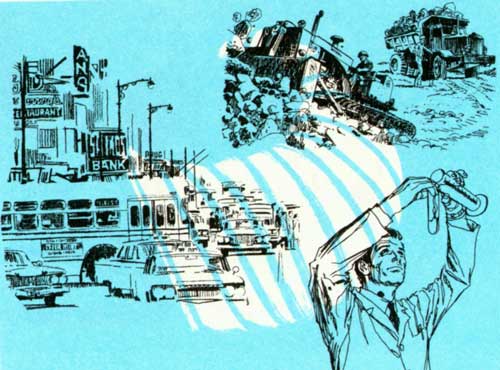
Certain other philosophers, growing in numbers these days, say emphatically that you can and should. These are the history-minded people, the wilderness folk, the nature traditionalists, and the others whose main concern is that man and the pleasant world around him have lost all semblance of a balanced relationship with each other, and whose view of the sturdy plunderlust of our ancestors is that our inheritance of it, combined with the technology of bulldozers, is aiming us straight toward a world in which our own structures and destructions may be all there is to see, our own fumes and sewage all there is to smell, our own voices and machines all there is to hear. Some people of this stamp are quietly pessimistic; others actively commit themselves to fight. Some who fight see present human growth and the growth of human demands on resources as the stark unavoidable realities they are, and seek mainly to guide them and mitigate their effects. Others stiffen their necks against development to meet those demands, staunch enemies to all reservoirs and other forms of compromise, stubborn if highminded nay-sayers against the tide, consistent even when illogical.
Taken as a whole, however, these people with a sense of the imponderable human value of natural ways and natural things may constitute the most powerful support available for thoughtful planning and conservation. In a precipitate and voracious society plunging on into its future, they look back and seek to retain the best of what has always been, for conservationism at least in this sense is conservatism too. Upon their increase in numbers, in broad understanding and in political forcefulness, upon the arrival of their basic values at a point of publicly accepted respectability at least equal to that presently enjoyed by time-hallowed exploitation and the profit motive, hope for a decent future must heavily depend.
All of these ways of looking at man's problematical relationship with the crust of the planet he inhabits, plus a number of others, are at work within the minds of conscious people in this region and in the great cauldron of its politics. Here they mingle with State and regional and local loyalties and private self-interests into a fine American soup of eagerness and reluctance, faith and apprehension, awareness and befuddlement, chicanery and square dealing, altruism and frank greed, rage and reasonableness, that is as real as any mountain in the Basin and as inevitable a consideration for realistic planning as the river's own characteristics of flow. For any proposal or set of proposals for action in the Basin that does not take into account what the Basin's people are like, and how their idiosyncrasies and preferences and sympathies find political expression, is foredoomed to failure, be it ever so ideal in anyone's abstract terms.
Pecuniary matters
Then there is money. Restoration and protection of the scheme of things and its adjustment to needful human use, on the scale we are considering in the Potomac Basin, is expensive, often involving many millions of dollars for action against only one phase of deterioration or threat or shortage. In accordance with the breadth of overall aims, much of this money must be Federal. Where benefits or responsibilities are clear, as in relation to sewage treatment plants and sources of water supply, states or communities or institutions usually pay a share. If Federal policies regarding flood protection and river flow augmentation for pollution control are made more logical in the ways sketched earlier in this report—as seems likely—such sharing will increase. Private investment or philanthropy may often play a part, as in the purchase of municipal bonds, the donation of scenic property for public use, or—a hopeful trend of recent date—a private organization's use of its money to facilitate high public purposes. The main example of this last service on the Potomac is the recent purchase and interim retention of important wildlife and park lands on Mason Neck by the Nature Conservancy, for later resale without profit to public agencies when needed authorizations and funds have been obtained.
Nevertheless, most such projects do have a public purpose with diffuse benefits, and sooner or later most of their cost has to be paid out of public dollars deriving from collected local, State and Federal taxes. Sometimes it is dispensed through Federal grant programs created by Congress to meet pressing needs, or from other special sources fitting the occasion. More often it must be sought in the standard established manner: concrete proposals for action shaped and presented, with a computation of the cost and the value of expected benefits, to Congress, State legislatures, or local governments for examination and authorization, and funds or bond issues later voted for carrying them out.
The cash available for both regular programs and special proposals from year-to-year will vary according to the state of the economy, the number and severity of other demands on government budgets, and their relative apparent urgency. This imposes on planners not only an obligation to make sure that what they propose has public value that fully justifies its price, but also a need to gear immediate priorities and projects realistically to the amount of money there is some hope of getting for them. It is an unhappy fact that there is often less than no point in presenting even fine proposals for legislative consideration at a financially inappropriate point in history. Once defeated, whatever the reason, they may forever languish in limbo.
At this particular point in history, this country has been for some time involved in a tough, costly conflict in Southeast Asia which inexorably absorbs much of the available Federal money. Americans are a rich people, riding a wave of prosperity, and much is left over for other things. But in this turbulent and questing era, they also have a good many other urgent and expensive problems and projects on their hands besides those dealing directly with natural resources and conservation. The problems are familiar words on the front pages of newspapers and in evening conversations: poverty, urban crisis, transportation, national defense, public health, world hunger and unrest, space exploration, schools, and the rest. All cost hugely. And, though individual conservation proposals of clearly critical importance most often receive fair and full consideration, one or two or more of these other realms for action usually loom larger to the eye of the public and the Congress than do environmental programs in general. Therefore they get first shot at the funds available for spending year by year.
Most people have a bias in favor of their own chosen field of interest. To some, the right use of the natural earthly framework of things matters supremely. They tend toward a conviction that sooner or later it will stand very high on any list of priorities for spending, as the magnitude of what is being lost and diminished is borne in on the consciousness of the general public. Yet, as of now, it faces heavy competition for limited funds, and this is another reality for consideration, as solid for the moment as the Basin's physical problems, as solid as the politics of which it is a facet.
The implications of complexity
These are not the only uncertainties and complexities that confront anyone who would act toward restoring and preserving the waters and landscapes of the Potomac and making them serve man, but some of the more specific and potent ones not dealt with earlier in this report. Others have been discussed in former chapters or at least have received cursory mention. Among them are water technology's state of flux that offers a strong if hazily defined hope of being able to do things better and better as time passes; the need for more and better data; the problems for which workable solutions simply do not yet exist; the inequities or inconsistencies created by certain present Federal water policies; the dubiousness inherent in forecasts of future human pressures and problems; the frequently crossed purposes of high agencies regarding environmental action; the difficulty of feeding true esthetic and recreational values into cost-benefit computations; and the paralytic tangle of motives and loyalties in regard to planning at the local level. And a great many others could be found.
Taken all together and linked to the assumption—fundamental in this report—that the Potomac and its landscape deserve rescue and coordinated right use, these areas of doubt, changefulness, and difficulty add up to a strong body of argument for flexible continuing planning on a Basinwide scale and for a specific, authoritative Potomac Basin institution to guide it and put it into effect.
There are two main alternatives to such flexible planning and coordination and they both, under present and probably future conditions, point toward slightly modified chaos. The first would be to allow going or incipient Federal and State programs for water quality improvement and erosion control and such things to take their overall course, while water supply, landscape protection, and other problems are dealt with in the traditional, piecemeal, localized manner as conditions here and there become bad and force action, or as "fall-out" from non-Basin programs takes casual effect. This relinquishment of coordination would make the task of clean-up immensely harder and less effective in the long run, and it would turn over most of the Basin's unprotected scenic amenities to exploitation on the basis of their short-term utility and the profit they could be made to yield.
The second alternative would be to shape a rigid overall plan for the Basin prescribing definite solutions, feasible in terms of tried and true technology, for all its problems that exist today and are expected to materialize in the future, and then to seek authorization and funds to put the plan into effect. This procedure has disadvantages already noted in detail in this report. It makes large irreversible decisions that future generations, stuck with the results, may find less than totally attractive, especially since they very probably will have better ways of doing things. It pins itself to fallible assumptions about those future generations, and must be formed in terms of present laws and policies, which are not always ideal. Physically, a plan of this kind could be worked out that would function with reasonable efficiency, at least in water matters, for there is nothing primitive about today's technology. But esthetically it would leave much to be desired even by present standards, and politically, furthermore, its very wholeness and rigidity would mean that it would have to be sold as a complete package or else be doomed to fragmentation, which would lead to much the same sort of piecemeal expedient development as no plan at all. Quite aside from the budgetary difficulties of the moment, the Potomac Basin's political complexity makes whole acceptance and implementation of such a plan extremely doubtful.
The question of an agency
If flexible coordinative planning's advantages for a place like the Potomac Basin are recognized, and it is accepted as the most reasonable and hopeful way to approach problems there, the question arises as to what kind of agency is best suited to carry it forward and to act on it. Besides certain unique agencies like the Tennessee Valley Authority several types of institutions are available that can be oriented toward a whole interstate river basin.
An interstate compact is a detailed agreement between two or more States to act toward a common specific goal. It needs the approval of Congress, but the Federal government usually takes no formal part in the compact commission's activities, nor are Federal activities in the basin subject to compact commission control. A Federal-interstate compact, on the other hand, does have Federal participation and provides for some limitation on Federal freedom to act on basin problems without compact commission consent. Compact commissions under either of these types of agreement can have wide or quite limited powers in regard to planning, construction, management, and such things, depending on the specific agreement itself.
Two kinds of Federally-directed bodies with primary emphasis on planning are in operation in various river basins. A Title II river basin commission, as defined in the Water Resources Planning Act of 1965, is formed by the President to carry out comprehensive basin planning, with a Federal chairman and members from Federal agencies, Basin States, and approved interstate or international agencies with jurisdiction in the Basin. A Basin inter-agency committee is created by agreement among Federal agencies for an assigned mission, usually the coordination of Federal and State planning through the exchange of information about programs and projects.
The main work of the Federal Interdepartmental Task Force on the Potomac has been done at the same time that the new Water Resources Council has been studying out its powers and putting them to use. Formed before the Water Resources Council, the Task Force was assembled as a unique entity rather than as one of the categories of Federal planning organizations mentioned above. But, having been shaped after a directive from the President and having worked in cooperation with the Basin States' Governors' Advisory Committee, the Task Force together with that Advisory Committee has been exercising some of the main functions of a Title II river basin commission. These commissions can plan flexibly, in stages, if this is desirable. They make recommendations for comprehensive development which can quite compatibly be implemented by a separate basin management authority, perhaps of a type recommended by the commission.
In these terms, the water-related recommendations that accompany this Interior Department report, which have been concurred in by the other Federal agencies on the Task Force and by the Governors' Potomac River Basin Advisory Committee, can be considered a first stage in a new approach to comprehensive planning for the Potomac. Hence it is time not only to undertake these recommended initial actions toward the balanced development and preservation of the Basin, but also to consider an agency or agencies to take over such coordinative planning, management, and operation as may be necessary. From the start, it has been recognized that a long-term management agency was going to be desirable, and we have been inquiring toward its definition. From the start also, it has seemed obvious that some form of Federal-interstate compact offered the most promise, for various reasons.
The direct and special interest of the Federal government in the Basin is extensive, and clearly justifies continuing Federal participation in any planning and development. On the other hand, to invest all or most management authority for such a politically complex region in Federal hands would ignore certain powerful realities, and would throw away a chance to achieve the most meaningful kind of "creative Federalism." The Basin States have shown strong willingness to take on responsibility and authority in relation to the Basin's problems and to cooperate with one another and with the Federal government toward their solution. An organization based in such cooperation could cut through much of the Basin's tangle of jurisdictions involved and to each of them individually, and would be responsible to each and all. It could mesh the efforts of the numerous and diverse action agencies sponsored by each jurisdiction and aim them toward overall Basin goals, probably more effectively than any other arrangement could.
Early in this planning effort, primary responsibility for inquiring into the desirable characteristics of such an agency was allotted to the Governors' Advisory Committee. After over two years' hard work by a subcommittee, the Advisory Committee has lately made public the preliminary draft of a Potomac River Basin Compact. It proposes a compact commission with broad power and responsibilities to adopt and maintain comprehensive plans for water resources and amenities, and to acquire, construct and operate facilities related to water problems and use, watershed management, and recreation. It would be financed by government and private funds, could issue bonds, would absorb INCOPOT, and would consist of six members—one each from the four Basin States, the District of Columbia, and the Federal Government.
The draft compact is currently being discussed at public hearings scheduled in various parts of the Basin, and is under review by the Water Resources Council. Undoubtedly it will be altered somewhat during these processes, and it will very possibly undergo further alteration at the hands of the State legislatures and the Congress, which will have to review and approve it before the agency it proposes can be created. All of this will take a good deal of time. The detailed features of the institution that may emerge cannot be precisely known at this point, and a specific Federal recommendation for its establishment is not yet possible. Nonetheless, the compact draft's essential principles—adequate authority, accepted responsibility, and protection of the interests of the participant jurisdictions while moving toward coordinated Basinwide accomplishment—are sound and needful ones, and offer the best kind of hope of implementing and continuing the sort of flexible, coordinated planning and action that we have advocated in this report.
The members of the Potomac Planning Task Force, the A.I.A. group, in their recently published independent report, have made a strong recommendation for a new type of Federal institution, a Potomac Development Foundation, which would be headed by a Presidentially appointed administrator and would have a planning staff and a top-caliber professional advisory board. It would not engage in construction, operation, or management of projects, but would be liberally financed over a period of five years out of Federal funds and would emerge as a self-sustaining agency with power to assist in Basin planning, to acquire land, to make grants for various purposes, and to sponsor appropriate development of the Basin's resources with low-interest loans. With a strong orientation toward ecological values, scenic preservation, architectural amenity, and recreation, it would emphasize a long-range approach to coordinated Basin planning.
A Development Foundation of this kind would obviously harmonize with the main principles enunciated in this present report. It is also envisioned by the A.I.A. group as compatible with a compact commission or other management agency, though they have recognized that the relationship between the two would need to be studied out at length.
The proposal is a bold one and an appealing one, with much promise, particularly in its potential for giving full weight to ecology and the amenities in planning. We are hopeful that its basic idea will get serious consideration during the period of institutional study and review that is coming up.
In the period before permanent planning and management machinery for the Potomac materializes, the Basin will get much protection against major disruptive change through the continuing interest of Federal and State agencies made aware of its problems during this first-stage planning effort, through improvement and preservation programs already in movement or initiated by this report, and perhaps most of all through aroused and informed public interest. There is room for a broadly based citizens' watchdog organization to keep tabs on Basin affairs and to exert leverage in such critical fields as local planning. It might be formed as a new group or might be built around an existing organization such as the new Potomac Basin Center, whose function has been to comment impartially and intelligently on Basin planning and prospects.
Action now
In the different chapters of this report, various things stand out that need to be started quickly, either to satisfy looming demands for water development and water quality control, or to restore or protect scenic, ecological, and recreational assets which, if not attended to quite soon, are going to either disappear or suffer irreparable damage. A few recommendations for action on certain of these immediate problems were made in our Interim Report of two years ago, together with recommendation on one or two noncontroversial items clearly not in conflict with any conceivable ultimate Basin aims. In abbreviated essence, the main Interim recommendations, made with Interdepartmental Task Force and Interstate Advisory Committee approval, were as follows:
(1) That a decision on the construction of Seneca dam and reservoir on the Potomac main stem be indefinitely deferred, but that the site be preserved as much as possible against further encroachment, in case it is ever needed;
(2) That three relatively small reservoirs be built on tributary creeks in the Paw Paw Bends area of the upper Basin, in addition to the authorized Bloomington reservoir on the North Branch, to begin providing a safe margin of water for metropolitan Washington and to serve Basin recreational needs;
(3) That a permanent "green sheath" of protection for the Potomac main stem, together with major recreational opportunity, be assured by means of a new kind of composite park of varying width along both shores from Washington, D.C., to Cumberland, Maryland;
(4) That the Cacapon River and the West Virginia portion of the Shenandoah be given Wild River status by Congress to protect their shores against excessive and inappropriate encroachment;
(5) That water quality programs and research be accelerated toward certain minimum goals;
(6) That Soil Conservation Service and related Forest Service programs for erosion control, water management and development, and recreation benefits be accelerated;
(7) That the authorized boundaries of the George Washington National Forest be extended to provide public access to and protection of the two forks of the Shenandoah above their confluence;
(8) That Mason Neck on the upper estuary be preserved; and
(9) That the George Washington Memorial Parkway be extended from Mount Vernon to Yorktown as the beginning of a system of scenic roads and parkways in and around the Basin.
One of the recommendations has had to be deferred, though the need implicit in it remains acute—that the Cacapon and the West Virginia Shenandoah be included in the Wild Rivers Bill then pending before Congress. It had been thought that this Bill might be used to protect the Basin's threatened main tributary rivers, beginning with these two in West Virginia, but afterward doubt arose that the standards set up for Wild Rivers—the primary point of reference being Western streams flowing through sparsely peopled, often publicly owned country—would make sense or be feasible in a settled region.
Mason Neck has been preserved by great effort on the part of individuals, organizations, and different levels of government. More remains to be done in the way of consolidation of what is there and its adaptation to intended purposes, but the hardest part of the job is accomplished; a critically endangered asset has been protected. Funds have been voted by Congress for the acquisition of the Bloomington reservoir site in accordance with the Interim recommendation. Water quality improvement in the Basin is on the point of being significantly accelerated toward high goals, as the new State standards are reviewed and approved and start getting enforcement, though for specific trouble spots and categories of pollution special Federal or other action is going to be needed and is the subject of new recommendations accompanying this final report.
The rest of the Interim Report measures require Congressional action, which none has yet received. In some cases this is because technically detailed authorizing legislation has taken time to prepare, in others because budgetary or policy realities have brought delay or reconsideration, and in still others because of a feeling at higher levels that certain recommendations could be better evaluated in terms of a final report's whole set of proposals. In the present set of recommendations they are repeated, for they represent genuine needs. Some have been slightly altered in the light of evolving restrictive reality, more recent knowledge, or flexibility, and the suggested or implied Interim scheduling for some has been changed. It is no longer envisioned, for instance, that the parkway extension below Mount Vernon will be authorized and constructed quickly.
The present recommendations, though much wider in overall scope than our earlier ones, represent only a first step in planning for the Basin, for reasons presented in full in this report. They are attuned to present economic and technological possibilities, as they must be. We believe that if they get full and calm appraisal they will prove to be acceptable politically, for all of them that call for major projects represent solutions for acute and imminent problems for which other satisfactory solutions do not presently exist, and to the greatest possible degree they have been made flexible to accommodate possible future change in aims or techniques.
In most cases, the reasons for specific recommendations have already been given in the body of this report. However, the primary public interest that focuses on the matter of major storage reservoirs may make it worthwhile at this point to review and enlarge upon the facts. Some reservoirs are going to have to be built if the Basin is to cope satisfactorily with water supply, water quality, and recreational demands. At the time of the Interim Report, we recognized that the three reservoirs in the Paw Paw Bends area, together with Bloomington, were very possibly not going to be enough to meet the need, but we made a recommendation for their authorization because it was clear that they would take the edge off the immediately looming water problem at Washington, would mesh well with any additional future storage in the Basin, and would have no major disruptive scenic effects but instead would provide a great deal of high-quality flat-water recreation in an area where there was significant demand for it.
These considerations still apply. However, the more complete picture of Basin water problems that has emerged in our studies since the Interim Report shows that at least two more reservoirs are very possibly going to be needed, and that the most useful scheduling of initial projects will combine an answer for upstream problems with the satisfaction of near-future needs at metropolitan Washington.
Besides the stretch of concentrated industry and population along the North Branch, where Bloomington Reservoir is going to be needed as soon as possible, three upper-Basin areas with major storage sites available near at hand are faced with large water shortages in the near or middle future, and have streams that would benefit greatly from flow augmentation. In the order of the critical importance of their problems, they are Frederick, Maryland, on the Monocacy; Chambersburg, Pennsylvania, on the Conococheague Creek; and the Staunton-Waynesboro area on the upper tributaries of the Shenandoah's South Fork, in Virginia.
Chambersburg lies in an area where opposition to any major reservoirs has been heavy. An interim solution to the local problem, though possibly not satisfactory in the long run, can be found in a system of small headwater reservoirs. The major Chambersburg reservoir site has received full consideration as an element in a water-storage package to begin dealing with Basin demands. But its immediate advantages are not so unique as to justify going against the area's apparent wishes, and it has not been included as a recommendation.
The reservoirs at Verona near Staunton and at Sixes Bridge on the Monocacy, fortunately, can be adequately coordinated with Bloomington and the three Paw Paw impoundments to provide roughly a twenty-year margin of safety in water supply at Washington, besides coping with foreseeable shortages in their immediate neighborhoods, furnishing desired flat-water recreation, and contributing greatly to water quality and recreation benefits downstream. They are also locally and State supported. For these reasons, they have been chosen to fill out the recommended system of major reservoirs to meet near-future Basin demands.
The construction schedule recommended is based on the rate at which upstream and metropolitan demands are expected to develop in relation to each other. And, in accordance with flexible principles of planning, there is provision that if more desirable alternative sources of water or any changes in expected aims or demands evolve, the schedule or the plan itself may be altered. Thus, if this first-stage plan is adopted, the reservoirs to which the region will be committed at any given time will be only those for which there is actual immediate need, but coordination will not have been lost. This same kind of flexibility is built into the recommendations relating to flow augmentation for quality control.
Other proposals for major action are self-explanatory or are analyzed in detail in separate sub-task force material. Among these latter is the Potomac National River, as the park proposal is now designated, which represents the most hopeful approach to defending the main stem Potomac against destructive encroachment and enhancing its potential for recreation.
Some of the recommendations presented are relatively small in scope but nonetheless essential to cleaning up, preservation, or other desirable ends. Others aim not toward immediate action but toward research or legislation to clear the way for needed action—examples are those regarding acid mine drainage and the possible need for a new Federal category of "pastoral" or "scenic" rivers in populated regions. And still others are only suggestions that non-Federal jurisdictions act in regard to specific problems that fall within the realm of their responsibility.
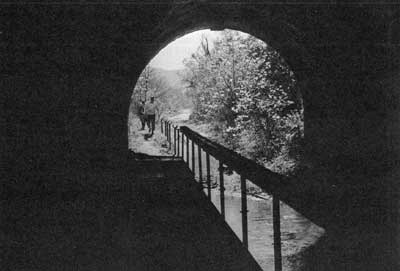
If this body of recommendations is significantly implemented as an initial program, it can lead to a good solid beginning on the things that need to be done in the Potomac Basin. Without treading heavily on the freedom of choice of future populations, it can satisfy the water demands of the Basin during a long enough span of years to give scientists time to examine the full range of evolving alternatives for water management, and planners freedom to choose perhaps better ways of meeting future demands than are now available.
The program can clean up the main streams of the Basin and assure their healthy and copious flow even in time of drought, keep their banks beautiful, and make them more available than they presently are for the people's enjoyment. Even in the major trouble spots of the present time—stretches like the lower North Branch and the metropolitan estuary—dramatic improvement in the appearance of the water and its usefulness for boating and fishing and such things will be possible if the recommendations are followed out to where they lead, though full restoration in such spots, particularly in the estuary, is going to require an expansion of present knowledge and a long-continuing effort on the part of all agencies and jurisdictions.
The program will not assure general protection of the Basin's landscape, for only the Basin's people, generation on generation of them, can assure that. But it can preserve some of the major treasures in that landscape and mitigate some of the worst threats to it. And by fostering projects to illustrate how a respect for the landscape can be put to work, and bringing people into closer contact with the old realities of the Basin's natural world, it can stimulate understanding and feeling that will lead to wider restoration and protection, possibly that general protection that only the people can assure.
If the spirit of these recommendations prevails, we believe that they can lead reasonably soon to a Potomac Basin fit to serve as a model for the nation. And if they are followed by further stages of continuing, flexible, coordinated planning that will apply the best technology to new problems as they arise, keep Basin aims in mind, maintain a high sense of values, and leave open all possible options for the people who come after, the Basin will remain a model. And that has been the aiming point of our study and our planning.