Chapter III · : ALGONQUIAN MYTHS AND LEGENDS
Reading edition
Glooskap and Malsum
The Algonquin Indians have perhaps a more extensive mythology than the majority of Indian peoples, and as they have been known to civilization for several centuries their myths have the advantage of having been thoroughly examined.
One of the most interesting figures in their pantheon is Glooskap, which means 'The Liar'; but so far from an affront being intended to the deity by this appellation, it was bestowed as a compliment to his craftiness, cunning being regarded as one of the virtues by all savage peoples.
Glooskap and his brother Malsum, the Wolf, were twins, and from this we may infer that they were the opposites of a dualistic system, Glooskap standing for what seems 'good' to the savage, and Malsum for all that was 'bad.'[1] Their mother died at their birth, and out of her body Glooskap formed the sun and moon, animals, fishes, and the human race, while the malicious Malsum made mountains, valleys, serpents, and every manner of thing which he considered would inconvenience the race of men.
Each of the brothers possessed a secret as to what would kill him, as do many other beings in myth and fairy story, notably Liew Llaw Gyffes in Welsh romance.
Malsum asked Glooskap in what manner he could be killed, and the elder brother, to try his sincerity, replied that the only way in which his life could be taken was by the touch of an owl's feather—or, as some variants of the myth say, by that of a flowering rush. Malsum in his turn confided to Glooskap that he could only perish by a blow from a fern-root. The malicious Wolf, taking his bow, brought down an owl, and while Glooskap slept struck him with a feather plucked from its wing. Glooskap immediately expired, but to Malsum's chagrin came to life again. This tale is surprisingly reminiscent of the Scandinavian myth of Balder, who would only die if struck by a sprig of mistletoe by his brother Hodur. Like Balder, Glooskap is a sun-god, as is well proved by the circumstance that when he dies he does not fail to revive.
But Malsum resolved to learn his brother's secret and to destroy him at the first opportunity. Glooskap had told him subsequently to his first attempt that only a pine-root could kill him, and with this Malsum struck him while he slept as before, but Glooskap, rising up and laughing, drove Malsum into the forest, and seated himself by a stream, where he murmured, as if musing to himself: "Only a flowering rush can kill me." Now he said this because he knew that Quah-beet, the Great Beaver, was hidden among the rushes on the bank of the stream and would hear every word he uttered. The Beaver went at once to Malsum and told him what he regarded as his brother's vital secret. The wicked Malsum was so glad that he promised to give the Beaver whatever he might ask for. But when the beast asked for wings like a pigeon Malsum burst into mocking laughter and cried: "Ho, you with the tail like a file, what need have you of wings?" At this the Beaver was wroth, and, going to Glooskap, made a clean breast of what he had done. Glooskap, now thoroughly infuriated, dug up a fern-root, and, rushing into the recesses of the forest, sought out his treacherous brother and with a blow of the fatal plant struck him dead.
Scandinavian Analogies
But although Malsum was slain he subsequently appears in Algonquian myth as Lox, or Loki, the chief of the wolves, a mischievous and restless spirit. In his account of the Algonquian mythology Charles Godfrey Leland appears to think that the entire system has been sophisticated by Norse mythology filtering through the Eskimo. Although the probabilities are against such a theory, there are many points in common between the two systems, as we shall see later, and among them few are more striking than the fact that the Scandinavian and Algonquian evil influences possess one and the same name.
When Glooskap had completed the world he made man and the smaller supernatural beings, such as fairies and dwarfs. He formed man from the trunk of an ash-tree, and the elves from its bark. Like Odin, he trained two birds to bring him the news of the world, but their absences were so prolonged that he selected a black and a white wolf as his attendants. He waged a strenuous and exterminating warfare on the evil monsters which then infested the world, and on the sorcerers and witches who were harmful to man. He levelled the hills and restrained the forces of nature in his mighty struggles, in which he towered to giant stature, his head and shoulders rising high above the clouds. Yet in his dealings with men he was gentle and quietly humorous, not to say ingenuous.
On one occasion he sought out a giant sorcerer named Win-pe, one of the most powerful of the evil influences then dwelling upon the earth. Win-pe shot upward till his head was above the tallest pine of the forest, but Glooskap, with a god-like laugh, grew till his head reached the stars, and tapped the wizard gently with the butt of his bow, so that he fell dead at his feet.
But although he exterminated many monsters and placed a check upon the advance of the forces of evil, Glooskap did not find that the race of men grew any better or wiser. In fact, the more he accomplished on their behalf the worse they became, until at last they reached such a pitch of evil conduct that the god resolved to quit the world altogether. But, with a feeling of consideration still for the beings he had created, he announced that within the next seven years he would grant to all and sundry any request they might make. A great many people were desirous of profiting by this offer, but it was with the utmost difficulty that they could discover where Glooskap was. Those who did find him and who chose injudiciously were severely punished, while those whose desires were reasonable were substantially rewarded.
Glooskap's Gifts
Four Indians who won to Glooskap's abode found it a place of magical delights, a land fairer than the mind could conceive. Asked by the god what had brought them thither, one replied that his heart was evil and that anger had made him its slave, but that he wished to be meek and pious. The second, a poor man, desired to be rich, and the third, who was of low estate and despised by the folk of his tribe, wished to be universally honoured and respected. The fourth was a vain man, conscious of his good looks, whose appearance was eloquent of conceit. Although he was tall, he had stuffed fur into his moccasins to make him appear still taller, and his wish was that he might become bigger than any man of his tribe and that he might live for ages.
Glooskap drew four small boxes from his medicine-bag and gave one to each, desiring that they should not open them until they reached home. When the first three arrived at their respective lodges each opened his box, and found therein an unguent of great fragrance and richness, with which he rubbed himself. The wicked man became meek and patient, the poor man speedily grew wealthy, and the despised man became stately and respected. But the conceited man had stopped on his way home in a clearing in the woods, and, taking out his box, had anointed himself with the ointment it contained. His wish also was granted, but not exactly in the manner he expected, for he was changed into a pine-tree, the first of the species, and the tallest tree of the forest at that.
Glooskap and the Baby
Glooskap, having conquered the Kewawkqu', a race of giants and magicians, and the Medecolin, who were cunning sorcerers, and Pamola, a wicked spirit of the night, besides hosts of fiends, goblins, cannibals, and witches, felt himself great indeed, and boasted to a certain woman that there was nothing left for him to subdue.
But the woman laughed and said: "Are you quite sure, Master? There is still one who remains unconquered, and nothing can overcome him."
In some surprise Glooskap inquired the name of this mighty individual.
"He is called Wasis," replied the woman; "but I strongly advise you to have no dealings with him."
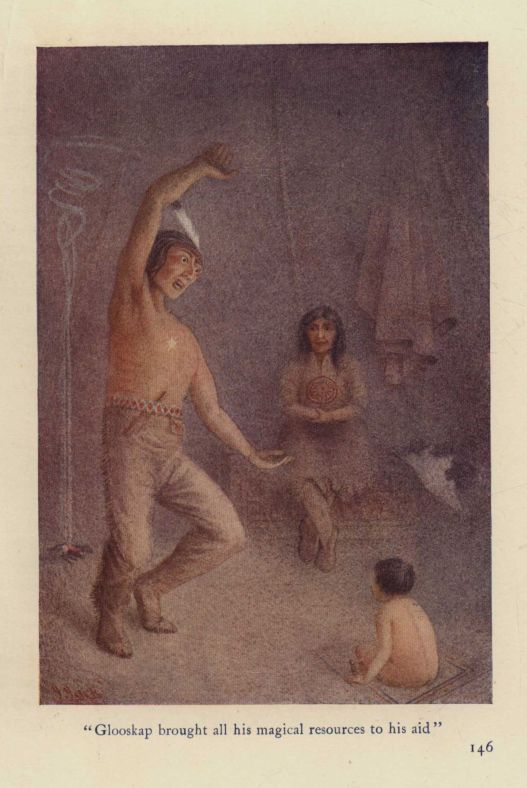
Wasis was only the baby, who sat on the floor sucking a piece of maple-sugar and crooning a little song to himself. Now Glooskap had never married and was quite ignorant of how children are managed, but with perfect confidence he smiled to the baby and asked it to come to him. The baby smiled back to him, but never moved, whereupon Glooskap imitated the beautiful song of a certain bird. Wasis, however, paid no heed to him, but went on sucking his maple-sugar. Glooskap, unaccustomed to such treatment, lashed himself into a furious rage, and in terrible and threatening accents ordered Wasis to come crawling to him at once. But Wasis burst into direful howling, which quite drowned the god's thunderous accents, and for all the threatenings of the deity he would not budge. Glooskap, now thoroughly aroused, brought all his magical resources to his aid. He recited the most terrible spells, the most dreadful incantations. He sang the songs which raise the dead, and which sent the devil scurrying to the nethermost depths of the pit. But Wasis evidently seemed to think this was all some sort of a game, for he merely smiled wearily and looked a trifle bored. At last Glooskap in despair rushed from the hut, while Wasis, sitting on the floor, cried, "Goo, goo," and crowed triumphantly. And to this day the Indians say that when a baby cries "Goo" he remembers the time when he conquered the mighty Glooskap.
"Glooskap brought all his magical resources to his aid"
Glooskap's Farewell
At length the day on which Glooskap was to leave the earth arrived, and to celebrate the event he caused a great feast to be made on the shores of Lake Minas. It was attended by all the animals, and when it drew to a close Glooskap entered his great canoe and slowly drifted out of sight. When they could see him no longer they still heard his beautiful singing growing fainter and fainter in the distance, until at last it died away altogether. Then a strange thing happened. The beasts, who up to this time had spoken but one language, could no longer understand each other, and in confusion fled away, never again to meet in friendly converse until Glooskap shall return and revive the halcyon days of the Golden Age.
This tradition of Glooskap strikingly recalls that of the Mexican god Quetzalcoatl, who drifted from the shores of Mexico eastward toward the fabled land of Tlapallan, whence he had originally come. Glooskap, like the Mexican deity alluded to, is, as has already been indicated, a sun-god, or, more properly speaking, a son of the sun, who has come to earth on a mission of enlightenment and civilization, to render the world habitable for mankind and to sow the seeds of the arts, domestic and agricultural. Quetzalcoatl disappeared toward the east because it was the original home of his father, the sun, and not toward the west, which is merely the sun's resting-place for the night. But Glooskap drifted westward, as most sun-children do.
How Glooskap Caught the Summer
A very beautiful myth tells how Glooskap captured the Summer. The form in which it is preserved is a kind of poetry possessing something in the nature of metre, which until a few generations ago was recited by many Algonquian firesides. A long time ago Glooskap wandered very far north to the Ice-country, and, feeling tired and cold, sought shelter at a wigwam where dwelt a great giant—the giant Winter. Winter received the god hospitably, filled a pipe of tobacco for him, and entertained him with charming stories of the old time as he smoked. All the time Winter was casting his spell over Glooskap, for as he talked drowsily and monotonously he gave forth a freezing atmosphere, so that Glooskap first dozed and then fell into a deep sleep—the heavy slumber of the winter season. For six whole months he slept; then the spell of the frost arose from his brain and he awoke. He took his way homeward and southward, and the farther south he fared the warmer it felt, and the flowers began to spring up around his steps.
At length he came to a vast, trackless forest, where, under primeval trees, many little people were dancing. The queen of these folk was Summer, a most exquisitely beautiful, if very tiny, creature. Glooskap caught the queen up in his great hand, and, cutting a long lasso from the hide of a moose, secured it round her tiny frame. Then he ran away, letting the cord trail loosely behind him.
The Elves of Light
The tiny people, who were the Elves of Light, came clamouring shrilly after him, pulling frantically at the lasso. But as Glooskap ran the cord ran out, and pull as they might they were left far behind.
Northward he journeyed once more, and came to the wigwam of Winter. The giant again received him hospitably, and began to tell the old stories whose vague charm had exercised such a fascination upon the god. But Glooskap in his turn began to speak. Summer was lying in his bosom, and her strength and heat sent forth such powerful magic that at length Winter began to show signs of distress. The sweat poured profusely down his face, and gradually he commenced to melt, as did his dwelling. Then slowly nature awoke, the song of birds was heard, first faintly, then more clearly and joyously. The thin green shoots of the young grass appeared, and the dead leaves of last autumn were carried down to the river by the melting snow. Lastly the fairies came out, and Glooskap, leaving Summer with them, once more bent his steps southward.
This is obviously a nature-myth conceived by a people dwelling in a climate where the rigours of winter gave way for a more or less brief space only to the blandishments of summer. To them winter was a giant, and summer an elf of pigmy proportions. The stories told during the winter season are eloquent of the life led by people dwelling in a sub-arctic climate, where the traditional tale, the father of epic poetry, whiles away the long dark hours, while the winter tempest roars furiously without and the heaped-up snow renders the daily occupation of the hunter impossible.
Glooskap's Wigwam
The Indians say that Glooskap lives far away, no one knows where, in a very great wigwam. His chief occupation is making arrows, and it would appear that each of these stands for a day. One side of his wigwam is covered with arrows, and when his lodge shall be filled with them the last great day will arrive. Then he will call upon his army of good spirits and go forth to attack Malsum in a wonderful canoe, which by magical means can be made to expand so as to hold an army or contract so that it may be carried in the palm of the hand. The war with his evil brother will be one of extermination, and not one single individual on either side will be left. But the good will go to Glooskap's beautiful abode, and all will be well at last.
The Snow-Lodge
Chill breezes had long forewarned the geese of the coming cold season, and the constant cry from above of "Honk, honk," told the Indians that the birds' migration was in progress.
The buffalo-hunters of the Blackfeet, an Algonquian tribe, were abroad with the object of procuring the thick robes and the rich meat which would keep them warm and provide good fare through the desolate winter moons. Sacred Otter had been lucky. Many buffaloes had fallen to him, and he was busily occupied in skinning them. But while the braves plied the knife quickly and deftly they heeded not the dun, lowering clouds heavy with tempest hanging like a black curtain over the northern horizon. Suddenly the clouds swooped down from their place in the heavens like a flight of black eagles, and with a roar the blizzard was upon them.
"He descried a great tepee"
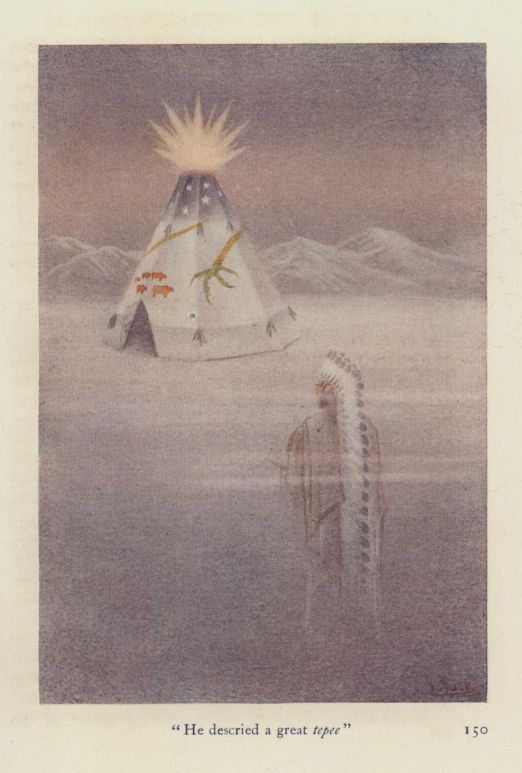
Sacred Otter and his son crouched beneath the carcass of a dead buffalo for shelter. But the air was frore as water in which the ice is floating, and he knew that they would quickly perish unless they could find some better protection from the bitter wind. So he made a small tepee, or tent, out of the buffalo's hide, and both crawled inside. Against this crazy shelter the snow quickly gathered and drifted, so that soon the inmates of the tiny lodge sank into a comfortable drowse induced by the gentle warmth. As Sacred Otter slept he dreamed. Away in the distance he descried a great tepee, crowned with a colour like the gold of sunlight, and painted with a cluster of stars symbolic of the North. The ruddy disc of the sun was pictured at the back, and to this was affixed the tail of the Sacred Buffalo. The skirts of the tepee were painted to represent ice, and on its side had been drawn four yellow legs with green claws, typical of the Thunder-bird. A buffalo in glaring red frowned above the door, and bunches of crow-feathers, with small bells attached, swung and tinkled in the breeze.
Sacred Otter, surprised at the unusual nature of the paintings, stood before the tepee lost in admiration of its decorations, when he was startled to hear a voice say:
"Who walks round my tepee? Come in—come in!"
The Lord of Cold Weather
Sacred Otter entered, and beheld a tall, white-haired man, clothed all in white, sitting at the back of the lodge, of which he was the sole occupant. Sacred Otter took a seat, but the owner of the tepee never looked his way, smoking on in stolid silence. Before him was an earthen altar, on which was laid juniper, as in the Sun ceremonial. His face was painted yellow, with a red line in the region of the mouth, and another across the eyes to the ears. Across his breast he wore a mink-skin, and round his waist small strips of otter-skin, to all of which bells were attached. For a long time he kept silence, but at length he laid down his black stone pipe and addressed Sacred Otter as follows:
"I am Es-tonea-pesta, the Lord of Cold Weather, and this, my dwelling, is the Snow-tepee, or Yellow Paint Lodge. I control and send the driving snow and biting winds from the Northland. You are here because I have taken pity upon you, and on your son who was caught in the blizzard with you. Take this Snow-tepee with its symbols and medicines. Take also this mink-skin tobacco-pouch, this black stone pipe, and my supernatural power. You must make a tepee similar to this on your return to camp."
The Lord of Cold Weather then minutely explained to Sacred Otter the symbols of which he must make use in painting the lodge, and gave him the songs and ceremonial connected with it. At this juncture Sacred Otter awoke. He observed that the storm had abated somewhat, and as soon as it grew fair enough he and his son crawled from their shelter and tramped home waist-high through the soft snow. Sacred Otter spent the long, cold nights in making a model of the Snow-tepee and painting it as he had been directed in his dream. He also collected the 'medicines' necessary for the ceremonial, and in the spring, when new lodges were made, he built and painted the Snow-tepee.
The power of Sacred Otter waxed great because of his possession of the Snow-lodge which the Lord of Cold had vouchsafed to him in dream. Soon was it proved. Once more while hunting buffalo he and several companions were caught in a blizzard when many a weary mile from camp. They appealed to Sacred Otter to utilize the 'medicine' of the Lord of Cold. Directing that several women and children who were with the party should be placed on sledges, and that the men should go in advance and break a passage through the snow for the horses, he took the mink tobacco-pouch and the black stone pipe he had received from the Cold-maker and commenced to smoke. He blew the smoke in the direction whence the storm came and prayed to the Lord of Cold to have pity on the people. Gradually the storm-clouds broke and cleared and on every side the blue sky was seen. The people hastened on, as they knew the blizzard was only being held back for a space. But their camp was at hand, and they soon reached it in safety.
Never again, however, would Sacred Otter use his mystic power. For he dreaded that he might offend the Lord of Cold. And who could afford to do that?
The Star-Maiden
A pretty legend of the Chippeways, an Algonquian tribe, tells how Algon, a hunter, won for his bride the daughter of a star. While walking over the prairies he discovered a circular pathway, worn as if by the tread of many feet, though there were no foot-marks visible outside its bounds. The young hunter, who had never before encountered one or these 'fairy rings,' was filled with surprise at the discovery, and hid himself in the long grass to see whether an explanation might not be forthcoming. He had not long to wait. In a little while he heard the sound of music, so faint and sweet that it surpassed anything he had ever dreamed of. The strains grew fuller and richer, and as they seemed to come from above he turned his eyes toward the sky. Far in the blue he could see a tiny white speck like a floating cloud. Nearer and nearer it came, and the astonished hunter saw that it was no cloud, but a dainty osier car, in which were seated twelve beautiful maidens. The music he had heard was the sound of their voices as they sang strange and magical songs. Descending into the charmed ring, they danced round and round with such exquisite grace and abandon that it was a sheer delight to watch them. But after the first moments of dazzled surprise Algon had eyes only for the youngest of the group, a slight, vivacious creature, so fragile and delicate that it seemed to the stalwart hunter that a breath would blow her away.
He was, indeed, seized with a fierce passion for the dainty sprite, and he speedily decided to spring from the grass and carry her off. But the pretty creatures were too quick for him. The fairy of his choice skilfully eluded his grasp and rushed to the car. The others followed, and in a moment they were soaring up in the air, singing a sweet, unearthly song. The disconsolate hunter returned to his lodge, but try as he might he could not get the thought of the Star-maiden out of his head, and next day, long before the hour of the fairies' arrival, he lay in the grass awaiting the sweet sounds that would herald their approach. At length the car appeared. The twelve ethereal beings danced as before. Again Algon made a desperate attempt to seize the youngest, and again he was unsuccessful.
"Let us stay," said one of the Star-maidens. "Perhaps the mortal wishes to teach us his earthly dances." But the youngest sister would not hear of it, and they all rose out of sight in their osier basket.
Algon's Strategy
Poor Algon returned home more unhappy than ever. All night he lay awake dreaming of the pretty, elusive creature who had wound a chain of gossamer round his heart and brain, and early in the morning he repaired to the enchanted spot. Casting about for some means of gaining his end, he came upon the hollow trunk of a tree in which a number of mice gambolled. With the aid of the charms in his 'medicine'-bag he turned himself into one of these little animals, thinking the fair sisters would never pierce his disguise.
Algon carries the Captured Maiden home to his Lodge
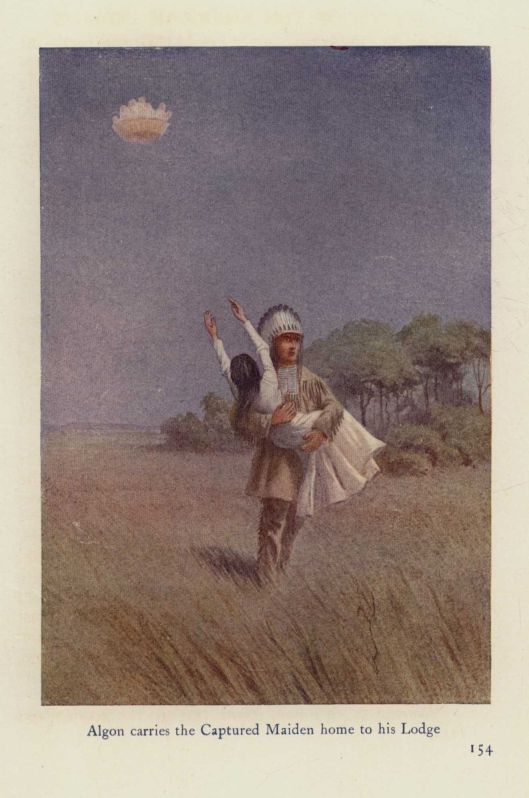
That day when the osier car descended its occupants alighted and danced merrily as they were wont in the magic circle, till the youngest saw the hollow tree-trunk (which had not been there on the previous day) and turned to fly. Her sisters laughed at her fears, and tried to reassure her by overturning the tree-trunk. The mice scampered in all directions, and were quickly pursued by the Star-maidens, who killed them all except Algon. The latter regained his own shape just as the youngest fairy raised her hand to strike him. Clasping her in his arms, he bore her to his village, while her frightened sisters ascended to their Star-country.
Arrived at his home, Algon married the maiden, and by his kindness and gentleness soon won her affection. However, her thoughts still dwelt on her own people, and though she indulged her sorrow only in secret, lest it should trouble her husband, she never ceased to lament her lost home.
The Star-Maiden's Escape
One day while she was out with her little son she made a basket of osiers, like the one in which she had first come to earth. Gathering together some flowers and gifts for the Star-people, she took the child with her into the basket, sang the magical songs she still remembered, and soon floated up to her own country, where she was welcomed by the king, her father.
Algon's grief was bitter indeed when he found that his wife and child had left him. But he had no means of following them. Every day he would go to the magic circle on the prairie and give vent to his sorrow, but the years went past and there was no sign of his dear ones returning.
Meanwhile the woman and her son had almost forgotten Algon and the earth-country. However, when the boy grew old enough to hear the story he wished to go and see his father. His mother consented, and arranged to go with him. While they were preparing to descend the Star-people said:
"Bring Algon with you when you return, and ask him to bring some feature from every beast and bird he has killed in the chase."
Algon, who had latterly spent almost all his time at the charmed circle, was overjoyed to see his wife and son come back to him, and willingly agreed to go with them to the Star-country. He worked very hard to obtain a specimen of all the rare and curious birds and beasts in his land, and when at last he had gathered the relics—a claw of one, a feather of another, and so on—he piled them in the osier car, climbed in himself with his wife and boy, and set off to the Star-country.
The people there were delighted with the curious gifts Algon had brought them, and, being permitted by their king to take one apiece, they did so. Those who took a tail or a claw of any beast at once became the quadruped represented by the fragment, and those who took the wings of birds became birds themselves. Algon and his wife and son took the feathers of a white falcon and flew down to the prairies, where their descendants may still be seen.
Cloud-Carrier and the Star-Folk
A handsome youth once dwelt with his parents on the banks of Lake Huron. The old people were very proud of their boy, and intended that he should become a great warrior. When he grew old enough to prepare his 'medicine'-bag he set off into the forest for that purpose. As he journeyed he grew weary, and lay down to sleep, and while he slept he heard a gentle voice whisper:
"Cloud-carrier, I have come to fetch you. Follow me."
The young man started to his feet.
"I am dreaming. It is but an illusion," he muttered to himself, as he gazed at the owner of the soft voice, who was a damsel of such marvellous beauty that the sleepy eyes of Cloud-carrier were quite dazzled.
"Follow me," she said again, and rose softly from the ground like thistledown. To his surprise the youth rose along with her, as lightly and as easily. Higher they went, and still higher, far above the tree-tops, and into the sky, till they passed at length through an opening in the spreading vault, and Cloud-carrier saw that he was in the country of the Star-people, and that his beautiful guide was no mortal maiden, but a supernatural being. So fascinated was he by her sweetness and gentleness that he followed her without question till they came to a large lodge. Entering it at the invitation of the Star-maiden, Cloud-carrier found it filled with weapons and ornaments of silver, worked in strange and grotesque designs. For a time he wandered through the lodge admiring and praising all he saw, his warrior-blood stirring at the sight of the rare weapons. Suddenly the lady cried:
"Hush! My brother approaches! Let me hide you. Quick!"
The young man crouched in a corner, and the damsel threw a richly coloured scarf over him. Scarcely had she done so when a grave and dignified warrior stalked into the lodge.
"Nemissa, my dear sister," he said, after a moment's pause, "have you not been forbidden to speak to the Earth-people? Perhaps you imagine you have hidden the young man, but you have not." Then, turning from the blushing Nemissa to Cloud-carrier, he added, good-naturedly:
"If you stay long there you will be very hungry. Come out and let us have a talk."
The youth did as he was bid, and the brother of Nemissa gave him a pipe and a bow and arrows. He gave him also Nemissa for his wife, and for a long time they lived together very happily.
The Star-Country
Now the young man observed that his brother-in-law was in the habit of going away every day by himself, and feeling curious to know what his business might be, he asked one morning whether he might accompany him.
The brother-in-law consented readily, and the two set off. Travelling in the Star-country was very pleasant. The foliage was richer than that of the earth, the flowers more delicately coloured, the air softer and more fragrant, and the birds and beasts more graceful and harmless. As the day wore on to noon Cloud-carrier became very hungry.
"When can we get something to eat?" he asked his brother-in-law.
"Very soon," was the reassuring reply. "We are just going to make a repast." As he spoke they came to a large opening, through which they could see the lodges and lakes and forests of the earth. At one place some hunters were preparing for the chase. By the banks of a river some women were gathering reeds, and down in a village a number of children were playing happily.
"Do you see that boy down there in the centre of the group?" said the brother of Nemissa, and as he spoke he threw something at the child. The poor boy fell down instantly, and was carried, more dead than alive, to the nearest hut.
The Sacrifice
Cloud-carrier was much perplexed at the act of his supernatural relative. He saw the medicine-men gather round the child and chant prayers for his recovery.
"It is the will of Manitou," said one priest, "that we offer a white dog as a sacrifice."
So they procured a white dog, skinned and roasted it, and put it on a plate. It flew up in the air and provided a meal for the hungry Cloud-carrier and his companion. The child recovered and returned to his play.
"Your medicine-men," said Nemissa's brother, "get a great reputation for wisdom simply because they direct the people to me. You think they are very clever, but all they do is to advise you to sacrifice to me. It is I who recover the sick."
Cloud-carrier found in this spot a new source of interest, but at length the delights of the celestial regions began to pall. He longed for the companionship of his own kin, for the old commonplace pastimes of the Earth-country. He became, in short, very homesick, and begged his wife's permission to return to earth. Very reluctantly she consented.
"Remember," she said, "that I shall have the power to recall you when I please, for you will still be my husband. And above all do not marry an Earth-woman, or you will taste of my vengeance."
The young man readily promised to respect her injunctions. So he went to sleep, and awoke a little later to find himself lying on the grass close by his father's lodge. His parents greeted him joyfully. He had been absent, they told him, for more than a year, and they had not hoped to see him again.
The remembrance of his sojourn among the Star-people faded gradually to a dim recollection. By and by, forgetting the wife he had left there, he married a young and handsome woman belonging to his own village. Four days after the wedding she died, but Cloud-carrier failed to draw a lesson from this unfortunate occurrence. He married a third wife. But one day he was missing, and was never again heard of. His Star-wife had recalled him to the sky.
The Snow-Man Husband
In a northern village of the Algonquins dwelt a young girl so exquisitely beautiful that she attracted hosts of admirers. The fame of her beauty spread far and wide, and warriors and hunters thronged to her father's lodge in order to behold her. By universal consent she received the name of 'Handsome.' One of the braves who was most assiduous in paying her his addresses was surnamed 'Elegant,' because of the richness of his costume and the nobility of his features. Desiring to know his fate, the young man confided the secret of his love for Handsome to another of his suitors, and proposed that they two should that day approach her and ask her hand in marriage. But the coquettish maiden dismissed the young braves disdainfully, and, to add to the indignity of her refusal, repeated it in public outside her father's lodge. Elegant, who was extremely sensitive, was so humiliated and mortified that he fell into ill-health. A deep melancholy settled on his mind. He refused all nourishment, and for hours he would sit with his eyes fixed on the ground in moody contemplation. A profound sense of disgrace seized upon him, and notwithstanding the arguments of his relations and comrades he sank deeper into lethargy. Finally he took to his bed, and even when his family were preparing for the annual migration customary with the tribe he refused to rise from it, although they removed the tent from above his head and packed it up for transport.
The Lover's Revenge
After his family had gone Elegant appealed to his guardian spirit or totem to revenge him on the maiden who had thus cast him into despondency. Going from lodge to lodge, he collected all the rags that he could find, and, kneading snow over a framework of animals' bones, he moulded it into the shape of a man, which he attired in the tatters he had gathered, finally covering the whole with brilliant beads and gaudy feathers so that it presented a very imposing appearance. By magic art he animated this singular figure, placed a bow and arrows into its hands, and bestowed on it the name of Moowis.
Together the pair set out for the new encampment of the tribe. The brilliant appearance of Moowis caused him to be received by all with the most marked distinction. The chieftain of the tribe begged him to enter his lodge, and entertained him as an honoured guest. But none was so struck by the bearing of the noble-looking stranger as Handsome. Her mother requested him to accept the hospitality of her lodge, which he duly graced with his presence, but being unable to approach too closely to the hearth, on which a great fire was burning, he placed a boy between him and the blaze, in order that he should run no risk of melting. Soon the news that Moowis was to wed Handsome ran through the encampment, and the nuptials were celebrated. On the following day Moowis announced his intention of undertaking a long journey. Handsome pleaded for leave to accompany him, but he refused on the ground that the distance was too great and that the fatigues and dangers of the route would prove too much for her strength. Finally, however, she overcame his resistance, and the two set out.
A Strange Transformation
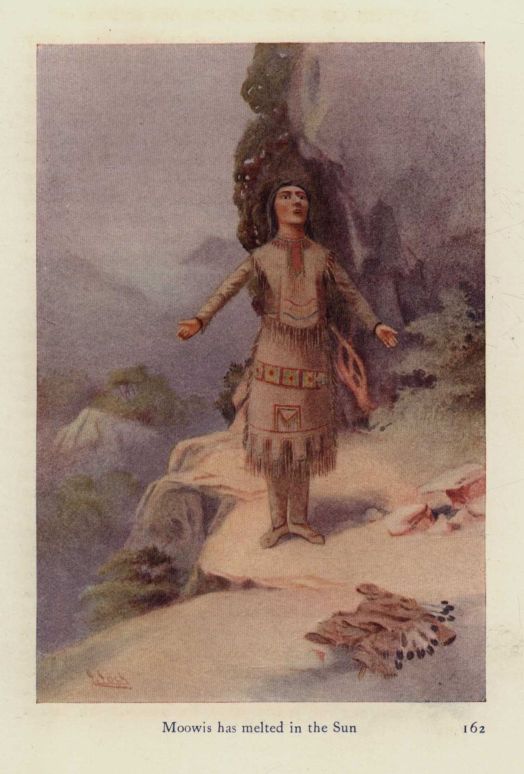
A rough and rugged road had to be traversed by the newly wedded pair. On every hand they encountered obstacles, and the unfortunate Handsome, whose feet were cut and bleeding, found the greatest difficulty in keeping up with her more active husband. At first it was bitterly cold, but at length the sun came out and shone in all his strength, so that the girl forgot her woes and began to sing gaily. But on the appearance of the luminary a strange transformation had slowly overtaken her spouse. At first he attempted to keep in the shade, to avoid the golden beams that he knew meant death to him, but all to no purpose. The air became gradually warmer, and slowly he dissolved and fell to pieces, so that his frenzied wife now only beheld his garments, the bones that had composed his framework, and the gaudy plumes and beads with which he had been bedecked. Long she sought his real self, thinking that some trick had been played upon her; but at length, exhausted with fatigue and sorrow, she cast herself on the ground, and with his name on her lips breathed her last. So was Elegant avenged.
The Spirit-Bride
A story is told of a young Algonquin brave whose bride died on the day fixed for their wedding. Before this sad event he had been the most courageous and high-spirited of warriors and the most skilful of hunters, but afterward his pride and his bravery seemed to desert him. In vain his friends urged him to seek the chase and begged him to take a greater interest in life. The more they pressed him the more melancholy he became, till at length he passed most of his time by the grave of his bride.
Moowis had melted in the Sun
He was roused from his state of apathy one day, however, by hearing some old men discussing the existence of a path to the Spirit-world, which they supposed lay to the south. A gleam of hope shone in the young brave's breast, and, worn with sorrow as he was, he armed himself and set off southward. For a long time he saw no appreciable change in his surroundings—rivers, mountains, lakes, and forests similar to those of his own country environed him. But after a weary journey of many days he fancied he saw a difference. The sky was more blue, the prairie more fertile, the scenery more gloriously beautiful. From the conversation he had overheard before he set out, the young brave judged that he was nearing the Spirit-world. Just as he emerged from a spreading forest he saw before him a little lodge set high on a hill. Thinking its occupants might be able to direct him to his destination, he climbed to the lodge and accosted an aged man who stood in the doorway.
"Can you tell me the way to the Spirit-world?" he inquired.
The Island of the Blessed
"Yes," said the old man gravely, throwing aside his cloak of swan's skin. "Only a few days ago she whom you seek rested in my lodge. If you will leave your body here you may follow her. To reach the Island of the Blessed you must cross yonder gulf you see in the distance. But I warn you the crossing will be no easy matter. Do you still wish to go?"
"Oh, yes, yes," cried the warrior eagerly, and as the words were uttered he felt himself grow suddenly lighter. The whole aspect, too, of the scene was changed. Everything looked brighter and more ethereal. He found himself in a moment walking through thickets which offered no resistance to his passage, and he knew that he was a spirit, travelling in the Spirit-world. When he reached the gulf which the old man had indicated he found to his delight a wonderful canoe ready on the shore. It was cut from a single white stone, and shone and sparkled in the sun like a jewel. The warrior lost no time in embarking, and as he put off from the shore he saw his pretty bride enter just such another canoe as his and imitate all his movements. Side by side they made for the Island of the Blessed, a charming woody islet set in the middle of the water, like an emerald in silver. When they were about half-way across a sudden storm arose, and the huge waves threatened to engulf them. Many other people had embarked on the perilous waters by this time, some of whom perished in the furious tempest. But the youth and maiden still battled on bravely, never losing sight of one another. Because they were good and innocent, the Master of Life had decreed that they should arrive safely at the fair island, and after a weary struggle they felt their canoes grate on the shore.
Hand in hand the lovers walked among the beautiful sights and sounds that greeted their eyes and ears from every quarter. There was no trace of the recent storm. The sea was as smooth as glass and the sky as clear as crystal. The youth and his bride felt that they could wander on thus for ever. But at length a faint, sweet voice bade the former return to his home in the Earth-country.
The Master of Life
"You must finish your mortal course," it whispered softly. "You will become a great chief among your own people. Rule wisely and well, and when your earthly career is over you shall return to your bride, who will retain her youth and beauty for ever."
The young man recognized the voice as that of the Master of Life, and sadly bade farewell to the woman. He was not without hope now, however, but looked forward to another and more lasting reunion.
Returning to the old man's lodge, he regained his body, went home as the gentle voice on the island had commanded him, and became a father to his people for many years. By his just and kindly rule he won the hearts of all who knew him, and ensured for himself a safe passage to the Island of the Blessed, where he arrived at last to partake of everlasting happiness with his beautiful bride.
Otter-Heart
In the heart of a great forest lay a nameless little lake, and by its side dwelt two children. Wicked magicians had slain their parents while they were yet of tender years, and the little orphans were obliged to fend for themselves. The younger of the two, a boy, learned to shoot with bow and arrow, and he soon acquired such skill that he rarely returned from a hunting expedition without a specimen of his prowess in the shape of a bird or a hare, which his elder sister would dress and cook.
When the boy grew older he naturally felt the need of some companionship other than that of his sister. During his long, solitary journeys in search of food he thought a good deal about the great world outside the barrier of the still, silent forest. He longed for the sound of human voices to replace the murmuring of the trees and the cries of the birds.
"Are there no Indians but ourselves in the whole world?" he would ask wistfully.
"I do not know," his sister invariably replied. Busying herself cheerfully about her household tasks, she knew nothing of the strange thoughts that were stirring in the mind of her brother.
But one day he returned from the chase in so discontented a mood that his unrest could no longer pass unnoticed. In response to solicitous inquiries from his sister, he said abruptly:
"Make me ten pairs of moccasins. To-morrow I am going to travel into the great world."
The girl was much disturbed by this communication, but like a good Indian maiden she did as he requested her and kept a respectful silence.
Early on the following morning the youth, whose name was Otter-heart, set out on his quest. He soon came to a clearing in the forest, but to his disappointment he found that the tree-stumps were old and rotten.
"It is a long, long time," he said mournfully, "since there were Indians here."
In order that he might find his way back, he suspended a pair of moccasins from the branch of a tree, and continued his journey. Other clearings he reached in due time, each showing traces of a more recent occupation than the last, but still it seemed to him that a long time must have elapsed since the trees were cut down, so he hung up a pair of moccasins at each stage of his journey, and pursued his course in search of human beings.
At last he saw before him an Indian village, which he approached with mingled feelings of pleasure and trepidation, natural enough when it is remembered that since his early childhood he had spoken to no one but his sister.
The Ball-Players
On the outskirts of the village some youths of about his own age were engaged in a game of ball, in which they courteously invited the stranger to join. Very soon he had forgotten his natural shyness so far as to enter into the sport with whole-hearted zest and enjoyment. His new companions, for their part, were filled with astonishment at his skill and agility, and, wishing to do him honour, led him to the great lodge and introduced him to their chief.
Now the chief had two daughters, one of whom was surnamed 'The Good' and the other 'The Wicked.' To the guest the names sounded rather suggestive, and he was not a little embarrassed when the chief begged him to marry the maidens.
"I will marry 'The Good,'" he declared.
But the chief would not agree to that.
"You must marry both," he said firmly.
Here was a dilemma for our hero, who had no wish to wed the cross, ugly sister. He tried hard to think of a way of escape.
"I am going to visit So-and-so," he said at last, mentioning the name of one of his companions at ball, and he dressed himself carefully as though he were about to pay a ceremonious visit.
Directly he was out of sight of the chief's lodge, however, he took to his heels and ran into the forest as hard as he could. Meanwhile the maidens sat waiting their intended bridegroom. When some hours passed without there being any signs of his coming they became alarmed, and set off to look for him.
Toward nightfall the young Otter-heart relaxed his speed. "I am quite safe now," he thought. He did not know that the sisters had the resources of magic at their command. Suddenly he heard wild laughter behind him. Recognizing the shrill voice of The Wicked, he knew that he was discovered, and cast about for a refuge. The only likely place was in the branches of a dense fir-tree, and almost as soon as the thought entered his mind he was at the top. His satisfaction was short-lived. In a moment the laughter of the women broke out anew, and they commenced to hew down the tree. But Otter-heart himself was not without some acquaintance with magic art. Plucking a small fir-cone from the tree-top, he threw it into the air, jumped astride it, and rode down the wind for half a mile or more. The sisters, absorbed in their task of cutting down the tree, did not notice that their bird was flown. When at last the great fir crashed to the ground and the youth was nowhere to be seen the pursuers tore their hair in rage and disappointment.
Otter-Heart's Stratagem
Only on the following evening did they overtake Otter-heart again. This time he had entered a hollow cedar-tree, the hard wood of which he thought would defy their axes. But he had under-estimated the energy of the sisters. In a short time the tree showed the effect of their blows, and Otter-heart called on his guardian spirit to break one of the axes.
His wish was promptly gratified, but the other sister continued her labours with increased energy. Otter-heart now wished that the other axe might break, and again his desire was fulfilled. The sisters were at a loss to know what to do.
"We cannot take him by force," said one; "we must take him by subtlety. Let each do her best, and the one who gets him can keep him."
So they departed, and Otter-heart was free to emerge from his prison. He travelled another day's journey from the spot, and at last, reaching a place where he thought he would be safe, he laid down his blanket and went in search of food. Fortune favoured the hunter, and he shortly returned with a fine beaver. What was his amazement when he beheld a handsome lodge where he had left his blanket!
"It must be those women again," he muttered, preparing to fly. But the light shone so warmly from the lodge, and he was so tired and hungry, that he conquered his fears and entered. Within he found a tall, thin woman, pale and hungry-eyed, but rather pretty. Taking the beaver, she proceeded to cook it. As she did so Otter-heart noticed that she ate all the best parts herself, and when the meal was set out only the poorest pieces remained for him. This was so unlike an Indian housewife that he cast reproaches at her and accused her of greediness. As he spoke a curious change came over her. Her features grew longer and thinner. In a moment she had turned into a wolf and slunk into the forest. It was The Wicked, who had made herself pretty by means of magic, but could not conceal her voracious nature.
Otter-heart was glad to have found her out. He journeyed on still farther, laid down his blanket, and went to look for game. This time several beavers rewarded his skill, and he carried them to the place where he had left his blanket. Another handsome lodge had been erected there! More than ever he wanted to run away, but once more his hunger and fatigue detained him.
"He rode down the wind"
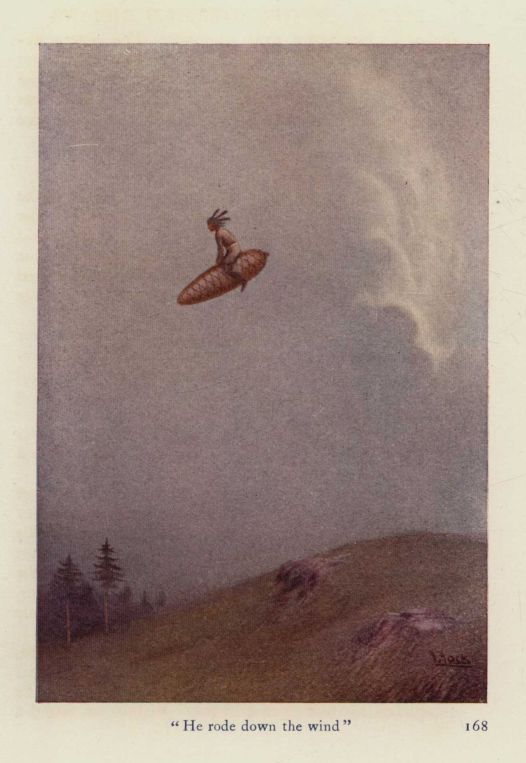
"Perhaps it is The Good," he said. "I shall go inside, and if she has laid my blanket near her couch I shall take it for a sign and she shall become my wife."
The Beaver-Woman
He entered the lodge, and found a small, pretty woman busily engaged in household duties. Sure enough she had laid his blanket near her couch. When she had dressed and cooked the beavers she gave the finest morsels to her husband, who was thoroughly pleased with his wife.
Hearing a sound in the night, Otter-heart awoke, and fancied he saw his wife chewing birch-bark. When he told her of the dream in the morning she did not laugh, but looked very serious.
"Tell me," asked Otter-heart, "why did you examine the beavers so closely yesterday?"
"They were my relatives," she replied; "my cousin, my aunt, and my great-uncle."
Otter-heart was more than ever delighted, for the otters, his totem-kin, and the beavers had always been on very good terms. He promised never to kill any more beavers, but only deer and birds, and he and his wife, The Good, lived together very happily for a long time.
The Fairy Wives
Once upon a time there dwelt in the forest two braves, one of whom was called the Moose and the other the Marten. Moose was a great hunter, and never returned from the chase without a fine deer or buffalo, which he would give to his old grandmother to prepare for cooking. Marten, on the other hand, was an idler, and never hunted at all if he could obtain food by any other means. When Moose brought home a trophy of his skill in the hunt Marten would repair to his friend's lodge and beg for a portion of the meat. Being a good-natured fellow, Moose generally gave him what he asked for, to the indignation of the old grandmother, who declared that the lazy creature had much better learn to work for himself.
"Do not encourage his idle habits," said she to her grandson. "If you stop giving him food he will go and hunt for himself."
Moose agreed with the old woman, and having on his next expedition killed a bear, he told the grandmother to hide it, so that Marten might know nothing of it.
When the time came to cook the bear-meat, however, the grandmother found that her kettle would not hold water, and remembering that Marten had just got a nice new kettle, she went to borrow his.
"I will clean it well before I return it," she thought. "He will never know what I want it for."
But Marten made a very good guess, so he laid a spell on the kettle before lending it, and afterward set out for Moose's lodge. Looking in, he beheld a great quantity of bear-meat.
"I shall have a fine feast to-morrow," said he, laughing, as he stole quietly away without being seen.
On the following day the old grandmother of Moose took the borrowed kettle, cleaned it carefully, and carried it to its owner. She never dreamed that he would suspect anything.
"Oh," said Marten, "what a fine kettleful of bear-meat you have brought me!"
"I have brought you nothing," the old woman began in astonishment, but a glance at her kettle showed her that it was full of steaming bear-meat. She was much confused, and knew that Marten had discovered her plot by magic art.
Moose Demands a Wife
Though Marten was by no means so brave or so industrious as Moose, he nevertheless had two very beautiful wives, while his companion had not even one. Moose thought this rather unfair, so he ventured to ask Marten for one of his wives. To this Marten would not agree, nor would either of the women consent to be handed over to Moose, so there was nothing for it but that the braves should fight for the wives, who, all unknown to their husband, were fairies. And fight they did, that day and the next and the next, till it grew to be a habit with them, and they fought as regularly as they slept.
In the morning Moose would say: "Give me one of your wives." "Paddle your own canoe," Marten would retort, and the fight would begin. Next morning Moose would say again: "Give me one of your wives." "Fish for your own minnows," the reply would come, and the quarrel would be continued with tomahawks for arguments.
"Give me one of your wives," Moose persisted.
"Skin your own rabbits!"
Meanwhile the wives of Marten had grown tired of the perpetual skirmishing. So they made up their minds to run away. Moose and Marten never missed them: they were too busy righting.
All day the fairy wives, whose name was Weasel, travelled as fast as they could, for they did not want to be caught. But when night came they lay down on the banks of a stream and watched the stars shining through the pine-branches.
"If you were a Star-maiden," said one, "and wished to marry a star, which one would you choose?"
"I would marry that bright little red one," said the other. "I am sure he must be a merry little fellow."
"I," said her companion, "should like to marry that big yellow one. I think he must be a great warrior." And so saying she fell asleep.
The Red Star and the Yellow Star
When they awoke in the morning the fairies found that their wishes were fulfilled. One was the wife of the great yellow star, and the other the wife of the little red one.
This was the work of an Indian spirit, whose duty it is to punish unfaithful wives, and who had overheard their remarks on the previous night. Knowing that the fulfilment of their wishes would be the best punishment, he transported them to the Star-country, where they were wedded to the stars of their choice. And punishment it was, for the Yellow Star was a fierce warrior who frightened his wife nearly out of her wits, and the Red Star was an irritable old man, and his wife was obliged to wait on him hand and foot. Before very long the fairies found their life in the Star-country exceedingly irksome, and they wished they had never quitted their home.
Not far from their lodges was a large white stone, which their husbands had forbidden them to touch, but which their curiosity one day tempted them to remove. Far below they saw the Earth-country, and they became sadder and more home-sick than ever. The Star-husbands, whose magic powers told them that their wives had been disobedient, were not really cruel or unkind at heart, so they decided to let the fairies return to earth.
"We do not want wives who will not obey," they said, "so you may go to your own country if you will be obedient once."
The fairies joyfully promised to do whatever was required of them if they might return home.
"Very well," the stars replied. "You must sleep to-night, and in the morning you will wake and hear the song of the chickadee, but do not open your eyes. Then you will hear the voice of the ground-squirrel; still you must not rise. The red squirrel also you shall hear, but the success of our scheme depends on your remaining quiet. Only when you hear the striped squirrel you may get up."
The Return to Earth
The fairies went to their couch and slept, but their sleep was broken by impatience. In the morning the chickadee woke them with its song. The younger fairy eagerly started up, but the other drew her back.
"Let us wait till we hear the striped squirrel," said she.
When the red squirrel's note was heard the younger fairy could no longer curb her impatience. She sprang to her feet, dragging her companion with her. They had indeed reached the Earth-country, but in a way that helped them but little, for they found themselves in the topmost branches of the highest tree in the forest, with no prospect of getting down. In vain they called to the birds and animals to help them; all the creatures were too busy to pay any attention to their plight. At last Lox, the wolverine, passed under the tree, and though he was the wickedest of the animals the Weasels cried to him for help.
"If you will promise to come to my lodge," said Lox, "I will help you."
"We will build lodges for you," cried the elder fairy, who had been thinking of a way of escape.
"That is well," said Lox; "I will take you down."
While he was descending the tree with the younger of the fairies the elder one wound her magic hair-string in the branches, knotting it skilfully, so that the task of undoing it would be no light one. When she in her turn had been carried to the ground she begged Lox to return for her hair-string, which, she said, had become entangled among the branches.
"Pray do not break it," she added, "for if you do I shall have no good fortune."
The Escape from Lox
Once more Lox ascended the tall pine, and strove with the knots which the cunning fairy had tied. Meanwhile the Weasels built him a wigwam. They filled it with thorns and briers and all sorts of prickly things, and induced their friends the ants and hornets to make their nests inside. So long did Lox take to untie the knotted hair-string that when he came down it was quite dark. He was in a very bad temper, and pushed his way angrily into the new lodge. All the little creatures attacked him instantly, the ants bit him, the thorns pricked him, so that he cried out with anger and pain.
The fairies ran away as fast as they could, and by and by found themselves on the brink of a wide river. The younger sat down and began to weep, thinking that Lox would certainly overtake them. But the elder was more resourceful. She saw the Crane, who was ferryman, standing close by, and sang a very sweet song in praise of his long legs and soft feathers.
"'Will you carry us over the river?' she asked"
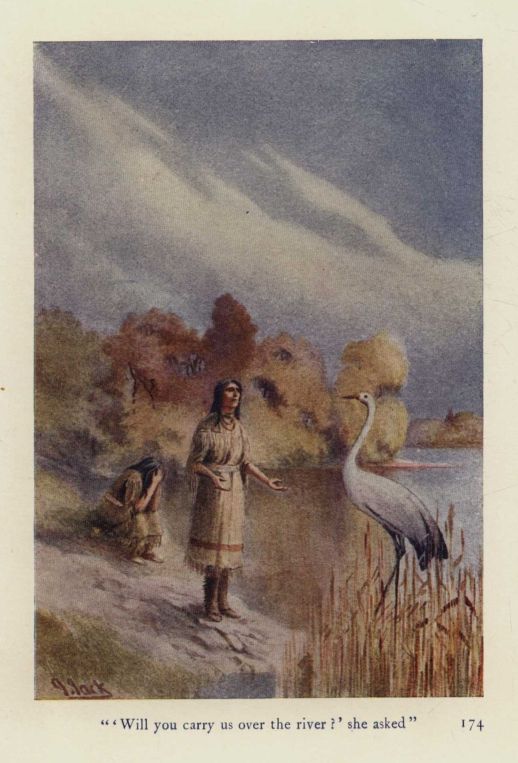
"Will you carry us over the river?" she asked at length.
"Willingly," replied the Crane, who was very susceptible to flattery, and he ferried them across the river.
They were just in time. Scarcely had they reached the opposite bank when Lox appeared on the scene, very angry and out of breath.
"Ferry me across, Old Crooked-legs," said he, and added other still more uncomplimentary remarks.
The Crane was furious, but he said nothing, and bore Lox out on the river.
"I see you," cried Lox to the trembling fairies. "I shall have you soon!"
"You shall not, wicked one," said the Crane, and he threw Lox into the deepest part of the stream.
The fairies turned their faces homeward and saw him no more.
The Malicious Mother-in-Law
An Ojibway or Chippeway legend tells of a hunter who was greatly devoted to his wife. As a proof of his affection he presented her with the most delicate morsels from the game he killed. This aroused the jealousy and envy of his mother, who lived with them, and who imagined that these little attentions should be paid to her, and not to the younger woman. The latter, quite unaware of her mother-in-law's attitude, cooked and ate the gifts her husband brought her. Being a woman of a gentle and agreeable disposition, who spent most of her time attending to her household duties and watching over her child and a little orphan boy whom she had adopted, she tried to make friends with the old dame, and was grieved and disappointed when the latter would not respond to her advances.
The mother-in-law nursed her grievance until it seemed of gigantic proportions. Her heart grew blacker and blacker against her son's wife, and at last she determined to kill her. For a time she could think of no way to put her evil intent into action, but finally she hit upon a plan.
One day she disappeared from the lodge, and returned after a space looking very happy and good-tempered. The younger woman was surprised and delighted at the alteration. This was an agreeably different person from the nagging, cross-grained old creature who had made her life a burden! The old woman repeatedly absented herself from her home after this, returning on each occasion with a pleased and contented smile on her wrinkled face. By and by the wife allowed her curiosity to get the better of her, and she asked the meaning of her mother-in-law's happiness.
The Death-Swing
"If you must know," replied the old woman, "I have made a beautiful swing down by the lake, and always when I swing on it I feel so well and happy that I cannot help smiling."
The young woman begged that she too might be allowed to enjoy the swing.
"To-morrow you may accompany me," was the reply. But next day the old woman had some excuse, and so on, day after day, till the curiosity of her son's wife was very keen. Thus when the elder woman said one day, "Come with me, and I will take you to the swing. Tie up your baby and leave him in charge of the orphan," the other complied eagerly, and was ready in a moment to go with her mother-in-law.
When they reached the shores of the lake they found a lithe sapling which hung over the water.
"Here is my swing," said the old creature, and she cast aside her robe, fastened a thong to her waist and to the sapling, and swung far over the lake. She laughed so much and seemed to find the pastime so pleasant that her daughter-in-law was more anxious than ever to try it for herself.
"Let me tie the thong for you," said the old woman, when she had tired of swinging. Her companion threw off her robe and allowed the leather thong to be fastened round her waist. When all was ready she was commanded to swing. Out over the water she went fearlessly, but as she did so the jealous old mother-in-law cut the thong, and she fell into the lake.
The old creature, exulting over the success of her cruel scheme, dressed herself in her victim's clothes and returned to the lodge. But the baby cried and refused to be fed by her, and the orphan boy cried too, for the young woman had been almost a mother to him since his parents had died.
"Where is the baby's mother?" he asked, when some hours had passed and she did not return.
"At the swing," replied the old woman roughly.
When the hunter returned from the chase he brought with him, as usual, some morsels of game for his wife, and, never dreaming that the woman bending over the child might not be she, he gave them to her. The lodge was dark, for it was evening, and his mother wore the clothes of his wife and imitated her voice and movements, so that his error was not surprising. Greedily she seized the tender pieces of meat, and cooked and ate them.
The heart of the little orphan was so sore that he could not sleep. In the middle of the night he rose and went to look for his foster-mother. Down by the lake he found the swing with the thong cut, and he knew that she had been killed. Crying bitterly, he crept home to his couch, and in the morning told the hunter all that he had seen.
"Say nothing," said the chief, "but come with me to hunt, and in the evening return to the shores of the lake with the child, while I pray to Manitou that he may send me back my wife."
The Silver Girdle
So they went off in search of game without a word to the old woman; nor did they stay to eat, but set out directly it was light. At sunset they made their way to the lake-side, the little orphan carrying the baby. Here the hunter blackened his face and prayed earnestly that the Great Manitou might send back his wife. While he prayed the orphan amused the child by singing quaint little songs; but at last the baby grew weary and hungry and began to cry.
Far in the lake his mother heard the sound, and skimmed over the water in the shape of a great white gull. When she touched the shore she became a woman again, and hugged the child to her heart's content. The orphan boy besought her to return to them.
"Alas!" said she, "I have fallen into the hands of the Water Manitou, and he has wound his silver tail about me, so that I never can escape."
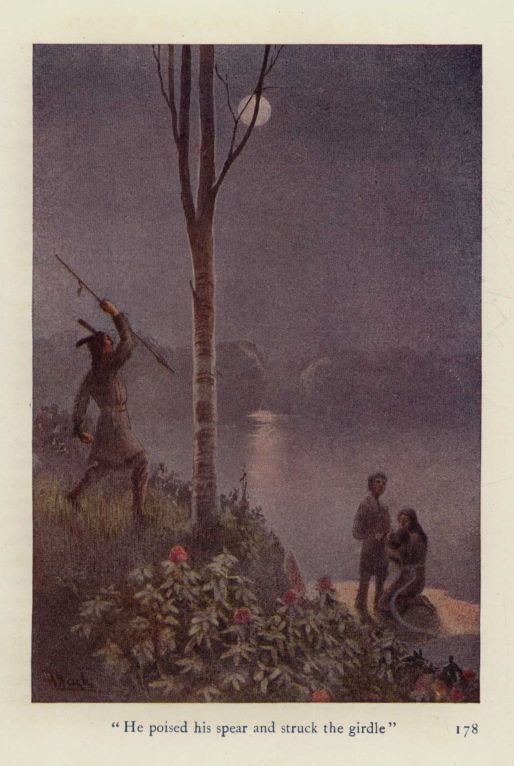
As she spoke the little lad saw that her waist was encircled by a band of gleaming silver, one end of which was in the water. At length she declared that it was time for her to return to the home of the water-god, and after having exacted a promise from the boy that he would bring her baby there every day, she became a gull again and flew away. The hunter was informed of all that had passed, and straightway determined that he would be present on the following evening. All next day he fasted and besought the good-will of Manitou, and when the night began to fall he hid himself on the shore till his wife appeared. Hastily emerging from his concealment, the hunter poised his spear and struck the girdle with all his force. The silver band parted, and the woman was free to return home with her husband.
"He poised his spear and struck the girdle"
Overjoyed at her restoration, he led her gently to the lodge, where his mother was sitting by the fire. At the sight of her daughter-in-law, whom she thought she had drowned in the lake, she started up in such fear and astonishment that she tripped, overbalanced, and fell into the fire. Before they could pull her out the flames had risen to the smoke-hole, and when the fire died down no woman was there, but a great black bird, which rose slowly from the smoking embers, flew out of the lodge, and was never seen again.
As for the others, they lived long and happily, undisturbed by the jealousy and hatred of the malicious crone.
The Maize Spirit
The Chippeways tell a charming story concerning the origin of the zea maize, which runs as follows:
A lad of fourteen or fifteen dwelt with his parents, brothers, and sisters in a beautifully situated little lodge. The family, though poor, were very happy and contented. The father was a hunter who was not lacking in courage and skill, but there were times when he could scarcely supply the wants of his family, and as none of his children was old enough to help him things went hardly with them then. The lad was of a cheerful and contented disposition, like his father, and his great desire was to benefit his people. The time had come for him to observe the initial fast prescribed for all Indian boys of his age, and his mother made him a little fasting-lodge in a remote spot where he might not suffer interruption during his ordeal.
Thither the boy repaired, meditating on the goodness of the Great Spirit, who had made all things beautiful in the fields and forests for the enjoyment of man. The desire to help his fellows was strong upon him, and he prayed that some means to that end might be revealed to him in a dream.
On the third day of his fast he was too weak to ramble through the forest, and as he lay in a state between sleeping and waking there came toward him a beautiful youth, richly dressed in green robes, and wearing on his head wonderful green plumes.
"The Great Spirit has heard your prayers," said the youth, and his voice was like the sound of the wind sighing through the grass. "Hearken to me and you shall have your desire fulfilled. Arise and wrestle with me."
The Struggle
The lad obeyed. Though his limbs were weak his brain was clear and active, and he felt he could not but obey the soft-voiced stranger. After a long, silent struggle the latter said:
"That will do for to-day. To-morrow I shall come again."
The lad lay back exhausted, but on the morrow the green-clad stranger reappeared, and the conflict was renewed. As the struggle went on the youth felt himself grow stronger and more confident, and before leaving him for the second time the supernatural visitor offered him some words of praise and encouragement.
On the third day the youth, pale and feeble, was again summoned to the contest. As he grasped his opponent the very contact seemed to give him new strength, and he fought more and more bravely, till his lithe companion was forced to cry out that he had had enough. Ere he took his departure the visitor told the lad that the following day would put an end to his trials.
"To-morrow," said he, "your father will bring you food, and that will help you. In the evening I shall come and wrestle with you. I know that you are destined to succeed and to obtain your heart's desire. When you have thrown me, strip off my garments and plumes, bury me where I fall, and keep the earth above me moist and clean. Once a month let my remains be covered with fresh earth, and you shall see me again, clothed in my green garments and plumes." So saying, he vanished.
The Final Contest
Next day the lad's father brought him food; the youth, however, begged that it might be set aside till evening. Once again the stranger appeared. Though he had eaten nothing, the hero's strength, as before, seemed to increase as he struggled, and at length he threw his opponent. Then he stripped off his garments and plumes, and buried him in the earth, not without sorrow in his heart for the slaying of such a beautiful youth.
His task done, he returned to his parents, and soon recovered his full strength. But he never forgot the grave of his friend. Not a weed was allowed to grow on it, and finally he was rewarded by seeing the green plumes rise above the earth and broaden out into graceful leaves. When the autumn came he requested his father to accompany him to the place. By this time the plant was at its full height, tall and beautiful, with waving leaves and golden tassels. The elder man was filled with surprise and admiration.
"It is my friend," murmured the youth, "the friend of my dreams."
"It is Mon-da-min," said his father, "the spirit's grain, the gift of the Great Spirit."
And in this manner was maize given to the Indians.
The Seven Brothers
The Blackfeet have a curious legend in explanation of the constellation known as the Plough or Great Bear. Once there dwelt together nine children, seven boys and two girls. While the six older brothers were away on the war-path the elder daughter, whose name was Bearskin-woman, married a grizzly bear. Her father was so enraged that he collected his friends and ordered them to surround the grizzly's cave and slay him. When the girl heard that her spouse had been killed she took a piece of his skin and wore it as an amulet. Through the agency of her husband's supernatural power, one dark night she was changed into a grizzly bear, and rushed through the camp, killing and rending the people, even her own father and mother, sparing only her youngest brother and her sister, Okinai and Sinopa. She then took her former shape, and returned to the lodge occupied by the two orphans, who were greatly terrified when they heard her muttering to herself, planning their deaths.
Sinopa had gone to the river one day, when she met her six brothers returning from the war-path. She told them what had happened in their absence. They reassured her, and bade her gather a large number of prickly pears. These she was to strew in front of the lodge, leaving only a small path uncovered by them. In the dead of night Okinai and Sinopa crept out of the lodge, picking their way down the little path that was free from the prickly pears, and meeting their six brothers, who were awaiting them. The Bearskin-woman heard them leaving the lodge, and rushed out into the open, only to tread on the prickly pears. Roaring with pain and anger, she immediately assumed her bear shape and rushed furiously at her brothers. But Okinai rose to the occasion. He shot an arrow into the air, and so far as it flew the brothers and sister found themselves just that distance in front of the savage animal behind them.
The Chase
The beast gained on them, however; but Okinai waved a magic feather, and thick underbrush rose in its path. Again Bearskin-woman made headway. Okinai caused a lake to spring up before her. Yet again she neared the brothers and sister, and this time Okinai raised a great tree, into which the refugees climbed. The Grizzly-woman, however, succeeded in dragging four of the brothers from the tree, when Okinai shot an arrow into the air. Immediately his little sister sailed into the sky. Six times more he shot an arrow, and each time a brother went up, Okinai himself following them as the last arrow soared into the blue. Thus the orphans became stars; and one can see that they took the same position in the sky as they had occupied in the tree, for the small star at one side of the bunch is Sinopa, while the four who huddle together at the bottom are those who had been dragged from the branches by Bearskin-woman.
The Beaver Medicine Legend[2]
Two brothers dwelt together in the old time. The elder, who was named Nopatsis, was married to a woman who was wholly evil, and who hated his younger brother, Akaiyan. Daily the wife pestered her husband to be rid of Akaiyan, but he would not agree to part with his only brother, for they had been together through long years of privation—indeed, since their parents had left them together as little helpless orphans—and they were all in all to each other. So the wife of Nopatsis had resort to a ruse well known to women whose hearts are evil. One day when her husband returned from the chase he found her lamenting with torn clothes and disordered appearance. She told him that Akaiyan had treated her brutally. The lie entered into the heart of Nopatsis and made it heavy, so that in time he conceived a hatred of his innocent brother, and debated with himself how he should rid himself of Akaiyan.
Summer arrived, and with it the moulting season when the wild water-fowl shed their feathers, with which the Indians fledge their arrows. Near Nopatsis's lodge there was a great lake, to which these birds resorted in large numbers, and to this place the brothers went to collect feathers with which to plume their darts. They built a raft to enable them to reach an island in the middle of the lake, making it of logs bound securely with buffalo-hide. Embarking, they sailed to the little island, along the shores of which they walked, looking for suitable feathers. They parted in the quest, and after some time Akaiyan, who had wandered far along the strand, suddenly looked up to see his brother on the raft sailing toward the mainland. He called loudly to him to return, but Nopatsis replied that he deserved to perish there because of the brutal manner in which he had treated his sister-in-law. Akaiyan solemnly swore that he had not injured her in any way, but Nopatsis only jeered at him, and rowed away. Soon he was lost to sight, and Akaiyan sat down and wept bitterly. He prayed earnestly to the nature spirits and to the sun and moon, after which he felt greatly uplifted. Then he improvised a shelter of branches, and made a bed of feathers of the most comfortable description. He lived well on the ducks and geese which frequented the island, and made a warm robe against the winter season from their skins. He was careful also to preserve many of the tame birds for his winter food.
One day he encountered the lodge of a beaver, and while he looked at it curiously he became aware of the presence of a little beaver.
"My father desires that you will enter his dwelling," said the animal. So Akaiyan accepted the invitation and entered the lodge, where the Great Beaver, attended by his wife and family, received him. He was, indeed, the chief of all the beavers, and white with the snows of countless winters. Akaiyan told the Beaver how cruelly he had been treated, and the wise animal condoled with him, and invited him to spend the winter in his lodge, when he would learn many wonderful and useful things. Akaiyan gratefully accepted the invitation, and when the beavers closed up their lodge for the winter he remained with them. They kept him warm by placing their thick, soft tails on his body, and taught him the secret of the healing art, the use of tobacco, and various ceremonial dances, songs, and prayers belonging to the great mystery of 'medicine.'
The summer returned, and on parting the Beaver asked Akaiyan to choose a gift. He chose the Beaver's youngest child, with whom he had contracted a strong friendship; but the father prized his little one greatly, and would not at first permit him to go. At length, however, Great Beaver gave way to Akaiyan's entreaties and allowed him to take Little Beaver with him, counselling him to construct a sacred Beaver Bundle when he arrived at his native village.
In due time Nopatsis came to the island on his raft, and, making sure that his brother was dead, began to search for his remains. But while he searched, Akaiyan caught up Little Beaver in his arms and, embarking on the raft, made for the mainland, espied by Nopatsis. When Akaiyan arrived at his native village he told his story to the chief, gathered a Beaver Bundle, and commenced to teach the people the mystery of 'medicine,' with its accompanying songs and dances. Then he invited the chiefs of the animal tribes to contribute their knowledge to the Beaver Medicine, which many of them did.
Having accomplished his task of instruction, which occupied him all the winter, Akaiyan returned to the island with Little Beaver, who had been of immense service to him in teaching the Indians the 'medicine' songs and dances. He returned Little Beaver to his parents, and received in exchange for him a sacred pipe, being also instructed in its accompanying songs and ceremonial dances. On the island he found the bones of his credulous and vengeful brother, who had met with the fate he had purposed for the innocent Akaiyan. Every spring Akaiyan visited the beavers, and as regularly he received something to add to the Beaver Medicine Bundle, until it reached the great size it now has. And he married and founded a race of medicine-men who have handed down the traditions and ceremonials of the Beaver Medicine to the present day.
The Sacred Bear-Spear
An interesting Blackfoot myth relates how that tribe obtained its sacred Bear-spear. Many generations ago, even before the Blackfeet used horses as beasts of burden, the tribe was undertaking its autumn migration, when one evening before striking camp for the night it was reported that a dog-sledge or cart belonging to the chief was missing. To make matters worse, the chief's ermine robe and his wife's buckskin dress, with her sacred elk-skin robe, had been packed in the little cart. Strangely enough, no one could recollect having noticed the dog during the march. Messengers were dispatched to the camping-site of the night before, but to no avail. At last the chief's son, Sokumapi, a boy about twelve years of age, begged to be allowed to search for the missing dog, a proposal to which his father, after some demur, consented. Sokumapi set out alone for the last camping-ground, which was under the shadows of the Rocky Mountains, and carefully examined the site. Soon he found a single dog-sledge track leading into a deep gulch, near the entrance to which he discovered a large cave. A heap of freshly turned earth stood in front of the cave, beside which was the missing cart. As he stood looking at it, wondering what had become of the dog which had drawn it, an immense grizzly-bear suddenly dashed out. So rapid was its attack that Sokumapi had no chance either to defend himself or to take refuge in flight. The bear, giving vent to the most terrific roars, dragged him into the cave, hugging him with such force that he fainted. When he regained consciousness it was to find the bear's great head within a foot of his own, and he thought that he saw a kindly and almost human expression in its big brown eyes. For a long time he lay still, until at last, to his intense surprise, the Bear broke the silence by addressing him in human speech.
"Have no fear," said the grizzly. "I am the Great Bear, and my power is extensive. I know the circumstances of your search, and I have drawn you to this cavern because I desired to assist you. Winter is upon us, and you had better remain with me during the cold season, in the course of which I will reveal to you the secret of my supernatural power."
Bear Magic
It will be observed that the circumstances of this tale are almost identical with those which relate to the manner in which the Beaver Medicine was revealed to mankind. The hero of both stories remains during the winter with the animal, the chief of its species, who in the period of hibernation instructs him in certain potent mysteries.
The Bear, having reassured Sokumapi, showed him how to transform various substances into food. His strange host slept during most of the winter; but when the warm winds of spring returned and the snows melted from the hills the grizzly became restless, and told Sokumapi that it was time to leave the cave. Before they quitted it, however, he taught the lad the secret of his supernatural power. Among other things, he showed him how to make a Bear-spear. He instructed him to take a long stick, to one end of which he must secure a sharp point, to symbolize the bear's tusks. To the staff must be attached a bear's nose and teeth, while the rest of the spear was to be covered with bear's skin, painted the sacred colour, red. The Bear also told him to decorate the handle with eagle's feathers and grizzly claws, and in war-time to wear a grizzly claw in his hair, so that the strength of the Great Bear might go with him in battle, and to imitate the noise a grizzly makes when it charges. The Bear furthermore instructed him what songs should be used in order to heal the sick, and how to paint his face and body so that he would be invulnerable in battle, and, lastly, told him of the sacred nature of the spear, which was only to be employed in warfare and for curing disease. Thus if a person was sick unto death, and a relative purchased the Bear-spear, its supernatural power would restore the ailing man to health. Equipped with this knowledge, Sokumapi returned to his people, who had long mourned him as dead. After a feast had been given to celebrate his home-coming he began to manufacture the Bear-spear as directed by his friend.
How the Magic Worked
Shortly after his return the Crows made war upon the Blackfeet, and on the meeting of the two tribes in battle Sokumapi appeared in front of his people carrying the Bear-spear on his back. His face and body were painted as the Great Bear had instructed him, and he sang the battle-songs that the grizzly had taught him. After these ceremonies he impetuously charged the enemy, followed by all his braves in a solid phalanx, and such was the efficacy of the Bear magic that the Crows immediately took to flight. The victorious Blackfeet brought back Sokumapi to their camp in triumph, to the accompaniment of the Bear songs. He was made a war-chief, and ever afterward the spear which he had used was regarded as the palladium of the Blackfoot Indians. In the spring the Bear-spear is unrolled from its covering and produced when the first thunder is heard, and when the Bear begins to quit his winter quarters; but when the Bear returns to his den to hibernate the spear is once more rolled up and put away. The greatest care is taken to protect it against injury. It has a special guardian, and no woman is permitted to touch it.
The Young Dog Dance
A dance resembling the Sun Dance was formerly known to the Pawnee Indians, who called it the Young Dog Dance. It was, they said, borrowed from the Crees, who produced the following myth to account for it.
One day a young brave of the Cree tribe had gone out from his village to catch eagles, in order to provide himself with feathers for a war-bonnet, or to tie in his hair. Now the Crees caught eagles in this fashion. On the top of a hill frequented by these birds they would dig a pit and cover it over with a roof of poles, cunningly concealing the structure with grass. A piece of meat was fastened to the poles, so that the eagles could not carry it off. Then the Indian, taking off his clothes, would descend into the pit, and remain there for hours, or days, as the case might be, until an eagle was attracted by the bait, when he would put his hand between the poles, seize the bird by the feet, and quickly dispatch it.
The young brave whose fortune it was to discover the Young Dog Dance had prepared the trap in this wise, and was lying in the pit praying that an eagle might come and bring his uncomfortable vigil to an end. Suddenly he heard a sound of drumming, distant but quite distinct, though he could not tell from what direction it proceeded. All night the mysterious noise continued. Next night as he lay in the same position he heard it again, and resolved to find out its origin, so he clambered out of his pit and went off in the direction from which the drum-beating seemed to proceed. At last, when dawn was near, he reached the shores of a great lake. Here he stopped, for the sounds quite evidently came from the lake. All that day he sat by the water bemoaning his ill-luck and praying for better fortune. When night fell the drumming began anew, and the young man saw countless animals and birds swimming in the lake. Four days he remained on the lake-shore, till at length, worn out by fatigue and hunger (for many days had elapsed since he had eaten), he fell asleep.
The Lodge of Animals
When he awoke he found himself in a large lodge, surrounded by many people, some of whom were dancing, while others sat round the walls. All these people wore robes made from the skins of various animals or birds. They were, in fact, the animals the young Indian had seen swimming in the water, who had changed themselves into human shape. A chief at the back of the lodge stood up and addressed him thus:
"My friend, we have heard your prayers, and our desire is to help you. You see these people? They represent the animals. I am the Dog. The Great Spirit is very fond of dogs. I have much power, and my power I shall give to you, so that you may be like me, and my spirit will always protect you. Take this dance home to your people, and it will make them lucky in war." And he imparted the nature of the rite to the Indian by action.
The Dog turned from the Cree brave and his eye swept the company.
The Gift
"Brothers," he said, "I have given him my power. Will you not pity him and give him the power you have?"
For a time there was silence. No one seemed disposed to respond to the chief's appeal. At last the Owl rose.
"I will help you," he said to the young man. "I have power to see in the dark wherever I may go. When you go out at night I will be near you, and you shall see as well as I do. Take these feathers and tie them in your hair." And, giving him a bunch of feathers, the Owl sat down.
There was a pause, and the next to rise was the Buffalo Bull, who gave to the young Indian his strength and endurance and the power to trample his enemies underfoot. As a token he gave him a shoulder-belt of tanned buffalo-hide, bidding him wear it when he went on the war-path.
By and by the Porcupine stood up and addressed the guest. Giving him some of his quills with which to ornament the leather belt, he said:
"I also will help you. I can make my enemies as weak as women, so that they fly before me. When you fight your foes shall flee and you shall overcome them."
Another long silence ensued, and when at last the Eagle rose every one listened to hear what he had to say.
"I also," he said majestically, "will be with you wherever you go, and will give you my prowess in war, so that you may kill your foes as I do." As he spoke he handed to the brave some eagle feathers to tie in his hair.
The Whooping Crane followed, and gave him a bone from its wing for a war-whistle to frighten his enemies away.
The Deer and the Bear came next, the one giving him swiftness, with a rattle as token, and the other hardiness, and a strip of fur for his belt.
After he had received these gifts from the animals the brave lay down and fell asleep again. When he awoke he found himself on the shores of the lake once more.
Returning home, he taught the Crees the Young Dog Dance, which was to make them skilful in war, and showed them the articles he had received. So the young men formed a Society of Young Dogs, which practised the dance and obtained the benefits.
The Medicine Wolf
A quaint story of a 'medicine' wolf is told among the Blackfoot Indians. On one occasion when the Blackfeet were moving camp they were attacked by a number of Crow Indians who had been lying in wait for them. The Blackfeet were travelling slowly in a long, straggling line, with the old men and the women and children in the middle, and a band of warriors in front and in the rear. The Crows, as has been said, made an ambush for their enemies, and rushed out on the middle portion of the line. Before either party of the Blackfoot warriors could reach the scene of the struggle many of the women and children had perished, and others were taken captive by the attacking force. Among the prisoners was a young woman called Sits-by-the-door. Many weary miles lay between them and the Crow camp on the Yellowstone River, but at length the tired captives, mounted with their captors on jaded horses, arrived at their destination. The warrior who had taken Sits-by-the-door prisoner now presented her to a friend of his, who in turn gave her into the keeping of his wife, who was somewhat older than her charge. The young Blackfoot woman was cruelly treated by the Crow into whose possession she had passed. Every night he tied her feet together so that she might not escape, and also tied a rope round her waist, the other end of which he fastened to his wife. The Crow woman, however, was not unmoved by the wretchedness of her prisoner. While her husband was out she managed to converse with her and to show her that she pitied her misfortunes. One day she informed Sits-by-the-door that she had overheard her husband and his companions plotting to kill her, but she added that when darkness fell she would help her to escape. When night came the Crow woman waited until the deep breathing of her husband told her that he was sound asleep; then, rising cautiously, she loosened the ropes that bound her captive, and, giving her a pair of moccasins, a flint, and a small sack of pemmican, bade her make haste and escape from the fate that would surely befall her if she remained where she was. The trembling woman obeyed, and travelled at a good pace all night. At dawn she hid in the dense undergrowth, hoping to escape observation should her captors pursue her. They, meanwhile, had discovered her absence, and were searching high and low, but no tracks were visible, and at last, wearied with their unprofitable search, they gave up the chase and returned to their homes.