Chapter II · : MEXICAN MYTHOLOGY (continued 2)
Reading edition
If the sins of the penitent were not very grave the priest would enjoin upon him a fast of a more or less prolonged nature. Only old men confessed crimes in veneribus, as the punishment for such was death, and younger men had no desire to risk the penalty involved, although the priests were enjoined to strict secrecy.
Father Burgoa describes very fully a ceremony of this kind which came under his notice in 1652 in the Zapotec village of San Francisco de Cajonos. He encountered on a tour of inspection an old native cacique, or chief, of great refinement of manners and of a stately presence, who dressed in costly garments after the Spanish fashion, and who was regarded by the Indians with much veneration. This man came to the priest for the purpose of reporting upon the progress in things spiritual and temporal in his village. Burgoa recognised his urbanity and wonderful command of the Spanish language, but perceived by certain signs that he had been taught to look for by long experience that the man was a pagan. He communicated his suspicions to the vicar of the village, but met with such assurances of the cacique’s soundness of faith that he believed himself to be in error for once. Shortly afterwards, however, a wandering Spaniard perceived the chief in a retired place in the mountains performing idolatrous ceremonies, and aroused the monks, two of whom accompanied him to the spot where the cacique had been seen indulging in his heathenish practices. They found on the altar “feathers of many colours, sprinkled with blood which the Indians had drawn from the veins under their tongues and behind their ears, incense spoons and remains of copal, and in the middle a horrible stone figure, which was the god to whom they had offered this sacrifice in expiation of their sins, while they made their confessions to the blasphemous priests, and cast off their sins in the following manner: they had woven a kind of dish out of a strong herb, specially gathered for this purpose, and casting this before the priest, said to him that they came to beg mercy of their god, and pardon for their sins that they had committed during that year, and that they brought them all carefully enumerated. They then drew out of a cloth pairs of thin threads made of dry maize husks, that they had tied two by two in the middle with a knot, by which they represented their sins. They laid these threads on the dishes of grass, and over them pierced their veins, and let the blood trickle upon them, and the priest took these offerings to the idol, and in a long speech he begged the god to forgive these, his sons, their sins which were brought to him, and to permit them to be joyful and hold feasts to him as their god and lord. Then the priest came back to those who had confessed, delivered a long discourse on the ceremonies they had still to perform, and told them that the god had pardoned them and that they might be glad again and sin anew.”
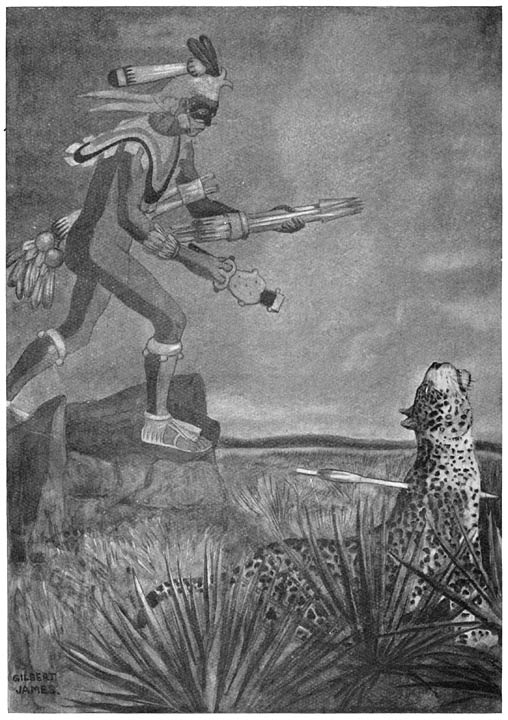
Cloud Serpent, the Hunter-God
Gilbert James
Chalchihuitlicue
This goddess was the wife of Tlaloc, the god of rain and moisture. The name means Lady of the Emerald Robe, in allusion to the colour of the element over which the deity partly presided. She was specially worshipped by the water-carriers of Mexico, and all those whose avocation brought them into contact with water. Her costume was peculiar and interesting. Round her neck she wore a wonderful collar of precious stones, from which hung a gold pendant. She was crowned with a coronet of blue paper, decorated with green feathers. Her eyebrows were of turquoise, set in as mosaic, and her garment was a nebulous blue-green in hue, recalling the tint of sea-water in the tropics. The resemblance was heightened by a border of sea-flowers or water-plants, one of which she also carried in her left hand, whilst in her right she bore a vase surmounted by a cross, emblematic of the four points of the compass whence comes the rain.
Mixcoatl
Mixcoatl was the Aztec god of the chase, and was probably a deity of the Otomi aborigines of Mexico. The name means Cloud Serpent, and this originated the idea that Mixcoatl was a representation of the tropical whirlwind. This is scarcely correct, however, as the hunter-god is identified with the tempest and thunder-cloud, and the lightning is supposed to represent his arrows. Like many other gods of the chase, he is figured as having the characteristics of a deer or rabbit. He is usually depicted as carrying a sheaf of arrows, to typify thunderbolts. It may be that Mixcoatl was an air and thunder deity of the Otomi, older in origin than either Quetzalcoatl or Tezcatlipoca, and that his inclusion in the Nahua pantheon becoming necessary in order to quieten Nahua susceptibilities, he received the status of god of the chase. But, on the other hand, the Mexicans, unlike the Peruvians, who adopted many foreign gods for political purposes, had little regard for the feelings of other races, and only accepted an alien deity into the native circle for some good reason, most probably because they noted the omission of the figure in their own divine system. Or, again, dread of a certain foreign god might force them to adopt him as their own in the hope of placating him. Their worship of Quetzalcoatl is perhaps an instance of this.
Camaxtli
This deity was the war-god of the Tlascalans, who were constantly in opposition to the Aztecs of Mexico. He was to the warriors of Tlascala practically what Huitzilopochtli was to those of Mexico. He was closely identified with Mixcoatl, and with the god of the morning star, whose colours are depicted on his face and body. But in all probability Camaxtli was a god of the chase, who in later times was adopted as a god of war because of his possession of the lightning dart, the symbol of divine warlike prowess. In the mythologies of North America we find similar hunter-gods, who sometimes evolve into gods of war for a like reason, and again gods of the chase who have all the appearance and attributes of the creatures hunted.
Iztlilton
Ixtlilton (The Little Black One) was the Mexican god of medicine and healing, and therefore was often alluded to as the brother of Macuilxochitl, the god of well-being or good luck. From the account of the general appearance of his temple—an edifice of painted boards—it would seem to have evolved from the primitive tent or lodge of the medicine-man, or shaman. It contained several water-jars called tlilatl (black water), the contents of which were administered to children in bad health. The parents of children who benefited from the treatment bestowed a feast on the deity, whose idol was carried to the residence of the grateful father, where ceremonial dances and oblations were made before it. It was then thought that Ixtlilton descended to the courtyard to open fresh jars of pulque liquor provided for the feasters, and the entertainment concluded by an examination by the Aztec Æsculapius of such of the pulque jars dedicated to his service as stood in the courtyard for everyday use. Should these be found in an unclean condition, it was understood that the master of the house was a man of evil life, and he was presented by the priest with a mask to hide his face from his scoffing friends.
Omacatl
Omacatl was the Mexican god of festivity and joy. The name signifies Two Reeds. He was worshipped chiefly by bon-vivants and the rich, who celebrated him in splendid feasts and orgies. The idol of the deity was invariably placed in the chamber where these functions were to take place, and the Aztecs were known to regard it as a heinous offence if anything derogatory to the god were performed during the convivial ceremony, or if any omission were made from the prescribed form which these gatherings usually took. It was thought that if the host had been in any way remiss Omacatl would appear to the startled guests, and in tones of great severity upbraid him who had given the feast, intimating that he would regard him no longer as a worshipper and would henceforth abandon him. A terrible malady, the symptoms of which were akin to those of falling-sickness, would shortly afterwards seize the guests; but as such symptoms are not unlike those connected with acute indigestion and other gastric troubles, it is probable that the gourmets who paid homage to the god of good cheer may have been suffering from a too strenuous instead of a lukewarm worship of him. But the idea of communion which underlay so many of the Mexican rites undoubtedly entered into the worship of Omacatl, for prior to a banquet in his honour those who took part in it formed a great bone out of maize paste, pretending that it was one of the bones of the deity whose merry rites they were about to engage in. This they devoured, washing it down with great draughts of pulque. The idol of Omacatl was provided with a recess in the region of the stomach, and into this provisions were stuffed. He was represented as a squatting figure, painted black and white, crowned with a paper coronet, and hung with coloured paper. A flower-fringed cloak and sceptre were the other symbols of royalty worn by this Mexican Dionysus.
Opochtli
Opochtli (The Left-handed) was the god sacred to fishers and bird-catchers. At one period of Aztec history he must have been a deity of considerable consequence, since for generations the Aztecs were marsh-dwellers and depended for their daily food on the fish netted in the lakes and the birds snared in the reeds. They credited the god with the invention of the harpoon or trident for spearing fish and the fishing-rod and bird-net. The fishermen and bird-catchers of Mexico held on occasion a special feast in honour of Opochtli, at which a certain liquor called octli was consumed. A procession was afterwards formed, in which marched old people who had dedicated themselves to the worship of the god, probably because they could obtain no other means of subsistence than that afforded by the vocation of which he was tutelar and patron. He was represented as a man painted black, his head decorated with the plumes of native wild birds, and crowned by a paper coronet in the shape of a rose. He was clad in green paper which fell to the knee, and was shod with white sandals. In his left hand he held a shield painted red, having in the centre a white flower with four petals placed crosswise, and in his right hand he held a sceptre in the form of a cup.
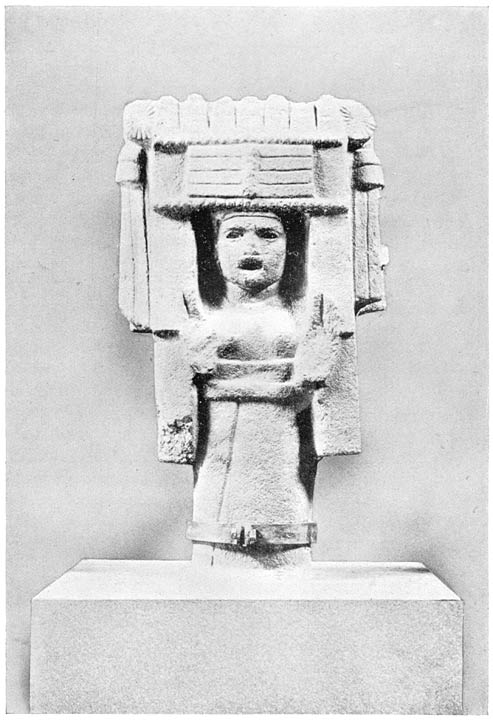
Mexican Goddess
Photo C. B. Waite, Mexico
Yacatecutli
Yacatecutli was the patron of travellers of the merchant class, who worshipped him by piling their staves together and sprinkling on the heap blood from their noses and ears. The staff of the traveller was his symbol, to which prayer was made and offerings of flowers and incense tendered.
The Aztec Priesthood
The Aztec priesthood was a hierarchy in whose hands resided a goodly portion of the power of the upper classes, especially that connected with education and endowment. The mere fact that its members possessed the power of selecting victims for sacrifice must have been sufficient to place them in an almost unassailable position, and their prophetic utterances, founded upon the art of divination—so great a feature in the life of the Aztec people, who depended upon it from the cradle to the grave—probably assisted them in maintaining their hold upon the popular imagination. But withal the evidence of unbiased Spanish ecclesiastics, such as Sahagun, tends to show that they utilised their influence for good, and soundly instructed the people under their charge in the cardinal virtues; “in short,” says the venerable friar, “to perform the duties plainly pointed out by natural religion.”
Priestly Revenues
The establishment of the national religion was, as in the case of the mediæval Church in Europe, based upon a land tenure from which the priestly class derived a substantial though, considering their numbers, by no means inordinate revenue. The principal temples possessed lands which sufficed for the maintenance of the priests attached to them. There was, besides, a system of first-fruits fixed by law for the priesthood, the surplusage therefrom being distributed among the poor.
Education
Education was entirely conducted by the priesthood, which undertook the task in a manner highly creditable to it, when consideration is given to surrounding conditions. Education was, indeed, highly organised. It was divided into primary and secondary grades. Boys were instructed by priests, girls by holy women or “nuns.” The secondary schools were called calmecac, and were devoted to the higher branches of education, the curriculum including the deciphering of the pinturas, or manuscripts, astrology and divination, with a wealth of religious instruction.
Orders of the Priesthood
At the head of the Aztec priesthood stood the Mexicatl Teohuatzin (Mexican Lord of Divine Matters). He had a seat on the emperor’s council, and possessed power which was second only to the royal authority. Next in rank to him was the high-priest of Quetzalcoatl, who dwelt in almost entire seclusion, and who had authority over his own caste only. This office was in all probability a relic from “Toltec” times. The priests of Quetzalcoatl were called by name after their tutelar deity. The lesser grades included the Tlenamacac (Ordinary Priests), who were habited in black, and wore their hair long, covering it with a kind of mantilla. The lowest order was that of the Lamacazton (Little Priests), youths who were graduating in the priestly office.
An Exacting Ritual
The priesthood enjoyed no easy existence, but led an austere life of fasting, penance, and prayer, with constant observance of an arduous and exacting ritual, which embraced sacrifice, the upkeep of perpetual fires, the chanting of holy songs to the gods, dances, and the superintendence of the ever-recurring festivals. They were required to rise during the night to render praise, and to maintain themselves in a condition of absolute cleanliness by means of constant ablutions. We have seen that blood-offering—the substitution of the part for the whole—was a common method of sacrifice, and in this the priests engaged personally on frequent occasions. If the caste did not spare the people it certainly did not spare itself, and its outlook was perhaps only a shade more gloomy and fanatical than that of the Spanish hierarchy which succeeded it in the land.
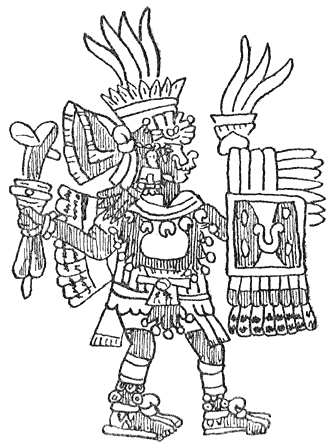
Tepoxtecatl