NOTES.
Reading edition
Rates, Trains, Hotel Accommodations.—The round-trip fare from Tacoma via the Tacoma Eastern is $6.00. This includes railway transportation to Ashford and automobile-stage ride from Ashford to Longmire Springs and return. Tickets are good for the season. To parties of ten or more traveling together a single ticket is issued at $5.00 per capita. A week-end ticket, Saturday to Monday, is sold at $5.00. The rates from Seattle to the Springs are $1.50 more, in each case, than the Tacoma rates. The train schedule for 1911 follows:
SOUTHBOUND NORTHBOUND
Leave Seattle 7.45 a. m. and 12.30 p. m. Leave Inn 7.15 a. m. and 1.30 p. m.
Arrive Tacoma 8.55 a. m. and 1.40 p. m. Arrive Ashford 8.30 a. m. and 2.45 p. m.
Leave Tacoma 9.05 a. m. and 1.50 p. m. Leave Ashford 8.40 a. m. and 2.55 p. m.
Arrive Ashford 11.20 a. m. and 4.05 p. m. Arrive Tacoma 10.55 a. m. and 5.10 p. m.
Leave Ashford 11.30 a. m. and 4.15 p. m. Leave Tacoma 11.05 a. m. and 5.15 p. m.
Arrive at Inn 12.45 p. m. and 5.30 p. m. Arrive Seattle 12.15 p. m. and 6.30 p. m.
The National Park Inn, Longmire Springs, provides excellent rooms in the Inn, with a large number of well-furnished and comfortable tents near by. The rates range from $2.50 to $3.75 a day, including meals. The dining-room is under the Chicago, Milwaukee & Puget Sound dining-car management, which insures a satisfactory table.
At the older Longmire Hotel, the rate is $2.50 a day for room and board. This hotel is open all the year, and in winter is much frequented by persons seeking Winter sports, or making use of the mineral springs.
The springs are of great variety, and are highly recommended for their medicinal virtues. Within an area of several acres, there are a score of these springs, varying from the normal temperature of a mountain stream almost to blood heat. Well-appointed bathhouses are maintained. Fee, including attendance, $1.00.
At Reese's Camp, in Paradise Park, and at Mrs. Hall's similar tent hotel in Indian Henry's Park, the charge for meals, with a tent for sleeping, is $2.50 per day.
Stages, Horses, Guides.—The cost of getting from Longmire Springs to Paradise or Indian Henry's is moderate. Many prefer to make the trips on foot over the mountain trails. Parties are made up several times a day, under experienced guides, for each of these great "parks," and sure-footed horses are provided for those who wish to ride, at $1.50 for the round trip. Guides and horses for the new trail to Eagle Peak are at the same rate. Guides may be had at the National Park Inn or at either of the "camps" for many interesting trips over the mountain trails. Horses also are furnished. The charge varies with the number in a party.
Stages carry passengers from the Inn over the government road to Nisqually glacier, Narada Falls and Reese's Camp in Paradise Park. The charge for the trip to Narada and return is $2.00; to Paradise and return, $3.00.
For those who wish to make the ascent to the summit over the Gibraltar trail, trustworthy guides may be engaged at the Inn or at Reese's. Arrangements should be made several days in advance. The cost of such a trip depends upon the number in a party. The guides make a charge of $25 for the first member of the party, and $5 each for the others. They furnish alpenstocks, ropes, and calks for the shoes of climbers at a reasonable charge. Each person should carry with him a blanket or extra coat and a small amount of food, for use in the event of being on the summit over night. Still heavier clothing will be required if the night is to be spent at Camp Muir. A sleeping-bag, which can be easily made, or purchased at any outfitter's, will prove invaluable to campers. Ascents from other points than Reese's are usually made in special parties. All persons are warned not to attempt an ascent unless accompanied by experienced guides. Lives have been lost through neglect of this precaution.
For persons visiting the North Side, the Northern Pacific rate from Tacoma to Fairfax is $1.25, and from Seattle to Fairfax, with change of cars at Puyallup, $1.75. Guides and horses may be engaged at Fairfax for the Spray Park trail.
Automobiles and Motorcycles.—These vehicles are permitted to use the government road, as far as the Nisqually glacier, under the following regulations of the Interior Department:
No automobile or motorcycle will be permitted within the Park unless its owner secures a written permit from the Superintendent, Edward S. Hall, Ashford, Washington, or his representative. Applications must show: Names of owner and driver, number of machine, and inclusive dates for which permit is desired, not exceeding one year, and be accompanied by a fee of $5 for each automobile and $1 for each motorcycle. All permits will expire on December 31. Permits must be presented to the Superintendent or his authorized representatives at the park entrance on the government road.
Automobiles and motorcycles will be permitted on the government road west of Longmire Springs between the hours of 7 a. m. and 8.30 p. m., but no automobile or motorcycle shall enter the Park or leave Longmire Springs in the direction of the western boundary, later than 8 p. m., the use of automobiles and motorcycles to be permitted between Longmire Springs and Nisqually glacier between the hours of 9 a. m. and 9.30 p. m., but no automobile or motorcycle shall leave Longmire Springs in the direction of the glacier later than 7 p. m.
When teams, saddle horses, or pack trains approach, automobiles and motorcycles shall take position on the outer edge of the roadway, taking care that sufficient room is left on the inside for them to pass, and remaining at rest until they have passed, or until the drivers are satisfied regarding the safety of their horses. Horses have the right of way, and automobiles and motorcycles will be backed or otherwise handled to enable horses to pass with safety.
Speed shall be limited to 6 miles per hour, except on straight stretches where approaching teams, saddle horses, and pack trains will be visible, when, if none are in sight, this speed may be increased to the rate indicated on signboards along the road; in no event, however, shall it exceed 15 miles per hour. Signal with horn shall be given at or near every bend to announce to approaching drivers the proximity of a machine.
Violation of any of the foregoing rules, or the general regulations of the Park, will cause the revocation of permit, subject the owner of the automobile or motorcycle to any damages occasioned thereby and to ejectment from the reservation, and be cause for refusal to issue a new permit without prior sanction in writing from the Secretary of the Interior.
Literature of the Mountain.—Vancouver, Winthrop, Kautz, Stevens and Van Trump have been noted in the text. Other early accounts of, or references to, the Mountain may be found in Wilkes: Narrative U. S. exploring expedition. Phil. 1845, v. 4, 413, 415, 424; U. S. War Dep't: Explorations for railroad to Pacific, 1853-4, v. 1, 192; Gibbs: Journal Am. Geog. Soc., v. 4, 354-357. Gibbs's Indian vocabularies, published at different dates, were reprinted four years after his death in Contributions to Am. Ethnol., v. 1. Wash. 1877.
For Emmons's account of his exploration in 1870, see Bulletin Am. Geog. Soc. v. 9, 44-61. Am. Jour. of Science, v. 101, 157-167, and Nation v. 23, 313. Prof. Israel C. Russell's studies of the peak are in U. S. geol. survey, 5th an. rep. 335-339 and 18th an. rep., part 2, 349-415. See also his Glaciers of N. Am., Bost. 1901, 62-67, and Volcanoes of N. Am., Bost. 1895, 241-246. For other accessible studies consult Wright: Ice age in N. Am. N. Y. 1889, and Muir: Our national parks, Bost. 1901.
The long controversy over the name of the peak is impartially reviewed in Snowden: History of Washington. N. Y. 1909, v. 4, 249-254. Snowden calls especial attention to an able paper by the late Thaddeus Hanford of Olympia on the Indian names and recommending the name Tacoma for the Territory, which was printed in the Washington Standard in January, 1866. This article should be reprinted by the State Historical Society, as it represents a movement of considerable force at one time against the inept and confusing name adopted for the State. The Indian evidence for the native name of the Mountain was collected in Wickersham: Is it "Mt. Tacoma" or "Mt. Rainier?", pamphlet, Tacoma, 1893. The argument of an eminent traveler and author against "Mt. Rainier" may be found in Finck: Pacific coast scenic tour. N. Y. 1891, 209-213, 229-230; also in the same writer's more recent article, Scribner's Magazine, v. 47, 234-5. See also Lyman: The Columbia river. N. Y. 1909, p. 32, 352-370, and The Mountains of Washington, in The Mountaineer, v. 1, 7-10; and Charles F. Lummis's editorial articles in Out West, v. 23, 367 and 494. On the other hand, Prof. Davidson, in Sierra Club Bulletin, v. 6, 87-98, presents reasons on which that club accepted "Mt. Rainier."
Wheeler: Climbing Mt. Rainier, St. Paul, 1895, and Plummer: Illustrated guide book to Mt. Tacoma, Tacoma, n. d., are two pamphlets now out of print.
The ascents by the Mazama, Sierra and Mountaineers clubs have furnished material for a great variety of articles on the geology, botany and glacier action, as well as many accounts of climbing adventures. Mazama, v. 2, Sierra Club Bulletin, v. 6, and The Mountaineer, v. 1 and 2, are mainly devoted to this peak. For articles in periodicals of wider circulation, see Review of Reviews, v. 9, 163-171 (by Carl Snyder); Out West, v. 24, 365-395 (Willoughby Rodman); National geog. mag., v. 20, 530-538 (Milnor Roberts); Scribner's v. 22, 169-171 (I. C. Russell); Outing, v. 5, 323-332 (J. R. W. Hitchcock), and v. 38, 386-392 (Ada Woodruff Anderson); Overland, n. s., v. 2, 300-312 (W. D. Lyman), v. 8, 266-278 (George Bailey), v. 32, 114-123 (J. P. Montgomery), v. 46, 447-455 (Harry H. Brown), v. 55, 552-560 (A. W. McCully), and v. 56, 150-155 (A. W. McCully); Pacific monthly, v. 8, 196-202 (John Muir); The world today, v. 9, 1047-53 (Anne Shannon Monroe); Good words, v. 42, 101-114 (Arthur Inkersley); Appalachia, v. 7, 185-205 (Ernest C. Smith), and v. 11, 114-125 (W. A. Brooks); Country life in Am., v. 14, 170-171 (C. E. Cutter); The Northwest, v. 1, 2-10 (Bailey Willis); Outdoor life, v. 26, 15-24 (Edna Cadwallader). Special studies of the rocks of the peak may be found in U. S. geol. sur., 12th an. rep. pt. 1, 612 (J. P. Iddings), and in Neues Jahrbuch, v. 1, 222-226, Stuttgart, 1885 (K. Oebeke).
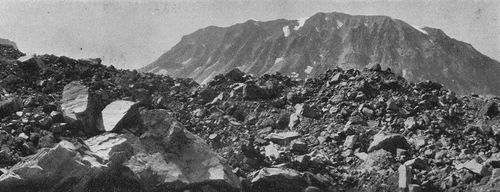
Glacial debris on lower part of Winthrop Glacier, with Sluiskin Mountains beyond.