STONEHENG RESTORED, (continued 2)
Reading edition
Furthermore, Suetonius Paulinus was too well skilled in the discipline of war, to make the seat thereof in a Countrey so absolutely Roman, as betwixt the British Ocean and the River Thames. He had it’s true (being return’d from Anglesey) abandoned London, no colony. But upon what result? finding his accesse of strength disproportionable to the War in hand, and thereforeTacit. Ann. lib. 14. determined with the losse of one Town to preserve the rest whole, (whether London or Camalodunum is not to the purpose) and, by attending the motions of the enemy, wait all fair occasions to give Boadicia battell,Dion. Cass. lib. 62. being unwilling to try his fortune too suddenly, multitude and successe making the Britans outrageously daring. In the interim neverthelesse, raising what forces, the exigency of so important affairs would permit.
Which way Suetonius marched from London is altogether omitted, yet if lawfull to conjecture, why not? to draw off the Forces of Catus Decianus Procurator, (not long before fled into Gaul, for fear of this War) together with the remains of Petilius Cerealis troops; quartered, as Anonymus confesseth,Ner. Cæs. fo. 105. in those very camps yet appearing about Gildsbrough and Daintry in Northamptonshire, then, confining the Icenian Dominion to the Westward. Which Troops therefore, lay doubtlesse, in very great danger if not timely relieved; especially in case Boadicia should conduct her Army that way; as, ere long afterwards she did so far as Verulam; this course being taken by her, not improbably, in pursuit of Suetonius. Neither was it very dangerous for the Roman Generall to lead his Forces that way, the Enemies main strength lying about Camalodunum. Howsoever, whether he marched up to them or no, concluded it is, he made his retreat towards Pœnius Posthumus encamped with the second Legion in the borders of the Silures, (now Herefordshire, Radnorshire &c.) for which Legion, Suetonius sending to have it brought up to his Rendezvouz, his commands being slighted, that strength failed him. The way which Suetonius took,Ner. Cæs. fo. 154. after his departure, was in mine opinion (saith Anonymus) towards Severn, where Pœnius Posthumus encamped with the second Legion among the Silures. So also Spencer our famous English Poet finds it. Whereby it appears, Suetonius retreat was not Westward to Salisbury Plains, but Northerly towards that second Legion. In this retreat, I may not omit, Anonymus conducts him over the Thames at London;Ner. Cæs. fo. 155. which if granted, and, that he kept the river upon his right hand still, untill engaging Boadicia, as Anonymus saith he did: then was Suetonius march far away indeed from Salisbury Plain. The course of that River winding, as we all know, through Barkshire out of Oxfordshire, where Tame from the County Buckingham, and Isis from the edge of Glocester Province, make their conjunction a little beneath Dorchester. And, if keeping this course still by the Rivers side, Suetonius marcht alongst the banks of Cherwell also, then must Anonymus, whether he will or no, bring him up close to Gildsbrough and Daintry, as aforesaid;Ner. Cæs. fo. 166. and thereby (for it is admitted Cerealis horse-troops were at the fight) reconciling all opinions, upon his direct way towards the second Legion.
How far on, neverthelesse, toward Pœnius Posthumus Camp Suetonius advanced is uncertain; but, that the battell might be fought in some Plain about Verulam, or upon that rode, is not altogether improbable. (Especially considering part of Suetonius strength consisted of Londoners, who, as Auxiliaries followed him in this War, and would not stay behind). For, the Roman Generall when marshalling his Army for fight, had with him (saith Tacitus) the aids of the places adjoyning. What places were these? the last place named by him was Verulam, the next place before it London; and, if the Historian intends either of these two, by the places adjoyning to the field, where the battell fought; then, may Anonymus prove the desarts in Africa, as soon as the Plains of Salisbury, to be the place of Battell.
Spencer saith,Cant. 10. the battell was fought near Severn:
Which seeing stout Bunduca up arose, And taking arms, the Britons to her drew; With whom she marched straight against her foes, And them vnwares besides the Seuerne did enclose.
Suetonius, when resolving for fight,Tacit. Ann. lib. 14. deligit locum artis faucibus, & à tergo silvâ clausum, satis cognito, nihil hostium nisi in fronte, & apertam planitiem esse sine metu insidiarum. Choosed a place with a narrow entrance, enclosed behind with a wood, being well assured, he had no enemies but before him, and the Plain being open was without fear of Ambush. Thus Tacitus describes the field, the Roman Army consisting of scarce ten thousand armed men. In what part of Britan soever this Plain lay, it was, for certain, of no great extent, being hardly able to contain the vast multitudes of Boadicia’s Army; computed two hundred and thirty thousand fighting men, by Dion, and therefore could not possibly be Salisbury Plain. For, the Britans placing their carts and wagons supra extremum ambitium campi, in the utmost borders of the field, had so environed their Army therewith, that upon the rout given, they could hardly flee away, quia circumjecta vehicula sepserant abitus, by reason the carts (saith Tacitus) hedged in the passages on every side, and (to use Anonymus own words)Ner. Cæs. fo. 179. were like a wall against evasion. Now, if the Britans had so surrounded the utmost borders of Salisbury Plain, and in such manner barricado’d up all the passages thereof, their numbers should rather have been millions then thousands, as every man knowing those Plains must needs confesse. Besides, Anonymus self tels us,Ner. Cæs. fo. 178. after the Britans in the head of their battel began to shrink and turn, that alone was a blow to all behind, who being many score of thousands, remain’d untoucht, during the fight, because they could never come up to handy-strokes, for want of room in the narrowings of the field. He told us even now there was scope enough. Whereabout in these parts of Britain, (saith he)Ner. Cæs. fo. 161. that very place was, unlesse it were upon Salisbury Plain, where there is a black heath, and scope enough, is not for me to imagine. Now, on the contrary, when coming to the issue, he tels us the Plain was narrow, and they wanted room. Did the Britans want room in the field, and were on Salisbury Plain? Surely, in the heat of his describing the Battel Anonymus forgot his own invention; the fury of the Romans, in beating down the British squadrons, therewith dasht the main force of his conceit to peeces. Suspicious and jealous men had need of good memories. Upon the aforesaid situation he might rather have observed, the great experience of the Romane Generall in martiall affairs, then from thence suggested, the Britans in point of honour erected Stoneheng to the memory of Boadicia, Suetonius not onely choosing to make good a straight enclosed behinde with a wood, for securing his own small Troops, but such a straight also, where the Plain, or field before it, was not of sufficient extent for Boadicia to marshall her great Army in. Furthermore, Anonymus determining (it seems) to parcell out his ground proportionable to the numbers, undertakes to give posterity an exact survey of this Plain, telling us, it was a Plain of five or six miles over: This makes it more apparent ’twas not Salisbury Plain, which far and wide so expatiates it self through the middle of Wiltshire, that it is not onely five or six miles, but (as I may say) five times six miles over. This famous battell then, being struck upon a Plain hardly capable of Boadicia’s Army, was not fought upon Salisbury Plain; but, on some other, which Suetonius Paulinus found best for his own advantage, and therefore Stoneheng (as Anonymus would fain have it) could not be the Sepulchre of Boadicia.
Dion. Cass. lib. 62.
Concerning Boadicia’s magnificent obsequies; a mighty Prince may be buried with great solemnity, yet no materiall Monument dedicated to his memory. Examples of this kinde are so frequent, there needs no mention of them. Humaverunt magnificè, (they are Dions words) the Britans laid her into the earth magnificently, with as much pomp, happily, and honour, attending her to the grave, as their barbarous customs for their glorious Chieftain would admit; but, that they raised any Monument, or erected whatsoever kinde of Sepulchre for her, much lesse so notable a structure as Stoneheng, he no where tels us. Which had the Britans done, the Historian could not avoid, taking more knowledge thereof, then of her bare enterment, and would undoubtedly have recorded it. Again, grant Salisbury Plain the place of Battell, yet, Dion saith not, they buried her magnificently where the battell fought, only, Humaverunt magnificè: adding withall, those, that escaped the field, prepared to re-enforce themselves for a new triall, in the mean while a disease seizing on Bunduica, she died. Now then, after so terrible an overthrow, wherein ’tis reported she lost fourscore thousand Britans; Boadicia, in all likelihood, endevoured to recover the Icenian Countreys, her principall strength; having in her speech before the Battell insinuated the fenny parts thereof, as a refuge if the worst should happen. In what Countreys else could they recruit? where falling sick she died, (whether by violent or naturall death is not materiall) and as ever observed among all Nations, was, no doubt, buried in her own territories, among the graves of her renowned Ancestors.
That the Britans, untill Julius Agricolas time,Ner. Cæs. fo. 117. had learned nothing (as Anonymus takes speciall notice) but to fight, and were no handicraftsmen, whereby they might be capable of erecting such works as Stoneheng, being already fully proved from Tacitus, I will adde, the ringleaders or heads of commotions against Empires and Commonwealths were anciently, (in many Countreys at this day) not only themselves punishable by the Laws with death, but their whole families and kindred though guiltlesse, suffered in like manner; their very houses also, being razed to the ground, lest any knowledge of such pernicious undertakings should remain visible to posterity: and a capitall crime it was, in whomsoever that restor’d them. How comes it then, Boadicia the principall promoter,Sueton. in Ner. and Head of an insurrection so fatall, as accounted by Suetonius Tranquillus, among the infortunate losses of the Roman Empire,Dion. Cas. lib. 62. and the more ignominious by a womans conduct, should be permitted by the conquering Romans, a monument to eternize her fame to succeeding Ages? Boadicia, that ript up the bellies of the Roman Legionaries, and cutting out their bowels impal’d their bodies upon burning stakes; that hanged up the most noble and honourable Roman Dames naked, and slicing off their paps, sowed them to their mouths, as in act of eating them; that in scalding water boiled the Roman infants, and young children to death; their Parents, Husbands, and Commanders unable to relieve them, but enforced to give way, and happy in so saving themselves from the cruell inhumanities of the Conqueresse. We fought for to live, saith Tacitus. Yet, when ere long afterwards, victoriously recovering Britain to Cæsar, by so memorable a battell as compared to their victories of old, should the Romans suffer the enthralled Britans to erect a Trophy to her memory, whose purpose was absolutely to root out all that was Roman here? what greater infamy to the Roman name, except the permission of it? They, who rased and broke in peeces whatever titles and inscriptions, bearing the names of their Cæsars; pulled down and demolished the royall Ensigns, Trophies, Statues, Temples, or whatever else sacred, to their own Emperors, when actively administring to the prejudice of the Romane State; would they permit any publick monuments be erected to the memory of a conquered Prince, of an Enemy so barbarously cruell as Boadicia? That she lives in History, they could not prevent; so live their worst of Emperors. Moreover, publick Monuments were in all ages set up in honour of the Vanquishers, not vanquished; respecting which, Anonymus should also, either have made Boadicia Victresse, or never supposed Stoneheng her Sepulchre.
The time assigned by Anonymus,Ner. Cæs. fo. 182. for erecting these orderly irregular, and formlesse uniform heaps of massive marble, (as he cals them) to the everlasting remembrance of Boadicia, is much above fifteen hundred years since: Petronius Turpilianus succeeding Suetonius Paulinus in the Leivtenancy of Britain; who by his idle and lazy life, making the world beleeve there was peace here: Anonymus will have it a proper time, for permitting such an office to the Britans, in Boadicia’s honour. Times of peace, ’tis confest, when Arts flourish under nobly minded Governours, are chiefly proper for erecting magnificent buildings. The Government under Petronius was guilty of none of these. As for the State of Britain in generall, Tacitus in the life of Agricola tels us, Petronius had composed the former troubles; but in what sort, the fourteenth book of his Annals declares; non irritato hoste, neque lacessitus, neither the Enemy, incensed him; nor he, provoked the Enemy: otherwise Petronius durst not do. And, if peace setled, why doth the Historian call them Enemies? Concerning his own person in particular, Petronius gave himself over to an unprofitable life, disguising it under the honourable name of peace. Honestum pacis nomen segni otio imposuit, saith Tacitus. And, the Britans (as said before) were not then civilized, nor friends to such Arts as either nourish or are nourished by peace, therefore such a work of wonder as this Antiquity famed, not to be expected from them. For, as through the malignities of the Age, wherein Aurelius Ambrosius lived, the Britans had utterly lost the practice of all those Sciences, in times foregoing, learned by their Auncestors from the Romans: so, through the neglect of civil policy in the preceding Roman Governours, in this Leivtenancy of Petronius, the Britans had not attained the knowledge of any those Arts, not many years afterwards, taught their posterity by the Romans. Whole imperiall Eagles took not wing in Britain with such lofty speed, as over other Countreys; The Britans being a fierce Nation, slowly giving ear to any peace,Tacit. Ann. lib. 14. the Romans had work enough in subduing them. Julius Cæsar rather shewed the Island to his successors, then left them possession of it: Augustus and Tiberius held it policy to neglect it: Caligula intending to invade Britain, was diverted by his Wars in Germany: Claudius first prosecuting the conquest with effect, established the colony at Camalodunum, and his Leivtenants Aulus Plautius, Flavius Vespasianus, Ostorius Scapula, and Didius Gallus by little and little, after much contest, and various successe, subdued certain Countries; and reducing the nearest part of the Island to the form of a Province, built also, or rather cast up some few fortifications further within the land: Nero’s Generals had much to do in keeping, what their predecessors gained; Suetonius Paulinus (under him) struck that fortunate battell with Boadicia, else the Romans beaten out of all. So that, in the time of Petronius, the Romans having obtained no such assured dominion over the Britans, as might make them, themselves confident to undertake great and stately buildings here, for their own either publick, or private accommodations; (the ruine of Camalodunum being too fresh in memory) occasion was not offered, nor the time yet come, to let the Britans know by what Arts all civill Nations of the world, did erect their excessive, rather then not magnificent structures, for eternizing their names to succeeding generations. And therefore, the Leivtenancy of Petronius Turpilianus, not proper for building this stony marvell, as Anonymus suspects. For, beside what’s delivered, whensoever Stoneheng built, the preparation only of materials for the work, and bringing them to the place, what Engines or Arts soever used, necessarily, spent more time, then Petronius consumed in the whole continuance of his government here. What tumults succeeded him, let others declare.
Furthermore, if those times of Petronius would not, yet (saith Anonymus) other ensuing seasons might permit such an office to the Britans, her name for ever glorious among them. The hainousnesse of her Rebellion, horridnesse of her cruelties, and inveterate hatred Boadicia bore to the Romans, whereby her name for ever infamous among them, clearly manifest all other ensuing seasons, equally improper for those ancient inhabitants of this Island, to erect Stoneheng. If the Britans, once attaining the Romane manner of Architecture, in any succeeding times had expelled the Romans, and been triumphant; some probable reason, at least, Anonymus might have alledged, towards advancing his opinion. But Boadicia and her Complices overthrown, the Roman Power in this Island encreasing dayly, and the liberty of the Britans as fast declining, no following season could be opportunely favourable, for undertaking such a work by them; the erecting whereof, yea the sole endeavouring to commemorate by such publick means, so mortall an enemy to the Romans as Boadicia: nothing but the dearest lives of the bold attempters, could, certainly, expiate. The Temple upon Mount Cœlius at Rome, begun to ClaudiusSuet. in Vespas. sacred memory by Agrippina, was destroyed to the very foundations by Nero. If then, insulting Agrippina might not erect a memorable structure, to the glory of her deceased Cæsar; whom the Senate and People of Rome, in all solemne manner deified: What oppressed Britan, durst undertake the raising a publick Monument to the honour of vanquished Boadicia, whom the State (in all reason) for ever declared enemy to the Roman Empire? And though, after a long succession of years, the Romans abandoned this Island, yet, when departed, the Britans were left in such deplorable condition, (at large declared before) that, albeit her name never so glorious among them, they had much more to do, in saving their own miserable lives from plague, famine, and the sword, then any opportunity, or ability to erect whatever Monument to the glory of Boadicia. But, of this enough; the invalidity of Anonymus opinion especially respected. The discovering the originall foundation of an Antiquity so famous, being not to be enforced by jealous suspicions, raised upon bare and groundlesse conjectures.
THIS Antiquity (call’d by Henry Huntingdon, The second: by Poly-olbion ——First wonder of the land)
because the Architraves are set upon the heads of the upright stones, and hang (as it were) in the air, is generally known by the name of Stone-heng. It is sited upon the Plain in the County of Wiltshire in England, not far from Ambresbury (the foundations of whose ancient buildings, frequently digged up, render it to have been in times past a Town of no small fame) six miles at least from new Salisbury northwards.
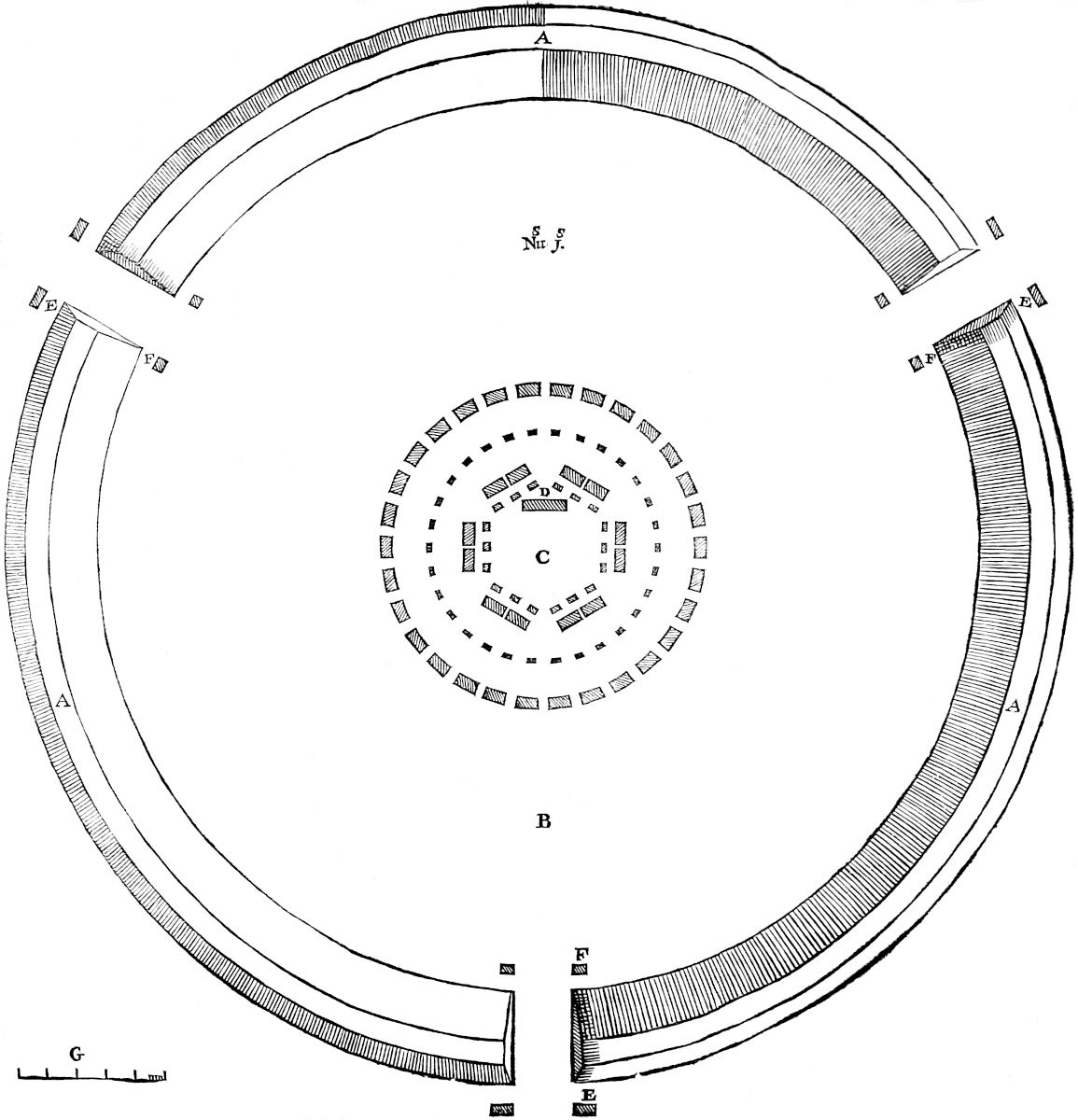
The whole work, in generall, being of a circular form, is one hundred and ten foot diameter, double winged about without a roof, anciently environed with a deep Trench, still appearing about thirty foot broad. So that, betwixt it, and the work it self, a large and void space of ground being left, it had, from the Plain, three open entrances, the most conspicuous thereof lying North-east. At each of which, was raised, on the outside of the Trench aforesaid, two huge stones gate-wise, parallel whereunto, on the inside two others of lesse proportion. The inner part of the work, consisting of an Exagonall figure, was raised, by due symmetry, upon the bases of four equilaterall triangles, (which formed the whole structure) this inner part likewise was double, having, within it also, another Exagon raised, and all that part within the Trench sited upon a commanding ground, eminent, and higher by much, then any of the Plain lying without, and, in the midst thereof, upon a foundation of hard chalk, the work it self was placed. Insomuch, from what part soever they came unto it, they rose by an easie ascending hill.
Which, that it may be the more clearly demonstrated, (being by me, with no little pains, and charge measured, and the foundations thereof diligently searched) I have reduced into Design, not onely as the ruine thereof now appears, but as (in my judgement) it was in its pristine perfection. And that the groundplot, with the uprights, and profyle of the whole work may the more distinctly be understood, I have purposely countersigned each Design of them with Numbers, and the particular parts thereof with Letters.
Nu. 1
Signifies the Plant of the whole work in generall, with the Trench round about it, drawn by a small scale, that it may be seen all at one view.
A
The Trench.
B
The Intervall betwixt the Trench and Work.
C
The Work it self; in the inmost part whereof, there is a stone appearing not much above the surface of the earth, (and lying towards the East) four foot broad, and sixteen foot in length. Which, whether it might be an Altar or no, I leave to the judgement of others, because so overwhelmed with the ruines of the Work, that I could make no search after it, but even with much difficulty, took the aforesaid proportion thereof. Yet for my part, I can apprehend no valid reason to the contrary, except that the whole constructure being circular in form, the Altar should rather have been placed upon the center of the Circle, then enclining to the circumference. Neverthelesse it cannot be denied, but being so sited, the Cell (as I may call it) was thereby left more free, for the due performance of those severall superstitious rites, which their Idolatry led them to. Besides, though the Altare amongst the Ancients was exalted and raised somwhat high above the earth; yet, their Ara was made quadrangular, not very high, and as some will have it close to the ground, being consecrated as well to the supernall as infernall Deities:Rosin. lib. 2. and therefore in respect of the form, it may hold well enough it was anciently an Altar.
D
The supposed Altar.
E
The great stones which made the entrances from the outside of the Trench, seven foot broad, three foot thick, and twenty foot high.
F
The parallel stones, on the inside of the Trench, four foot broad, and three foot thick; but they lie so broken, and ruined by time, that their proportion in height cannot be distinguisht, much lesse exactly measured.
G
The scale of fifty foot.
The Design follows.
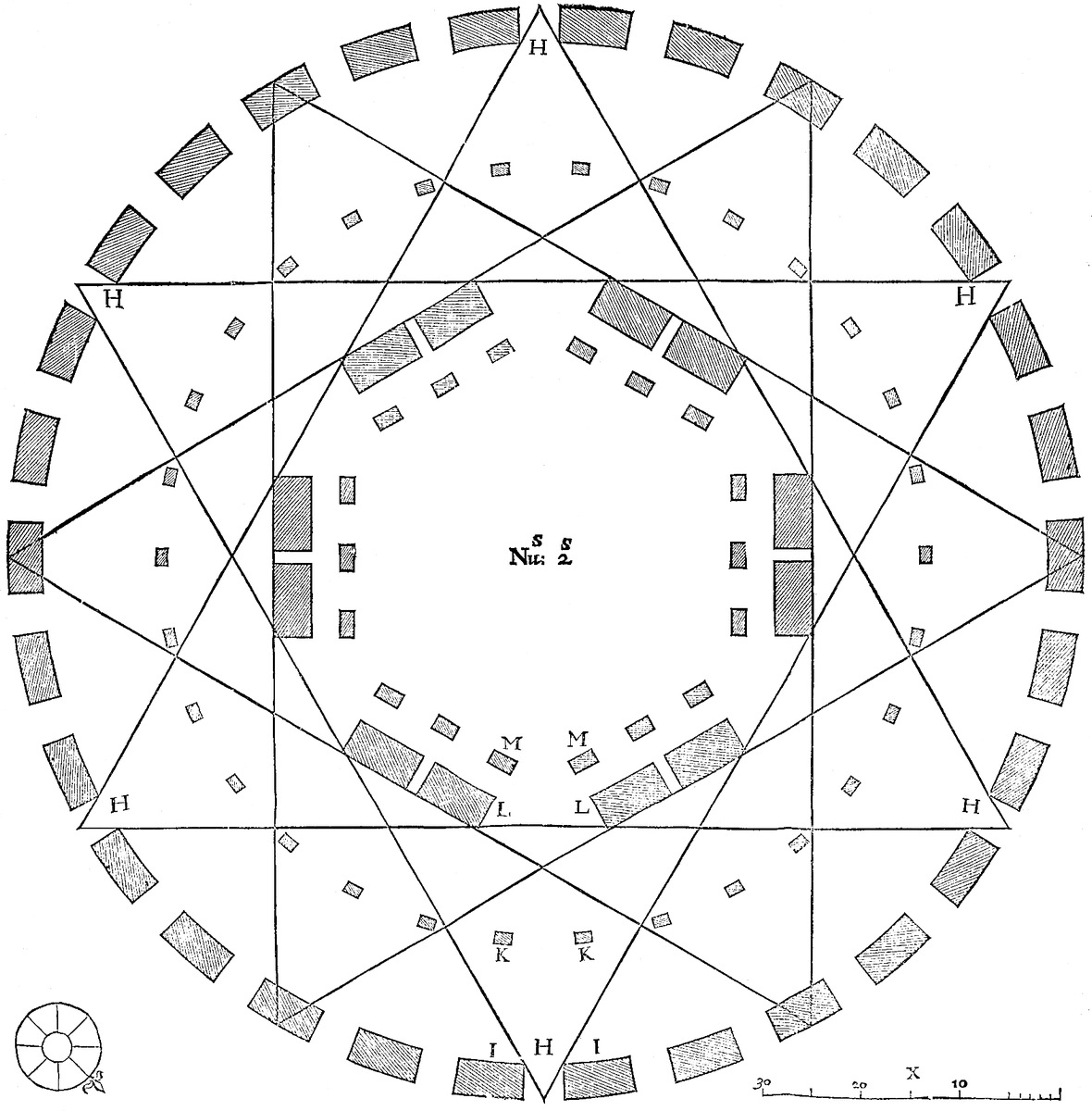
Nu. 2
The Groundplot of the work, as when first built, in a greater form, with the foure equilaterall triangles making the Scheame, by which the whole work was composed.
H
The six principall entrances, three whereof directly opposite to those of the Trench.
I
The stones which made the outward Circle, seven foot in breadth; three foot and an half thick, and fifteen foot and an half high: each stone having two tenons mortaised into the Architrave, continuing upon them, throughout the whole circumference. For, these Architraves, being joynted directly in the middle of each of the perpendicular stones that their weight might have an equall bearing, and upon each side of the joynt a tenon wrought, (as remains yet to be seen) it may positively be concluded thereby, the Architrave continued round about this outward circle.
K
The smaller stones of the inner circle, one foot and an half in bredth, one foot thick, and six foot high. These had no Architraves upon them, but were raised perpendicular, of a pyramidall form. That, there was no Architrave upon these, may be hence concluded, the stones being too small to carry such a weight, the spaces being also too wide, to admit of an Architrave upon them without danger of breaking, and being but six foot high, there could not, possibly, be a convenient head-height remaining for a passage underneath, especially, considering fully the greatnesse of the whole work.
L
The stones of the greater Hexagon, seven foot and an half in breadth, three foot nine inches thick, and twenty foot high, each stone having one tenon in the middle.
M
The stones of the Hexagon within, two foot six inches in breadth, one foot and an half thick, and eight foot high, in form pyramidall, like those of the inner circle.
The Scale which hath this mark, X, is of thirty foot, by which likewise all the ensuing Designs are drawn.
The Design follows.
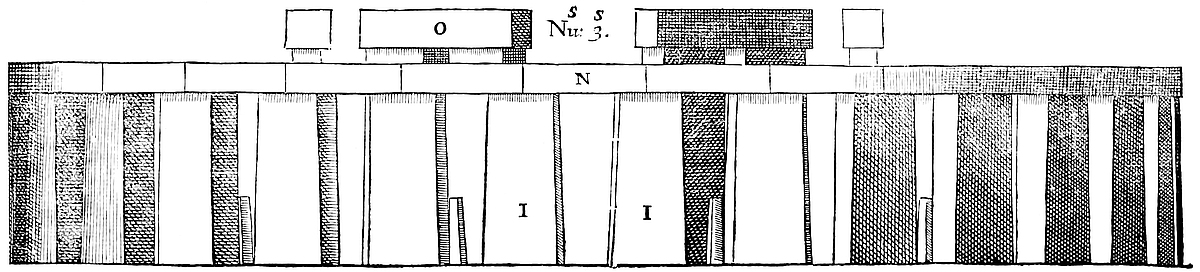
Nu. 3
The upright of the work, as when entire, in which the perpendicular stones of the outward circle, are countersigned with the Letter I, as in the groundplot.
N
The Architrave lying round about upon them, being mortaised into them, and joynted in the middle of each of the perpendicular stones. This Architrave is three foot and an half broad, and two foot and an half high.
O
The Architrave lying on the top of the great stones of the Hexagon, and mortaised also into them, sixteen foot long, three foot nine inches broad, and three foot four inches high. This Architrave continuing onely from stone to stone, left betwixt every two and two, a void space free to the Air uncovered. For, if they had been continued throughout the whole Hexagon, then necessarily there must have been two tenons upon each of the said stones, as those of the outward circle had, but being disposed as aforesaid, that one, which was in the middle, and yet remains apparent, was sufficient for the thing intended.
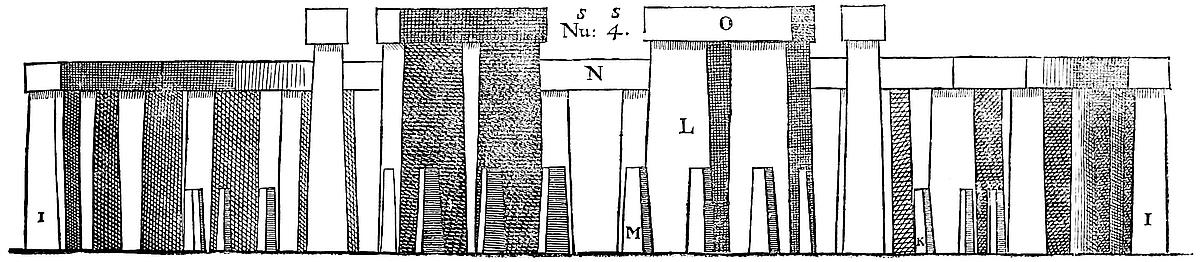
Nu. 4
The Profyle, or cut, through the middle of the work, as entire, countersigned with the Letters of the Groundplot.
The Designs follow.
Nu. 5
The whole work in Prospective, as when entire, whereby the generall composure of the particular parts of the uprights, are together all seen: and, by which also, the stately Aspect, and magnificent greatnesse thereof, are fully, and more apparently conspicuous.
Nu. 6
The Groundplot of the work, as it now stands, countersigned with the same Letters by which the Plant marked Nu. 2 is described. The stones of the greater Hexagon, and outward circle, after so long contest with the violence of time, and injury of weather, are for the most part standing at this day; which, though not all at their full height, as when first set up, yet the Footsteps neverthelesse, of so many of them as exprest in the Design, are still remaining in their proper places. Those of the inner circle, and lesser Hexagon, not only exposed to the fury of all devouring Age, but to the rage of men likewise, have been more subject to ruine. For, being of no extraordinary proportions, they might easily be beaten down, or digged up, and at pleasure, made use of for other occasions. Which, I am the rather enduced to beleeve, because, since my first measuring the work, not one fragment of some then standing, are now to be found.
Nu. 7
The Ruine yet remaining drawn in Prospective.
P
The manner of the tenons, of a round form, mortaised into the Architrave of the outward Circle.
Q
The tenons of like form in the middle of the stones of the greater Hexagon.
R
The English foot (by which the work it self was measured) divided into twelve inches, and each inch subdivided into four parts.
The Designs follow.
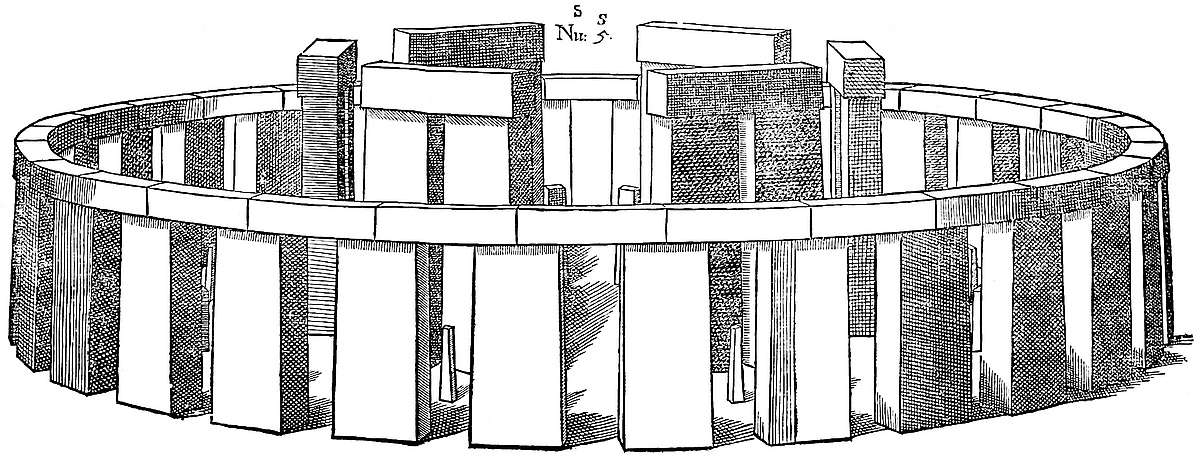
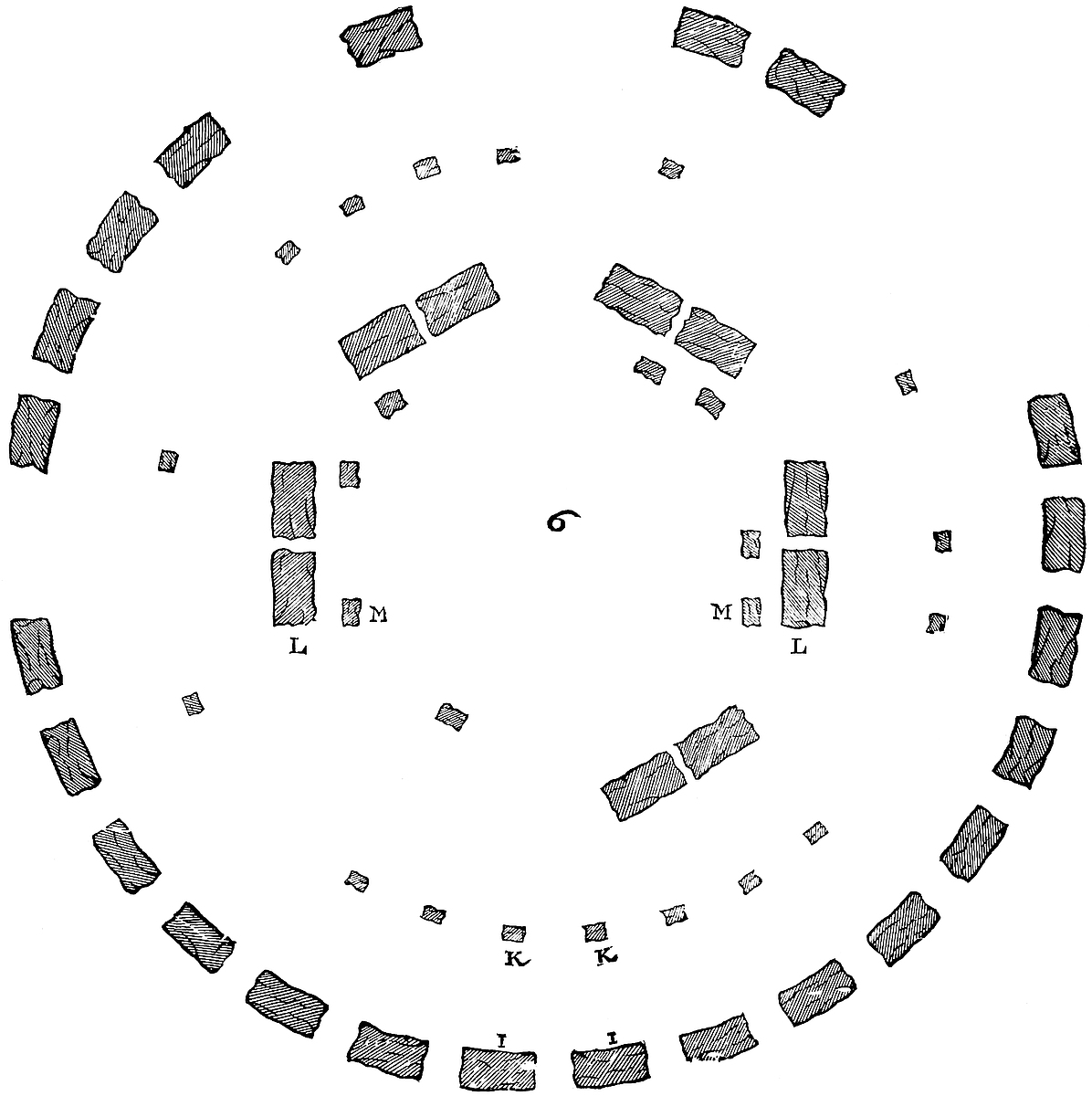
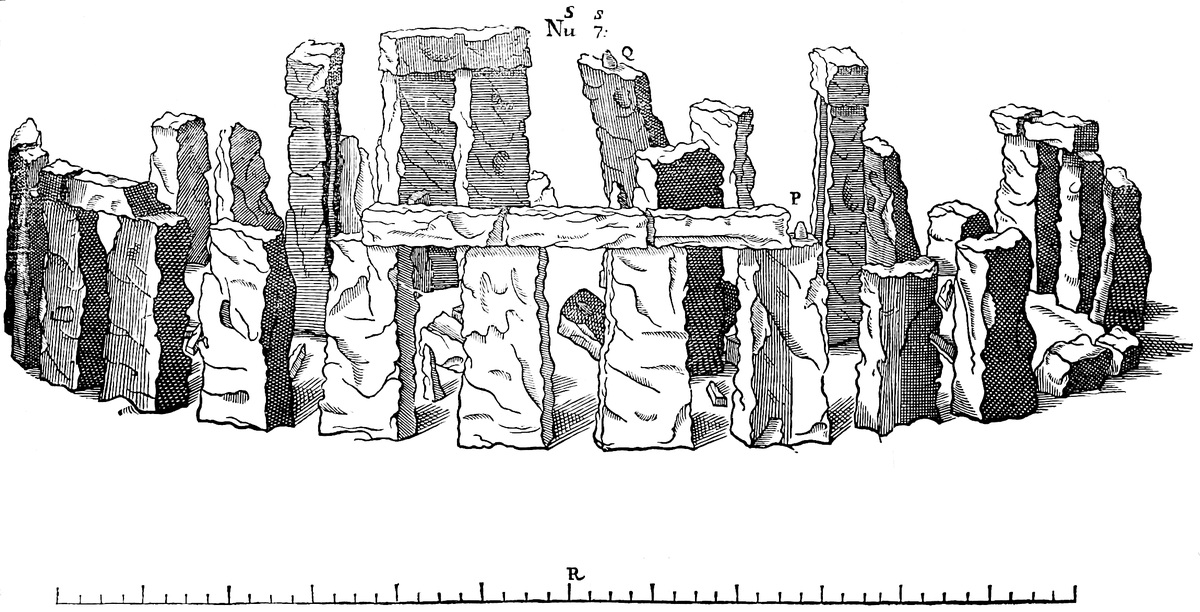
Hitherto, upon what occasion Stoneheng built (you may easily perceive) is very doubtfull, the true History of those times, when first erected, and by which the memory of things especially made over to succeeding Ages, being either not written, or if written, utterly lost. Likewise, as for what use set up, not yet known; so, by whom also founded, is equally uncertain.
You cannot but remember, in what manner the ancient Inhabitants of this Island lived, before reduced to civility by the Romans I have formerly delivered: also, how they were first instructed by them, in severall Arts and Sciences, whereof the Britans wholly ignorant, before the Romans arrivall here, and teaching them. I have given you in like manner, a full description of this Antiquity, whereby doubtlesse it appears to you, as in truth it is, a work built with much Art, Order and Proportion. That the ancient Britans, before the discovery of this Island by the Romans, could not be the Founders thereof, by the former reasons, I suppose, is clearly manifested. For, where Art is not, nothing can be performed by Art. As, for that which concerns the British Nobility, Aurelius Ambrosius, or Boadicia, enough already.
It rests now, to endeavor the discovering by whom Stoneheng built; in what time, and, for what use anciently erected. But, it is not expected (I hope) any absolute resolution should be given by me, in so doubtfull a matter; for, as it hath been always lawfull for every man in such like matters (saith Camden) both to think what he will, and relate what others have thought: So pardon me, if I take upon me, what others have done before me, and interpose mine own opinion also, grounded neverthelesse upon such Authorities, customes, and concurrence of time, as very probably may satisfie judicious and impartiall Readers.
Touching the Founders of Stoneheng. Among the Ægyptian Antiquities, or those Eastern Nations from whom the Græcians deduced their learning, I find not any such composure ever used: or with the Greeks themselves, mention made of any work conformable to this, in point of Order, (as the mod conversant in those Histories cannot contradict) I read neverthelesse, in Pausanias,Pausan. fo. 392. of a Temple amongst the Eleans erected without walls: novam quandam in Eleorum foro templi formam vidi. I saw (saith he) in the market place of the Eleans, a Temple of a new form. Modicæ est ædes altitudinis, sine parietibus, tectum è quercu dolatis fulcientibus tibicinibus. A low thing, without walls, having the roof supported with props of oaken timber (instead, it seems, of Columnes) neatly wrought. He remembers a Temple also in AtticaIdem fo. 75: sacred to Jove without a roof. The Thracians (as I read likewise) used to build Temples dedicated to Sol, of a round form, open in the middle, and also without a roof: by the form, or roundnesse thereof, they signified the Suns figure; by making them open, and rooflesse, they expressed his surmounting, and dilating light equally to all things. Thraces soli rotunda templa faciebant (saith Daniel Barbaro)In Vitr. lib. 4. in medio sub divo, & aperta erant: hac forma Solis figuram innuebant: quòd autem aperta essent, & sine tecto, innuebant Solem supra omnia esse, & lumen suum diffundere.
Howsoever, considering what magnificence the Romans in prosperous times anciently used in all works, both publick, and private: their knowledge and experience in all Arts and Sciences: their powerfull means for effecting great works: together with their Order in building, and manner of workmanship accustomed amongst them: Stoneheng in my judgement was a work, built by the Romans, and they the sole Founders thereof. For, if look upon this Antiquity, as an admired and magnificent building, who more magnificent then the Romans?Scamoz. lib. 1. fo. 9. Essi soli frà i populi dell’ vniverso, con ogni termine di magnificenza edificarono tutti i generi d’edifici. They only amongst all the Nations of the Universe, erecting all sorts of buildings, with all kinds of magnificence, saith Scamozzo in the first Book of his Architecture. If consider the Art, and elegant disposition thereof, all Arts and Sciences (we must know) were in full perfection with them, and Architecture, which amongst the Greeks was youthfull only, and vigorous; under the Romans their Empire grown to the full height became manly and perfect, not in inventions, and elegancy of forms alone, but also in exquisitenesse of Art, and excellency of materials. Salito al colmo l’imperio Romano, ella pure divenne virile e perfetta: non solo nelle inventioni, e nella elleganza delle forme, mà parimente nell’ esquisitezza dell’ artificio, e nella singolarità della materia. As the same Author hath it. If take notice of their power and ways by which they effected such goodly structures, their means were not ordinary according to the common custome of other People; and why? because, besides particular Artisans practised in severall Arts, they employed in those their works whole bodies of their own Armies, and whatever Nations subdued by them. The Romans were wont to exercise therein (saith Camden)Camden fo. 64. their Souldiers, and the common multitude, upon great policy doing the same, left being idle they should grow factious, and affect alteration in the State. The Britans complained (saith Tacitus likewise) corpora & manus contrivisse, that their bodies and hands were worn out, and consumed by the Romans, in bringing to effect their great and admired undertakings: in that kind employing their slaves and prisoners also, as holding it, rather then by violent deaths to cut them off; more profitable for the Commonwealth, more exemplary for others, and far greater punishment for their Prisoners, to enjoyn them continuall labour.
If observe their Order in building; the only Order of Architecture, which Italy may truly glory in the invention of, is the Tuscane Order, so called, because first found out by the Tuscans, that in a more then ordinary manner they might reverence their Deities in Temples composed thereof.Choul. fo. 5. (Janus their first King, according to the common opinion of divers ancient Historians, being the first of all others, that built Temples to the Gods) Which Order, though first used by the Tuscans, certain it is, the Romans took from them, and brought it in use with other Arts, in severall parts of the world, as their conquests led them on. Now of this Tuscan Order, a plain, grave, and humble manner of Building, very solid and strong Stoneheng principally consists. So that, observing the Order whereof Stoneheng built, there being no such Elements known in this Island as distinct Orders of Architecture, untill the Romans introduced them, the very work it self, of so great Antiquity, declares the Romans Founders thereof. Who, that hath right judgement in Architecture, knows not the difference, and by the manner of their works how to distinguish Ægyptian, Greek, and Roman structures of old, also Italian, French and Dutch buildings in these modern times? Is not our Shipping by the mould thereof, known throughout the world English built? Who did not by the very Order of the work, assure himself, the body of the Church of S. Paul London, from its Tower to the West end anciently built by the Saxons: as the Quire thereof, from the said Tower to the East end by the Normans, it being Gothick work? yet that there might be a Roman Temple in old time standing in that place, I will not deny, the numbers of Oxeheads digged up and anciently sacrificed there, setting all other reasons aside, so probably manifesting the same. And in all likelihood, the Romans for so notable a structure as Stoneheng, made choice of the Tuscane rather then any other Order, not only as best agreeing with the rude, plain, simple nature of those they intended to instruct, and use for which erected; but also, because presuming to challenge a certain kind of propriety therein, they might take occasion thereby, to magnifie to those then living the virtue of their Auncestors for so noble an invention, and make themselves the more renowned to posterity, for erecting thereof, so well ordred a building.
Besides, the Order is not only Roman, but the Scheam also (consisting of four equilaterall triangles, inscribed within the circumference of a Circle) by which this work Stoneheng formed, was an Architectonicall ScheamVitr. lib. 5. used by the Romans. Whereof, I shall have more occasion to speak, when I come to set down, for what use this Antiquity at first erected.
Again, the Portico at Stoneheng, is made double, as in structures of great magnificence the ancient Romans used; so at the foot of the Capitol the Temple to Jove the Thunderer, built by Augustus Cæsar; so the Pantheon at Athens, royally adorned with one hundred and twenty vast columnes of rich Phrygian marble, by the Emperour Adrian. But, some may alledge, the Romans made the Pillars of their double Portico’s, of one and the same symmetry, or very little different, which in this Antiquity otherwise appearing, cannot be a Roman work. To as much purpose it may be alledged the Temple of Diana at Magnesia, was no Greek work, because the Pillars of the inner Portico were wholly left out. Yet it’s true, the Romans usually made them as is objected, and the reason was, because of the weight the inner Pillars carried: now, in this work, no roof being to be sustained, nor any manner of weight born up, though the judgement of the Architect, thereby to save labour and expence, ordered the stones making the Portico within, of a far lesse proportion then those of the outward circle, it retains neverthelesse the proper Aspect (principally aim’d at by the ancient Architects) in use amongst the Romans, and consequently for ought alledged to the contrary by them built.
In this Antiquity, there is a Portico also (as I may rightly term it) within the Cell, or greater Hexagon, reduced likewise into the same figure. Now, that the Romans used to make Portico’s on the inside of their buildings, as well sacred as secular, by the ruines of their Basilicaes or Courts of Judicature; by that Temple without a roof anciently dedicated to Jove in Mount Quirinalis, now the Horse Mount in Rome; by the Temple of Bacchus there of a round form, at this day consecrate to S. Agnes without the gate Viminalis, manifestly appears. But in what ever structures else the Romans used them, certain it is, within their most stately Temples which lay uncovered, and had no roofs, they always made such Portico’s; and though in other Temples they sometimes dispos’d them, yet from Vitruvius it may be gathered, they properly belonged to the Aspect Hypæthros, which was uncovered and rooflesse as this Antiquity Stoneheng, he peremptorily assigning Portico’s to be made on the inside of no kind of Temples,Vitr. lib. 3. cap. 1. but those; His words are, Hypæthros in interiore parte habet columnas, remotas à parietibus ad circuitionem (ut porticus) peristyliorum. Temples open to the air, and without roofs, have columnes on the inside, distant from the walls, as Courts Portico’s about them. Even, after the same decorum as at Stoneheng.
Furthermore, if cast an eye upon their artifice and manner of workmanship, Stoneheng appears built directly agreeable to those rules, which the Romans observed in great works. For, the Roman Architects, in distinguishing the manner of their Temples, always observed (as Vitruvius in his third book teacheth us) the greater the Columnes were, the closer they set them together; so in this Antiquity, the stones being great, the spaces betwixt them are likewise narrow.
The Architraves also, in this work were all of them set without morter, and fixed upon the upright stones by tenons (as formerly described) in the very same manner, as in great structures, where the stones solid, and of more then ordinary greatnesse, the Romans were wont to doe.Leo Bap. Alber. lib. 3. They laid them without any unctuous incorporating matter, nullo fulta glutino, saith Leo Baptista Albertus. And divers examples of this kind might be brought, I my self amongst other Antiquities have seen the ruines of an Aquaeduct, built by the Romans in Provynce, running through a deep valley, and raised in height equall to the adjacent Mountains, upon huge Arches fifty eight foot wide, the stones whereof, being of extraordinary scantlings, were laid without any cement or morter, to incorporate them with the rest of the work. And, where occasion guided their judgements to the observance of this rule, they united and compared the stones together, by certain ligatures or holdfasts, (the Italians call them Perni, pegs or tops, for such they resemble, and we, from the verb tenere to hold, not improperly calling them tenons) quæ inferiores, & unà superiores in lapides infixæ, cavatæ fuere, ne quid fortè protrusi ordines alteri ab alteris distrahantur. Which (saith Albertus)Leo Bap. Alber. lib. 3. being formed in the inferiour stones, were hollowed or mortaised into those above, left by any chance they should start one from another, and break the order of the work. Here the Florentine Architect gives us the self same manner of banding stones, when the Romans laid them without morter, as if he had seen this very Antiquity Stoneheng.
Moreover, what ever footsteps of the Romans found in other places of this Island, it’s not inconsiderately to be past over, that in Wiltshire, the County (as is said before) where our Stoneheng remains, Roman Antiquities are most perspicuous, not only, by the apparent testimonies of the coyns of their Emperors in divers places digged up, but by severall their encamping places yet to be seen, as Leckham,Camden. in times of yore a seat of the Romans: the place also where old Salisbury now sheweth it self, within six miles of Stoneheng: and within three miles thereof Yanesbury Castle, supposed a work of Vespasians when he conquered, and after kept in subjection the Belgæ, ancient inhabitants of that tract. Likewise the mines nearer yet to Stoneheng,Speed. of a fortresse our Historians hold anciently a garrison of the Romans, and in many other forts of that Shire (both by their form and manner of making well known to have been Roman) the tract of their footing is yet left.
But it is objected, If Stoneheng a Roman work, how comes it, no Roman Author makes mention of it? I answer, their Historians used not to commit to writing every particular work, or action the Romans performed: if so, how vast would their volumes have been? Stoneheng ’tis granted, is much admired by us, yet, how far more admirable works were the Romans Founders of, not mentioned in any of their ancient stories? That notable bridge invented and built by Cæsar, for passing his Army over the Rhine, himself at large describes, remembring little or nothing neverthelesse concerning divers other as great works in Gaul and Batavia, suppos’d to be performed by him also. Dion, Herodian, Eutropius and other their Historians tell us, the Romans built the so famed wall, commonly by us called the Picts wall, extending crosseover our Island from the Irish Sea to the German Ocean, above fourscore Italian miles in length, with many towers and fortresses erected upon it; when works of as great admiration in Britain they have past in silence: those wonderfull causeys made throughout the land, by dreining and drying up Fens, levelling hils, raising valleys, and paving them with stones of such breadth, that Wains might without danger passe one by another, not any ancient Roman Author (for ought appears) directly mentioning. Yet, who doubts them Roman works?Cam. fo. 64. I dare confidently avouch, the Romans by little and little founded and raised them up, saith Camden. And why? mark I pray, because, whilst Agricola governed Britain, Tacitus tels us, severall ways were enjoyned. If then, because Tacitus affirms in generall terms only, severall ways enjoyned, Camden confidently concludes them Roman works, no Roman History otherwise remembring them; Why may it not, the same Tacitus telling us in like manner, Agicola exhorted the Britans in private, and helpt them in common, to build Temples, Houses, and Places of publick resort, as peremptorily be inferr’d, Stoneheng was a work built by the Romans, though not particularly remembred by them in their stories? In a word, Temples and places of publick resort,Tacitus. Beda. the Romans built here, and were the first that did so, leaving it to after ages to find out by their Manner of building, Order in building, and Power and Means for building, such lofty ruines, as appears in this Antiquity, could be remains of none but Roman building.
The next thing to be enquired after, is, in what time Stoneheng built. Happily, about those times, when the Romans having setled the Country here under their own Empire, and, together with bringing over Colonies reduced the naturall inhabitants of this Island unto the society of civill life, by training them up in the liberall Sciences. For, then also (saith Camden)Camden fo. 63. did they furnish the Britans, with goodly houses, and stately buildings, in such sort, that the reliques and rubbish of their ruines, cause the beholders now, exceedingly to admire the same, and the common sort of People plainly say, those Roman works were made by Giants, of such exceeding great admiration, and sumptuous magnificence they are.
This relation of Camdens, reflects chiefly upon the time of Agricola; neverthelesse, that Stoneheng (though fabled Giants work) was then built, I dare not affirm: the great works of the Romans, brought to perfection in this Island, being not the work of a day. It hath been the invention of wise Romans of old, affecting civility, to raise goodly buildings here: but the precise times when, in things so far from all knowledge, cannot be with any certainty avouched. For my part, I should choose to assign those times for building thereof, when the Romans in their chief prosperity most flourished here, and refer the first erection to the time betwixt Agricolas government formerly mentioned, and the reign of Constantine the Great: in order to which, the times rather somwhat after Agricola, if not during his own Lievtenancy, then next preceding Constantine. For, long before Constantine acquired the Soveraignty (which was not till the year of our Lord three hundred and ten) the magnificent splendor of that mighty Empire began sensibly to wane, and the ambition of the great Captains of Rome, (some few excepted) tended rather to make parties for obtaining the Purple Robe, then (after the manner of their ancestors) to eternise their names by great and admirable works, or patronizing good Arts, for want whereof they began likewise to decay apace; Serly in his third Book speaking of those times, telling us, that id temporis Architecti, si cum superioribus conferantur, rudiores & ineptiores extitisse videntur. In those days although there were many Architects, yet, compared with such as lived in the preceding Ages, they were very rude and unskilfull. Besides, the condition wherein this Island was, divers years preceding Constantine, would not admit such undertakings. For, by the civil discord of the Romans, the Britans taking occasion to make frequent revolts, in hope to recover their lost liberty, the Romans were put upon other manner of Councels then to think of building; namely to reduce the Britans to their wonted obedience, and keep the Province in some reasonable quiet, by expelling the Scots and Picts (savage and perfidious People even from times of old) making daily inroads and incursions thereunto.
Now, as for these reasons, it’s not likely Stoneheng could be built in the times next before Constantine, so, by what follows, it will manifestly appear, it was not erected after his Reign. For, after his transplanting the seat of the Empire into the East, and the government of the then known world, under the Romans, distinguished by East and Western Emperours, a deluge of barbarous Nations (like so many Locusts) swarmed over all. Who, as with their vast multitudes they oft had formerly attempted it, so, thence forward, till bringing that mighty Empire unto its finall and fatall period; and thereby utterly destroying in like manner all Arts and Sciences, together with Architecture, (not restored again, even in Italy it self, untill, as formerly remembred) they never desisted. Moreover, in the times after Constantine, no Temples to Heathen Deities (such as I shall make appear this Antiquity Stoneheng was) were erected here, they being times of defacing, rather then erecting idolatrous places. For, most of the succeeding Emperors becoming Christians, the tempestuous storms of perfection were over, and the thick clouds of superstition beginning to be dissolved by the bright beams of the Gospel, and true light of CHRIST, every where Temples were shut up against false Gods, and set open to the true GOD. According to that of Gildas,Gildas. No sooner was the blustering tempest, and storm of persecution blown over, but the faithfull Christians, who in the time of trouble and danger had hidden themselves in woods, deserts, and secret caves, being come abroad in open sight, renovant Ecclesias ad solum usque destructas, basilicas sanctorum martyrum fundant, construunt, perficiunt &c. Churches ruinate to the very ground they reedifie, Temples of holy Martyrs they found, build, and finish &c. So that, in stead of idolatrous Temples, built in the Ages preceding Constantine, during his reign and after, whilst the Romans continued in any prosperous state here, by erecting Christian Churches, they began generally to neglect, and suffer fall to decay, rather then new build Temples to their Pagan Gods.
These pressing occurrences therefore, to wit, civill broyls amongst the Romans themselves, frequent insurrections of the Britans, daily inrodes by the Picts and Scots, together with the downfall of Paganism, decay of Arts, and fatall ruine of the whole Empire, making the times both long before and after Constantine incompatible for undertaking such works as this Antiquity, it may safely enough be concluded, if Stoneheng not founded by Agricola, yet created it might be about fifteen hundred and fifty years ago, in the times somewhat after his government,Tacit. in Vit. Agr. the Province being formerly left by him in good and peaceable state, the Britans reduced from Barbarity to order and civill conversation, and the Romans flourishing in all manner of Arts and Sciences.
Now, concerning the use for which Stoneheng at first erected, I am clearly of opinion, it was originally a Temple, it being built with all accommodations properly belonging to a sacred structure. For, it had an intervall or spacious Court lying round about it, wherein the Victimes for oblation were slain, into which it was unlawfull for any profane person to enter: it was separated from the circumadjacent Plain, with a large Trench in stead of a wall, as a boundary about the Temple, most conformable to the main work, wholly exposed to open view: Without this Trench, the promiscuous common multitude, with zeal too much, attended the ceremonies of their solemne though superstitious Sacrifices, and might see the oblations, but not come within them: It had likewise its peculiar Cell, with Portico’s round about, into which Cell, as into their Sanctum sanctorum (pardon the expression) none but the Priests entred to offer Sacrifice, and make atonement for the People: Within the Cell an Ara or Altar was placed, having its proper position towards the East, as the Romans used. Aræ spectent ad Orientem, saith Vitruvius.Vitr. lib. 4. cap. 8. And, that there hath been the heads of Bulls, or Oxen, of Harts, and other such beasts digged up, or in, or near this Antiquity (as divers now living can testifie) is not to be omitted; for who can imagine, but these were the heads of such, as anciently there offered in Sacrifice? together with which also, were heaped up great quantities of Charcole, happily used about the performance of their superstitious ceremonies. That the ancient Romans had Charcole in use amongst them, Pliny affirms.Plin. lib.16. Tom. 1. lib. 33. Tom. 2. And when I caused the foundations of the stones to be searched, my self found, and yet have by me to shew the cover of a Thuribulum, or some such like vase (I suppose) wherein Choul in his discourse of their Religion, reportsRosin. lib. 3. Choul fol. 217, 229. the ancient Romans used to carry Incense, wine or holy water, for service in their Sacrifices, lying about three foot within the ground, near one of the stones of the greater Hexagon.
The Order whereof this Temple consists, according to the rules of Art observed by the ancient Romans in works of this kinde, is mingled of Greek and Tuscane work. For, as the plainnesse and solidnesse of the Tuscane Order, appears eminently throughout the whole Antiquity: so the narrownesse of the spaces betwixt the stones, visibly discovers therein, the delicacy of the Corinthian Order. Which commixture amongst the Roman Architects was very usuall, in regard Vitruvius (in his fourth Book and seventh Chapter) treating somwhat largely (his method otherwise considered) of severall sorts of the like composed Temples, mixt of the Greek and Tuscane manners tels us:Vitr. lib. 4. cap. 7. that, Nonnulli de Tuscanicis generibus sumentes columnarum dispositiones, transferunt in Corinthiorum & Ionicorum operum ordinationes. Some taking the qualities of the columns of the Tuscane Order, transfer them into the symmetry of the Corinthian and Ionick works. Whereby (to please themselves it seems in their own inventions) efficiunt Tuscanicorum & Græcorum operum communem ratiocinationem. They make of the Tuscane and Greek works one common composure. As the same Author likewise remembers.
The Aspect of this Temple; by which we understand that first shew which Temples make to those that draw near unto them, is Dipteros Hypæthros, which is double winged about uncovered. Dipteros circa ædem duplices habet columnarum ordines (saith Vitruvius)Vitr. lib. 3. cap. 1. Dipteros hath double orders of columnes about the Temple. Hypæthros sub divo est, sine tecto, (as the same Author) Hypæthros is open to the air, without a roof.
The Manner of this Temple is Pycnostylos, or narrow spaces. Pycnostylos is that kinde of Temples,Vitr. lib. 3. cap. 2. which hath the columnes set thick, and close together crebris columnis, as Vitruvius also hath it.
But it may be objected, though it appears from very good Authorities, the Artifice, and workmanship of this Antiquity, together with the Scheam which formed it, were Roman: and the Order of which consisting, invented in Italy, and so consequently Roman in like manner: as also, by the severall peculiar accommodations, the probable reliques of Heathenish Sacrifices, and determinate rules of Architecture, it was anciently a Temple: Neverthelesse it appears not, the Romans ever used any whatever profane structure like this, much lesse any manner of Temples of this kinde of invention, Where the Temple lies open without walls, surrounded only with pillars. For, that the upright stones which make this work Stoneheng, are in stead of them, may well enough be granted.
To this I answer, the learned in Antiquities very well know, those things which oblivion hath so long removed out of mind, are hardly to be discovered. Yet, as to the first part of the objection, that the Romans never used any whatever profane structure like this, Varro de re rustica (as I find him cited by Philander) tels us,Phil. in Vitr. lib. 4. that they had in use amongst them a round building without any wals, having a double Order of columns round about, this he cals by the name of Tholus, ædificium rotundum, columnatum duplici columnarum ordine. A round edifice (saith he) environed about with a double order of columns. Which double Order of Columns Pyrrho Ligorio a famous Neapolitane Architect, and great discoverer of Antiquities, in his description thereof designes without a roof also.
But to come to their sacred works, which in regard of this Antiquity, are (it’s true) of most concernment, I find the Romans used (as Vitruvius witnesseth)Vitr. lib. 4. cap. 7. such manner of Temples. For (in his fourth Book, and seventh Chapter) he delivers, there were amongst others two forms of round Temples, commonly in use amongst them, the one called Monopteros; the other Peripteros. This, had the Cell enclosed about with a continued wall, and at a proportionate distance from it, the columns placed which made a Portico round about it, clean different from Stoneheng: the other made open, and in stead of a wall encompassed with a row of pillars only, having no enclosed Cell within it at all, as much conducing to our purpose in hand. His words are these,Ædes sacræ Templa dicta fuerunt, quòd essent quasi ædes Deorum. Rosin. lib. 2. cap. 2. Fiunt autem ædes rotundæ, è quibus aliæ sine cella columnatæ constituuntur. They make also (saith he) round Temples, of which some are built without a Cell, environed with Pillars only. These were without any wals, (as his Commenter hath it) lying open to the Air. And truly (as I may presume to say)Dan. Barbar. from this very manner the invention of Stoneheng was principally taken, in ordering whereof, the Architect disdaining usuall and common forms, of both the aforesaid forms composed one. For, taking the outward circle from the Monopteros, he made it open also as in that, but in stead of the continued wall circularly enclosing the Cell of the Peripteros, at Stoneheng he made only an Hexagon about the Cell, leaving the same open in like manner. And, as Hermogenes (whom I shall have occasion to remember again) to illustrate his work, leaving out the inner row of Pillars, made a single Portico about the Temple at Magnesia, whereby it came to be a new invention, for which he is famous to posterity: so the subtile Architect, whosoever he was, to ennoble this his work, adding the said Hexagon here, made a double Portico round about this Temple, and thereby a new invention likewise, no lesse famous to succeeding Ages. Our Antiquity Stoneheng had otherwise been of the self same Aspect without a Cell, as Vitruvius hath before delivered. That Temple Monopteros, was environed with a row of pillars; this Temple Stoneheng, in stead of them, supplied with a rank of pillasters (as they may well be called) continuing round about it. That, lay open to the air without any walls: so doth this at Stoneheng. That, had over the pillars an Architrave, Freese, and Cornice, the Order being delicate: this at Stoneheng, over the pillasters an Architrave only, as most conformable to the solidnesse of the Order and plainnesse of the work.
Thus it fully appears, the ancient Romans used to erect Temples, which lay open without walls, surrounded only with pillars; in invention like this at Stoneheng. But, let us see whether the form Monopteros, had any roof over it. That the Romans had Temples uncovered, and without roofs, like Stoneheng, is in part already, and shall more manifestly be hereafter proved: and searching curiously into their Antiquities, it will be found the greatest, most splendid, and most magnificent work of all others, which the Ancients made for service of their Deities, were those kinde of Temples of the Aspect Hypæthros. Whether the Monopteros was one of that kind, appears not yet, and Vitruvius is very obscure therein; neverthelesse, that it was built without a roof, I shall illustrate by these reasons.
First, Vitruvius tels us not it had a roof; for, in his precepts of all severall kinds of Temples, after he hath delivered the Aspect, Form, and Manner of them with much exactnesse, he omits not throughout his fourth Book to demonstrate aswell the contignation, as proportion of timbers of the roofs, belonging to all those Temples, which had any, and when vaulted he gives us likewise the form thereof, if the Temples so covered: but, in the description of the form Monopteros, there is no manner of timber work, nor form of vault, nor the least word mentioned of any roof at all, in what place soever throughout his whole work speaking thereof. In which respect, considering all Temples having roofs, those roofs are described by Vitruvius, and that he describes no roof belonging to this, it must necessarily follow, the Temples in form Monopteros had no roofs over them.
Again, after giving the proportion of the Architrave over the columnes of the Monopteros, he saith, Zophorus & reliqua quæ insuper imponuntur, ita uti in tertio volumine de symmetriis scripsit. The Freese and other ornaments laid upon them, are as in his third Book of symmetries made mention of. Now, in his third Book, he only treats of proportions, and not one word is so much as mentioned by him of any manner of roofs at all, only in the close of the said Book, he gives the proportion of frontispices belonging to quadrangular Temples: the same referment in like manner he makes for the ornaments of the Peripteros, and withall proceeds to a full description, in what manner the roof of its Cell was made, which questionlesse, he would likewise have done in the other form, if it had been covered. For, he saith, whatever is to be laid above the Freese of the Monopteros, is, as set down in his third Book: but, in his third Book, there is not One word mentioned of any roofs; the conclusion then follows the Monopteros was without a roof.
Lastly, he positively tels us it was sine Cella, without a Cell: now the Cell (and which for distinction sake I have so called in describing this Antiquity, because it was applied to the same use, to perform their sacred rites in) was indeed properly, the inner,Bern. Baldo. or chief part of the Temple, quam nos corpus Templi vulgò dicimus, we commonly call it the body of the Church, which enclosed with wals, was covered with a roof, as Vitruvius declares in the form Peripteros, tecti ratio ita habeatur &c. The manner of a roof (saith he) was thus &c. But, the Monopteros was without a Cell, and consequently without a roof also, as having no walls to bear it. For, in regard of the manner of the Architecture, the pillars standing in Island (as we say) the work could not securely bear a roof, if made of any great capacity: either therefore, they made Temples of this form very little (in which respect only, Palladio supposeth it might be vaulted) inconsistent with the Roman greatnesse, or else, like Stoneheng they were wholly uncovered and rooflesse. Howsoever, it is manifest, the Aspect was just the same. And if I should say, the ruines of one after the same form also, remains yet in Oxfordshire, which the common people usually call Rolle-rich-stones, take it but as my conjecture only, as likewise one or two built after the like manner in Scotland, no man unlesse Hector Boetius knowing by what Kings.
Moreover, the proportions appearing in this Antiquity Stoneheng, are much conformable to those, assigned by Vitruvius to the parts of the Monopteros: He tels us, Tribunal habent & ascensum ex suæ diametri tertia parte: they had the Tribunal, (by which is understood that levell upon which the Temple placed) and the ascent, consisting of one third part of the Diameter. So at Stoneheng, the work it self is one third part of the Diameter of the circumvallation: And, acording to the proportion allowed by him to the Ascent, it seems those Temples were sited more stately then others, (by consequence great also) and certain it is, whosoever views this Antiquity attentively with judgement, upon the place where remaining (for the Folio being too little I could not expresse it in Design) and doth allow a proportionate depth to the Trench surrounding it; considering also, together therewith, the levell of the plain lying without, he will then finde it standing upon such a rising ground, that the Ascent unto it, was not much lesse magnificent, then what Vitruvius hath declared.
Furthermore, besides the aforementioned round Temples, Vitruvius in the same Chapter tels us, that, generibus aliis constituuntur ædes, ex iisdem symmetriis ordinatæ, & alio genere dispositiones habentes. The Romans built them after other manner of inventions, following the same proportions, and having their disposures after another kinde. Of which, if vouchsafed to posterity the descriptions, some of them might have been found, not only agreeable in Aspect, but happily of the very self same form also, as this Temple Stoneheng doth appear.
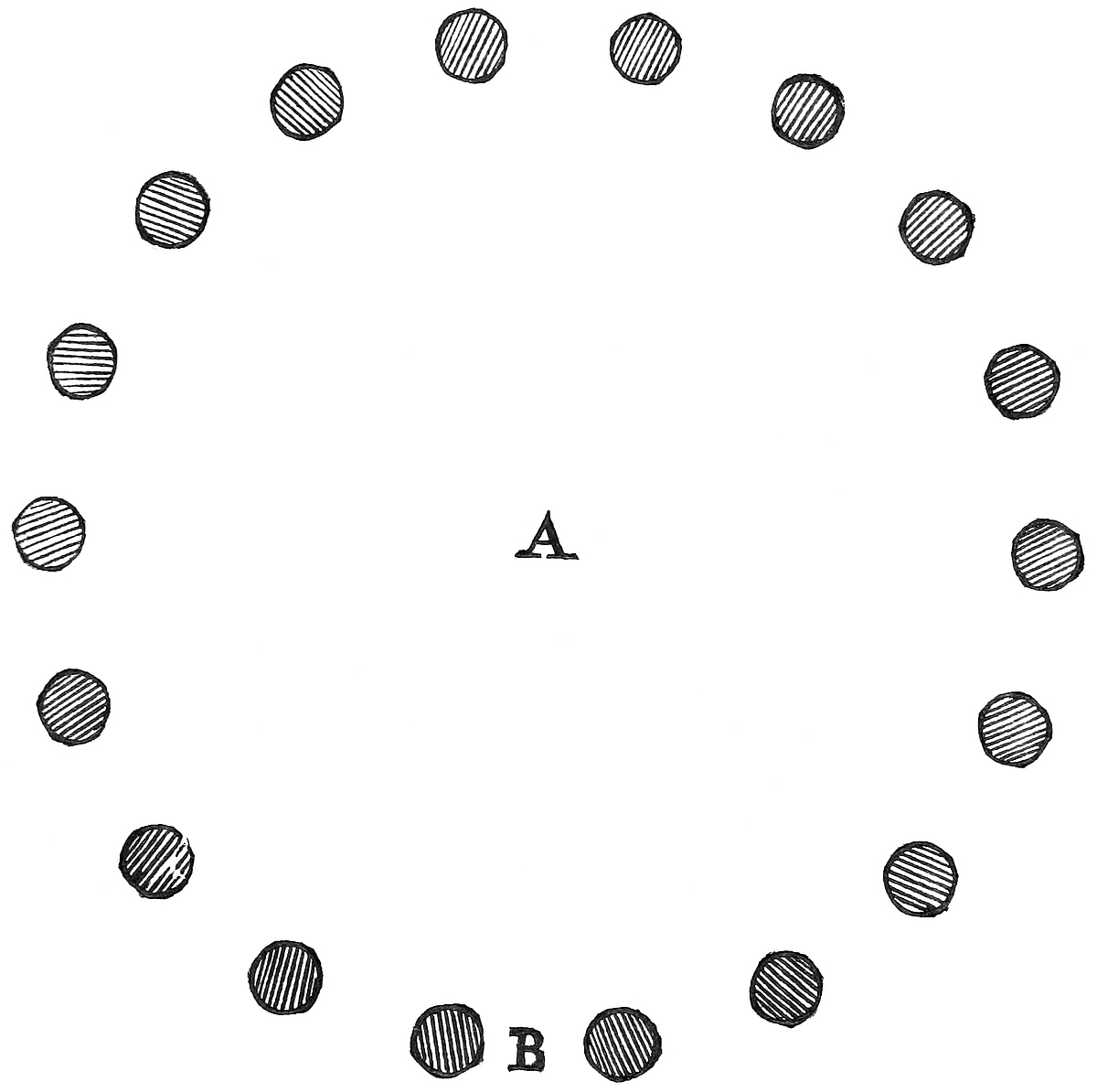
Now considering this discourse may happen into the hands of those, who cannot by words so easily apprehend things of this Art, I have for their satisfaction brought into Design, the plants of both the aforesaid Temples mentioned by Vitruvius, whereby their conformity with Stoneheng, and the invention thereof taken from them, is more clearly manifested.
A
The Plant of the Monopteros.
B
The Order of Pillars which continued round about it, to which the outward circle (of Pillasters) in this Antiquity Stoneheng, directly corresponds, as will appear in the second Figure thereof, formerly described by the Letter I.
The Design follows.
C
The Plant of the Peripteros.
D
The Portico continuing about the Cell.
E
The Circular Cell enclosed with a wall, which in the Temple Stoneheng, to vary the invention, was converted into an Hexagonall form, and in stead of walling it round about, the Architect as said before, left it wholly open, as most agreeing with the nature of the Deity to whom consecrate.
The Design follows.
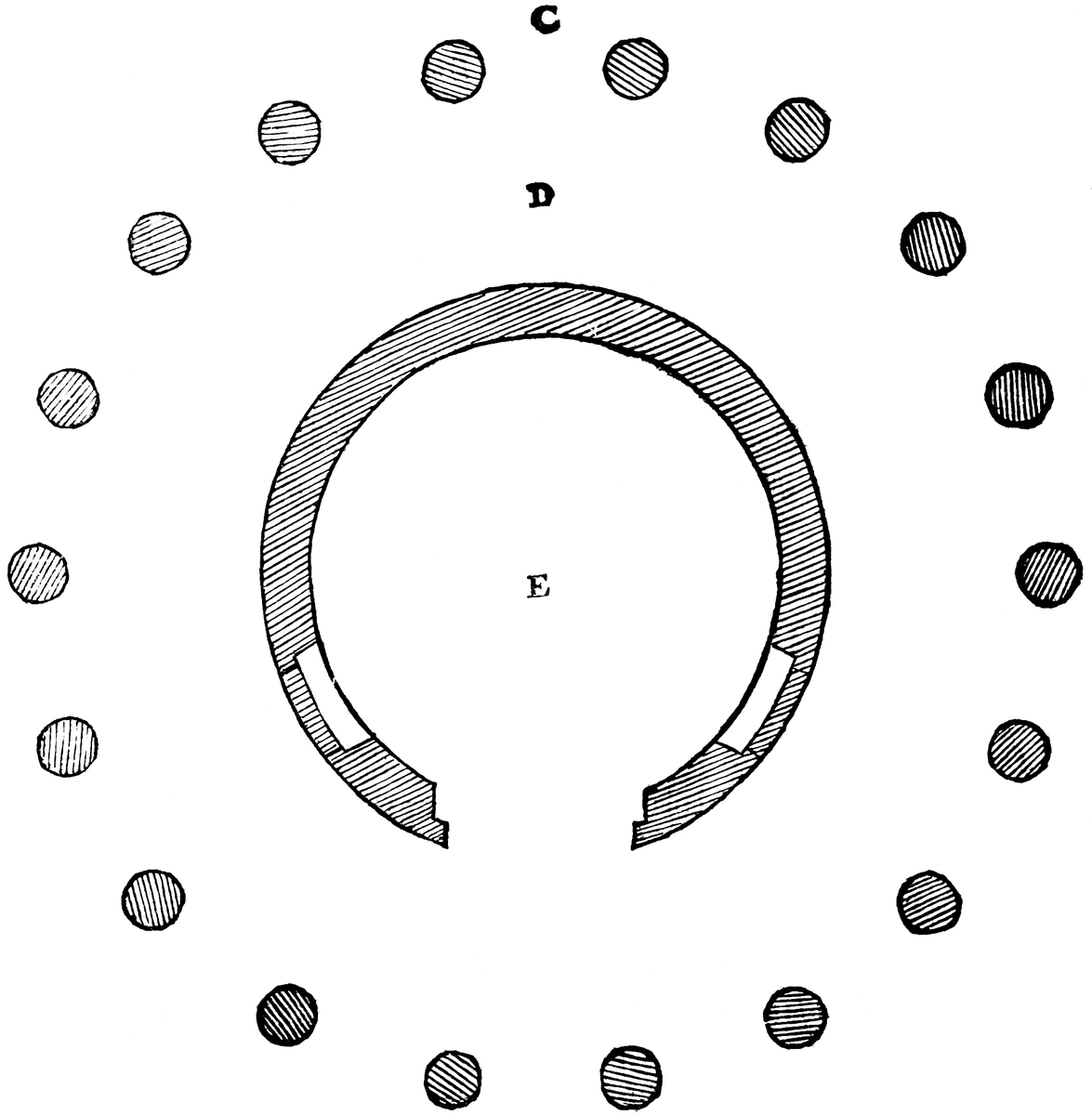
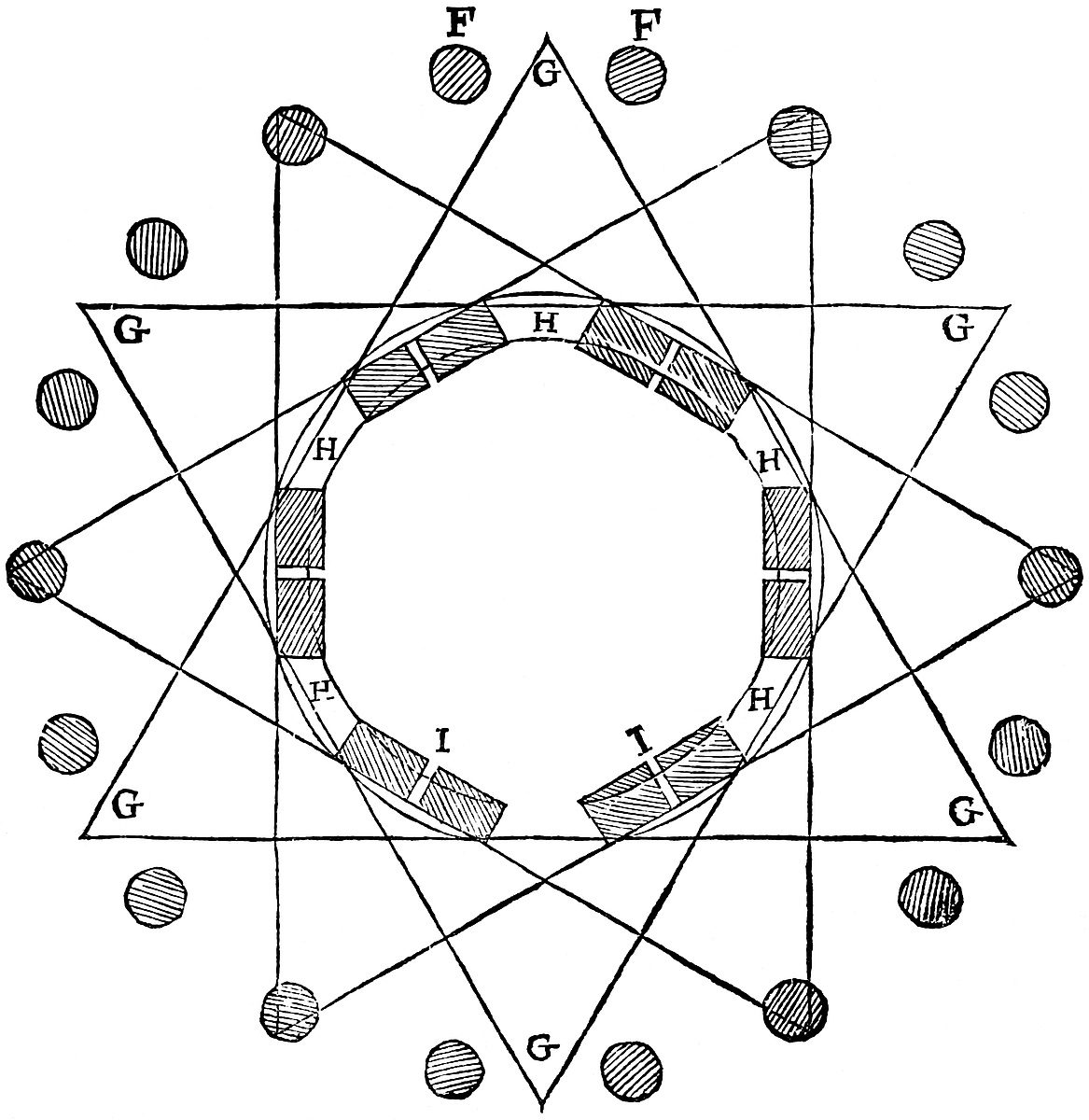
By the Plants of which said Roman Temples, although it is plainly manifest, from whence the invention of Stoneheng was taken: yet, that it may more clearly be understood, I have, unto the Order of pillars which makes the Portico of the last of those Temples, applied the Architectonicall Scheam by which our Antiquity was formed; whereby the intersection of the severall triangles fully demonstrates after what manner the greater Hexagon made open at Stoneheng, was raised from the solid wall environing the Cell of the Peripteros.
F
The Rank of Pillars which made the Portico of the Peripteros.
G
The Architectonicall Scheam by which Stoneheng formed.
H
The circular wall environing the Cell of the Peripteros.
I
After what manner the stones of the greater Hexagon at Stoneheng, were raised from the circumference of the said wall.
The Design follows.
But, before deliver my judgment, unto which of their Deities this Temple Stoneheng was anciently dedicated by the Romans, I shall give you some customs in force amongst the Ancients, relating the Decorum used by them, in building their particular Temples: whereby, those several opinions seemingly conclusive to whom Stoneheng sacred, may more evidently appear invalid, and my own more apparently probable. Those therefore that endevour the searching out Antiquities of Architecture, must amongst others, especially prescribe to themselves five things to be guided by. viz. The Situation, Aspect, Manner, Form, and Order of the work as in use amongst the Ancients. For, inventing the severall ornaments of Architecture, at first for honour and distinction onely of their Deities, they appropriated to each of them particular situations, precise forms, peculiar Orders, according to the severall qualities, in regard whereof adored by them.
The situation of the Temples to Venus, Mars, Vulcan, they ordained to be chosen without their Cities, as those which moved mens minds to lasciviousnesse, wars, and devastations. Within their Cities they placed the Temples of the Patrons of Chastity, Peace, good Arts: and of such Gods also, to whom the Protection of their Cities committed. To Pallas, Mercury, and Isis the chief Presidents of Artificers, and Merchants, they built Temples near the Market places, or upon the Market places themselves. To Apollo and Bacchus near the Theater. To Hercules near the Cirque or Amphitheater. Unto Æsculapius and Salus, in places most of all others healthfull, and near to pure streams, and waters; because the infirm people, coming out of a pestilent and contagious Aire, to that which was good and healthfull, by drinking those waters might the sooner, and with lesse difficulty be recovered, whereby zeal to those supposed Deities encreased.
The Aspect Hypæthros, mentioned before, of which Stoneheng appears built, was proper only to some of their Gods, as shall be remembred in due time: the other five (needlesse here to name) were indifferently disposed, sometime to one, and sometime to another Deity, as the magnificence of the Temples to be built required, and, as to be made with Portico’s or without.
The Manner, which Vitruvius distinguishes into five kinds, according as the intercolumnes are of five severall proportions, was only so far forth peculiarly appropriated to their Deities, as it was agreeable to the proper Order, otherwise they followed the greatnesse of the Work.
But, to each of them appropriating particular forms of Temples; to some of their Gods, they made them of a round form, to others quadrangular, to others of many angles: some of them having their Temples covered, with roofs over them; others again built uncovered, without any manner of roofs at all: As, our Antiquity Stoneheng.
Lastly, the Order of which they built them, was so diligently observed, according to the peculiar qualities of their Deities, that seldom or never they varied: as in fit place I shall remember. These aforesaid rules also were so firmly observed by the Ancients, that even at first sight the Roman Architects of old were able to judge, to what Deity, this, or that Temple sacred: and the modern Italian Architects, by the ruines of them at this day, give such notable testimonies towards the discovery of them, as are very hardly to be contradicted. Whosoever desires more of this, may read Vitruvius, Leo Baptista Albertus, and other Authors writing of Architecture. That then we may arrive to a degree of certainty unto whom our Stoneheng anciently dedicated; some such Deitie of the Romans is to be found out, in whose honour they built Temples, not only in such situations as this at Stoneheng; but with whole nature or quality the Form and Aspect thereof may be agreeable also; and the Order proper. For, whosoever goes about to enforce other reasons, do as I conceive but beat the air, neither can they reduce this Antiquity to any probable Originall.
To which of the Roman Deities Stoneheng consecrated, are, as I said before, severall opinions. Some presume it sacred to Diana, but upon what ground their conjecture is raised, considering both the Aspect and Manner of this Temple utterly different from those the Ancients used to dedicate to Her, I cannot conceive;Vitr. lib. 3. cap. 1 & 2. for, the Manner of the Temples erected to Diana, was Diastylos, i.e. columnis ampliùs patentibus, made with large and void spaces: the Aspect of that at Ephesus was Dipteros; that at Magnesia Pseudodipteros: which Manner Hermogenes inventing to save expence and labour, though he left out the Order of pillars within, and thereby the Portico came to be more large, yet the Aspect continued still the same. And, as in the Aspect and Manner, so likewise in the Order and Form it’s different: that, at Ephesus aforesaid being of the Ionick Order, the Order peculiarly appropriated to Diana, and quadrangular: of the same Form also, was that at Magnesia aforesaid, and so likewise the Romans built them, as by the now Church of S. John Evangelist at the Latian, or Latine Port, anciently the Temple of Diana; and that in Mount Aventine also,Fab. Cal. the chief of her Temples in Rome, fully appears. The situation of the Temples dedicated to her, was in groves, whence Vitruvius calsVitr. lib. 4. cap. 7. her grovy Diana.
Ecce suburbanæ templum nemorale Dianæ, saith Ovid. See where Diana’s grovy Temple stands.
In which sort Virgil, Pliny, and other Authors also tell us her Temples were always sited. The Architecture therefore of the Temples to Diana, and this at Stoneheng being so far different, there is no probable reason Stoneheng should be suppos’d dedicated to her.
Moreover, whether or no this opinion maybe consistent with any of those qualities, the Ancients endowed this Goddesse with, let us examine further the Nature of the Deity it self. Is StonehengNat. Com. lib. 3. cap. 18. consecrated to Diana because she presided over ways? what publick roads then, or common high-ways are to be read of, which anciently led over the Downs near this Antiquity? The most ancient ways we meet with, and which the Romans first made in this Island, as CamdenCamden fo. 64. sets them down, are four, Watling-street, Ikemild-street, Ermin-street, and the Fosse. Watling-street led through Verolamium directly as it were by a streight line to the West side of Leicestershire,Camden fo. 517. and from thence through the Northerly Counties into Wales. Ikemild-street began in the Countrey of the Iceni, tending Eastward. Ermin-street in the same quarter, running through Cambridgeshire, Huntingdonshire, and so on towards Lincolnshire led the right way into the Northern Countreys on that side: (this street-way, happly, may be that which among the inhabitants passeth now by the name of High Dike.) The Fosse passing through Warwickshire,Ibid. fo. 366. came down to Stow on the Would, thence to Cirncester, from Cirncester continuing on towards Bath and beyond it to Somerton into the Western Provinces: the ridge whereof is yet to be seen in divers places of that tract. All of them lying so far from Stoneheng that none of them are remembred to come nearer then Cirncester to any part of the Plains whereon it stands, and therefore in this respect there can be no cause to imagine this Antiquity should be dedicated to her. Or, is Stoneheng sacred to Diana, because she was the Patronesse of Gates? for which reason the Ancients built her Temples, either near to them within their Cities, or not far from them in the pleasant suburbs. But what Cities, or places having any such Gates, were ever found anciently so near Stoneheng, as might cause the dedication of so great a work to her? surely none. Or, is Stoneheng hallowed to Diana because she had the tutelage of Mountains? if so, then where are those Mountains to be found near this Antiquity on Salisbury Plains? which Plains, North, South, East and Westward through the midst of Wiltshire are so open, that they terminate the Horizon. If any such Mountains there, why do all Historians call them Plains? But admit Mountains somtimes on Salisbury Plain, what then became of them? were they removed by Earthquakes, swallowed into the ground by an Hiatus of the earth, or levell’d by inundations? then let it be made apparent when such like accidents fell out. Or is Stoneheng dedicated to Diana, because she delighted to bath her self in fountains and fresh springs? where are those fountains and fresh springs to be found? haply, in the utmost borders they may be had, none certainly in the body of the Plains, or any thing near Stoneheng: spring veins being not there to be found, unlesse by sinking wells or pits very deep, which the inhabitants are enforced to make in severall places for watering their sheep, and as glad they are there, as the Patriarchs of old in the deserts of Canaan to come by them. Or is Stoneheng sacred to Diana, because reputed Goddesse of hunting? then, who ever desirous of a Temple for her, may finde it in Daphne, the anciently famous suburbs of Antiochia, where was not onely a Temple dedicated to her,Strab. li. 16. but an Asylum also, as Strabo witnesseth: such places only being held proper for her mysteries, where interven’d variety of pleasures, goodly shadowy groves, delicate walks, and pleasant springs of most cool and fresh waters. In the midst of these delights the Ancients sited her Temples, not in wilde Downs, or vast Plains, so wide and open that hardly see from one side of them to another, affording neither shelter for travellers against canicular heats, nor succour for cattell against the boisterous blasts of blustering Boreas. Lastly, is Stoneheng dedicated to Diana, because the supposed guardian of woods? then remains it to be made apparent by them, those Plains in ancient times bore another countenance then at present. That they were full of Forrests, woods and groves, with variety of lawns, replenished and stored with such sorts of game, and wilde beasts in chase whereof Diana and her companions are said to recreate themselves: from whence some are of opinion she was called Diana, as much to sayRosin. lib. 2. cap. 7. Deviana, quoniam venantes per devia & silvas deviare solent, captantes feras. Because of huntsmens deviating, or wandring out of the way, through uncouth paths and woods in pursuit of their game. That those Plains afforded as much pleasure and delights as the Thessalian Tempe, the Syrian Daphne, or what place else as famous where her Temples anciently stood: and, in what unknown age they were disafforrested and laid wast. Which, if ever so, certainly some signs thereof would remain, or at least be found there, as well as in other parts of the Island, in times past overgrown with woods. As in Anglesey formerly mentioned; in Cheshire, where, in digging their marlepits are often found huge trees, demonstrating to posterity the forrests there anciently growing; in the Isle of Axholm in Lincolnshire, where the inhabitants have hardly any fewell, but what such trees afford so digged out of the earth; in Somersetshire, where I my self have seen trunks of trees lying under ground, and expressing the places in times past overgrown with trees, very few or none being in those places now standing. Besides, some remembrance of the aforesaid forrests and woods History questionlesse would yeeld; now what occasion soever Historians take for mentioning this tract, not one word is delivered by them to that purpose, all unanimously consenting ’twas never other then at present an open and champion Countrey. A Theater on which Bellona often displayed her bloody ensigns, and acted severall tragedies in times of old: A field of Mars, where Romans, Saxons and after Danes for obtaining the dominion of this Island decided their ambitious controversies. Of which actions we have visible testimony unto this day, witnesse those burrows, and places where they cast the bodies of their slain, over all quarters of the plain dispersed, which in long time are so shrowded by nature with ever growing grasse, that their memory will remain by their sepulchres to all posterity; that which consumes all works of Art, making them still more fresh and flourishing: witnesse spoils of war there frequently digged up, as formerly remembred: severall encamping places of those severall Nations in all parts of the plain even yet appearing, no place in the whole Island, respecting the circuit, having more remains of them: Also that huge Trench, mentioned before by the name of Wansdike, running through the very bowels of them, such manner of trenches appearing no where in any part of England beside, saving where the like plains interveen; so at Newmarket Heath the like trench vulgarly called Devils Dike, as if made by Devils not by men, is to be seen; though in ancient times it was the limits of the Kingdome of the East Angles,Camden fo. 490. and it took end, as Camden very well observes, where the passages by reason of woods grew cumbersome: Which, if the like be granted for Wansdike (as is very probable, it ending also with the Plains) then without controversie there were no more woods in times of old on Salisbury Plains then at this day; it running overthwart them, as in a direct line from East to West. And who knows not, that other manner of fortifications then running trenches upon direct lines are to be cast up for defence of woody situations? But why urge more Authorities, when the Inhabitants of the Countrey tell us, the soil or ground being hot, dry, and chalky is altogether improper for the growth of trees. Thus then the situation of the place, so antipathizing in all respects with the nature and qualities anciently attributed to Diana, and the Manner, Form, and Order of this Antiquity, so contrary to the custome used by the Ancients in erecting her Temples, no reason wherefore this Temple Stoneheng should be conceiv’d as erected for celebration of the superstitious ceremonies anciently ascribed unto her Worship.
Some, again, would have Stoneheng consecrated to Pan; because Pan a Greek word signifying the Universe, under him the whole frame of Nature was adored. And therefore, the Ancients made his statues with horns, saith Servius, expressing thereby the beams of the Sun, and horns of the Moon; those issuing from his forehead, and turning upwards towards Heaven, as Boccace will have it, signified the Celestiall bodies: feigning also, as the world moves with extraordinary swiftnesse, he excelled likewise in speed of running. By the purple, ruddy, and enflamed face, attributed to Pan, that pure fire, above all other Elements holding his place in the confines of the Celestiall Sphears was demonstrated: by his large long beard descending down upon his breast, the two superiour Elements Aire and Fire of a masculine nature, sending down their impressions upon the other two naturally feminine was shewed: by the spotted skin covering his breast and shoulders, the eighth sphear wholly embelished with glorious stars; inveloping in like manner all appertaining to the nature of sublunary creatures was represented: by the sheep-hook which he held in one hand, Natures dominion over all things (according to Boccace) was signified: and as Servius saith, because this staffe, or rod was crooked, the year revolving into it self, was thereby expressed: in the other hand holding a Pipe, consisting of seven reeds, whereby, the Celestiall harmony conceived by some to have seven sounds, and seven different tunes, according to the number of the Planets, and their Sphears which are seven, was so set forth.
After this manner Mythologists discourse of Pan, with various opinions, according to the subtile niceties of their severall fancies: and in these respects as having relation to the Heavens, this Antiquity Stoneheng is imagined sacred to Him. ’Tis true, if Mythologie, and not demonstrative reasons were to be fixt upon in matters of Architecture, the former conceptions might be some ground to frame conjectures Stoneheng sacred to Pan. But, Architecture depending upon demonstration, not fancy, the fictions of Mythologists are no further to be embraced, then as not impertinently conducing to prove reall truths. Wherefore, the aforesaid ancient rules for building Temples considered, and comparing the Order, Form, Aspect and Situation of the Temples to Pan, with the like in this Antiquity, so much contrariety is found betwixt them, as may convince any reasonable judgement Stoneheng not dedicated to Him.
Pan pastorum, venatorum, & universæ vitæ rusticanæ præsidem crediderunt Antiqui, saithNat. Com. lib. 5. Natalis Comes. Pan was the reputed God amongst the Ancients, of Shepherds, Huntsmen, and all those that led an agrestick life. The same Author also calling him Piscatorum Deum, the God of Fishermen as well as Shepherds. Arcadibus Deorum antiquissimus & honoratissimus est Pan, saith Dionysius.Dion. Hali. lib. 1. Rosin. lib. 2. Pan is the most ancient, and most honoured Deity of the Arcadians. And in Arcadia itself where he was principally adored, they built his Temples for the most part in Towns of the same Form and Order as to Juno: In the Town of Heræa, habet Pan templum suum (saith PausaniasPausan. fo. 496. in his description of Arcadia) quod olim Junoni dicatum fuit, Pan had his Temple which anciently was dedicated to Juno. Now, the Order appropriated to Juno by the Romans, was the Ionick, as is manifest from Vitruvius, who tels us, To Juno, Diana, and Bacchus, and to the other DeitiesVitr. lib. 1. cap. 2. of the same quality, they built Temples of the Ionick Order. The Form in like manner of her sacred structures was quadrangular, as in Mount Aventine, in foro Olitorio (or the herb Market) in Mount Quirinal, and elswhere amongst the Romans theAlexan. Don. Pomp. Totti. ruines of her Temples do evidently witnesse: as also, her Temples anciently at Argos, and amongst the Elians in Greece, built of the like Form, and of the Dorick Order. But this AntiquityPausan. fo. 114. & 317. is of the severe Tuscane work, and of a round figure. The Temples to Pan had a Portico onely in front, at Stoneheng it continues round about the Cell. The Temples to Pan were not exposed to the open Aire, and built uncovered as Stoneheng was, but had roofs upon them. For, Ignis ei perpetuus ardebat, therein they kept perpetuall fire,Ibid. fo. 516. as at Acacesium a Town also of Arcadians; all Temples wherein they kept such fires being covered, as the Temple to Apollo at Delphos amongst the Greeks, and to Vesta at Rome amongst the Romans. But, if at any time they did erect them distant from a Town, reserving always the Form and Order, they chose such situations as wholly environed with trees; for example, the Temple to Pan in Mount Lycæus, was compassed in with a thick wood, condenso circumseptum luco, as Pausanias hath it: so likewise, that Temple sacred to Him in the Parthenian Forrest, according to the said Author. Now, this Temple Stoneheng is sited in an open champion Countrey, where scarce a bush or tree, much lesse thick woods, or forrests to be seen throughout the whole Plain; nor was there ever any in times of old as History remembers, and the nature of the soil, as I am informed, is no wise prosperous for their growing there, as is sufficiently before declared.
But Pan (say they) being the God of Shepherds, why might not Stoneheng to gratifie them be erected, and consequently by the Romans dedicated to their God Pan? no place in the whole Island more abounding with sheep, then the circumadjacent Plains; the almost innumerable flocks whereof, not only most plentifully satisfying the bordering inhabitants for food; but, from their delicate fleeces, a great part of the known universe are clad also. I answer, amongst the Romans (declared at large before to be Founders of Stoneheng) I do not finde any one Temple, Holy House, Sanctuary, Grove, Altar, or any such like sacred structure consecrated to Pan in their own Country; much lesse any Temple dedicated unto Him by them in Britain: and therefore, utterly improbable this Temple Stoneheng should be erected by the Romans unto Pan.
There was a Temple indeed,Dion. Hal. lib. 1. Rosin. lib. 2. cap. 20. built to Pan Lycæus on Mount Palatine, by those Arcadians which accompanied Evander into Italy; in which, though the Romans in succeeding times performed the same rites, as the Arcadians anciently had instituted; yet, He passed with the Romans under the name of Lupercus,Justin. lib. 43. and in honour of Him, as some Authors of opinion, certain festivals or games called Lupercalia, at Rome onely, not in Provinces conquered by them, were solemnized by the Romans; Noblemens sons running in those games,Plutarch. in Rom. Rosin. lib. 3. cap. 2. according to the primitive institution setting forth and beginning their course at Mount Palatine, and so round about the City to the same place again. I may not omit, neverthelesse, that severall Authors deliver the Lupercalia were instituted in thankfulnesse to Lupa, or the wolf that gave Romulus suck, and the course of those games beginning at Mount Palatine (not so much in remembrance it seems of Pans Temple there, as) from the Lupercal or the very place they say wherePlut. in Rom. Romulus was cast out.
Dionysius of Halicarnassus tels usDion. lib. 1. the Arcadians built the aforesaid Temple to Pan, idoneo invento loco &c. when they had found out a convenient place for it adjoyning to their habitations: the condition or nature of which place is not unworthy your observation; for by his description thereof we shall easily perceive what manner of situation was by the Arcadian Shepherds held proper for performing the ceremonies of their God Pan. His words are, Erat tum, ut fertur, spelunca sub tumulo magna, denso querceto contecta, & sub petris profundi fonticuli, solúmque rupibus contiguum nemorosum, & frequentibus ac proceris opacum arboribus: ibi ara deo extructa, more patrio sacra fecerunt. Under the Hill (to wit, Mount Palatine) was anciently, as report goes (saith he) a great cave or den, covered over by a thick grove, deep wells or riverets running amongst the stones of the cave, and round about it a wood, by the many and tall trees growing therein very dark and obscure: there the Altar of the God was placed, and his Sacrifices after their Country manner performed. Now is Stoneheng thus sited, or was there ever any such like place near this Antiquity? of all the places in England that I know, none comes nearer that cave, then Ochy-hole in Somersetshire: And if the Ancients held such dismall situations only proper for Pans Temples, then without peradventure Stoneheng was never erected in honour of him, they being no innovators in their superstitions.
A further observation may be made to our purpose, upon the aforesaid description, Erat tum antrum magnum, it was anciently (saith Dionysius)Dion. lib. 1. a great cave. But in his own time, which was under Augustus, the Romans had so choked up the place with building, that the manner how Pans Temple in old time stood, was hardly to be discovered: nunc quidem ædificiis (saith he) fanum circumquaque sepientibus, difficilis conjectura est qualis olim loci natura fuerit. At this present, verily, the Temple being every way environed with buildings, it is hardly to be conjectured in what manner of place it anciently stood. This was the cause which enforced him to deliver to posterity the former description meerly upon report. Certainly then, the Romans employing the place to profaner uses, Pans Deity was little esteemed by them; otherwise, they would never have polluted it, by setting up private houses upon the place consecrated to him. Now the Romans slighting him after this manner at home, little reason appears so magnificent a structure as Stoneheng, should be erected by them for adoration of Pan in other Countreys.
Furthermore, the Sacrifices in times of old offered to Pan were milk and honey, offered up in simple Shepherds crocks or earthen pitchers: quare non ritè sacrificabant, qui tauros illi immolabant, aut qui in aureis poculis lac aut vinum offerebant &c.Nat. Com. lib. 5. Wherefore, they sacrificed not aright, saith Natalis Comes, who immolated Buls or Oxen unto him, or out of golden cups poured forth milk or wine upon his Altars; for goblets of that metall were proper onely for the supernall and celestiall Deities, not to terrestriall, and such as had care of Heardsmen or Shepherd Swains. To which purpose also, the same Author out of Apollonius Smyrnæus remembers Pan, thus speaking of himself.
Sum Deus agrestis, cur his sunt aurea sacris Pocula? quo vinum funditis Italicum? Ad petram cur stat taurus cervice ligatus? Parcite: non hæc est victima grata mihi. Pan montanus ego sum, ligneus, ipsáque vestis Pellicea est: mustum è fictilibúsque bibo.
In English thus:
A rurall God am I, in golden cup The Falern wine, why then d’yee offer up? Why at mine Altar, stands the stern Bull bound, Or Oxe that’s fat, with laurell girland crown’d? Spare ye such cost: no gratefull victimes these Are unto me, others lesse costly please. A Mountaineer, a wood-man clad in skin Am I: your wine in earthen vessels bring.
But the Sacrifices anciently offered at Stoneheng (already remembred) were Buls or Oxen, and severall sorts of beasts, as appears by the heads of divers kinds of them, not many years since there digged up.
As for that of the Pantheon, it is very well known the Ancients so called it, not in any relation to Pan, but because it was sacred to Jove the Revenger, and according to others to Cibele, and all Gods. For which reason, Boniface the fourth obtained licence from the Emperour Phocas,Platin. in Bon. to consecrate it to the Virgin Mary, and all Saints. And who knows not the Architecture thereof wholly different from this of Stoneheng? The Pantheon hath its Cell enclosed with a continued solid wall, and the Portico only in front, of the delicate Corinthian Order; of which Order the inner part consisted likewise, being vaulted in most admirable and magnificent manner. From whenceDion. lib. 53. Dion Cassius delivers his opinion, inde id nominis habere, quod forma convexa fastigiatum, cœli similitudinem ostenderet, it to be called the Pantheon, because by the form of that vault wherewith covered, it represented the concave of Heaven, or (as others will) the figure of the world; for the world being mans house, the firmament is as the vaulted roof thereof. At the crown of the vault it had an opening, by which only it received light and air. But, this Antiquity Stoneheng built of a grave and humble Order (as is said before) had a double Portico continuing round about it, the Cell thereof free and open, and every way exposed to the air, received light from all parts.
Wherefore leaving these, Stoneheng was dedicated, as I conceive, to the God Cœlus, by some Authors called Cœlum, by others Uranus, from whom the Ancients imagined all things took their beginning. My reasons are, First, in respect of the situation thereof; for it stands in a Plain, remote from any Town or Village, in a free and open air, without any groves or woods about it.
Secondly, in regard of the Aspect; for Stoneheng was never covered, but built without a roof. Which Decorum the Romans ever observed, both in the Situation and Aspect of the Temples dedicated to this their God, and to Jove the Lightner, the Sun, and the Moon.Vitr. li. 1. cap. 2. Jovi fulguratori, & Cœlo, & Soli, & Lunæ, ædificia sub divo Hypæthráque constituuntur. To Jove the Lightner, and to Cœlus, and to the Sun, and to the Moon, they erected buildings in the open air and uncovered, saith Vitruvius in the second Chapter of his first Book. Take with you also his reason. Horum enim Deorum & species & effectus in aperto mundo atque lucenti præsentes videmus, because both the forms and effects of these Deities, we behold present before our eyes, in a clear and open view. Another reason I find also why they built their Temples to Cœlus,Godw. Antiq. l. 1. cap. 20. and those other Deities uncovered as Stoneheng: because they counted it an hainous matter to see those Gods confined under a roof, whose doing good consisted in being abroad.
Thirdly, in regard of the Form of Stoneheng, which is circular.Pier. Valer. Hier. lib. 39. This figure was proper to the Temples of Cœlus and Tellus, whom the Ancients called Vesta, as Valerianus (in his Hieroglyphicks) affirms. Non solamente la palla, ma una simplice piegatura di ruota, appresso gli Egizziani demostrava il Cielo. Not only (saith he) the circular form, but the meer segment of a circle amongst the Egyptians was an Hieroglyphick of Cœlus. And to this purpose also, Leo Baptista Albertus useth these words.Leo Bapt. Alb. lib. 7. Ædem Vestæ, quam esse terram putarent, rotundam ad pilæ similitudinem, faciebant. Unto Vesta, whom they reputed to be the Earth, they built Temples of a round form globelike. Besides, observe what Philander commenting on Vitruvius tels us.Philand. in 4. lib. Vitr. cap. 7. Templorum quanquam alia fiant quadrata, alia multorum angulorum, Cœli naturam imitati veteres, imprimis rotundis sunt delectati: Although (saith he) the Ancients made some Temples square, some of six sides, others of many angles, they were especially delighted with making of them round, as representing thereby the Form or Figure of Cœlum, Heaven.
Fourthly, in respect of the Order whereof Stoneheng built. The severity of this Tuscane work, retaining in it a shew (as it were) of that first face of Antiquity (as A. Palladio terms it)An. Pal. li. 1. being most agreeable to the nature of this their God, reputed the ancientest of all their Deities, and Father of Saturn. For, it was the custome of the Ancients (as in part I remembred before) to appropriate the severall Orders of Architecture, according to the particular qualifications of those they deified.Vitr. lib. 1. cap. 2. Minervæ, & Marti, & Herculi, ædes Doricæ fient: his enim diis propter virtutem, sine deliciis ædificia constitui decet. To Minerva, and Mars, and Hercules, Temples of the Dorick Order were made; for, to these Deities in respect of their valiant actions, it was requisite to build without delicacy. Veneri, Floræ, Proserpinæ, Fontium Nymphis, Corinthio genere constitutæ, aptas videbuntur habere proprietates, quòd his diis propter teneritatem, graciliora & florida, foliísque & volutis ornata opera facta augere videbuntur justum decorem. To Venus, Flora, Proserpina, the Fountain Nymphs, the Corinthian Order was thought most proper: because unto these in regard of their tender natures, the work seemed to advance a just decorum, when made delicate and flourishing, and adorned with leaves and volutes. Junoni, Dianæ, Libero Patri cæterísque diis qui eadem sunt similitudine, si ædes Ionicæ construerentur, habita erat ratio mediocritatis, quod & ab severo more Doricorum, & à teneritate Corinthiorum, temperabitur earum institutio proprietatis. To Juno, Diana, Bacchus, and to the other Deities of the same quality, building Temples of the Ionick Order, they had regard unto the mean, that from the severe manner of the Dorick, and delicacy of the Corinthian, the condition of their indowments might be duly moderated, saith Vitruvius. To Jupiter, Sol, and Luna, though they made Temples sub divo open to the air and without roofs like this Antiquity; yet were they not built of severe and humble but most delicate Orders, and accordingly were adorned with costly ornaments, and beautified with various enrichments in severall sorts of sculpture, as by the ruines of them in divers parts of Italy remaining to this day, evidently appears. Respecting therefore, this Decorum used by the Ancients in building their Temples, and that this work Stoneheng is principally composed of a most grave Tuscane manner, by just proportions of an agreeable form; it is in mine opinion, as I said before, most agreeable to the quality and condition of that ancient Cœlus, whom Antiquity reputed the very stem whence all those Deities in the succeeding Ages proceeded. Cœlus ex eadem conjuge (scilicet Tellure) procreavit Oceanum, Cœlum, Hyperionem &c. & Apollod. lib. 1. novissimum omnium Saturnum suscepit. Cœlus, by the same wife (to wit Tellus) had Oceanus, Cœlum, Hyperion &c. and last of all begat Saturn. To which purpose also Lactantius, I finde Uranius by his wife Vesta had Saturn and Ops: Saturn attaining the government, called his father Uranius, Cœlus, and his mother Terra; that by this change of names, he might the more magnifie the splendor of his originall &c. Further, I conceive it will not be impertinent to our purpose in hand, to deliver what the Ancients have reported of Cœlus; and wherefore they ascribed divine Honours unto Him.