Part 1 — III
Arthur Livingston translation
ARTICLE AND NOUN
[Note:—The English language presents a far simpler situation than the Italian as regards the agreement of article and adjectives. Gender itself being, in the case of English nouns, more a matter of logical theory than of word-ending, adjectival agreement in the formal sense in practically unknown to English grammar. Likewise the formation of the plural is much simpler in English than in Italian, where the singular and plural word-endings are closely associated with gender. It is a question, in fact, whether the whole subject of the gender of English nouns should not be taken up somewhat later in connection with the pronouns, where English shows three singular forms masculine, feminine, neuter (him, her, it) as against the Italian two, masculine and feminine (lo, la, plural li, le, etc.). Signora Montessori's discussion of the situation in Italian still remains instructive to the teacher of English as an illustration of method. We retain her text, accordingly, in its entirety.—Tr.]
As we have already said, the words chosen for grammatical study are all printed on small rectangular pieces of cardboard. The little cards are held together in packages by an elastic band and are kept in their respective boxes. The first box which we present has two compartments. In the holders at the back of each compartment are placed the cards which show the part of speech to be studied, in this case article and noun. The article cards are placed in the article compartment and the nouns in the noun compartment. When the children have finished their exercise they replace the cards—the nouns in the place for the nouns and the articles in the place for the articles. If the words article and noun are not a sufficient guide for the child, the color at least will make the task easy. In fact the child will place the black cards for the noun in the compartment indicated by the black guide-card (marked noun); the tan cards for the article with the tan guide-card (marked article). This exercise recalls the child's experience with the alphabet boxes, where one copy of each letter is pasted to the bottom of the box as a guide for the child in replacing the other letters. The child begins to speak of the article-section, the noun-section, and the article-cards and noun-cards. In so doing he begins to distinguish between the parts of speech. The material must be prepared very accurately and in a definitely determined quantity. For the first exercise, the children are given boxes with the articles and nouns shuffled together in their respective compartments. But there must be just enough articles of each gender to go with the respective nouns. The child's task is to put the right article in front of the right noun—a long and patient research, which, however, is singularly fascinating to him.
We have prepared the following words. We should recall, however, that the cards are not found in the boxes in this order, but are mixed together—the articles shuffled in their box-section and the nouns in theirs.
il fazzoletto (the handkerchief) il libro (the book) il vestito (the dress) il tavolino (the little table) lo specchio (the mirror) lo zucchero (the sugar) lo zio (the uncle) lo stivale (the boot) i colori (the colors) i fiori (the flowers) i disegni (the drawings) i compagni (the companions) gli zoccoli (the wooden shoes) gli uomini (the men) gli articoli (the articles) le sedie (the chairs) la stoffa (the cloth) la perla (the pearl) la piramide (the pyramid) la finestra (the window) le scarpe (the shoes) le addizioni (the sums) le piante (the plants, the trees) l'occhio (the eye) l'amico (the friend) l'acqua (the water) l'albero (the tree) gl'invitati (the guests) gl'incastri (the insets) gl'italiani (the Italians) gl'insetti (the insects)
(We suggest as a corresponding English exercise the introduction of the indefinite article. This substitution involves four processes against the eight of the Italian exercise. The use of an before a vowel is quite analogous to the problem of the Italian l' and gl'. However the theoretical distinction between the definite and indefinite article, as regards meaning, is reserved by Signora Montessori to a much later period, though the practical distinction appear in the earliest Lessons and Commands.—Tr.)
the handkerchief the book the dress the table the mirror the sugar the colors the flowers the drawings the children the shoes the men a man a pearl a prism a card a window a chair a tree an orange an apple an uncle an eye an insect an American an aunt
One of the first steps in grammar. The children are deeply interested in placing the correct articles and nouns together. (A Montessori School in Italy.)
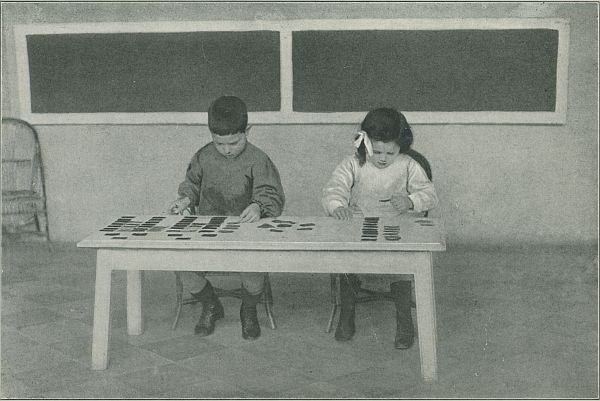
The child tries to combine article and noun and puts them side by side on his little table. In this exercise he is guided by sound just as he was in building words with the movable alphabet. There the child's first step was to find relationships between real objects and the linguistic sounds corresponding to them. Now he sees suddenly revealed to him hitherto unsuspected relationships between these sounds, these words. To have an empirical way of demonstrating and testing these relationships, to practise very thoroughly on two kinds of words, suddenly brought forth into systematic distinctness from the chaos of words in his mind, offers the child not only a necessary exercise but the sensation of relief which comes from satisfying an inner spiritual need. With the most intense attention he persists to the very end of the exercise and takes great pride in his success. The teacher as she passes may glance about to see if all the cards are properly placed, but the child, doubtless, will call her to admire or verify the work that he has done, before he begins to gather together, first, all the articles, then, all the nouns, to return them to their boxes.
Grammar Boxes. The one on the left is for articles and nouns only; the one on the right, for articles, nouns, and adjectives.
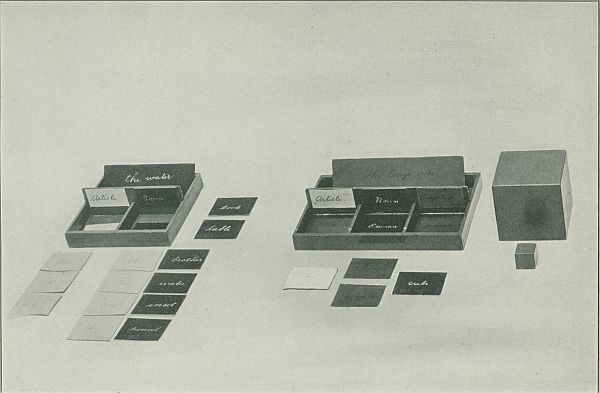
This is the first step; but he proceeds with increasing enthusiasm to set the words in his mind "in order," thereby enriching his vocabulary by placing new acquisitions in an already determined place. Thus he continues to construct, with respect to exterior objects, an inner spiritual system, which had already been begun by his sensory exercises.
Singular and Plural
The exercises on the number and gender of nouns are done without the help of the boxes. The child already knows that those words are articles and nouns, so we give him now small groups of forty cards (nouns and articles) held together by an elastic band. In each one, the group (tied separately) of the ten singular nouns serves as the guide for the exercise. These nouns are arranged in a column on the table, one beneath the other, and the other cards, which are shuffled, must be placed around this first group in the right order. There are two more cards of different colors on which the words singular and plural respectively are written; and these are placed at the top of the respective columns. We have prepared four series of ten nouns in alphabetical order. In this way four children may do the exercise at the same time and by exchanging material they come in contact with a very considerable number of words.
This is the way the cards should finally be arranged in the four different exercises:
Singolare Plurale Singular Plural
il bambino i bambini the child the children, etc.
il berretto i berretti the cap
la bocca le bocche the mouth
il calamaio i calamai the inkstand
la calza le calze the stocking
la casa le case the house
il cappello i cappelli the hat
Singolare Plurale Singular Plural
la maestra le maestre the teacher the teachers, etc.
la mano le mani the hand
la matita le matite the pencil
il naso i nasi the nose
il nastro i nastri the ribbon
l'occhio gli occhi the eye
l'orologio gli orologi the clock (watch)
il panchetto i panchetti the bench
Singolare Plurale Singular Plural
il dente i denti the tooth the teeth, etc.
l'elastico gli elastici the elastic
il fagiolo i fagioli the bean
la fava le fave the bean
la gamba le gambe the leg
il gesso i gessi the plaster
la giacca le giacche the coat
il grembiale i grembiali the apron
Singolare Plurale Singular Plural
il piede i piedi the foot the feet, etc.
il quaderno i quaderni the copy book
la rapa i rape the turnip
la scarpa le scarpe the shoe
la tasca le tasche the pocket
il tavolino i tavolini the table
la testa le teste the head
l'unghia le unghie the nail (finger)
Like material has been prepared for the masculine and feminine forms: The masculine group is kept by itself, while the feminines are shuffled.
Maschile Femminile Masculine Feminine
il conte la contessa the count the countess, etc.
l'amico l'amica the friend
l'asino l'asina the donkey
il babbo la mamma the father
il benefattore la benefattrice the benefactor
il bottegaio la bottegaia the shop-keeper
il cugino la cugina the cousin
il cuoco la cuoca the cook
il cacciatore la cacciatrice the hunter
il cavallo la cavalla the horse
Maschile Femminile Masculine Feminine
il duca la duchessa the duke the duchess, etc.
il canarino la canarina the canary
il dottore la dottoressa the doctor
il dattilografo la dattilografa the stenographer
l'elefante l'elefantessa the elephant
il figlio la figlia the son
il fratello la sorella the brother
il gallo la gallina the cock
il gatto la gatta the cat
Maschile Femminile Masculine Feminine
il leone la leonessa the lion the lioness, etc.
l'ispettore l'ispettrice the inspector
il lupo la lupa the wolf
il lettore la lettrice the reader
il maestro la maestra the schoolmaster
il marchese la marchesa the marquis
il mulo la mula the mule
il nonno la nonna the grandfather
il nemico la nemica the enemy
l'oste l'ostessa the host the hostess, etc.
l'orologiaio l'orologiaia the watch-maker
il poeta la poetessa the poet
il pellicciaio la pellicciaia the furrier
il padre la madre the father
il re la regina the king
il ranocchio la ranocchia the frog
lo sposo la sposa the husband
il servo la serva the man-servant
il somaro la somara the ass
Finally there are three series of nouns in four forms: Singular and Plural, Masculine and Feminine. Each group has eighty cards counting both nouns and articles, and the ten singular masculines in the guiding group are kept together, apart from the others. The title cards (twelve in number) are singular and plural and for each of them is a card marked masculine and a card marked feminine. The following is the order of the material when properly arranged by the child:
Singolare Singular
Maschile Femminile Masculine Feminine
l'amico l'amica the friend the friend, etc.
il bambino la bambina the child
il burattinaio la burattinaia the puppet-player
il contadino la contadina the peasant
il cavallo la cavalla the horse
il compagno la compagna the companion
il disegnatore la disegnatrice the designer
il dattilografo la dattilografa the stenographer
l'ebreo l'ebrea the Jew
il fanciullo la fanciulla the boy
Plurale Plural
Maschile Femminile Masculine Feminine
gli amici le amiche the friends the friends, etc.
i bambini le bambine the children
i burattinai le burattinaie the puppet-players
i contadini le contadine the peasants
i cavalli le cavalle the horses
i compagni le compagne the companions
i disegnatori le disegnatrici the designers
i dattilografi le dattilografe the stenographers
gli ebrei l'ebree the Jews
i fanciulli le fanciulle the boys
Singolare Singular
Maschile Femminile Masculine Feminine
il gatto la gatta the cat the cat, etc.
il giardiniere la giardiniera the gardener
il giovinetto la giovinetta the youth
l'infermiere l'infermiera the nurse
l'italiano l'italiana the Italian
il lavoratore la lavoratrice the worker
il medico la medichessa the physician
il materassaio la materassaia the mattress-maker
l'operaio l'operaia the workman
il pittore la pittrice the painter
Plurale Plural
Maschile Femminile Masculine Feminine
i gatti le gatte the cats the cats, etc.
i giardinieri le giardiniere the gardeners
i giovinetti le giovinette the youths
gl'infermieri le infermiere the nurses
gl'italiani le italiane the Italians
i lavoratori le lavoratrici the workers
i medici le medichesse the physicians
i materassai le materassaie the mattress-makers
gli operai le operaie the workmen
i pittori le pittrici the painters
Singolare Singular
Maschile Femminile Masculine Feminine
il ragazzo la ragazza the boy the girl, etc.
il romano la romana the Roman
lo scolare la scolara the scholar
il sarto la sarta the tailor
il santo la santa the saint
il tagliatore la tagliatrice the cutter
l'uomo la donna the man
il vecchio la vecchia the old man
il visitatore la visitatrice the visitor
lo zio la zia the uncle
Plurale Plural
Maschile Femminile Masculine Feminine
i ragazzi le ragazze the boys the girls, etc.
i romani le romane the Romans
gli scolari le scolare the scholars
i sarti le sarte the tailors
i santi le sante the saints
i tagliatori le tagliatrici the cutters
gli uomini le donne the men
i vecchi le vecchie the old men
i visitatori le visitatrici the visitors
gli zii le zie the uncles
Occasionally class exercises are used in our schools for the four forms of the Italian noun, masculine and feminine, singular and plural. They take the form almost of a game, which the children find amusing. A child for instance distributes around the class all the plural nouns. Then he reads aloud a noun in the singular. The child who holds the corresponding plural answers immediately. The same thing is next done for masculine and feminine, and, finally, for all four forms at once.
When these exercises have become familiar to the child, others somewhat more difficult may be presented. These new ones comprise: nouns which change form completely as they change gender and of which, so far, only the most familiar examples (babbo, "father," mamma, "mother," etc.) have been given (Series A); nouns in which the form is the same in the singular of both genders (Series B); those in which both genders have a common form in the singular and a common form in the plural (Series C); nouns which have only one form for both singular and plural (Series D); nouns where the same form appears in both genders but with a different meaning (Series E); finally, nouns which change gender as they pass from the singular to the plural (Series F).
SERIES A
Singolare Singular
Maschile Femminile Masculine Feminine
il babbo la mamma the father the mother
il becco la capra the he-goat the she-goat
il frate la suora the friar the nun
il fratello la sorella the brother the sister
il genero la nuora the son-in-law the daughter-in-law
il montone la pecora the ram the ewe
il maschio la femmina the male the female
il marito la moglie the husband the wife
il padre la madre the father the mother
il padrino la madrina the godfather the godmother
il porco la scrofa the hog the sow
il toro la vacca the bull the cow
l'uomo la donna the man the woman
il re la regina the king the queen
Plurale Plural
Maschile Femminile Masculine Feminine
i babbi le mamme the fathers the mothers, etc.
i becchi le capre the he-goats
i frati le suore the friars
i fratelli le sorelle the brothers
i generi le nuore the sons-in-law
i montoni le pecore the rams
i maschi le femmine the males
i mariti le mogli the husbands
i padri le madri the fathers
i padrini le madrine the godfathers
i porci le scrofe the hogs
i tori le vacche the bulls
gli uomini le donne the men
i re le regine the kings
SERIES B
Singolare Singular
Maschile Femminile Masculine Feminine
l'artista l'artista the artist the artist, etc.
il collega la collega the colleague
il dentista la dentista the dentist
il pianista la pianista the pianist
il telefonista la telefonista the telephone operator
il telegrafista la telegrafista the telegraph operator
il violinista la violinista the violinist
Plurale Plural
Maschile Femminile Masculine Feminine
gli artisti le artiste the artists the artists, etc.
i colleghi le colleghe the colleagues
i dentisti le dentiste the dentists
i pianisti le pianiste the pianists
i telefonisti le telefoniste the telephone operators
i telegrafisti le telegrafiste the telegraph operators
i violinisti le violiniste the violinists
SERIES C
Singolare Singular
Maschile Femminile Masculine Feminine
il consorte la consorte the husband the wife, etc.
il custode la custode the keeper
il cantante la cantante the singer
l'erede l'erede the heir
il giovane la giovane the youth
l'inglese l'inglese the Englishman
il nipote la nipote the nephew (grandson)
i consorti le consorti the husbands the wives, etc.
i custodi le custodi the guards
i cantanti le cantanti the singers
gli eredi l'eredi the heirs
i giovani le giovani the youths
gl'inglesi le inglesi the Englishmen
i nipoti le nipoti the nephews (grandsons)
SERIES D
Singolare Singular
il bazar i bazar the bazaar the bazaars, etc.
il caffè i caffè the coffee
il gas i gas the gas
la gru le gru the crane
il lapis i lapis the pencil
la libertà le libertà the liberty
l'omnibus gli omnibus the omnibus
la virtù le virtù the virtue
SERIES E
Singolare Singular
Maschile Femminile Masculine Feminine
il melo la mela the apple tree the apple
il pesco la pesca the peach tree the peach
l'ulivo l'uliva the olive tree the olive
il pugno la pugna the blow (punch) the battle
il manico la manica the handle the sleeve
il suolo la suola the floor the sole
Plurale Plural
Maschile Femminile Masculine Feminine
i meli le mele the apple tree the apples
i peschi le pesche the peach tree the peaches
gli ulivi le ulive the olive trees the olives
i pugni le pugne the blows (punches) the battles
i manichi le maniche the handles the sleeves
i suoli le suole the floors the soles
SERIES F
Singolare Plurale Singular Plural
il centinalo le centinala the hundred the hundreds, etc.
il dito le dita the finger
la eco gli echi the echo
il paio le paia the pair
il riso le risa the smile (laugh)
l'uovo le uova the egg
The Singular and Plural in English
Translator's Note:—While the formation of the English plural does not present the complications of gender that appear in Italian, the phonetic adaptations required by the plural ending -s along with certain orthographical caprices and historical survivals of the language, result in a situation somewhat more complex than treated by Signora Montessori. In fact, her analysis of the Italian plural requires eight word-lists, while English requires at least fourteen, not including the question of foreign nouns. The special stress on the article is hardly necessary in English. An analogous treatment for English would be somewhat as follows:
SERIES I
(Simple plurals in -s)
Singular Plural
book books
bed beds
desk desks
street streets
tree trees
card cards
prism prisms
lamp lamps
cow cows
cat cats
train trains
ticket tickets
car cars
floor floors
chairs chairs
pin pins
shoe shoes
wagon wagons
bean beans
counter counters
SERIES II
(Plurals in -es, including -s pronounced like -es)
List A
Singular Plural
house houses
horse horses
prize prizes
judge judges
cage cages
case cases
sausage sausages
wedge wedges
edge edges
ledge ledges
List B
Singular Plural
bush bushes
church churches
box boxes
fox foxes
glass glasses
watch watches
topaz topazes
class classes
wretch wretches
SERIES III
(Plurals of Nouns in -o)
List A
Singular Plural
potato potatoes
negro negroes
volcano volcanoes
tomato tomatoes
SERIES III
(Plurals of Nouns in -o)
List A
hero heroes
mosquito mosquitoes
motto mottoes
domino dominoes
List B
Singular Plural
piano pianos
soprano sopranos
zero zeros
banjo banjos
halo halos
dynamo dynamos
canto cantos
solo solos
memento mementos
chromo chromos
SERIES IV
(Nouns in -f or -fe)
List A
Singular Plural
calf calves
elf elves
half halves
loaf loaves
wolf wolves
shelf shelves
thief thieves
leaf loaves
self selves
List B
Singular Plural
knife knives
wife wives
life lives
List C
Singular Plural
staff staffs
wharf wharfs
puff puffs
cliff cliffs
scarf scarfs
chief chiefs
fife fifes
SERIES V
(Nouns in -y)
List A
Singular Plural
body bodies
sky skies
gipsy gipsies
berry berries
penny pennies
soliloquy soliloquies
sty sties
Mary Maries
ferry ferries
country countries
List B
Singular Plural
boy boys
valley valleys
day days
derby derbys
SERIES VI
(Plurals in -en)
Singular Plural
child children
ox oxen
brother brethren (brothers)
SERIES VII
(Plurals with internal change (umlaut))
Singular Plural
foot feet
tooth teeth
goose geese
louse lice
mouse mice
man men
woman women
SERIES VIII
(Singular and Plural identical)
Singular Plural
sheep sheep
fish fish
deer deer
swine swine
SERIES IX
(Compound words)
List A
Singular Plural
black-bird black-birds
steamboat steamboats
redcoat redcoats
redbreast redbreasts
forget-me-not forget-me-nots
spoonful spoonfuls
mouthful mouthfuls
List B
Singular Plural
brother-in-law brothers-in-law
mother-in-law mothers-in-law
court-martial courts-martial
attorney-general attorneys-generals
general-in-chief generals-in-chief
Knight-Templar Knights-Templar
All these groups of words in their order are reproduced in special booklets which the children may take home and read. In actual practise such books have proved both convenient and necessary. The children generally spend much time on them and delight in reading the words over and over in the order in which they themselves have discovered them in the card exercise. This recalls and fixes their own ideas, inducing a sort of inner maturation which is often followed by the spontaneous discovery of grammatical laws on the relations of nouns, or by a lively interest which throws the children into exclamations or laughter as they observe what great differences of meaning are sometimes caused by a very slight change in the word. At the same time these simple exercises, so fruitful in results, may be used for work at home and well meet the demands for something to do with which children are continually assailing their parents. For homework we have prepared alphabets where the letters are printed in type-writing order. With them the child can compose words, or later, sentences, at the same time becoming familiar with the alphabet arrangement of standard typewriters.