CONTENTS
Reading edition
PAGE
CHAPTER I
Geographical spread of the word Mongol.—Beginning of the Mongol career.—Mythical account of Temudjin’s origin.—Kaidu, ancestor of the great historical Mongols.—Origin of the Urudai and Manhudai tribes.—Family of Kaidu.—Origin of the Taidjuts.—Bartan, grandfather of Temudjin.—Yessugai, father of Temudjin.—Kabul’s visit to China.—Capture and escape of Kabul.—Shaman killed for the death of a patient.—Death of Ambagai.—Death of Okin Barka.—March of Kutula against China.—Kaidan, Tuda and Yessugai hold a council.—Attack of the Durbans.—Bartan, the father of Yessugai, dies.—Triumph of Yessugai 1
CHAPTER II
Rivalry between descendants of Kabul and Ambagai.—Kidnapping of Hoelun by Yessugai.—Birth and naming of Temudjin.—Yessugai finds a wife for Temudjin.—Death of Yessugai, 1175.—Neglect of Hoelun.—Targutai draws away Yessugai’s people.—Temudjin begins his career by the murder of his half-brother.—Capture of Temudjin by the Taidjuts.—Temudjin’s escape from captivity.—Assistance rendered by Sorgan Shira.—Marriage of Temudjin to Bortai.—Friendship of Temudjin and Boörchu.—Alliance of Togrul and Temudjin.—Chelmai, son of Charchiutai.—Capture of Bortai by the Merkits.—Pursuit of Temudjin.—Origin of the worship of Mount Burham.—Assistance of Togrul in recovering Bortai.—Ancestors of Jamuka.—Temudjin made Khan.—Appointment of officers.—Temudjin’s first victory in battle.—Temudjin’s brutal punishment of prisoners.—Juriats join Temudjin’s forces.—Marriage of Temudjin’s sister to Podu.—Marriage of Temudjin’s mother to Munlik.—Barins withdraw from alliance.—Efforts of Temudjin to win the friendship of Jamuka 16
CHAPTER III
Attack of Temudjin and Togrul upon the Lake Buyur Tartars.—Togrul is given the title of Wang Khan.—Attack of Temudjin upon the Churkis.—Origin of the Churkis.—Death of Buri Buga.—Adopted sons of Hoelun, mother of Temudjin.—Temudjin and Wang Khan attack the Merkits, 1197.—Desertion of Wang Khan.—Wang Khan’s men routed by Naimans.—Rescue of Wang Khan by Temudjin.—Second defeat of the Naimans.—Temudjin and Wang Khan become as father and son to each other.—Wang Khan and Temudjin march against the Taidjuts, 1200.—Taidjuts are joined by several neighboring tribes.—Offering made by Taidjuts and their allies when taking oath.—Defeat of Taidjuts and Merkits by Temudjin.—Jamuka is made Khan.—Effort of Jamuka to surprise and kill Temudjin, 1201.—Shamans cause wind and rain to strike Temudjin.—Defeat of Jamuka.—Punishment of Temudjin’s brother, Belgutai, for exposing plans.—Temudjin marches against the Tartars.—Marriage of Temudjin to Aisugan.—Defeat of Tukta Bijhi, a Merkit chief.—Temudjin asks for Wang Khan’s granddaughter for Juchi.—Efforts of Jamuka to rouse the jealousy of Sengun, son of Wang Khan.—Sengun tries to break the alliance between his father and Temudjin.—Discovery of a plot to kill Temudjin.—Attack of Wang Khan and Sengun upon Temudjin.—Victory of Temudjin.—Death of Huildar.—Message of Temudjin to Wang Khan.—Message of Temudjin to Sengun.—Message of Temudjin to Jamuka.—Attack of Temudjin upon Wang Khan.—Defeat of Wang Khan and Sengun.—Temudjin rewards his warriors.—Temudjin takes as wife the daughter of Jaganbo, Wang Khan’s brother.—Death of Wang Khan and Sengun, 1203 37
CHAPTER IV
Attack upon Temudjin by Baibuga, his father-in-law.—Council held by Temudjin, 1204.—Battle with the Naimans, autumn of 1204.—Capture of Kurbassu, the wife of Baibuga.—Surrender to Temudjin of tribes allied to Jamuka.—Subjection of the Merkits.—Marriage of Temudjin to the daughter of Dair Usun.—Revolt and pursuit of the Merkits.—Death of Tohtoa.—Defeat and capture of Jamuka.—Death of Jamuka.—Temudjin is made Grand Khan, takes the title Jinghis.—Temudjin rewards his officers.—Temudjin gives his wife to Churchadai.—Temudjin distrusts his brother, Kassar.—Defence of Kassar by his mother, Hoelun.—Death of Hoelun.—Temudjin alarmed at the power of Taibtengeri, a Shaman.—Murder of Taibtengeri.—Jinghis Khan’s (Temudjin) campaign against Tanguts.—Jinghis Khan’s position secured in Northeastern Asia.—Kara Kitai, geographically.—The Uigurs.—Triumphs of Jinghis alarm China.—Mission of Jinghis’ envoys to the Uigurs.—Indignation of the Uigurs.—Mongols invade Tangut, 1207.—Tangut King gives his daughter in marriage to Jinghis.—Return of Jinghis.—Arslan Khan of the Karluks gives homage to Jinghis.—Marriage of Arslan to Altun Bijhi, Jinghis’ daughter 62
CHAPTER V
China, 618 to 907, A.D.—Fall of Tang dynasty.—The Kitans.—Parin proclaims himself Emperor, 916.—House of Sung unites nearly all China, 960.—Tribute paid by the Sung Emperor to the Kitans, 1004.—Victory over the Kitans by Aguta in 1114.—Founding of a new State, Kin kwe, by Aguta.—Death of Aguta.—Invasion of North China by Kin Emperor, 1125.—Kin Emperor besieges Kai fong fu, 1126.—Sung Emperor seized and sent to Manchuria.—Message of Jinghis Khan to the sovereign of China.—Jinghis sets out to subdue the Chinese Empire, 1211.—Sons of Jinghis.—Army equipment.—Advance of 1,200 miles to the Great Wall of China.—Friendship of the Onguts.—Insurrection of the Kitans.—Chong tu invested.—Jinghis sends Subotai against the Merkits.—Jinghis resumes activity in China, 1213.—Attack of Tangut on China, 1213.—Mongols attack lands bordering on the Hoang Ho, 1214.—Defence of Chong tu.—Mongols attack Nan king.—Defeat of the Merkits.—Corea’s submission to Jinghis, 1218.—Death of Boroul, 1217.—Origin of Mukuli, one of Jinghis’ greatest generals.—Jinghis’ fourth attack on the Tanguts, 1218.—Origin of Kara Kitai.—Victory of Yeliu over Kashgar.—Invasion of Kwaresm by Yeliu.—Treachery of Gutchluk.—Execution of Gutchluk by Chepé.—Kara Kitai attacked by Shah Mohammed.—The World-Shaking Limper (Tamerlane).—Attack of Kara Kitans by Mongols.—Death of the Gurkhan of Kara Kitai, 1136 79
CHAPTER VI
Addition of Kara Kitai to Mongol domains.—End of Seljuk rule.—Kutb ud din Mohammed made Kwaresmian Shah.—Mohammed seizes Balk and Herat.—Invasion of the lands of the Gurkhan by Mohammed, 1208.—Defeat and capture of Shah Mohammed.—Mohammed and Osman make an attack on the Gurkhan.—Success of the Kwaresmian Shah.—Mohammed gives his daughter in marriage to Osman, ruler of Samarkand.—Kwaresmians killed by Osman.—Storming of Samarkand by Mohammed.—Death of Osman.—Seizure of a part of the Gur Kingdom.—Assassination of Ali Shir by command of Mohammed, his brother, 1213.—Winning of Ghazni by Mohammed, 1216.—Discovery of letters from the Kalif warning the Gurs against Mohammed.—Efforts of Nassir the Kalif to stop Kwaresmian growth.—Limited power of the Kalif.—Envoy sent by Mohammed to the Kalif.—Ali ul Muluk is recognized as Kalif.—Murder of Ogulmush by command of the Kalif.—Annexation of Irak by Mohammed.—Mohammed advances on Bagdad.—Retreat of Mohammed.—Mohammed alarmed by Mongol movements.—Mohammed receives envoys from Jinghis Khan, 1216–17.—Sunnites and Shiites.—Determination of the Kalif to ask Jinghis to defend the Sunnites.—Invitation to Jinghis branded on the head of the envoy.—Message of Jinghis to Shah Mohammed.—Arrest of Mongolian merchants.—Second message from Jinghis to Mohammed.—Murder of Bajra, Jinghis Khan’s envoy.—Turkan Khatun, the mother of Shah Mohammed.—Trouble caused by Turkan Khatun.—A Mongol tempest.—Conspiracy of Bedr ud din.—Arrangement of the Mongol army.—Investment of Otrar, November, 1218.—Capture of Otrar, April, 1219.—Slaughter of the Turk garrison at Benakit.—Escape of Melik Timur.—Investment of Bokhara, June, 1219.—Surrender of Bokhara.—Feeding of Mongol horses in the Grand Mosque.—Storming of the fortress.—March of Jinghis on Samarkand.—Surrender of Samarkand.—Pursuit of the Kwaresmian ruler 93
CHAPTER VII
Indecision of Shah Mohammed.—Escape of Mohammed to Nishapur.—Submission of Balkh.—Proclamation of the Shah to Nishapur.—Pursuit of Mohammed.—Withdrawal of Mohammed from Nishapur.—Sack of Nishapur.—Flight of Mohammed to an island in the Caspian.—Death of Shah Mohammed, January 10, 1221.—Escape of Turkan Khatun to the mountains.—Succession of Jelal ud din.—Surrender of Ilak and of Turkan Khatun.—Siege and capture of the Kwaresmian capital.—Attack made on the Talekan district by Jinghis.—Siege of Ghazni.—March of Tului against Khorassan, 1220.—Attack on Nessa.—Attack and capture of Merv.—Revenge of Togachar’s widow.—March of the Mongols against Herat.—Turkmans near Merv escape and form the nucleus of the Ottoman Empire.—Jelal ud din at Ghazni, 1221.—Death of a grandson of Jinghis.—Revenge of Jinghis.—Retreat of Jelal from Ghazni.—Pursuit of Jelal by Jinghis.—Battle at the Indus between Jelal and Jinghis.—Leap of Jelal into the Indus.—Siege of Herat, 1222.—Mongol army marches on Herat a second time 113
CHAPTER VIII
Jinghis passes the winter near the Indus, 1222–23.—Resolve of Jinghis to return to Mongolia, 1223.—Myths regarding this resolution.—Command of Jinghis to kill useless prisoners.—March of Chepé Noyon to Tiflis.—Command of Jinghis to Chepé Noyon to exterminate the Polovtsi.—March of Chepé to Tiflis.—Chepé’s alliance with the Polovtsi.—Betrayal of the Polovtsi, their flight to Russia.—Mystislav aids the Polovtsi against the Mongols.—Defeat of the Russians on the Kalka, 1224.—Terror of Southern Russia.—Jinghis at his home on the Kerulon, 1225.—Mukuli’s conquest of lands belonging to the Kin dynasty, 1216.—Death of Mukuli, 1223.—Jinghis enters Tangut, 1226.—Siege of Ling chau.—Submission of Ling chau.—Death of Jinghis Khan, 1227.—Burial of Jinghis.—Jinghis Khan’s disposal of his Empire.—Kurultai of election held on the Kerulon, 1229.—Accession of Ogotai. His plans of expeditions.—Offerings made to the shade of Jinghis.—First work of Ogotai 131
CHAPTER IX
Condition of Persian Irak at the time of Jinghis Khan’s death.—Flight of Jelal ud din to Delhi.—Marriage of Jelal to the daughter of Iletmish.—Effort of Jelal to take possession of his inheritance.—Founding of the Kara Kitan dynasty of Kerman.—Marriage of Jelal to the daughter of Borak.—Advance of Jelal into Fars.—Marriage of Jelal to the daughter of the Atabeg of Shiraz.—Effort of Jelal to overcome his brother, Ghiath.—Jelal marches against Nassir, Kalif of Islam.—Capture of Dakuka by Jelal, 1225.—Possession of Tebriz by Jelal.—Expedition against Georgia, 1225.—Second march of Jelal to Tiflis, 1226.—Conquest of Georgia.—Jelal attacks Kars.—Defeat of a Mongol division by Jelal.—Attack of the Mongols on Jelal in Ispahan, 1227.—Murder of Mohammed, a favorite of Jelal.—Ghiath ud din strangled by Borak.—Jelal demands tribute from the Shirvan Shah.—Attack of Jelal on the combined armies of Georgia and Armenia.—Second siege of Khelat by Jelal.—Death of Nassir the Kalif, 1225.—Succession of Zahir as Kalif and then of Mostansir.—Jelal invested with the title of Shah in Shah.—Capture of Khelat by Jelal, 1230.—Defeat of Jelal at Kharpert.—March of Jelal on Khelat.—March of Jelal on Gandja.—Attack and defeat of Jelal by Mongols.—Death of Jelal, 1231.—End of Kwaresmian dynasty 145
CHAPTER X
Ravage of Amid and Mayafarkin by Mongols.—Devastation of Azerbaidjan.—Capture of Erbil by Mongols.—Mongols in Arabian Irak, 1238.—Capture of Gandja by Mongols, 1235.—Capture of Tiflis by Mongols, 1239.—Mongols advance to the Tigris.—Visit of Prince Avak and his sister, Tamara, to Ogotai, 1240.—Mongols in Syria, 1244.—Capture of regions north of Lake Van.—Sheherzur sacked by Mongols.—The Mongols driven off from Yakuba by Bagdad troops.—Refusal of Queen Rusudan to leave Usaneth.—Death of Rusudan.—Installation of Kuyuk, 1246.—Death of Kei Kosru, 1245.—Struggle of Rokn ud din for rule in Rūm.—Death of Alai ud din.—Mangu Grand Khan of the Mongols, 1251.—Visit of Rokn ud din to Sarai.—Entrance of Baidju into Rūm.—Great ruin effected by Mongols in Asia Minor.—Appointment by Juchi of Chin Timur as Governor of Kwaresm.—Ravaging by Kwaresmian bands in Khorassan.—Attack upon the Kankalis by Chin Timur.—Visit of the Prince of Iran to Ogotai.—Authority transferred from Chin Timur to Sari Bahadur.—Reinstatement of Chin Timur.—Chin Timur’s choice of Kurguz as chancellor.—Death of Chin Timur, 1235.—Visit of Kurguz to Ogotai.—Kurguz appointed to collect taxes.—Residence of Kurguz at Tus.—Command of Ogotai to raise up Khorassan, and repeople Herat.—Struggle between Sherif and Kurguz.—Death of Kurguz.—Succession of Sherif.—Sherif’s oppression of the people of Tebriz.—Death of Sherif, 1244.—Visit of Argun to the Kurultai which elected Kuyuk, 1251.—Election of Mangu, 1251.—Argun’s reception in Merv.—Shems ud din’s reign in Herat.—Death of Rokn ud din.—Death of Shems ud din, 1244.—Death of Kutb ud din, 1258.—Position of Persia in 1254 172
CHAPTER XI
The Ismailian known in Europe as Assassins.—Death of Mohammed, 632.—Omar made Kalif, 634.—Murder of Aly, 661.—Election of Muavia in Damascus.—Winning of Egypt by Muavia.—Yezid, son of Muavia, named heir.—Death of Muavia. Succession of Yezid, 680.—Death of Muslim.—Hussein camps on the plain of Kerbala.—Death of Hussein, October, 680.—Babek, 816.—Seizure of Babek by Motassim, 835.—Execution of Babek.—Origin of Abdallah.—Spread of the peculiar beliefs of Abdallah.—Amed, son of Abdallah.—Rise of Karmath.—Fights in the East and West.—Obeidallah, first Fatimed Kalif, 909.—Winning of Egypt and Southern Syria by descendants of Obeidallah, 967.—Addition of Aleppo to the Fatimed Empire, 991.—Founding of the Eastern Ismailians, or Assassins, by Hassan Ben Sabah.—Omar Khayyam and Nizam ul Mulk.—Death of Alp Arslan.—Seizure of the fortress of Alamut by Hassan Sabah, 1090.—Rivalry of Hassan and Nizam ul Mulk.—Death of Nizam ul Mulk and Melik Shah, 1092.—Peculiar belief of Hassan Sabah.—Assassins in Syria.—Friendship of Risvan, Prince of Aleppo, for the Order.—Assassination of the Prince of Mosul, 1113.—Death of Risvan.—Akhras attempts to exterminate the Assassins.—Revenge of the Assassins.—Surrender of the fortress of Sherif, 1120.—Death of Hassan Sabah, 1124.—Kia Busurgomid succeeds Hassan Sabah.—Possession of Banias by Assassins.—Hugo De Payens, Grand Master of the Templars in Jerusalem, 1129.—Death of Togteghin.—Succession of his son, Tajulmuluk.—Efforts to murder Tajulmuluk.—Execution of the Assassins 197
CHAPTER XII
Murder of Aksonkor Burshi, Prince of Mosul, 1126.—Murder of Busi, Prince of Damascus.—Murder of Sindjar’s vizir by Assassins, 1127.—Vengeance of Assassins.—Death of a Fatimid Kalif by the daggers of the Assassins, 1134.—Death of Kia Busurgomid, 1138.—Appointment of Mohammed to succeed his father.—Murder of Mostershed.—Death of Rashid, his successor.—Assassin doctrine as delivered to Sindjar.—Succession of Mohammed, 1138.—Nur ed din in Syria.—Attack against Damascus, 1154.—Friendship of Nur ed din for the Abbasids.—Triumph of Nur ed din in Haram.—Arrival of Shawer in Damascus.—Shawer’s request for aid against the Crusaders.—Plot of Shawer to destroy Shirkuh.—Death of Shirkuh, 1169.—Saladin’s origin.—Saladin first vizir of the Kalif.—Exposure of the secrets of the Assassins by Hassan II.—Efforts of Hassan to establish his descent from Kalifs of Egypt.—Death of Hassan.—Death of Nur ed din, 1174.—Egypt governed by Saladin in the name of Salih.—Defeat of the troops of Aleppo, by Saladin, 1175.—End of the Fatimid Kalifat.—Saladin attacked by Assassins.—Attack of Massiat by Saladin.—Compromise of Sinan.—Death of Mohammed II.—Succession of Jelal ud din Hassan, son of Mohammed, 1213.—Jelal’s return to the true faith.—Death of Jelal ud din, 1225.—Succession of his son, Alai ed din.—Death of Alai ed din.—Succession of Rokn ud din.—Attack of Hulagu upon the Assassins.—Surrender of Rokn ud din.—Visit of Rokn ud din to the court of Mangu, 1257.—Death of Rokn ud din 222
CHAPTER XIII
Message of Hulagu to Kalif of Bagdad, 1257.—Kalif rebukes Hulagu.—Hulagu’s envoys insulted by the people.—Second message of the Kalif to Hulagu to warn him against making war on the Abbasids.—Attempted treason of Aké, commandant of Daritang.—Possession of the Daritang road by Hulagu.—Prediction of the astrologer.—Capture of Luristan by the Mongols.—Advance of Feth ud din to meet the Mongol division.—Opening of canals from the Tigris by the Mongols.—Triumph of Hulagu.—Submission of the Kalif of Bagdad.—Bagdad sacked by the Mongols.—Death of Kalif of Bagdad, 1258.—Appointment of Ben Amran as prefect.—Alb Argun’s accession to the throne of Luristan.—Summons of Hulagu to Bedr ud din, Prince of Mosul.—Presents given by the Prince of Mosul to Hulagu.—Death of Salih, 1249.—Death of Turan Shah, successor of Salih.—Accession of Eibeg to the throne of Egypt.—Attempt of Nassir to drive Eibeg from the throne.—Message of Hulagu to Nassir.—Advance of Hulagu’s army into Syria.—Accusation of Hulagu against Kamil, the Eyubite prince.—Summons sent by Hulagu to the Prince of Mardin.—Message of Nassir to Mogith.—Succession of Mansur, son of Eibeg.—Kutuz becomes Sultan.—Siege of El Biret.—Mongols camp near Aleppo.—Assault and capture of Aleppo, January 25, 1260.—Damascus left defenceless by Nassir 247
CHAPTER XIV
News of the death of Mangu, 1259.—Desire of Kutuz to take the field against the Mongols.—Imprisonment of Hulagu’s envoy.—Meeting of the two armies on the plain of Ain Jalut, 1260.—Defeat of the Mongols by Kutuz.—Arrival of Kutuz in Damascus.—Pursuit of the Mongols by Beibars.—Death of Kutuz, 1260.—Enthronement of Beibars.—Youth of Beibars.—Yshmut, son of Hulagu, demands the surrender of Mayafarkin.—Death of Kamil.—Attack of Yshmut on Mardin.—Kalif’s investiture of Beibars with the sovereignty.—Departure from Cairo of the Sultan and the Kalif, 1262.—Entrance of Mostansir into Hitt.—Attack of Sanjar on the Mongols who were moving against Mosul.—Death of Sanjar.—Siege of Mosul.—Slaughter of the inhabitants of Mosul.—Death of Prince of Mosul.—Death of Salih.—Visit of Salih, the Melik of Mosul, to Beibars in Egypt.—Enthronement of Beibars.—Berkai’s criticism of Hulagu.—Defeat of Hulagu by Nogai.—Return of Hulagu to Tebriz.—Letter of Beibars to Berkai.—Detention of envoys by Michael Palæologus.—Desire of Berkai for an alliance against Hulagu.—Attack of Hayton, King of Cilicia, on Egyptian territory.—Death of Seif ud din Bitikdji, 1263.—Troubles in Fars.—Reception of Seljuk Shah at the Oxus, by Hulagu.—Death of Abu Bekr, 1260.—Accession of Mohammed Shah to the throne of Fars, 1262.—Death of Seljuk Shah.—Uns Khatun placed on the throne of Fars, 1264.—Sherif ud din claims to be the Mahdi promised by the Shiites.—March of the Mongols against Sherif ud din.—Siege of El Biret, 1264.—Death of Hulagu, 1265.—Death of Hulagu’s wife Dokuz Khatun.—Berkai’s second campaign to the Caucasus, 1264.—Death of Berkai, 1266.—Nogai’s army retreats on Shirvan 267
CHAPTER XV
Kin Emperor sends offerings to the spirit of Jinghis Khan, 1229.—Mongols continue warfare in China.—Siege of Li ho chin by Mongols, 1227.—King Yang attacked by Mongols, 1229.—Defeat of the Mongols by Yra buka, 1230.—Advance of Ogotai and Tului on China.—Ogotai anxious to seize Honan.—Surrender of Fong tsiang.—Arrival of Yra buka, the Kin general at Teng chu, 1234.—Tului’s report to Ogotai of the situation in Honan.—Siege of Yiu chin by Tului.—Capture and death of Yra buka.—Ogotai visits Tului.—Ogotai asks the Kin Emperor to submit.—Advance of Mongols on Shan chiu.—Fall of Honan.—Siege of Nan King.—Appearance of the plague.—Flight of the Emperor from his capital.—Attack of the capital by Subotai.—Defence of Pian king.—Surrender of Pian king.—Execution of Baksan.—Appearance of Mongols near Tsai chiu.—Attack of Tsai chiu by Tatchar, son of Boroul.—Nin kia su yields the throne to Ching lin.—Death of Nin kia su.—Death of Ching lin.—Death of Tului, October, 1232.—End of dominion of the Kins in China, 1234 295
CHAPTER XVI
Kurultai summoned by Ogotai at Talantepe, 1234.—Kurultai summoned by Ogotai at Kara Kurum, 1235.—Batu marches West.—An army sent to Cashmir and India.—Expedition against China.—Assassination of Tsui li.—Recall of Subotai.—Reoccupation of Ching tu by the Chinese, 1239.—Sack of Ching tu by Mongols.—Entrance into Hu kuang of Kutchu, 1236.—Death of Kutchu.—Attack on Liu chiu by Chagan, a Mongol general, 1238.—Withdrawal of Chagan.—Three victories of Meng kong over Mongols, 1239.—Offers of peace by Wang tsie, a Mongol envoy.—Death of Ogotai, 1241.—Influence of Abd ur Rahman over the widow of Ogotai.—Delay of Batu in coming to the Kurultai.—Election of Kuyuk as Emperor.—Death of Turakina, Ogotai’s widow.—Death of Fatima, a favorite of Turakina.—Batu learns of the death of Kuyuk, 1248.—Kurultai called by Batu.—Mangu, son of Tului, saluted as Emperor, 1251.—Refusal of Ogotai’s sons to recognize the legality of the Kurultai which appointed Mangu.—Discovery of a plot to assassinate Mangu.—Death of Siurkukteni, mother of Mangu, 1252.—Desire of Mangu to kill the partisans of Ogotai’s sons.—Removal of all Uigurs favorable to Ogotai’s descendants by Mangu.—Mangu gives Honan to Kubilai, 1252.—Tali the capital of Nan chao under Mongol rule.—Return of Kubilai to Mongolia.—Journey of Uriang Kadai to Mangu’s court to report on work done in the South, beyond China.—Return of Uriang Kadai, 1254.—Summons of Uriang Kadai to Chen chi kung, sovereign of Tung king (Gan nan), to own himself tributary to Mangu.—Surrender of Kiao chi, the Gan nan capital, to Uriang Kadai.—Chen chi kung resigns in favor of his son, 1253.—Popularity of Kubilai in China.—Jealousy of Mangu.—Recall of Kubilai, 1257.—March of Mangu to the Sung Empire.—March of Mangu against Ku chu yai, a fortress west of Pao ning.—Mangu’s conquest of Western Su chuan.—Death of Mangu, 1259.—Kubilai at Ju in Honan, 1259.—Effort of Arik Buga, master at Kara Kurum, to usurp power.—Treaty of Kia se tao and Kubilai.—Encampment of Kubilai outside the walls of Pekin.—Election and enthronement of Kubilai.—Battle between Kubilai and Arik Buga.—Defeat of Arik Buga 310
CHAPTER XVII
March of Arik Buga to Kara Kurum.—Attack of Arik Buga on Kubilai northeast of Shang tu.—Defeat of Arik Buga.—Reverses of Arik Buga.—Appeal of Arik Buga to the mercy of his brother, 1264.—Death of Arik Buga, 1266.—Claim of Kaidu, grandson of Ogotai, to headship of the Mongols.—Decision of Kubilai to conquer all China.—Revolt of Litan, one of Kubilai’s generals.—Death of Litan.—Kubilai moves against Southern China, 1267.—Kubilai’s command to At chu to besiege Siang yang, 1268.—Attack of Mongols on Fan ching, 1273.—The Emperor’s discovery of the siege of Siang yang by the Mongols.—Control of Fan ching by the Mongols.—Surrender of Siang yang by Liu wen hwan.—Death of Tu tsong, the Emperor, August, 1274.—Surrender of many cities to Bayan.—Surrender of Su chuan, 1278.—Bayan advises Kubilai to continue operations in China.—Arrival of the Emperor and Empress at Kubilai’s court.—March of Bayan against Lin ngan.—Election of Y wang as governor of the Empire.—Command obtained from the Emperor, by Bayan, ordering Sung subjects to submit to the Mongols.—Chinese defections follow Mongol successes.—Effort of Alihaiya to bribe Ma ki to surrender Kwe lin fu, the capital of Kiang se.—Defeat and capture of Ma ki.—Death of Toan tsong, 1278.—Kuang Wang is made Emperor under the name Ti ping.—Destruction of the army of the Sung Emperor.—Blocking of Chinese vessels by Mongol barges.—Capture of more than 800 Chinese vessels.—Death of Chang shi kie.—Kubilai finds himself master of China, January 31, 1279 336
CHAPTER XVIII
Struggle of Kubilai with Kaidu lasting from the death of Arik Buga to the death of Kubilai.—End of the Sung dynasty.—Departure of troops for Corea.—Mongol fleet encounters a storm.—Return of the fleet.—Attack and defeat of the King of Burma.—Death of Sutu, a distinguished Mongol general.—Kubilai plans a second Japanese expedition.—Victory of Kubilai’s forces over the Tung king men in seventeen engagements.—Visit of Yang ting pie to the islands south of China, 1285.—Arrival of the ships of ten kingdoms in Tsinan chiu.—Desire of Tok Timur to put Shireki, son of Mangu, on the throne, 1277.—Tok Timur attacked by Bayan.—Flight of Tok Timur.—Tok Timur asks aid of Shireki; failing to get it he sets up Sarban.—Forming of a new league against Kubilai by Kaidan with Nayan as leader.—Capture and death of Nayan.—Gift of Kara Kurum to Bayan, as headquarters.—Kubilai’s departure from Shang tu for the West.—Recall of Bayan.—Kubilai sends a thousand ships to attack Java.—Effort of Wang chu to free the Chinese Empire.—Death of Ahmed, Kubilai’s Minister of Finance.—Execution of Wang chu.—Execution of Sanga.—Death of Kubilai, February, 1294.—Election of Timur.—Death of Bayan at the age of fifty-nine.—Treaty of Timur with the King of Tung king.—Spread of revolt.—Death of Kaidu, 1301.—Daughter of Kaidu.—Homage rendered Chabar as Kaidu’s successor.—Timur acknowledged as overlord.—War between Chabar and Dua, 1306.—Death of Dua.—Gebek, son of Dua, proclaimed successor.—Attack of Chabar on Gebek.—Defeat of Chabar 361
CHAPTER XIX
Accession of Ananda, grandson of Kubilai.—Removal of Ananda.—Succession of Khaishan, under the name of Kuluk.—Death of Khaishan, 1311.—Batra is proclaimed under the name Bayantu.—Cause and beginning of the ruin of Mongol power in China.—Appointment of Shudi Bala as successor of Bayantu.—Death of Bayantu in 1320.—Assassination of Shudi Bala. The first death by assassination in the Imperial family.—Succession of Yissun Timur.—Appointment of Asukeba as heir.—Death of Yissun Timur.—The widow of Yissun Timur proclaims Asukeba.—Effort of Tob Timur to secure the throne for his brother, Kushala.—Defeat of the partisans of Asukeba.—Exile of the Empress.—Sudden death of Kushala while feasting, 1329.—Tob Timur is made Emperor.—Death of Tob Timur.—Death of the young son of Kushala.—Accession of Togan Timur, Kushala’s eldest son.—Revolt in Honan, Su chuan and Kwang tung.—Removal of Tob Timur’s tablet from the hall of Imperial ancestors, 1340.—Completion of the annals of the Liao, the Kin, and the Sung dynasties.—Insurrection in South China, 1341.—Fang kwe chin, a pirate, harries the coast of Che kiang.—Declaration of Han chan tong of the appearance of Buddha to free China from the Mongol yoke.—Death of Han chan tong.—Departure of Mongols from the Yang tse region.—Capture of Han yang and Wu chang in Hu kwang by Siu chiu hwei.—Recapture of Hang chiu by the Mongol general, Tong pu.—Appearance of Chang se ching in Kiang nan.—Siu chiu hwei proclaims himself Emperor.—Defeat of a Mongol general by Ni wen tsiun.—Appearance of Chu yuan chang, the man destined to destroy Mongol rule, and found the Ming dynasty.—Capture of Nan king, Yang chiu and Chin kiang by Chu.—Defeat of adherents of Ming wang, the pseudo Sung Emperor, by Chagan Timur, a Mongol general.—Control of Hu kwang and Kiang si by Siu chiu hwei.—Chin proclaims himself Emperor.—Plans of Chagan Timur to capture Nan king.—Aiyuchelitala named as heir by Togan Timur.—Invitation of Ali hwei to Togan Timur to yield what is left of Mongol power.—Defeat of Tukien Timur.—Assassination of Chagan Timur by Wang se ching.—Appearance of Ming yu chin as Emperor.—March of Chu, the coming Emperor of China, against Chin yiu liang.—Defeat of Chin yiu liang.—Surrender of cities to Chu.—Effort of Polo Timur to capture Tsin ki.—Defeat of Polo Timur by Ku ku Timur.—The heir of the Mongol throne acts against the Grand Khan, his father.—Polo Timur made commander-in-chief by Togan Timur.—News of the capture of Shang tu.—Death of Ming yu chin, 1366.—Disappearance of Han lin ulh.—Efforts of Chu to liberate China.—Surrender of all cities to Chu’s generals.—Terror of Togan Timur caused by conquests of Chu.—Chu proclaimed Emperor, the name Ming is given to his dynasty.—Entrance of Chu into Ta tu, 1368.—Death of Togan Timur.—Capture of Togan Timur’s grandson by Ming forces.—Advance of Su tu, the Ming general, to the Kerulon.—Death of the Mongol heir. Succession of his son Tukus Timur, 1378.—Defeat of Tukus Timur by Chu forces.—Assassination of Tukus Timur.—Civil war roused by Yissudar.—Invitation of the Emperor of China to Buin Shara to declare himself vassal.—Invasion of Mongolia by a Chinese army.—Yung lo’s advance to the Kerulon.—Defeat of the Mongols.—Death of Buin Shara, 1412.—The Manchu dynasty.—End of Mongol power 384
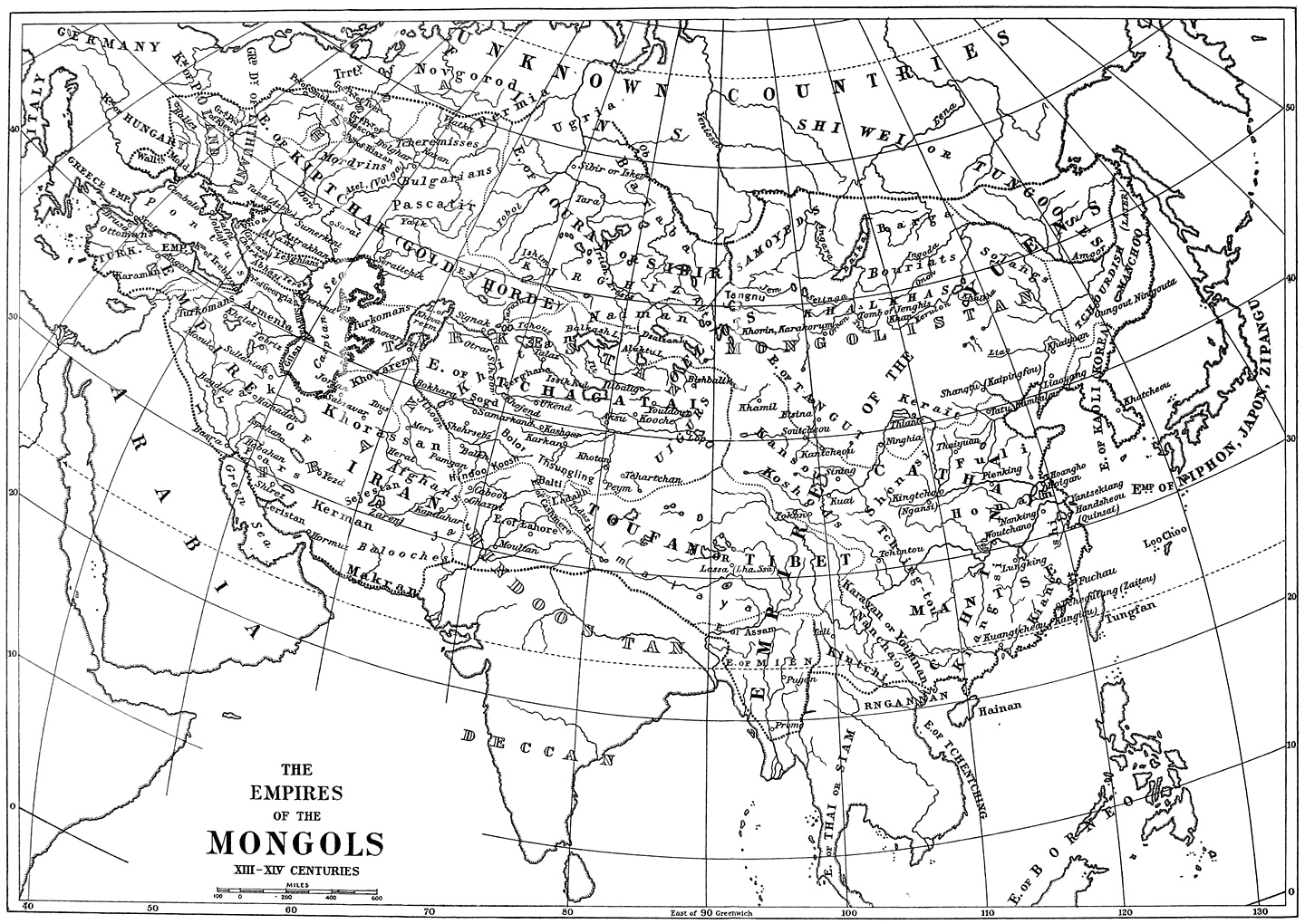
THE EMPIRES OF THE MONGOLS
XIII–XIV CENTURIES