THE UTLAUT SITE (23SA162W): AN ONEOTA-HISTORIC MISSOURI BURIAL SITE
Reading edition
by Patricia J. O’Brien and Kevin Hart
The Utlaut site (23SA162W) is located on the floodplain of the Missouri River about one mile west of Malta Bend, Saline County, Missouri and approximately two miles northwest of the junction of Highway 65 and 127.
The site is situated on land owned by Oscar John of Sweet Springs, Missouri and was farmed by Ryland Utlaut of Grand Pass. Both kindly allowed us to excavate there. We were directed to the site by J. M. “Buster” Crick of Corder, Missouri, a local collector who had been finding ceramics which looked “Mississippian.” His aid was invaluable, for without it this work could not have been done.
Scattered occupational debris was found covering an area ca. 100 feet in diameter around our test, but the major materials recovered, in six burials, seem not to be related to the surface debris. Those materials will be reported in a later paper dealing with site 23SA162, the Cole Lake Sand Ridge site.
As mentioned, the Utlaut site is situated on the floodplain of the river. The area, though, is in reality an old beach of the Missouri, formed when the river swung south of its present course and came near Grand Pass. Because the soil was almost pure sand, all of it was screened.
The initial test was an east-west trench comprising five alternating squares (Fig. 2). Burial materials were found between stakes 35W and 55W north and south of the 0 line (Fig. 2). Remains of five burials were recovered. While a few bones were treated as a separate burial in the field (Burial 5), they were found to be related to Burial 2 on completion of the analysis. The bones in burials 1 through 5 were in very poor condition, and because of cultivation many are missing.
BURIAL DESCRIPTIONS
The osteological analysis of the skeletal remains found in Appendix I is by the junior author and Clark Larsen. The descriptions to follow will focus on the cultural nature of the burials.
Burial 1. This is an adult male. The body was extended and oriented on a northeast-southwest axis with the head northeast. Although a vessel was found in the same square as the burial, it is thought that it belongs to Burial 4. One projectile point was found just east of the neck. Due north by about one foot was a biface chopper/scraper. These artifacts may be associated with this burial (Figs. 2 and 3).
49
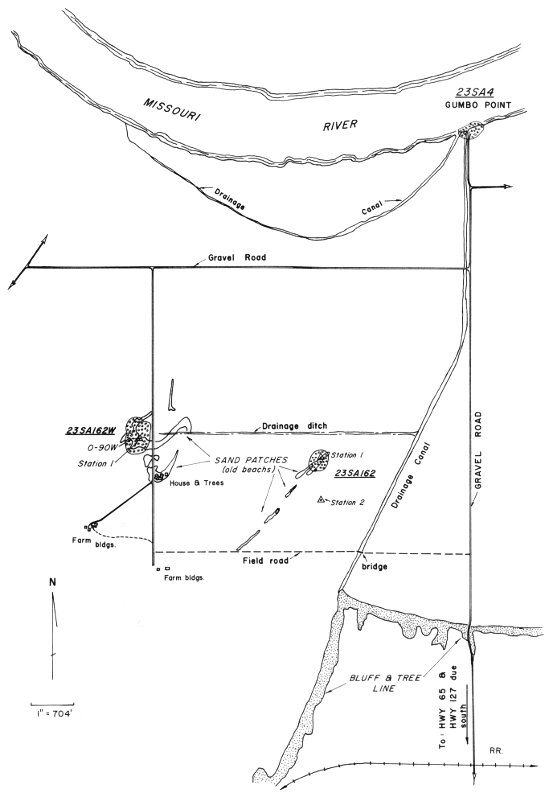
Figure 1. Floodplain of the Missouri River with locations of 23SA4 Gumbo Point site, 23SA162W Utlaut site, and 23SA162 Cole Lake Sand Ridge site.
50
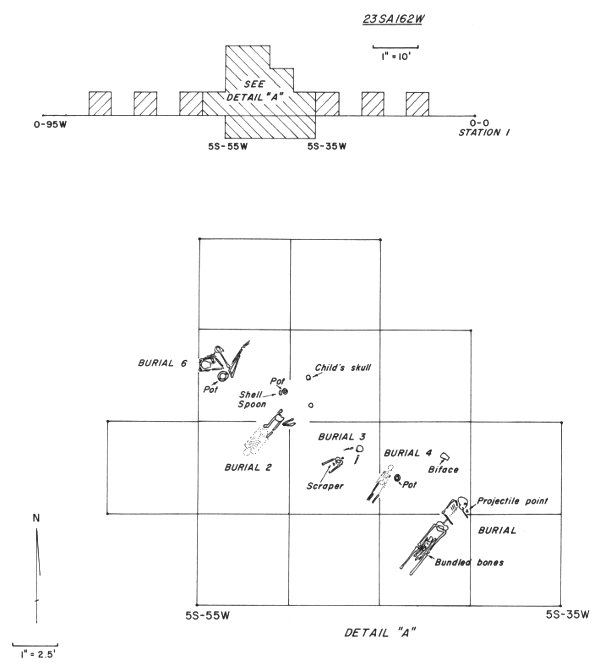
Figure 2. Test excavations at the Utlaut site, 23SA162W, with Detail “A” showing the burials.
BURIAL 6
Pot
BURIAL 2
Child’s skull
Pot
Shell Spoon
BURIAL 3
Scraper
BURIAL 4
Pot
Biface
BURIAL
Projectile point
Bundled bones
51
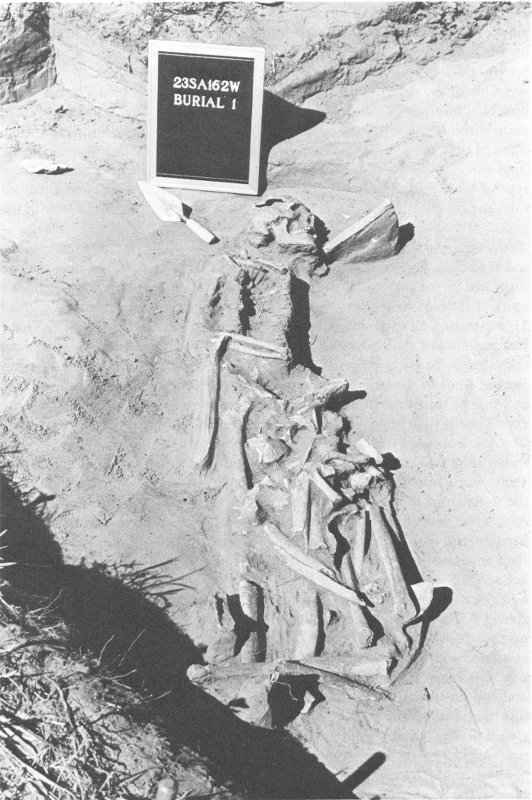
Figure 3. Burial 1, 23SA162W. View is toward northeast.
52
The projectile point is triangular, of tan-cream chert and is 3.1 cm. long, 1.44 cm. wide and 0.25 cm. thick (Fig. 4a). It is a typical Mississippian/Oneota point. The biface was cream colored with cortex present. There is a scraper edge on the long axis on one side (Fig. 4b). It is 14.0 cm. long, 9.9 cm. wide, and 3.1 cm. thick.
One of the most interesting aspects of this 35+ year old male burial is the possible “trophy” skeletal materials placed on the knee area. Remains of three persons and possibly a fourth were found in a fragmentary condition, and while some of the long bones were intact, the cranial remains present were shattered. Two explanations seem most obvious: (1) the remains are the result of some type of human sacrifice, or (2) they are secondary burial of remains disturbed from their original location. These ideas will be more fully explored later in the paper.
Burial 2. The skeletal material recovered from this burial was very fragmentary and the actual number of individuals involved could be three rather than the two suggested in the anatomical analysis. No complete skeleton was found, rather a series of jumbled long bones with the femur head facing southwest (Figs. 2 and 5), suggesting an extended burial on a northeast-southwest axis. At the knee area was found a skull which showed evidence of burning. This data, even more than that of Burial 1, suggests “human sacrifice” or some such exotic behavior. Because some of the long bones were burnt too, it is possible the firing occurred as a part of the burial ritual. At the northeastern end of the burial was found a child’s skull; its relationship to the adult is unclear at this time.
Also associated with Burial 2 was a ceramic vessel and a fresh water mollusc spoon (Fig. 6a-b). The spoon was very fragile and crumbled on cleaning. The vessel was a small globular jar with an everted rim and two strap handles. On the shoulder of the vessel below the handles were incised double nestled chevrons, while two single incised lines ran vertically from neck to base between the handles (Fig. 6a). The handles had double incised lines on them. The vessel was shell tempered with a slight scalloping of the lip. It was 7.63 cm. high, the orifice was 6.27 and 6.07 cm. in diameter, while the shoulder was 9.95 and 9.5 cm. in diameter. The vessel seems to be a typical Oneota form.
Burial 3. This burial was extended with head to the northeast and body on a northeast-southwest axis (Fig. 7). It was a child’s, and the only grave goods associated with it was a chert scraper (Fig. 4c). It was found south of the pelvic area. It is cream chert, is 3.39 cm. long, 1.78 cm. wide and 0.6 cm. thick. Anterioral and posterioral flattening of the frontal and occipital region is marked on this individual’s skull.
Burial 4. The burial when found was highly fragmentary; the legs are all that remain. No artifacts were found with it. Alignment of the legs indicates that the head was to the northeast and the body was on a northeast-southwest axis. However, in the process of analyzing these data it was discovered that by projecting the former location of the missing head and torso, this burial seems to be associated with the isolated pot from square 0-40W. As figures 2 and 8 show, the vessel would have been placed beside the left shoulder.
53
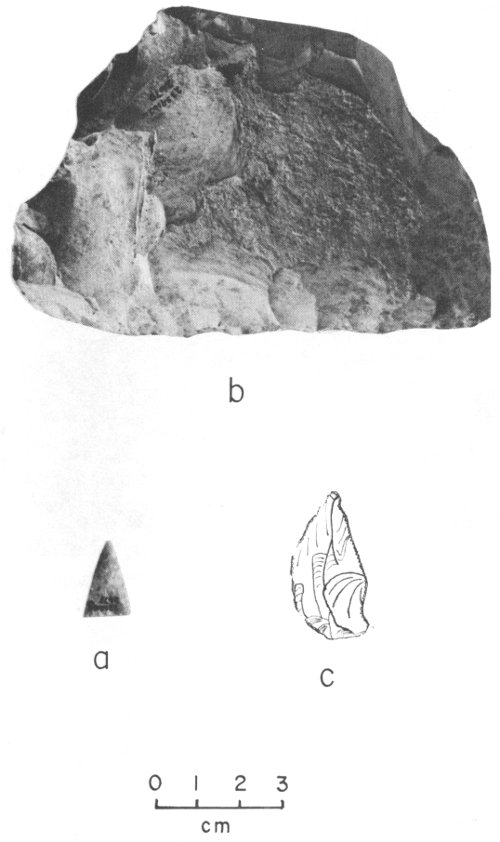
Figure 4. Artifacts recovered from the Utlaut site, 23SA162W: a. triangular un-notched projectile point, Burial 1; b. Biface chopper/scraper, Burial 1; c. scraper, Burial 3.
54
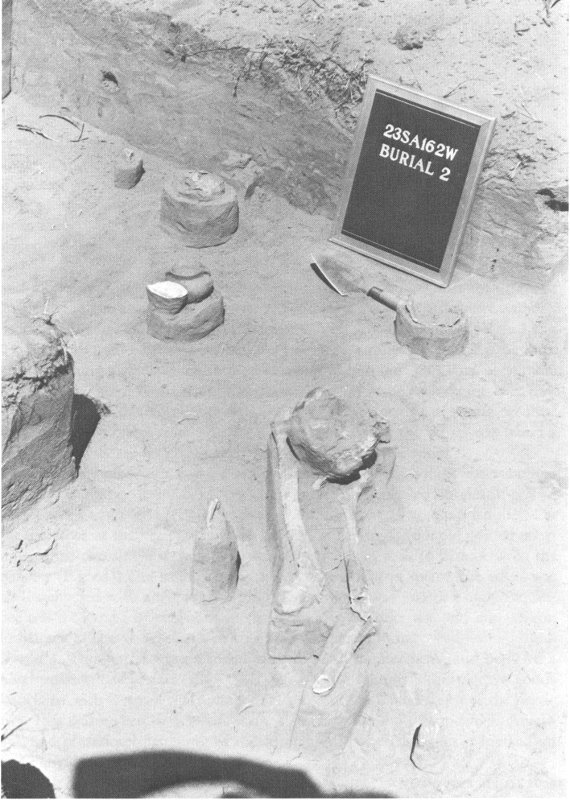
Figure 5. Burial 2, 235A162W. View is toward northeast.
55
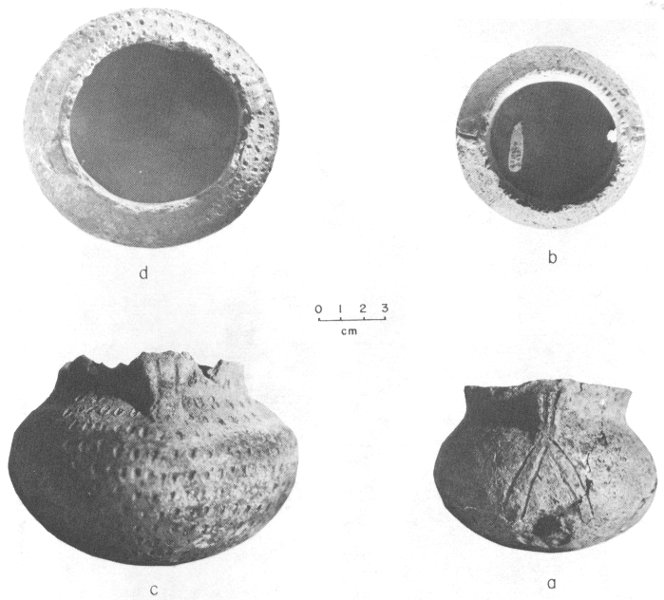
Figure 6. Top and side views of vessels recovered at the Utlaut site, 23SA162W: a-b Burial 2; c-d Burial 4.
56
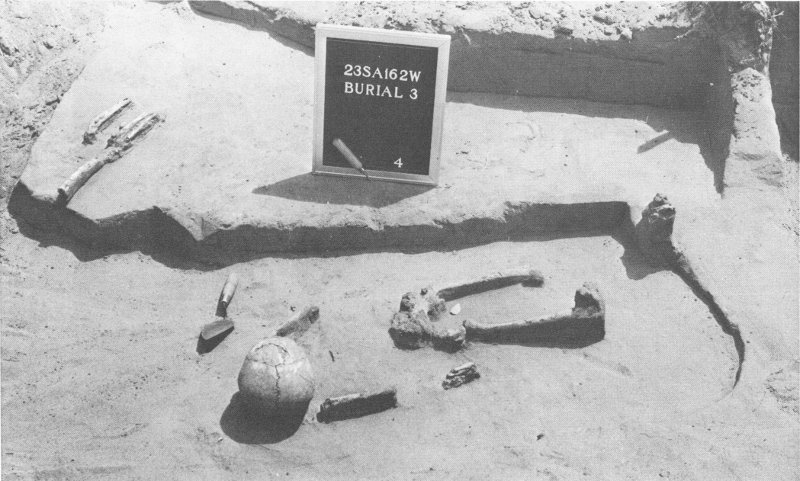
Figure 7. Burial 3, 23SA162W. View is toward the south. Burial 4 is to the left.
57
This oval-shaped vessel has 14 rows of punctations running around the whole surface. There are two strap handles each with two incised lines placed vertical to the rim (Fig. 6c-d). The rim has been damaged by the plow. Orifice size is 8.21 cm. at the handles and 7.7 cm. between them. It is 12.36 by 13.2 cm. at the shoulder and 8.15 cm. high (incomplete).
Vessels with similar extensive all-over punctation are reported from the Lower Mississippi River Valley and called Parkin Punctated (Phillips, Ford and Griffin 1951:Fig. 94). But a vessel with extensive punctation over the upper two-thirds of it, with some zoned punctates in parallel lines below the handles, has been reported from Gumbo Point (23SA4), an historic Missouri site about a mile and a quarter to the northeast (Chapman 1959:Fig. 36).
Henning (1970) does not report such a design from the Utz site nor other nearby Oneota sites. This tempts one to suggest the vessel has stronger affinities to the historic Missouri than to the Oneota component nearby.
Burial 5. These highly fragmentary remains probably belong with the child in Burial 2. They were found in the northeast corner of square 5N-50W which is just north of the area of the child’s skull in Burial 2.
Burial 6. This individual was interred in a different pattern from the others. It was semi-flexed with the head and shoulders slumped forward and down as if the burial pit was not large enough to hold him (Figs. 2 and 9). Rodents had run through the chest area and gnawed some of the bone.
Grave goods consisted of a whole vessel and glass trade beads. The vessel, which was at his knee, was a globular jar having two strap handles with four incised lines running vertically from the rim, and double nestled chevrons below them. The chevron was filled with narrow-line, incised punctates (Fig. 10a-b). The rim was damaged. The vessel is 10.5 by 11.7 cm. at the orifice, 16.3 by 18.0 cm. at the shoulder and 12.8 cm. high, making it slightly oval in shape.
Two kinds of beads were found. One was a “seed” bead ca. 0.18 cm. in diameter with a 0.05 cm. hole. There were 202 of these found in the sand around the head and shoulders. They may have been in the hair. All were turquoise in color. The second kind included three larger specimens—two turquoise blue and one black. The blue were 0.66 x 0.84 cm., 0.8 x 0.75 cm. and 0.82 x 0.63 cm. in diameter and length. The first had a 0.2 cm. hole and the others 0.18 cm. The black was 0.58 x 0.58 cm. with a 0.12 cm. hole. These beads were found in the area of the left wrist.
These materials are historic trade goods, and are not significantly different from those at Gumbo Point (Chapman 1959) or at the Utz site (Robert T. Bray, personal communication). Although these materials could be the result of English or even American trading activities, it is thought they are French, for the following reasons.
58
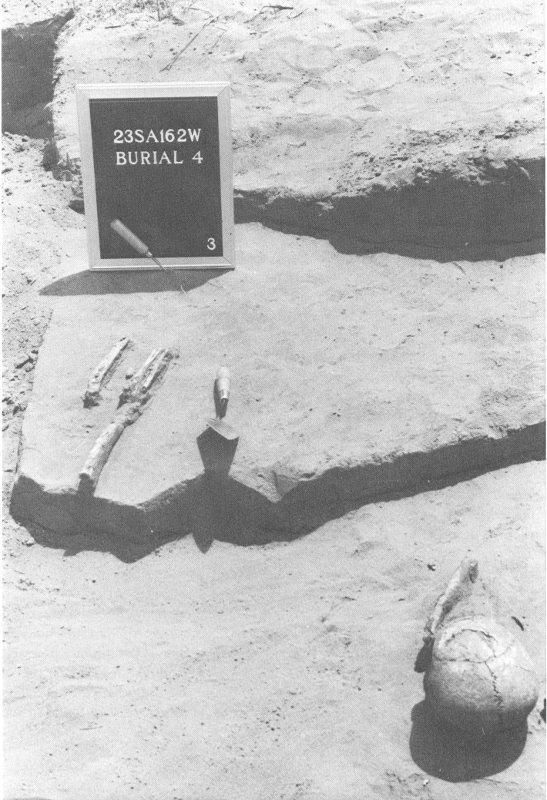
Figure 8. Burial 4 23SA162W. View is toward the southwest. The skull of Burial 3 is in the right hand corner.
59
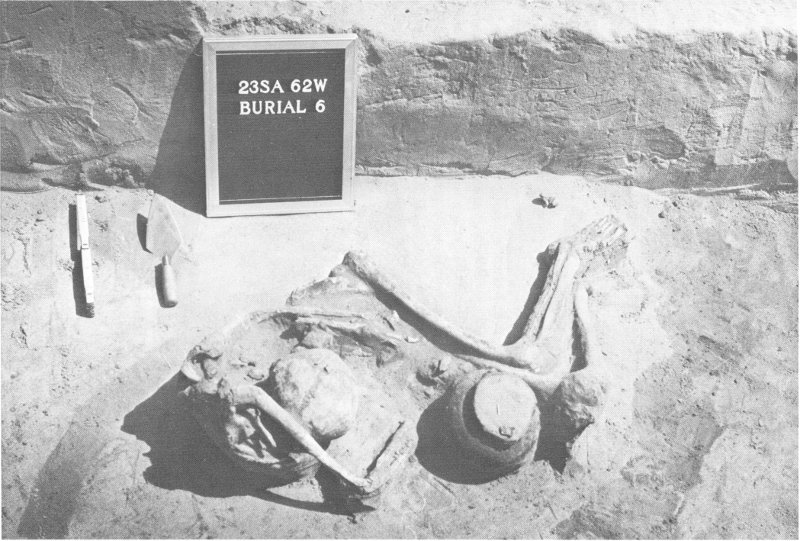
Figure 9. View of Burial 6, 23SA162W. View is toward the north.
60
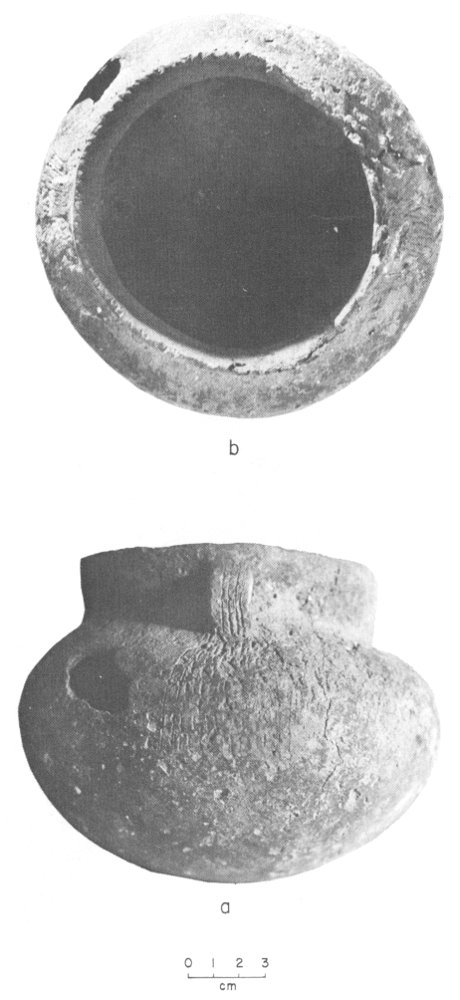
Figure 10. Top and side view of vessel recovered with Burial 6 at the Utlaut site, 23SA162W.
61
It is probable that this individual was a member of the Gumbo Point late Missouri village which may date 1727-1777 A.D. (Chapman 1959:63). This village was very near Fort Orleans which dates 1723-1728 A.D. (Bray 1961a:216-219). At the same time, this burial is associated with others which have no trade goods and apparently are completely prehistoric. Therefore, one could argue that the body was interred at the time of the proto-historic-historic boundary for that village. That boundary would be about 1727 A.D. if Chapman’s (1959:2) assumed dating of the beginning of the village following the abandonment of the Utz site is correct.
However, it could be argued that Burial 6 had nothing to do with the Oneota burials with it, and that the body could date as late as 1777 A.D. But for that to be so, we would have to assume it was just chance that of the several old beaches in that field this Indian was placed right in an earlier burial area. Rather, it seems more reasonable to have the cemetery area known and indeed the burials marked, so that the interment could take place without disturbing them.
Whether the Missouri Indians marked their graves cannot be stated, as no data on their mortuary practices are known. We do know that the Winnebago placed a post at the head of a grave (Radin 1923:144), and as the Missouri and Winnebago are both Chiwere Sioux, it is possible that this is an old shared trait. If this is so, and if the 1727 A.D. dating is correct, the trade goods are probably French as they were extremely active in this area at this early date.
DISCUSSION
Two separate, but related, cultural components are present at the site: Oneota and historic Missouri. Burials 1 through 4 were originally supine extended interments, although they have suffered much from plowing, and their associated artifacts indicate a general Oneota affiliation. Burial 4 with its punctated vessel though is probably late, bordering on the late proto-historic-historic Missouri line. Burial 6, with its glass trade beads, is historic, and since the Gumbo Point site (23SA4), a historic Missouri village dating around 1727-1777 A.D., is only one and a quarter miles to the northeast of the Utlaut site, the burial is probably an Indian of that village.
The following data on Oneota burial practices can be extracted from these data. Individuals are buried in a supine extended position on a northeast-southwest axis. In three cases, Burials 1, 3 and 4, the head is to the northeast; in one, Burial 2, it is southwest. Grave goods of pots, projectile point, shell spoon or scraper were present but seemingly not very diagnostic of social position, although the pots may be associated only with children here (Burials 2 and 4). Also, unless one assumes everyone was buried at the same time, it seems that the graves were marked so people could be interred over a period of time without 62 disturbing early graves, and so they could be aligned with each other.
Two adults seem to have “trophy” skeletal materials with them: a skull on the knees of Burial 2 (burnt) and many fragments of three and possibly four people on the lower legs of Burial 1. Bray (1961b:17-19) reports a “trophy head” with an Orr focus Oneota burial at the Flynn site, and glass trade beads with it point to this being an historic Ioway trait. Because there is no historic data on Missouri Indian burial practices, it is not possible now to tell if the trait is associated with them nor just what it may mean.
One could explain the skeletal remains, especially those with Burial 1 as secondary interments of graves which were somehow disturbed. In which case the term “trophy” would be inappropriate and misleading. This possibility is found in the fact that the Winnebago had two burial patterns: inhumation and platform associated with the phratry divisions of the culture, although the latter practice died out in historic times (Radin 1923:140). Since the Missouri are related to the Winnebago it is possible that these materials are inhumed platform burials.
However, the presence of single skulls with Burial 2, burnt too, and with an Ioway at the Flynn site cannot be explained that easily. The skull on the knees of Burial 2 was burnt at the time of interment as the knee area was also burned. Then too, if one was collecting platform burial remains to be inhumed, more than just the skulls would be lying about to be collected. Again if we look at the Winnebago we get some interesting data. In a discussion of grave-post markings, Radin (1923:155) points out that a warrior who had killed a man and cut off his head received a special grave-post signifying the deed. Unfortunately, he does not tell us if the head was buried with him.
As can be seen by the above discussion, there are data to support both interpretations, and indeed, maybe these burials in fact are the result of both sets of behavior rather than only one set.
A comparison of the Utlaut site Oneota burials with other Oneota burial data follows. From the Leary site in Nebraska Wedel reports (1935:25-26) two types of interments: (1) supine burials with beads to the north (3), east (3) or south (2). Associated with them are knives, hematite and a bison hoe as grave goods. (2) Bundled or jumbled bones within a pit and probably removed from scaffolds. Bass reports (1961) a body without head, semi-flexed on its back and left side.
Myers and Bass (n.d.) give the following data on Oneota burial material from Iowa. At the Hartley site (13AM103) in Allamakee County, Burial 1 was primary extended with head west and face north. It was a child about ten years old and with it was a pot and chert knife. Burial 2 was a female, 20-30 years old, primary extended with head northeast and no artifacts. Burial 3 was a child, 10-13 years old with a pot. It was a secondary burial. Burial 4 was a female, 20-30 years of age, primary extended with head to the east. A bison scapula hoe was with it. Burial 5 was a male, 25-35 years old; it was a primary one with the body 63 in a semi-sitting position and head on chest. The head faced northwest and the face was down. No grave goods were present. Burial 7 was a secondary bundled indeterminate adult. Burial 8 was a female, 18-28 years, primary extended burial with head to the northwest and no artifacts. Burial 10 was a nine year old child, primary extended with head to east. A pot was associated with it (Myers and Bass n.d.:7-11).
At the Blood Run site (13L02) in Lyon county, five burials were reported by Myers and Bass (n.d.). Burial 1 was a 3 to 4 year old child. It was extended in a pit in a mound with head facing northwest. Associated were copper earrings, two wooden tubes at the ears and a rim sherd at the right elbow. Burial 2 was a 30-40 year old male, extended supine with head northwest and no artifacts. Burial 3 was a 35-45 year old male, extended with head north and face to the east. It may be burnt on the left side. Associated was a catlinite pipe and a shell bead. Burial 4 was a male, 21-28 years of age, extended supine with head northeast and no artifacts. Finally, Burial 5 was a 2-3 year old child, associated with Burial 2; the grave goods were three blue glass beads (Myers and Bass n.d.:35-40).
At Correctionville site the burials are reported as extended supine (Myers and Bass n.d.:43). At the Flynn site (13AM51) in Allamakee county ten burials were recovered (Bray 1961b: 15-18). Burial 1 was a fully extended, supine adult with head to north. Associated were a raven skull, two bone beads, two shell beads, two copper or brass ornaments, a bone pendant and a small animal scapula. Burial 2 was a fully extended supine adult with head north. Associated were a pumice lump, red ochre, rolled copper or brass tubes, chert flakes and a belt of rolled copper or brass beads. Burial 3 was a fully extended supine adult with two triangular projectile points and some small animal bones. Burial 4 was a fully extended supine adult oriented east-west. No trade goods were found; only aboriginal bone whistles, a heron beak, a bone tube and a squirrel skull. Burial 5 was an adult oriented north-south and accompanied by many offerings: a pot, a fresh water clam shell, 100 copper/brass beads, 12 copper/brass bracelets, sheet copper, two steel knives, a steel awl, chert flakes, glass beads and “bead” girdle as in Burial 1. Burial 6 was a fully extended supine adult with a north-south orientation, with the head north. Artifact associations were blue and green glass beads, a beaver incisor, chert flakes, a polished bison rib, a beaded girdle as with Burials 1 and 5 and a “trophy” human skull at the left knee area. Burial 7 was different because it was deeper, under slabs of rock, and in a pit. Present was a child’s skull and two carnivore jaws. Burials 8 and 9 were incomplete and damaged, but seem to have been an adult and a 30-month old child. Burial 10 was a fetus or newborn infant.
Ten burials are reported (Henning 1970:120-212) from the Utz site (23SA2), the nearest large Oneota site just a few miles east of the Utlaut site. Position, sex and age are known only for a few. Burial 3 was a 27 year old male, fully extended 64 with a mussel shell, sheet copper and bone tube. Burial 4 consisted of two adults, but only one complete, fully extended 40 year old female. Burial 5 was a 30 year old male with a bone awl, a deer phalanx and worked hematite. Burial 7 was a 35 year old male with knives and abrader. Burial 8 was fully extended, 35 years old, male, covered with red ochre and was accompanied by several chert flakes. He may have died of wounds, since a projectile point was found in the cervical vertebrae. Finally, in the summer of 1970 an adult male was found in a storage/trash pit at the site (Robert T. Bray, personal communication).
Having reviewed the data on Oneota burials in Nebraska, Iowa and Missouri, the following hypotheses or assertions or guesses are offered concerning the general character of Oneota mortuary practices. Hopefully they will be tested in the future when more, especially descriptive, data become available.
(1) The bodies typically seem to be supine and fully extended.
(2) Orientation to a specific cardinal point does not seem to be involved as they range all around the compass.
(3) There appears to be some evidence that the graves were marked.
(4) Although most burials have some grave goods material, some do not. Except for the “trophy” material and the fact that some of the historic burials have more artifacts, there do not seem to be marked differences in the wealth of the burials. Possibly each individual is accompanied by some personal tool or ornament. At the Flynn, Hartley and Utlaut sites, burials of children are accompanied by ceramic vessels—at the Blood Run site, with a rim sherd. If this is a pattern, it changed in historic times because burials with pots and trade goods are adult (Flynn, B. 5, and Utlaut, B. 6).
(5) The lack of rich burials in the proto-historic (Oneota) period and their presence in the historic suggests a process of social stratification may be occurring because of new wealth. But this may be more apparent than real, if the “trophy” material at the Utlaut site was the proto-historic means of marking status to be replaced in the historic period by trade goods. If that is so, then it would suggest some social stratification in Oneota continuing through to the known historic Missouri chiefs.
Acknowledgments. The senior author is pleased to acknowledge the support of Kansas State University’s Bureau of General Research for a 1970 Summer Fellowship. The fellowship made possible this research. The cooperation of Robert T. Bray, Director, Lyman Archaeological Research Center, University of Missouri, is gratefully acknowledged for his help and many kindnesses throughout this work. To him, and my other colleagues: Alfred E. Johnson and W. Raymond Wood, who all helped to run the joint Midwestern Archaeological Field School in the summer of 1970 go my thanks. William M. Bass kindly loaned me the Myers and Bass manuscript which was most appreciated as it was essential for this analysis. Finally, thanks are due to the students of the field school who excavated these materials: Mike Gilman, Tom Green, Kevin Hart, Ann Hirsh 65 and Donna Roper, for without their good spirits and effort the work could not have been done.
REFERENCES CITED
ANDERSON, J. E.
1969 The Human Skeleton: A Manual for Archaeologists. National Museum of Canada, Ottawa.
BASS, WILLIAM M.
1971 Personal Communication.
BASS, WILLIAM M.
1961 1960 Excavations at the Leary Site, Richardson County, Nebraska 25RH1. Plains Anthropologist, 6: 31, 201-202.
BRAY, ROBERT T.
1961a The Missouri Indian Tribe in Archaeology and History. Missouri Historical Review, LV: 3, 213-225. Columbia.
1961b The Flynn Cemetery: An Orr Focus Oneota Burial Site in Allamakee County, Iowa. Journal of the Iowa Archaeological Society, 10: 4, 15-25.
BROTHWELL, DON R.
1963 Digging Up Bones. British Museum, London.
HENNING, DALE R.
1970 Development and Interrelationships of Oneota Culture in the Lower Missouri River Valley. The Missouri Archaeologist, Vol. 32, Whole Volume. Columbia.
KROGMAN, WILTON M.
1962 The Human Skeleton in Forensic Medicine. Charles C. Thomas, Springfield, Illinois.
MCKERN, THOMAS W. AND T. D. STEWART
1957 Skeletal Age Changes in Young American Males. Technical Report EP-45, Quartermaster Research and Development Center, U.S. Army, Natick, Massachusetts.
MORSE, DAN
1969 Ancient Disease in the Midwest. Reports of Investigations No. 15, Illinois State Museum.
MYERS, JUDY A. AND WILLIAM M. BASS
n.d. An Analysis of the Human Skeletal Material from Some Oneota Sites. Unpublished Manuscript.
TROTTER, MILDRED AND GOLDEN C. GLESER
1958 A Re-evaluation of Estimation of Stature Based on Measurements of Stature During Life and of Long Bones After Death. American Journal of Physical Anthropology, 16: 1, 79-124. Philadelphia.
66
PHILLIPS, P., J. A. FORD AND J. B. GRIFFIN
1951 Archaeological Survey in the Lower Mississippi Alluvial Valley, 1940-1947. Papers of the Peabody Museum of American Archaeology and Ethnology, Harvard University, Vol. XXV. Cambridge.
RADIN, PAUL
1923 The Winnebago Tribe. Thirty-seventh Annual Report of the Bureau of American Ethnology, Smithsonian Institution.
67