RETROSPECTIVE GLEANINGS.
Reading edition
THE POST OFFICE.
In the year 1635, Charles I. directed his postmaster to open a communication between London and Edinburgh, &c. &c. In 1653-4, the revenues of the Post-office were farmed by the Council of State and Protector, at 10,000l. per annum. Some idea of their progressive increase may be gained by the perusal of the following:—
1664 £21,000
1674 43,000
1685 65,000
1688 76,318
1697 90,505
1710 111,467
1715 145,227
1744 235,492
1775 345,321
1785 463,753
1793 607,268
1814 2,005,987
Since 1814, Mr. Macculloch considers the revenue of the Post-office to have been about stationary.
ANTIQUARES.
BEDE'S CHAIR.
BEDE'S CHAIR.
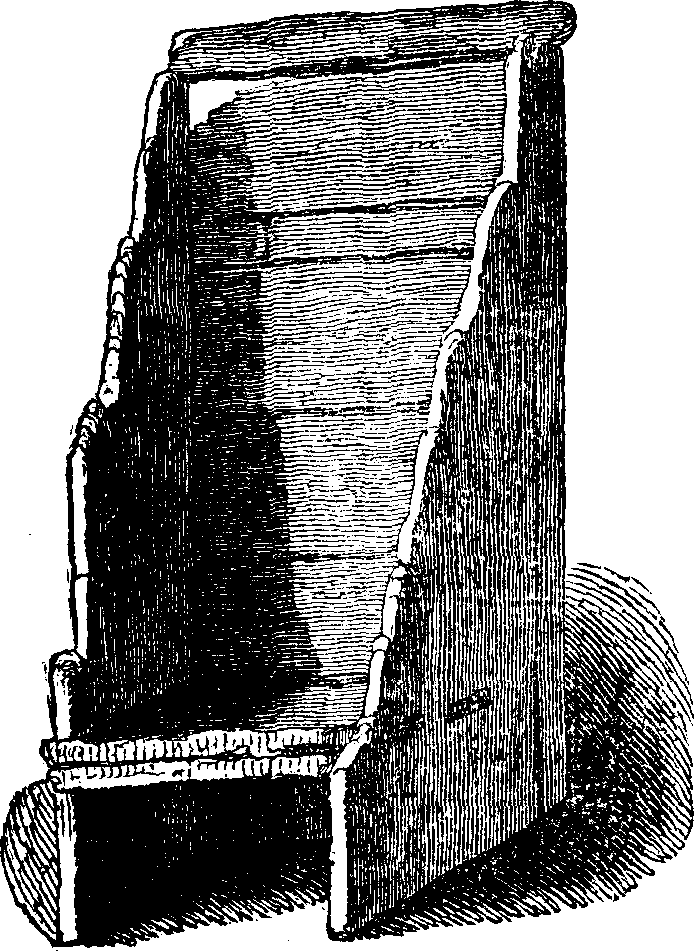
This curious relic is preserved in the vestry of the ancient church of Jarrow, two miles from South Shields, in the county of Durham. It is a large chair of oak, traditionally said to have been the seat of the VENERABLE BEDE, the pre-eminent boast of the monastery, a portion only of the church of which establishment remains at Jarrow. The chair is very rudely formed, and, with the exception of the back, is of great age. To have been possessed by Bede, it must be eleven hundred years old; but there is no precisely authentic testimony of its belonging to that learned writer. The Danes and Normans are said to have plundered the monastery of all its valuables; though it is reasonable to suppose, that the monks would preserve the seat of their principal with more reverential care, and attach to it more importance, than they would to any other article of furniture. Mr. Fosbroke, the diligent antiquarian, refers to it as Bede's Chair in accredited manner; that is, as taken for granted, or without note or comment of doubt.
Bede died May 26, 735, in the sixty-third year of his age. He was first buried in his own monastery, but his remains were afterwards removed, and interred in Durham cathedral; and, being subsequently canonized, he was enrolled in the Romish calendar of saints. His character is thus drawn by William of Malmsbury:—"He was a man, that, although born in the extreme corner of the world, yet the light of his learning spread over all parts of the earth. All the hours which he had to spare from the monastic exercises of prayer, and singing in the choirs by day and night, (in which he was constant, and very devout,) he most diligently spent in study, and divided his whole time between that and his devotions."
The Chair is not the only memorial of Bede preserved in this neighbourhood. About one mile west of Jarrow is a Well, still called St. Bede's, to which it was customary, almost as late as the middle of the last century, to convey diseased children, and, after dropping in a crooked pin, to dip them for the recovery of their health: round the Well, also, on every Midsummer Eve, was a great resort of the neighbouring people, with bonfires, music, and dancing. The mystical properties of the Well are not of difficult solution: since it was reasonable enough to associate the restorative effects of cold bathing with sanctity; and the rejoicings at the spring were indicative of the gladness of the people, in connexion with a name endeared to them, by the wisdom, virtue, and benevolence, of its possessor.
GOLD-BEATING.
Early in the 17th century, great surprise was excited upon the promulgation of the fact, that the Parisian gold-beaters could produce 1,600 leaves, or 105 square feet, from one ounce of gold; but the surprise of the public was redoubled, when, upon the discovery of the fine skin now in use, they found that 147 square feet could be produced from the same quantity.
ANTIQUARES.
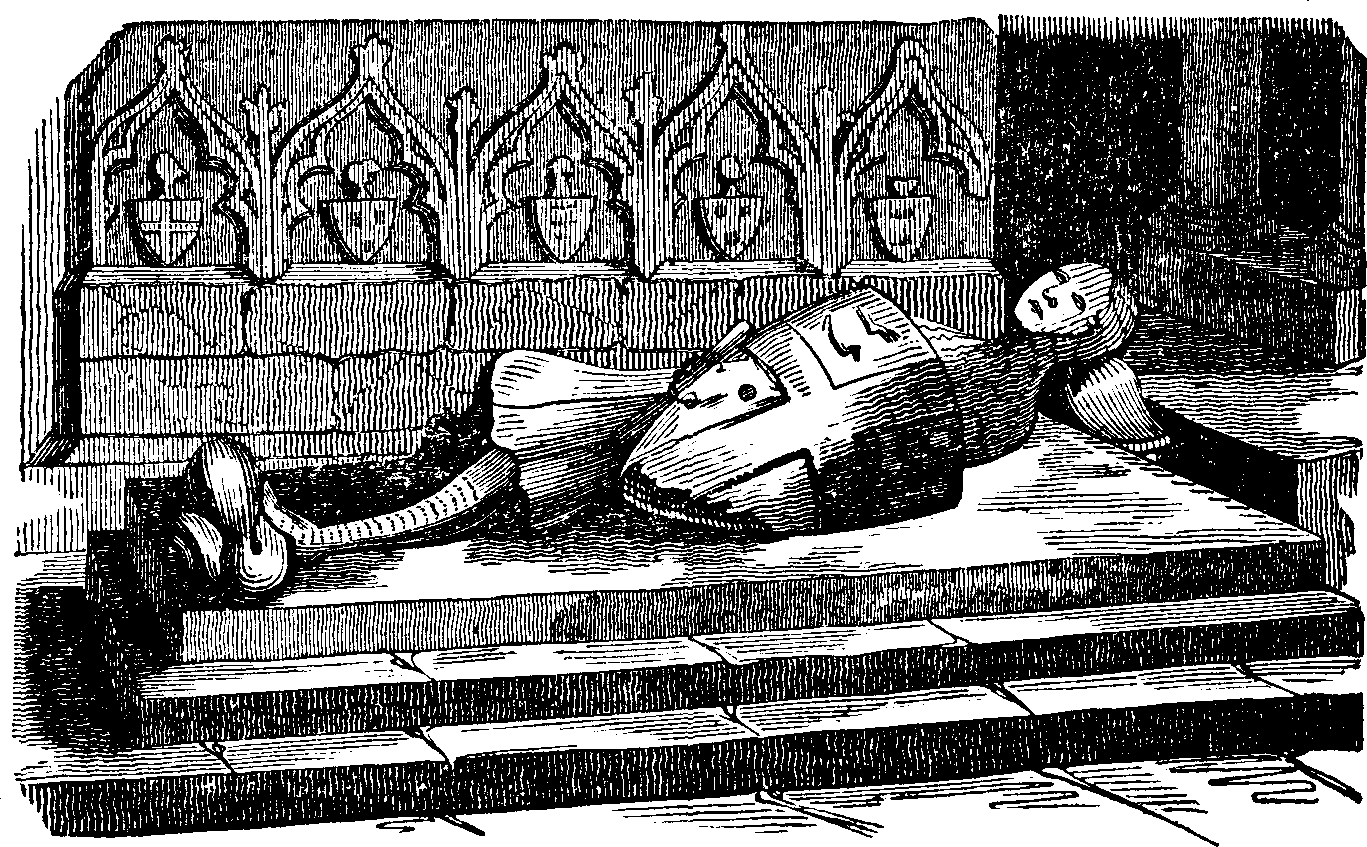
MONUMENT OF A CRUSADER.
This Engraving will be received by the attentive inquirer, as an interesting specimen of the sepulchral architecture of olden times; and, judging from the mutilated remains, its original beauty would have reminded us of the remark of an antiquarian writer,—that he never saw a fine monument out of England.
(Monument of a Crusader, in Winchester Cathedral.)