Spirit of Discovery.
Reading edition
THE ISLAND OF ROTUMA.10
"A new Cythera emerges from the bosom of the enchanted wave. An amphitheatre of verdure rises to our view; tufted groves mingle their foliage with the brilliant enamel of meadows; an eternal spring, combining with an eternal autumn, displays the opening blossoms along with the ripened fruit."—Maltebrun.
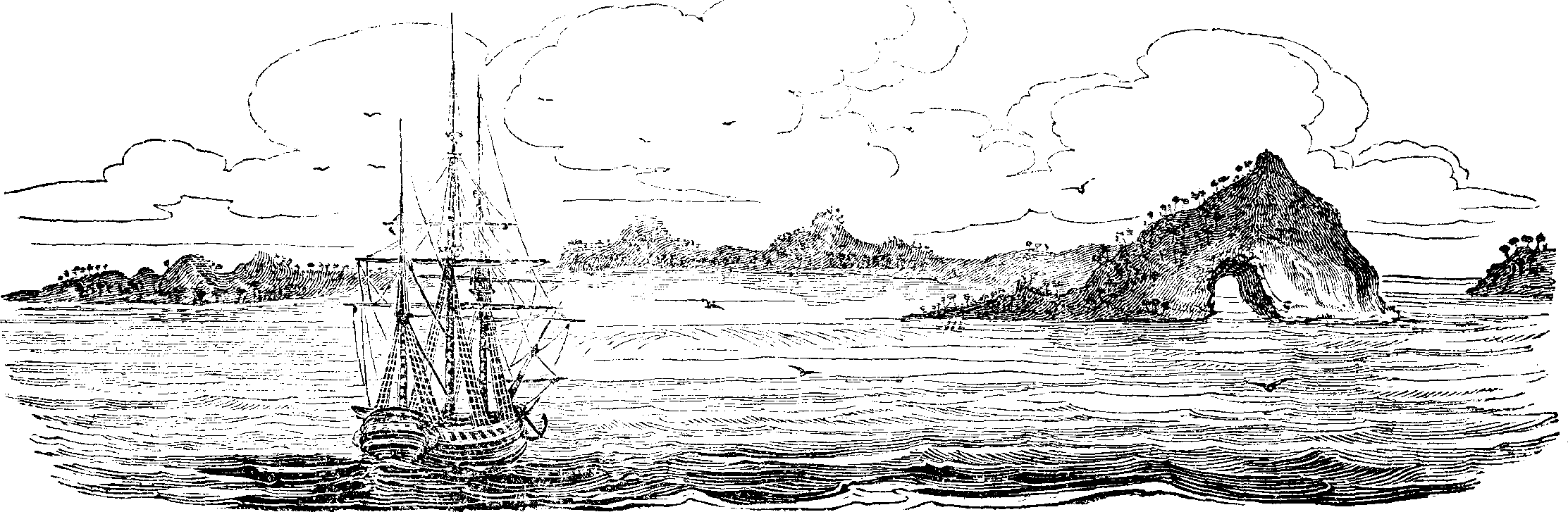
This is one of the beautiful islands of Polynesia, in the South Pacific Ocean. It was discovered in the year 1791, and has been since occasionally visited by English and American whalers, and a few other ships, for the purpose of procuring water and a supply of vegetable productions, with which it abounds. It is situated in latitude 12° 30' south, and longitude 177° east, and is distant about 260 miles from the nearest island of the Fidji group. It is of a moderate height, densely wooded, and abounding in cocoa-nut trees, and is about from thirty to thirty-five miles in circumference. Its general appearance is beautifully picturesque, verdant hills gradually rising from the sandy beach, giving it a highly fertile appearance. It is surrounded by extensive reefs, on which at low water the natives may be seen busily engaged in procuring shell and other fish, which are abundantly produced on them, and constitute one of their articles of daily food. At night, they fish by torch-light, lighting fires on the beach, by which the fish are attracted to the reefs. The torches are formed of the dried spathe or fronds of the cocoa-nut tree, and enable them to see the fish, which they take with hand-nets. It is by these lights that the fish are attracted, but not so in the opinion of the natives, who say, "they come to the reef at night to eat, then sleep, and leave again in the morning."
[Mr. George Bennett, in his account of his recent visit, says:—]
We made this island on the 21st of February, 1830: it bore west by south-half-south, about twenty-five miles distant; at 11 A.M. when close in, standing for the anchorage, we were boarded by several natives, who came off in their canoes, and surprised us by their acquaintance with the English language; this it seems they had acquired from their occasional intercourse with shipping, but principally from the European seamen, who had deserted from their ships and were residing on the island in savage luxury and indolence. When at anchor, the extremes of the land bore from east by north to west by compass. An island rather high, quoin shaped, and inhabited, situated at a short distance from the main land, (between which there is a passage for a large ship,) was at some distance from our present anchorage, and bore west-half-north by compass; it was named Ouer by the natives. Close to us were two rather high islands, or islets, of small extent, planted with cocoa-nut trees, and almost connected together by rocks, and to the main land by a reef; they shelter the bay from easterly winds. Their bearings are as follow:—the first centre bore east-half-north; the second centre bore east-half-south, extreme of the main land east-south-east by compass. One of the chiefs, on our anchoring, addressing the Commander made the following very humane observation, "If Rótuma man steal, to make hang up immediately." Had this request been complied with, there would have been a great depopulation during our stay, and it is not improbable that a few chiefs might have felt its effects.
On a second visit to this island in March, 1830, we anchored in a fine picturesque bay, situated on the west side of the island, named Thor, in fourteen fathoms, sand and coral bottom, about three miles distant from the centre. A reef extends out some distance from the beach at this bay, almost dry at low water, and with much surf at the entrance, from which cause the procuring of wood and water is attended with more difficulty than at Onhaf Bay.
On landing, the beautiful appearance of the island was rather increased than diminished; vegetation appeared most luxuriant, and the trees and shrubs blooming with various tints, spread a gaiety around; the clean and neat native houses were intermingled with the waving plumes of the cocoa-nut, the broad spreading plantain, and other trees peculiar to tropical climes. That magnificent tree the callophyllum inophyllum, or fifau of the natives, was not less abundant, displaying its shining, dark, green foliage, contrasted by beautiful clusters of white flowers teeming with fragrance. This tree seemed a favourite with the natives, on account of its shade, fragrance, and ornamental appearance of the flowers. When I extended my rambles more inland, through narrow and sometimes rugged pathways, the luxuriance of vegetation did not decrease, but the lofty trees, overshadowing the road, defended the pedestrian from the effects of a fervent sun, rendering the walk under their umbrageous covering cool and pleasant. The gay flowers of the hibiscus tiliaceus, as well as the splendid huth or Barringtonia speciosa, covered with its beautiful flowers, the petals of which are white, and the edges of the stamina delicately tinged with pink, give to the trees when in full bloom a magnificent appearance; the hibiscus rosa-chinensis, or kowa of the natives also grows in luxuriance and beauty. The elegant flowers of these trees, with others of more humble and less beautiful tints, everywhere meet the eye near the paths, occasionally varied by plantations of the ahan or taro, arum esculentum, which, from a deficiency of irrigation, is generally of the mountain variety. Of the sugar-cane they possess several varieties, and it is eaten in the raw state; a small variety of yam, more commonly known by the name of the Rótuma potato, the ulé of the natives, is very abundant; the ulu or bread-fruit, pori or plantain and the vi, (spondias dulcis, Parkinson,) or, Brazilian plum, with numerous other kinds, sufficiently testify the fertility of the island. Occasionally the mournful toa or casuarina equisetifolia, planted in small clumps near the villages or surrounding the burial-places, added beauty to the landscape.
The native houses are very neat; they are formed of poles and logs, the roof being covered with the leaves of a species of sagus palm, named hoat by the natives, and highly valued by them for that purpose on account of their durability; the sides are covered with the plaited
The natives are a fine-looking and well-formed people; they are of good dispositions, but are much addicted to thieving, which seems indeed to be a national propensity; they are of a light copper colour, and the men wear the hair long and stained at the extremities of a reddish brown colour; sometimes they tie the hair in a knot behind, but the most prevailing custom is to permit it to hang over the shoulders. The females may be termed handsome, of fine forms, and although possessing a modest demeanour, flocked on board in numbers on the ship's arrival. The women before marriage have the hair cut close and covered with the shoroi, which is burnt coral mixed with the gum of the bread-fruit tree; this is removed after marriage and their hair is permitted to grow long, but on the death of a chief or their parents it is cut close as a badge of mourning. Both sexes paint themselves with a mixture of the root of the turmeric plant (curcuma longa) and cocoa-nut oil, which frequently changed our clothes and persons of an icteroid hue, from our curiosity to mingle with them in the villages—theirs to come on board the ship.
On visiting the king, who resided at the village of Fangwot, we found him a well-formed and handsome man, apparently about thirty years of age; the upper part of his body was thickly covered with the Rang, or paint of turmeric and oil, which had been recently laid on in honour of the visit from the strangers. There was somewhat of novelty, but little of "regal magnificence" in our reception. In the open air, under the wide-spreading branches of their favourite Fifau, (Callophyllum Inophyllum) sat his Majesty squatted on the ground, and surrounded by a crowd of his subjects. The introduction was equally unostentatious; one of the natives who had accompanied us from the ship, pointing towards him, said, in tolerably pronounced English, "That the king." His Majesty not being himself acquainted with our language, one of his attendants, who spoke it with considerable fluency, acted as interpreter. After some common-place questions, such as where the ship came from, where bound to, what provisions we stood in need of, &c., we adjourned to the royal habitation, which differed in no respect from the other native houses. Yams, bread-fruit, and fish, wrapped in the plantain leaves in which they had been cooked, were here placed before us, with cocoa-nut water for our beverage; plantain leaves serving also as plates.
The chiefs are elected kings in rotation, and the royal office is held for six months, but by the consent of the other chiefs, it may be retained by the same chief for two or three years. The royal title is Sho: the king to whom we had been introduced, as a chief, is named Mora. We had an interview also with the former king, named Riemko; he is a chief of high rank, and a very intelligent man: he spoke the English language with much correctness. Being naturally of an inquisitive disposition, and possessing an exceedingly retentive memory, he had acquired much information; this he displayed by detailing to us many facts connected with the history of Napoleon Buonaparte, Wellington, &c., which had been related to him by various European visiters, and which he appeared to retain to the most minute particulars. He surprised us by inquiring if we resided in "Russell-square, London?"
An innate love of roaming seems to exist among these people; they set sail without any fixed purpose in one of their large canoes: few ever return, some probably perish, others drift on islands either uninhabited, or if inhabited, they mingle with the natives, and tend to produce those varieties of the human race which are so observable in the Polynesian Archipelago. I frequently asked those of Rótuma what object they had in leaving their fertile island to risk the perils of the deep? the reply invariably was, "Rótuma man want to see new land:" they thus run before the wind until they fall in with some island, or perish in a storm. Cook and others relate numerous instances of this kind.
As an evidence of the great desire of the natives of both sexes to leave their native land, I may mention the offers which were made to the commander of the ship, of baskets of potatoes and hogs, as an inducement to be carried to the island of Erromanga, where our vessel was next bound to. Two hundred were taken on board for the purpose of cutting Sandal wood, but from the unhealthy state in which we found the island on our arrival, and the numerous deaths that had occurred among native gangs that had been brought by other vessels for a similar purpose, we returned to Rótuma and landed them all safely. The perfect apathy with which they leave parents and connexions, departing with strangers to a place respecting which they are in total ignorance, is quite surprising, placing an unbounded confidence in those differing in colour, language, and customs from themselves: the young, timid females, to whom a ship was a novelty, those who had never before seen a ship, were all anxious to visit foreign climes,—even, they said, London.
MOUNT ARARAT.
A short time since there were given in the St. Petersburgh Academical Journal some authentic particulars of Professor Parrot's journey to Mount Ararat. After being baffled in repeated attempts, he at length succeeded in overcoming the obstacles which beset him, and ascertained the positive elevation of its peak to be 16,200 French feet: it is, therefore, more than 1,500 feet loftier than Mount Blanc. He describes the summit as being a circular plane, about 160 feet in circumference, joined by a gentle descent, with a second and less elevated one towards the east. The whole of the upper region of the mountain, from the height of 12,750 English feet, being covered with perpetual snow and ice. He afterwards ascended what is termed "The Little Ararat," and reports it to be about 13,100 English feet high.—W.G.C.
SAILING UP THE ESSEQUIBO.
(Concluded from page 360.)
A family of Indians was seen crossing the river in their log canoe, and disappearing under the bushes on the opposite side; my companion and myself paddled after them, and we landed under some locust trees, and found an Indian settlement. The logies were sheds, open all round, and covered with the leaves of the trooly-palm, some of them twenty-four feet long; and suspended from the bamboo timbers of the roof were hammocks of net-work, in which the men were lazily swinging. One or two of those who were awake were fashioning arrow-heads out of hard wood. The men and children were entirely naked, with the exception of the blue lap or cloth for the loins; the women in their blue petticoat and braided hair were scraping the root of the cassava tree into a trough of bark; it was then put into a long press of matting, which expresses the poisonous juice; the dry farina is finally baked on an iron plate. The old women were weaving the square coëoo or lap of beads, which they sometimes wear without a petticoat; also armlets and ankle ornaments of beads. Some were fabricating earthen pots, and all the females seemed actively employed. They offered us a red liquor, called caseeree, prepared from the sweet potato; also piwarry, the intoxicating beverage made by chewing the cassava, and allowing it to ferment. At their piwarry feasts the Indians prepare a small canoe full of this liquor, beside which the entertainers and their guests roll together drunk for two or three days. Their helpmates look after them, and keep them from being suffocated with the sand getting into their mouths: but piwarry is a harmless liquor, that is to say, it does not produce the disease and baneful effects of spirits, for after a sleep the Indians rise fresh and well, and only occasionally indulge in a debauch of this kind. Fish, which the men had shot with their arrows, and birds, were brought out of the canoe, and barbacoted or smoke-dried on a grating of bamboos over a fire; and we followed an old man with a cutlass to their small fields of cassava, cleared by girdling and burning a part of the forest behind the logies. These Indians were of the Arrawak nation; we afterwards saw Caribs, Accaways, &c.
The rivers and creeks, and the whole of the interior of British Guiana at a distance from the sea, are unknown and unexplored. October and November are the driest months in the year, and the best for expeditions into the interior. I was unable to go as far up the river as I wished, from the great freshes; the rain fell every day, yet I penetrated in all directions as far as I could, and I trust to be able, at some more favourable season, to return to that interesting country.
Two years ago, a Mr. Smith, a mercantile man from Caraccas, was joined at George Town by a Lieutenant Gullifer, R.N. They proceeded down the Pomeroon river, then up the Wyeena creek, travelled across to the Coioony, sailed down it, and then went up the Essequibo to the Rio Negro, which, it appears, connects the Amazons and Oroonoco rivers. At Bara, on the Rio Negro, Mr. Smith, from sitting so long cramped up in coorials or canoes, became affected with dropsy; and allowing himself to be tapped by an ignorant quack, died after a fortnight's illness. Lieutenant Gullifer sailed down the Rio Negro to the Amazons, and remained at Para for some months, till he heard from England. From domestic details he received at Para, he fell into low spirits, and proceeded to Trinidad, where, one morning, he was found suspended to a beam under the steeple of the Protestant church! His papers, and Mr. Smith's, consisting of journals of their travels, were sent to a brother of Lieutenant Gullifer's, on the Marocco coast of Essequibo, where I went and saw the papers, and was most anxious to obtain them for the Geographical Society; but Mr. Gullifer said that he must consult first with the other relatives.
Among other interesting details I found in the notes, I may mention the following:—High up the Essequibo they fell in with a nation of anthropophagi, of the Carib tribe. The chief received the travellers courteously, and placed before them fish with savoury sauce; which being removed, two human hands were brought in, and a steak of human flesh! The travellers thought that this might be part of a baboon of a new species; however, they declined the invitation to partake, saying that, in travelling, they were not allowed to eat animal food. The chief picked the bones of the hands with excellent appetite, and asked them how they had relished the fruit and the sauce. They replied that the fish was good and the sauce excellent. To which he answered, "Human flesh makes the best sauce for any food; these hands and the fish were all dressed together. You see these Macooshee men, our slaves; we lately captured these people in war, and their wives we eat from time to time." The travellers were horrified, but concealed their feelings, and before they retired for the night, they remarked that the Macooshee females were confined in a large logie, or shed, surrounded with a stockade of bamboos; so that, daily the fathers, husbands, and brothers of these unfortunate women, saw them brought out, knocked on the head, and devoured by the inhuman cannibals. Lieutenant Gullifer, who was in bad condition, got into his hammock and slept soundly; but Mr. Smith, being in excellent case, walked about all night, fearing that their landlord might take a fancy to a steak of white meat. They afterwards visited a cave, in which was a pool of water; the Indians requested them not to bathe in this, for if they did, they would die before the year was out. They laughed at their monitors and bathed; but sure enough were both "clods of the valley" before the twelvemonth had expired.—Journal of the Geographical Society, Part 2.