MANNERS AND CUSTOMS.
Reading edition
PETER PENCE
Were an ancient levy, or tax, of a penny on each house throughout England, paid to the Pope. It was called Peter-pence because collected on the day of St. Peter ad vincula. By the Saxons it was called Rome-feoh—i.e. the fee of Rome; and also Rome-scot, and Rome-pennying, because collected and sent to Rome;—and lastly, it was called Hearth-money, because every dwelling-house was liable to it, provided there were thirty-pence vivæ pecuniæ belonging to it;—nay, and every religious house, the Abbey of St. Alban's alone excepted.
This Peter-pence was at first given as a pension, or alms, by Ina, king of the West Saxons, in the year 727, being then in pilgrimage at Rome; and the like was done by Offa, king of the Mercians, throughout his dominions, in 794; and afterwards by Ethelwulph, through the whole kingdom, in the year 855.
It was not intended as a tribute to the Pope, but chiefly for the support of the English school, or college, at Rome. The popes, however, shared it with the college, and at length found means, to appropriate it to themselves.
At first it was only an occasional contribution; but it became at last a standing tax, being established by the laws of King Canute, Edward the Confessor, the Conqueror, &c. The bishops, who were charged with the collecting it, employed the rural deans and archdeacons therein.
Edward III. first forbade the payment; but it soon after returned, and continued till the time of Henry VIII., when Polydore Virgil resided here as the Pope's receiver general. It was abolished under that prince, and restored again under Philip and Mary; but it was finally prohibited under Queen Elizabeth.
WALTER E.C.
POPISH RELICS.
Ere the bright dawn of the Reformation lighted upon England, the furniture of churches appears, from ancient records, to have been of a splendid description; and vast sums are stated to have been lavished upon the images of saints, &c. Great Saint Mary's Chapel, Cambridge, is in the possession of an inventory of the goods and chattels possessed by that ancient edifice in the 19th year of Henry VII., of which the following is a transcript:—
"Item—A coat of tawney damask, purfled with velvet, appertaining to our Lady.
"Item—A coat for her son, of the same satin, purfled with black velvet, and spangled with gold.
"Item—A relic, called a box of silver with the oil of St. Nicholas.
"Item—Another little box of silver, with a bone of St. Lawrence.
"Item—A shoe of silver for the image of our Lady, and a piece of a penny, weighing in all two ounces in a box.
"Item—An image of our Lady and her Son, of copper and gilt, with a chrystal stone.
"Item—A collar of gold for to hang about our Lady's neck, of nine links in the collar.
"Item—A cap of black velvet, with fine pearl, for our Lady's son.
"Item—Two maces for St. Edmund.
"Item—Three small crowns for St. Katherine.
"Item—A cross and staff for St. Nicholas."
The orthography of this extract has been modernized, but the idiom (if any) has been retained.
JUVENIS.
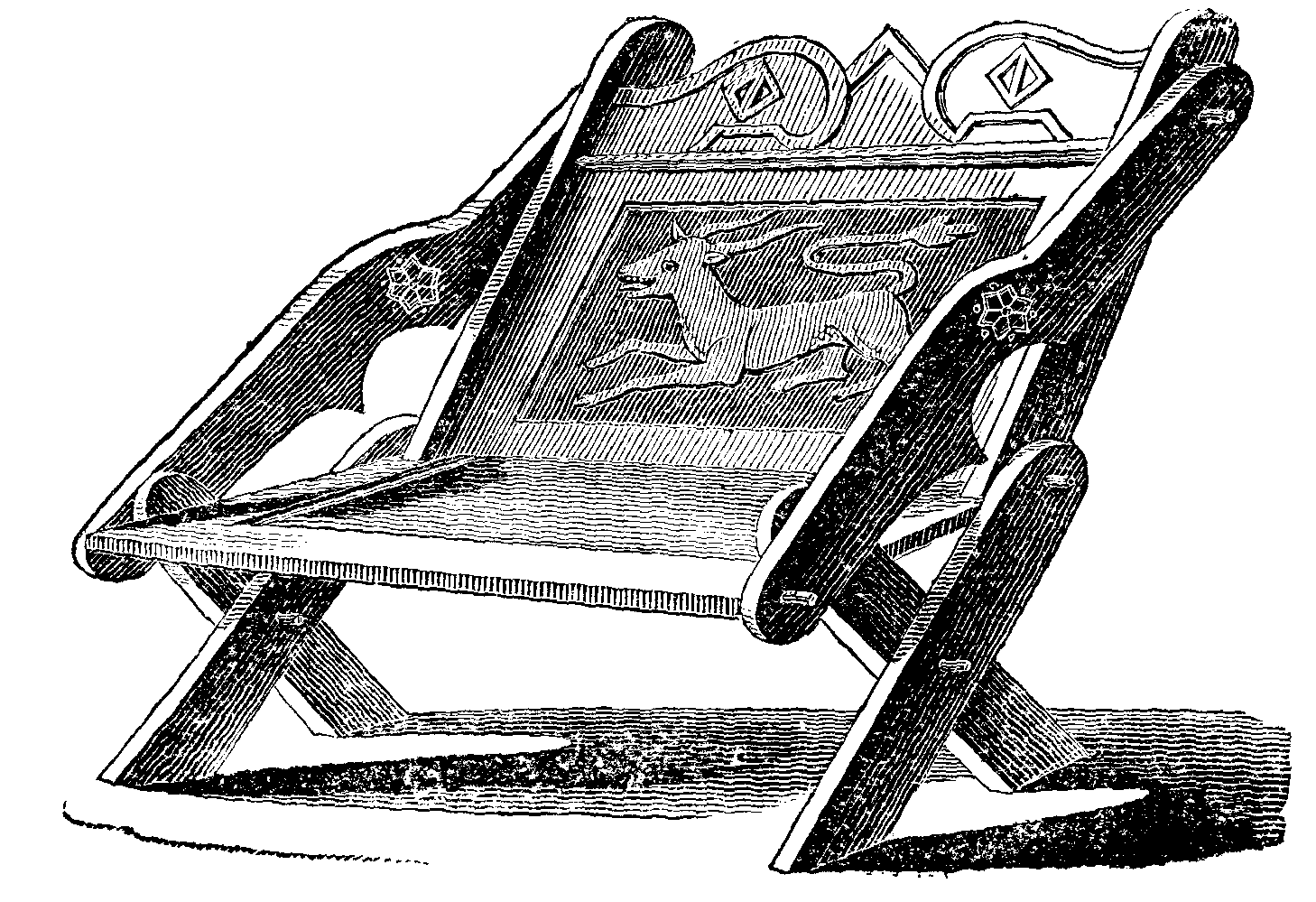
ANCIENT CHAIR.
This curious relic is traditionally called the Prior's Chair, and belonged to the priory of Southwick, which formerly stood near Portsmouth, in Hampshire. It is made of oak, its several parts being fastened together with small wooden pegs. On the back of the chair, within a square panel, is carved an animal somewhat resembling a buck, which was probably the armorial bearing of the prior; as it was anciently, and is now, the custom to carve or paint on chairs placed in halls or other conspicuous places, the crest or arms of the proprietor. Above the panel are two mitres, and on each side of the arms of the chair is a rose, ornamented with rays issuing from its centre. This ancient specimen of furniture is extremely interesting as a specimen of the mechanical ingenuity of the age in which it was constructed, and as the only vestige of the establishment to which it was annexed. Upon part of the Priory buildings being taken down, a few years since, the Chair with other old furniture found on the premises, was sold by auction, when it was rescued from the hands of a person who was bidding for it as a smoking chair, by a gentleman, who allowed a drawing to be taken of it. Of the Priory of Southwick very scanty information is to be obtained: no mention of it is to be found in the Monasticon: but Sir Robert Atkyns, in his history of Gloucestershire, says that it was founded by Henry I. and dedicated to St. Mary. It was for canons regular of the order of St. Augustine. The last prior surrendered this convent on the 7th of April, 1539: it was valued in the catalogue of religious houses at 257l.
ANTIQUE KNIFE-HANDLE.
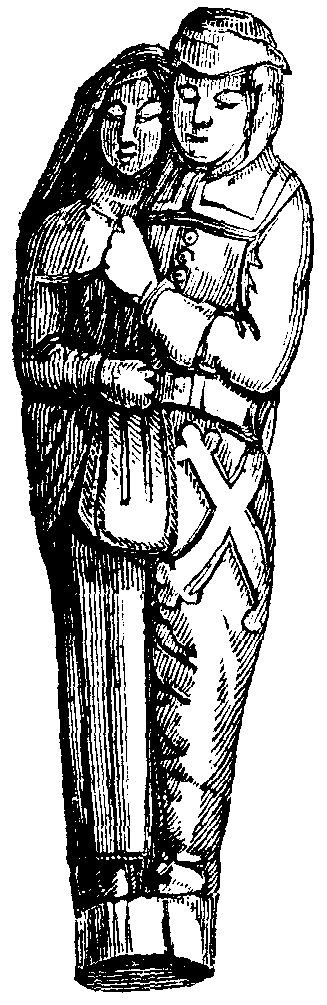
This was found about 20 years since, at the manorhouse of Lake, near Amesbury, in Wiltshire. The handle consists of two figures, a warrior and a female: it was probably the haft of a small knife or dagger, is made of brass, and considering its great antiquity, is in good preservation. The features of the figures are the parts mostly injured by wear; the female holds in the right hand a small bag or purse, the custom of carrying which fell into disuse in the days of Queen Elizabeth. This ancient haft is, however, most likely of an age considerably anterior to the above reign, and from the costume in general, and the simple cross hilt of the sword attached to the warrior's side, it may not unjustly claim a date coeval with the Crusades.
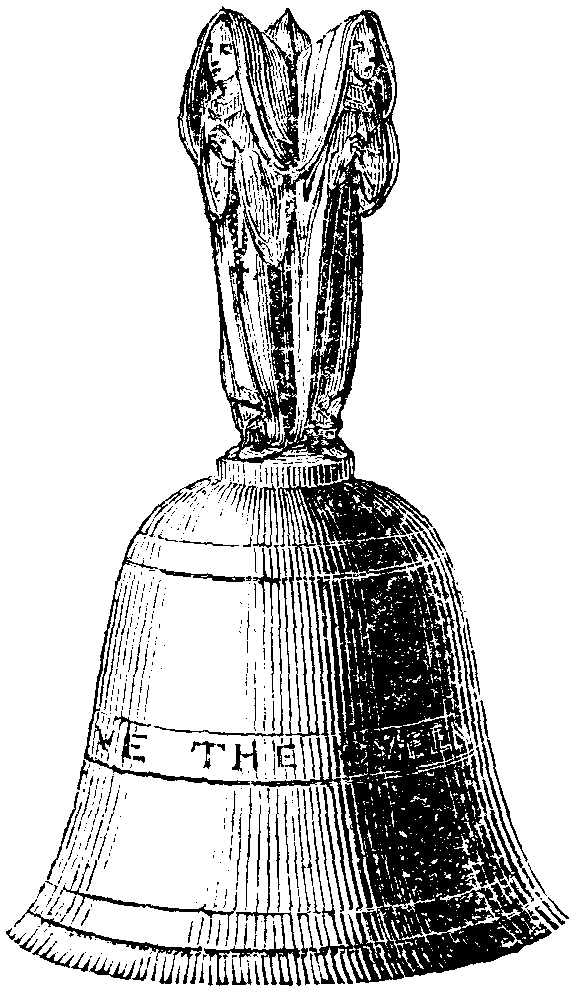
ANCIENT BELL.
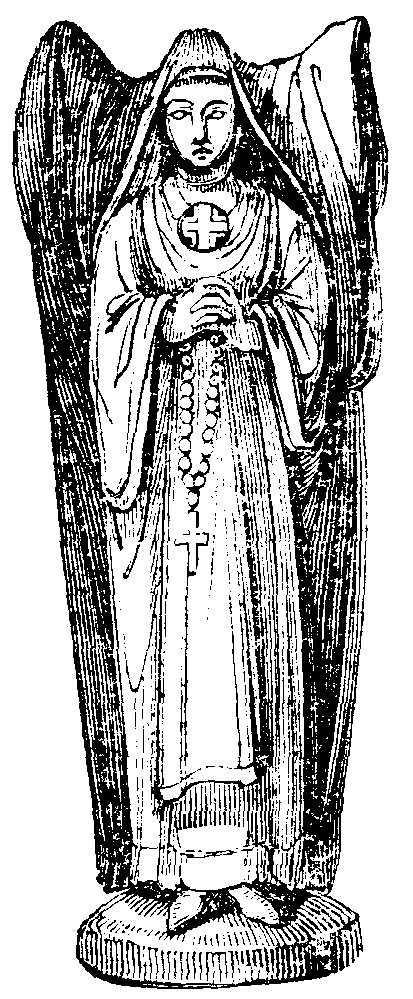
This Bell, as the motto (God save the Queen, 1560,) explains, is of the age of Elizabeth. The handle is of considerably older date, and probably belonged to a mass-bell, as it bears the effigies of a devotee, holding her beads, and a cross. Indeed, the prayer for the Queen, on the Bell, in English, would indicate its subsequent age. This curious relic was a few years since in the possession of the Rev. Mr. Crutwell, a name distinguished in topographical and antiquarian literature.
FALCONRY TENURE.
The manorial rights of Comberton, in the county of Cambridge, were formerly held by the lord, being the keeper of the king's falcons. A record of the year 1374 says, that the manor was held "by the service of carrying a goshawk at coronations."—JUVENIS.