THE NATURALIST.
Reading edition
ANIMAL INSTINCT: ANECDOTE OF A TAME SNAKE.
(To the Editor.)
The following remarkable circumstance clearly proves how foreign to children, is the fear or even the idea of danger; and, at the same time, it presents to the contemplative mind a striking instance of the wisdom which the Almighty has displayed in the works of the creation! In what a wonderful manner has he endowed all his creatures with sensibility, regulated their habits, and provided for their wants; and so ingeniously are the animal and vegetable kingdoms arranged, that the former is, in a great measure, dependent on the latter for nourishment and support.
From the study of Nature may be deduced a most valuable lesson: namely, to think nothing that exists on the face of the globe unworthy of our attention and notice: and were we to confine ourselves to the practice of this excellent maxim, we should not rest satisfied, until we had obtained a complete insight into the economy and habits of such curious objects.
A labouring man residing near the White Cross, (about a mile westward of the city of Hereford,) and occupying a cottage belonging to Thomas Webb, Esq. of that place, in the month of May last, repeatedly observed one of his children (a little girl not eighteen months old,) reserving at meal-time a part of her allowance of food, and carrying it invariably to one particular corner of the house. Curiosity induced the father to watch more minutely the proceedings of the child, and great was his astonishment, when on the girl as usual repairing to the spot, and making a noise something similar to the chirping of a bird, a snake appeared out of a hole in the wall, and fearlessly partook of the repast provided for it by its infantine attendant.
Such a circumstance is very uncommon, though not unprecedented; for that indefatigable naturalist, Gilbert White, mentions a tame snake in his meritorious Natural History of Selborne. The greater degree of surprise must be attributed to the case itself, that a child so young should have the courage to approach an animal of the reptile order; but it serves only to corroborate the statement previously made:—children are destitute of fear, and consequently have no dread of danger.
PHILAETHES.
Hereford.
THE BUSTARD.
The Bustard, huge Rasor, with gular pouch long, With legs formed for running, and beak that is strong, Whose presence this island regards now as rare.
Jennings's Ornithologia.
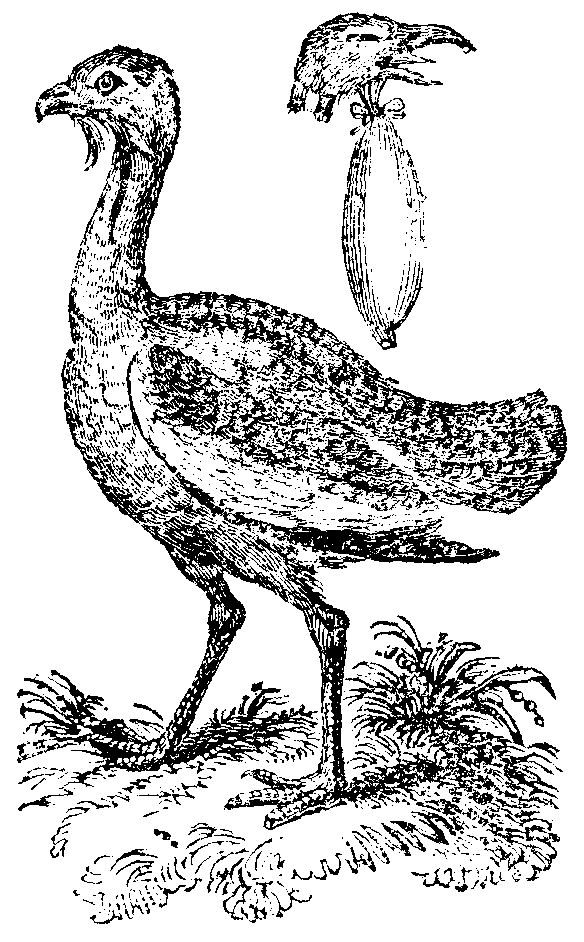
The Great Bustard.
The Bustard is stated to have been known to descend suddenly from its flight, and from some unknown caprice, to attack a horse and its rider with great violence; and with such blind fury as to suffer itself to be seized by the traveller rather than attempt an escape. Two instances of this kind are recorded in the Gentleman's Magazine of about the year 1807.