LYDFORD BRIDGE.
Reading edition
LYDFORD BRIDGE.
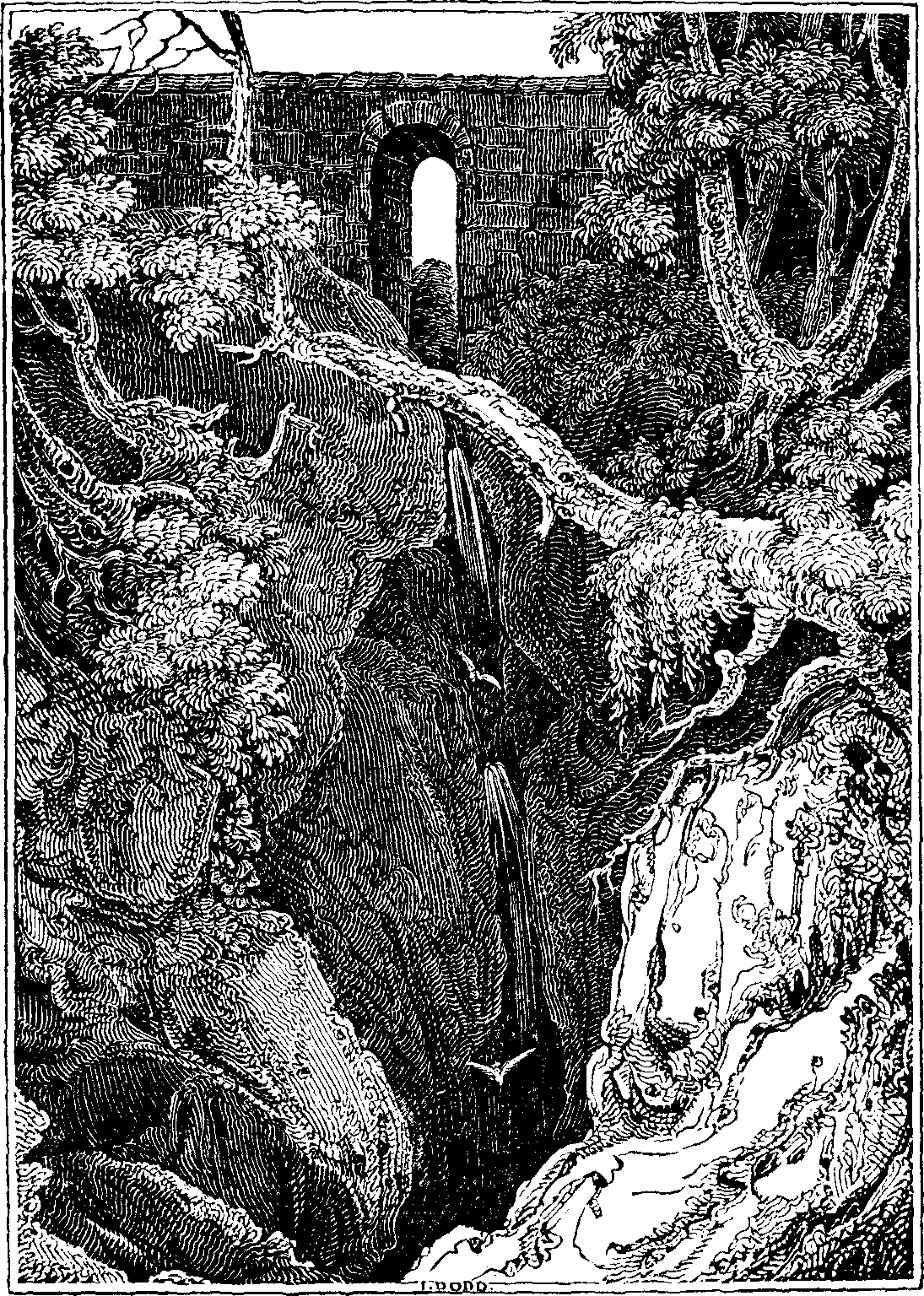
They have a castle on a hill; I took it for an old windmill, The vane's blown off by weather; To lie therein one night, its guest, 'Twere better to be ston'd and prest, Or hang'd—now choose you whether.
Scenes of this description frequently give rise to marvellous stories; and Lydford Bridge has furnished many themes for the gossip's tongue. It is related, that a London rider was benighted on this road, in a heavy storm, and, wishing to get to some place of shelter, spurred his horse forward with more than common speed. The tempest had been tremendous during the night; and in the morning the rider was informed that Lydford Bridge had been swept away with the current. He shuddered to reflect on his narrow escape; his horse having cleared the chasm by a great sudden leap in the middle of his course, though the occasion of his making it at the time was unknown.
Two or three persons have chosen this spot for self-destruction; and in a moment of desperation, have dashed themselves from the bridge into the murky chasm.
Libels on Poets.—Cicero tells us, Democritus and Plato said that there could be no good poet without a tincture of madness; and Aristotle calls poets madmen.—P.T.W.
THOU WERT THE RAINBOW OF MY DREAMS.
Thou wert the rainbow of my dreams, To whom the eyes of Hope might turn, And bid her sacred flame arise Like incense from the festal urn; But as the thunder clouds conspire To wreck the lovely summer sky, So Death destroyed the liquid fire Which shone so brightly in thine eye! The cypress weeps upon thy tomb: But when the stars unfold their leaves Amid their bow'rs of purple gloom, More fervently my spirit grieves; And as the rainbow sheds its light In fairy hues upon the sea, So this cold world appears more bright When pensive Memory thinks of thee!
G.R.C.
LORD BYRON.
Highness.—A vessel containing several of my friends and servants, having been captured and conducted by a Turkish frigate to your fortresses, was released by your highness' command. I return you thanks, not for releasing a vessel bearing a neutral flag, and which being under British protection, no one had a right to detain; but for having treated my friends with great courtesy while at your disposal. Hoping it may not be unacceptable to your highness, I have requested the Greek Governor of this place to grant me four Turkish prisoners; which has been readily conceded. I send them therefore, free, to your highness, in order to return your courtesy as far as is in my power. They are sent without conditions, but if the affair is worthy of your remembrance, I would merely beseech your highness to treat with humanity such Greeks as are in your power, or may chance to fall into the hands of the Musselmen, since the horrors of war are sufficient in themselves, without adding on either side cruelties in cold blood.
I have the honour to be, &c.
NOEL BYRON, Peer of England.
Missolonghi, Jan. 23, 1824.
WHEN WILT THOU RETURN?
When wilt thou return? The silver clouds are closing Like billows o'er the fairy path Of sunset there reposing; The sapphire fields of heaven, With its golden splendour burn, And purple is the mountain peak,— But when wilt thou return? When wilt thou return? The woods are bright with summer, And the violet's bower is grac'd With the rose—a queenly comer; The stars, that in the air Like ethereal spirits burn, Seem watching for thy steps,— Oh I when wilt thou return?
When wilt thou return? The sheathless sword is idle, And each warrior from his steed Has thrown aside the bridle. Hark!—'tis the trumpet's call! With hope our bosoms burn; Its echo wakes the distant hills, Announcing thy return!